Vocabulaires

Découvrez, apprenez et maîtrisez le vocabulaire anglais

noun
/klɔː/
griffe (griffe)

sharp curved nail on the foot of an animal or bird

"The cat extended its sharp claws to climb the tree."

"Le chat a étendu ses griffes acérées pour grimper à l'arbre." (Le chat a étendu ses griffes acérées pour grimper à l'arbre.)
noun
/kleɪ/
argile (argile)

a natural material made of fine earth that becomes hard when baked, used for making pottery

"The artist molded the wet clay into a beautiful vase."

"L'artiste a moulé l'argile humide en un joli vase." (L'artiste a moulé l'argile humide en un joli vase.)
verb
/kliːn/
nettoyer (nettoyer)

To make something free from dirt, marks, or mess.

"She cleaned the kitchen before the guests arrived."

"Elle a nettoyé la cuisine avant l'arrivée des invités." (Elle a nettoyé la cuisine avant l'arrivée des invités.)
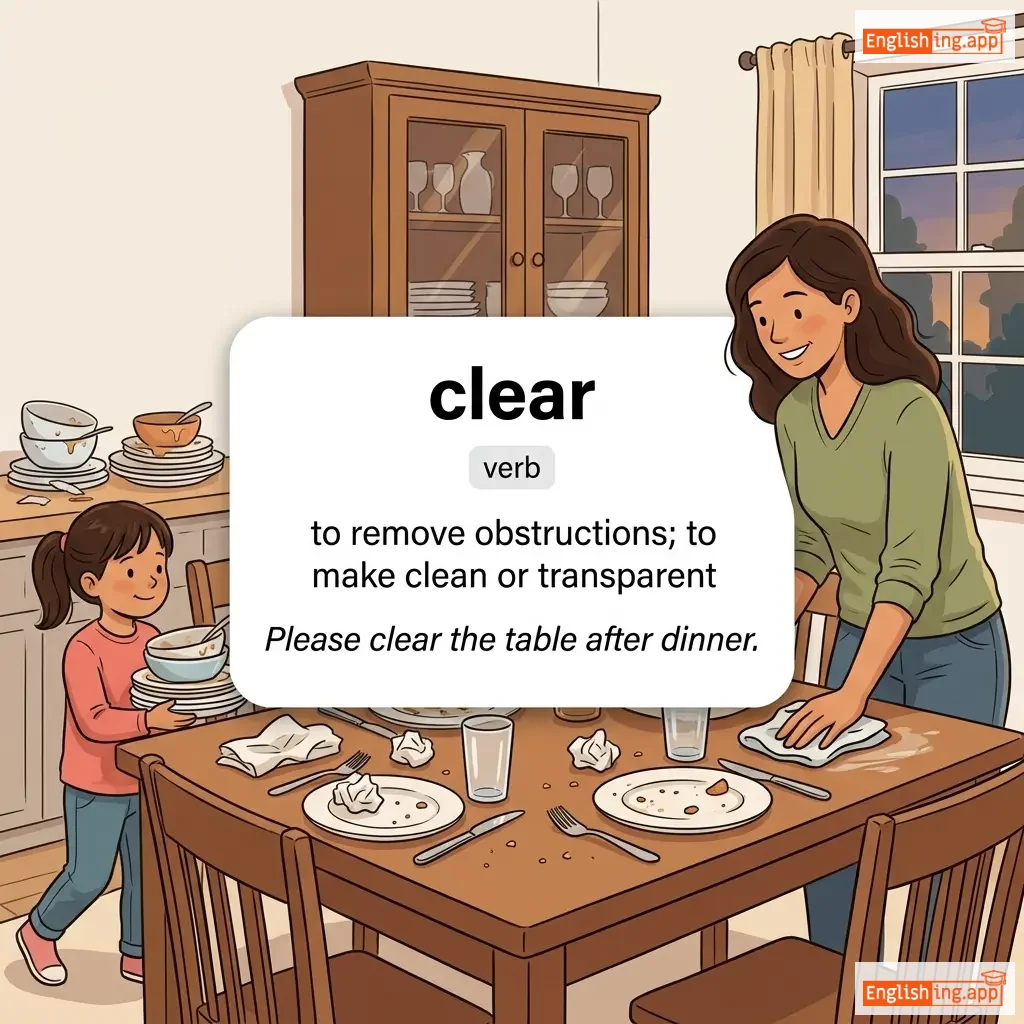
clear definition card — visual illustration of the meaning
adjective
/klɪr/
clair (clair)

Easy to perceive, understand, or see through.

"It was a clear day with no clouds in the sky."

"C'était une journée claire sans nuages dans le ciel." (C'était une journée claire sans nuages dans le ciel.)
noun
/ˈklɪərəns/
autorisation / permis (autorisation / permis)

official permission or authorization; the removal of something unwanted; the distance between two objects

"The pilot received clearance to land the plane."

"Le pilote a reçu l'autorisation d'atterrir l'avion." (Le pilote a recu l'autorisation d'atterrir l'avion.)
adverb
/ˈklɪrli/
clairement (clairement)

In a way that is easy to perceive, understand, or see.

"She spoke clearly so that everyone could understand."

"Elle a parlé clairement pour que tout le monde puisse comprendre." (Elle a parlé clairement pour que tout le monde puisse comprendre.)
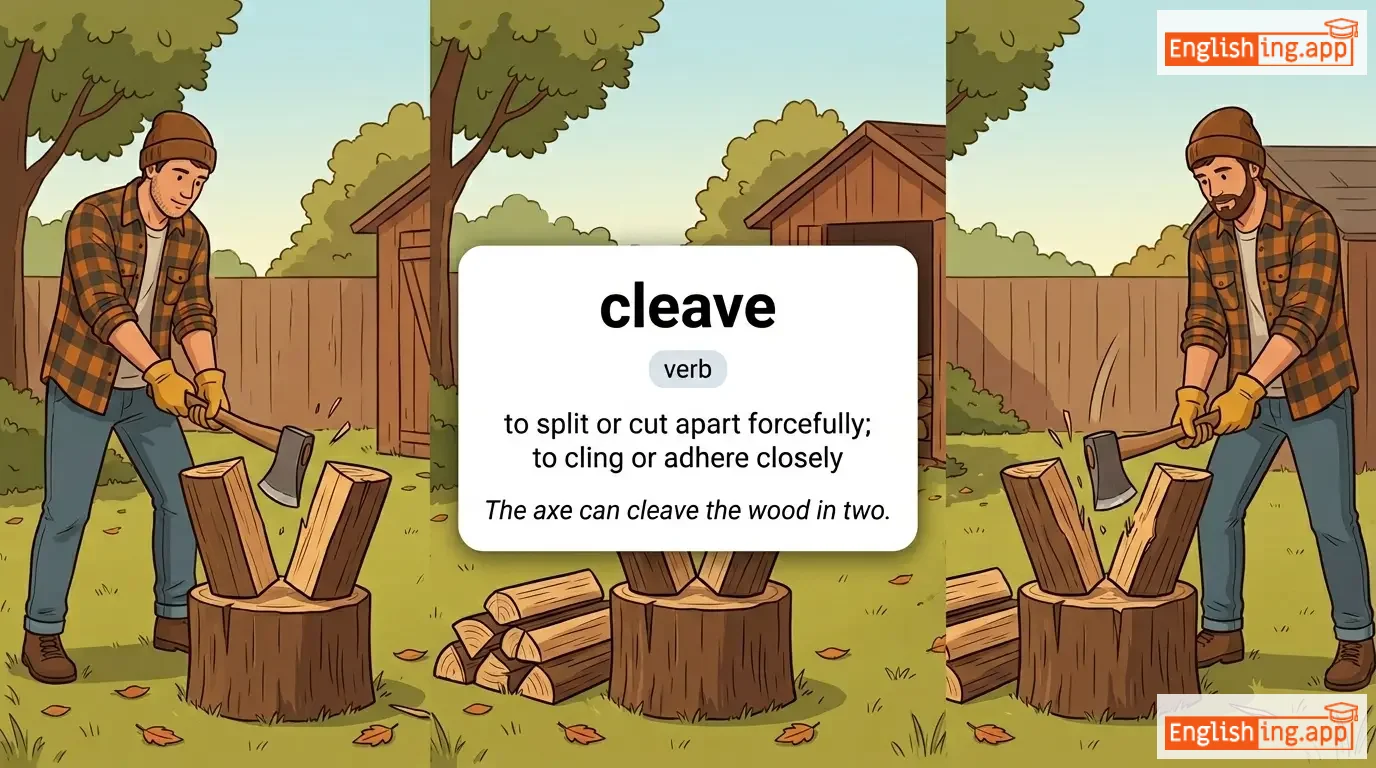
cleave definition card — visual illustration of the meaning
verb
/kliːv/
fendre / s'accrocher (fendre / s'accrocher)

to split or cut apart forcefully; to cling or adhere closely

"The axe can cleave the wood in two."

"La hache peut fendre le bois en deux." (La hache peut fendre le bois en deux.)
noun
/ˈkliː.vər/
grand couteau (grand couteau)

a heavy knife with a broad blade used for chopping meat or vegetables

"The chef used a cleaver to chop the chicken bones."

"Le chef a utilisé un grand couteau pour couper les os de poulet." (Le chef a utilisé un grand couteau pour couper les os de poulet.)
noun/adjective
/klɛft/
fissure (fissure)

a split or crack; a space or opening made by cleavage

"The goat disappeared into a cleft in the rocks."

"La chèvre a disparu dans une fissure dans les rochers." (La chèvre a disparu dans une fissure dans les rochers.)
noun
/ˈklɛmənsi/
clémence (clemence)

mercy, leniency, or forgiveness shown towards someone

"The judge showed clemency and reduced his sentence."

"Le juge a montré de la clémence et a réduit sa peine." (Le juge a montre de la clemence et a reduit sa peine.)
adjective
/ˈklɛmənt/
clément / doux (clément / doux)

mild or merciful; describing weather as mild and pleasant

"The prisoners hoped for a clement judge."

"Les prisonniers espéraient un juge clément." (Les prisonniers espéraient un juge clément.)
noun
/klɑːrk/
employé (employe)

A person employed in an office or bank to keep records, accounts, and undertake other routine administrative duties.

"The clerk helped me find the correct form."

"L'employé m'a aidé à trouver le formulaire correct." (L'employé m'a aidé à trouver le formulaire correct.)
adjective
/ˈklɛvər/
astucieux, intelligent (astucieux, intelligent)

Quick to understand, learn, and devise ideas or solutions; intelligent.

"She is clever enough to solve the puzzle quickly."

"Elle est assez astucieuse pour résoudre le puzzle rapidement." (Elle est assez astucieuse pour résoudre le puzzle rapidement.)
noun
/kliːˈʃeɪ/
cliché (cliche)

An overused expression or idea that has lost its originality or impact.

"The speech was filled with old clichés that failed to inspire the audience."

"Le discours était rempli de vieux clichés qui n'ont pas réussi à inspirer l'audience." (Le discours etait rempli de vieux cliches qui n'ont pas reussi a inspirer l'audience.)
verb
/klɪk/
cliquer (cliquer)

to press a button on a computer mouse or similar device

"She clicked the link to open the website."

"Elle a cliqué sur le lien pour ouvrir le site web." (Elle a cliqué sur le lien pour ouvrir le site web.)
noun
/ˈklaɪənt/
client (klian)

A person or organization using the services of a professional or company.

"The lawyer met with her client to discuss the case."

"L'avocat a rencontré son client pour discuter du dossier" (L'avocat a rencontre son client pour discuter du dossier)
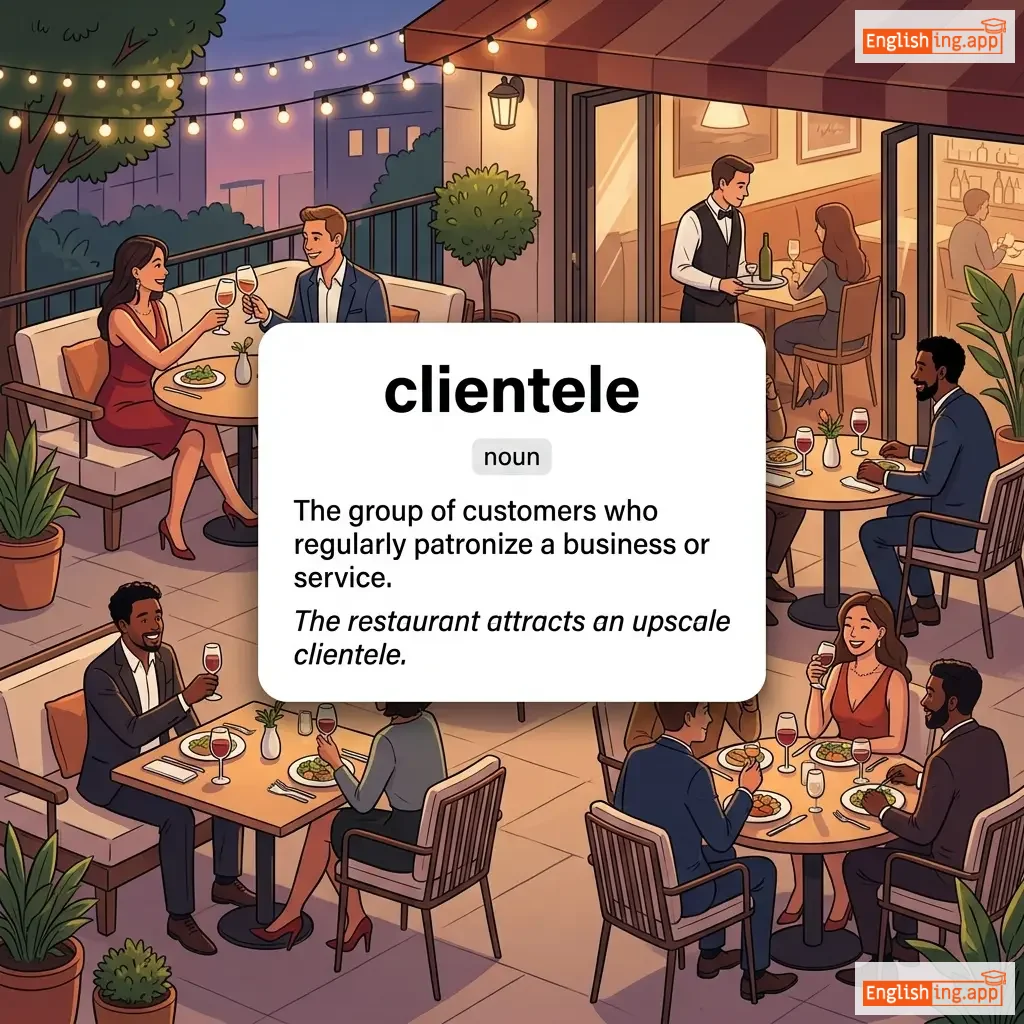
clientele definition card — visual illustration of the meaning
noun
/ˌklaɪənˈtɛl/
clientèle (clientele)

The group of customers who regularly patronize a business or service.

"The restaurant attracts an upscale clientele."

"Le restaurant attire une clientèle haut de gamme." (Le restaurant attire une clientele haut de gamme.)
noun
/klɪf/
falaise (falaise)

a high, steep face of rock or earth

"The waves crashed against the bottom of the cliff."

"Les vagues se sont écrasées contre le bas de la falaise." (Les vagues se sont écrasées contre le bas de la falaise.)
adjective
/klaɪˈmæktɪk/
climactique (climactique)

Relating to the most exciting or important moment of something.

"The film ended with a climactic battle scene."

"Le film s'est terminé par une scène de bataille climactique." (Le film s'est terminé par une scène de bataille climactique.)
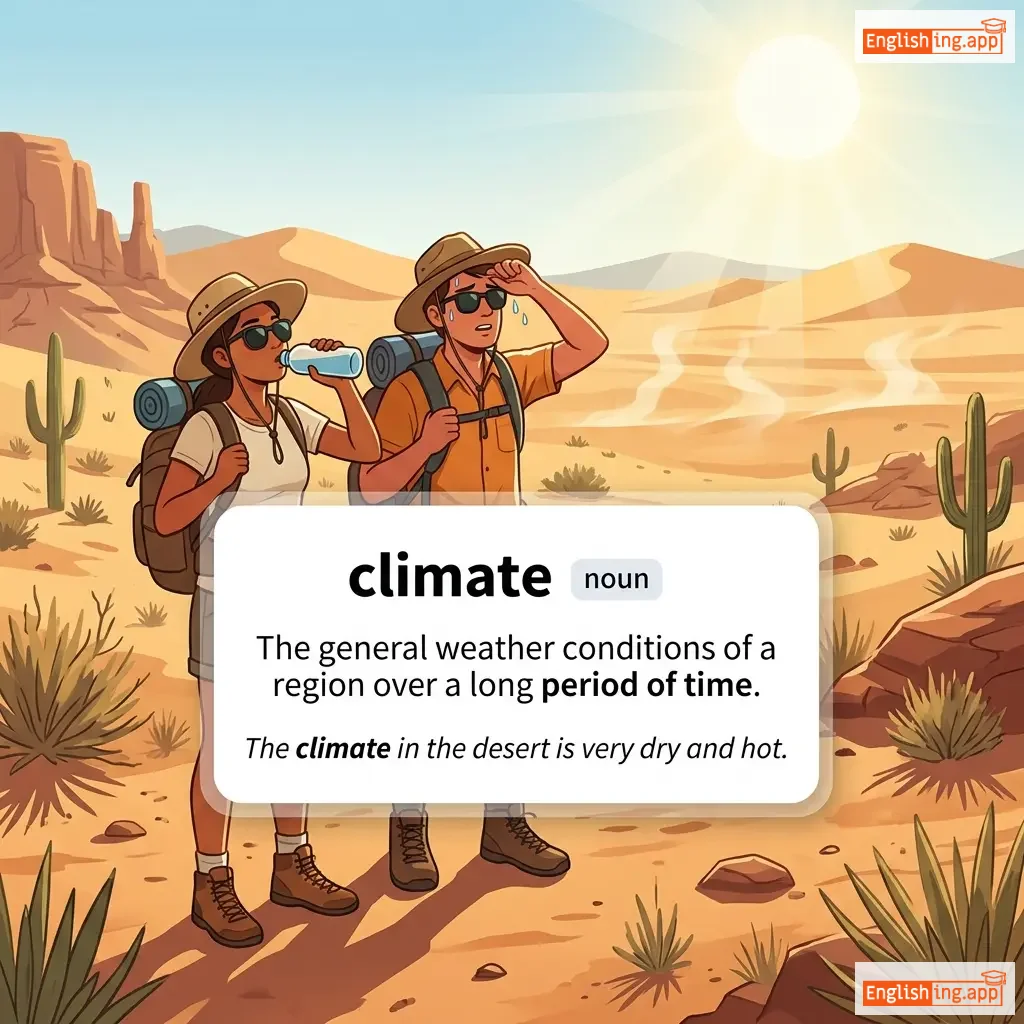
climate definition card — visual illustration of the meaning
noun
/ˈklaɪ.mət/
climat (climat)

The general weather conditions of a region over a long period of time.

"The climate in the desert is very dry and hot."

"Le climat dans le désert est très sec et chaud." (Le climat dans le désert est très sec et chaud.)
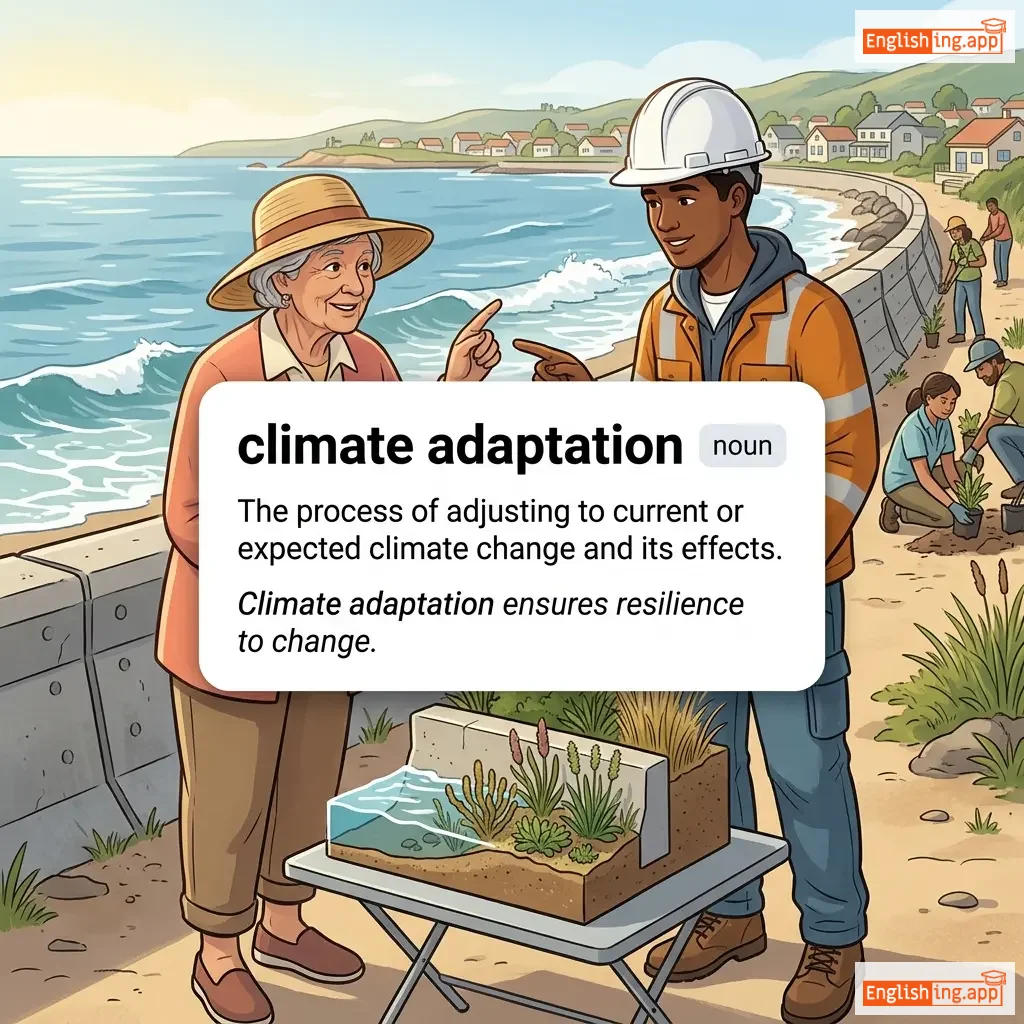
climate adaptation definition card — visual illustration of the meaning
noun
/ˈklaɪ.mət əˌdæp.teɪ.ʃən/
adaptation climatique (adaptation climatique)

The process of adjusting to current or expected climate change and its effects.

"Climate adaptation ensures resilience to change."

"L'adaptation climatique assure la résilience face au changement." (L'adaptation climatique assure la resiliance face au changement.)
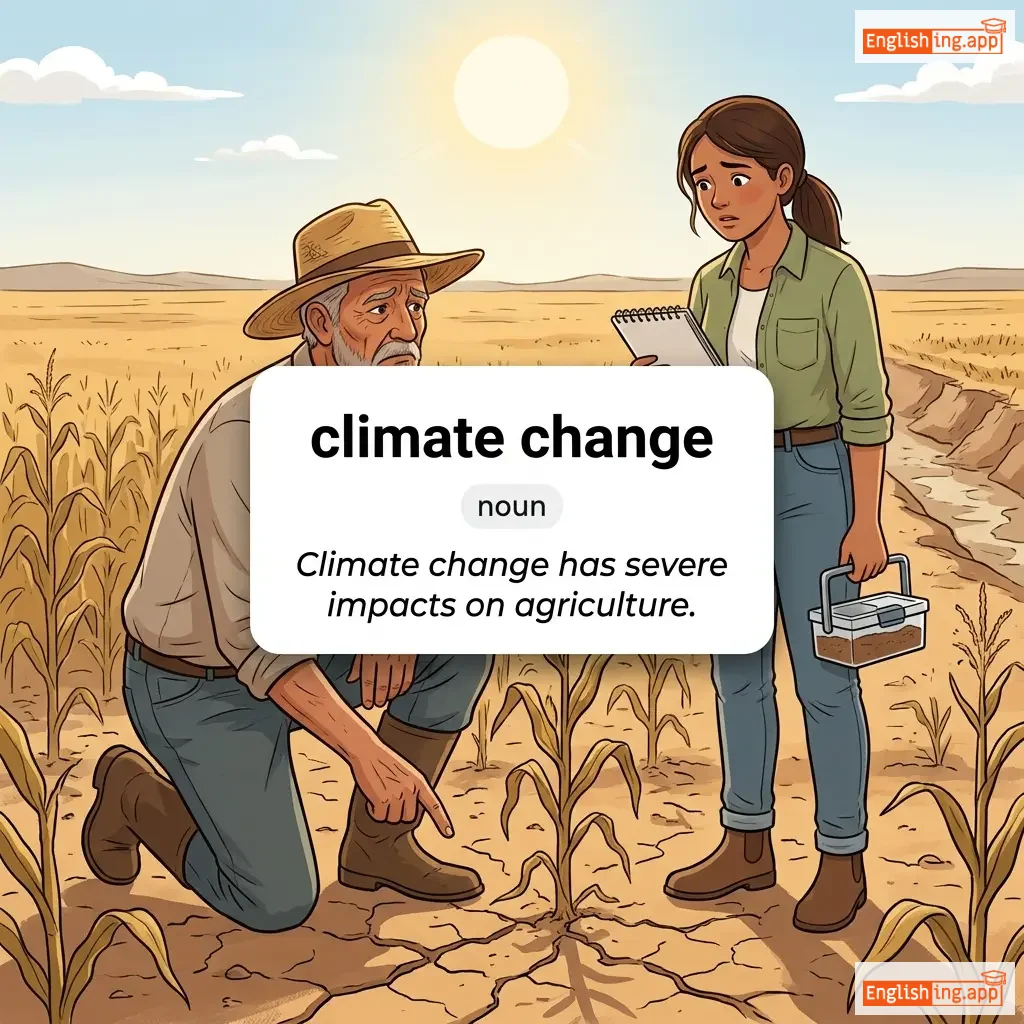
climate change definition card — visual illustration of the meaning
noun
ˈklaɪ.mət tʃeɪndʒ
changement climatique (changement climatique)

Long-term changes in global or regional climate patterns, primarily caused by human activities.

"Climate change has severe impacts on agriculture."

"Le changement climatique a des impacts graves sur l'agriculture." (Le changement climatique a des impacts graves sur l'agriculture.)
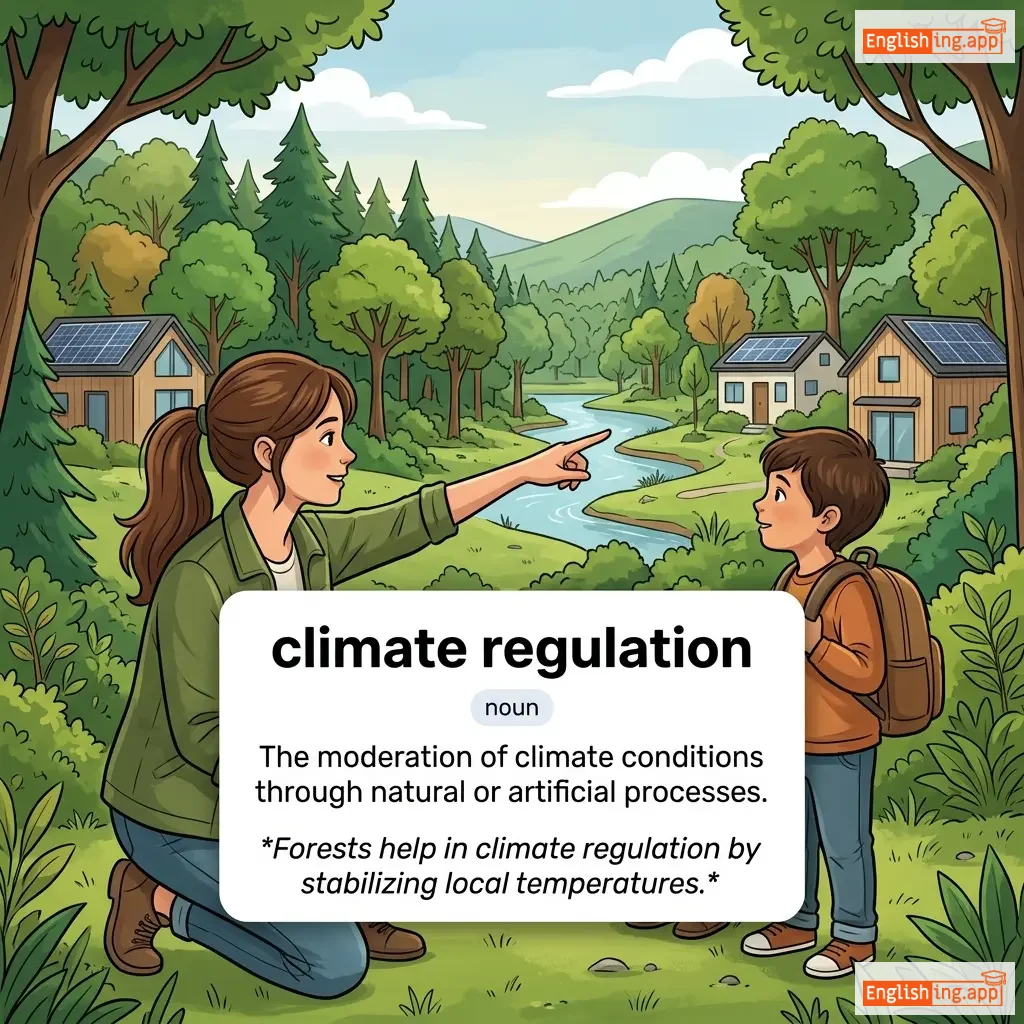
climate regulation definition card — visual illustration of the meaning
noun
ˈklaɪmət ˌrɛɡjʊˈleɪʃən
régulation du climat (regulation du climat)

The moderation of climate conditions through natural or artificial processes.

"Forests help in climate regulation by stabilizing local temperatures."

"Les forêts aident à la régulation du climat en stabilisant les températures locales." (Les forets aident a la regulation du climat en stabilisant les temperatures locales.)
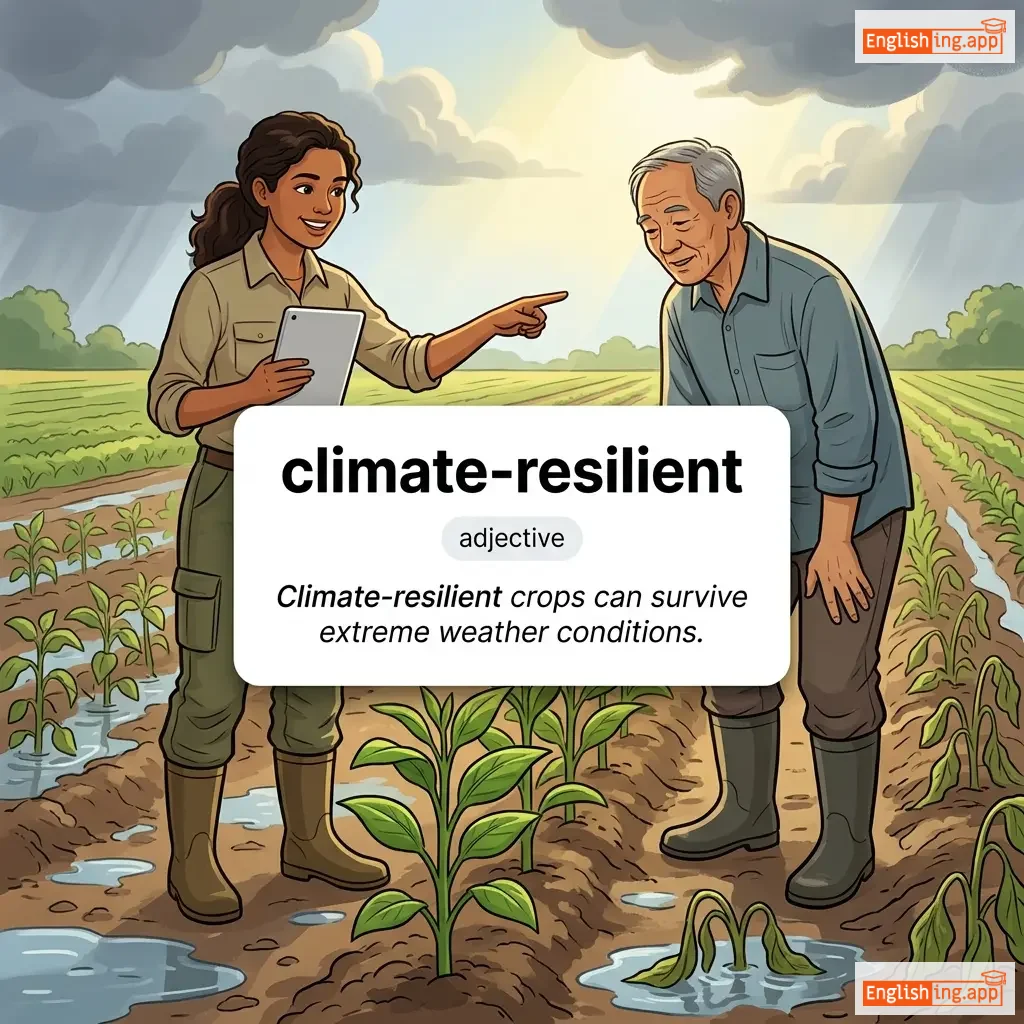
climate-resilient definition card — visual illustration of the meaning
adjective
ˈklaɪ.mət rɪˈzɪl.i.ənt
résistant au climat (resistant au climat)

Able to cope with the adverse effects of climate change; sustainable and adaptable.

"Climate-resilient crops can survive extreme weather conditions."

"Les cultures résistantes au climat peuvent survivre à des conditions météorologiques extrêmes." (Les cultures resistantes au climat peuvent survivre a des conditions meteorologiques extremes)
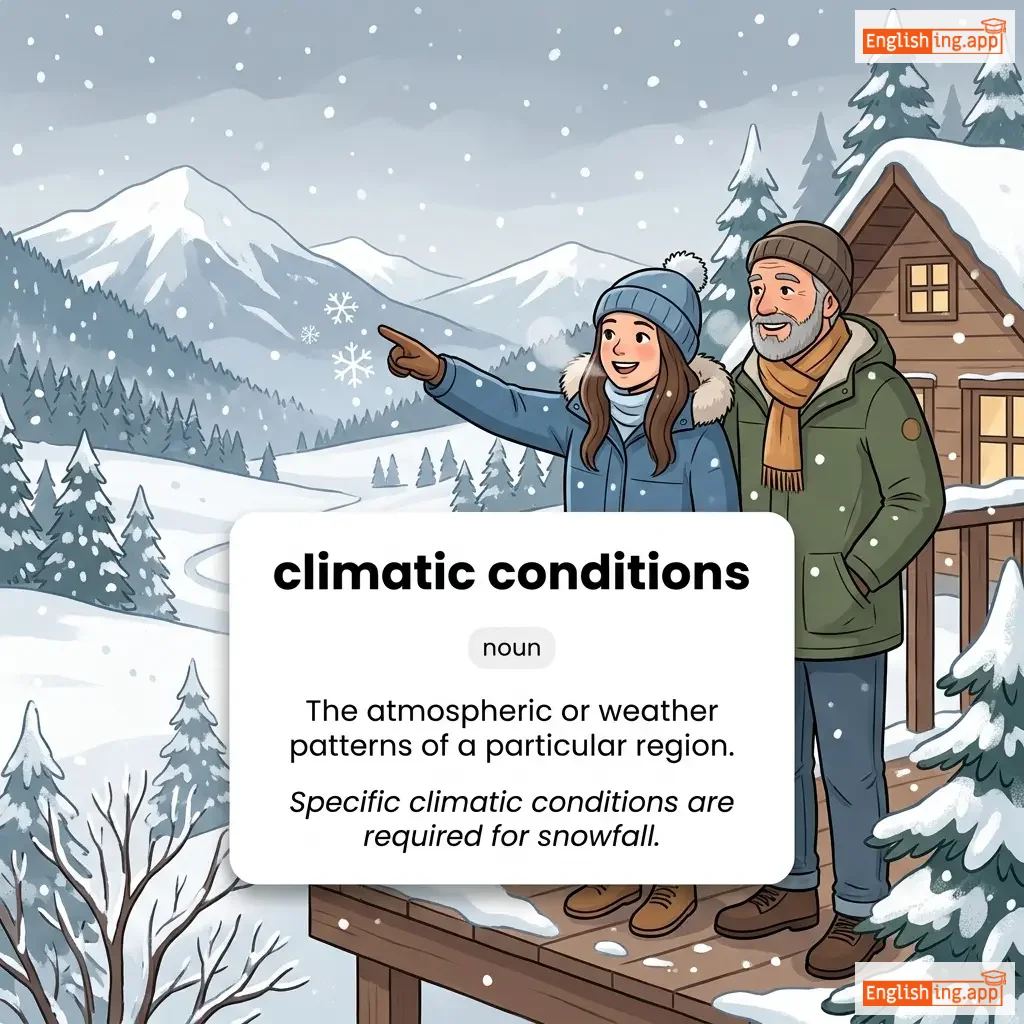
climatic conditions definition card — visual illustration of the meaning
noun
ক্লাইম্যাটিক কন্ডিশন্স
conditions climatiques (conditions climatiques)

The atmospheric or weather patterns of a particular region.

"Specific climatic conditions are required for snowfall."

"Des conditions climatiques spécifiques sont nécessaires pour les chutes de neige." (Des conditions climatiques specifiques sont necessaires pour les chutes de neige.)
noun
/ˈklaɪ.mæks/
point culminant (point culminant)

the most intense, exciting, or important point of something; the highest or most intense point in a process

"The movie reached its climax during the final battle scene."

"Le film a atteint son point culminant lors de la scène finale de la bataille." (Le film a atteint son point culminant lors de la scene finale de la bataille.)
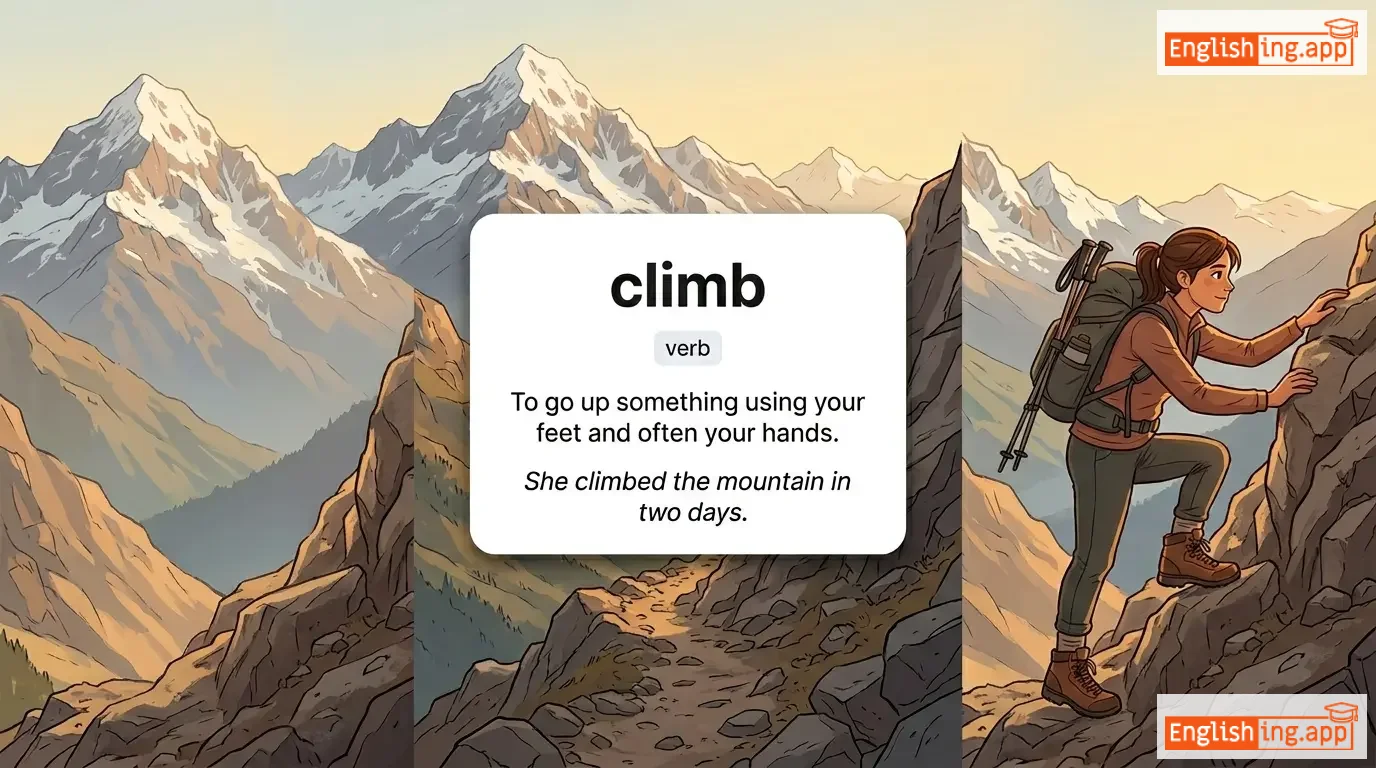
climb definition card — visual illustration of the meaning
verb
/klaɪm/
grimper (grimper)

To go up something using your feet and often your hands.

"She climbed the mountain in two days."

"Elle a grimpé la montagne en deux jours." (Elle a grimpé la montagne en deux jours.)
noun
/ˈklaɪ.mɪŋ læŋ læŋ/
plante grimpante lang lang (plante grimpante lang lang)

a climbing plant with fragrant flowers native to tropical regions

"The climbing lang lang vine produces beautiful fragrant flowers."

"La plante grimpante lang lang produit de belles fleurs parfumées." (La plante grimpante lang lang produit de belles fleurs parfumées.)
noun
/ˈklaɪmɪŋ fɪʃ/
poisson grimpeur (poisson grimpeur)

a type of fish that can climb trees and survive out of water for short periods

"The climbing-fish can move from one pond to another by climbing trees."

"Le poisson grimpeur peut se déplacer d'un étang à l'autre en grimpant aux arbres." (Le poisson grimpeur peut se deplacer d'un etang a l'autre en grimpant aux arbres)
noun
/klaɪm/
climat (climat)

A region defined by its climate.

"He traveled to warmer climes during the winter."

"Il a voyagé dans des climats plus chauds pendant l'hiver." (Il a voyagé dans des climats plus chauds pendant l'hiver.)
verb
/klɪntʃ/
assurer (assurer)

To secure or settle something decisively; to grasp tightly.

"The team clinched the championship with a last-minute goal."

"L'équipe a remporté le championnat avec un but de dernière minute." (L'équipe a remporté le championnat avec un but de dernière minute.)
verb
/klɪŋ/
bonheur (bonheur)

to hold on tightly to someone or something

"The child clung to his mother in fear."

"Elle ne pouvait pas cacher son bonheur lorsqu'elle a reçu le prix." (Elle ne pouvait pas cacher son bonheur lorsqu'elle a reçu le prix.)
noun
/ˈklɪn.ɪk/
clinique (clinique)

A place where people receive medical treatment without staying overnight.

"She went to the clinic for a health check-up."

"Elle est allée à la clinique pour un examen médical." (Elle est allée à la clinique pour un examen médical.)
adjective
/ˈklɪn.ɪ.kəl/
clinique (clinique)

Related to the observation and treatment of patients rather than theoretical study.

"The doctor conducted a clinical examination."

"Le médecin a effectué un examen clinique." (Le medecin a effectue un examen clinique.)
verb, noun
/klɪp/
couper / clip (couper / clip)

to cut or trim something; a short extract from a film, broadcast, or recording

"She clipped the coupon from the newspaper."

"Elle a découpé le coupon dans le journal." (Elle a decoupe le coupon dans le journal.)
noun
/ˈklɪpər/
tondeuse / bateau rapide du XIXe siècle (tondeuse / bateau rapide du dix-neuvième siècle)

a tool used for cutting, or a fast sailing ship of the 19th century

"The barber used clippers to trim his hair."

"Le barbier a utilisé des tondeuses pour couper ses cheveux." (Le barbier a utilise des tondeuses pour couper ses cheveux.)
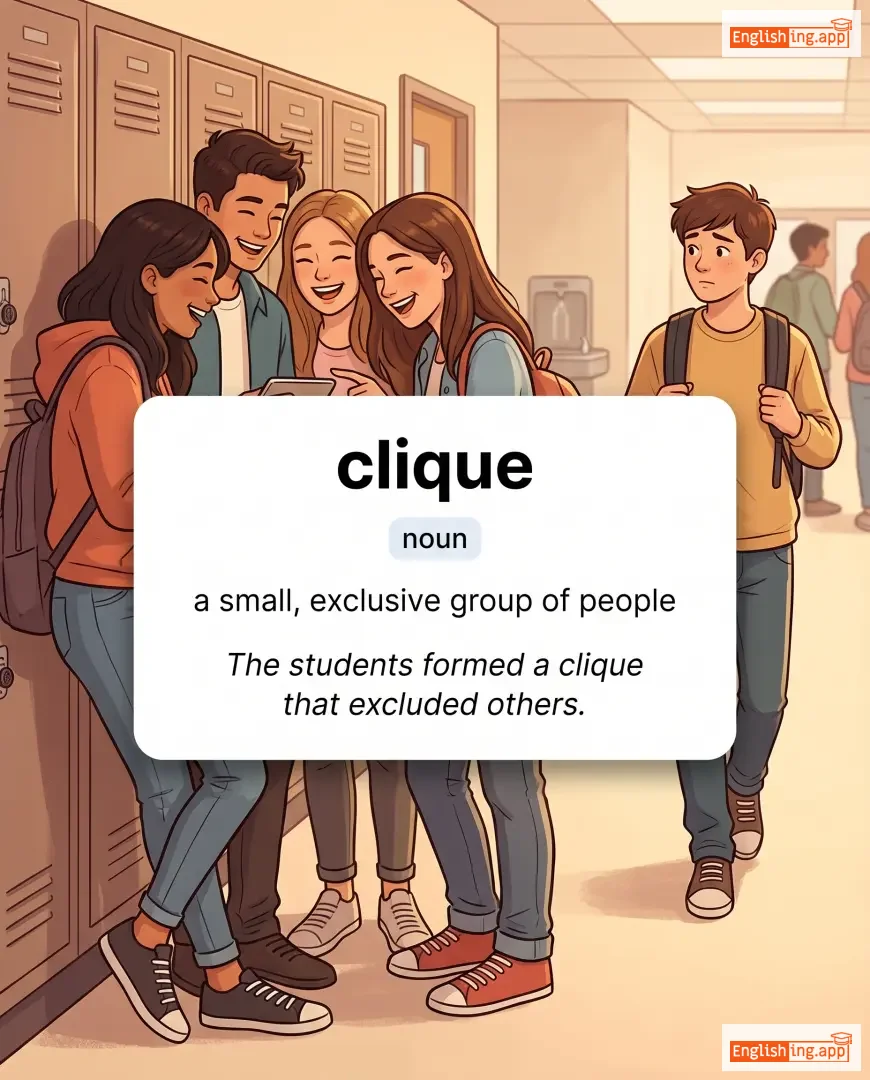
clique definition card — visual illustration of the meaning
noun
/kliːk/
clique (clique)

a small, exclusive group of people

"The students formed a clique that excluded others."

"Les étudiants ont formé une clique qui excluait les autres." (Les étudiants ont formé une clique qui excluait les autres.)
noun, verb
/kloʊk/
manteau (manteau)

a loose outer garment; to cover, hide, or disguise

"The spy cloaked his identity with a false name."

"L'espion a caché son identité sous un faux nom." (L'espion a caché son identité sous un faux nom.)
noun
/klɒk/
horloge (horloge)

An instrument used to measure and show time.

"The clock on the wall shows the correct time."

"L'horloge sur le mur indique l'heure correcte." (L'horloge sur le mur indique l'heure correcte.)
adverb
/ˈklɒkwaɪz/
dans le sens des aiguilles d'une montre (dans le sens des aiguilles d'une montre)

in the direction that clock hands move; in a circular direction from left to right

"Turn the valve clockwise to tighten it."

"Tournez la vanne dans le sens des aiguilles d'une montre pour la serrer." (Tournez la vanne dans le sens des aiguilles d'une montre pour la serrer.)
verb, noun
/klɑːɡ/
boucher / sabot en bois (boucher / sabot en bois)

to block or become blocked; a type of heavy wooden shoe

"The sink was clogged with food waste."

"L'évier était bouché avec des déchets alimentaires." (L'évier était bouché avec des déchets alimentaires.)
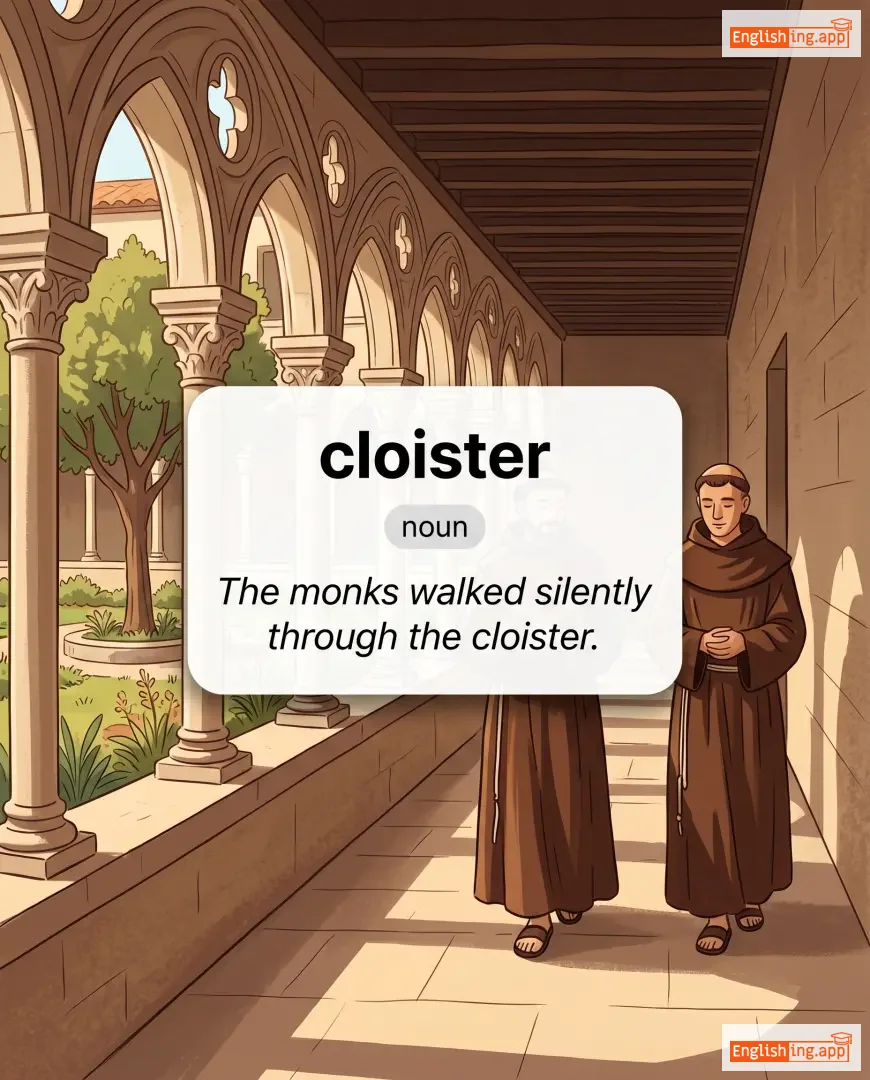
cloister definition card — visual illustration of the meaning
noun
/ˈklɔɪstər/
cloître (cloitre)

a covered walk in a convent, monastery, or cathedral, typically with a wall on one side and a colonnade open to a quadrangle on the other.

"The monks walked silently through the cloister."

"Les moines marchaient silencieusement à travers le cloître." (Les moines marchaient silencieusement à travers le cloître.)
verb, adjective
/kloʊz/ (verb), /kloʊs/ (adjective)
fermer, près (fermer, pres)

To shut something (verb); near in space or relationship (adjective).

"Please close the door when you leave."

"Veuillez fermer la porte lorsque vous partez." (veuillez fermer la porte lorsque vous partez.)
adjective
/ˌkloʊs ˈhɔːld/
naviguer aussi près que possible du vent (naviguer aussi pres que possible du vent)

of a sailing ship, sailing as nearly as possible towards the direction from which the wind is blowing.

"The yacht was close-hauled as it cut through the waves."

"Le yacht était naviguant aussi près que possible du vent en coupant les vagues." (Le yacht etait naviguant aussi pres que possible du vent en coupant les vagues.)
adjective
/kloʊzd/
fermé (ferme)

not open; shut

"The store is closed on Fridays."

"Le magasin est fermé le vendredi." (Le magasin est fermé le vendredi.)
adverb
/ˈkloʊsli/
bonheur (bonheur)

in a way that is very near in space, time, or relationship; carefully and attentively

"The detective examined the evidence closely."

"Elle ne pouvait pas cacher son bonheur lorsqu'elle a reçu le prix." (Elle ne pouvait pas cacher son bonheur lorsqu'elle a reçu le prix.)
adjective, noun
/ˈkloʊsər/
plus près, clôturant (plus pres, cloturant)

more near in distance or relationship; someone or something that concludes an activity

"She moved closer to the window."

"Elle s'est approchée de la fenêtre." (Elle s'est approchée de la fenêtre.)
adjective
/ˈkloʊ.sɪst/
le plus proche (le plus proche)

nearest in distance or relationship

"He is my closest friend."

"Il est mon ami le plus proche." (Il est mon ami le plus proche.)
noun
/ˈklɒzɪt/
armoire (armoire)

a small room or enclosed space used for storing clothes or other things

"She keeps her winter coats in the closet near the door."

"Elle garde ses manteaux d'hiver dans l'armoire près de la porte." (Elle garde ses manteaux d'hiver dans l'armoire pres de la porte.)
noun
/ˈkloʊʒər/
fermeture (fermeture)

the action or process of closing something, or the sense of finality or resolution.

"The closure of the company left many employees without jobs."

"La fermeture de l'entreprise a laissé de nombreux employés sans emploi." (La fermetyr de lantrépriz a laissez de nom-breux employés san empley.)