Vocabulaires

Découvrez, apprenez et maîtrisez le vocabulaire anglais

noun
/ˈbɑːr.nɪ.kəl/
balane (balane)

a marine crustacean that attaches itself permanently to underwater surfaces

"The old ship's hull was covered with barnacles."

"La coque du vieux navire était couverte de balanes." (La coque du vieux navire était couverte de balanes.)
noun
/ˈbærəˌɡræf/
instrument qui enregistre les variations de pression atmosphérique (instrument qui enregistre les variations de pression atmospherique)

an instrument that records changes in atmospheric pressure

"The scientist checked the barograph for pressure variations."

"Le scientifique a vérifié le barographe pour les variations de pression." (Le scientifique a verifie le barographe pour les variations de pression.)
noun
/bəˈrɒmɪtər/
baromètre de pression atmosphérique (barometre de pression atmospherique)

an instrument that measures atmospheric pressure

"The barometer indicated a storm was approaching."

"Le baromètre a indiqué qu'une tempête approchait." (Le barometre a indique qu'une tempete approchait.)
adjective
/bəˈroʊk/
style baroque (style baroque)

relating to a highly ornate and extravagant style of art, architecture, or music from the 17th and early 18th centuries; excessively elaborate or complex

"The church was decorated in a baroque style with intricate details."

"L'église était décorée dans un style baroque avec des détails complexes." (L'église était décorée dans un style baroque avec des détails complexes.)
noun
/bəˈrɑːʒ/
barrage ou attaque rapide (barrage)

a concentrated outpouring of questions, criticisms, or blows; a rapid, continuous attack

"The politician faced a barrage of tough questions from reporters."

"Le politicien a fait face à un barrage de questions difficiles de la part des journalistes." (Le politicien a fait face à un barrage de questions difficiles de la part des journalistes.)
noun
/ˈbærəl/
grand baril (grand baril)

a large cylindrical container used to hold liquids

"The wine was stored in a wooden barrel."

"Le vin a été stocké dans un grand baril en bois." (Le vin a ete stocke dans un grand baril en bois.)
adjective
/ˈbærən/
stérile (steril)

too poor to produce much or any vegetation; unproductive or empty

"The land was barren and could not support crops."

"La terre était stérile et ne pouvait pas supporter les cultures." (La terre était stérile et ne pouvait pas supporter les cultures.)
noun/verb
/ˌbærɪˈkeɪd/
barricade (barricade)

a barrier erected to block or defend against movement; to block a passage with obstacles

"Protesters built a barricade across the street."

"Les manifestants ont construit une barricade à travers la rue." (Les manifestants ont construit une barricade à travers la rue.)
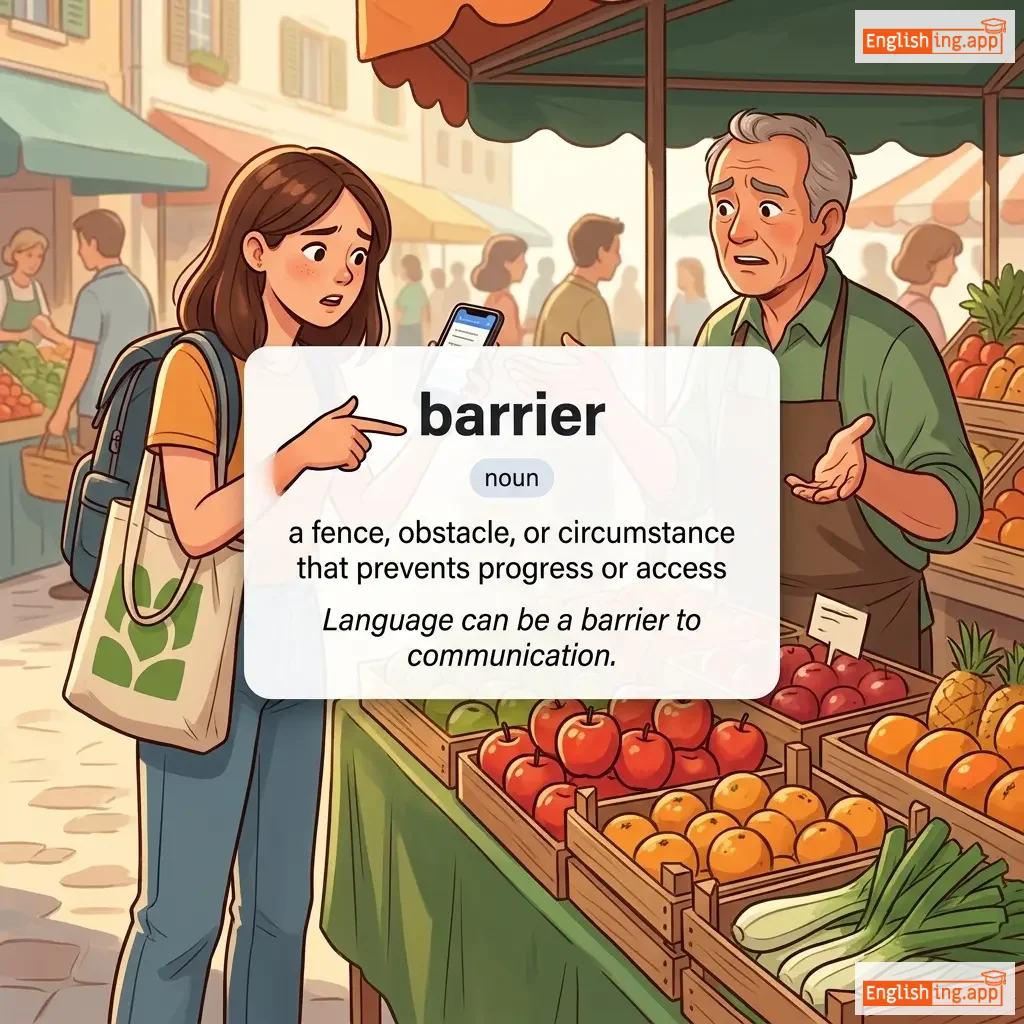
barrier definition card — visual illustration of the meaning
noun
/ˈbæriər/
barrière (barrière)

a fence, obstacle, or circumstance that prevents progress or access

"Language can be a barrier to communication."

"La langue peut être une barrière à la communication." (La langue peut être une barrière à la communication.)
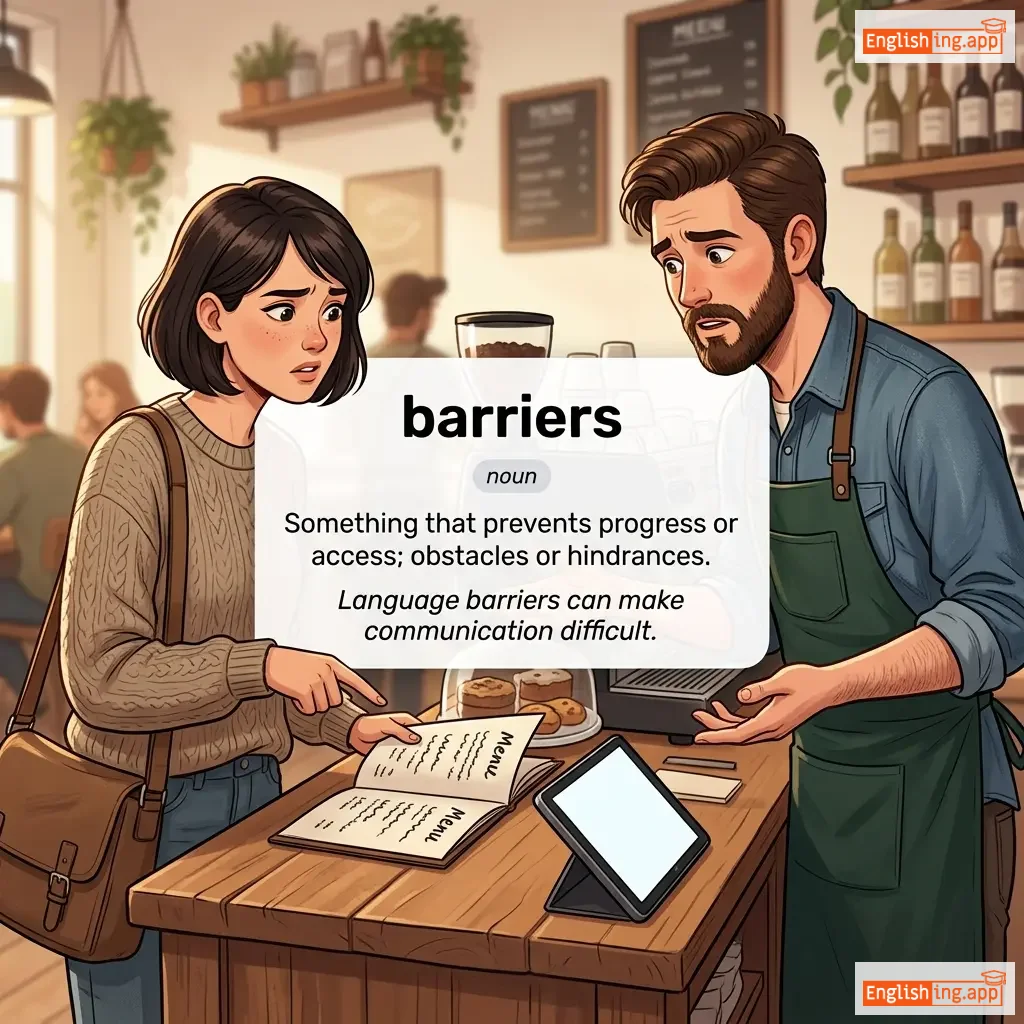
barriers definition card — visual illustration of the meaning
noun
/ˈbæɹɪəz/
barrières (barrieres)

Something that prevents progress or access; obstacles or hindrances.

"Language barriers can make communication difficult."

"Les barrières linguistiques peuvent rendre la communication difficile." (Les barrières linguistiques peuvent rendre la communication difficile.)
preposition
/ˈbɑːrɪŋ/
sauf, à l'exception de (sauf, a l'exception de)

except for; if not for

"Barring a miracle, the team will not win the championship."

"À l'exception d'un miracle, l'équipe ne gagnera pas le championnat." (A l'exception d'un miracle, l'équipe ne gagnera pas le championnat.)
noun
/ˈbærɪstər/
avocat (avocat)

A type of lawyer in certain legal systems who specializes in courtroom advocacy and litigation.

"The barrister argued the case passionately before the judge."

"L'avocat a plaidé l'affaire avec passion devant le juge." (L'avocat a plaidé l'affaire avec passion devant le juge.)
verb
/ˈbɑːrtər/
troc (trok)

To exchange goods or services without using money.

"They bartered their crops for handmade tools."

"Ils ont échangé leurs récoltes contre des outils faits à la main." (Ils ont échangé leurs récoltes contre des outils faits à la main.)
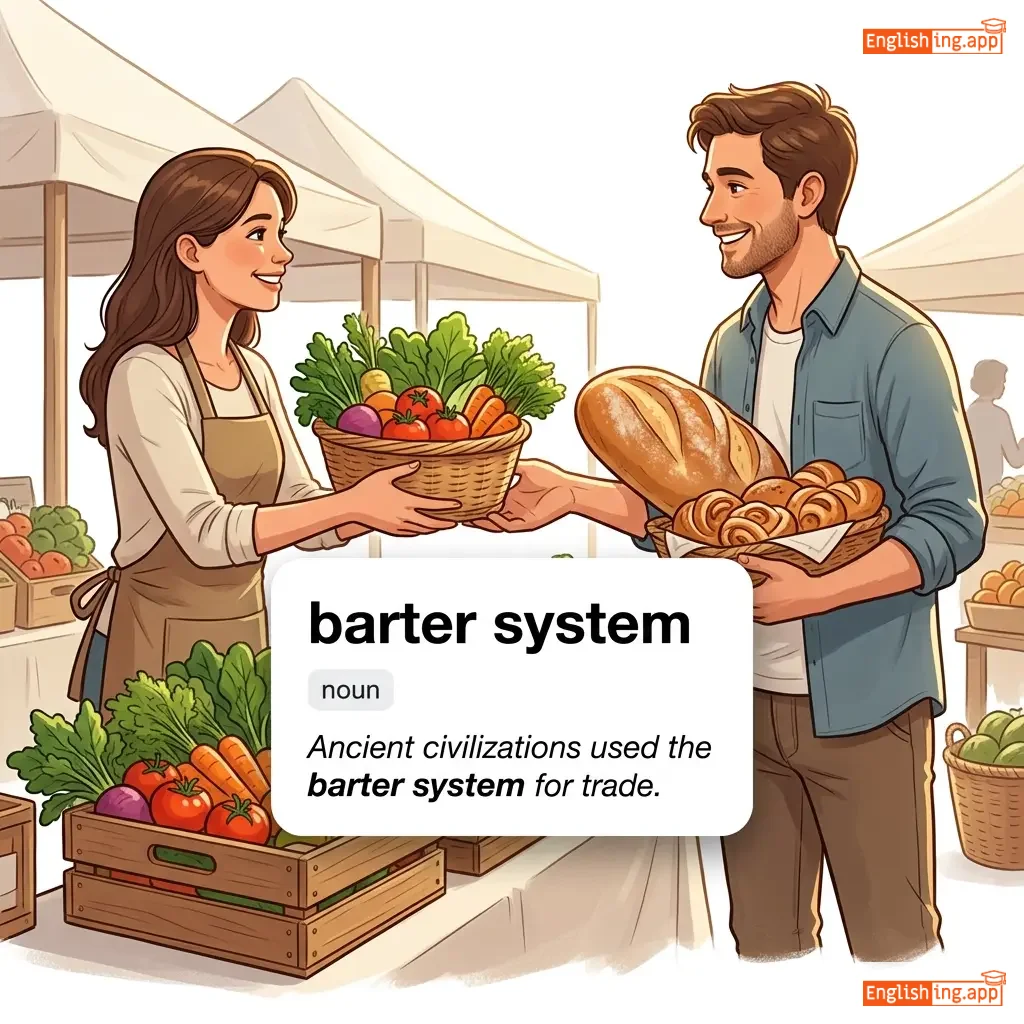
barter system definition card — visual illustration of the meaning
noun
/ˈbɑːr.tər ˌsɪs.təm/
système d'échange (systeme d'echange)

A system of exchange where goods and services are traded directly without using money.

"Ancient civilizations used the barter system for trade."

"Les civilisations anciennes utilisaient le système d'échange pour le commerce." (Les civilisations anciennes utilisaient le systeme d'echange pour le commerce.)
noun
/ˈbɑːrtərər/
barteur (barteur)

A person who trades goods or services without using money.

"The barterer exchanged fruits for some pottery."

"Le barteur a échangé des fruits contre des pots." (Le barteur a échangé des fruits contre des pots.)
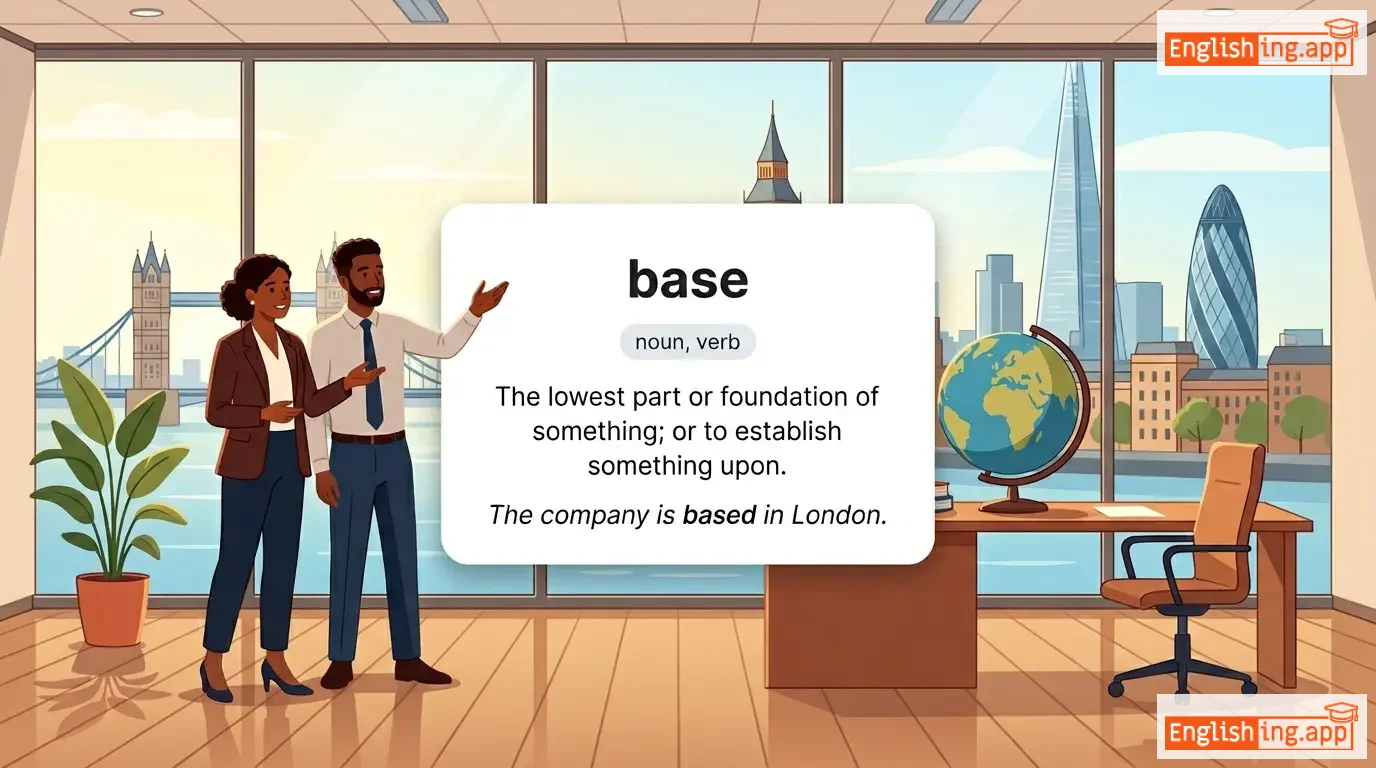
base definition card — visual illustration of the meaning
noun, verb
/beɪs/
base (base)

The lowest part or foundation of something; or to establish something upon.

"The company is based in London."

"L'entreprise est basée à Londres." (L'entreprise est basée à Londres.)
noun
/ˈbeɪsˌbɔːl/
béisbol (beisbol)

a sport in which two teams try to score runs by hitting a ball and running around bases

"He loves watching baseball games on TV."

"Il adore regarder des matchs de béisbol à la télévision." (Il adore regarder des matchs de béisbol à la télévision.)
noun
/ˈbeɪsbɔːrd/
plinthe (plinthe)

A narrow board running along the bottom of an interior wall, covering the joint between wall and floor.

"The carpenter painted the baseboard white."

"Le menuisier a peint la plinthe en blanc." (Le menuisier a peint la plinthe en blanc.)
adjective
/ˈbeɪs.ləs/
sans fondement; infondé; sans base (sans fondement; infondé; sans base)

without foundation; groundless; unfounded

"The accusations against him were completely baseless."

"Les accusations contre lui étaient complètement infondées." (Les accusations contre lui étaient complètement infondées.)
noun
/ˈbeɪsmənt/
cave (kav)

the lowest floor of a building, usually partly or completely below ground

"The laundry room is in the basement."

"La buanderie est dans la cave." (La buanderie est dans la cave.)
adjective
/ˈbæʃ.fəl/
timide (timid)

shy, easily embarrassed, or reluctant to draw attention

"She gave a bashful smile when he complimented her."

"Elle a donné un sourire timide lorsqu'il l'a complimentée." (Elle a donne un sourire timide lorsqu'il l'a complimentee.)
adjective
/ˈbeɪsɪk/
de base (de base)

forming the most important or simplest part of something

"She taught me the basic rules of chess."

"Elle m'a enseigné les règles de base des échecs." (Elle m'a enseigne les regles de base des echecs.)
adverb
/ˈbeɪsɪkli/
fondamentalement (fondamentalement)

in the most important or fundamental way; essentially

"Basically, the project was a success despite some small issues."

"Fondamentalement, le projet a été un succès malgré quelques petits problèmes." (Fondamentalement, le projet a ete un succes malgre quelques petits problemes.)
noun
/ˈbeɪ.zəl/
basilic (basilic)

an aromatic herb with green leaves used in cooking, especially Italian cuisine

"The pasta sauce was flavored with fresh basil."

"La sauce de pâtes était parfumée avec du basilic frais." (La sauce de pâtes était parfumée avec du basilic frais.)
noun
/ˈbeɪ.zəl siːdz/
graines de basilic (graines de basilic)

small black seeds from the basil plant, often used in drinks and desserts

"I added basil seeds to my lemonade for a refreshing drink."

"J'ai ajouté des graines de basilic à ma limonade pour une boisson rafraîchissante." (J'ai ajouté des graines de basilic à ma limonade pour une boisson rafraîchissante.)
noun
/ˈbeɪsɪs/
base (base)

the underlying support or foundation for an idea, argument, or process

"Trust is the basis of any strong relationship."

"La confiance est la base de toute relation forte." (La confiance est la base de toute relation forte.)
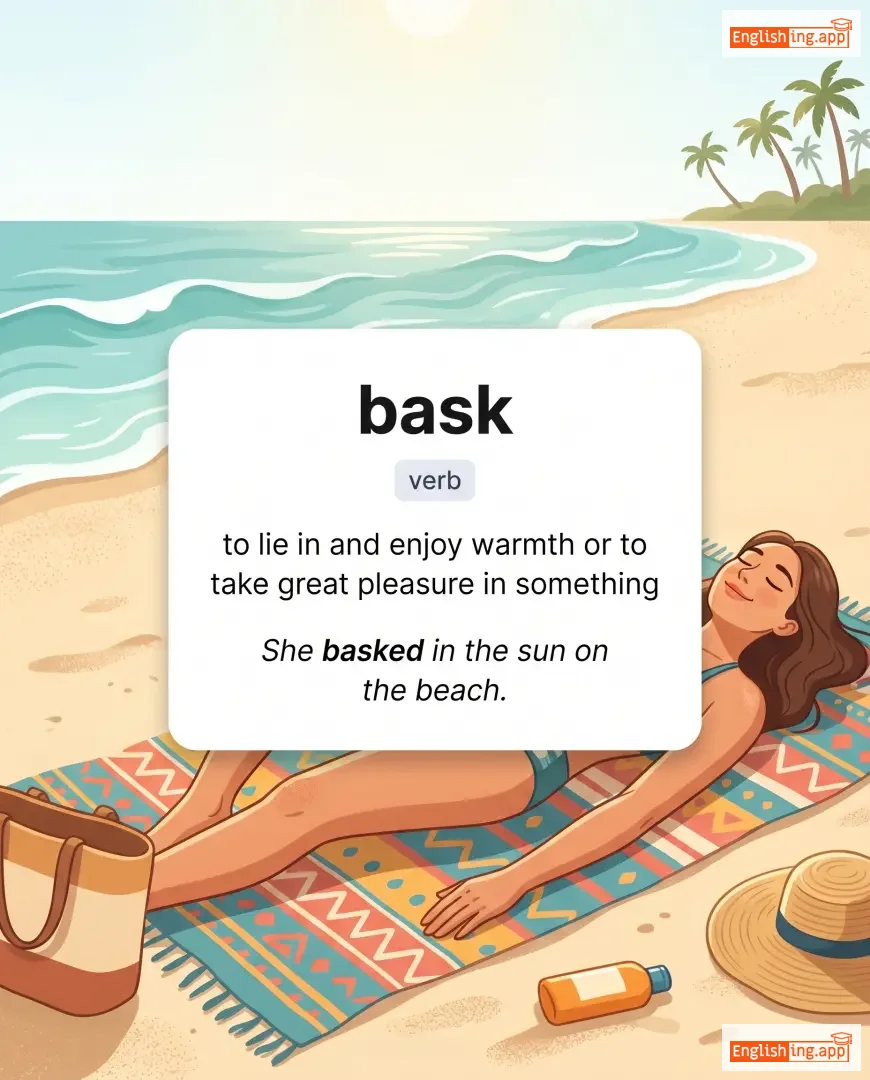
bask definition card — visual illustration of the meaning
verb
/bæsk/
prendre le soleil (prendre le soleil)

to lie in and enjoy warmth or to take great pleasure in something

"She basked in the sun on the beach."

"Elle a pris le soleil sur la plage." (Elle a pris le soleil sur la plage.)
noun
/ˈbæskɪt/
panier (panier)

a container made of woven materials used for carrying or storing things

"She carried the apples in a basket."

"Elle a porté les pommes dans un panier." (Elle a porté les pommes dans un panier.)
noun
/ˈbæskɪtbɔːl/
basket-ball (basketball)

a game played by two teams who try to score points by throwing a ball through a hoop

"He loves playing basketball with his friends."

"Il aime jouer au basket-ball avec ses amis." (Il aime jouer au basketball avec ses amis.)
noun
/beɪs/
voix masculine basse / guitare basse (voix masculine basse / guitare basse)

the lowest adult male singing voice; also, low-frequency sounds in music or a type of fish

"He played the bass guitar at the concert."

"Il a joué de la guitare basse au concert." (Il a joué de la guitare basse au concert.)
noun
/bəˈsuːn/
un type de hautbois (instrument à vent en bois de grande taille) (un type de hautbois (instrument à vent en bois de grande taille))

a large woodwind instrument with a deep sound

"The orchestra featured a beautiful bassoon solo."

"L'orchestre a présenté un magnifique solo de basson." (L'orchestre a présenté un magnifique solo de basson.)
noun/adjective
/ˈbæstərd/
bâtard (batard)

a child born to unmarried parents (offensive); also used informally as an insult or to describe something unpleasant

"He called him a bastard in anger."

"Il l'a traité de bâtard avec colère." (Il l'a traité de bâtard avec colère.)
noun
/ˈbæs.tərd tiːk/
teck bâtard (teck batard)

A flowering tree with bright orange-red flowers, also known as flame of the forest

"The bastard teak tree blooms with vibrant orange flowers in spring."

"L'arbre de teck bâtard fleurit avec des fleurs orange vibrantes au printemps." (L'arbre de teck batard fleurit avec des fleurs orange vibrantes au printemps.)
noun
/ˌbæstərdaɪˈzeɪʃən/
dégénérescence / altération (degenerescence / alteracion)

the act of corrupting, degrading, or misrepresenting something

"Critics called the remake a bastardization of the original film."

"Les critiques ont qualifié le remake de bastardisation du film original." (Les critiques ont qualifie le remake de bastardisation du film original.)
verb
/ˈbæstərdaɪz/
dénaturer (denaturer)

to corrupt or debase something by altering it from its original form; to change in a way that reduces quality or purity

"Critics argue that the remake bastardized the original novel."

"Les critiques disent que le remake a dénaturé l’œuvre originale." (Les critiques disent que le remake a denature l oeuvre originale)
verb
/beɪst/
verser ou badigeonner de la graisse fondue, du jus ou du liquide sur la viande pendant la cuisson pour la garder humide (verser ou badigeonner de la graisse fondue, du jus ou du liquide sur la viande pendant la cuisson pour la garder humide)

to pour or brush melted fat, juices, or liquid over meat during cooking to keep it moist

"She basted the turkey every 30 minutes to keep it juicy."

"Elle a badigeonné la dinde toutes les 30 minutes pour la garder juteuse." (Elle a badigeonné la dinde toutes les 30 minutes pour la garder juteuse.)
noun
/ˈbæs.ti.ən/
bastion, forteresse (bastion, forteresse)

a stronghold or fortification; a place or institution strongly defending particular principles

"The castle stood as a bastion against enemy attacks."

"Le château se tenait comme un bastion contre les attaques ennemies." (Le chateau se tenait comme un bastion contre les attaques ennemies.)
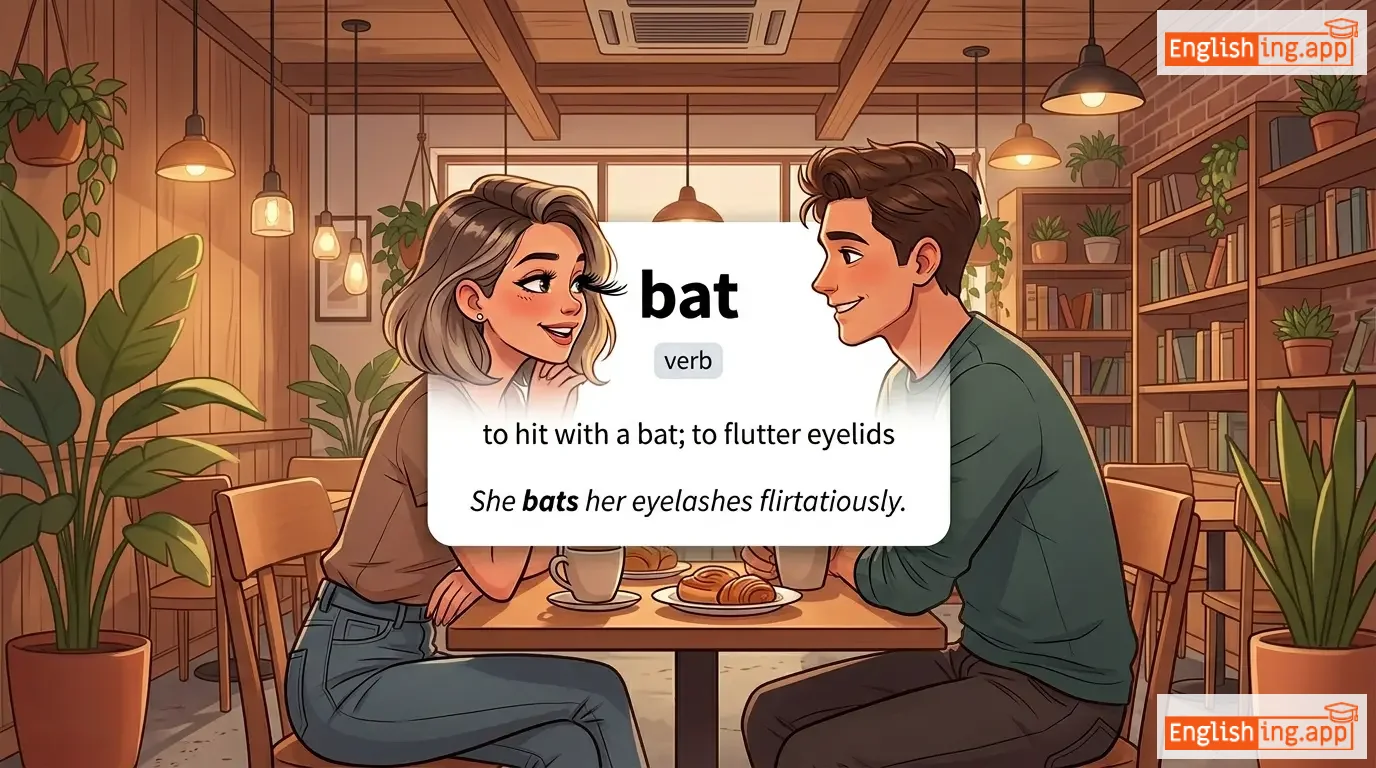
bat definition card — visual illustration of the meaning
noun
/bæt/
batte (batte)

a wooden or metal club used to hit a ball in sports like baseball or cricket

"He swung the bat and hit the ball hard."

"Il a tourné la batte et a frappé la balle fort." (Il a tourne la batte et a frappe la balle fort.)
noun
/bætʃ/
une quantité d'articles produits ou traités en même temps (une quantité d'articles produits ou traités en même temps)

a quantity of items produced or processed at one time

"She baked a fresh batch of cookies this morning."

"Elle a cuit un nouveau lot de biscuits ce matin." (Elle a cuit un nouveau lot de biscuits ce matin.)
😮‍💨

bate (bête)

verb
/beɪt/
réduire, atténuer (réduire, atténuer)

to lessen or restrain; to diminish the force or intensity of something

"He spoke with bated breath as he waited for the result."

"Il parla avec une respiration retenue en attendant le résultat." (Il parla avec une respiration retenue en attendant le résultat.)
noun
/bɑːθ/
bain (bain)

an act of washing the body in water; or the container used for this purpose

"She took a long bath after work."

"Elle a pris un long bain après le travail." (Elle a pris un long bain après le travail.)
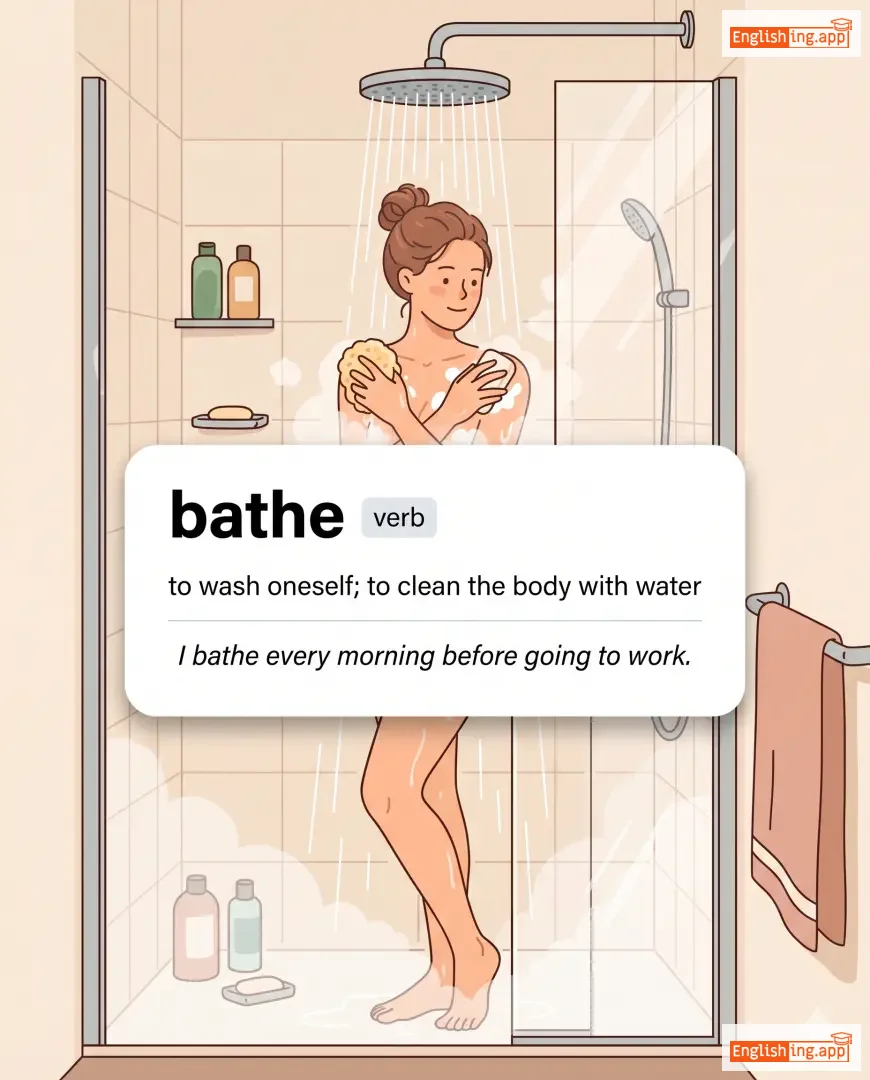
bathe definition card — visual illustration of the meaning
verb
/beɪð/
se baigner (se baigner)

to wash oneself; to clean the body with water

"I bathe every morning before going to work."

"Je me baigne chaque matin avant d'aller au travail." (Je me baigne chaque matin avant d'aller au travail)
adjective
/bəˈθɛt.ɪk/
sentiment insignifiant (sentiment insignifiant)

displaying insincere or trivial emotion; producing an unintended ridiculous effect through sudden change from serious to silly

"The movie's ending was unintentionally bathetic rather than tragic."

"La fin du film était bathétique au lieu d'être tragique." (La fin du film etait bathetique au lieu d'etre tragique.)
noun
/ˈbɑːθruːm/
salle de bains (salle de bains)

a room containing a toilet and usually a sink or shower

"The bathroom is on the second floor."

"La salle de bains est au deuxième étage." (La salle de bains est au deuxieme etage.)
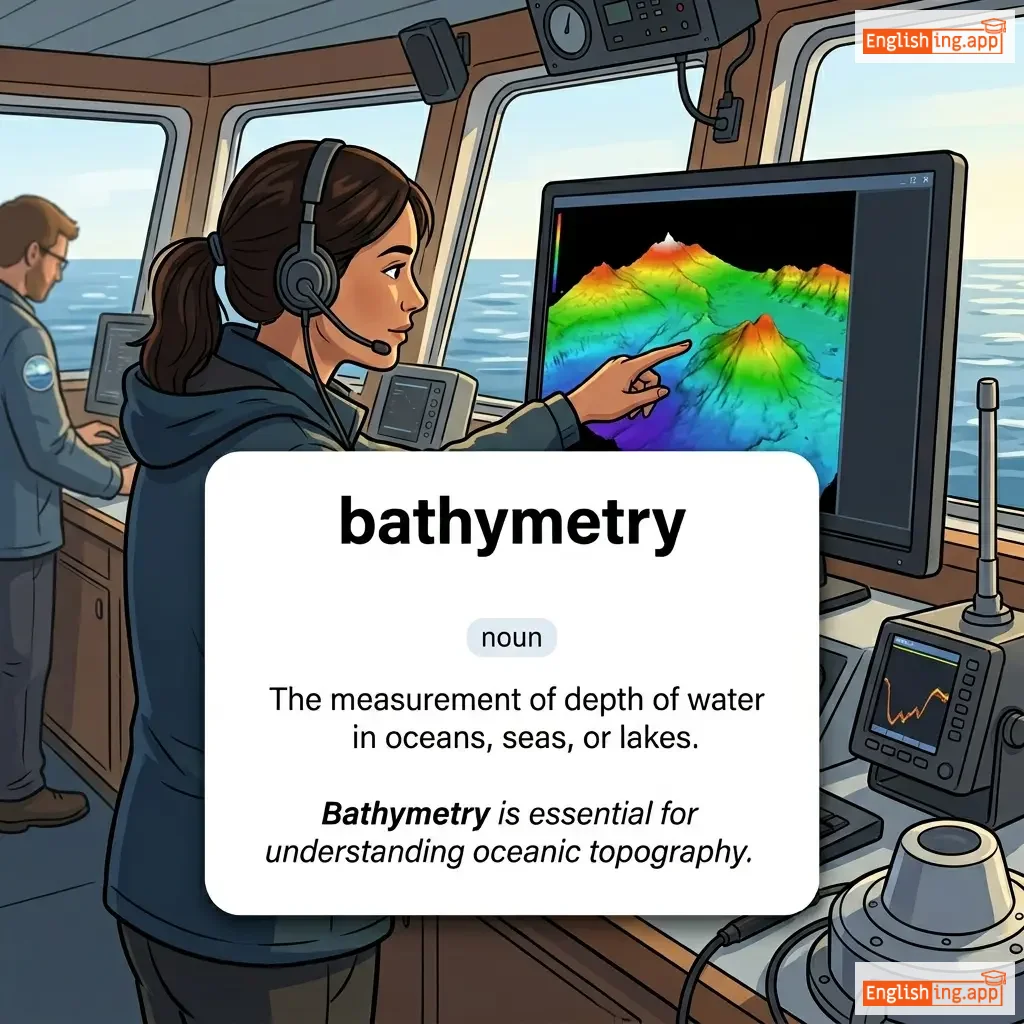
bathymetry definition card — visual illustration of the meaning
noun
/bəˈθɪm.ə.tri/
bathymétrie (bathymetrie)

The measurement of depth of water in oceans, seas, or lakes.

"Bathymetry is essential for understanding oceanic topography."

"La bathymétrie est essentielle pour comprendre la topographie océanique." (La bathymétrie est essentielle pour comprendre la topographie océanique.)
noun
/bəˈtɒn/
bâton / symbole d'autorité (baton / symbole d'autorite)

A thin stick carried by a conductor to direct an orchestra, or used as a symbol of authority.

"The conductor raised his baton to begin the symphony."

"Le chef d'orchestre leva son bâton pour commencer la symphonie." (Le chef d'orchestre leva son baton pour commencer la symphonie.)
noun
/bəˈtæljən/
bataillon (bataillon)

A large body of soldiers ready for battle, typically consisting of several companies.

"The battalion was deployed to the front line."

"Le bataillon a été déployé sur la ligne de front." (Le bataillon a ete deploie sur la ligne de front.)
verb
/ˈbætn/
fixer (fixer)

To fasten or secure something tightly.

"They battened down the hatches before the storm."

"Ils ont fixé les écoutilles avant la tempête." (Ils ont fixé les écoutilles avant la tempête.)
verb
/ˈbætər/
frapper violemment (frapper violemment)

To strike repeatedly with force.

"The waves battered the shoreline all night."

"Les vagues ont battu le rivage toute la nuit." (Les vagues ont battu le rivage toute la nuit.)
noun
/ˈbætəri/
batterie (batterie)

A device that stores and provides electrical energy; also refers to a group of similar things or repeated blows.

"The phone battery ran out after a long day."

"La batterie du téléphone s'est épuisée après une longue journée." (La batterie du telephone s'est epuisée apres une longue journee.)