

Passez à la version Pro pour accéder à tout le vocabulaire
Message vocabulaire Pro
Passer à la version ProTraduction
Passé
Participe Passé
Troisième Personne du Singulier
Gérondif
Signification
Phrase d'Exemple
Traduction de la Phrase d'Exemple
Synonymes
Antonymes
Collocations
Mnémonique
Swipe left or right, or use the buttons. Tap image to zoom.
Passez à la version Pro pour accéder à toutes les phrases
Message phrases Pro
Passer à la version ProTraduction de la Phrase d'Exemple
Mot
Lesson 50Lesson 50 - Basculement de Masque
|
Émoji
|
Mot | Images | Traduction | Passé | Participe Passé | Troisième Personne du Singulier | Gérondif | Signification | Phrase d'Exemple | Traduction de la Phrase d'Exemple | Expression d'Exemple | Signification de l'Expression d'Exemple | Traduction de l'Expression d'Exemple | Synonymes | Antonymes | Collocations | Mnémonique |
|---|---|---|---|---|---|---|---|---|---|---|---|---|---|---|---|---|---|
|
#2374
🙌
|
/heɪl/
verb
(hèl)
••••••
|
- •••••• |
saluer / acclamer
saluer / acclamer
••••••
|
hailed
hèld
••••••
|
hailed
hèld
••••••
|
hails
hèls
••••••
|
hailing
hèling
••••••
|
To call out to attract attention or to praise enthusiastically.
••••••
|
The athlete was hailed as a hero after the victory.
L'athlète a été acclamé comme un héros après la victoire.
••••••
|
L'athlète a été acclamé comme un héros après la victoire.
L'athlete a ete acclaime comme un heros apres la victoire.
••••••
|
hail a taxi
saluer un taxi
••••••
|
to signal and stop a taxi to get a ride
••••••
|
saluer un taxi
saluer un taxi
••••••
|
greet, call, acclaim, praise, salute
••••••
|
ignore, condemn, dismiss
••••••
|
hail a taxi, hail as a hero, hail the decision, hail enthusiastically
••••••
|
Hail = saluer quelqu'un ou acclamer comme un héros
••••••
|
|
#2375
💇
|
/hɛər/
noun
(hɛr)
••••••
|
- •••••• |
cheveux
cheveux
••••••
|
- •••••• | - •••••• | - •••••• | - •••••• |
the fine threads growing from the skin of humans and animals
••••••
|
She has long, black hair. |
Elle a les cheveux longs et noirs.
Elle a les cheveux longs et noirs.
••••••
|
let your hair down |
to relax and enjoy yourself without worrying
••••••
|
laisser ses cheveux tomber
laisser ses cheveux tomber
••••••
|
locks, strands, tresses, mane
••••••
|
baldness, bald head
••••••
|
long hair, curly hair, cut hair, hair color
••••••
|
Cheveux = Hair, cheveux en français ressemble à cheveux
••••••
|
|
#2376
💇
|
/ˈheəkʌt/
noun
(héèrkat)
••••••
|
- •••••• |
coupe de cheveux
coupe de cheveux
••••••
|
- •••••• | - •••••• | - •••••• | - •••••• |
the act or style of cutting hair
••••••
|
I got a haircut before the wedding.
ai got a héèrkat bifor ze weding
••••••
|
Je me suis fait une coupe de cheveux avant le mariage.
je me suis fait une coupe de cheveux avant le mariage
••••••
|
get a haircut
get a haircut
••••••
|
to have one’s hair cut
••••••
|
se faire couper les cheveux
se faire couper les cheveux
••••••
|
trim, hairstyle, cut, hairdo
••••••
|
growth, neglect
••••••
|
get a haircut, short haircut, new haircut, haircut style
••••••
|
Haircut = coupe de cheveux
••••••
|
|
#2377
💇
|
/ˈheəˌkʌtər/
noun
(hèrcuteur)
••••••
|
- •••••• |
coiffeur
coiffeur
••••••
|
- •••••• | - •••••• | - •••••• | - •••••• |
a person whose job is to cut and style hair; barber or hairdresser
••••••
|
The haircutter gave me a neat and stylish haircut.
le hèrcuteur guév mi un bon hèrcut
••••••
|
Le coiffeur m’a fait une belle coupe.
le coiffeur ma fait une belle coupe
••••••
|
- •••••• | - •••••• | - •••••• |
barber, hairdresser, stylist, coiffeur
••••••
|
client, customer
••••••
|
professional haircutter, local haircutter, skilled haircutter
••••••
|
haircutter = coiffeur qui coupe les cheveux
••••••
|
|
#2378
💇
|
/ˈherˌdrɛsər/
noun
(hèrdressèr)
••••••
|
- •••••• |
coiffeur; coiffeuse
coiffeur; coiffeuse
••••••
|
- •••••• | - •••••• | - •••••• | - •••••• |
a person whose job is to cut, style, and treat hair
••••••
|
The hairdresser gave me a stylish haircut before the wedding.
De hèrdressèr gev mi a stailish hèrcut bifor de veding.
••••••
|
Le coiffeur m’a fait une coupe élégante avant le mariage.
Le coiffeur m a fait une coupe elegante avant le mariage
••••••
|
- •••••• | - •••••• | - •••••• |
hairstylist, barber, stylist, hair stylist
••••••
|
client, customer
••••••
|
professional hairdresser, local hairdresser, visit a hairdresser, hairdresser salon
••••••
|
Coiffure = cheveux → coiffeur
••••••
|
|
#2379
½
|
/hæf/
noun, adjective
(half)
••••••
|
- •••••• |
moitié
moitie
••••••
|
- •••••• | - •••••• | - •••••• | - •••••• |
one of two equal parts of something
••••••
|
He ate half of the cake. |
Il a mangé la moitié du gâteau.
Il a mange la moitie du gateau.
••••••
|
half-hearted |
without much effort or enthusiasm
••••••
|
à moitié
a moitie
••••••
|
portion, part, piece, division
••••••
|
whole, complete
••••••
|
half price, half hour, half life, half way
••••••
|
Half signifie moitié, pense à diviser un gâteau, moitié = half
••••••
|
|
#2380
↔️
|
/ˌhæfˈweɪ/
adverb
(halfwei)
••••••
|
- •••••• |
à mi-chemin
a mi-chemin
••••••
|
- •••••• | - •••••• | - •••••• | - •••••• |
at or to a point equal in distance between two points
••••••
|
We met halfway between the two towns. |
Nous nous sommes rencontrés à mi-chemin entre les deux villes.
Nous nous sommes rencontrés à mi-chemin entre les deux villes.
••••••
|
meet halfway |
to compromise or find a middle ground
••••••
|
trouver un compromis
trouver un compromis
••••••
|
in the middle, midway, partway, center
••••••
|
completely, fully
••••••
|
halfway point, halfway through, halfway house, meet halfway
••••••
|
Mi-chemin signifie à moitié du chemin, donc c'est un compromis.
••••••
|
|
#2381
🏛️
|
/hɔːl/
noun
(hôl)
••••••
|
- •••••• |
hall
hall
••••••
|
- •••••• | - •••••• | - •••••• | - •••••• |
a large room or building for public gatherings, events, or passage
••••••
|
The graduation ceremony was held in the university hall.
La cérémonie de remise des diplômes a eu lieu dans le hall de l'université.
••••••
|
La cérémonie de remise des diplômes a eu lieu dans le hall de l'université.
La ceremonie de remise des diplomes a eu lieu dans le hall de l'universite.
••••••
|
hall of fame
hall de la renommée
••••••
|
a group or place honoring distinguished people
••••••
|
hall de la renommée
hall de la renommee
••••••
|
auditorium, chamber, corridor, passage, lobby
••••••
|
room, cubicle
••••••
|
lecture hall, concert hall, dining hall, entrance hall
••••••
|
hall (hall) est un grand espace, comme celui dans les universités. Souvenez-vous, le hall de la renommée.
••••••
|
|
#2382
🛑
|
/hɔːlt/
verb
(halt)
••••••
|
- •••••• |
arrêter
arreter
••••••
|
halted
halted
••••••
|
halted
halted
••••••
|
halts
halts
••••••
|
halting
halting
••••••
|
to stop or bring to a stop
••••••
|
The train suddenly halted at the station.
Le train s'est arrêté soudainement à la station.
••••••
|
Le train s'est arrêté soudainement à la station.
Le train s'est arrêté soudainement à la station.
••••••
|
- •••••• | - •••••• | - •••••• |
stop, cease, terminate, freeze
••••••
|
start, begin, continue
••••••
|
halt operations, halt progress, halt movement
••••••
|
Halt en anglais signifie arrêter en français
••••••
|
|
#2383
🔨
|
/ˈhæmər/
noun, verb
(hamèr)
••••••
|
- •••••• |
marteau
marteau
••••••
|
hammered
hamèréd
••••••
|
hammered
hamèréd
••••••
|
hammers
hamèrs
••••••
|
hammering
hamèring
••••••
|
a tool with a heavy metal head used for breaking things or driving in nails; to hit something forcefully with a hammer or similar object.
••••••
|
He used a hammer to fix the broken chair.
Il a utilisé un marteau pour réparer la chaise cassée.
••••••
|
Il a utilisé un marteau pour réparer la chaise cassée.
Il a utilisé un marteau pour réparer la chaise cassée.
••••••
|
hammer out
marteler
••••••
|
to work out the details of something through discussion and effort
••••••
|
travailler les détails
travailler les détails
••••••
|
mallet, pound, strike, beat, smash
••••••
|
caress, stroke
••••••
|
hammer blow, hammer strike, hammer nails, hammer out, hammer away
••••••
|
marteau = marteler, pour frapper les clous.
••••••
|
|
#2384
🤚
|
/hænd/
noun, verb
(hænd)
••••••
|
- •••••• |
main
main
••••••
|
handed
hændɪd
••••••
|
handed
hændɪd
••••••
|
hands
hændz
••••••
|
handing
hændɪŋ
••••••
|
the part of the body at the end of the arm used for holding things
••••••
|
She raised her hand to ask a question.
ʃi reɪzd hɜr hænd tʊ æsk ə kwɛsʧən.
••••••
|
Elle leva sa main pour poser une question.
Elle leva sa main pour poser une question.
••••••
|
in safe hands
ɪn seɪf hændz
••••••
|
being looked after by someone competent and reliable
••••••
|
en de bonnes mains
en de bonnes mains
••••••
|
palm, fist, grip, hold
••••••
|
foot, neglect
••••••
|
shake hands, hand in, hand out, raise hand
••••••
|
‘Main’ en français est comme ‘main’ en anglais – pour attraper des objets !
••••••
|
|
#2385
✋
|
/ˈhænd.fʊl/
noun
(hændfʊl)
••••••
|
- •••••• |
une poignée
une poignie
••••••
|
- •••••• | - •••••• | - •••••• | - •••••• |
the amount of something that can be held in one hand; a small number
••••••
|
She took a handful of nuts. |
Elle a pris une poignée de noix.
Elle a pris une poignee de noix.
••••••
|
a handful |
a small number of people or things; someone difficult to manage
••••••
|
un petit nombre de personnes ou de choses; quelqu'un de difficile à gérer
un petit nombre de personnes ou de choses; quelqu'un de difficile a gerer
••••••
|
few, small amount, little, portion
••••••
|
many, plenty
••••••
|
a handful of, only a handful, just a handful
••••••
|
une poignée en main, facile à retenir
••••••
|
|
#2386
🪟
|
/ˈhændl̩/
noun, verb
(hændl)
••••••
|
|
poignée / gérer
poignee / gerer
••••••
|
handled
hændəld
••••••
|
handled
hændəld
••••••
|
handles
hændlz
••••••
|
handling
hændlɪŋ
••••••
|
the part of an object designed to be held in the hand; to deal with or manage a situation
••••••
|
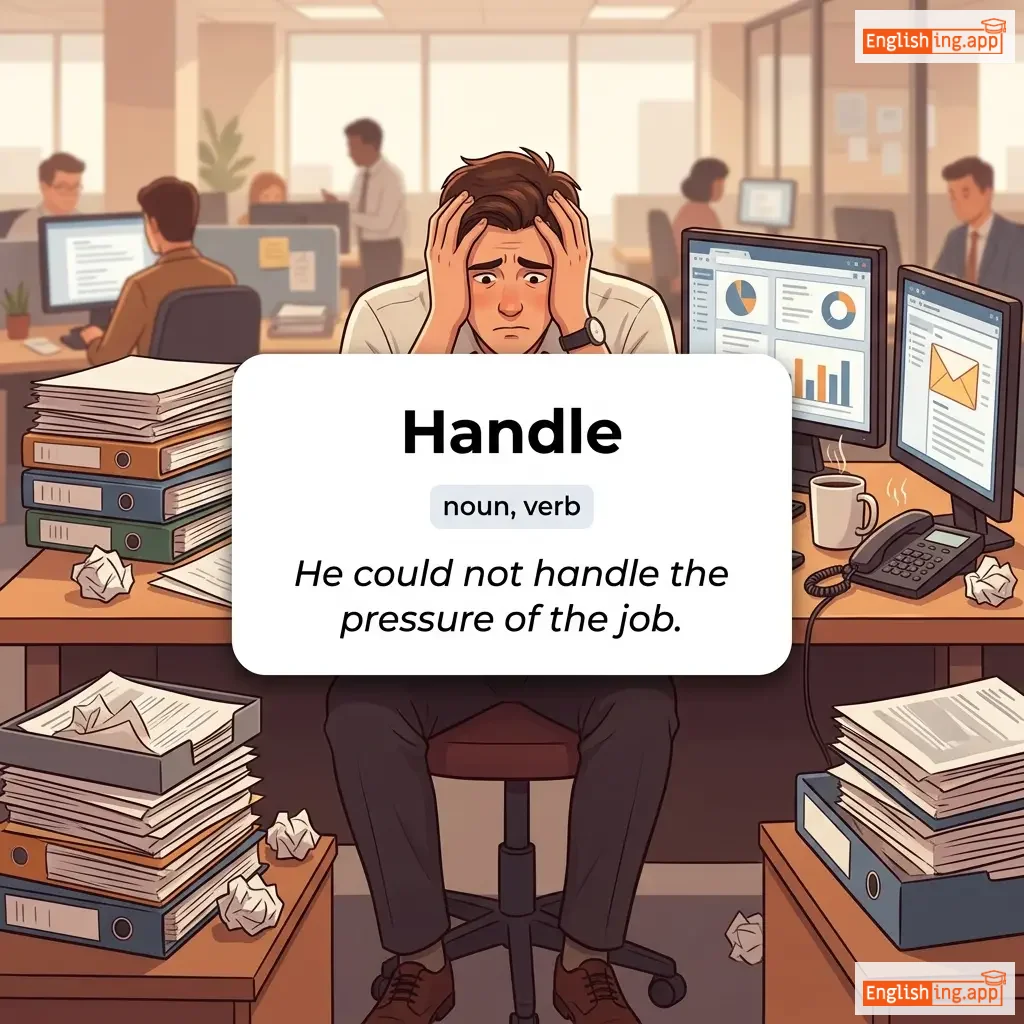
He could not handle the pressure of the job.
Il n'a pas pu gérer la pression du travail.
••••••
|
Il n'a pas pu gérer la pression du travail.
Il n'a pas pu gerer la pression du travail.
••••••
|
fly off the handle
perdre son sang-froid
••••••
|
to suddenly become very angry
••••••
|
devenir très en colère
devenir tres en colere
••••••
|
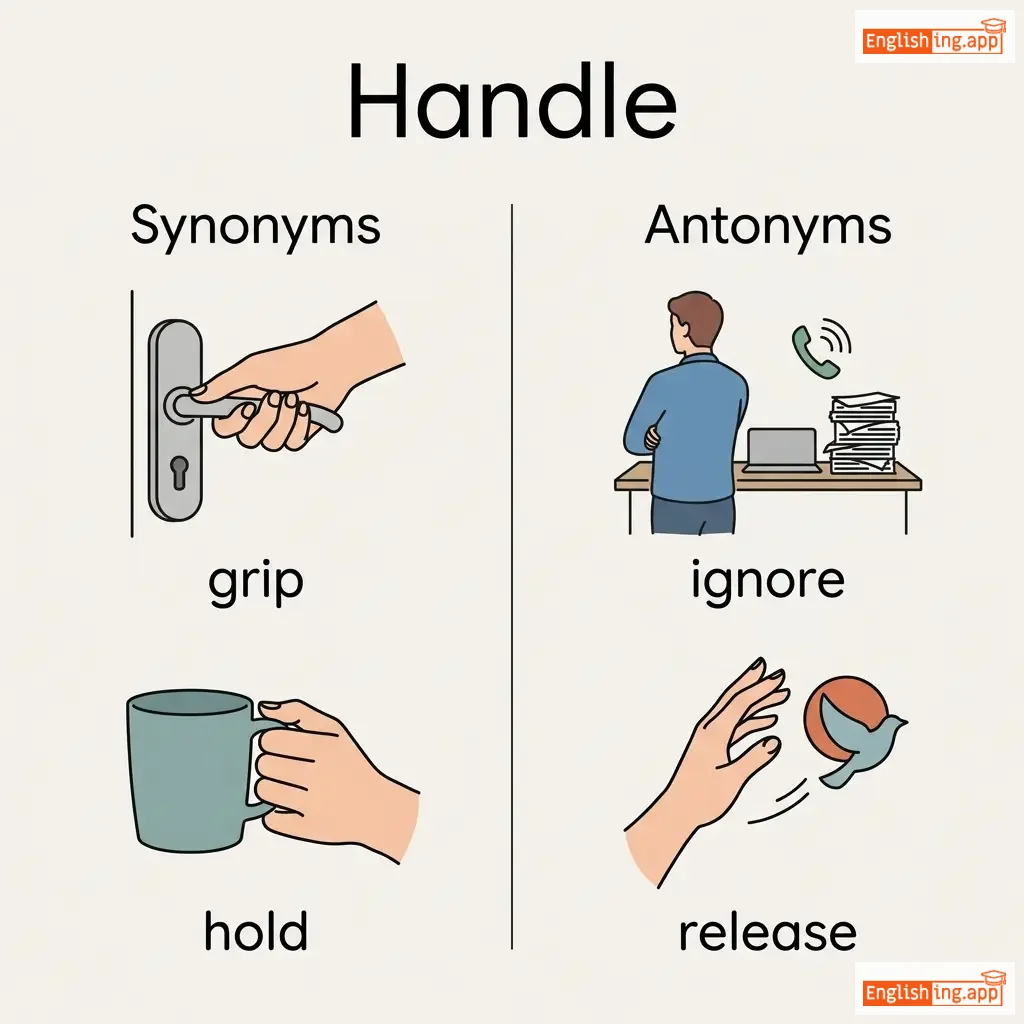
grip, hold, control, manage
••••••
|
ignore, release
••••••
|
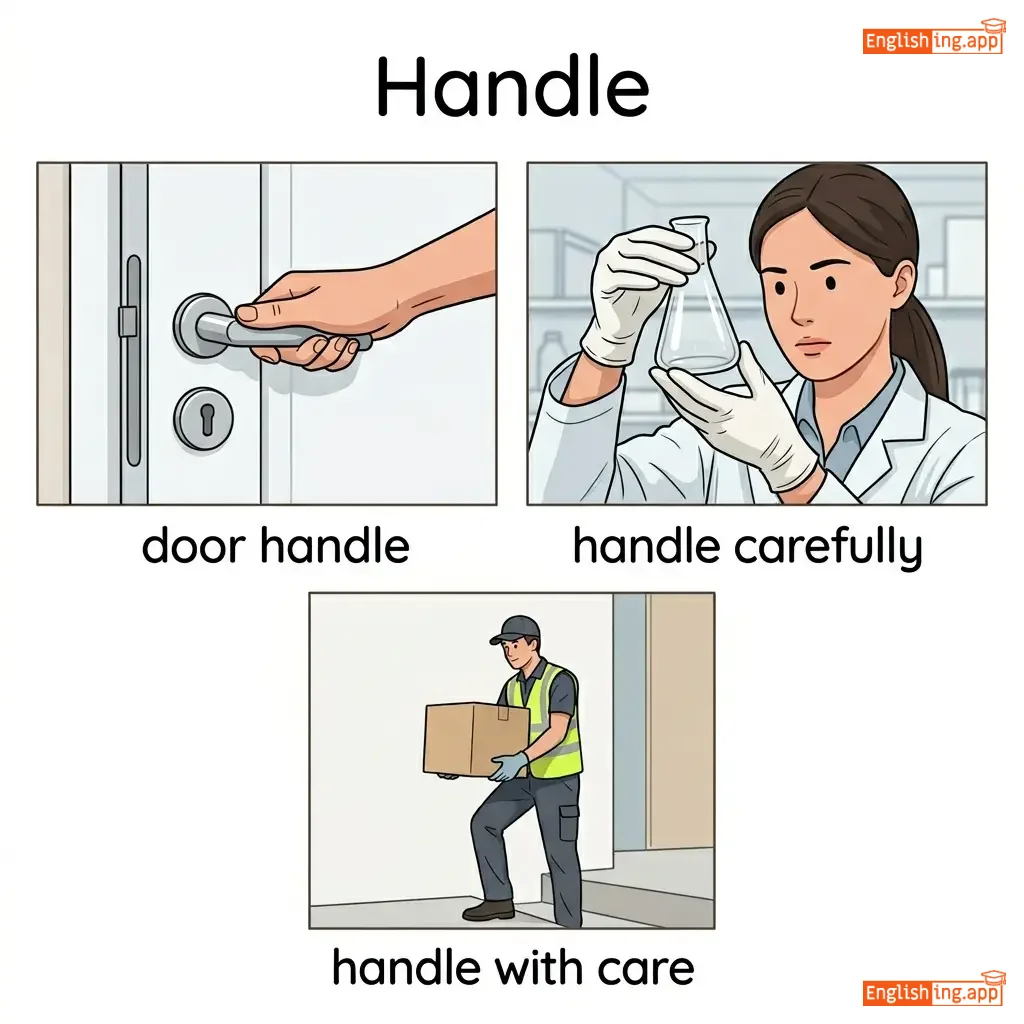
door handle, handle carefully, handle with care
••••••
|
Poignée - se rappeler de tenir une poignée pour gérer une situation
••••••
|
|
#2387
🤲
|
/ˈhændlɪŋ/
noun
(handling)
••••••
|
- •••••• |
gestion
gestion
••••••
|
- •••••• | - •••••• | - •••••• | - •••••• |
the act of managing or dealing with something or someone
••••••
|
His handling of the situation was impressive. |
Sa gestion de la situation était impressionnante.
Sa gestion de la situation était impressionnante.
••••••
|
- •••••• | - •••••• | - •••••• |
management, administration, control, supervision
••••••
|
mismanagement, neglect
••••••
|
handling a crisis, handling an issue, handling customers
••••••
|
Souvenez-vous de la gestion lorsqu'il s'agit de traiter efficacement une situation.
••••••
|
|
#2388
😎
|
/ˈhæn.səm/
adjective
(bonheur)
••••••
|
- •••••• |
bonheur
bonheur
••••••
|
- •••••• | - •••••• | - •••••• | - •••••• |
attractive in appearance, usually referring to men; also can mean generous or impressive in size.
••••••
|
He looked very handsome in his new suit.
Elle ne pouvait pas cacher son bonheur quand elle a reçu le prix.
••••••
|
Elle ne pouvait pas cacher son bonheur quand elle a reçu le prix.
Elle ne pouvait pas cacher son bonheur quand elle a reçu le prix.
••••••
|
handsome reward
poursuite du bonheur
••••••
|
a large or generous reward
••••••
|
poursuite du bonheur
poursuite du bonheur
••••••
|
attractive, good-looking, striking, dashing, elegant
••••••
|
ugly, unattractive, plain
••••••
|
handsome man, handsome reward, handsome profit, look handsome
••••••
|
Pour trouver le bonheur, commence par un sourire.
••••••
|
|
#2389
🛠️
|
/ˈhændi/
adjective
(hendi)
••••••
|
- •••••• |
facile à utiliser
facile a utiliser
••••••
|
- •••••• | - •••••• | - •••••• | - •••••• |
convenient to use or easily accessible; skillful with the hands
••••••
|
This pocket knife is very handy when you go camping. |
Ce couteau de poche est très pratique lorsque vous allez camper.
Ce couteau de poche est tres pratique lorsque vous allez camper.
••••••
|
handy with |
skilled or capable in using something
••••••
|
habile
habile
••••••
|
useful, convenient, practical, accessible, skillful
••••••
|
useless, inconvenient, clumsy
••••••
|
come in handy, very handy, handy tool, handy guide
••••••
|
Handy signifie pratique - comme une main qui rend tout facile.
••••••
|
|
#2390
🖼️
|
/hæŋ/
verb
(hang)
••••••
|
|
suspendre
suspendre
••••••
|
hung
hung
••••••
|
hung
hung
••••••
|
hangs
hangs
••••••
|
hanging
hanging
••••••
|
to suspend or attach something from above so that it moves freely or is supported
••••••
|
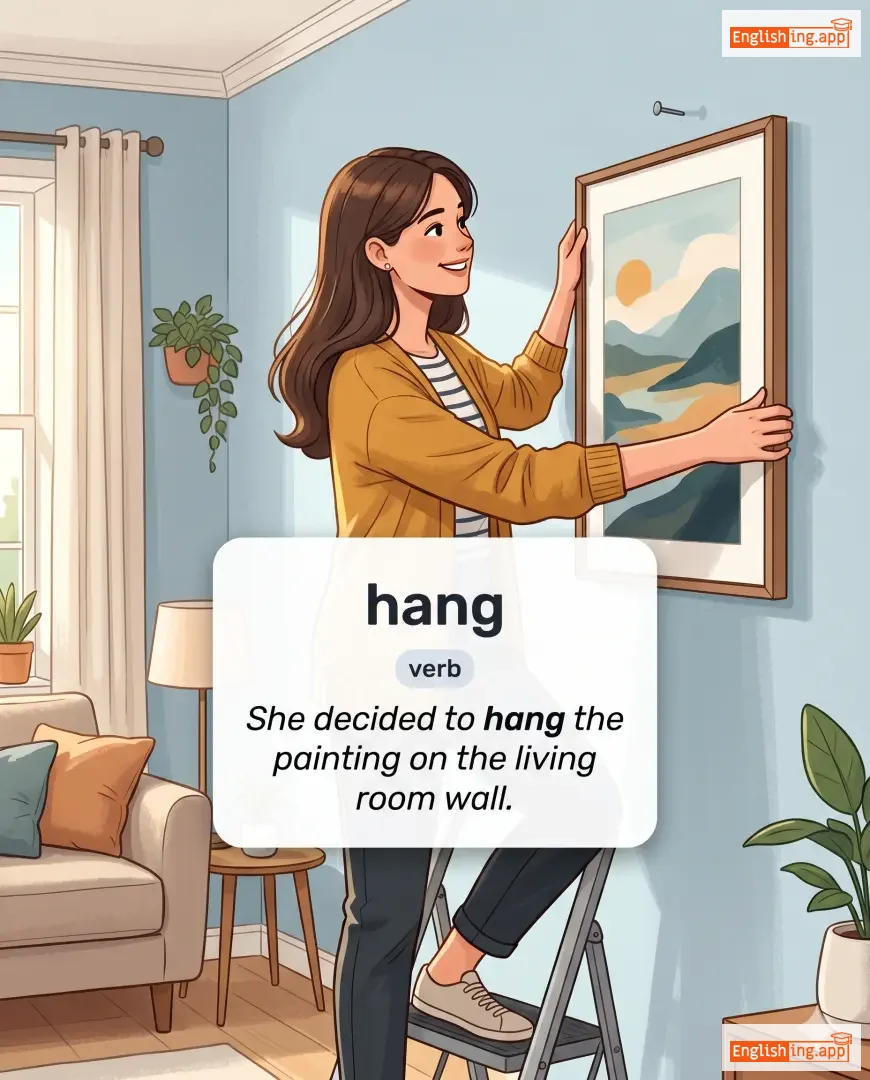
She decided to hang the painting on the living room wall.
Elle a décidé de suspendre le tableau sur le mur du salon.
••••••
|
Elle a décidé de suspendre le tableau sur le mur du salon.
Elle a décidé de suspendre le tableau sur le mur du salon.
••••••
|
hang in there
tenir bon
••••••
|
used to encourage someone to persevere through a difficult time
••••••
|
tenir bon
tenir bon
••••••
|
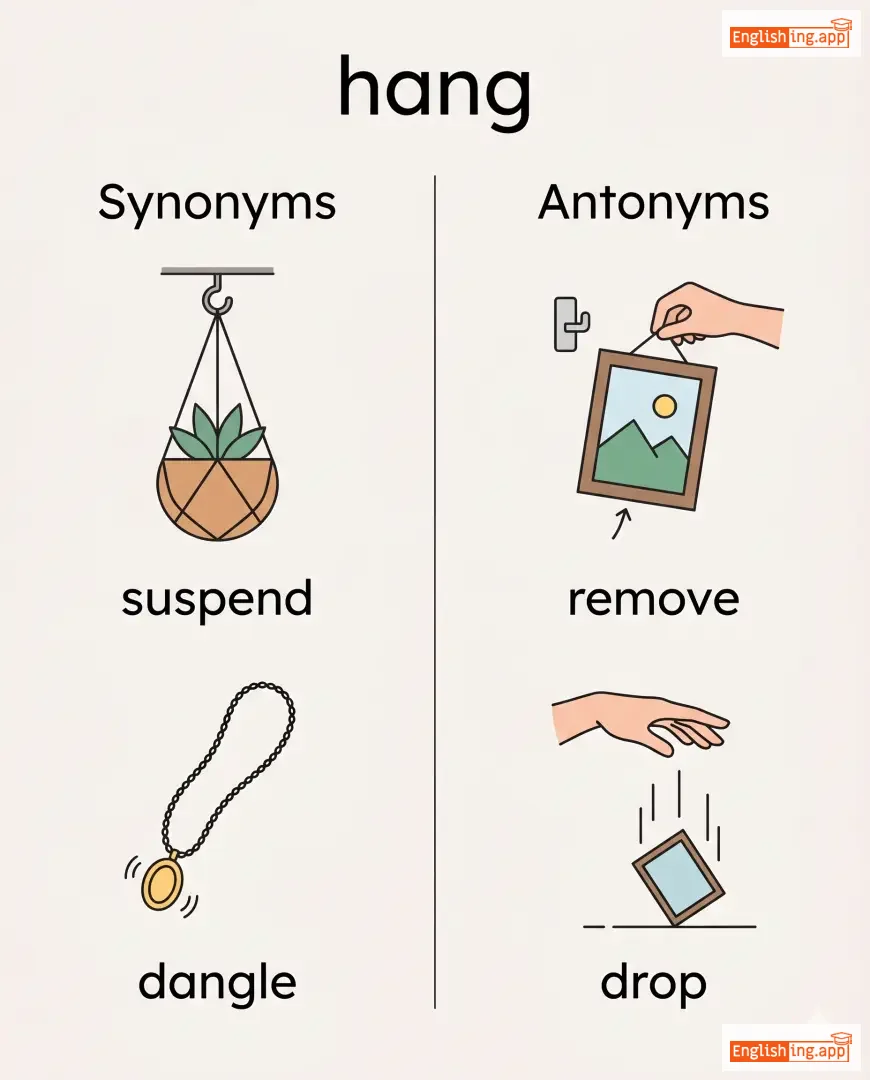
suspend, dangle, attach, display, drape
••••••
|
remove, drop, take down
••••••
|
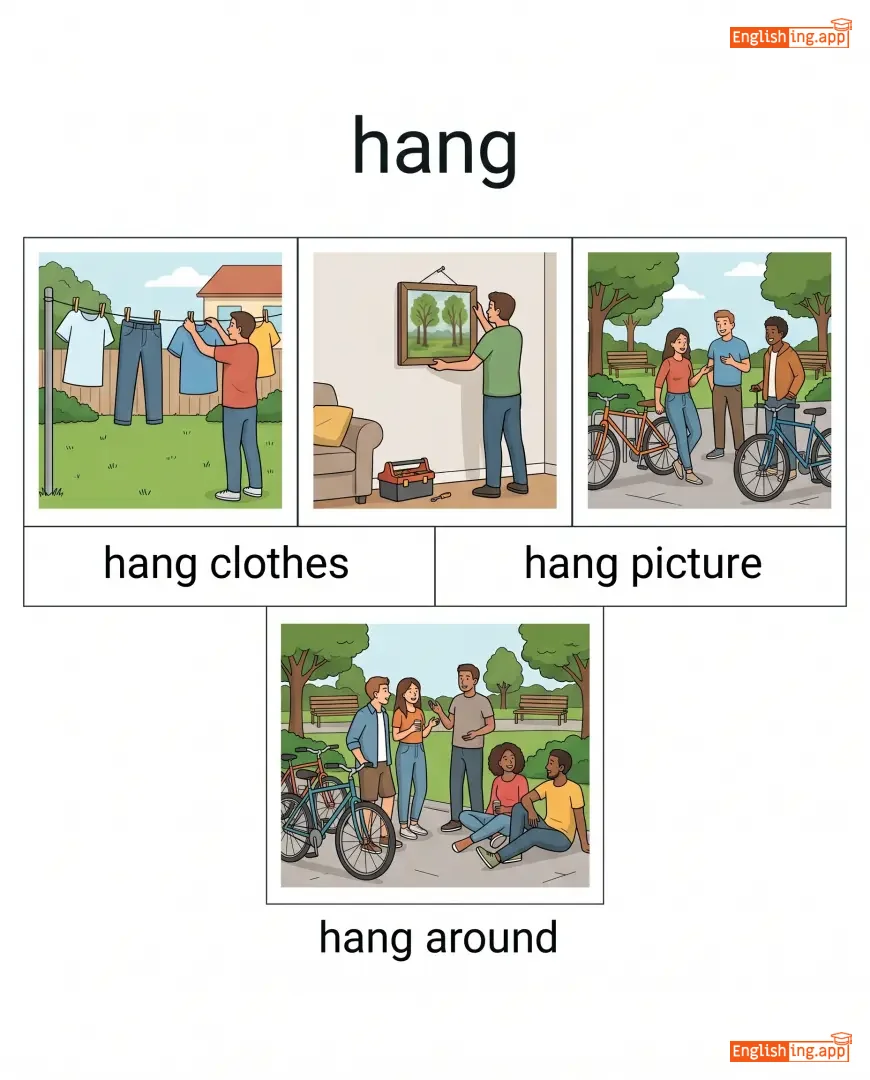
hang clothes, hang picture, hang around, hang up
••••••
|
En suspendant quelque chose, vous 'suspendrez' comme 'hang'.
••••••
|
|
#2391
👕
|
/ˈhæŋ.ər/
noun
(ˈhæŋɡər)
••••••
|
- •••••• |
cintre
cintre
••••••
|
- •••••• | - •••••• | - •••••• | - •••••• |
a shaped piece of wood, plastic, or metal with a hook at the top, used to hang up clothes
••••••
|
She hung her dress on a wooden hanger to prevent it from getting wrinkled. |
Elle a accroché sa robe sur un cintre en bois pour éviter qu'elle ne se froisse.
Elle a accroché sa robe sur un cintre en bois pour éviter qu'elle ne se froisse.
••••••
|
- •••••• | - •••••• | - •••••• |
clothes hanger, coat hanger, garment hook, clothing rack
••••••
|
floor, bed, chair, drawer
••••••
|
wire hanger, wooden hanger, plastic hanger
••••••
|
No •••••• |
|
#2392
✨
|
/ˈhæpən/
verb
(æpən)
••••••
|
- •••••• |
se produire
se produire
••••••
|
happened
æpənd
••••••
|
happened
æpənd
••••••
|
happens
æpənz
••••••
|
happening
æpəniŋ
••••••
|
to take place or occur, usually by chance
••••••
|
Accidents can happen at any time.
Les accidents peuvent se produire à tout moment.
••••••
|
Les accidents peuvent se produire à tout moment.
Les accidents peuvent se produire à tout moment.
••••••
|
what happens, happens
ce qui arrive, arrive
••••••
|
an expression used to accept events as they occur without worry
••••••
|
ce qui arrive, arrive
ce qui arrive, arrive
••••••
|
occur, take place, transpire, arise, ensue
••••••
|
prevent, stop, avoid
••••••
|
happen suddenly, happen accidentally, happen again, happen quickly
••••••
|
HAPPEN signifie quelque chose qui peut se produire soudainement, comme un accident.
••••••
|
|
#2393
😊
|
/ˈhæpɪli/
adverb
(happily)
••••••
|
- •••••• |
heureusement
heureusement
••••••
|
- •••••• | - •••••• | - •••••• | - •••••• |
in a happy manner; with pleasure or satisfaction
••••••
|
The children played happily in the garden. |
Les enfants ont joué heureusement dans le jardin.
Les enfants ont joué heureusement dans le jardin.
••••••
|
- •••••• | - •••••• | - •••••• |
joyfully, cheerfully, gladly, merrily
••••••
|
sadly, unhappily
••••••
|
live happily, happily married, smile happily, happily ever after
••••••
|
Happy + ly signifie agir joyeusement - comme lorsque 😊 les enfants jouent joyeusement.
••••••
|
|
#2394
😊
|
/ˈhæpinəs/
noun
(happiness)
••••••
|
|
bonheur
bonheur
••••••
|
- •••••• | - •••••• | - •••••• | - •••••• |
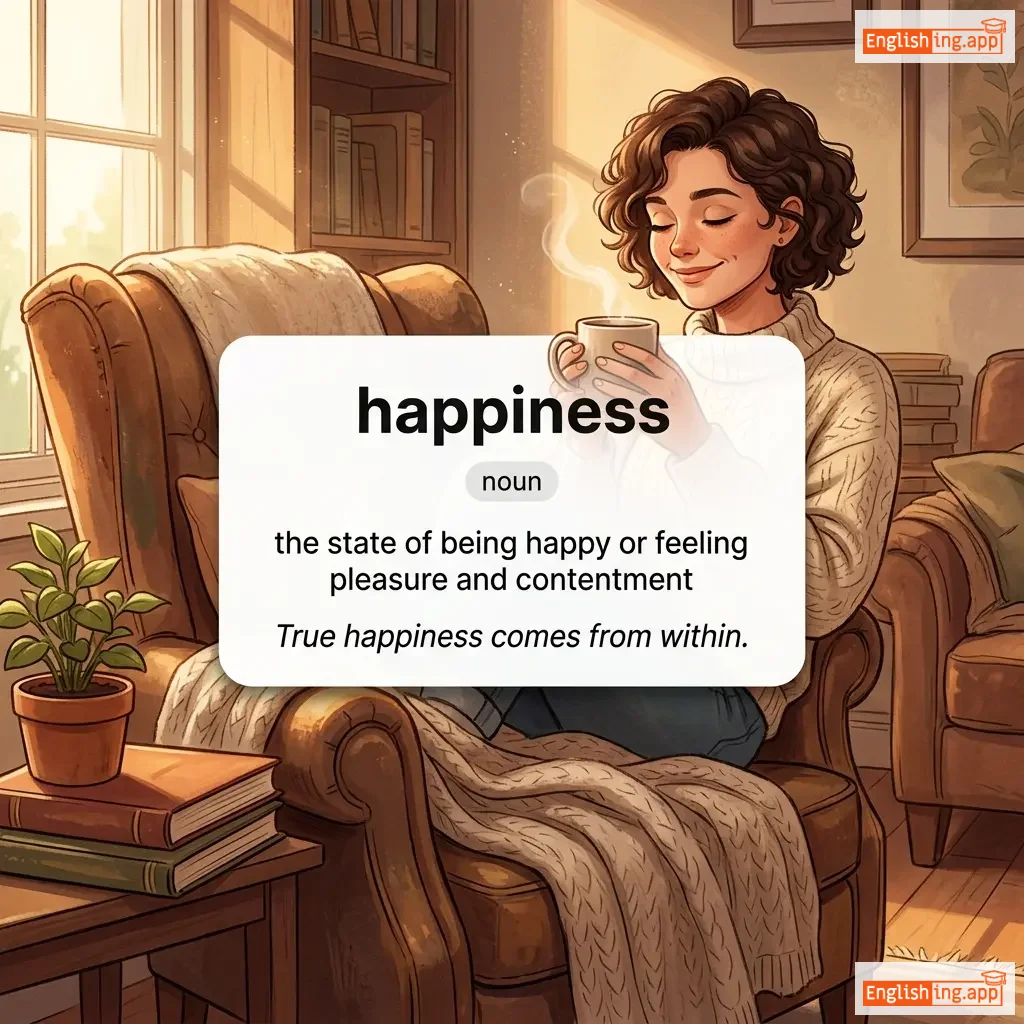
the state of being happy or feeling pleasure and contentment
••••••
|
True happiness comes from within. |
Le vrai bonheur vient de l'intérieur.
Le vrai bonheur vient de l'intérieur.
••••••
|
pursuit of happiness |
the right or effort to seek personal fulfillment or joy
••••••
|
quête du bonheur
quête du bonheur
••••••
|
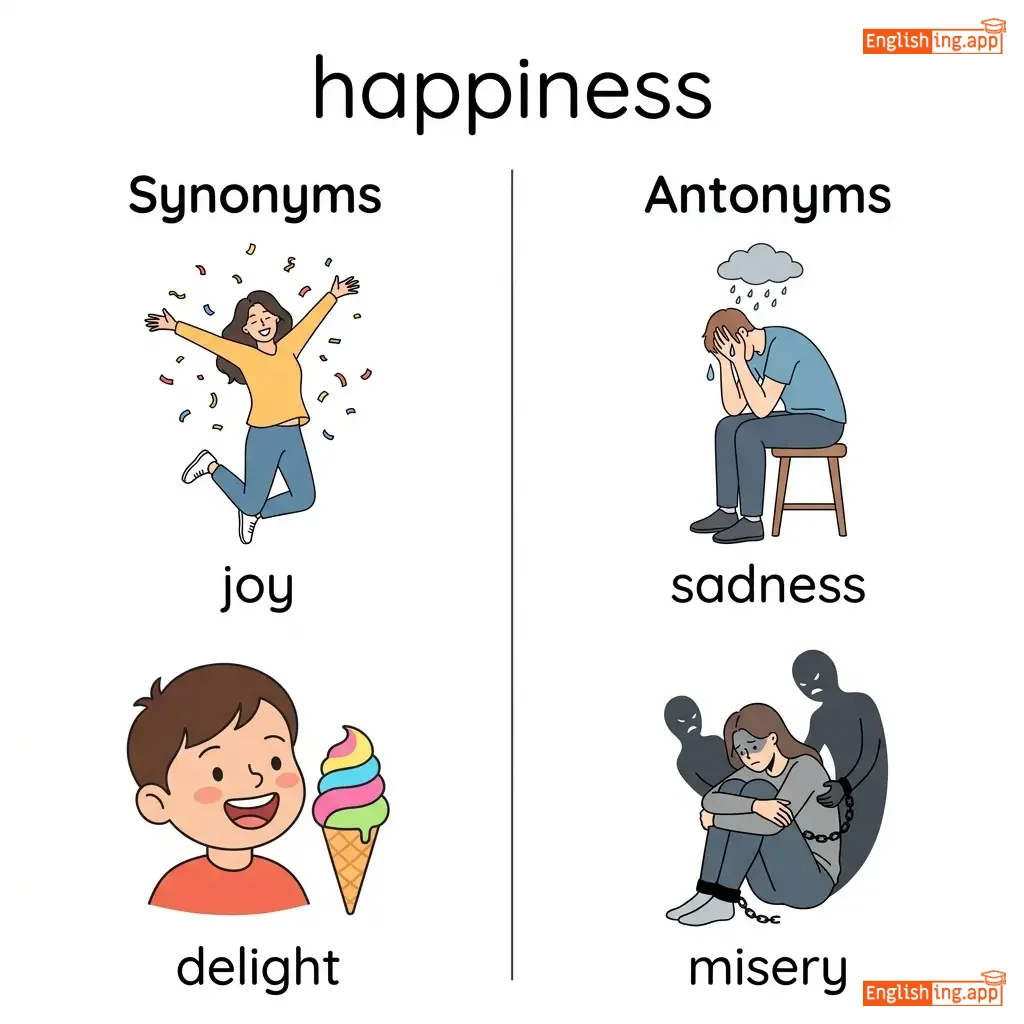
joy, delight, bliss, contentment, pleasure
••••••
|
sadness, misery, unhappiness
••••••
|
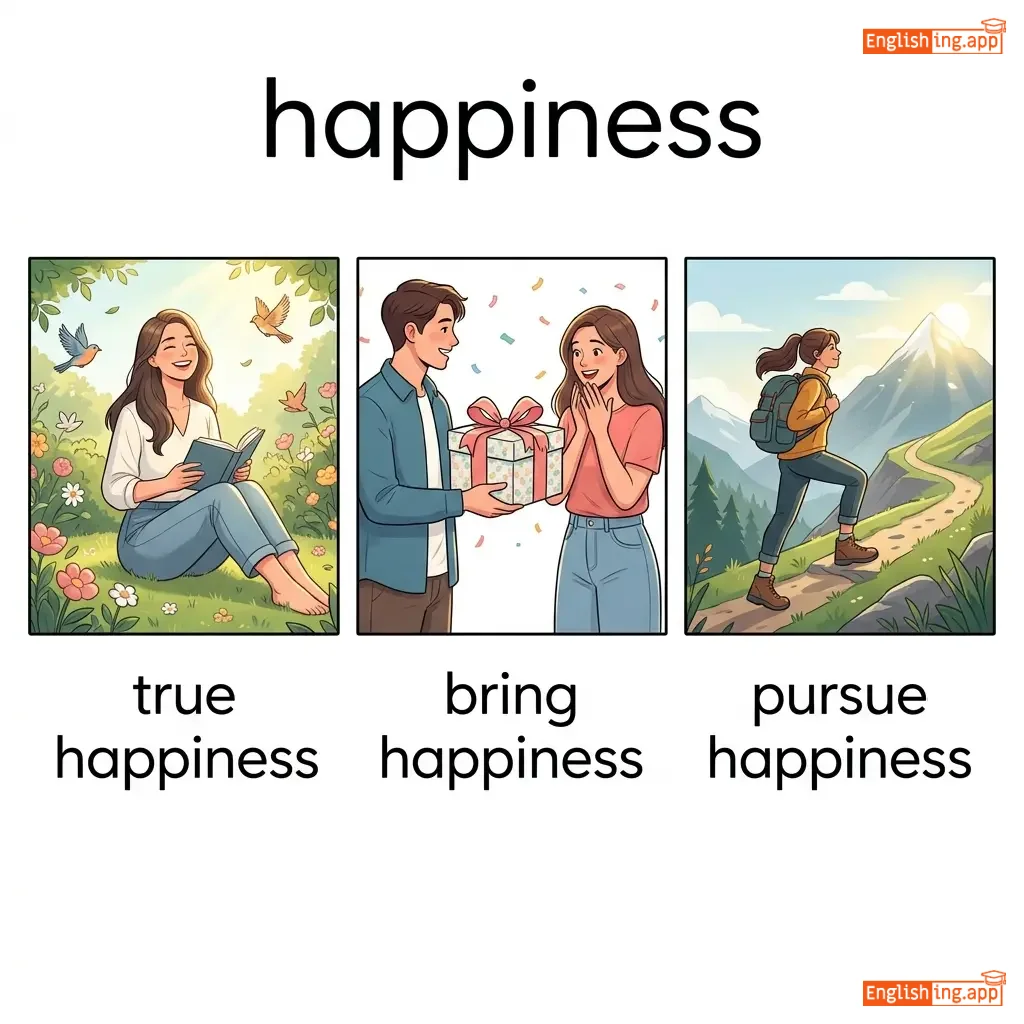
true happiness, bring happiness, pursue happiness, happiness and peace
••••••
|
Bonheur c'est comme un rayon de soleil, qui éclaire tout autour de nous 🌞
••••••
|
|
#2395
😀
|
/ˈhæpi/
adjective
(happi)
••••••
|
- •••••• |
heureux
heureux
••••••
|
- •••••• | - •••••• | - •••••• | - •••••• |
feeling or showing pleasure, contentment, or joy
••••••
|
She was very happy to receive the gift. |
Elle était très heureuse de recevoir le cadeau.
Elle était très heureuse de recevoir le cadeau.
••••••
|
happy hour |
a period when drinks are sold at reduced prices
••••••
|
heure heureuse
heure heureuse
••••••
|
joyful, cheerful, delighted, pleased, content
••••••
|
sad, unhappy, miserable
••••••
|
feel happy, look happy, happy moment, happy life
••••••
|
Happy = heureux 😊 - Souviens-toi, quand nous sommes heureux, nous disons 'I am HAPPY!'
••••••
|
|
#2396
🚫
|
/həˈræsmənt/
noun
(aʁasmɑ̃)
••••••
|
- •••••• |
harcèlement
harcelement
••••••
|
- •••••• | - •••••• | - •••••• | - •••••• |
aggressive pressure or intimidation; unwanted and repeated behavior causing discomfort
••••••
|
The company has a strict policy against workplace harassment.
L'entreprise a une politique stricte contre le harcèlement au travail.
••••••
|
L'entreprise a une politique stricte contre le harcèlement au travail.
L'entreprise a une politique stricte contre le harcelement au travail.
••••••
|
sexual harassment
harcèlement sexuel
••••••
|
unwanted sexual behavior that causes offense or humiliation
••••••
|
harcèlement sexuel
harcelement sexuel
••••••
|
bullying, abuse, intimidation, persecution, annoyance
••••••
|
support, respect
••••••
|
workplace harassment, verbal harassment, sexual harassment, report harassment
••••••
|
Harcèlement c'est déranger — donc harassment c'est déranger à répétition.
••••••
|
|
#2397
⚓
|
/ˈhɑːr.bər/
noun
(ar-bur)
••••••
|
- •••••• |
port
port
••••••
|
- •••••• | - •••••• | - •••••• | - •••••• |
a place on the coast where vessels may find shelter; a place of safety or refuge
••••••
|
The fishing boats returned safely to the harbour before the storm hit the coastline. |
Les bateaux de pêche sont rentrés en toute sécurité au port avant que la tempête ne frappe la côte.
Les bateaux de pêche sont rentrés en toute sécurité au port avant que la tempête ne frappe la côte.
••••••
|
- •••••• | - •••••• | - •••••• |
port, haven, marina, dock
••••••
|
open sea, storm, danger, exposure
••••••
|
safe harbour, natural harbour, harbour master
••••••
|
Le port est un refuge, comme un 'port' sûr pour les navires.
••••••
|
|
#2398
💪
|
/hɑːrd/
adjective
(harde)
••••••
|
- •••••• |
dur
dur
••••••
|
- •••••• | - •••••• | - •••••• | - •••••• |
solid, firm, or difficult to do or endure
••••••
|
The exam was very hard for most students. |
L'examen était très difficile pour la plupart des étudiants.
L'examen etait tres difficile pour la plupart des etudiants.
••••••
|
hard nut to crack |
a difficult problem or person to deal with
••••••
|
noix dure à casser
noix dure a casser
••••••
|
difficult, tough, rigid, strong, firm
••••••
|
easy, soft, simple
••••••
|
work hard, hard time, hard decision, hard life
••••••
|
Hard signifie dur, comme une noix dure à casser.
••••••
|
|
#2399
😅
|
/ˈhɑːd.li/
adverb
(hardli)
••••••
|
- •••••• |
à peine; difficilement; presque pas
a peine; difficilement; presque pas
••••••
|
- •••••• | - •••••• | - •••••• | - •••••• |
scarcely; barely; almost not at all
••••••
|
I could hardly believe what I was seeing. |
Je pouvais à peine croire ce que je voyais.
Je pouvais a peine croire ce que je voyais.
••••••
|
- •••••• | - •••••• | - •••••• |
barely, scarcely, rarely, seldom
••••••
|
easily, completely, fully, certainly
••••••
|
hardly ever, hardly any, hardly believe, hardly possible
••••••
|
Think of trying to see something, but it’s so faint you can hardly believe it.
••••••
|
|
#2400
💻
|
/ˈhɑːrdˌwɛr/
noun
(hardwèr)
••••••
|
- •••••• |
matériel informatique
materiel informatique
••••••
|
- •••••• | - •••••• | - •••••• | - •••••• |
the physical parts of a computer or electronic system, such as the monitor, keyboard, and processor
••••••
|
The company upgraded its computer hardware to improve performance. |
L'entreprise a mis à jour son matériel informatique pour améliorer les performances.
L'entreprise a mis a jour son materiel informatique pour ameliorer les performances.
••••••
|
hardware store |
a shop that sells tools, equipment, and building materials
••••••
|
magasin de matériel informatique
magasin de materiel informatique
••••••
|
equipment, machinery, device, apparatus, components
••••••
|
software, application, program
••••••
|
computer hardware, hardware components, upgrade hardware, hardware store
••••••
|
Le matériel est ce qu'on peut toucher, comme un clavier ou un écran, comparé au logiciel qui est intangible.
••••••
|
|
#2401
🐰
|
/heə(r)/
noun
(hèr)
••••••
|
- •••••• |
lièvre
lievre
••••••
|
- •••••• | - •••••• | - •••••• | - •••••• |
a fast-running long-eared mammal that resembles a large rabbit
••••••
|
The hare quickly ran across the field.
Le lièvre a couru rapidement à travers le champ.
••••••
|
Le lièvre a couru rapidement à travers le champ.
Le lievre a couru rapidement a travers le champ
••••••
|
- •••••• | - •••••• | - •••••• |
rabbit, bunny
••••••
|
tortoise
••••••
|
wild hare, hare and hounds, march hare
••••••
|
Hare in English sounds like 'hèr', and in French, 'lièvre' means hare
••••••
|
|
#2402
⚠️
|
/hɑːrm/
verb
(hɑʁm)
••••••
|
|
nuire
nuir
••••••
|
harmed
aʁmɛ
••••••
|
harmed
aʁmɛ
••••••
|
harms
aʁms
••••••
|
harming
aʁmɛ̃
••••••
|
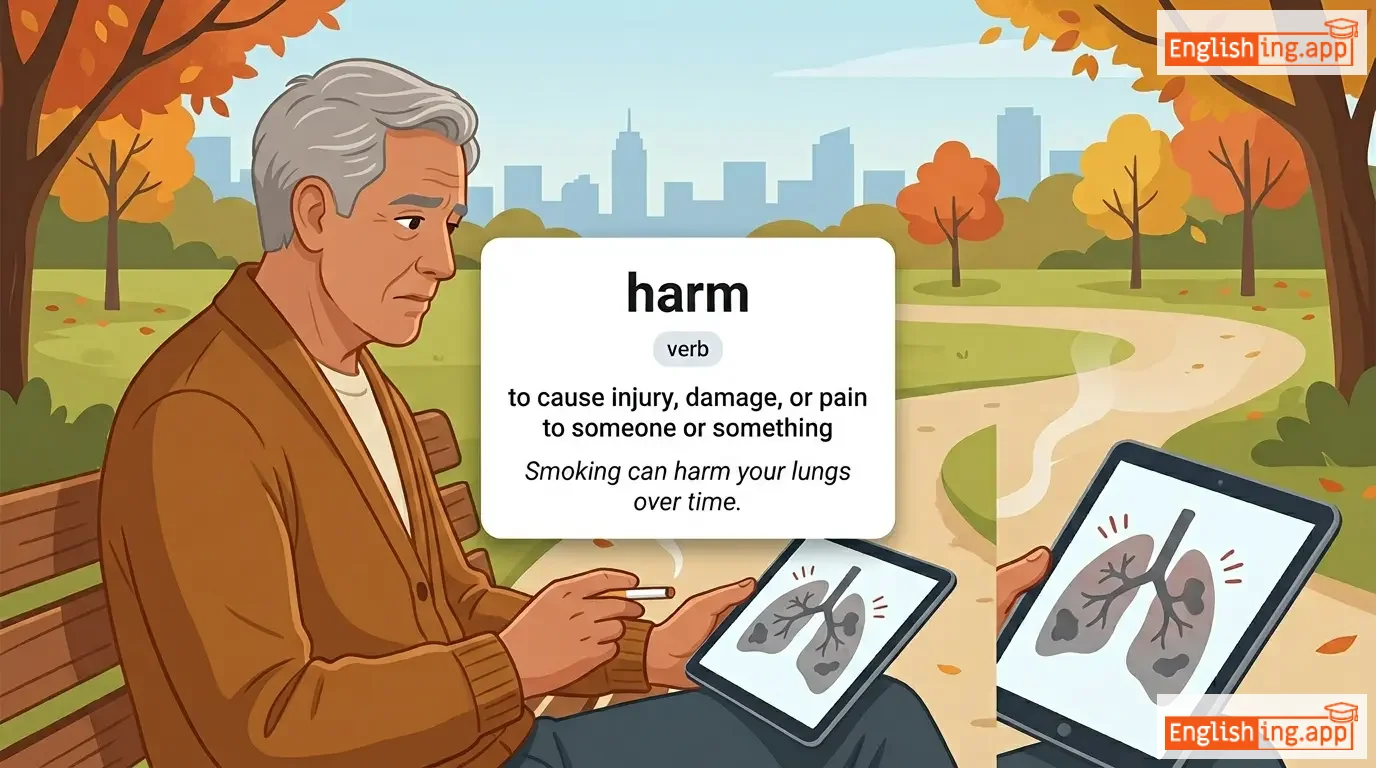
to cause injury, damage, or pain to someone or something
••••••
|
Smoking can harm your lungs over time.
Fumer peut endommager vos poumons avec le temps.
••••••
|
Fumer peut endommager vos poumons avec le temps.
Fumer peut endommager vos poumons avec le temps.
••••••
|
no harm done
aucun dommage causé
••••••
|
used to say that no damage or injury has occurred
••••••
|
aucun dommage causé
aucun dommage causé
••••••
|
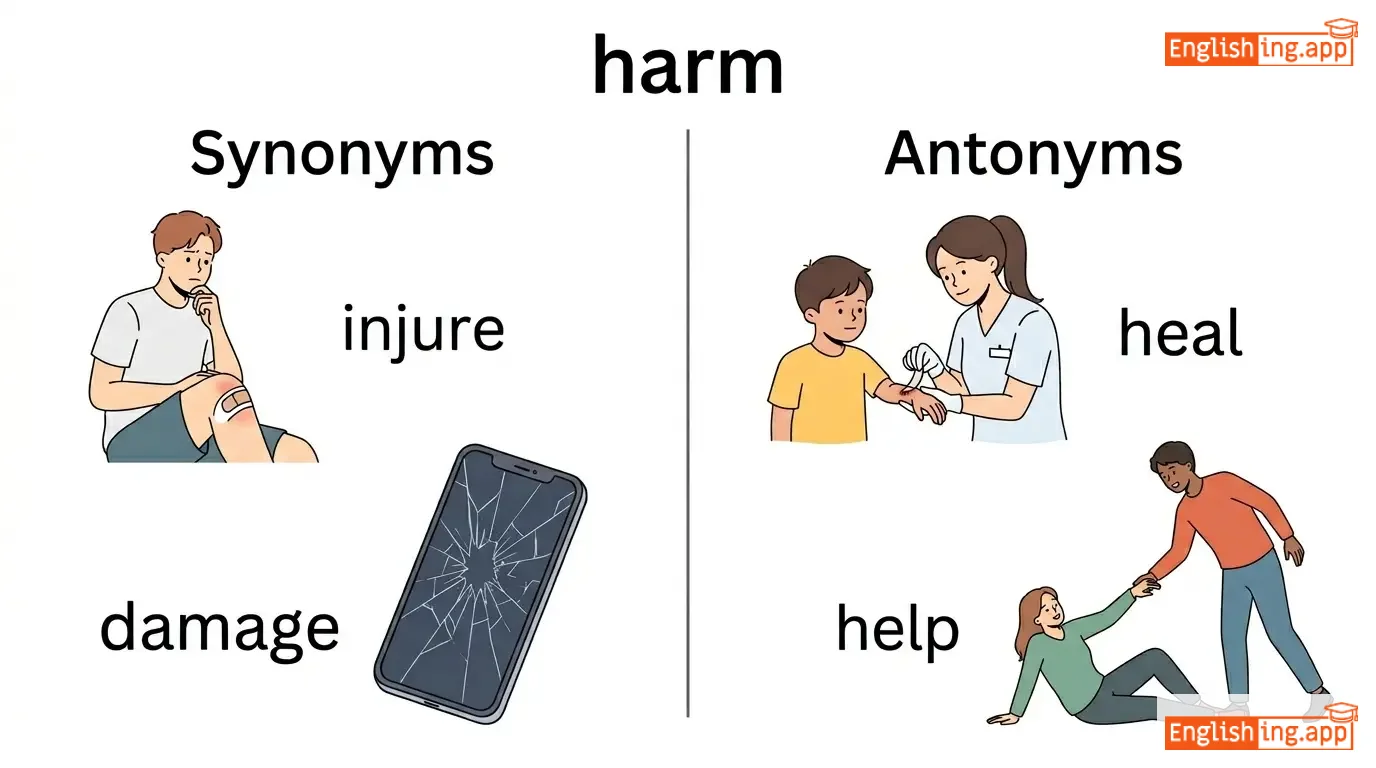
injure, damage, hurt, wound, impair
••••••
|
heal, help, repair
••••••
|
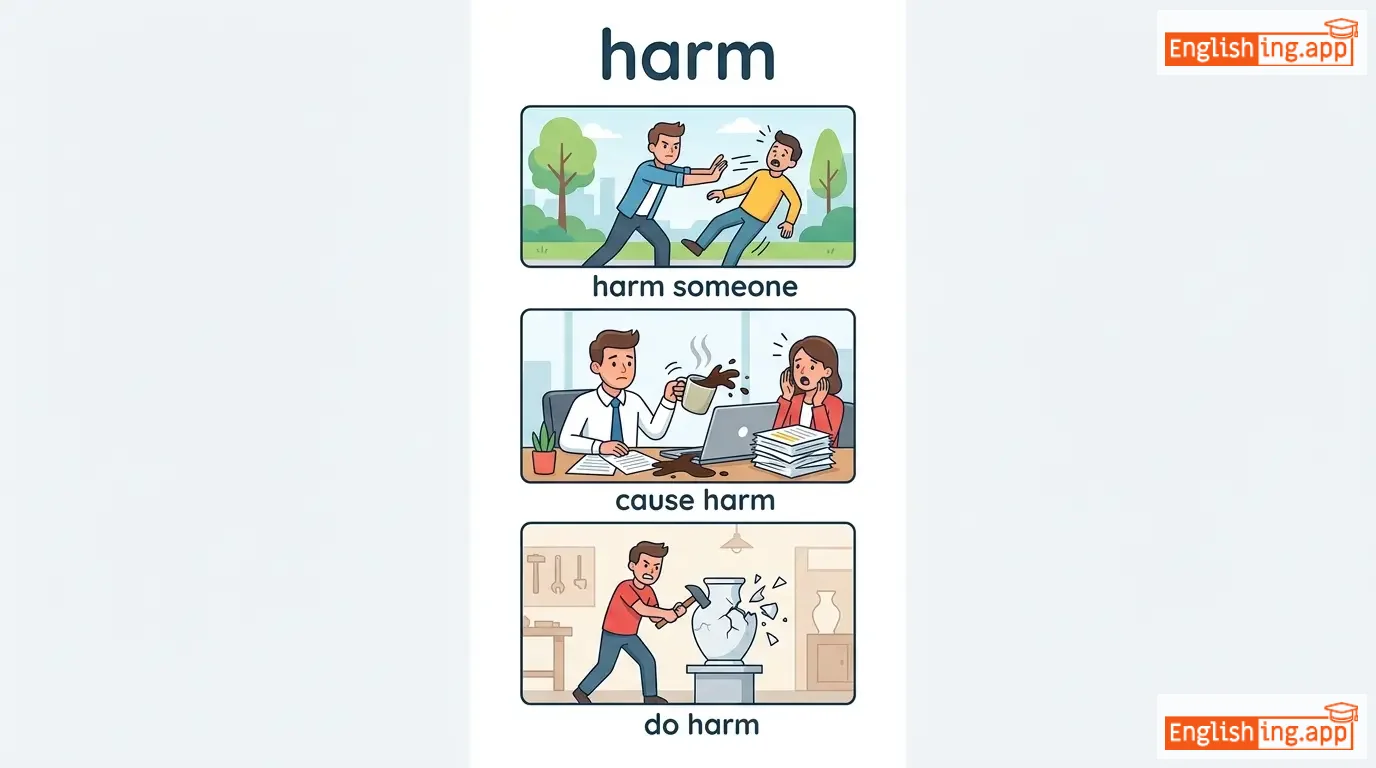
harm someone, cause harm, do harm, physical harm
••••••
|
HARM signifie nuire — souviens-toi, nuire aux autres peut nuire à toi-même.
••••••
|
|
#2403
☠️
|
/ˈhɑːrmfəl/
adjective
(hɑʁmful)
••••••
|
- •••••• |
nuisible
nuisible
••••••
|
- •••••• | - •••••• | - •••••• | - •••••• |
causing or likely to cause harm; damaging
••••••
|
Smoking is harmful to your health. |
Fumer est nuisible pour votre santé.
Fumer est nuisible pour votre santé.
••••••
|
- •••••• | - •••••• | - •••••• |
damaging, dangerous, detrimental, destructive
••••••
|
harmless, beneficial, helpful, safe
••••••
|
harmful effects, harmful chemicals, harmful substances
••••••
|
Nuisible ressemble à 'nuire', ce qui signifie faire du mal.
••••••
|
|
#2404
🕊️
|
/ˈhɑːrmləs/
adjective
(hɑːrmləs)
••••••
|
- •••••• |
inoffensif; innocent; sans danger
inoffensif; innocent; sans danger
••••••
|
- •••••• | - •••••• | - •••••• | - •••••• |
not able or likely to cause harm; innocent; safe
••••••
|
The snake looks dangerous but it's actually harmless. |
Le serpent semble dangereux, mais il est en réalité inoffensif.
Le serpent semble dangereux, mais il est en réalité inoffensif.
••••••
|
- •••••• | - •••••• | - •••••• |
safe, innocent, benign, non-toxic
••••••
|
harmful, dangerous, toxic, destructive
••••••
|
harmless fun, harmless joke, harmless bacteria
••••••
|
French 'inoffensif' is similar to 'inoffensive' in English.
••••••
|
|
#2405
🎶
|
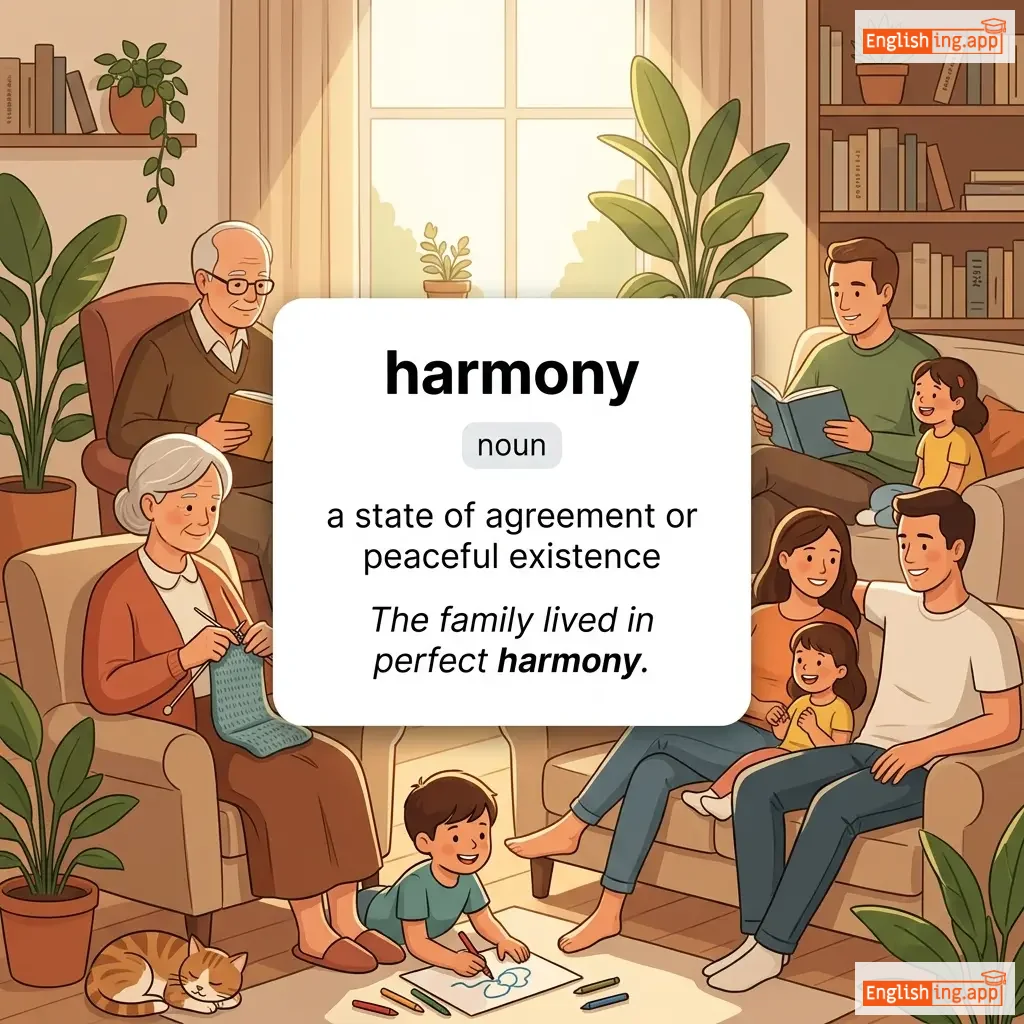
/ˈhɑːrməni/
noun
(harmonie)
••••••
|
|
harmonie
armoni
••••••
|
- •••••• | - •••••• | - •••••• | - •••••• |
a state of agreement or peaceful existence
••••••
|
The family lived in perfect harmony. |
La famille vivait dans une harmonie parfaite.
La famille vivait dans une harmonie parfaite.
••••••
|
in harmony with |
to be in agreement or consistent with
••••••
|
en harmonie avec
en harmonie avec
••••••
|
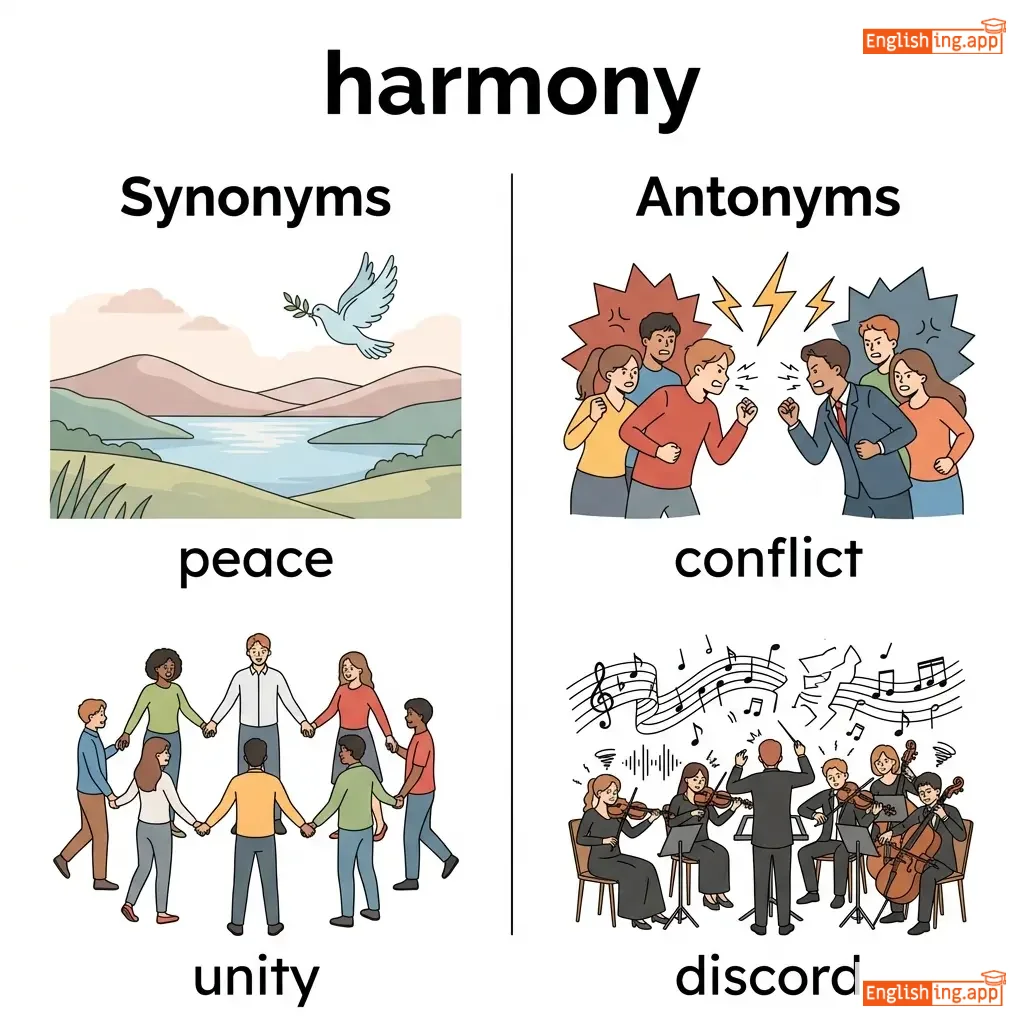
peace, unity, agreement, concord, balance
••••••
|
conflict, discord, chaos
••••••
|
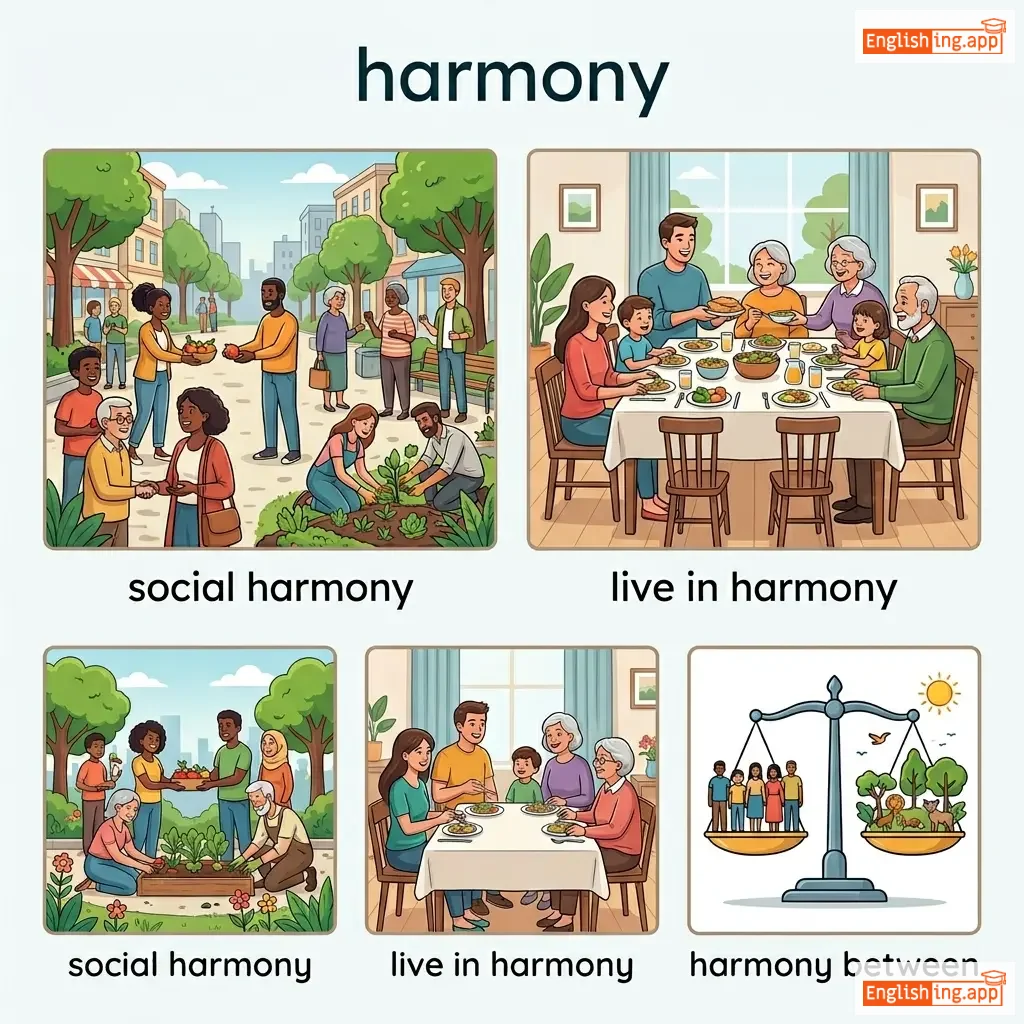
social harmony, live in harmony, harmony between
••••••
|
L'harmonie est comme un orchestre où tous les instruments jouent ensemble.
••••••
|
|
#2406
❄️
|
/hɑːrʃ/
adjective
(harsh)
••••••
|
- •••••• |
sévère
severe
••••••
|
- •••••• | - •••••• | - •••••• | - •••••• |
Unpleasantly rough or severe in sound, taste, conditions, or treatment.
••••••
|
The teacher's harsh tone frightened the students. |
Le ton sévère du professeur a effrayé les étudiants.
Le ton severe du professeur a effraye les etudiants.
••••••
|
harsh reality |
The unpleasant truth of a situation.
••••••
|
réalité sévère
realite severe
••••••
|
severe, stern, rough, cruel, brutal
••••••
|
gentle, mild, soft
••••••
|
harsh criticism, harsh reality, harsh conditions, harsh treatment
••••••
|
Une réalité sévère (severe) est comme un hiver rigoureux.
••••••
|
|
#2407
🌾
|
/ˈhɑːrvɪst/
noun
(harvɛst)
••••••
|
- •••••• |
récolte
recolte
••••••
|
- •••••• | - •••••• | - •••••• | - •••••• |
the process or period of gathering crops
••••••
|
Farmers are busy during the rice harvest season. |
Les fermiers sont occupés pendant la saison des récoltes de riz.
Les fermiers sont occupés pendant la saison des récoltes de riz.
••••••
|
reap the harvest |
to enjoy the results of your efforts
••••••
|
récolter les fruits de son travail
recolter les fruits de son travail
••••••
|
crop, yield, gathering, reaping, produce
••••••
|
sowing, planting, loss
••••••
|
harvest season, rice harvest, good harvest, harvest time
••••••
|
Récolte signifie ramasser ce qu'on a semé 🌾
••••••
|
|
#2408
👒
|
/hæt/
noun
(hæt)
••••••
|
- •••••• |
chapeau
chapeau
••••••
|
- •••••• | - •••••• | - •••••• | - •••••• |
a shaped covering for the head, often with a brim
••••••
|
He wore a black hat to the party. |
Il portait un chapeau noir à la fête.
Il portait un chapeau noir à la fête.
••••••
|
to wear many hats |
to have many roles or responsibilities
••••••
|
avoir de nombreux rôles ou responsabilités
avoir de nombreux rôles ou responsabilités
••••••
|
cap, headgear, helmet, bonnet
••••••
|
barehead
••••••
|
wear a hat, take off hat, straw hat, cowboy hat
••••••
|
Hat signifie chapeau, il est porté sur la tête.
••••••
|
|
#2409
💔
|
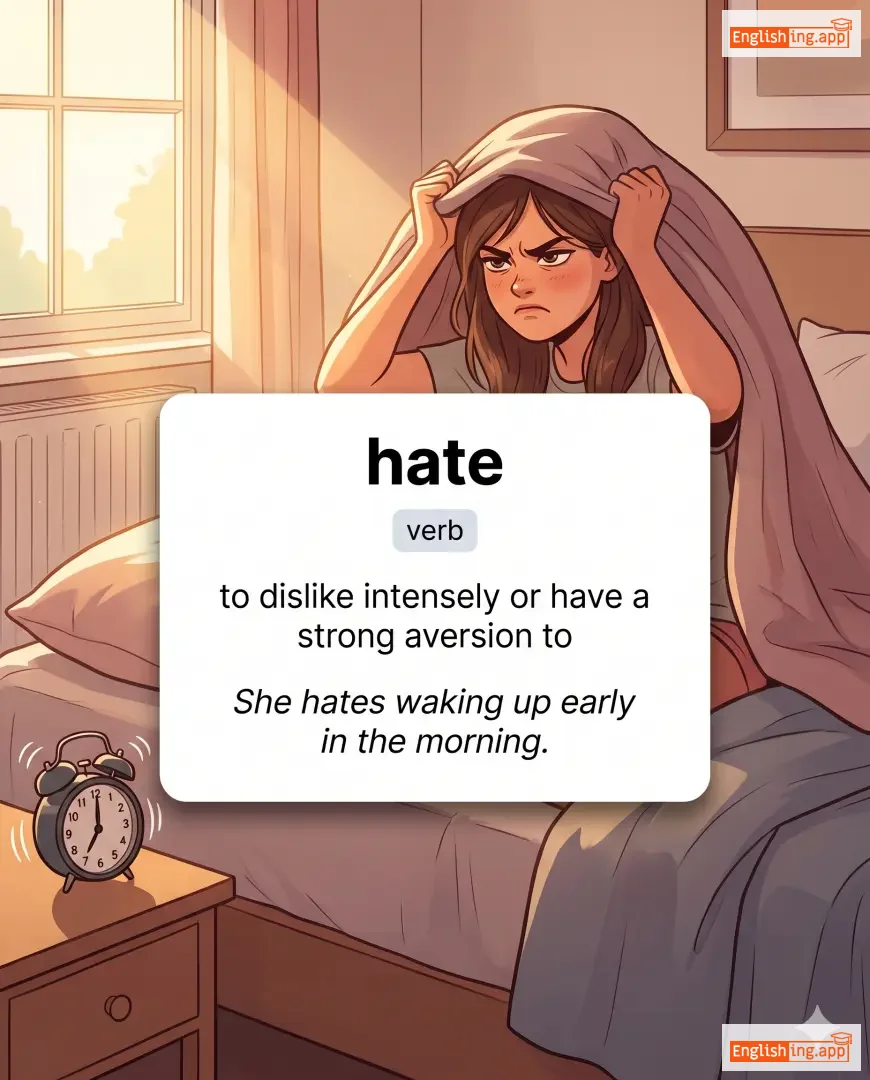
/heɪt/
verb
(hétènès)
••••••
|
|
détester
detester
••••••
|
hated
hétèd
••••••
|
hated
hétèd
••••••
|
hates
hèt
••••••
|
hating
hèting
••••••
|
to dislike intensely or have a strong aversion to
••••••
|
She hates waking up early in the morning.
Elle déteste se réveiller tôt le matin.
••••••
|
Elle déteste se réveiller tôt le matin.
Elle déteste se réveiller tôt le matin.
••••••
|
love to hate
aimer détester
••••••
|
something disliked but still talked about often
••••••
|
aimer détester
aimer détester
••••••
|
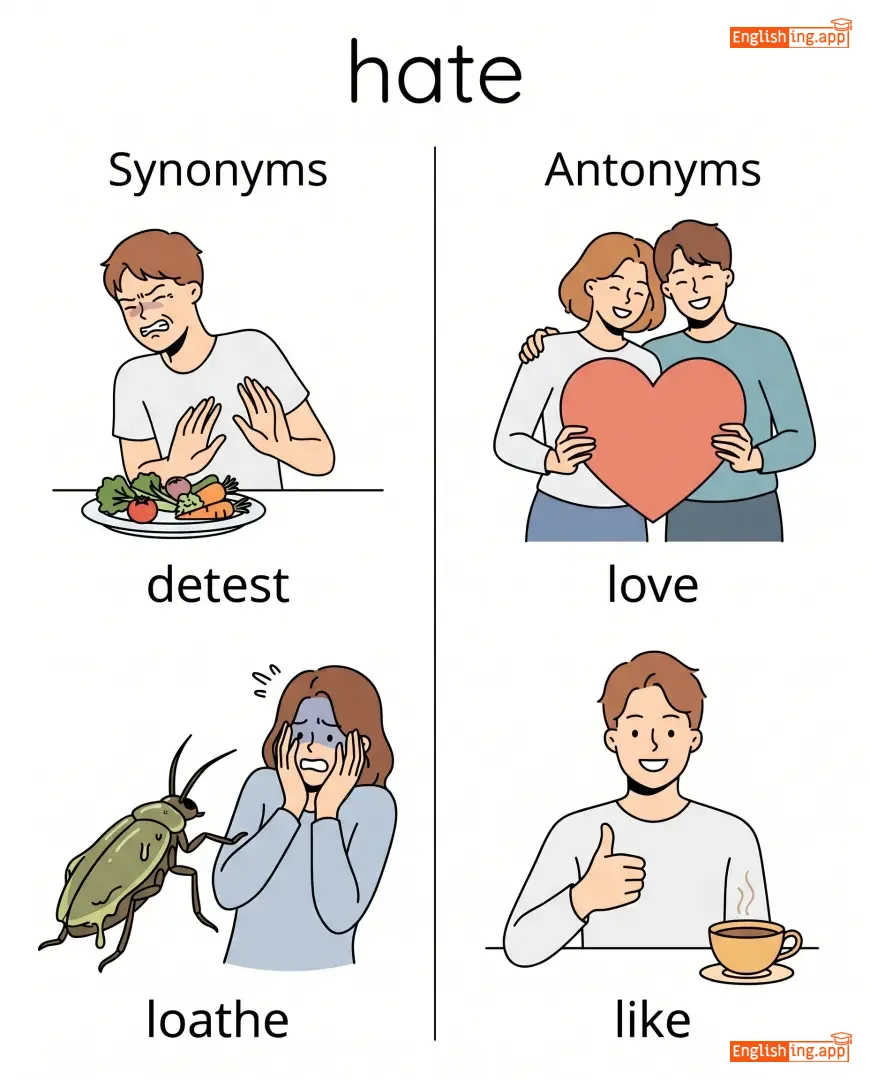
detest, loathe, despise, abhor
••••••
|
love, like, adore
••••••
|
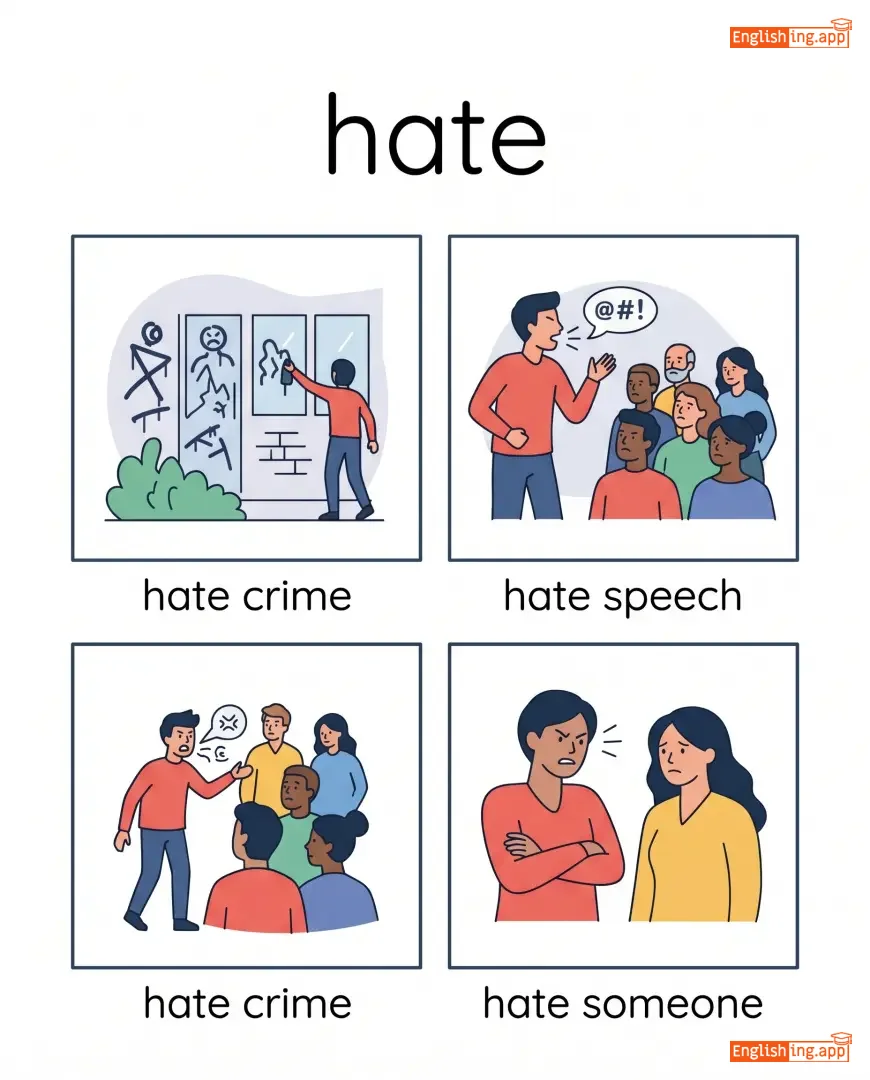
hate crime, hate speech, hate someone
••••••
|
Détester c'est comme dire non à l'asperge, mais en parler quand même.
••••••
|
|
#2410
😡
|
/ˈheɪt.fəl/
adjective
(hétfoul)
••••••
|
- •••••• |
Haineux
haineux
••••••
|
- •••••• | - •••••• | - •••••• | - •••••• |
causing or deserving hatred; extremely unpleasant or offensive
••••••
|
His hateful comments hurt everyone's feelings.
Ses commentaires haineux ont blessé les sentiments de tout le monde.
••••••
|
Ses commentaires haineux ont blessé les sentiments de tout le monde.
Ses commentaires haineux ont blessé les sentiments de tout le monde.
••••••
|
- •••••• | - •••••• | - •••••• |
detestable, loathsome, odious, abhorrent
••••••
|
lovable, pleasant, agreeable, likeable
••••••
|
hateful behavior, hateful speech, hateful attitude
••••••
|
Haineux et hateful évoquent la même idée de dégoût.
••••••
|
|
#2411
😡
|
/ˈheɪ.trəd/
noun
(hɛtʁɛd)
••••••
|
- •••••• |
haine
haine
••••••
|
- •••••• | - •••••• | - •••••• | - •••••• |
intense dislike or ill will; a feeling of strong aversion
••••••
|
His hatred for injustice motivated him to become a human rights lawyer. |
Sa haine de l'injustice l'a motivé à devenir avocat des droits de l'homme.
Sa haine de l'injustice l'a motivé à devenir avocat des droits de l'homme.
••••••
|
- •••••• | - •••••• | - •••••• |
loathing, animosity, hostility, resentment
••••••
|
love, affection, admiration, fondness
••••••
|
deep hatred, racial hatred, hatred towards
••••••
|
Haine = Une forte aversion
••••••
|
|
#2412
👻
|
/hɔːnt/
verb
(hant)
••••••
|
|
apparaître fréquemment dans ou remplir l'esprit de quelqu'un
apparaître fréquemment dans ou remplir l'esprit de quelqu'un
••••••
|
haunted
hanté
••••••
|
haunted
hanté
••••••
|
haunts
hante
••••••
|
haunting
hantant
••••••
|
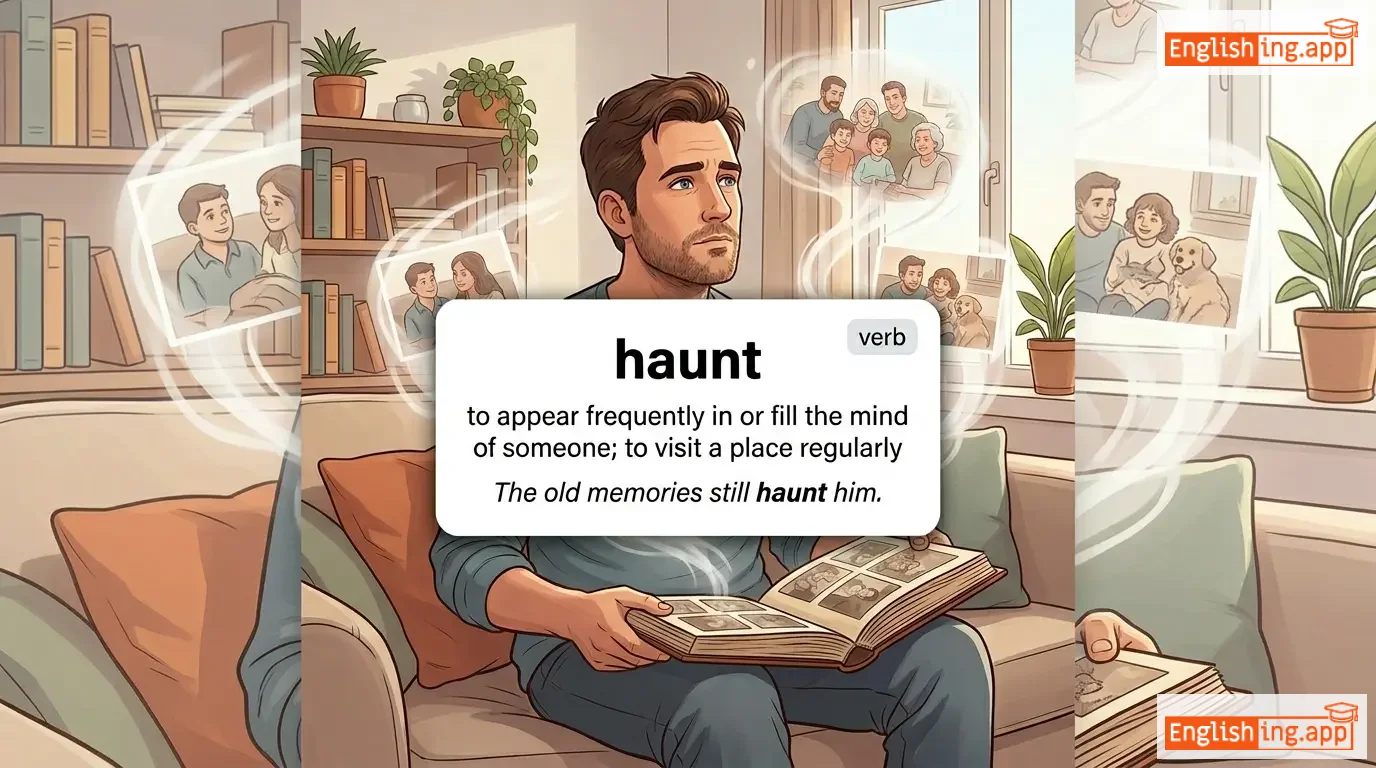
to appear frequently in or fill the mind of someone; to visit a place regularly
••••••
|
The old memories still haunt him.
les vieux souvenirs le hantent encore.
••••••
|
Les vieux souvenirs le hantent encore.
Les vieux souvenirs le hantent encore.
••••••
|
haunt one's dreams
hanter les rêves de quelqu'un
••••••
|
to repeatedly trouble or disturb someone mentally
••••••
|
hanter les rêves de quelqu'un
hanter les rêves de quelqu'un
••••••
|
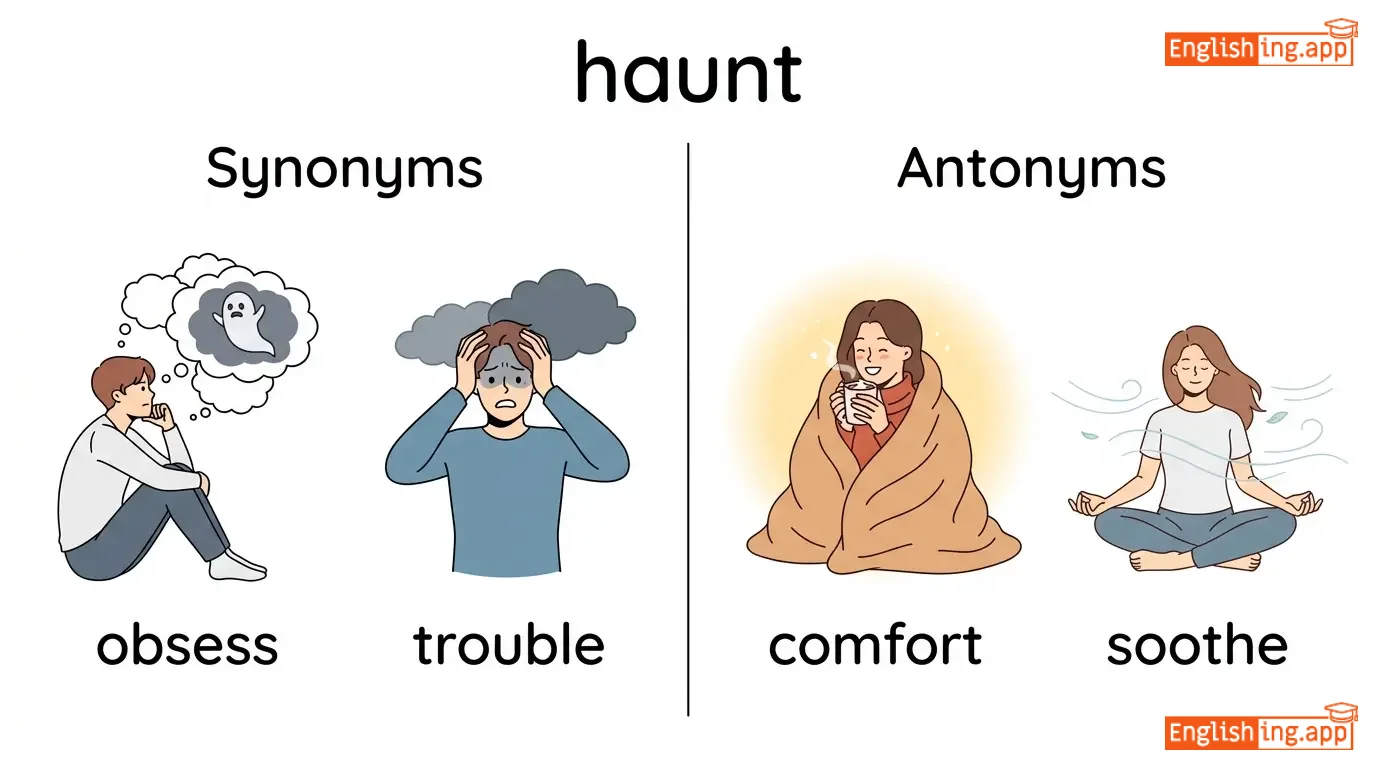
obsess, trouble, torment, visit, linger
••••••
|
comfort, soothe, forget
••••••
|
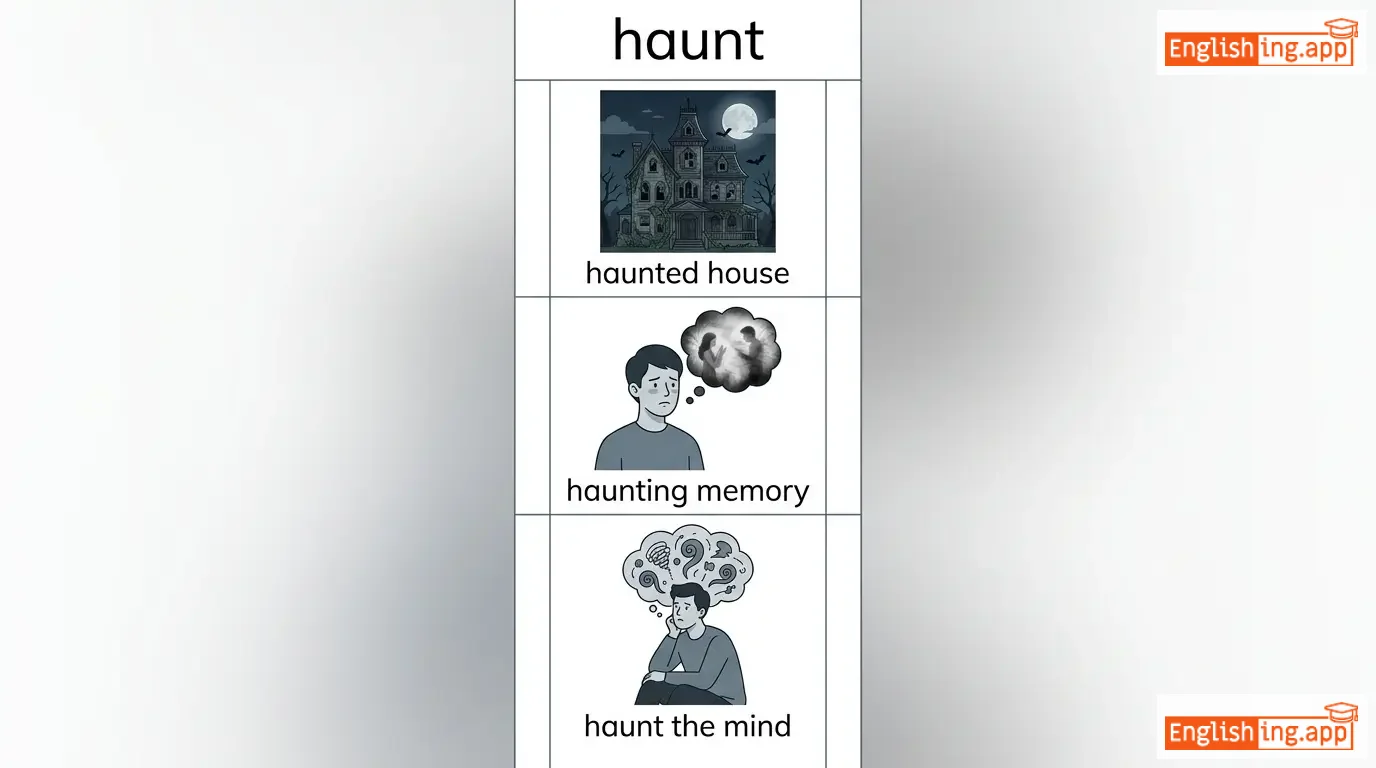
haunted house, haunting memory, haunt the mind, old haunt
••••••
|
Haunt signifie déranger—imaginez un fantôme qui hante.
••••••
|
|
#2413
🙌
|
/hæv/
verb
(av)
••••••
|
- •••••• |
avoir
avoir
••••••
|
had
était
••••••
|
had
était
••••••
|
has
a
••••••
|
having
ayant
••••••
|
to possess, own, or hold
••••••
|
They have three children.
Ils ont trois enfants.
••••••
|
Ils ont trois enfants.
Ils ont trois enfants.
••••••
|
have a good time
passer un bon moment
••••••
|
to enjoy oneself
••••••
|
passer un bon moment
passer un bon moment
••••••
|
own, possess, hold, contain
••••••
|
lack, want
••••••
|
have fun, have dinner, have time, have a look
••••••
|
Have signifie avoir, comme on dit 'j'ai' - I have it!
••••••
|
|
#2414
🐄
|
/heɪ/
noun
(é)
••••••
|
- •••••• |
foin
foin
••••••
|
- •••••• | - •••••• | - •••••• | - •••••• |
grass that has been cut, dried, and stored for use as animal feed
••••••
|
The cows were eating hay in the barn. |
Les vaches mangeaient de la foin dans la grange.
Les vaches mangeaient de la foin dans la grange.
••••••
|
make hay while the sun shines |
take advantage of a good opportunity while it lasts
••••••
|
faire du foin pendant que le soleil brille
faire du foin pendant que le soleil brille
••••••
|
fodder, straw, dried grass, silage, forage
••••••
|
grain, seed
••••••
|
bale of hay, hay field, haystack, dry hay
••••••
|
HAY signifie foin 🐄 — souviens-toi, 'Hé vache !' elles mangent du foin !
••••••
|
|
#2415
⚠️
|
/ˈhæzərd/
noun
(hazard)
••••••
|
- •••••• |
danger
danger
••••••
|
- •••••• | - •••••• | - •••••• | - •••••• |
A danger or risk.
••••••
|
Wet floors are a common hazard in the workplace.
Les sols mouillés sont un danger courant sur le lieu de travail.
••••••
|
Les sols mouillés sont un danger courant sur le lieu de travail.
Les sols mouillés sont un danger courant sur le lieu de travail.
••••••
|
at your own hazard
à vos risques et périls
••••••
|
at your own risk or responsibility
••••••
|
à vos risques et périls
à vos risques et périls
••••••
|
danger, risk, threat, peril, menace
••••••
|
safety, security, protection
••••••
|
fire hazard, safety hazard, health hazard, potential hazard
••••••
|
Hazard signifie danger, soyez prudent en cas de signal d'avertissement ⚠️.
••••••
|
|
#2416
👨
|
/hiː/
pronoun
(i)
••••••
|
- •••••• |
il (masculin)
il (masculin)
••••••
|
- •••••• | - •••••• | - •••••• | - •••••• |
used to refer to a male person or animal already mentioned or easily identified
••••••
|
He is my best friend. |
Il est mon meilleur ami.
Il est mon meilleur ami.
••••••
|
- •••••• | - •••••• | - •••••• |
the man, that person, him
••••••
|
she, her
••••••
|
he said, he was, he went, he did
••••••
|
He signifie il (masculin), comme HE-ro (Héros) est généralement masculin.
••••••
|
|
#2417
👤
|
/hɛd/
noun, verb
(tête)
••••••
|
- •••••• |
tête / chef
tete / chef
••••••
|
headed
têté
••••••
|
headed
têté
••••••
|
heads
têtes
••••••
|
heading
têtant
••••••
|
The upper part of the human body or to lead or be in charge of something.
••••••
|
She turned her head to look out the window.
Elle tourna sa tête pour regarder par la fenêtre.
••••••
|
Elle tourna sa tête pour regarder par la fenêtre.
Elle tourna sa tête pour regarder par la fenêtre.
••••••
|
head over heels
tête en bas
••••••
|
completely in love
••••••
|
complètement amoureux
completement amoureux
••••••
|
chief, leader, boss, director, skull
••••••
|
follower, subordinate
••••••
|
head of department, head office, head a team, shake your head
••••••
|
Tête signifie tête, et tête en bas est d'être complètement amoureux.
••••••
|
|
#2418
🤕
|
/ˈhɛdeɪk/
noun
(hedeɪk)
••••••
|
- •••••• |
mal de tête
mal de tete
••••••
|
- •••••• | - •••••• | - •••••• | - •••••• |
a continuous pain in the head; something that causes worry or difficulty
••••••
|
Too much screen time can give you a terrible headache. |
Trop de temps d'écran peut vous donner un terrible mal de tête.
Trop de temps d'ecran peut vous donner un terrible mal de tete.
••••••
|
a real headache |
something that causes a lot of trouble or difficulty
••••••
|
un vrai mal de tête
un vrai mal de tete
••••••
|
migraine, pain, nuisance, problem, discomfort
••••••
|
relief, comfort
••••••
|
severe headache, splitting headache, cause a headache, suffer from headache
••••••
|
Head ache signifie un ache (douleur) dans la tete – souviens-toi du mal de tête.
••••••
|
|
#2419
📰
|
/ˈhɛdˌlaɪn/
noun
(edlain)
••••••
|
- •••••• |
titre principal
titre principal
••••••
|
- •••••• | - •••••• | - •••••• | - •••••• |
The title of a newspaper article printed in large letters.
••••••
|
The scandal made front-page headlines.
Le scandale a fait la une.
••••••
|
Le scandale a fait la une des journaux.
Le scandale a fait la une des journaux.
••••••
|
grab the headlines
attirer les gros titres
••••••
|
to attract public attention
••••••
|
attirer l'attention publique
attirer l'attention publique
••••••
|
title, heading, banner, caption, news
••••••
|
detail, footnote
••••••
|
front-page headline, news headline, headline story, write a headline
••••••
|
Titre principal = ce que l'on voit en première page = gros titre.
••••••
|
|
#2420
🏢
|
/ˈhɛdˌkwɔːrtərz/
noun
(ɛdˈkwɔːrtərz)
••••••
|
- •••••• |
siège social
siege social
••••••
|
- •••••• | - •••••• | - •••••• | - •••••• |
The main office or center of operations of an organization.
••••••
|
The company’s headquarters is located in New York. |
Le siège social de l'entreprise est situé à New York.
Le siege social de l'entreprise est situe a New York.
••••••
|
- •••••• | - •••••• | - •••••• |
main office, center, base, hub, command post
••••••
|
branch, outpost
••••••
|
corporate headquarters, police headquarters, company headquarters, military headquarters
••••••
|
Headquarters = head + quarters → siège social, comme le quartier général d'une entreprise.
••••••
|
Vocabulary Quiz
Test your vocabulary by matching words with their translations or meanings.
Login to take the quiz
Comments (0)
Share your thoughts and join the discussion.
Join the discussion by logging in
Login to CommentNo comments yet
Be the first to share your thoughts!