Vocabularios

Descubra, aprenda y domine el vocabulario en inglés

noun
/ˈveɪ.pər/
vapor (vapor)

a mass of tiny water droplets suspended in the atmosphere; gas formed from a liquid

"Water vapour rises from the hot tea cup."

"El vapor de agua sube de la taza de té caliente." (El vapor de agua sube de la taza de té caliente.)
adjective, noun
/ˈvɛriəbl/
variable (variable)

liable to change; in mathematics, a symbol representing a quantity that may change

"The weather is highly variable in this region."

"El clima es altamente variable en esta región." (El clima es altamente variable en esta región.)
noun
/ˈvɛriəns/
varianza (varianza)

the state of being different or inconsistent; in statistics, a measure of the spread between numbers

"There is a wide variance in students' performance levels."

"Hay una amplia varianza en los niveles de rendimiento de los estudiantes." (Hay una amplia varianza en los niveles de rendimiento de los estudiantes.)
noun
/ˈvɛəriənt/
variación (variacion)

A form or version of something that differs in some way from other forms of the same thing.

"The new variant of the virus spread rapidly."

"La nueva variación del virus se propagó rápidamente." (La nueva variacion del virus se propago rapidamente.)
noun
/ˌvɛəriˈeɪʃən/
variación (variacion)

A change or slight difference in condition, amount, or level.

"There is a wide variation in climate across the country."

"Hay una gran variación en el clima en todo el país." (Hay una gran variacion en el clima en todo el pais.)
adjective
/ˈvɛərɪd/
variado (variado)

showing many different kinds or forms

"The menu offers a varied selection of dishes."

"El menú ofrece una selección variada de platos." (El menú ofrece una selección variada de platos.)
verb
/ˈvɛəriəˌɡeɪt/
variar (variar)

To diversify or mark with different colors or patterns.

"The artist used different shades to variegate the design."

"El artista usó diferentes tonos para variar el diseño." (El artista uso diferentes tonos para variar el diseño.)
adjective
/ˈvɛəriəˌɡeɪtɪd/
variegado (variegado)

Having different colors, especially in irregular patches or streaks.

"The garden was full of variegated plants."

"El jardín estaba lleno de plantas variegadas." (el hardin estaba lleno de plantas variegadas)
noun
/ˌvɛəriəˈɡeɪʃən/
variegación (variegacion)

The appearance of differently colored zones in the leaves, flowers, or stems of plants.

"Variegation makes the foliage look more attractive."

"La variegación hace que el follaje sea más atractivo." (La variegacion hace que el follaje sea mas atractivo.)
noun
/vəˈraɪəti/
variedad (variedad)

the quality or state of being different or diverse; a range of different things

"There is a variety of fruits available in the market."

"Hay una variedad de frutas disponibles en el mercado." (Hay una variedad de frutas disponibles en el mercado.)
adjective
/ˈvɛə.ri.əs/
varios (varios)

different from one another; of several different kinds

"She owns various kinds of books."

"Ella tiene varios tipos de libros." (Ella tiene varios tipos de libros.)
noun/verb
/ˈvɑːrnɪʃ/
barniz (barniz)

A liquid that is applied to wood or other materials to form a hard, shiny surface; also to apply such a liquid.

"The carpenter varnished the table to give it a glossy finish."

"El carpintero barnizó la mesa para darle un acabado brillante." (El carpintero barnizó la mesa para darle un acabado brillante.)
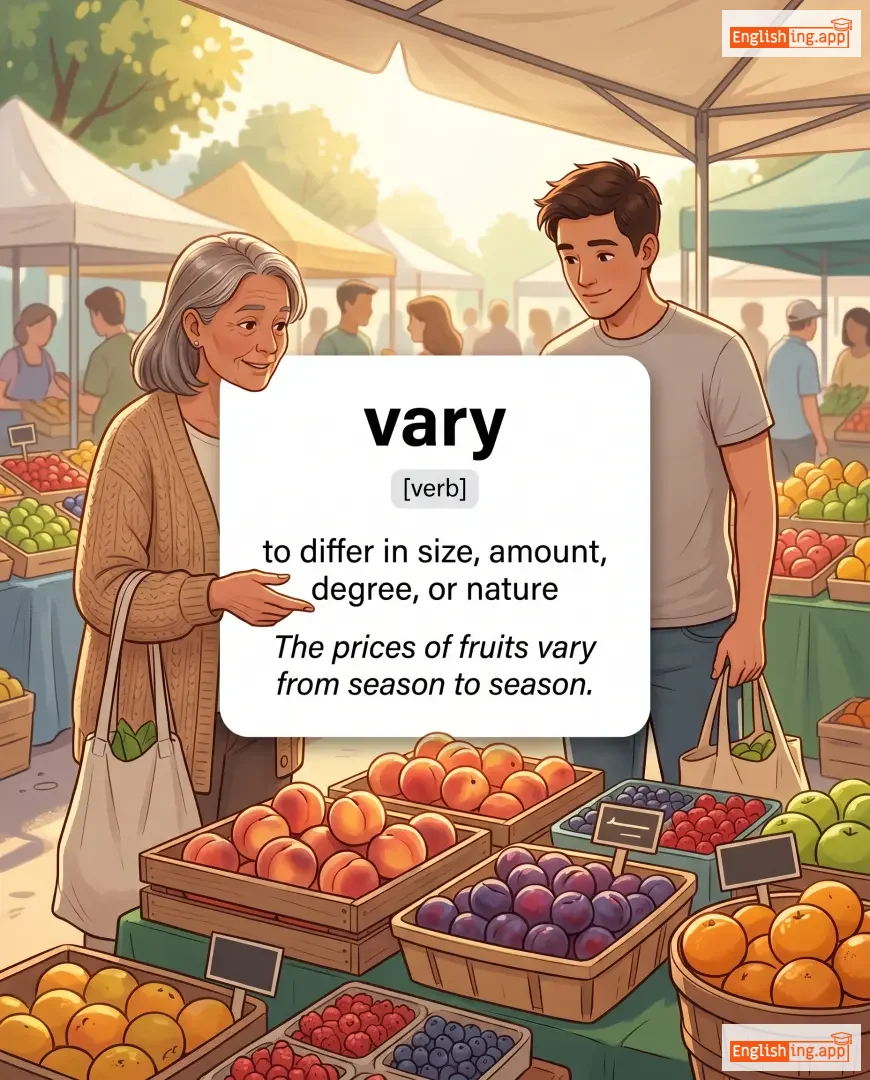
vary definition card — visual illustration of the meaning
verb
/ˈveəri/
variar (variar)

to differ in size, amount, degree, or nature

"The prices of fruits vary from season to season."

"Los precios de las frutas varían de temporada a temporada." (Los precios de las frutas varían de temporada a temporada.)
noun
/ˈvæsəl/
vasallo (vasallo)

A person or country in a subordinate position to another, especially in feudal times under a lord.

"The king granted land to his vassal in return for loyalty and service."

"El rey otorgó tierras a su vasallo a cambio de lealtad y servicio." (El rey otorgo tierras a su vasallo a cambio de lealtad y servicio.)
adjective
/vɑːst/
vasto (vast)

extremely large in size, amount, or extent

"The desert stretches across a vast area of land."

"El desierto se extiende a través de una vasta área de tierra." (El desierto se extiende a traves de una vasta area de tierra)
🛢️

vat (væt)

noun
/væt/
gran recipiente (gran recipiente)

A large container used for holding liquids such as dye or wine.

"The workers filled the vat with freshly pressed grape juice."

"Los trabajadores llenaron el gran recipiente con jugo de uva recién exprimido." (Los trabajadores llenaron el gran recipiente con jugo de uva recién exprimido.)
noun
/ˈvɔːdəvɪl/
vaudeville (vaudeville)

A type of entertainment popular in the early 20th century, featuring a mixture of comedy, song, dance, and variety acts.

"The vaudeville show included comedians, magicians, and dancers."

"El espectáculo de vaudeville incluía comediantes, magos y bailarines." (El espectaculo de vaudeville incluía comediantes, magos y bailarines.)
noun/verb
/vɔːlt/
bóveda segura / saltar (bóveda segura / saltar)

A secure room for storing valuables; also to leap or spring over something.

"The bank kept its gold bars in a secure vault."

"El banco guardaba sus lingotes de oro en una bóveda segura." (El banco guardaba sus lingotes de oro en una bóveda segura.)
verb
/vɔːnt/
presumir (presumir)

to boast or brag about something, especially in an excessive way

"He would often vaunt his achievements in front of his colleagues."

"A menudo alardeaba de sus logros frente a sus colegas." (A menudo alardeaba de sus logros frente a sus colegas.)
adjective
/ˈvɔːntɪd/
excesivamente elogiado (excesivamente elogiado)

praised or boasted about, especially excessively

"The vaunted technology failed to deliver the expected results."

"La tecnología excesivamente elogiada no logró entregar los resultados esperados." (La tecnología excesivamente elogiada no logró entregar los resultados esperados.)
verb
/vɪə(r)/
cambiar de dirección (cambiar de direccion)

to change direction suddenly

"The car veered off the road to avoid the accident."

"El coche viró fuera de la carretera para evitar el accidente." (El coche viro fuera de la carretera para evitar el accidente.)
noun
/ˈvɛdʒ.tə.bəl/
felicidad (felicidad)

a plant or part of a plant used as food

"I eat vegetables every day for health."

"Ella no pudo ocultar su felicidad cuando recibió el premio." (Ella no pudo ocultar su felicidad cuando recibió el premio.)
noun
/ˈvedʒtəbəl ɔɪl/
aceite vegetal (aceite vegetal)

Oil extracted from plants, seeds, or nuts used for cooking

"She heated vegetable oil in the pan before adding the vegetables."

"Ella calentó aceite vegetal en la sartén antes de agregar las verduras." (Ella calentó aceite vegetal en la sartén antes de agregar las verduras.)
noun
/ˈvedʒ.tə.bəlz/
verduras (verduras)

plants or parts of plants that are eaten as food, such as peas, beans, cabbage, potatoes, onions, or carrots

"We should eat more vegetables to maintain a healthy diet."

"Debemos comer más verduras para mantener una dieta saludable." (Debemos comer más verduras para mantener una dieta saludable.)
adjective
/ˈvɛdʒɪtəl/
vegetal (vegetal)

relating to or consisting of plants or vegetation

"The soup had a distinct vegetal flavor."

"La sopa tenía un sabor vegetal distintivo." (La sopa tenía un sabor vegetal distintivo.)
noun
/ˌvɛdʒəˈtɛəriən/
felicidad (felicidad)

a person who does not eat meat and sometimes other animal products, eating mainly vegetables, grains, and fruits

"She has been a vegetarian for over ten years."

"No pudo ocultar su felicidad cuando recibió el premio." (No pudo ocultar su felicidad cuando recibió el premio.)
verb
/ˈvɛdʒɪteɪt/
vegetar (vegetar)

to live in a dull, inactive, or unchallenging way, often with little physical or mental effort

"He spent his vacation vegetating on the couch in front of the TV."

"Él pasó sus vacaciones vegetando en el sofá frente a la televisión." (El paso sus vacaciones vegetando en el sofa frente a la television.)
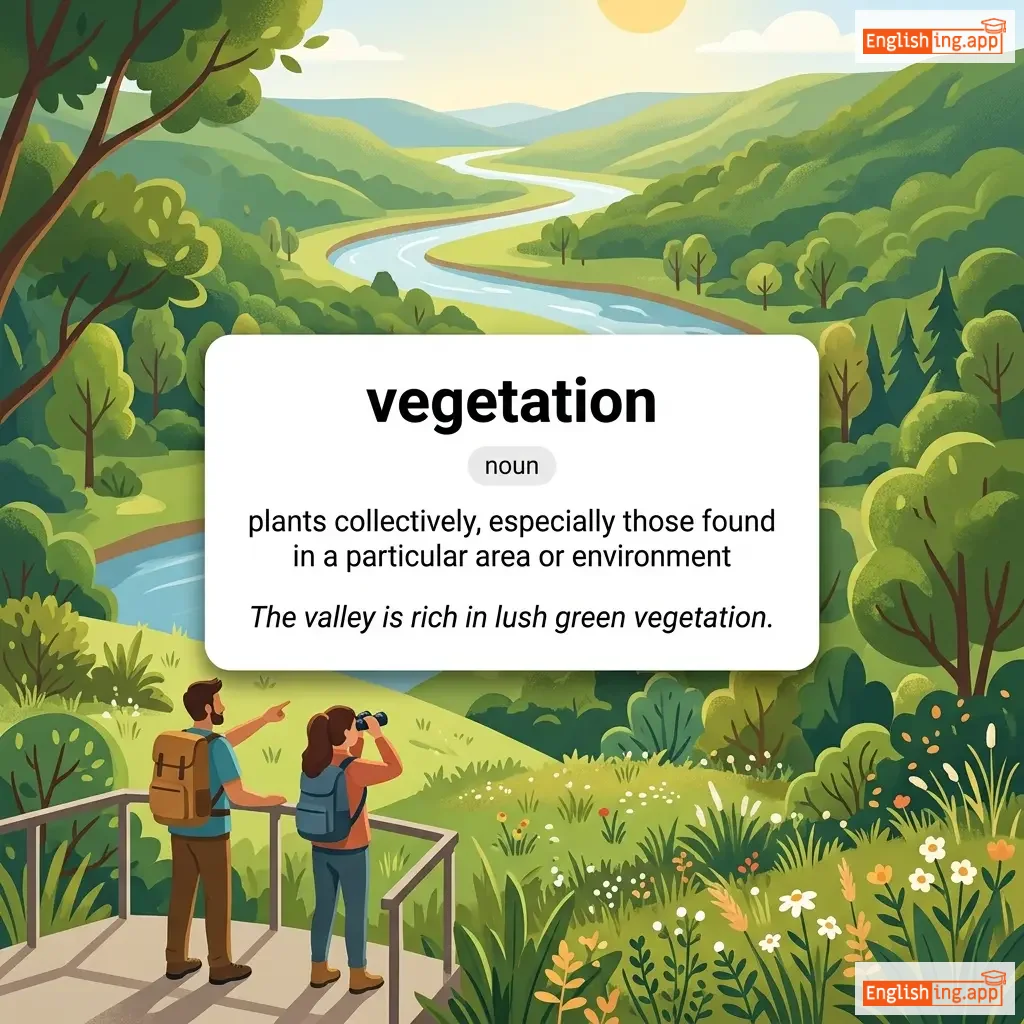
vegetation definition card — visual illustration of the meaning
noun
/ˌvɛdʒɪˈteɪʃən/
vegetación (vegetacion)

plants collectively, especially those found in a particular area or environment

"The valley is rich in lush green vegetation."

"El valle está lleno de vegetación verde y exuberante." (El valle esta lleno de vegetacion verde y exuberante.)
adjective
/ˈvɛdʒɪtətɪv/
relacionado con el crecimiento o los procesos básicos de la vida (relacionado con el crecimiento o los procesos básicos de la vida)

relating to growth or the basic processes of life, often without conscious thought or activity

"The patient remained in a vegetative state after the accident."

"El paciente permaneció en un estado vegetativo después del accidente." (El paciente permaneció en un estado vegetativo después del accidente.)
noun
/ˈviːəməns/
vehemencia (vehemencia)

Great forcefulness or intensity of expression, emotion, or conviction.

"She spoke with vehemence during the debate."

"Ella habló con vehemencia durante el debate." (Ella habló con vehemencia durante el debate.)
adjective
/ˈviːəmənt/
vehemente (vehemente)

showing strong feeling; forceful, passionate, or intense

"She made a vehement argument against the proposal."

"Ella hizo un argumento vehemente contra la propuesta." (Ella hizo un argumento vehemente contra la propuesta.)
noun
/ˈviːɪkəl/
vehículo (vehiculo)

a machine used for transporting people or goods

"He drives a vehicle to work every day."

"Él conduce un vehículo al trabajo todos los días." (Él conduce un vehículo al trabajo todos los días.)
noun
/ˈviː.ɪ.kəlz/
vehículos (vehiculos)

machines used for transporting people or goods from one place to another

"There are many different types of vehicles on the road today."

"Hoy en día hay muchos tipos de vehículos en la carretera." (Hoy en dia hay muchos tipos de vehiculos en la carretera)
noun
/veɪl/
velo (velo)

a piece of fine material worn by women to protect or conceal the face

"The bride wore a beautiful white veil during her wedding ceremony."

"La novia llevaba un hermoso velo blanco durante su ceremonia de boda." (La novia llevaba un hermoso velo blanco durante su ceremonia de boda)
noun
/veɪn/
vena (vena)

a tube in the body that carries blood to the heart

"The nurse checked the patient's veins for an IV insertion."

"La enfermera revisó las venas del paciente para la inserción del IV." (La enfermera revisó las venas del paciente para la inserción del IV.)
noun
/vəˈliːɪti/
deseo débil (deseo debil)

A wish or inclination not strong enough to lead to action.

"His interest in painting never grew beyond a mere velleity."

"Su interés en la pintura nunca creció más allá de un mero deseo débil." (Su interes en la pintura nunca crecio mas alla de un mero deseo debil.)
noun
/ˈvɛləm/
pergamino (pergamino)

a fine parchment made originally from the skin of a calf, used for writing or printing

"The ancient manuscript was written on vellum."

"El antiguo manuscrito fue escrito en pergamino." (El antiguo manuscrito fue escrito en pergamino.)
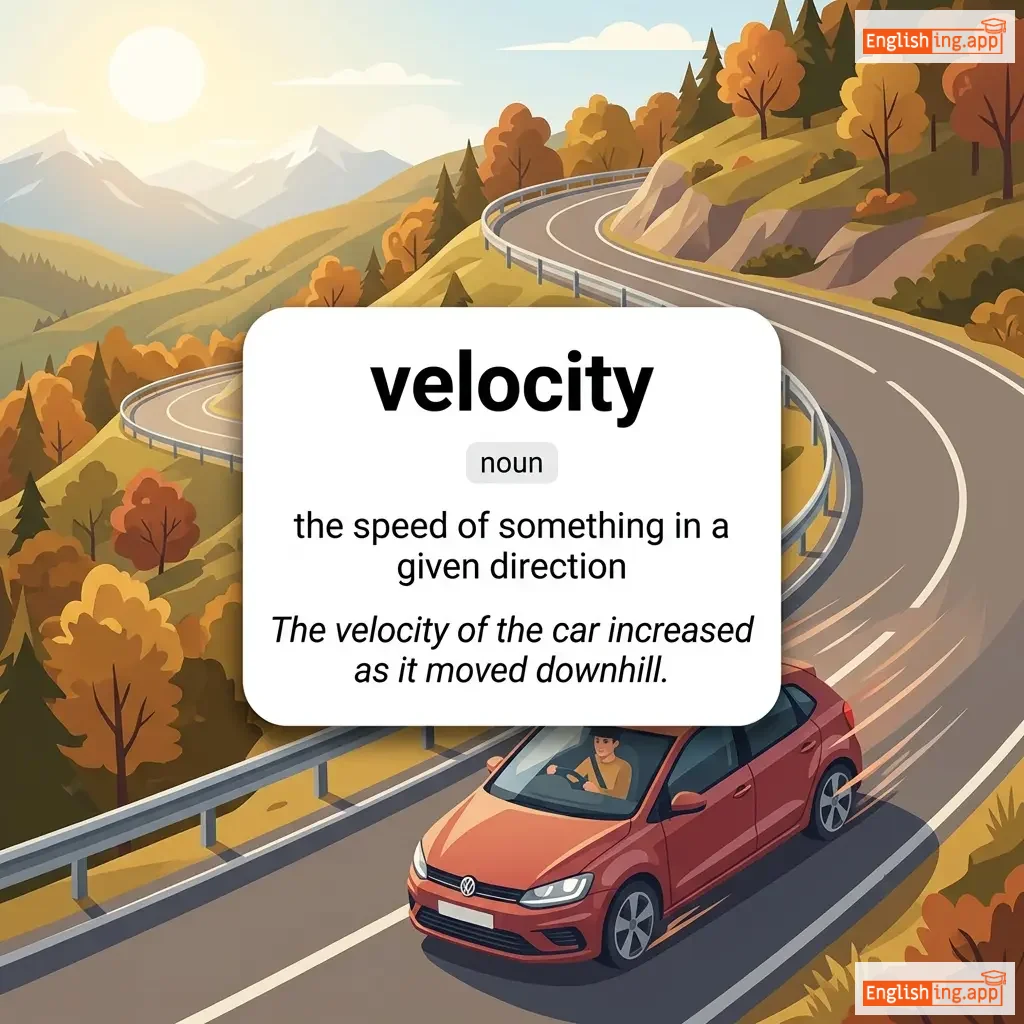
velocity definition card — visual illustration of the meaning
noun
/vəˈlɒsəti/
velocidad (velocidad)

the speed of something in a given direction

"The velocity of the car increased as it moved downhill."

"La velocidad del coche aumentó a medida que bajaba por la colina." (La velocidad del coche aumento a medida que bajaba por la colina.)
noun
/ˈvel.vɪt/
terciopelo (terciopelo)

a soft, luxurious fabric with a thick, short pile on one side

"The royal curtains were made of rich red velvet."

"Las cortinas reales estaban hechas de rico terciopelo rojo." (Las cortinas reales estaban hechas de rico terciopelo rojo.)
adjective
/ˈvɛlvəti/
felicidad (felicidad)

having a smooth, soft texture like velvet

"She spoke in a low, velvety voice."

"No podía ocultar su felicidad cuando recibió el premio." (No podía ocultar su felicidad cuando recibió el premio.)
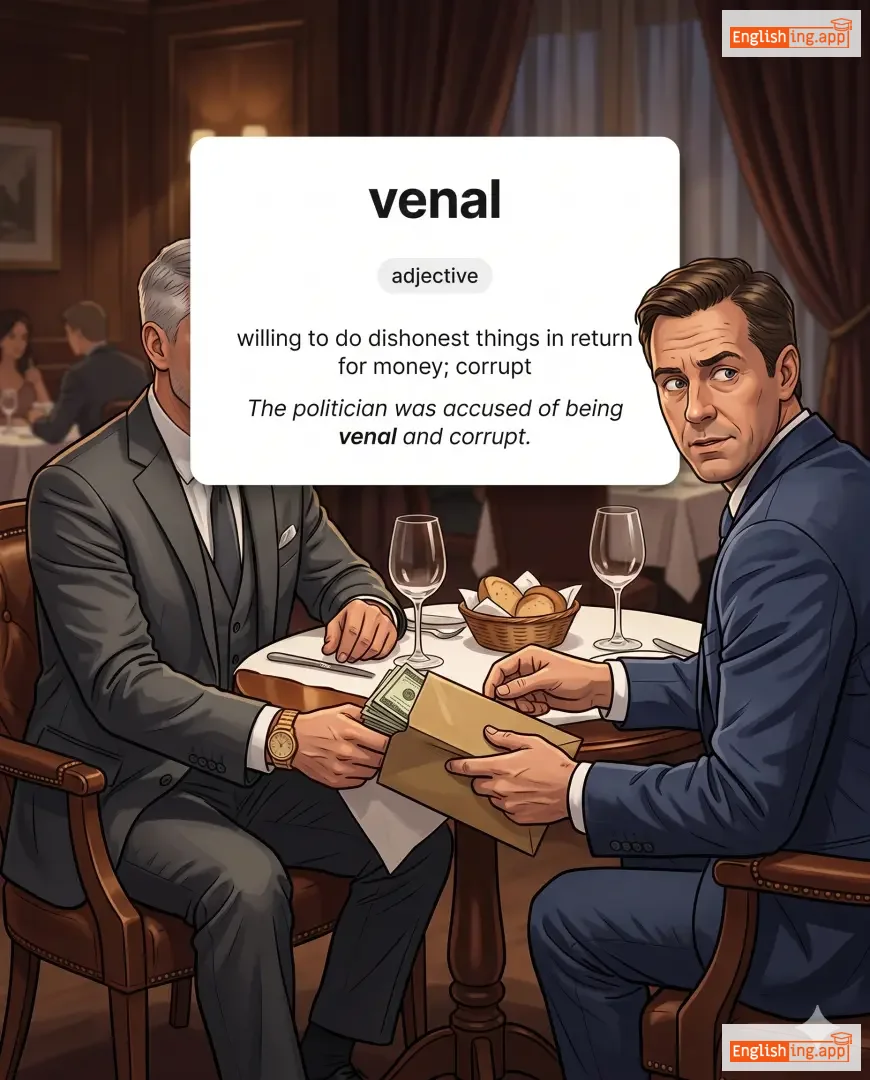
venal definition card — visual illustration of the meaning
adjective
/ˈviːnəl/
corrupto (corrupto)

willing to do dishonest things in return for money; corrupt

"The politician was accused of being venal and corrupt."

"El político fue acusado de ser venal y corrupto." (El político fue acusado de ser venal y corrupto.)
noun
/viːˈnæləti/
venalidad (venalidad)

the quality of being open to bribery or corruption

"The scandal revealed the venality of several senior officials."

"El escándalo reveló la venalidad de varios funcionarios de alto rango." (El escándalo reveló la venalidad de varios funcionarios de alto rango.)
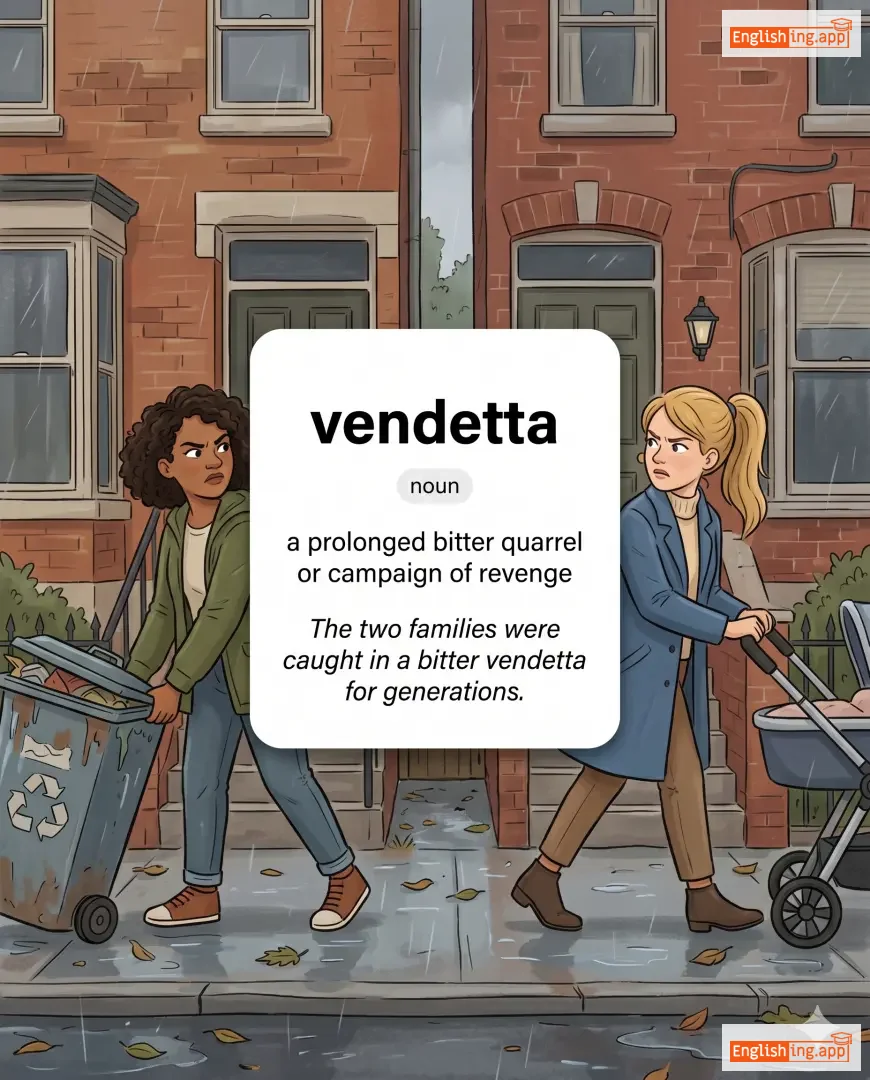
vendetta definition card — visual illustration of the meaning
noun
/vɛnˈdɛtə/
venganza (venganza)

a prolonged bitter quarrel or campaign of revenge

"The two families were caught in a bitter vendetta for generations."

"Las dos familias estuvieron atrapadas en una amarga venganza durante generaciones." (Las dos familias estuvieron atrapadas en una amarga venganza durante generaciones.)
adjective
/ˈvɛndɪbəl/
vendible (vendible)

Capable of being sold; marketable.

"Only vendible products were displayed at the trade fair."

"Solo los productos vendibles fueron exhibidos en la feria comercial." (Solo los productos vendibles fueron exhibidos en la feria comercial.)
noun
/vɛnˈdɪʃən/
venta (venta)

The act of selling; sale.

"The auction was a formal vendition of the estate's assets."

"La subasta fue una venta formal de los activos de la propiedad." (La subasta fue una venta formal de los activos de la propiedad.)
🧑‍🍳

Vendor (véndor)

noun
/ˈvɛndɔːr/
vendedor (vendedor)

A person or company that sells goods or services.

"The street vendor sold fresh fruits every morning."

"El vendedor de la calle vendió frutas frescas todas las mañanas." (El vendedor de la calle vendió frutas frescas todas las mañanas.)
noun
/vəˈnɪər/
felicidad (felicidad)

A thin decorative covering of fine wood applied to a coarser wood or other material; a superficially attractive appearance.

"The table was covered with a thin veneer of mahogany."

"Ella no pudo ocultar su felicidad cuando recibió el premio." (Ella no pudo ocultar su felicidad cuando recibió el premio.)
adjective
/ˈvɛnərəbl/
venerable (venerable)

Accorded a great deal of respect, especially because of age, wisdom, or character.

"The venerable professor was admired by generations of students."

"El venerable profesor fue admirado por generaciones de estudiantes." (El venerable profesor fue admirado por generaciones de estudiantes.)
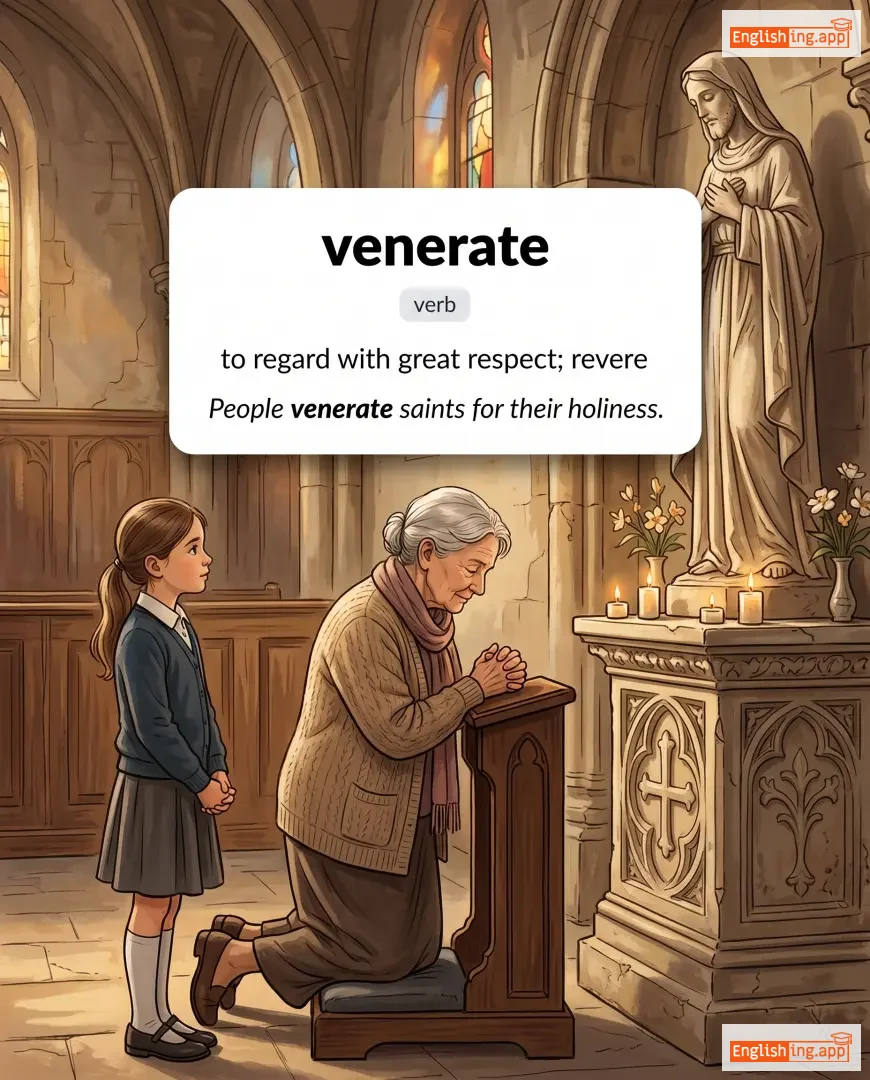
venerate definition card — visual illustration of the meaning
verb
/ˈvɛnəˌreɪt/
venerar (venerar)

to regard with great respect; revere

"People venerate saints for their holiness."

"La gente venera a los santos por su santidad." (La gente venera a los santos por su santidad.)
adjective
/ˈvɛnəˌreɪtɪd/
venerado (venerado)

respected and admired deeply

"The venerated professor was honored with an award."

"El profesor venerado fue honrado con un premio." (El profesor venerado fue honrado con un premio.)