Vocabularios

Descubra, aprenda y domine el vocabulario en inglés

adjective
/ʌnˈwəʊntɪd/
inusitado (inusitado)

Unusual, uncommon, or out of the ordinary.

"She spoke with an unwonted gentleness that surprised everyone."

"Ella habló con una suavidad inusual que sorprendió a todos." (Ella hablo con una suavidad inusual que sorprendio a todos.)
adjective
/ʌnˈwɜːrði/
indigno; no merecedor (indigno; no merecedor)

not deserving respect or attention; lacking worth or merit

"He felt unworthy of such praise and recognition."

"Él se sintió no digno de tal alabanza y reconocimiento." (Él se sintió no digno de tal alabanza y reconocimiento.)
verb
/ʌnˈræp/
desenvolver (desenvolver)

remove wrapping or covering from something; reveal something gradually or clearly

"She carefully unwrapped the gift with excitement."

"Ella desenvolvió el regalo con cuidado y emoción." (Ella desenvolvio el regalo con cuidado y emocion)
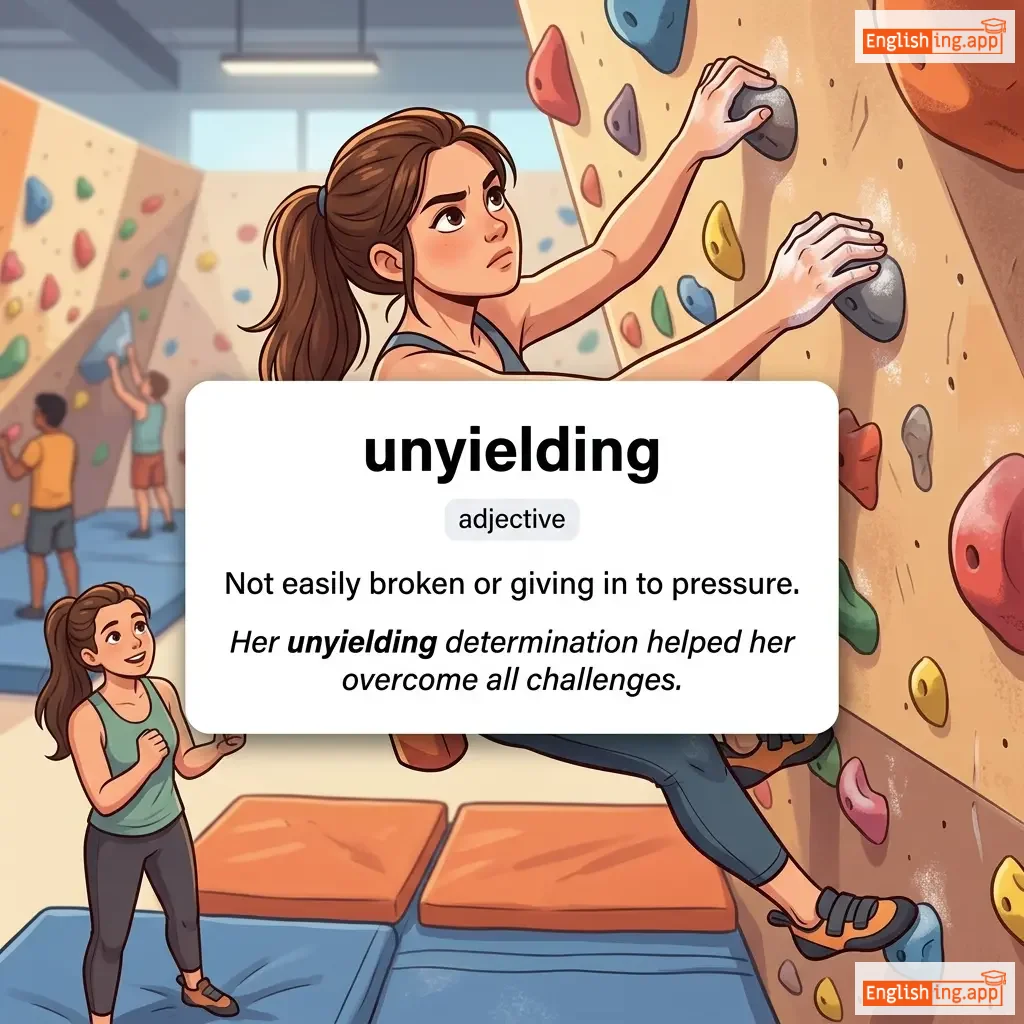
unyielding definition card — visual illustration of the meaning
adjective
ʌnˈjiːl.dɪŋ
inquebrantable o firme (inqueebrantable o firme)

Not easily broken or giving in to pressure.

"Her unyielding determination helped her overcome all challenges."

"Su determinación inquebrantable la ayudó a superar todos los desafíos." (Su determinacion inquebrantable la ayudo a superar todos los desafios.)
verb
/ʌnˈjoʊk/
desenganchar (desenganchar)

To release from a yoke or to free from restraint or obligation.

"The farmer unyoked the oxen after a long day of work."

"El agricultor desenganchó los bueyes después de un largo día de trabajo." (El agricultor desenganchó los bueyes después de un largo día de trabajo.)
⬆️

up (áp)

adverb
/ʌp/
arriba (arriba)

towards a higher position or level

"He climbed up the ladder quickly."

"Él subió rápidamente la escalera." (El subio rapidamente la escalera.)
noun
/ˈʌpˌkiːp/
mantenimiento (mantenimiento)

The process or cost of maintaining something in good condition.

"The upkeep of the old house is very expensive."

"El mantenimiento de la casa antigua es muy caro." (El mantenimiento de la casa antigua es muy caro.)
verb
/ʌpˈbreɪd/
reprender (reprender)

To scold or criticize someone harshly.

"The teacher upbraided the student for being late again."

"El maestro reprendió al estudiante por llegar tarde otra vez." (El maestro reprendió al estudiante por llegar tarde otra vez.)
noun/verb
/ˈʌpˌkæst/
lanzar hacia arriba (lanzar hacia arriba)

Verb: To cast or throw upward. Noun: Something thrown or directed upward.

"The fisherman upcast his net into the air."

"El pescador lanzó su red al aire." (El pescador lanzó su red al aire.)
adjective
/ˈʌpˌkʌmɪŋ/
próximo (proximo)

about to happen or appear

"The upcoming event will be held next week."

"El próximo evento se llevará a cabo la próxima semana." (El proximo evento se llevará a cabo la proxima semana.)
update definition card — visual illustration of the meaning
verb
/ˈʌpdeɪt/
actualizar (actualizar)

to make something more modern or accurate by adding new information or changing it

"Please update your profile information regularly."

"Por favor, actualice su información de perfil regularmente." (Por favor, actualice su informacion de perfil regularmente.)
verb
/ˈʌpˌɡreɪd/
actualizar (actualizar)

to raise something to a higher standard, improve

"We decided to upgrade the software to the latest version."

"Decidimos actualizar el software a la última versión." (Decidimos actualizar el software a la ultima version.)
noun
/ʌpˈhiːvəl/
upheaval (upheaval)

a violent or sudden change or disruption to something

"The company faced a major upheaval after the sudden resignation of its CEO."

"La empresa enfrentó un gran desorden tras la repentina renuncia de su CEO." (La empresa enfrento un gran desorden tras la repentina renuncia de su CEO.)
verb
/ʌpˈhiːv/
levantar (levantar)

to lift or raise something forcefully; to cause to rise suddenly

"The workers had to upheave the heavy stone to clear the path."

"Los trabajadores tuvieron que levantar la piedra pesada para despejar el camino." (Los trabajadores tuvieron que levantar la piedra pesada para despejar el camino.)
adjective
/ˈʌpˌhɪl/
difícil; que requiere gran esfuerzo; inclinado hacia arriba (dificil; que requiere gran esfuerzo; inclinado hacia arriba)

difficult; requiring great effort; sloping upward

"Learning a new language can be an uphill battle."

"Aprender un nuevo idioma puede ser una batalla difícil." (aprender un nuevo idioma puede ser una batalla dificil.)
verb
/ʌpˈhoʊld/
mantener (mantener)

to maintain or support a principle, law, or decision

"The judge promised to uphold justice at all costs."

"El juez prometió mantener la justicia a toda costa." (El juez prometió mantener la justicia a toda costa.)
preposition
/əˈpɒn/
sobre (sobre)

on or immediately after

"Upon hearing the news, he rushed to the hospital."

"Al escuchar la noticia, corrió al hospital." (Al escuchar la noticia, corrio al hospital.)
adjective
/ˈʌpər/
superior (superior)

higher in position or rank

"The upper floor of the building is under renovation."

"El piso superior del edificio está en renovación." (El piso superior del edificio está en renovación.)
adjective
/ˈʌpərˌmoʊst/
más alto (mas alto)

situated at the highest place or most important

"Her family's safety was uppermost in her mind during the crisis."

"La seguridad de su familia era lo más importante en su mente durante la crisis." (La seguridad de su familia era lo mas importante en su mente durante la crisis.)
adjective, adverb
/ˈʌpraɪt/
felicidad (felicidad)

positioned vertically; morally good and honest

"He remained upright despite the strong winds."

"Ella no pudo ocultar su felicidad cuando recibió el premio." (Ella no pudo ocultar su felicidad cuando recibió el premio.)
noun
/ˈʌp.raɪt.nəs/
rectitud; integridad (rectitud; integridad)

the quality of being honest and morally correct; integrity

"His uprightness in business dealings earned him great respect."

"Su rectitud en los negocios le ganó gran respeto." (Su rectitud en los negocios le ganó gran respeto.)
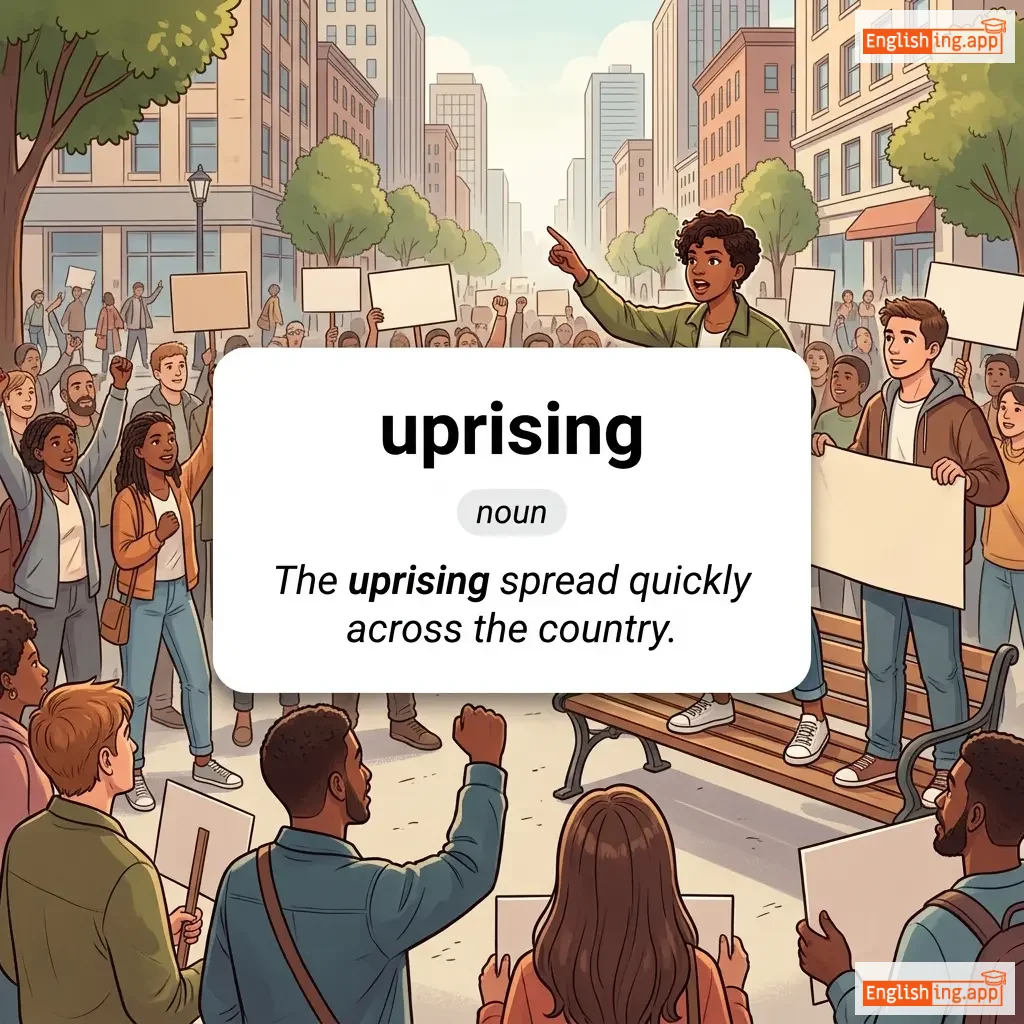
uprising definition card — visual illustration of the meaning
noun
/ˈʌpraɪzɪŋ/
levantamiento (levantamiento)

An act of resistance or rebellion; an attempt to overthrow authority or government.

"The uprising spread quickly across the country."

"El levantamiento se extendió rápidamente por todo el país." (El levantamiento se extendió rápidamente por todo el país.)
noun
/ˈʌp.rɔːr/
alboroto (alboroto)

A loud noise, commotion, or disturbance caused by a group of people.

"The announcement caused an uproar in the audience."

"El anuncio causó un alboroto en la audiencia." (El anuncio causó un alboroto en la audiencia.)
adjective
/ʌpˈrɔːr.i.əs/
sumamente cómico (sumamente comico)

Extremely funny or noisy; causing loud laughter or commotion.

"The comedian's jokes were absolutely uproarious."

"Los chistes del comediante fueron absolutamente sumamente cómicos." (Los chistes del comediante fueron absolutamente sumamente comicos.)
verb
/ʌpˈruːt/
desarraigar (desarraigar)

To pull something out of the ground; to remove or displace completely.

"They uprooted the old tree from the garden."

"Ellos desenterraron el viejo árbol del jardín." (Ellos desenterraron el viejo árbol del jardín.)
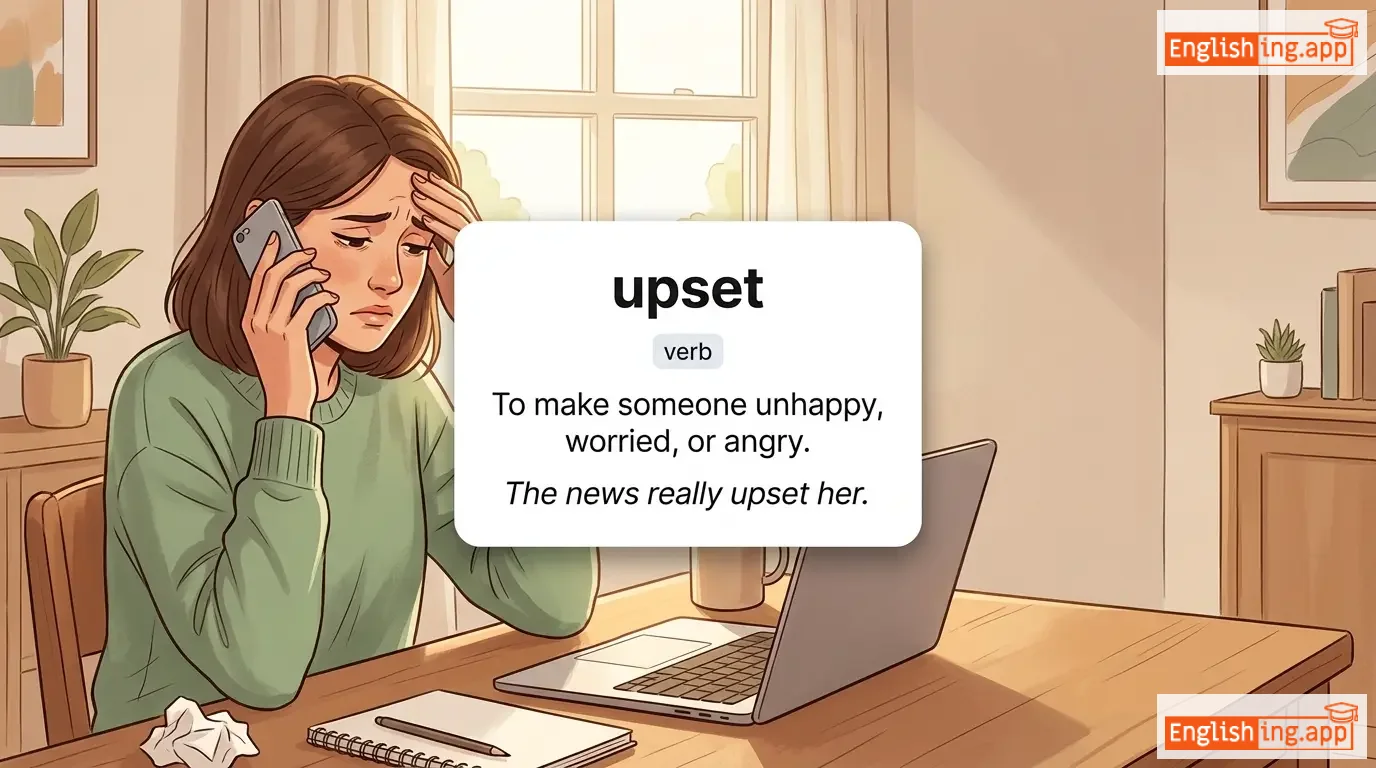
upset definition card — visual illustration of the meaning
verb
/ʌpˈsɛt/
molestar (molestar)

To make someone unhappy, worried, or angry.

"The news really upset her."

"Las noticias realmente la molestaron." (Las noticias realmente la molestaron.)
noun
/ˈʌp.ʃɒt/
resultado (resultado)

The final result or outcome of a process or situation.

"The upshot of the meeting was that the plan was postponed."

"El resultado de la reunión fue que el plan se pospuso." (El resultado de la reunion fue que el plan se pospuso.)
adverb
/ˌʌpsaɪd ˈdaʊn/
al revés (al reves)

with the upper part at the bottom; in or into a reversed position

"The picture was hanging upside-down on the wall."

"La foto estaba colgada al revés en la pared." (La foto estaba colgada al reves en la pared)
🏠⬆️

Upstairs

adverb
/ˌʌpˈstɛərz/

on or to a higher floor of a building

"She went upstairs to her bedroom."

noun
/ˈʌp.tɜːn/
mejora (mejora)

An improvement or upward trend in a situation, especially in business or economy.

"The company experienced an upturn in sales last quarter."

"La empresa experimentó una mejora en las ventas el último trimestre." (La empresa experimento una mejora en las ventas el ultimo trimestre.)
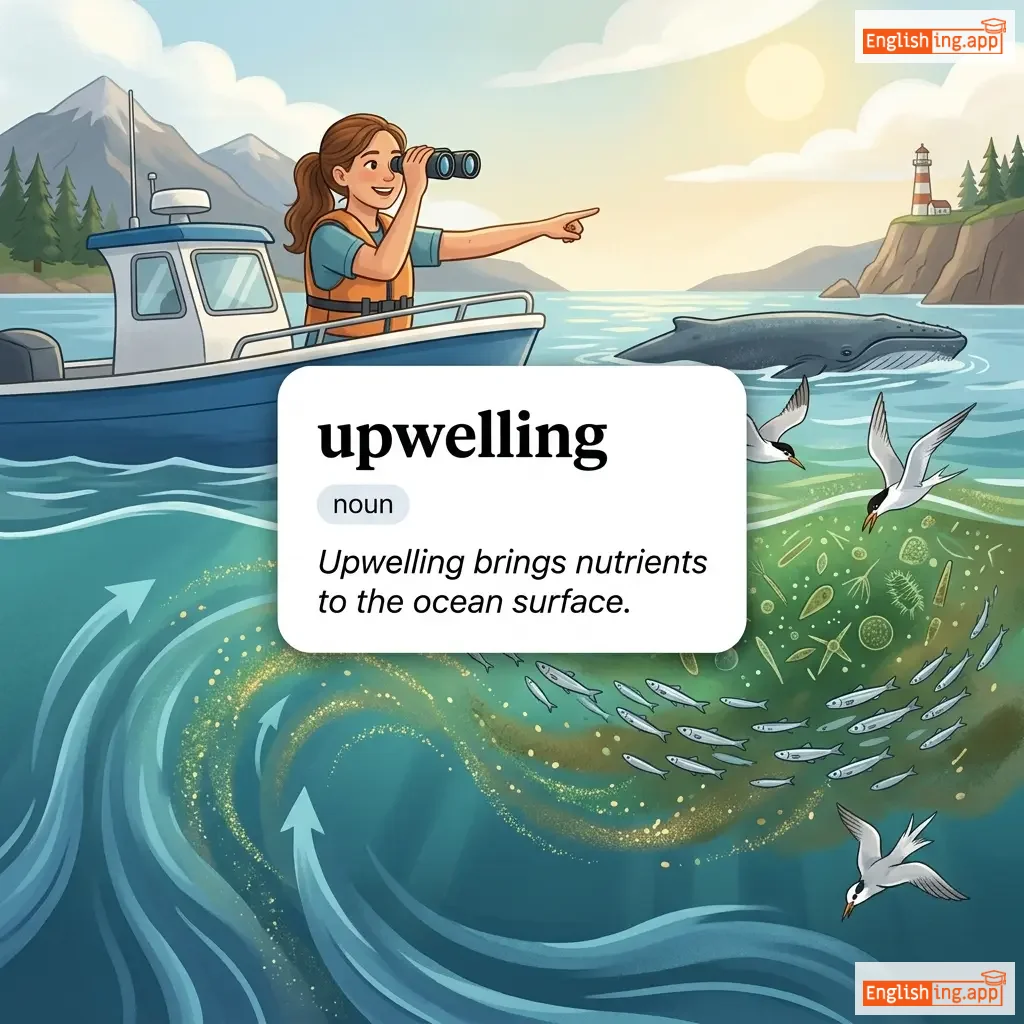
upwelling definition card — visual illustration of the meaning
noun
/ˈʌp.wel.ɪŋ/
Fenómeno oceanográfico que implica el movimiento de agua densa, fría y rica en nutrientes hacia la superficie del océano. (Fenomeno oceanografico que implica el movimiento de agua densa, fria y rica en nutrientes hacia la superficie del oceano.)

An oceanographic phenomenon that involves wind-driven motion of dense, cooler, and nutrient-rich water towards the ocean surface.

"Upwelling brings nutrients to the ocean surface."

"El upwelling lleva nutrientes a la superficie del océano." (El upwelling lleva nutrientes a la superficie del oceano.)
adjective
/ˈɜːrbən/
urbano (urbano)

related to, characteristic of, or situated in a city or town

"Urban areas often have higher population density than rural areas."

"Las áreas urbanas suelen tener una mayor densidad de población que las áreas rurales." (Las areas urbanas suelen tener una mayor densidad de poblacion que las areas rurales.)
adjective
/ɜːrˈbeɪn/
urbano (urbano)

showing polished manners, refinement, and sophistication

"He was an urbane gentleman who charmed everyone at the party."

"Era un caballero urbano que encantó a todos en la fiesta." (Era un caballero urbano que encantó a todos en la fiesta.)
noun
/ɜːrˈbænɪti/
urbanidad (urbanidad)

refined courtesy, elegance, and sophistication in manner

"Her urbanity made her popular among diplomats and leaders."

"Su urbanidad la hizo popular entre diplomáticos y líderes." (Su urbanidad la hizo popular entre diplomáticos y líderes.)
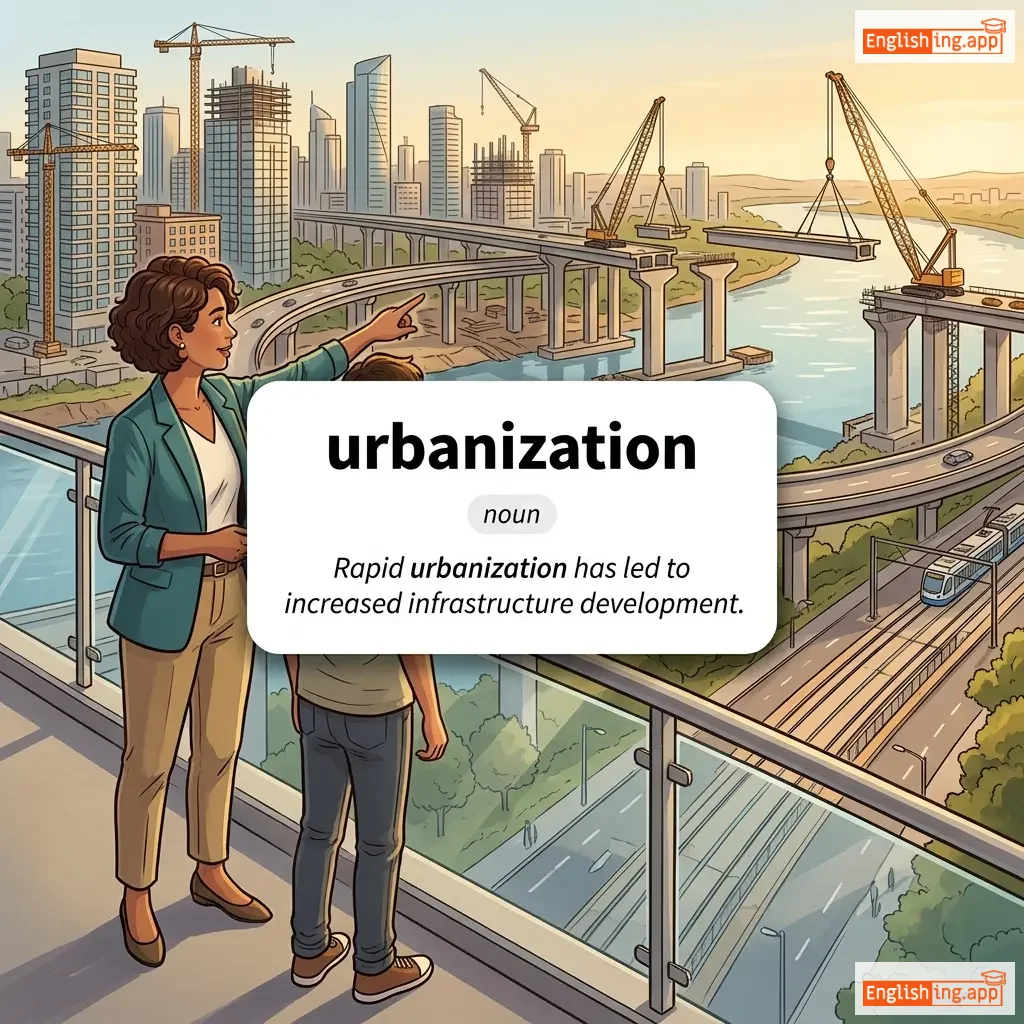
urbanization definition card — visual illustration of the meaning
noun
/ˌɜː.bən.aɪˈzeɪ.ʃən/
urbanización (urbanizacion)

The process by which towns and cities are formed and become larger as more people begin living and working in central areas.

"Rapid urbanization has led to increased infrastructure development."

"La rápida urbanización ha llevado al aumento del desarrollo de infraestructura." (La rapida urbanizacion ha llevado al aumento del desarrollo de infraestructura.)
noun
/ˈɜːrtʃɪn/
niño travieso de la calle (nino travieso de la calle)

a mischievous or poorly dressed child, often from the streets

"The ragged urchins played by the riverbank."

"Los niños callejeros con ropa rasgada jugaban junto al río." (Los ninos callejeros con ropa rasgada jugaban junto al rio.)
verb
/ɜːrdʒ/
instar (instar)

to strongly encourage or try to persuade someone to do something

"Doctors urge patients to exercise regularly."

"Los doctores instan a los pacientes a hacer ejercicio regularmente." (Los doctores instan a los pacientes a hacer ejercicio regularmente.)
noun
/ˈɜːrdʒənsi/
urgencia (urgencia)

The quality of requiring immediate attention or action.

"The doctor emphasized the urgency of starting treatment right away."

"El médico destacó la urgencia de comenzar el tratamiento de inmediato." (El medico destaco la urgencia de comenzar el tratamiento de inmediato.)
adjective
/ˈɜːrdʒənt/
urgente (urgente)

Requiring immediate action or attention.

"She sent an urgent message to her manager."

"Ella envió un mensaje urgente a su gerente." (Ella envió un mensaje urgente a su gerente.)
adverb
/ˈɜːrdʒəntli/
urgentemente (urgentemente)

in a way that requires immediate attention or action

"The patient urgently needs medical attention."

"El paciente necesita atención médica urgentemente." (el paciente necesita atencion medica urgentemente)
adjective
/ˈɜːrsaɪn/
osoide (osoide)

Relating to or resembling a bear.

"The man’s ursine strength amazed everyone."

"La fuerza osoide del hombre sorprendió a todos." (La fuerza osoide del hombre sorprendió a todos.)
pronoun
/ʌs/
nosotros (nosotros)

used to refer to the speaker and one or more other people as the object of a verb or preposition

"She gave us a gift."

"Ella nos dio un regalo." (Ella nos dio un regalo.)
noun
/ˈjuːsɪdʒ/
uso (uso)

The action of using something; the way in which a word or phrase is normally used.

"The book explains the proper usage of technical terms."

"El libro explica el uso adecuado de los términos técnicos." (El libro eksplika el uso adecuado de los términos técnicos.)
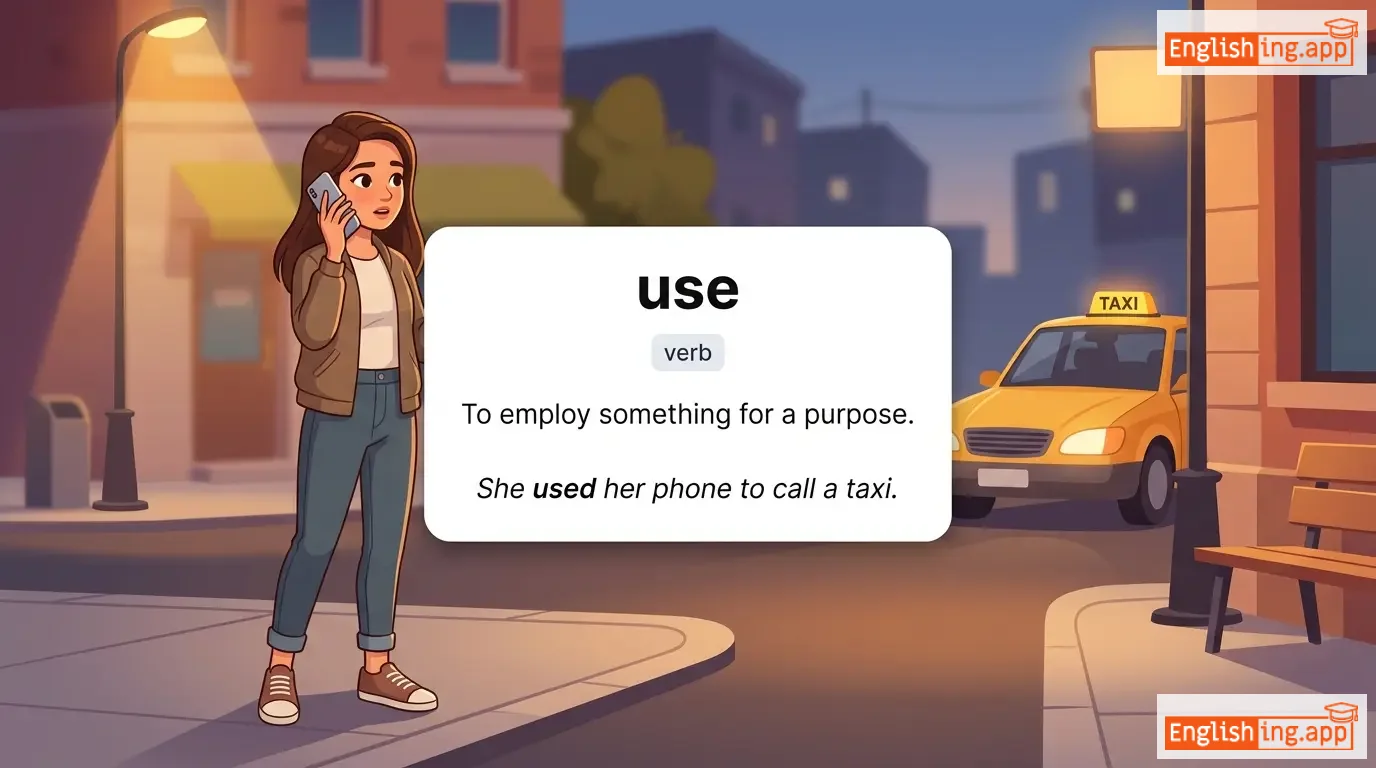
use definition card — visual illustration of the meaning
🛠️

use (yuz)

verb
/juːz/ (verb), /juːs/ (noun)
usar (usar)

To employ something for a purpose.

"She used her phone to call a taxi."

"Ella usó su teléfono para llamar un taxi." (Ella uso su telefono para llamar un taxi.)
adjective
/juːzd/
usado (usado)

having already been used

"This is a used car."

"Este es un coche usado." (Este es un coche usado.)
adjective
/ˈjuːsfəl/
útil (util)

having a practical or beneficial use

"This tool is very useful."

"Esta herramienta es muy útil." (Esta herramienta es muy util.)
noun
/ˈjuːs.fəl.nəs/
utilidad (utilidad)

the quality of being useful; practical value or helpfulness

"The usefulness of this tool became apparent during the project."

"La utilidad de esta herramienta se hizo evidente durante el proyecto." (La utilidad de esta herramienta se hizo evidente durante el proyecto.)
adjective
/ˈjuːsləs/
inútil (inutil)

not serving any purpose or value

"The broken phone is completely useless."

"El teléfono roto es completamente inútil." (El telefono roto es completamente inutil.)
noun
/ˈjuːzər/
usuario (usuario)

a person who uses or operates something

"He is a frequent user of this app."

"Él es un usuario frecuente de esta aplicación." (El es un usuario frecuente de esta aplicacion.)
adjective
/ˈjuːʒəl/
habitual (habitual)

habitually or typically occurring or done

"It’s our usual meeting spot."

"Es nuestro lugar habitual de reuniones." (Es nuestro lugar habitual de reuniones.)