Vocabularios

Descubra, aprenda y domine el vocabulario en inglés

adjective
/ˌjuːnɪˈlætərəl/
unilateral (unilateral)

Involving or affecting only one side or party without the agreement of others.

"The country took unilateral action without consulting its allies."

"El país tomó una acción unilateral sin consultar a sus aliados." (El pais tomo una accion unilateral sin consultar a sus aliados)
adjective
/ˌʌnɪˈmædʒənəbəl/
inimaginable (inimaginable)

impossible to conceive; beyond imagination

"The scale of destruction was unimaginable until we saw it firsthand."

"La escala de la destrucción era inimaginable hasta que lo vimos de primera mano." (La escala de la destrucción era inimaginable hasta que lo vimos de primera mano.)
adjective
/ˌʌnɪmˈpiːtʃəbl/
impecable (impecable)

Not able to be doubted, questioned, or criticized; completely trustworthy.

"She is known for her unimpeachable honesty."

"Ella es conocida por su honestidad impecable." (Ella es conocida por su honestidad impecable.)
noun
/ʌnɪmˈpɔːrtəns/
insignificancia (insignificancia)

the state or quality of being insignificant or not important

"He dismissed the issue with a sense of unimportance."

"Él desestimó el asunto con un sentido de falta de importancia." (El desestimo el asunto con un sentido de falta de importancia)
adjective
/ˌʌnɪmˈpɔːrtənt/
sin importancia (sin importancia)

not having much value, significance, or influence

"The detail seemed unimportant compared to the main issue."

"El detalle parecía sin importancia en comparación con el problema principal." (El detalle parecia sin importancia en comparacion con el problema principal)
adjective
/ˌʌnɪnˈfɔːrmd/
desinformado (desinformado)

lacking knowledge or awareness about a particular subject; not educated or informed

"The decision was made by an uninformed committee."

"La decisión fue tomada por un comité desinformado." (la decision fue tomada por un comite desinformado)
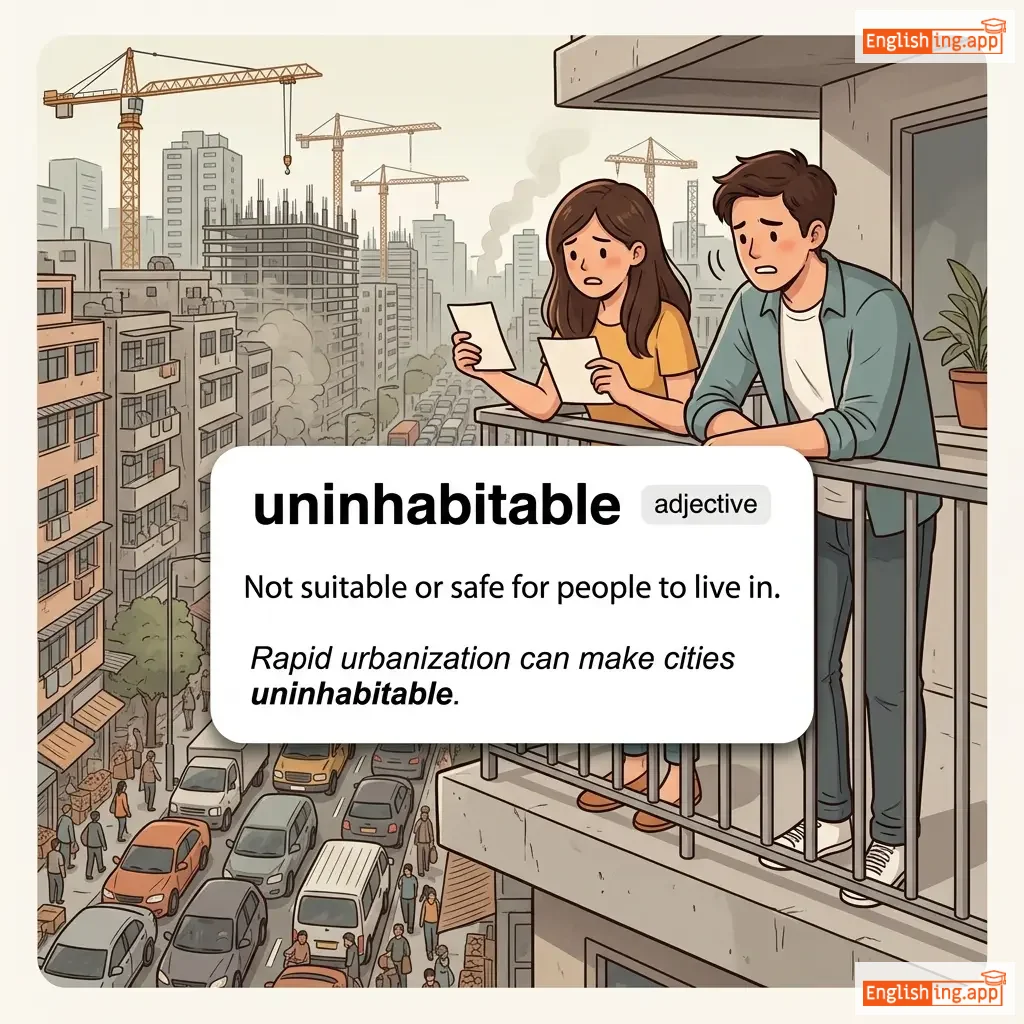
uninhabitable definition card — visual illustration of the meaning
adjective
ʌnɪnˈhæbɪtəbəl
inhabitable (inhabitable)

Not suitable or safe for people to live in.

"Rapid urbanization can make cities uninhabitable."

"La rápida urbanización puede hacer que las ciudades sean inhabitables." (La rápida urbanización puede hacer que las ciudades sean inhabitables.)
adjective
/ˌʌnɪnˈhɪbɪtɪd/
desinhibido (desinhibido)

Not restrained or restricted; free in behavior or expression.

"She gave an uninhibited laugh at the joke."

"Ella dio una risa desinhibida al chiste." (Ella dio una risa desinhibida al chiste.)
adjective
/ʌnˈɪndʒərd/
ileso (ileso)

Without injury; not physically harmed.

"All the passengers were rescued uninjured."

"Todos los pasajeros fueron rescatados ilesos." (Todos los pasajeros fueron rescatados ilesos.)
adjective
/ˌʌnɪnˈtenʃənəl/
no intencionado; accidental (no intencionado; accidental)

not done on purpose; accidental

"The damage to the car was unintentional."

"El daño al coche fue no intencionado." (El daño al coche fue no intencionado.)
adjective
/ˌʌnˈɪntrəstɪŋ/
aburrido (aburrido)

not holding attention or curiosity; boring

"The lecture was uninteresting and difficult to stay focused on."

"La conferencia fue aburrida y difícil de seguir." (La conferencia fue aburrida y dificil de seguir)
adjective
/ˌʌnˈɪntɪmeɪtɪŋ/
sin indicios (sin indicios)

Not giving a hint or suggestion; not indicating.

"His unintimating tone gave no clue of his true feelings."

"Su tono sin indicios no dio ninguna pista sobre sus verdaderos sentimientos." (Su tono sin indicios no dio ninguna pista sobre sus verdaderos sentimientos.)
noun
/ˈjuːnɪən/
unión (union)

the action or fact of joining or being joined with others, especially to form a single unit

"The union of the two companies created a global leader."

"La unión de las dos empresas creó un líder global." (La union de las dos empresas creo un lider global.)
adjective
/juːˈniːk/
único (uniko)

Being the only one of its kind; unlike anything else.

"Her dress was unique and caught everyone's attention."

"Su vestido era único y atrajo la atención de todos." (Su vestido era uniko y atrajo la atencion de todos.)
noun
/ˈjuːnɪsən/
al unísono (al unisono)

Simultaneous performance or utterance of action or speech.

"The choir sang in unison."

"El coro cantó al unísono." (El coro canto al unisono.)
adjective
/juːˈnɪsənənt/
armonioso (armonioso)

Sounding together or in harmony.

"The unisonant voices created a powerful effect."

"Las voces armoniosas crearon un efecto poderoso." (Las voces armoniosas crearon un efecto poderoso.)
noun
/ˈjuːnɪt/
unidad (unidad)

an individual thing or person regarded as a single and complete entity

"Each unit in the production line is carefully tested."

"Cada unidad en la línea de producción se prueba cuidadosamente." (Cada unidad en la linea de produccion se prueba cuidadosamente.)
noun
/ˌjuːnɪˈtɛəriən/
unitario (unitario)

A person who believes that God exists as one entity rather than as a Trinity; a member of a religious denomination that emphasizes individual freedom of belief.

"The Unitarian church is known for its inclusive and open-minded approach."

"La iglesia unitaria es conocida por su enfoque inclusivo y de mente abierta." (La iglesia unitaria es conocida por su enfoque inclusivo y de mente abierta.)
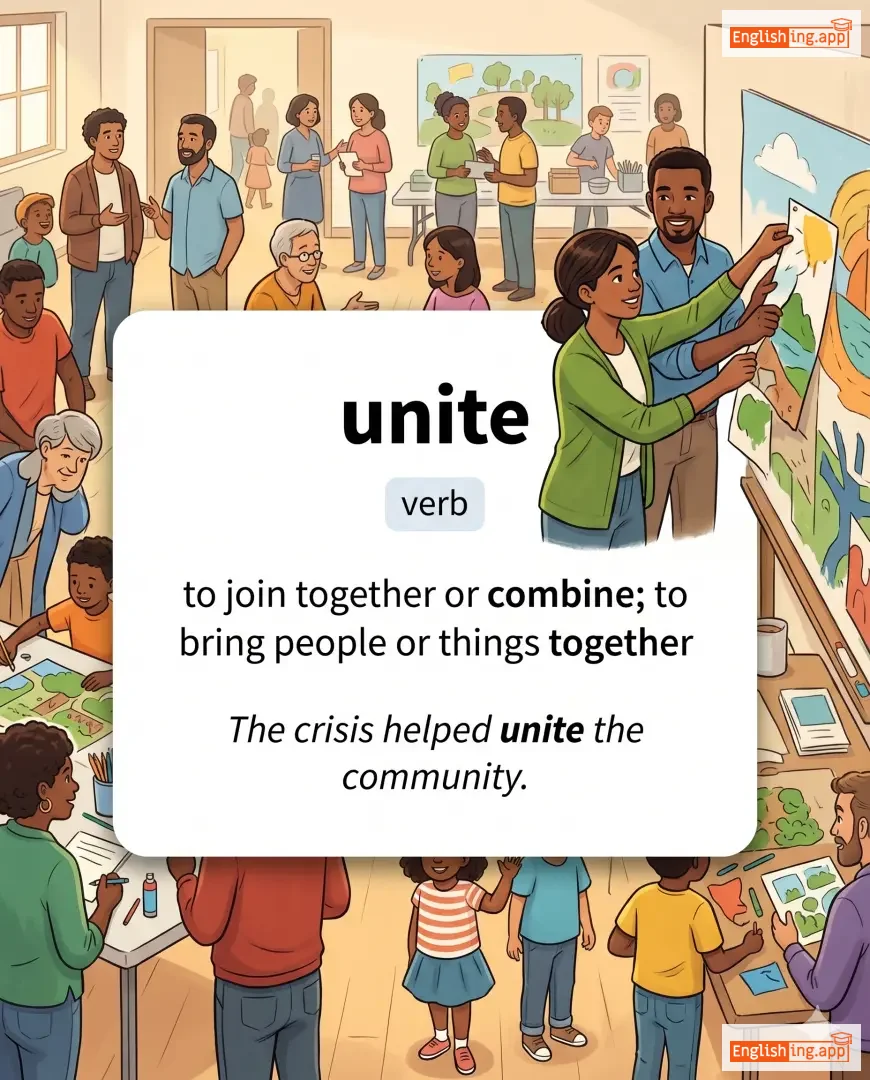
unite definition card — visual illustration of the meaning
verb
/juˈnaɪt/
unir (unir)

to join together or combine; to bring people or things together

"The crisis helped unite the community."

"La crisis ayudó a unir la comunidad." (La crisis ayudó a unir la comunidad.)
adjective
/juˈnaɪtɪd/
unido (unido)

joined together or combined as one

"The united team won the championship."

"El equipo unido ganó el campeonato." (El equipo unido ganó el campeonato.)
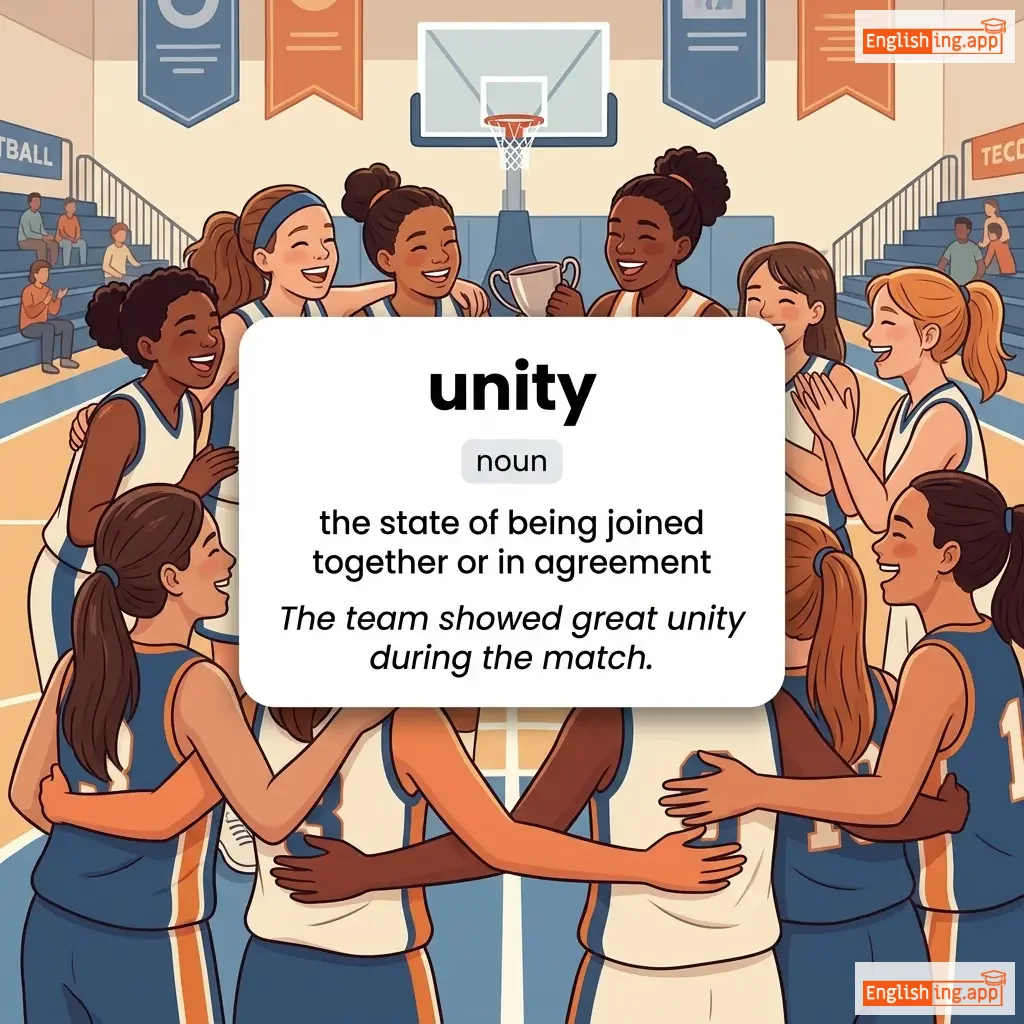
unity definition card — visual illustration of the meaning
🫱🏻‍🫲🏽

unity (yúniti)

noun
/ˈjuːnɪti/
unidad (unidad)

the state of being joined together or in agreement

"The team showed great unity during the match."

"El equipo mostró gran unidad durante el partido." (El equipo mostró gran unidad durante el partido.)
noun
/ˈjuːnɪvəˌlɛns/
univalencia (univalencia)

The state of having a single valence or combining power, especially in chemistry.

"Hydrogen is characterized by its univalence in chemical reactions."

"El hidrógeno se caracteriza por su univalencia en las reacciones químicas." (El hidrógeno se caracteriza por su univalencia en las reacciones químicas.)
adjective
/ˌjuːnɪˈvɜːsəl/
universal (universal)

Relating to or done by all people or things in the world; applicable everywhere or in all cases.

"There is a universal need for love and acceptance."

"Hay una necesidad universal de amor y aceptación." (Hay una necesidad universal de amor y aceptación.)
noun
/ˈjuːnɪvɜːrs/
universo (universo)

the totality of known or supposed objects and phenomena throughout space; the cosmos

"The universe is vast and full of mysteries."

"El universo es vasto y está lleno de misterios." (El universo es vasto y esta lleno de misterios.)
noun
/ˌjuːnɪˈvɜːrsɪti/
universidad (universidad)

an institution of higher education and research, which grants academic degrees

"She is studying law at the university."

"Ella está estudiando derecho en la universidad." (Ella esta estudiando derecho en la universidad.)
adjective
/ʌnˈdʒʌst/
injusto; incorrecto (injusto; incorrecto)

not fair or right; morally wrong

"The punishment was unjust for such a minor offense."

"El castigo fue injusto por tal pequeña ofensa." (El castigo fue injusto por tal pequena ofensa)
adjective
/ʌnˈkɛmpt/
desordenado (desordenado)

Having an untidy or disheveled appearance.

"He looked unkempt after sleeping outdoors all night."

"Se veía desordenado después de dormir al aire libre toda la noche." (Se veía desordenado después de dormir al aire libre toda la noche.)
adjective
/ʌnˈkaɪnd/
cruel; no amable (cruel; no amable)

cruel; not nice or caring toward others

"It was unkind of him to make fun of her appearance."

"Fue cruel de su parte hacer burla de su apariencia." (Fue cruel de su parte hacer burla de su apariencia.)
adverb
/ʌnˈkaɪndli/
cruelmente (cruelmente)

in a cruel, harsh, or unsympathetic manner

"She spoke unkindly about her colleague during the meeting."

"Ella habló cruelmente de su colega durante la reunión." (ella hablo cruelmente de su colega durante la reunion)
noun
/ʌnˈkaɪndnəs/
crueldad (crueldad)

lack of kindness; cruel or inconsiderate behavior

"His unkindness hurt her feelings deeply."

"Su crueldad hirió profundamente sus sentimientos." (Su crueldad hirio profundamente sus sentimientos)
adjective
/ʌnˈnoʊn/
desconocido (desconocido)

not known or familiar

"The origin of the disease remains unknown."

"El origen de la enfermedad sigue siendo desconocido." (El origen de la enfermedad sigue siendo desconocido.)
adjective
/ʌnˈlɔːfəl/
Ilegal (ilegal)

Not conforming to or permitted by law; illegal.

"The police arrested him for unlawful possession of weapons."

"La policía lo arrestó por posesión ilegal de armas." (La policia lo arresto por posesion ilegal de armas.)
conjunction
/ʌnˈlɛs/
a menos que (a menos que)

except if

"We won't go unless it stops raining."

"No iremos a menos que deje de llover." (No iremos a menos que deje de llover.)
adjective
/ʌnˈlɛtəd/
analfabeto (analfabeto)

lacking education or the ability to read and write; illiterate

"The unlettered villagers relied on oral traditions to preserve their history."

"Los aldeanos analfabetos dependían de las tradiciones orales para preservar su historia." (Los aldeanos analfabetos dependian de las tradiciones orales para preservar su historia.)
preposition/adjective
/ʌnˈlaɪk/
diferente (diferente)

differing from or not similar to

"Unlike his brother, he enjoys playing soccer."

"A diferencia de su hermano, le gusta jugar al fútbol." (A diferencia de su hermano, le gusta jugar al fútbol.)
adjective
/ʌnˈlaɪkli/
improbable (improbable)

not likely to happen or be true

"It is unlikely that he will arrive on time."

"Es improbable que él llegue a tiempo." (Es improbable que él llegue a tiempo.)
adjective
/ʌnˈlɪmɪtɪd/
ilimitado (ilimitado)

without any limits or restrictions

"The internet plan offers unlimited data for the whole month."

"El plan de internet ofrece datos ilimitados durante todo el mes." (El plan de internet ofrece datos ilimitados durante todo el mes.)
verb
/ʌnˈlɒk/
desbloquear (desbloquear)

to open something that is locked; to make something accessible or available

"She used the key to unlock the door."

"Usó la llave para desbloquear la puerta." (Uso la llave para desbloquear la puerta)
adjective
/ʌnˈlʌki/
desafortunado; de mala suerte (desafortunado; de mala suerte)

having bad luck; unfortunate

"He was unlucky to miss the winning shot."

"Él tuvo mala suerte al perder el tiro ganador." (Él tuvo mala suerte al perder el tiro ganador.)
adjective
/ʌnˈmænɪdʒəbəl/
incontrolable; fuera de control (incontrolable; fuera de control)

difficult or impossible to control or handle

"The large class became unmanageable without proper supervision."

"La gran clase se volvió incontrolable sin una supervisión adecuada." (La gran clase se volvio incontrolable sin una supervisión adecuada.)
adjective
/ʌnˈmærid/
soltero (soltero)

Not married; single.

"He is thirty-five and still unmarried."

"Él tiene treinta y cinco años y sigue soltero." (Él tiene treinta y cinco años y sigue soltero.)
verb
/ʌnˈmɑːsk/
desenmascarar (desenmascarar)

to remove a mask or covering; to reveal the true identity, nature, or intentions of someone or something

"The investigation helped unmask the real culprit behind the crime."

"La investigación ayudó a desenmascarar al verdadero culpable del crimen." (La investigacion ayudo a desenmascarar al verdadero culpable del crimen)
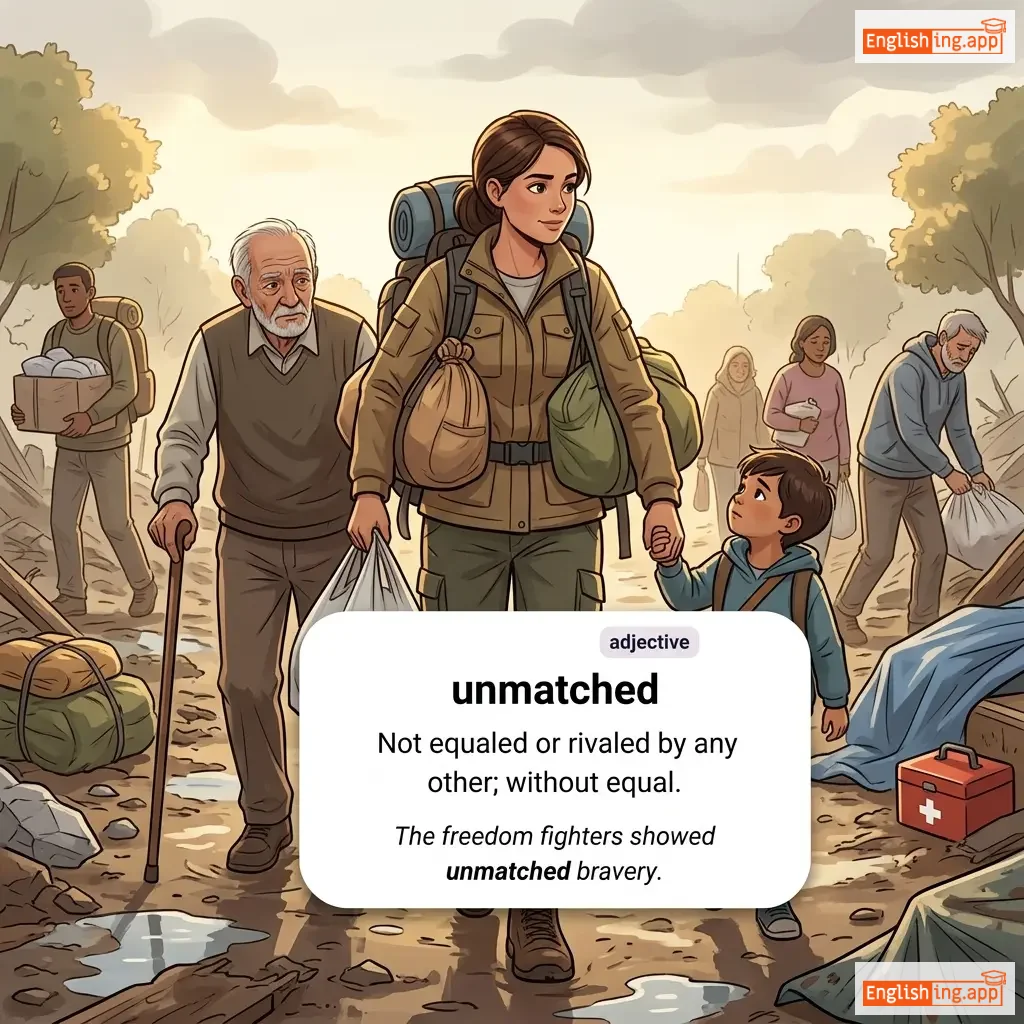
unmatched definition card — visual illustration of the meaning
adjective
ʌnˈmætʃt
incomparable (incomparable)

Not equaled or rivaled by any other; without equal.

"The freedom fighters showed unmatched bravery."

"Los luchadores por la libertad demostraron valentía incomparable." (Los luchadores por la libertad demostraron valentía incomparable.)
adjective
/ʌnˈmaɪndfəl/
despreocupado; descuidado; (despreocupado; descuidado)

not paying attention; careless; heedless

"She was unmindful of the danger around her."

"Ella no prestaba atención al peligro a su alrededor." (Ella no prestaba atencion al peligro a su alrededor.)
adjective
/ʌnˈmɪtɪɡeɪtɪd/
completo (kompleto)

absolute; not lessened or moderated

"The meeting was an unmitigated disaster."

"La reunión fue un desastre completo." (La reunion fue un desastre completo.)
adjective
/ʌnˈmɒdɪfaɪd/
sin modificar (sin modificar)

not changed from its original form or state

"The data was used in its unmodified form for analysis."

"Los datos se usaron en su forma sin modificar para el análisis." (los datos se usaron en su forma sin modificar para el analisis)
adjective
/ʌnˈnætʃrəl/
antinatural (antinatural)

contrary to the usual course of nature; artificial or abnormal

"The bright green color of the drink looked unnatural."

"El color verde brillante de la bebida parecía antinatural." (El color verde brillante de la bebida parecía antinatural.)
adverb
/ʌnˈnætʃrəli/
de manera antinatural (de manera antinatural)

in a way that is not natural or normal; excessively or strangely

"He smiled unnaturally, making everyone feel uncomfortable."

"Sonrió de manera antinatural, haciendo que todos se sintieran incómodos." (Sonrio de manera antinatural, haciendo que todos se sintieran incomodos)
adverb
/ʌnˈnesəserəli/
innecesariamente (innecesariamente)

to a greater extent than is needed; without necessity

"Don't worry unnecessarily about the exam."

"No te preocupes innecesariamente por el examen." (No te preocupes innecesariamente por el examen.)
adjective
/ʌnˈnɛsəsɛri/
innecesario (innecesario)

not needed or required

"The manager cut all unnecessary expenses to save costs."

"El gerente recortó todos los gastos innecesarios para ahorrar costos." (El gerente recortó todos los gastos innecesarios para ahorrar costos.)