Vocabularios

Descubra, aprenda y domine el vocabulario en inglés

adverb
/ˈtaɪtli/
fuertemente (fuertezmente)

in a way that is firm and difficult to move or open

"She held the baby tightly in her arms."

"Ella sostuvo al bebé fuertemente en sus brazos." (Ella sostuvo al bebe fuertemente en sus brazos.)
🙅‍♂️💵

tightwad (taɪtwɒd)

noun
/ˈtaɪtwɒd/
tacaño (tacano)

a person who is unwilling to spend money; a miser

"Everyone calls him a tightwad because he never buys gifts."

"Todos lo llaman tacaño porque nunca compra regalos." (Todos lo llaman tacano porque nunca compra regalos.)
noun
/ˈtaɪ.ɡrəs/
tigresa (tigresa)

an adult female tiger

"The powerful tigress hunted silently through the jungle."

"La poderosa tigresa cazó silenciosamente a través de la jungla." (La poderosa tigresa cazó silenciosamente a través de la jungla.)
noun
/tɪˈlɑpiə fɪʃ/
pez tilapia (pez tilapia)

a freshwater fish native to Africa, widely farmed for food due to its mild taste and fast growth

"Tilapia fish is one of the most commonly farmed fish species worldwide."

"El pez tilapia es una de las especies de peces más cultivadas en todo el mundo." (el pez tilapia es una de las especies de peces mas cultivadas en todo el mundo)
noun
/taɪl/
baldosa (baldosa)

a flat piece of baked clay or other material used for covering roofs, floors, or walls

"The kitchen floor is covered with ceramic tiles."

"El suelo de la cocina está cubierto con baldosas cerámicas." (El suelo de la cocina está cubierto con baldosas cerámicas.)
preposition
/tɪl/
hasta (hasta)

up to the time of; until

"She waited till midnight for his call."

"Ella esperó hasta la medianoche por su llamada." (Ella esperó hasta la medianoche por su llamada.)
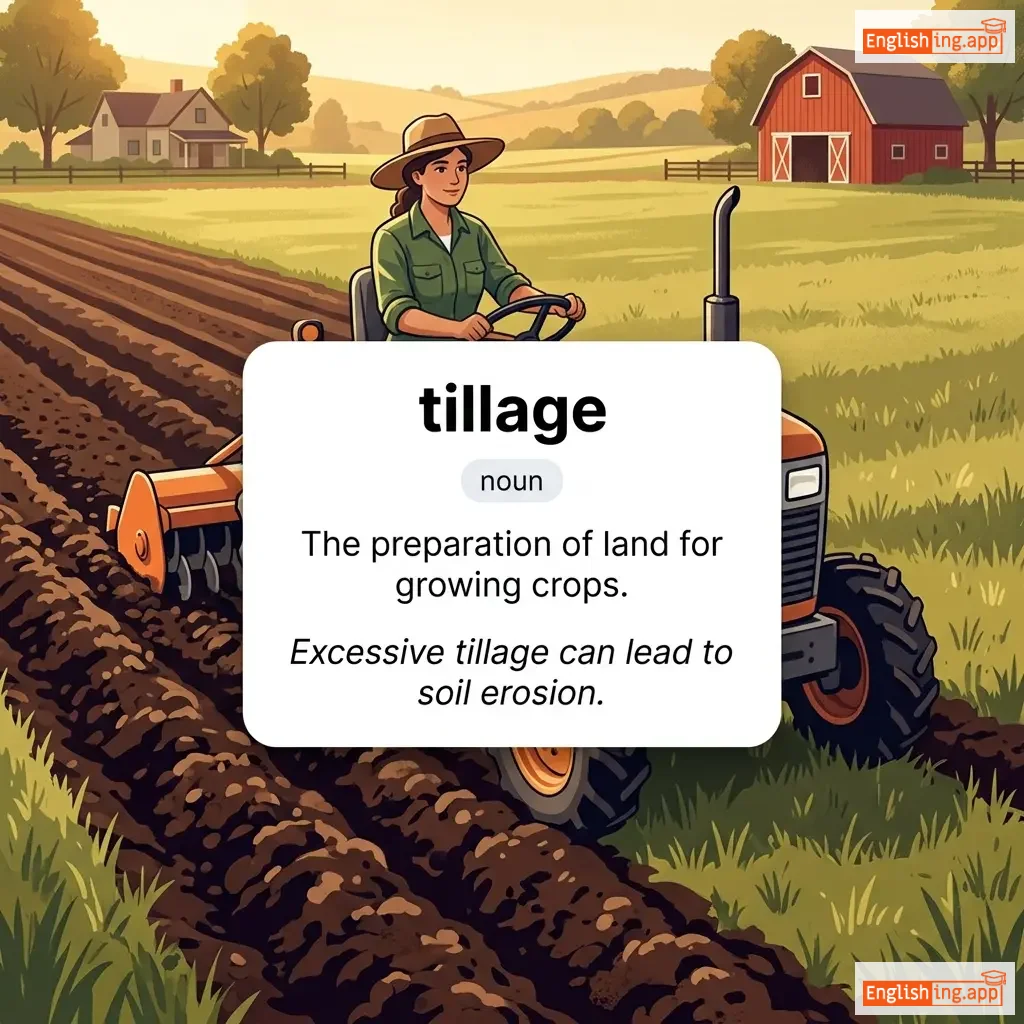
tillage definition card — visual illustration of the meaning
noun
ˈtɪl.ɪdʒ
labranza (labranza)

The preparation of land for growing crops.

"Excessive tillage can lead to soil erosion."

"La labranza excesiva puede causar erosión del suelo." (La labranza excesiva puede causar erosion del suelo.)
noun
/ˈtɪlər/
timón o persona que arada la tierra (timon o persona que arada la tierra)

A lever used to steer a boat or a person who tills the soil.

"The sailor gripped the tiller firmly to keep the boat on course."

"El marinero sujetó el timón firmemente para mantener el bote en curso." (El marinero sujeto el timon firmemente para mantener el bote en curso.)
noun
/tɪlθ/
condición del suelo (adecuación para sembrar cultivos) (condicion del suelo (adecuacion para sembrar cultivos))

The physical condition of soil in relation to its suitability for planting crops.

"The farmer checked the soil's tilth before planting the seeds."

"El agricultor revisó la tilth del suelo antes de sembrar las semillas." (El agricultor reviso la tilth del suelo antes de sembrar las semillas.)
noun
/ˈtɪmbər/
madera (madera)

wood prepared for use in building and carpentry

"The house was built entirely from local timber."

"La casa fue construida completamente con madera local." (La casa fue construida completamente con madera local.)
noun
/ˈtæmbər/ or /ˈtɪmbər/
característica del sonido musical o de la voz (caracteristica del sonido musical o de la voz)

The character or quality of a musical sound or voice as distinct from its pitch and intensity.

"Her voice had a warm timbre that soothed the audience."

"Su voz tenía un cálido timbre que calmaba a la audiencia." (Su voz tenia un calido timbre que calmaba a la audiencia.)
noun
/taɪm/
tiempo (tiempo)

a measured or measurable period during which an action, process, or condition exists or continues

"I don’t have enough time to finish the project."

"No tengo suficiente tiempo para terminar el proyecto." (No tengo suficiente tiempo para terminar el proyecto.)
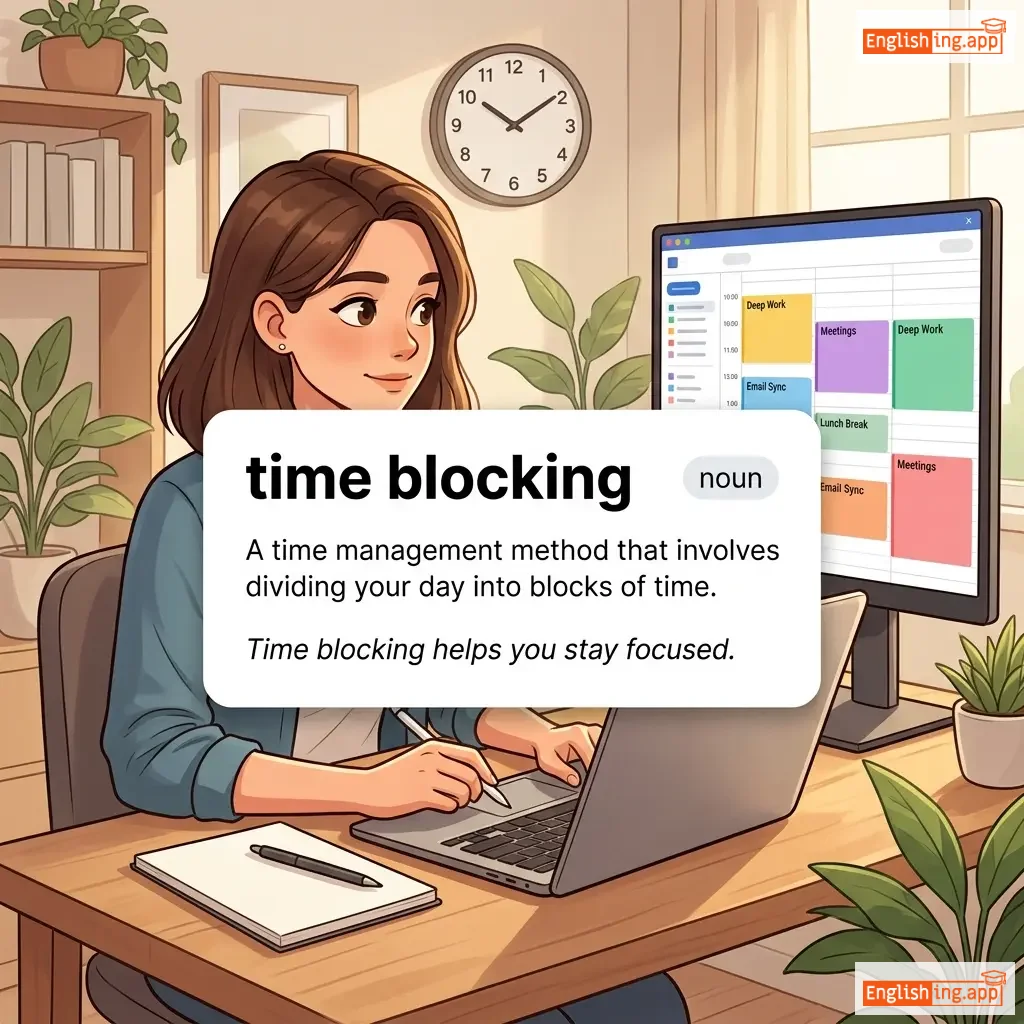
time blocking definition card — visual illustration of the meaning
noun
/taɪm ˈblɒk.ɪŋ/
bloqueo de tiempo (bloqueo de tiempo)

A time management technique where specific time slots are allocated for specific tasks or activities.

"Time-blocking helps in managing tasks efficiently."

"El time-blocking ayuda a gestionar las tareas de manera eficiente." (El time-blocking ayuda a gestionar las tareas de manera eficiente.)
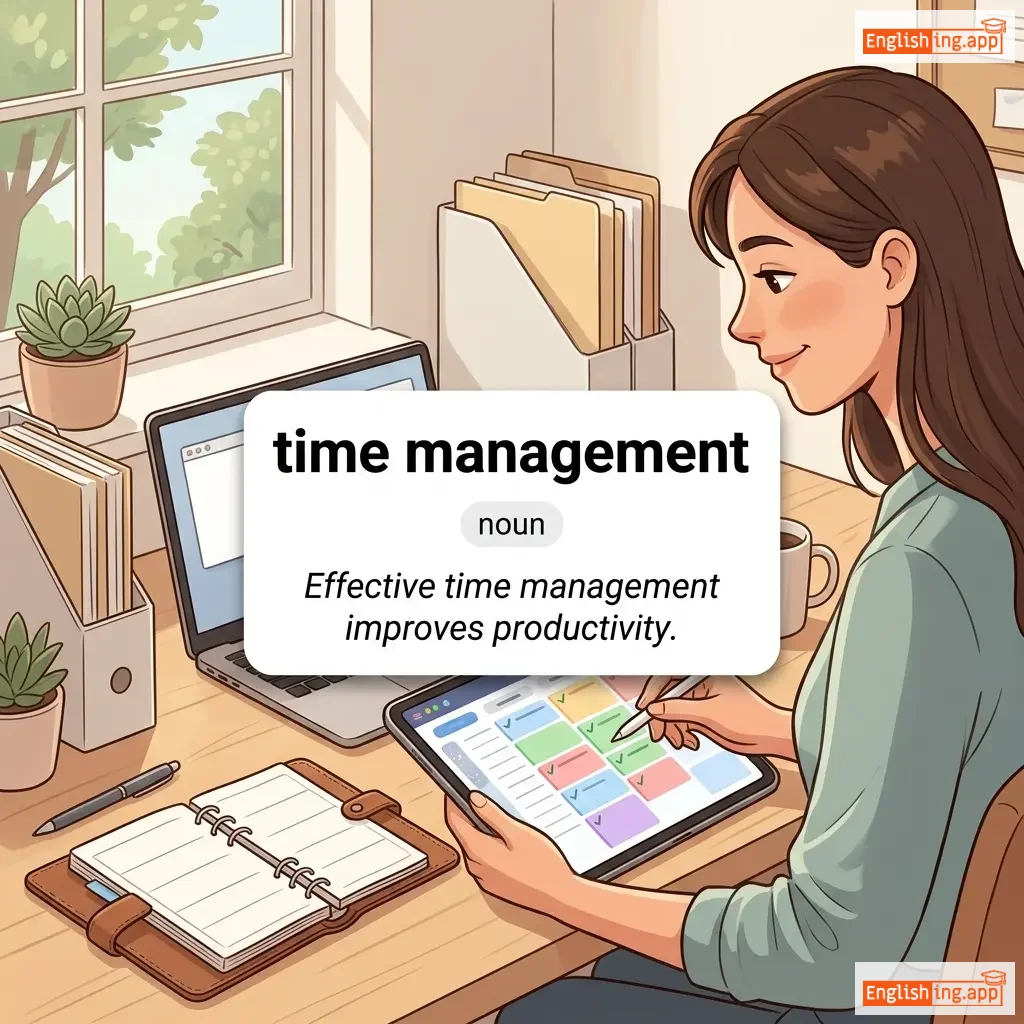
time management definition card — visual illustration of the meaning
noun
/taɪm ˈmæn.ɪdʒ.mənt/
gestión del tiempo (gestion del tiempo)

The ability to plan and control time effectively to accomplish tasks efficiently.

"Effective time management improves productivity."

"Una gestión efectiva del tiempo mejora la productividad." (Una gestion efectiva del tiempo mejora la productividad.)
verb
/taɪmd/
cronometrear (cronometrear)

to measure or record the duration or speed of something

"He timed the race with a stopwatch."

"Él cronometró la carrera con un cronómetro." (El cronometro la carrera con un cronometro.)
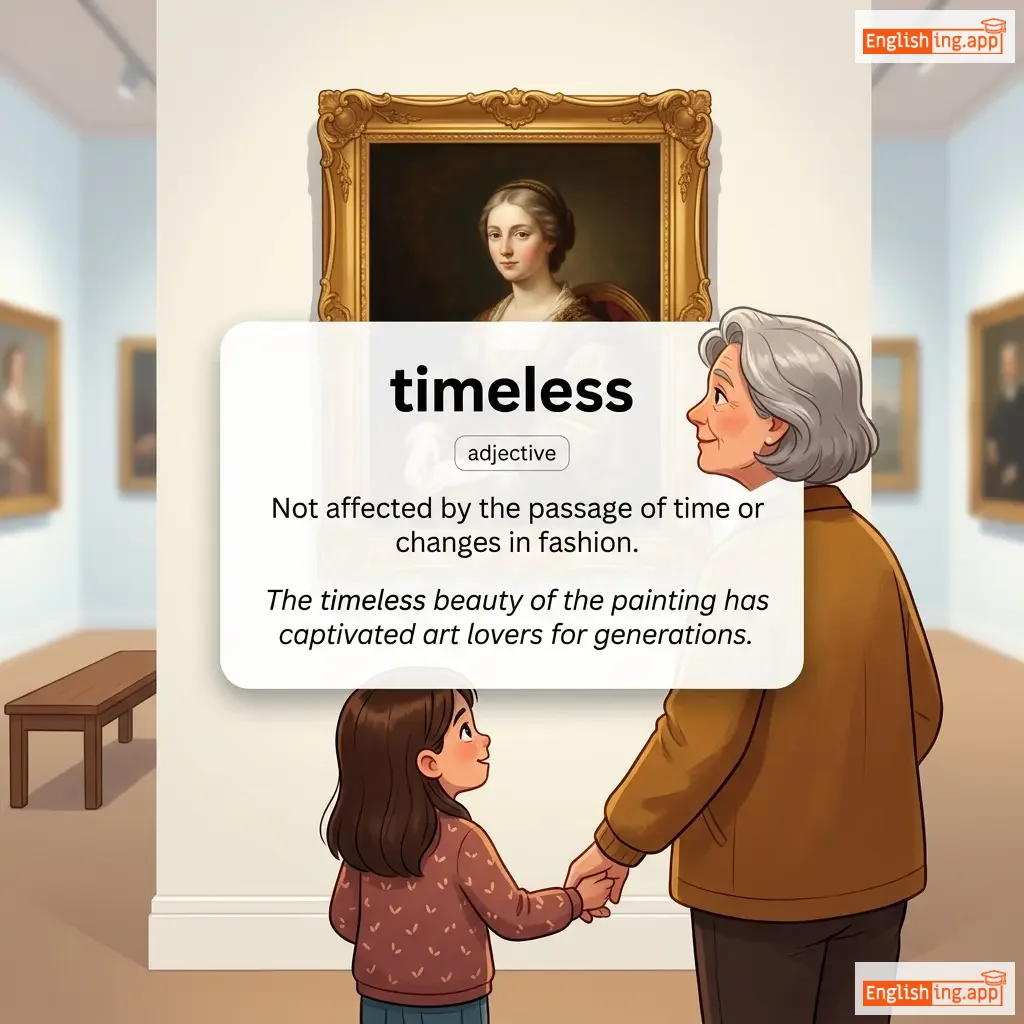
timeless definition card — visual illustration of the meaning
adjective
ˈtaɪmləs
atemporal (atemporal)

Not affected by the passage of time or changes in fashion.

"The timeless beauty of the painting has captivated art lovers for generations."

"La belleza atemporal de la pintura ha cautivado a los amantes del arte durante generaciones." (La belleza atemporal de la pintura ha cautivado a los amantes del arte durante generaciones.)
adjective
/ˈtaɪmli/
oportuno (oportuno)

Done or occurring at a favorable or useful time; opportune.

"Her timely advice helped me avoid a big mistake."

"Su consejo oportuno me ayudó a evitar un gran error." (su consejo oportuno me ayudo a evitar un gran error.)
timer definition card — visual illustration of the meaning
noun
ˈtaɪmər
temporizador (taimer)

An automatic mechanism for activating a device at a preset time; a device that measures time intervals.

"He set the timer for 30 minutes to complete the task."

"He programmed the timer for thirty minutes to complete the task." (El programo el temporizador para treinta minutos para completar la tarea.)
noun
/ˈtaɪm.teɪ.bəl/
horario (horario)

a schedule showing planned activities or events at particular times

"Please check the train timetable for departure times."

"por favor, verifique el horario del tren para los horarios de salida." (por favor, verifique el horario del tren para los horarios de salida.)
adjective
/ˈtaɪmwɔːrn/
desgastado por el tiempo (desgastado por el tiempo)

Worn or impaired by age; old and used many times.

"The timeworn house carried a sense of history and nostalgia."

"La casa desgastada por el tiempo llevaba una sensación de historia y nostalgia." (La casa desgastada por el tiempo llevaba una sensacion de historia y nostalgia.)
adjective
/ˈtɪmɪd/
tímido (timido)

lacking courage or confidence; easily frightened

"The timid child hid behind his mother when strangers approached."

"El niño tímido se escondió detrás de su madre cuando se acercaron los extraños." (El nino timido se escondio detras de su madre cuando se acercaron los extranos.)
noun
/tɪˈmɪdəti/
timidez (timidez)

lack of courage or self-confidence

"His timidity kept him from speaking up during the meeting."

"Su timidez le impidió hablar durante la reunión." (Su timidez le impidió hablar durante la reunión.)
noun
/ˈtaɪmɪŋ/
momento adecuado (momento adecuado)

the choice, judgment, or control of when something should be done

"Good timing is essential in business negotiations."

"Un buen momento es esencial en las negociaciones comerciales." (Un buen momento es esencial en las negociaciones comerciales.)
adjective
/ˈtɪmərəs/
temeroso (temeroso)

showing or suffering from nervousness, fear, or lack of confidence

"The timorous student hesitated to ask the teacher a question."

"El estudiante temeroso dudó en hacerle una pregunta al profesor." (El estudiante temeroso dudó en hacerle una pregunta al profesor.)
noun
/tɪn/
lata (lata)

a metal container; a chemical element (Sn)

"She bought a tin of biscuits from the store."

"Ella compró una lata de galletas en la tienda." (Ella compro una lata de galletas en la tienda.)
noun
/ˈtɪŋktʃər/
un leve trazo, una medicina hecha disolviendo una droga en alcohol (un leve trazo, una medicina hecha disolviendo una droga en alcohol)

a slight trace of something; a medicine made by dissolving a drug in alcohol

"There was a tincture of sadness in her smile."

"Había un leve trazo de tristeza en su sonrisa." (Había un leve trazo de tristeza en su sonrisa.)
noun, verb
/tɪndʒ/
un toque ligero de color o sabor (un toke ligero de color o sabor)

a slight added color, flavor, or feeling; to add a slight amount of color or quality

"Her voice was tinged with sadness."

"Su voz estaba teñida de tristeza." (Su voz estaba teñida de tristeza.)
verb
/ˈtɪŋkər/
ajustar (ajustar)

to make small adjustments or repairs to something, often experimentally or imperfectly

"He likes to tinker with old radios in his garage."

"A él le gusta ajustar radios viejos en su garaje." (A él le gusta ajustar radios viejos en su garaje.)
noun
/tɪnt/
matiz (matiz)

a slight shade or variation of a color

"The walls were painted white with a slight blue tint."

"Las paredes fueron pintadas de blanco con un ligero tinte azul." (Las paredes fueron pintadas de blanco con un ligero tinte azul.)
adjective
/ˈtaɪni/
muy pequeño (muy pequeno)

very small

"She held a tiny kitten in her hands."

"Ella sostuvo un pequeño gatito en sus manos." (Ella sostuvo un pequeno gatito en sus manos.)
noun
/tɪp/
consejo (consejo)

a small but useful piece of advice

"I received a tip on how to improve my presentation."

"Recibí un consejo sobre cómo mejorar mi presentación." (Recibi un consejo sobre como mejorar mi presentacion.)
verb
/ˈtɪpəl/
beber (beber)

to drink alcohol, especially regularly or in small amounts

"He likes to tipple at the local pub after work."

"A él le gusta beber en el pub local después del trabajo." (A él le gusta beber en el pub local después del trabajo.)
adjective
/ˈtɪpsi/
ligeramente ebria (ligeramente ebria)

slightly drunk

"She felt tipsy after just one glass of wine."

"Se sintió un poco ebria después de solo una copa de vino." (Se sintió un poco ebria después de solo una copa de vino.)
adjective
/ˈtɪp.tɒp/
excelente; de primera calidad (excelente; de primera calidad)

of the highest quality; excellent; in perfect condition

"The car is in tiptop condition."

"El coche está en excelente estado." (El coche esta en excelente estado)
noun
/taɪˈreɪd/
diatriba (diatriba)

a long, angry, or critical speech

"The manager launched into a tirade about poor performance."

"El gerente lanzó una diatriba sobre el bajo rendimiento." (El gerente lanzó una diatriba sobre el bajo rendimiento.)
noun
/taɪər/
llanta (llanta)

a rubber covering around a wheel

"The car’s tire burst on the highway."

"La llanta del coche explotó en la carretera." (La llanta del coche explotó en la carretera.)
adjective
/ˈtaɪərd/
cansado (cansado)

in need of rest or sleep

"I feel so tired after the long journey."

"Me siento tan cansado después del largo viaje." (Me siento tan cansado despues del largo viaje.)
adjective
/ˈtaɪərləs/
incansable (incansable)

Showing great effort or energy without becoming tired.

"She worked tirelessly to complete the project on time."

"Trabajó incansablemente para completar el proyecto a tiempo." (Trabajo incansablemente para completar el proyecto a tiempo.)
adjective
/ˈtaɪərsəm/
tedioso (tedioso)

Causing one to feel bored, annoyed, or tired.

"The long meeting became very tiresome."

"La larga reunión se volvió muy tediosa." (La larga reunión se volvió muy tediosa.)
adjective
/ˈtaɪərɪŋ/
agotador (agotador)

causing someone to feel exhausted or in need of rest

"The long journey was extremely tiring."

"El largo viaje fue extremadamente agotador." (El largo viaje fue extremadamente agotador)
noun
/ˈtɪʃ.uː/
pañuelo (panuelo)

a piece of soft absorbent paper or fabric

"She used a tissue to wipe her nose."

"Ella usó un pañuelo para limpiarse la nariz." (Ella uso un panuelo para limpiarse la nariz.)
adjective
/taɪˈtænɪk/
titanico (titanico)

Of exceptional strength, size, or power.

"The company made titanic efforts to expand into new markets."

"La compañía hizo esfuerzos titánicos para expandirse a nuevos mercados." (La compania hizo esfuerzos titanicos para expandirse a nuevos mercados.)
noun
/ˈtɪt.bɪt/
un pequeño trozo de comida sabrosa; una pequeña pieza interesante de información (titbit)

a small piece of tasty food; a small interesting piece of information

"She served delicious titbits at the party."

"Ella sirvió deliciosos bocaditos en la fiesta." (ella sirvio deliciosos bocaditos en la fiesta)
noun
/taɪð/
décima parte (decima parte)

A tenth part of one’s income or produce, often given as a religious offering.

"He gave a tithe of his earnings to the church."

"Él dio una décima parte de sus ganancias a la iglesia." (Él dio una decima parte de sus ganancias a la iglesia.)
verb
/ˈtɪtəleɪt/
excitar (exitar)

To excite or amuse, especially in a slightly sexual or playful way.

"The comedian's jokes titillated the audience."

"Los chistes del comediante excitaban a la audiencia." (Los chistes del comediante excitaban a la audiencia.)
noun
/ˈtaɪtəl/
título (titulo)

the name of a book, film, or piece of writing; also a formal designation or rank

"The book's title changed at the last minute."

"El título del libro cambió en el último minuto." (El titulo del libro cambio en el ultimo minuto.)
verb
/ˈtɪtər/
reírse tímidamente (reirse timidamente)

to laugh in a quiet, nervous, or restrained way

"The students began to titter when the projector froze."

"Los estudiantes comenzaron a reírse tímidamente cuando el proyector se detuvo." (Los estudiantes comenzaron a reirse timidamente cuando el proyector se detuvo.)
adjective
/ˈtɪtjələr/
titular (titular)

holding a title or position in name only without real power; relating to the title of a work

"She is the titular head of the committee, but decisions are made by the coordinator."

"Ella es la titular de la comisión, pero las decisiones las toma el coordinador." (Ella es la titular de la comision, pero las decisiones las toma el coordinador.)
➡️

to (tu)

preposition
/tuː/
a (a)

used for expressing motion or direction

"She is going to the market."

"Ella va al mercado." (Ella va al mercado.)
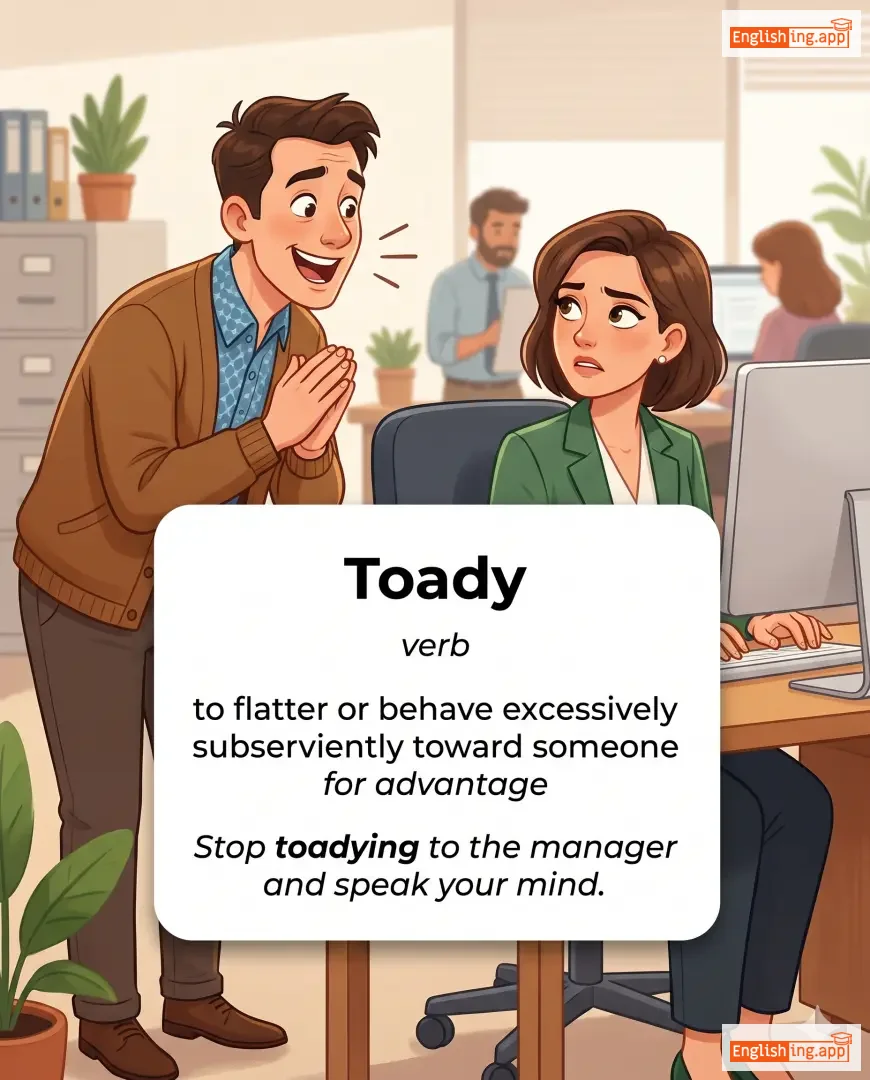
Toady definition card — visual illustration of the meaning
🙇‍♂️

Toady (tóudi)

verb
/ˈtoʊdi/
adular (adular)

to flatter or behave excessively subserviently toward someone for advantage

"Stop toadying to the manager and speak your mind."

"Deja de adular al gerente y expresa tu opinión." (Deja de adular al gerente y expresa tu opinión.)