Vocabularios

Descubra, aprenda y domine el vocabulario en inglés

verb
/ˈtɛrəˌfaɪ/
aterrorizar (aterrorizar)

To cause someone to feel extreme fear.

"The loud thunder terrified the children."

"El fuerte trueno aterrorizó a los niños." (El fuerte trueno aterrorizó a los niños.)
adjective
/ˌtɛrɪˈtɔːriəl/
territorial (territorial)

Relating to the ownership or control of land or territory.

"The two countries had a territorial dispute over the island."

"Los dos países tuvieron una disputa territorial sobre la isla." (Los dos paises tuvieron una disputa territorial sobre la isla.)
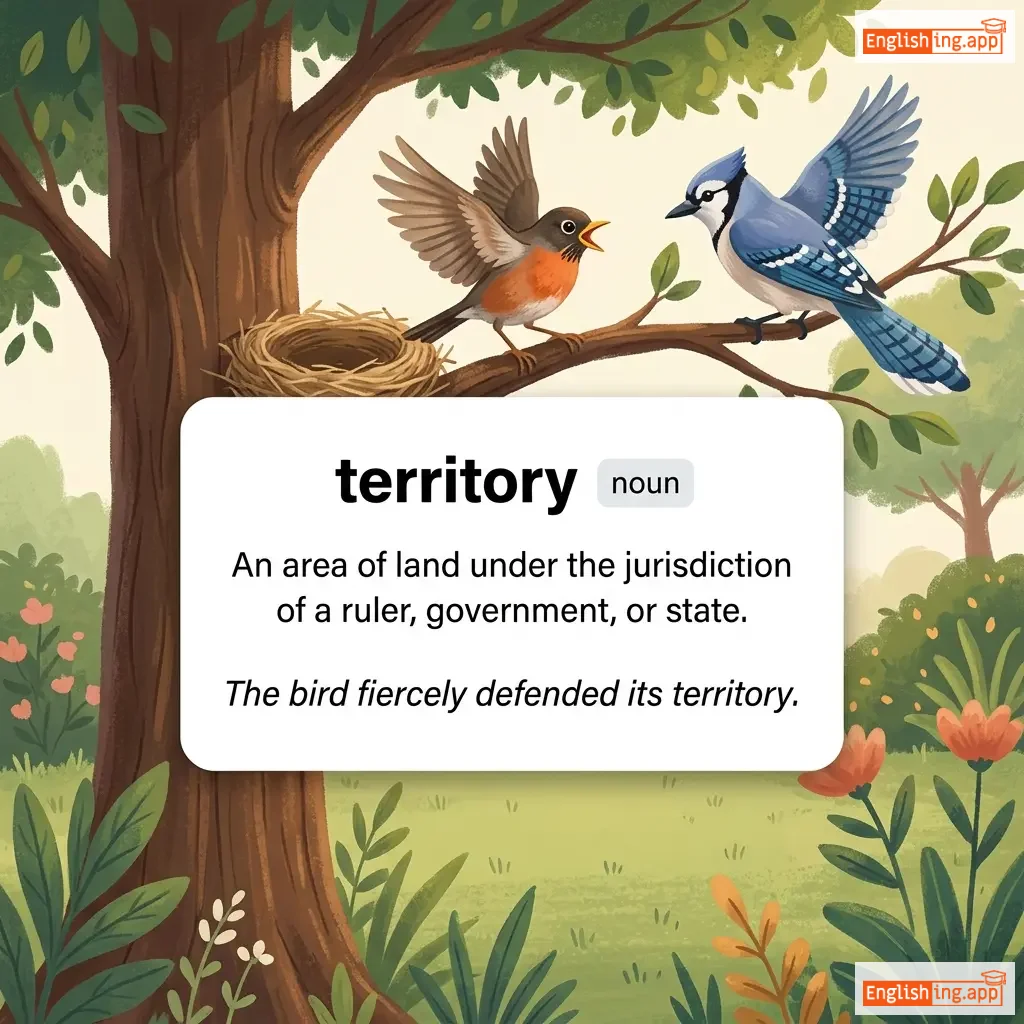
territory definition card — visual illustration of the meaning
noun
/ˈtɛrɪˌtɔːri/
territorio (territorio)

An area of land under the jurisdiction of a ruler, government, or state.

"The bird fiercely defended its territory."

"El pájaro defendió ferozmente su territorio." (El pajaro defendio ferozmente su territorio.)
noun
/ˈtɛrər/
terror (terror)

Extreme fear or dread.

"The villagers fled in terror during the attack."

"Los aldeanos huyeron aterrados durante el ataque." (Los aldeanos huyeron aterrados durante el ataque.)
noun
/ˈtɛrərɪzəm/
terrorismo (terrorismo)

the use of violence or threats to intimidate or coerce, especially for political purposes

"Terrorism is a serious threat to global peace and security."

"El terrorismo es una amenaza seria para la paz y seguridad global." (El terrorismo es una amenaza seria para la paz y seguridad global.)
noun
/ˈtɛrərɪst/
terrorista (terrorista)

a person who uses violence or threats to intimidate or coerce, especially for political purposes

"The terrorist was arrested by the police after the attack."

"El terrorista fue arrestado por la policía después del ataque." (El terrorista fue arrestado por la policía después del ataque.)
adjective
/tɜːrs/
conciso (conciso)

brief and to the point; sparing in the use of words

"His reply was terse and ended the conversation quickly."

"Su respuesta fue concisa y terminó rápidamente la conversación." (su respuesta fue concisa y termino rapidamente la conversacion.)
adjective
/ˈtɜːrʃieri/
terciario (tertiary)

third in order, rank, or level

"He is pursuing his tertiary education at the university."

"El esta cursando su educacion terciaria en la universidad." (El esta cursando su educacion terciaria en la universidad.)
adjective
/ˈtɛsəleɪtɪd/
enlazado (enlazado)

arranged in a pattern of repeated shapes fitting together without gaps

"The tessellated floor was made of colorful tiles arranged in perfect symmetry."

"El piso enlazado estaba hecho de baldosas coloridas dispuestas en simetría perfecta." (El piso enlazado estaba hecho de baldosas coloridas dispuestas en simetría perfecta.)
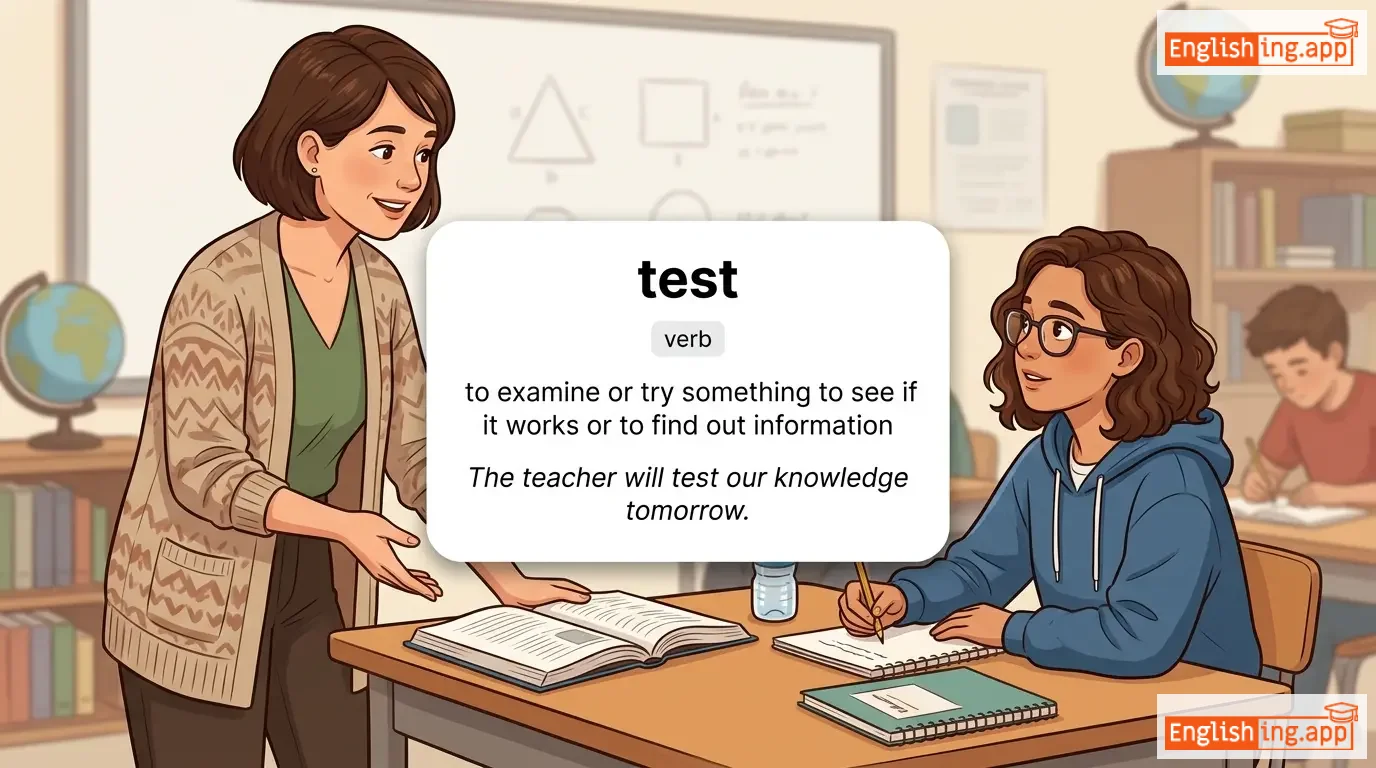
test definition card — visual illustration of the meaning
noun
/tɛst/
prueba (prueba)

a procedure intended to establish the quality, performance, or reliability of something

"The test results will determine whether the treatment is effective."

"Los resultados de la prueba determinarán si el tratamiento es efectivo." (Los resultados de la prueba determinarán si el tratamiento es efectivo.)
noun
/ˈtɛstəmənt/
testamento / prueba (testamento / prueba)

a person's will; or strong evidence of something

"His success is a testament to his hard work and dedication."

"Su éxito es un testamento de su trabajo arduo y dedicación." (Su éxito es un testamento de su trabajo arduo y dedicación.)
noun
/ˈtɛsteɪtər/
testador (testador)

a person who has made a will

"The lawyer read the will of the deceased testator."

"El abogado leyó el testamento del testador fallecido." (El abogado leyó el testamento del testador fallecido.)
verb
/ˈtɛstəfaɪ/
testificar (testificar)

to make a statement or declaration under oath or to give evidence

"She was called to testify in court about the accident."

"Fue llamada a testificar en el tribunal sobre el accidente." (Fue llamada a testificar en el tribunal sobre el accidente.)
noun
/ˌtɛstɪˈmoʊniəl/
testimonio (testimonio)

A formal statement testifying to someone's character, qualifications, or the quality of a product or service.

"The company shared a glowing testimonial from a satisfied customer."

"La compañía compartió un testimonio brillante de un cliente satisfecho." (La compania compartio un testimonio brillante de un cliente satisfecho.)
testimonials definition card — visual illustration of the meaning
noun
/ˌtɛstɪˈməʊnɪəlz/
testimonios, cartas de recomendación (testimonios, cartas de recomendacion)

Written or spoken statements of praise or recommendation from clients or customers.

"Positive testimonials can enhance a company's reputation."

"Los testimonios positivos pueden mejorar la reputación de una empresa." (Los testimonios positivos pueden mejorar la reputación de una empresa.)
noun
/ˈtɛstəˌmoʊni/
testimonio (testimonio)

A formal statement given in a court of law or evidence supporting a fact.

"Her testimony in court helped convict the criminal."

"Su testimonio en el juicio ayudó a condenar al criminal." (Su testimonio en el juicio ayudo a condenar al criminal.)
noun
/ˈtɛstɪŋ/
prueba (prueba)

the process of assessing or evaluating something, often by trying it out

"The testing of the new software is still ongoing."

"La prueba del nuevo software aún está en curso." (La prueba del nuevo software aún está en curso.)
adjective
/ˈtɛsti/
irritable (irritable)

Easily irritated or annoyed.

"He became testy when asked the same question repeatedly."

"Se puso irritable cuando le hicieron la misma pregunta repetidamente." (Se puso irritable cuando le hicieron la misma pregunta repetidamente.)
verb
/ˈtɛðər/
atar (atar)

To tie an animal with a rope or chain so it cannot move far.

"The farmer tethered the goat to a post."

"El granjero ató la cabra a un poste." (El granjero ató la cabra a un poste.)
noun
/tɛkst/
texto (texto)

a written or printed work or passage, especially a book or document

"The teacher asked us to read the text on page 50."

"El maestro nos pidió leer el texto en la página 50." (El maestro nos pidió leer el texto en la página 50.)
noun
/ˈtɛkstbʊk/
libro de texto (libro de texto)

a book used for studying a subject in school or college

"She bought a new biology textbook for her class."

"Ella compró un nuevo libro de biología para su clase." (Ella compró un nuevo libro de biología para su clase.)
noun
/ˈtek.staɪl/
textil (textil)

a type of cloth or woven fabric made by knitting or weaving fibers

"Bangladesh is famous for its high-quality textile industry."

"Bangladesh es famoso por su industria textil de alta calidad." (Bangladesh es famoso por su industria textil de alta calidad.)
noun
/ˈtɛkstʃər/
textura (textura)

the way something feels when you touch it; the quality of a surface or substance

"The fabric has a soft and smooth texture."

"La tela tiene una textura suave y lisa." (La tela tiene una textura suave y lisa.)
conjunction
/ðæn/
que (que)

used to introduce the second element in a comparison

"She is taller than her brother."

"Ella es más alta que su hermano." (Ella es más alta que su hermano.)
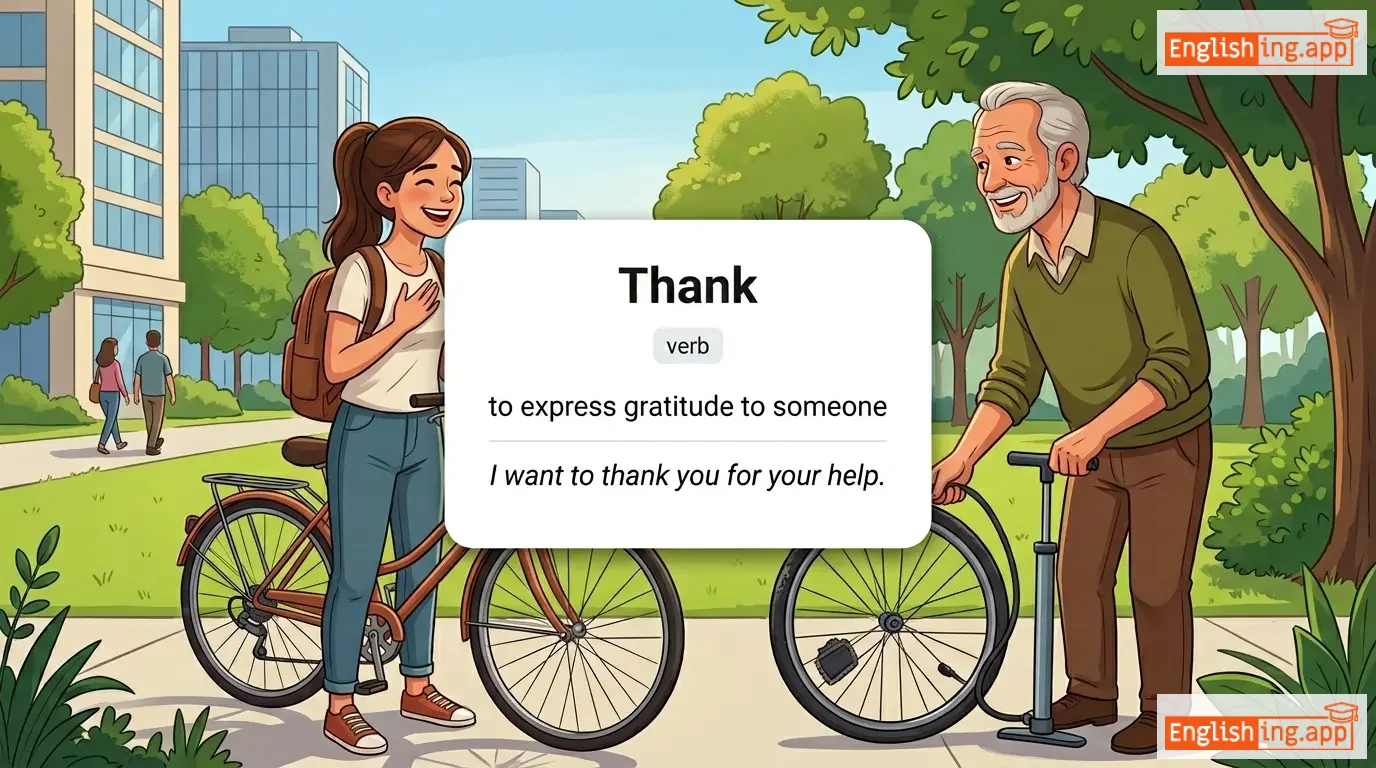
Thank definition card — visual illustration of the meaning
verb
/θæŋk/
agradecer (agradecer)

to express gratitude to someone

"I want to thank you for your help."

"Quiero agradecerte por tu ayuda." (Quiero agradecerte por tu ayuda.)
adjective
/ˈθæŋk.fəl/
agradecido; agradecida (agradecido; agradecida)

pleased and relieved; expressing gratitude; appreciative

"I am thankful for all your help and support."

"Estoy agradecido por toda tu ayuda y apoyo." (Estoy agradecido por toda tu ayuda y apoyo.)
adverb
/ˈθæŋkfəli/
afortunadamente (afortunadamente)

used to express relief or gratitude

"Thankfully, she arrived just in time for the meeting."

"Afortunadamente, ella llegó justo a tiempo para la reunión." (Afortunadamente, ella llegó justo a tiempo para la reunión.)
noun
/θæŋks/
gracias (gracias)

an expression of gratitude

"Thanks for helping me with the project."

"Gracias por ayudarme con el proyecto." (Gracias por ayudarme con el proyecto.)
noun
/ˈθæŋksˌɡɪvɪŋ/
Día de Acción de Gracias (Dia de Accion de Gracias)

an annual holiday in the US for giving thanks, celebrated with a meal

"We spent Thanksgiving dinner with our family."

"Pasamos la cena de Acción de Gracias con nuestra familia." (Pasamos la cena de Accion de Gracias con nuestra familia.)
pronoun
/ðæt/
ese (ese)

used to identify a specific person or thing observed or heard

"That is my book on the table."

"Ese es mi libro en la mesa." (Ese es mi libro en la mesa.)
noun
/ˈθɔːməˌtɜrdʒɪst/
taumaturgo (taumaturgo)

A worker of miracles or magician.

"The thaumaturgist amazed the audience with his tricks."

"El taumaturgo sorprendió a la audiencia con sus trucos." (El taumaturgo sorprendió a la audiencia con sus trucos.)
verb
/θɔː/
derretir (derretir)

to melt or cause to melt after being frozen

"The ice began to thaw in the sun."

"El hielo comenzó a derretirse bajo el sol." (El hielo comenzó a derretirse bajo el sol.)
article
/ðə/
el/la/los/las (el/la/los/las)

used to specify a noun as something already mentioned or known

"The sun rises in the east."

"El sol sale por el este." (El sol sale por el este.)
noun
/ˈθiː.ɑːr.ki/
tearquía (tearquia)

Rule or government by the gods; divine sovereignty.

"In ancient cultures, some societies believed in thearchy where gods directly guided human affairs."

"En las culturas antiguas, algunas sociedades creían en la tearquía, donde los dioses guiaban directamente los asuntos humanos." (En las culturas antiguas, algunas sociedades creían en la tearquía, donde los dioses guiaban directamente los asuntos humanos.)
noun
/ˈθiːətər/
teatro (teatro)

a building or area for dramatic performances

"We are going to the theater tonight."

"Vamos al teatro esta noche." (Vamos al teatro esta noche.)
adjective
/θiˈætrɪkl/
teatral (teatral)

Relating to the theater or exaggerated and dramatic in behavior or style.

"Her theatrical performance won the audience's applause."

"Su actuación teatral obtuvo el aplauso del público." (Su actuacion teatral obtuvo el aplauso del publico.)
noun
/θɛft/
robo (robo)

the action or crime of stealing

"The theft of his wallet was reported to the police."

"El robo de su billetera fue reportado a la policía." (El robo de su billetera fue reportado a la policía.)
👨‍👩‍👧‍👦

their (ðɛər)

pronoun
/ðɛər/
su (su)

belonging to or associated with the people or things previously mentioned

"Their house is on the corner."

"Su casa está en la esquina." (Su casa está en la esquina.)
pronoun
/ðɛərz/
de ellos (de ellos)

belonging to them; that which is theirs

"This book is theirs, not ours."

"Este libro es de ellos, no nuestro." (Este libro es de ellos, no nuestro.)
noun
/ˈθiːɪzəm/
teísmo (teismo)

Belief in the existence of a god or gods, especially a creator who intervenes in the universe.

"Theism is central to many world religions."

"El teísmo es central en muchas religiones del mundo." (El teísmo es central en muchas religiones del mundo.)
pronoun
/ðɛm/
ellos (ellos)

used to refer to people or things previously mentioned or easily identified

"I saw them at the park yesterday."

"Los vi a ellos en el parque ayer." (Los vi a ellos en el parque ayer.)
adjective
/θiːˈmætɪk/
temático (tematico)

Relating to or based on a theme.

"The book is organized into thematic chapters."

"El libro está organizado en capítulos temáticos." (El libro está organizado en capítulos temáticos.)
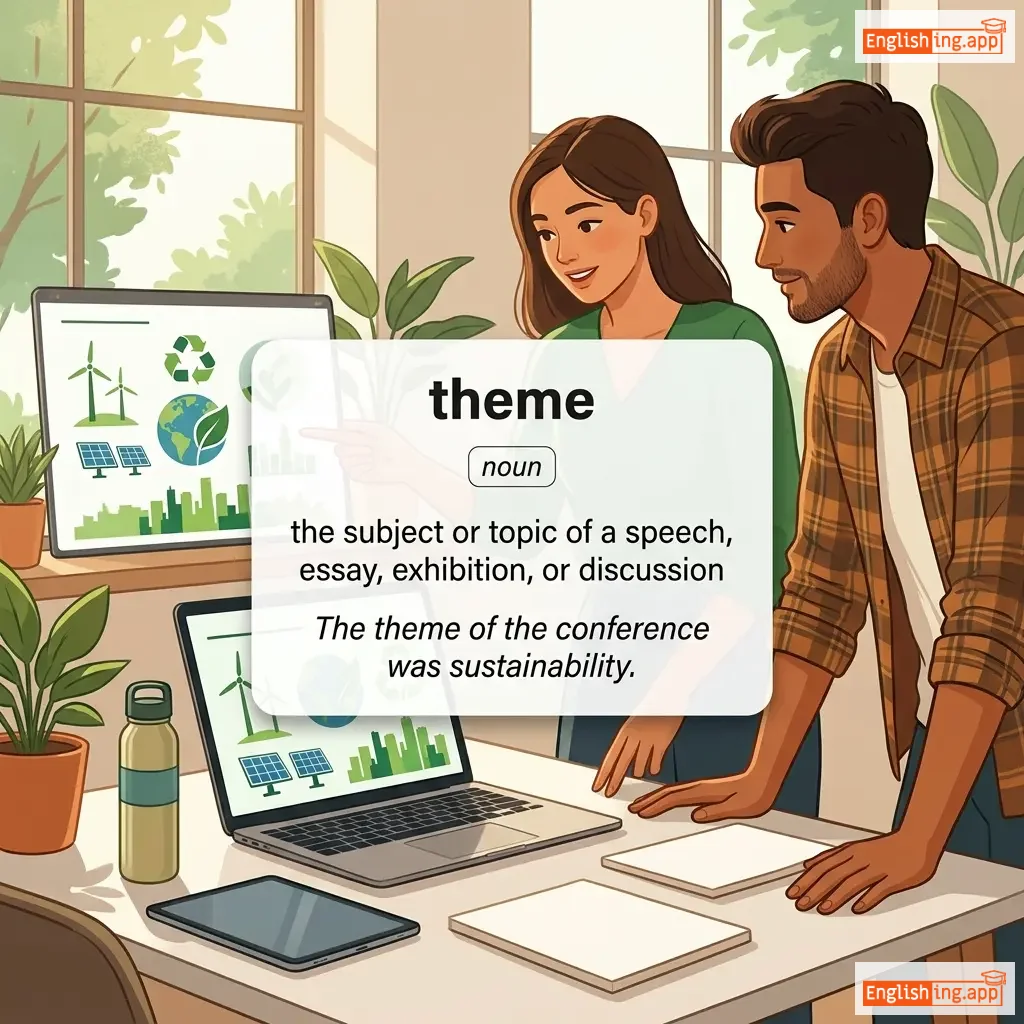
theme definition card — visual illustration of the meaning
noun
/θiːm/
tema (tema)

the subject or topic of a speech, essay, exhibition, or discussion

"The theme of the conference was sustainability."

"El tema de la conferencia fue la sostenibilidad." (El tema de la conferencia fue la sostenibilidad.)
pronoun
/ðəmˈsɛlvz/
a sí mismos (a si mismos)

used to emphasize the subject of the sentence or to refer to the subject doing something to itself

"They fixed the problem themselves."

"Ellos arreglaron el problema por sí mismos." (Ellos arreglaron el problema por si mismos.)
adverb
/ðɛn/
entonces (entonces)

at that time; next in order of time or place

"We went to the park, and then we had lunch."

"Fuimos al parque, y luego comimos." (Fuimos al parque, y luego comimos.)
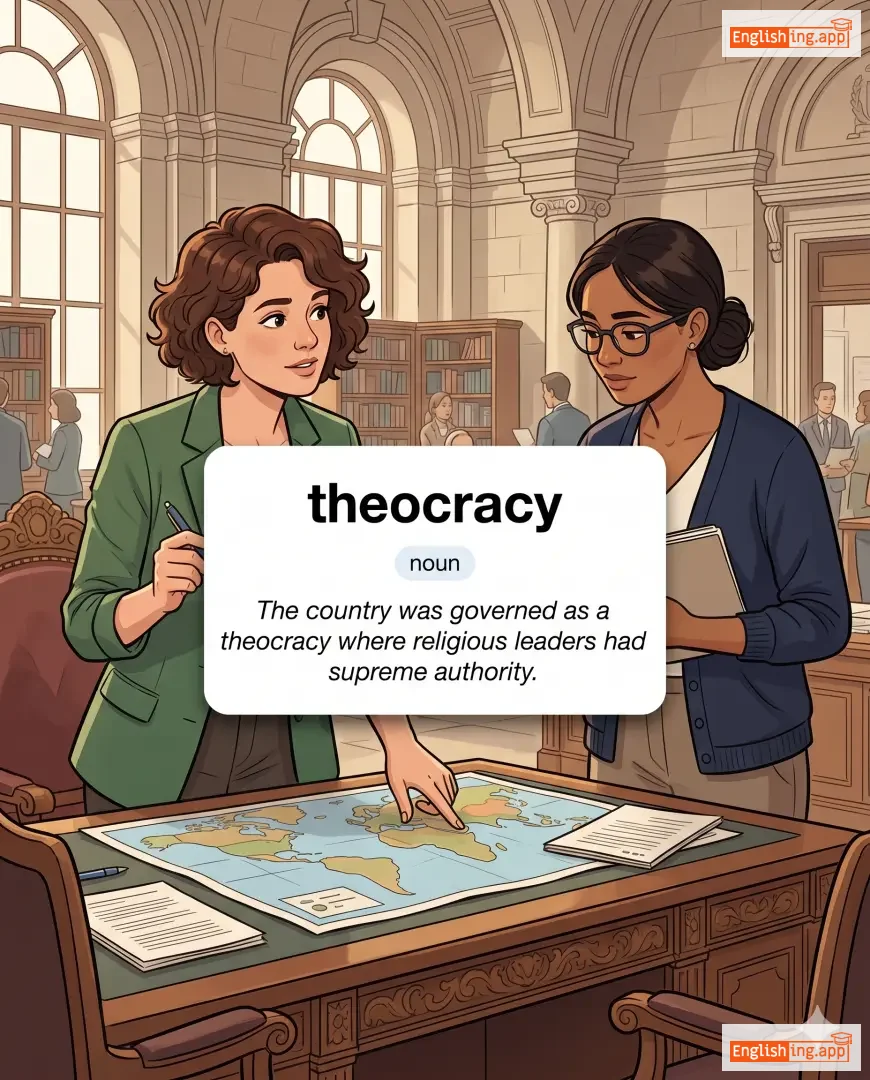
theocracy definition card — visual illustration of the meaning
noun
/θiˈɒkrəsi/
teocracia (teocracia)

A system of government in which priests or religious leaders rule in the name of God or a deity.

"The country was governed as a theocracy where religious leaders had supreme authority."

"El país era gobernado como una teocracia donde los líderes religiosos tenían la autoridad suprema." (El pais era gobernado como una teocracia donde los lideres religiosos tenian la autoridad suprema.)
noun
/θiˈɒkrəsi/
teocracia (teokracia)

Government or rule by religious leaders or clergy.

"Theocrasy often merges religious authority with political power."

"La teocracia a menudo fusiona la autoridad religiosa con el poder político." (La teocracia a menudo fusiona la autoridad religiosa con el poder politico.)
noun
/ˌθiːəˈloʊdʒən/
teólogo (teologo)

A person who studies or is an expert in theology.

"Theologians often debate complex questions of faith and morality."

"Los teólogos a menudo debaten sobre preguntas complejas de fe y moralidad." (Los teologos a menudo debaten sobre preguntas complejas de fe y moralidad.)
adjective
/ˌθiːəˈlɒdʒɪkl/
teológico (teologico)

Relating to the study of theology or religious belief.

"He wrote a theological paper on the concept of divine justice."

"Escribió un artículo teológico sobre el concepto de justicia divina." (Escribio un articulo teologico sobre el concepto de justicia divina.)
noun
/θiˈɒlədʒi/
teología (teologia)

The study of the nature of God and religious beliefs.

"She is pursuing a degree in theology at the university."

"Ella está cursando una carrera en teología en la universidad." (Ella está cursando una carrera en teología en la universidad.)