Vocabularios

Descubra, aprenda y domine el vocabulario en inglés

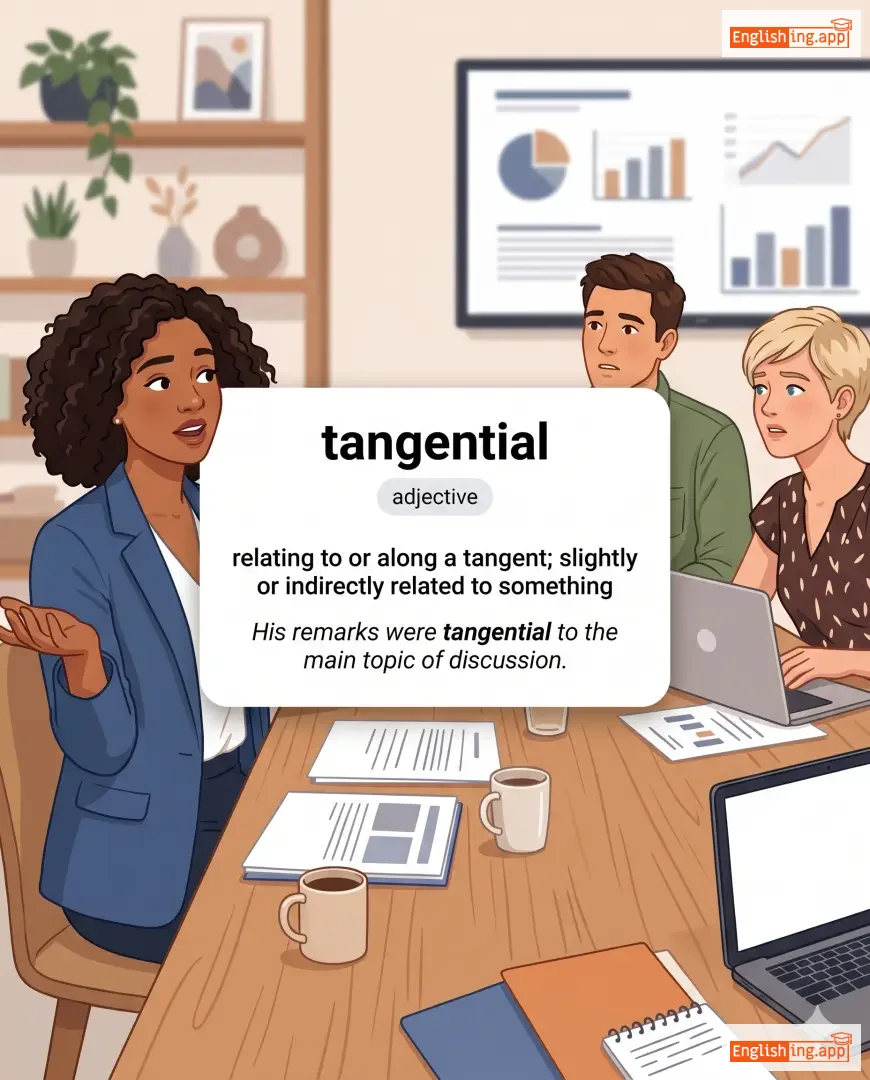
tangential definition card — visual illustration of the meaning
adjective
/tænˈdʒɛnʃəl/
tangencial (tangencial)

relating to or along a tangent; slightly or indirectly related to something

"His remarks were tangential to the main topic of discussion."

"Sus comentarios fueron tangenciales al tema principal de la discusión." (Sus comentarios fueron tangenciales al tema principal de la discusión.)
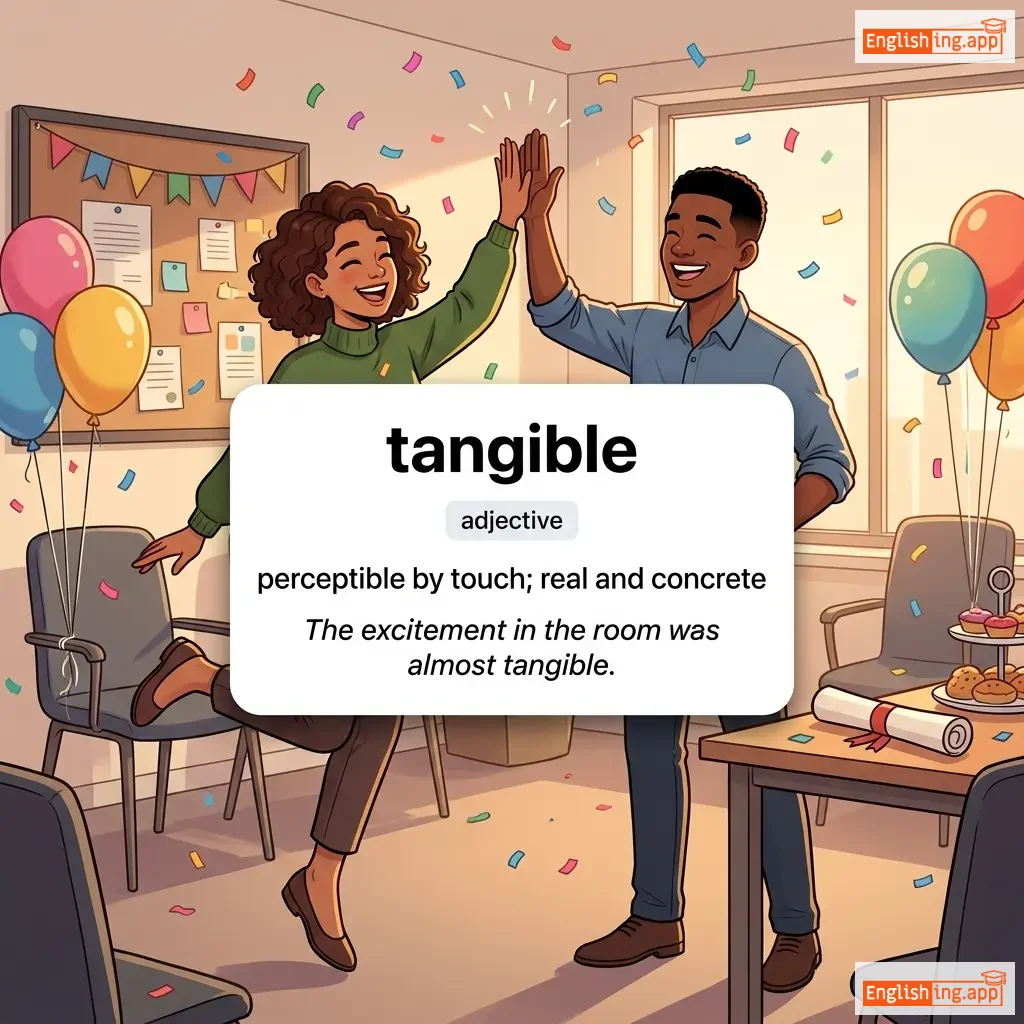
tangible definition card — visual illustration of the meaning
adjective
/ˈtændʒəbl/
tangible (tangible)

perceptible by touch; real and concrete

"The excitement in the room was almost tangible."

"La emoción en la habitación era casi tangible." (La emocion en la habitacion era casi tangible.)
adjective
/ˈtæŋ.i/
ácido (acido)

Having a strong, sharp, and pleasantly biting flavor or taste.

"The sauce had a tangy flavor that brightened the dish."

"La salsa tenía un sabor ácido que hizo que el plato fuera más sabroso." (La salsa tenía un sabor ácido que hizo que el plato fuera más sabroso.)
noun
/tæŋk/
tanque (tanke)

a large, heavy military vehicle that moves on tracks and is armed with weapons

"The army sent tanks to the front lines."

"El ejército envió tanques a las líneas del frente." (El ejercito envio tanques a las lineas del frente)
🧑‍🏭

tanner (táner)

noun
/ˈtæn.ər/
curtidor (curtidor)

A person whose job is to tan animal hides to make leather.

"The tanner worked long hours to produce fine leather."

"El curtidor trabajó muchas horas para producir buen cuero." (El curtidor trabajó muchas horas para producir buen cuero.)
noun
/ˈtæn.ə.ri/
curtiduría (curtiduria)

A place where animal hides are processed into leather.

"The tannery produced high-quality leather for export."

"La curtiduría produjo cuero de alta calidad para exportación." (La curtiduria produjo cuero de alta calidad para exportacion.)
verb
/ˈtæn.tə.laɪz/
tentación (tentacion)

To tease or torment someone with the promise of something desirable but unattainable.

"The aroma of the bakery tantalized the hungry children."

"El aroma de la panadería tentó a los niños hambrientos." (El aroma de la panaderia tento a los ninos hambrientos.)
adjective
/ˈtæn.tə.laɪ.zɪŋ/
tentador (tentador)

Something that excites desire or interest, often by being just out of reach.

"She wore a tantalizing perfume that caught everyone's attention."

"Ella llevaba un perfume tentador que llamó la atención de todos." (Ella llevaba un perfume tentador que llamó la atención de todos.)
adjective
/ˈtæntəmaʊnt/
equivalente (equivalente)

Equivalent in seriousness or effect; virtually the same as.

"His refusal to speak was tantamount to an admission of guilt."

"Su negativa a hablar fue equivalente a una admisión de culpa." (Su negativa a hablar fue equivalente a una admisión de culpa.)
noun
/ˈtæntrəm/
berrinche (berrinche)

An uncontrolled outburst of anger and frustration, typically in a young child.

"The child threw a tantrum when he didn’t get the toy."

"El niño hizo un berrinche cuando no consiguió el juguete." (El niño hizo un berrinche cuando no consiguió el juguete.)
verb
/tæp/
tocar (tocar)

to strike something lightly, usually with a quick, sharp sound

"He tapped on the door to get her attention."

"Él tocó la puerta para llamar su atención." (El toco la puerta para llamar su atencion.)
noun
/teɪp/
cinta (cinta)

a long, narrow strip of material, often sticky on one side, used for fastening or sticking things together

"I need some tape to seal this box."

"Necesito algo de cinta para sellar esta caja." (Necesito algo de cinta para sellar esta caja.)
verb
/ˈteɪpər/
afinar (afinar)

To gradually decrease in width, thickness, or intensity.

"The road tapers off as it reaches the mountains."

"La carretera se estrecha a medida que llega a las montañas." (La carretera se estrecha a medida que llega a las montañas.)
noun
/ˈtæpəstri/
tapiz (tapiz)

A piece of thick textile fabric with pictures or designs woven into it, often hung on walls.

"The museum displayed an ancient tapestry from the 15th century."

"El museo exhibió un tapiz antiguo del siglo XV." (El museo exhibió un tapiz antiguo del siglo XV.)
noun
/təˈræntjʊlə/
tarántula (tarantula)

A large hairy spider found in warm regions.

"The tarantula crawled across the desert floor."

"La tarántula se arrastraba por el suelo del desierto." (La tarántula se arrastraba por el suelo del desierto.)
adjective
/ˈtɑːrdi/
tarde (tarde)

Delayed; arriving or happening late.

"The student received a warning for being tardy to class."

"El estudiante recibió una advertencia por llegar tarde a clase." (El estudiante recibió una advertencia por llegar tarde a clase.)
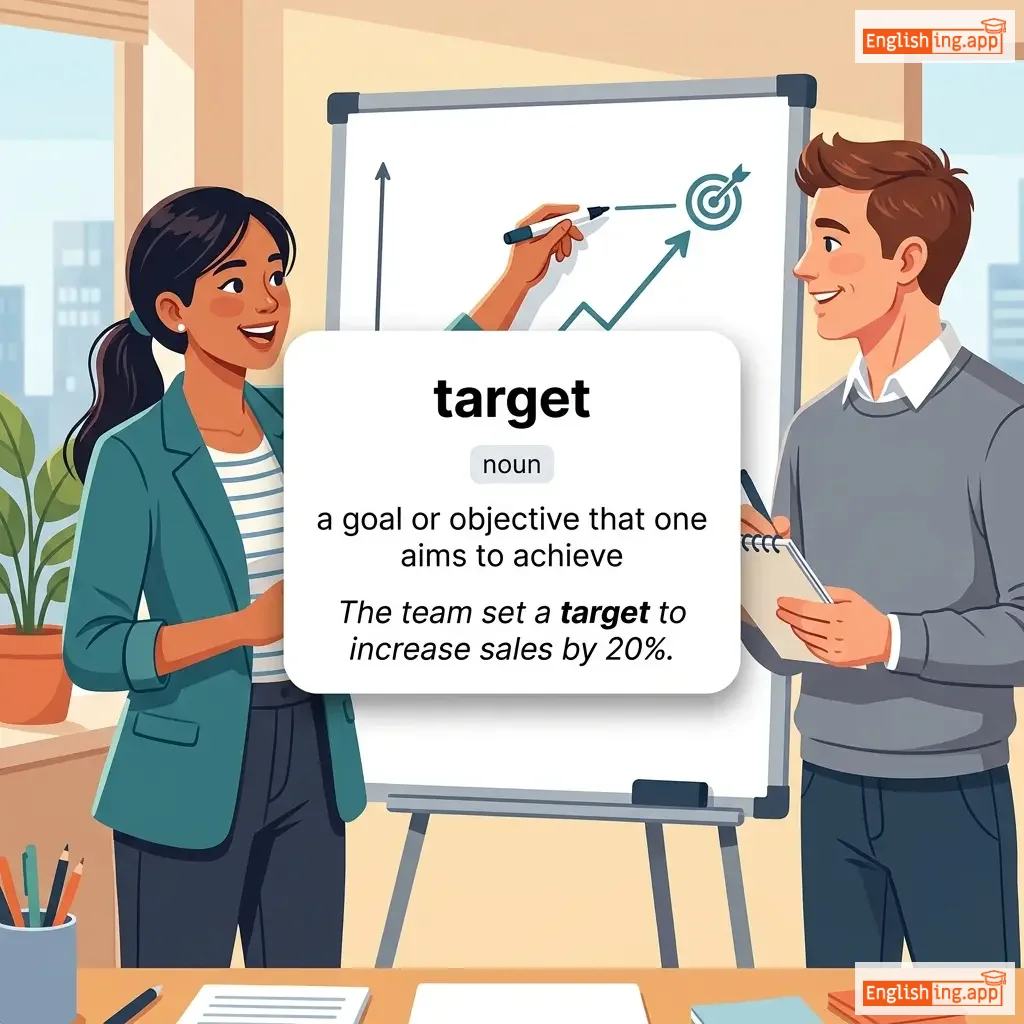
target definition card — visual illustration of the meaning
noun
/ˈtɑːɡɪt/
objetivo (objetivo)

a goal or objective that one aims to achieve

"The team set a target to increase sales by 20%."

"El equipo estableció un objetivo de aumentar las ventas en un 20%." (El equipo establecio un objetivo de aumentar las ventas en un 20%.)
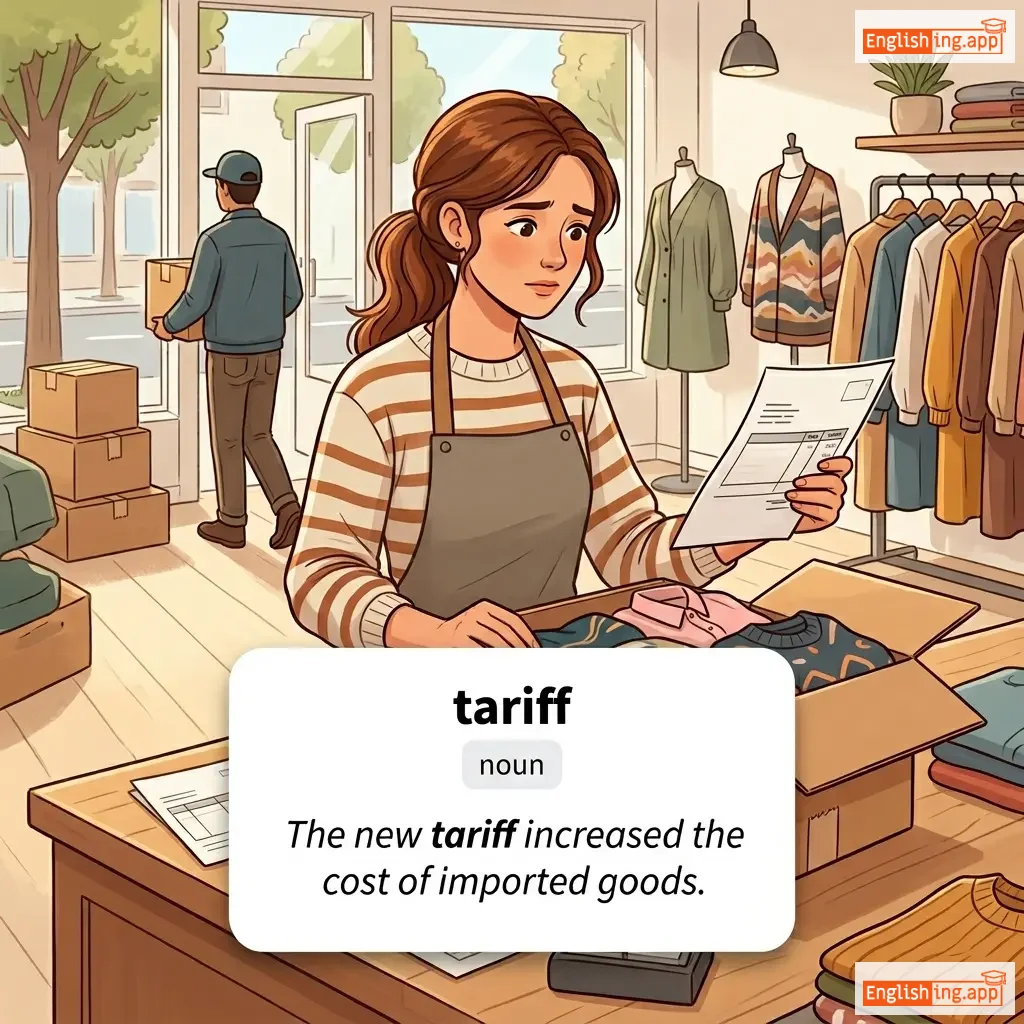
tariff definition card — visual illustration of the meaning
noun
/ˈtær.ɪf/
arancel (arancel)

A tax imposed by the government on imported or exported goods, also known as duty, customs tax, or levy.

"The new tariff increased the cost of imported goods."

"El nuevo arancel aumentó el costo de los bienes importados." (El nuevo arancel aumentó el costo de los bienes importados.)
noun
/tɑːrn/
lago de montaña (lago de montaña)

A small mountain lake or pool.

"We camped near a tranquil tarn in the highlands."

"Acampamos cerca de un tranquilo lago de montaña en las tierras altas." (Acampamos cerca de un tranquilo lago de montaña en las tierras altas.)
verb
/ˈtɑːrnɪʃ/
embarrar (embarrar)

To lose luster, especially as a result of exposure to air or moisture; to damage reputation.

"The silver jewelry tarnished quickly when left in the open air."

"La joyería de plata se embarró rápidamente cuando se dejó al aire libre." (La joyeria de plata se embarro rapidamente cuando se dejo al aire libre.)
noun
/tɑːrˈpɔːlɪn/
lona impermeable (tarpaulin)

A large sheet of strong, flexible, water-resistant material used for covering or protecting things.

"The workers used a tarpaulin to cover the construction materials from rain."

"Los trabajadores usaron una lona impermeable para cubrir los materiales de construcción de la lluvia." (Los trabajadores usaron una lona impermeable para cubrir los materiales de construccion de la lluvia.)
verb
/ˈtæri/
tardar (tardar)

To delay or linger; to stay longer than intended.

"Do not tarry, or you will miss the train."

"No tardes, o perderás el tren." (No tardes, o perderás el tren.)
noun, adjective
/tɑːrt/
tarta (tarta)

A small pie with a sweet or savory filling; or having a sharp, sour taste.

"She served a delicious apple tart for dessert."

"Ella sirvió una deliciosa tarta de manzana para el postre." (Ella sirvio una deliciosa tarta de manzana para el postre.)
noun
/tɑːsk/
tarea (tarea)

a piece of work or duty to be done

"He completed the task before the deadline."

"Él completó la tarea antes de la fecha límite." (El completo la tarea antes de la fecha limite.)
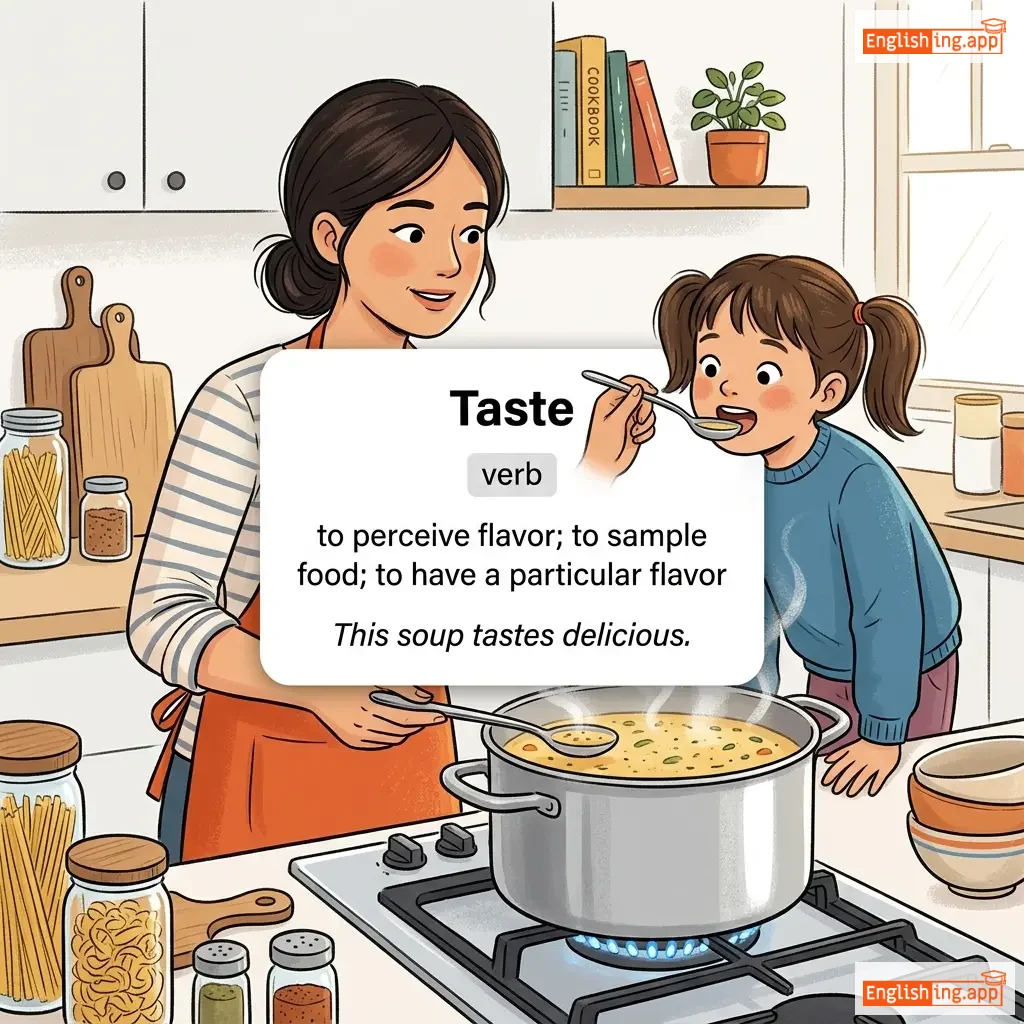
Taste definition card — visual illustration of the meaning
noun
/teɪst/
sabor (sabor)

the sensation of flavor perceived in the mouth

"The cake had a delicious taste."

"El pastel tenía un delicioso sabor." (El pastel tenía un delicioso sabor.)
adjective
/ˈteɪst.fəl/
delicioso; elegante; con buen gusto (delicioso; elegante; con buen gusto)

showing good judgment in matters of style and beauty

"She decorated her home in a very tasteful manner."

"Ella decoró su casa de una manera muy elegante." (Ella decoro su casa de una manera muy elegante.)
adjective
/ˈteɪst.ləs/
insípido (insipido)

lacking flavor; showing poor judgment in style

"The soup was completely tasteless and needed more seasoning."

"La sopa estaba completamente insípida y necesitaba más condimentos." (La sopa estaba completamente insipida y necesitaba mas condimentos.)
adjective
/ˈteɪsti/
sabroso (sabroso)

Having a pleasant, distinct flavor; delicious.

"The chef prepared a very tasty curry."

"El chef preparó un curry muy sabroso." (El chef preparó un curry muy sabroso.)
noun, verb
/ˈtætər/
trapo rasgado (trapo rasgado)

A torn piece of cloth or clothing; to become ragged or torn.

"The old flag hung in tatters after the storm."

"La vieja bandera colgaba hecha trizas después de la tormenta." (La vieja bandera colgaba hecha trizas después de la tormenta.)
noun, adjective
/ˌtætərdɪˈmeɪliən/
persona vestida con ropa rasgada (persona vestida con ropa rasgada)

A person dressed in ragged clothes; ragged or dilapidated in appearance.

"A tatterdemalion wandered the streets in search of food."

"Un tatterdemalion vagaba por las calles en busca de comida." (Un tatterdemalion vagaba por las calles en busca de comida.)
adjective
/ˈtæti/
desgastado (desgastado)

Worn out, shabby, or in poor condition.

"The sofa looked old and tatty after years of use."

"El sofá se veía viejo y desgastado después de años de uso." (El sofá se veía viejo y desgastado después de años de uso.)
verb
/tɔːnt/
provocar (provocar)

to provoke or challenge someone with insulting remarks

"The bully tried to taunt him with cruel words."

"El matón intentó provocarlo con palabras crueles." (El matón intentó provocarlo con palabras crueles.)
adjective
/tɔːt/
tenso (tenso)

stretched or pulled tight; tense

"The rope was pulled taut between the two poles."

"La cuerda estaba tensa entre los dos postes." (La cuerda estaba tensa entre los dos postes.)
adjective
/ˌtɔːtəˈlɒdʒɪkəl/
tautológico (tautologico)

expressing something by repeating the same idea in different words; redundant

"Saying 'free gift' is considered tautological."

"Decir 'regalo gratis' se considera tautológico." (Decir 'regalo gratis' se considera tautologico.)
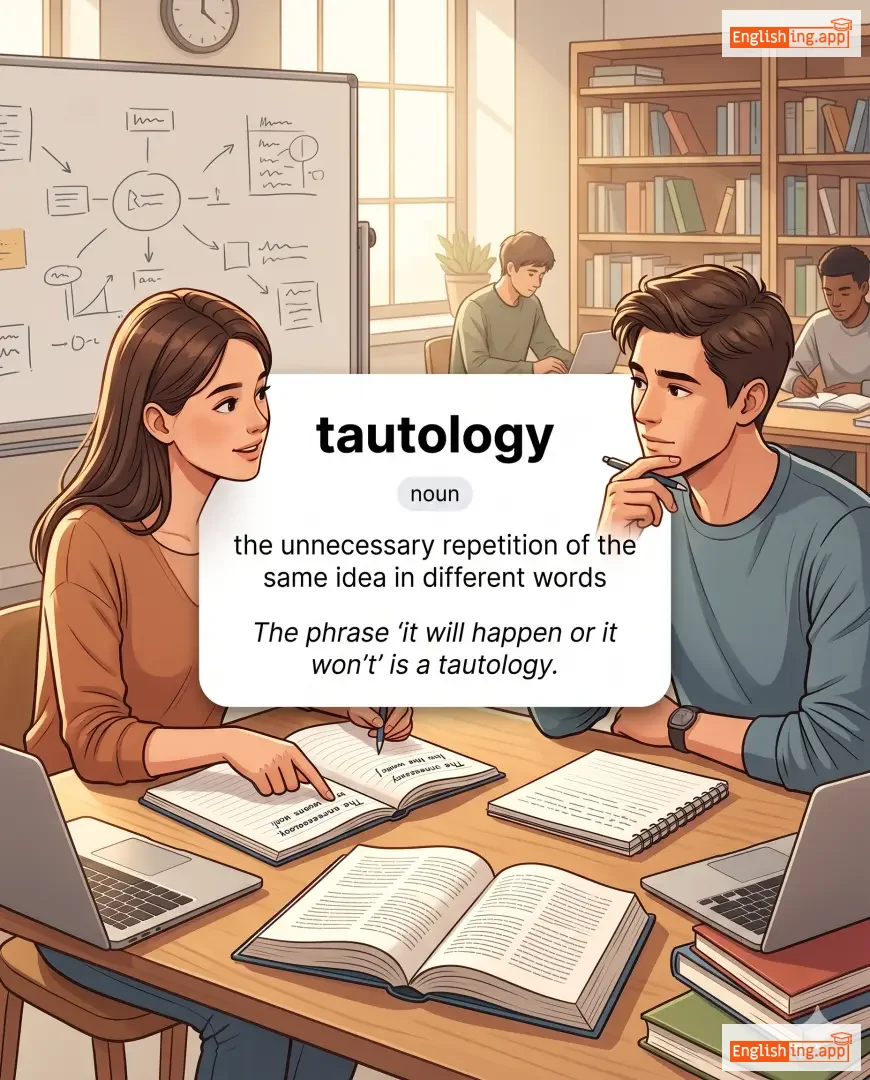
tautology definition card — visual illustration of the meaning
noun
/tɔːˈtɒlədʒi/
redundancia innecesaria (redundancia innecesaria)

the unnecessary repetition of the same idea in different words

"The phrase 'it will happen or it won’t' is a tautology."

"La frase 'pasará o no pasará' es una tautología." (La frase 'pasara o no pasara' es una tautologia.)
adjective
/ˈtɔːdri/
barato y llamativo pero de mala calidad (barato y llamativo pero de mala calidad)

cheap and showy but of poor quality

"She wore a tawdry necklace that broke easily."

"Ella llevaba un collar barato y llamativo que se rompió fácilmente." (Ella llevaba un collar barato y llamativo que se rompió fácilmente.)
adjective
/ˈtɔːni/
color marrón amarillento (color marron amarillento)

A warm, sandy or golden-brown color.

"The owl's tawny feathers blended with the tree bark."

"Las plumas marrón amarillento del búho se mezclaron con la corteza del árbol." (Las plumas marron amarillento del buho se mezclaron con la corteza del arbol.)
noun
/tæks/
impuesto (impuesto)

a compulsory contribution to state revenue, typically levied on income or sales

"The government increased the tax rate on luxury goods."

"El gobierno aumentó la tasa del impuesto sobre los bienes de lujo." (El gobierno aumento la tasa del impuesto sobre los bienes de lujo.)
noun
/tækˈseɪʃən/
imposición fiscal (imposicion fiscal)

The system of imposing and collecting taxes.

"Taxation is necessary for funding public services."

"La imposición fiscal es necesaria para financiar los servicios públicos." (La imposición fiscal es necesaria para financiar los servicios públicos.)
noun
/ˈtæksi/
taxi (taxi)

A car licensed to transport passengers in exchange for payment of a fare.

"We hailed a taxi to get to the airport."

"Tomamos un taxi para llegar al aeropuerto." (Tomamos un taxi para llegar al aeropuerto.)
noun
/ˈtæk.si kæb/
taxi (taksi)

A car that carries passengers for a fare, usually in cities

"We took a taxi cab to the restaurant."

"Tomamos un taxi al restaurante." (tomamos un taxi al restaurante.)
noun
/ˈtæksɪˌdɜːrmi/
taxidermia (taxidermia)

The art of preparing, stuffing, and mounting the skins of animals for display.

"The museum had a large collection of taxidermy animals."

"El museo tenía una gran colección de animales disecados." (El museo tenía una gran colección de animales disecados.)
adjective
/ˈtæksɪŋ/
agotador (agotador)

Requiring a lot of effort; physically or mentally demanding.

"Preparing for the exam was a taxing experience."

"Preparar para el examen fue una experiencia agotadora." (Preparar para el examen fue una experiencia agotadora.)
noun
/tækˈsɒnəmɪst/
taxónomo (taxonomo)

A scientist who classifies organisms into groups based on their characteristics.

"The taxonomist discovered a new species of insect."

"El taxónomo descubrió una nueva especie de insecto." (El taxonomo descubrio una nueva especie de insecto.)
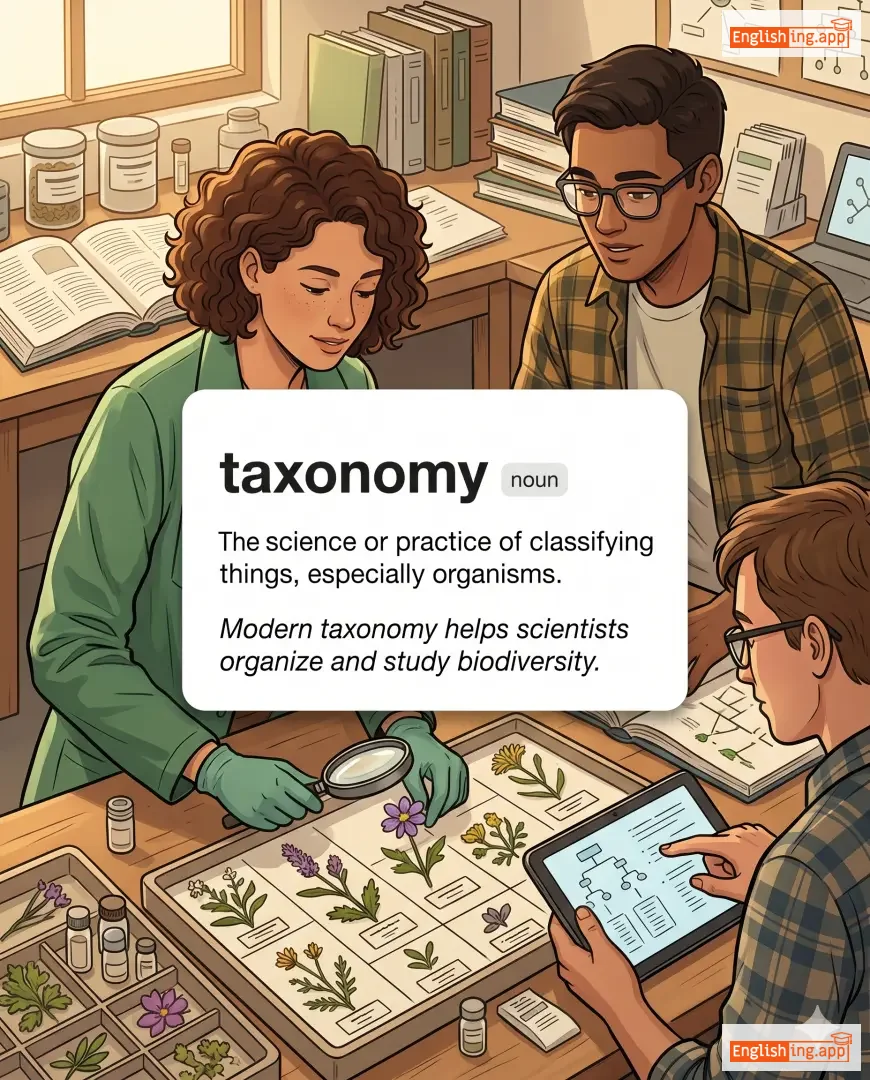
taxonomy definition card — visual illustration of the meaning
noun
/tækˈsɒnəmi/
ciencia de la clasificación (ciencia de la clasificacion)

The science or practice of classifying things, especially organisms.

"Modern taxonomy helps scientists organize and study biodiversity."

"La taxonomía moderna ayuda a los científicos a organizar y estudiar la biodiversidad." (La taxonomia moderna ayuda a los cientificos a organizar y estudiar la biodiversidad.)
noun
/ˈtæksˌpeɪər/
contribuyente (contribuyente)

a person who pays tax to the government

"The taxpayers' money is used to fund public services."

"El dinero de los contribuyentes se usa para financiar los servicios públicos." (El dinero de los contribuyentes se usa para financiar los servicios públicos.)
noun
/tiː/
(te)

a hot drink made by infusing the dried, crushed leaves of the tea plant in boiling water

"I drink tea every morning to start my day."

"Bebo té cada mañana para comenzar mi día." (Bebo té cada mañana para comenzar mi día.)
noun
/ˈtiː.pɒt/
tetera (tetera)

a container with a lid, handle, and spout for brewing and serving tea

"She poured hot water into the tea-pot to make tea."

"Ella vertió agua caliente en la tetera para hacer té." (Ella vertió agua caliente en la tetera para hacer té.)
noun
/tiː ˈstreɪnər/
colador de té (colador de te)

a small perforated device used to strain tea leaves from brewed tea

"I always use a tea-strainer when pouring tea into cups."

"Siempre uso un colador de té cuando sirvo el té en las tazas." (siempre uso un colador de te cuando sirvo el te en las tazas.)
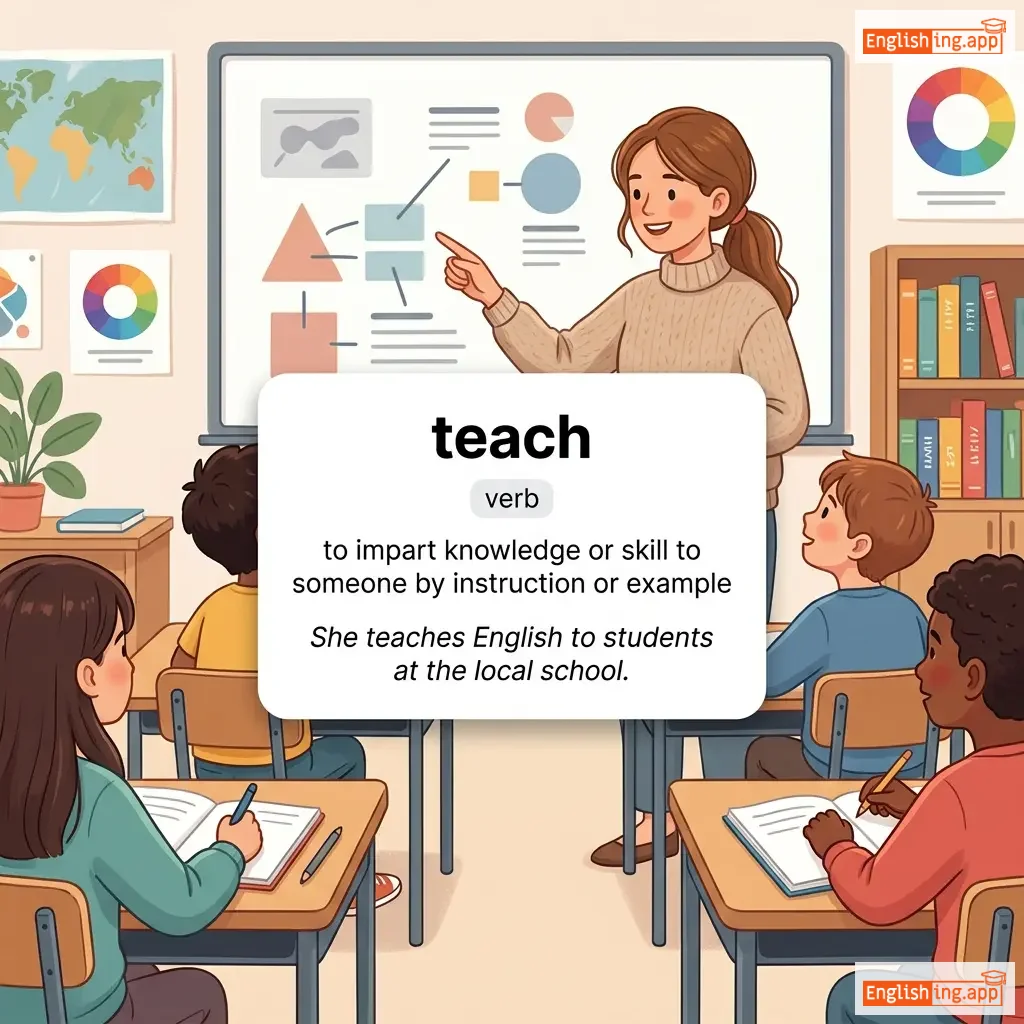
teach definition card — visual illustration of the meaning
verb
/tiːʧ/
enseñar (enseñar)

to impart knowledge or skill to someone by instruction or example

"She teaches English to students at the local school."

"Ella enseña inglés a los estudiantes de la escuela local." (Ella enseña inglés a los estudiantes de la escuela local.)