Vocabularios

Descubra, aprenda y domine el vocabulario en inglés

noun
/ˈtwaɪ.laɪt/
crepúsculo (crepusculo)

the soft glowing light from the sky when the sun is below the horizon; a period of decline

"We walked along the beach at twilight."

"Caminamos por la playa al crepúsculo." (Caminamos por la playa al crepusculo.)
👯‍♂️

twin (twɪn)

noun
/twɪn/
gemelo (gemelo)

either of two children born at the same time to the same mother

"They have twin girls."

"Tienen gemelas." (Tienen gemelas.)
noun
/twɪndʒ/
dolor agudo (dolor agudo)

a sudden, sharp pain or an emotional pang

"He felt a twinge of guilt after lying to his friend."

"Sintió un dolor agudo de culpa después de mentirle a su amigo." (Sintió un dolor agudo de culpa después de mentirle a su amigo.)
verb
/twɪst/
torcer, girar (torcer, girar)

to bend or turn something into a coil or spiral shape; to distort.

"He twisted the rope tightly around the pole."

"Él torció la cuerda alrededor del poste con fuerza." (El torció la cuerda alrededor del poste con fuerza.)
noun
/ˈtwɪstər/
tornado (tornado)

A tornado or something that twists; also refers to a challenging tongue twister.

"The twister destroyed several houses in the village."

"El tornado destruyó varias casas en el pueblo." (El tornado destruyo varias casas en el pueblo.)
noun
/twɪt/
tonto; burlarse (tonto; burlarse)

a silly or foolish person; to tease or make fun of someone

"Don't be such a twit and listen carefully."

"No seas tan tonto y escucha cuidadosamente." (No seas tan tonto y escucha cuidadosamente.)
2️⃣

two (tú)

noun
/tuː/
dos (dos)

the number following one

"She has two children."

"Ella tiene dos hijos." (Ella tiene dos hijos.)
noun
/tuː θɜːrdz/
dos tercios (dos tercios)

a fraction equal to two parts of three; 2/3.

"Two-thirds of the students passed the exam."

"Dos tercios de los estudiantes aprobaron el examen." (Dos tercios de los estudiantes aprobaron el examen.)
noun
/ˈtuːsəm/
pareja (pareja)

A pair of people considered together, often in a romantic or competitive context.

"They entered the dance competition as a twosome."

"Entraron a la competencia de baile como una pareja." (Entraron a la competencia de baile como una pareja.)
noun
/taɪˈkuːn/
magnate (magnate)

a wealthy, powerful businessperson

"The real estate tycoon invested in several skyscrapers."

"El magnate inmobiliario invirtió en varios rascacielos." (El magnate inmobiliario invirtió en varios rascacielos.)
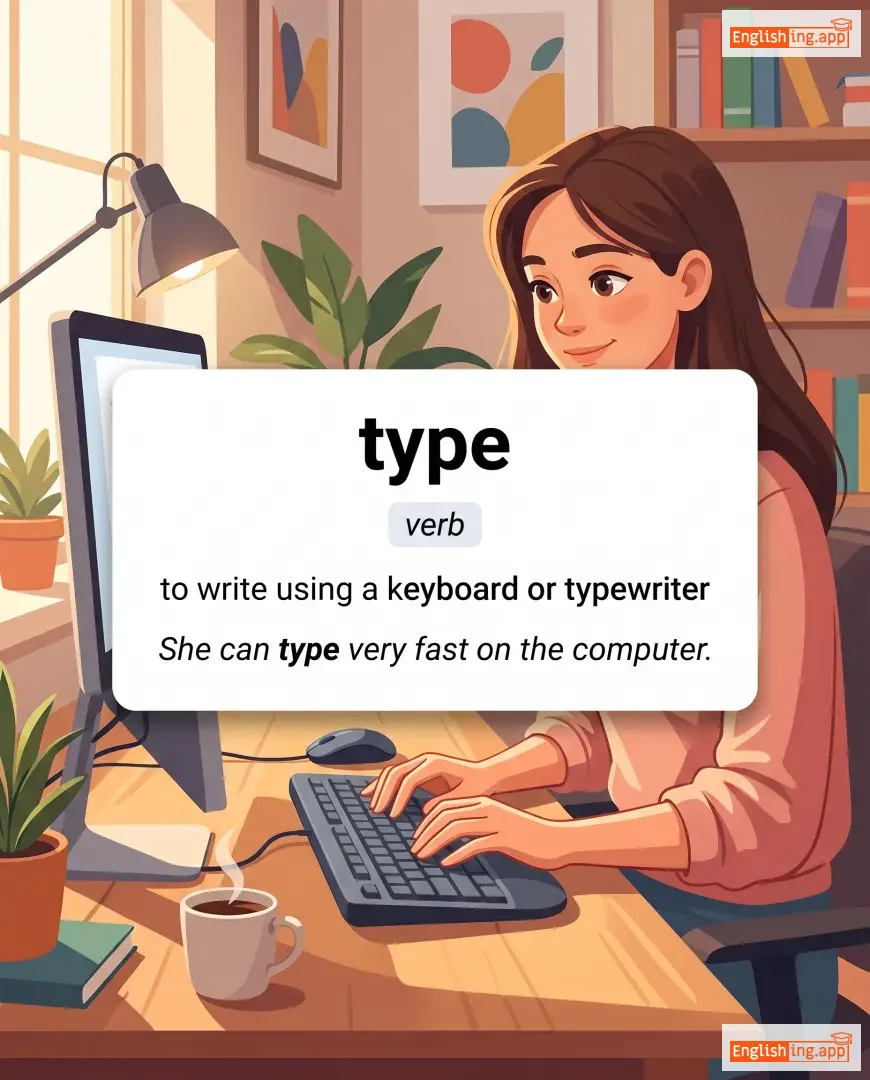
type definition card — visual illustration of the meaning
noun
/taɪp/
tipo (tipo)

a category of people or things having common characteristics

"What type of music do you like?"

"¿Qué tipo de música te gusta?" (¿Qué tipo de música te gusta?)
noun
/taɪˈfuːn/
tifón (tifon)

a tropical storm in the region of the Indian or western Pacific oceans

"The typhoon caused severe flooding in the coastal areas."

"El tifón causó graves inundaciones en las áreas costeras." (El tifón causó graves inundaciones en las áreas costeras.)
adjective
/ˈtɪpɪkəl/
relacionado con las características comunes de un tipo particular de persona o cosa (relacionado con las caracteristicas comunes de un tipo particular de persona o cosa)

having the usual qualities of a particular type of person or thing

"It was a typical summer day, hot and humid."

"Era un día típico de verano, caluroso y húmedo." (Era un dia tipico de verano, caluroso y humedo.)
adverb
/ˈtɪpɪkli/
normalmente (normalmente)

in a way that is typical of a particular person, thing, or group

"She typically arrives at work at 9 AM."

"Ella normalmente llega al trabajo a las 9 AM." (Ella normalmente llega al trabajo a las 9 AM.)
verb
/ˈtɪpɪfaɪ/
representar (representar)

to represent or be a typical example of something

"His leadership style typifies the new corporate culture."

"Su estilo de liderazgo representa la nueva cultura corporativa." (Su estilo de liderazgo representa la nueva cultura corporativa.)
noun
/ˈtaɪpoʊ/
error tipográfico (error tipografico)

a mistake made in typing

"The report was full of typos."

"El informe estaba lleno de errores tipográficos." (El informe estaba lleno de errores tipograficos.)
adjective
/ˌtaɪpəˈɡræfɪkəl/
tipográfico (tipografiko)

relating to the style, arrangement, or appearance of printed text

"There was a typographical error in the book."

"Había un error tipográfico en el libro." (Habia un error tipografiko en el libro.)
noun
/taɪˈpɒɡrəfi/
tipografía (tipografia)

the art and technique of arranging type to make written language legible and visually appealing

"Good typography improves the readability of a website."

"Una buena tipografía mejora la legibilidad de un sitio web." (Una buena tipografia mejora la legibilidad de un sitio web.)
adjective
/tɪˈrænɪkəl/
tiránico (tiraniko)

exercising power in a cruel or arbitrary way

"The tyrannical ruler silenced all opposition."

"El gobernante tiránico silenció toda oposición." (El gobernante tiránico silenció toda oposición.)
noun
/ˈtɪrəni/
tiranía (tiranía)

Cruel and oppressive government or rule by a tyrant.

"The people revolted against the tyranny of their ruler."

"La gente se rebeló contra la tiranía de su gobernante." (La gente se rebeló contra la tiranía de su gobernante.)
noun
/ˈtaɪ.rənt/
tirano (tirano)

a cruel and oppressive ruler; a person who exercises power in a harsh manner

"The people rebelled against the cruel tyrant."

"La gente se rebeló contra el cruel tirano." (La gente se rebeló contra el cruel tirano)
noun
/ˈtaɪroʊ/
principiante (principiante)

A beginner or novice in a field or activity.

"As a tyro in programming, she needed constant guidance."

"Como principiante en programación, necesitaba orientación constante." (Como principiante en programación, necesitaba orientación constante.)