Vocabularios

Descubra, aprenda y domine el vocabulario en inglés

adverb
/ˈsɜːrtʃɪŋli/
buscadoramente (buscadoramente)

In a way that seems to look for hidden meanings or truth.

"She looked at him searchingly, hoping for an honest answer."

"Ella lo miró buscando, esperando una respuesta honesta." (Ella lo miró buscando, esperando una respuesta honesta.)
noun
/ˈsiːskeɪp/
paisaje marino (paisaje marino)

A view or painting of the sea.

"The artist painted a beautiful seascape at sunset."

"El artista pintó un hermoso paisaje marino al atardecer." (El artista pintó un hermoso paisaje marino al atardecer.)
noun/verb
/ˈsiːzən/
estación / sazonar (estacion / sazonar)

One of the four periods of the year characterized by specific weather conditions; also, to add flavor to food.

"Spring is my favorite season of the year."

"La primavera es mi estación favorita del año." (La primavera es mi estacion favorita del año.)
adjective
/ˈsiːzənəbl/
temporal (temporal)

Appropriate to the time of year or season.

"We had seasonable weather for autumn."

"Tuvimos un clima apropiado para el otoño." (Tuvimos un clima apropiado para el otoño.)
adjective
/ˈsiːzənl/
estacional (estacional)

Relating to or dependent on a particular season.

"Seasonal fruits are available in the market."

"Las frutas de temporada están disponibles en el mercado." (Las frutas de temporada están disponibles en el mercado.)
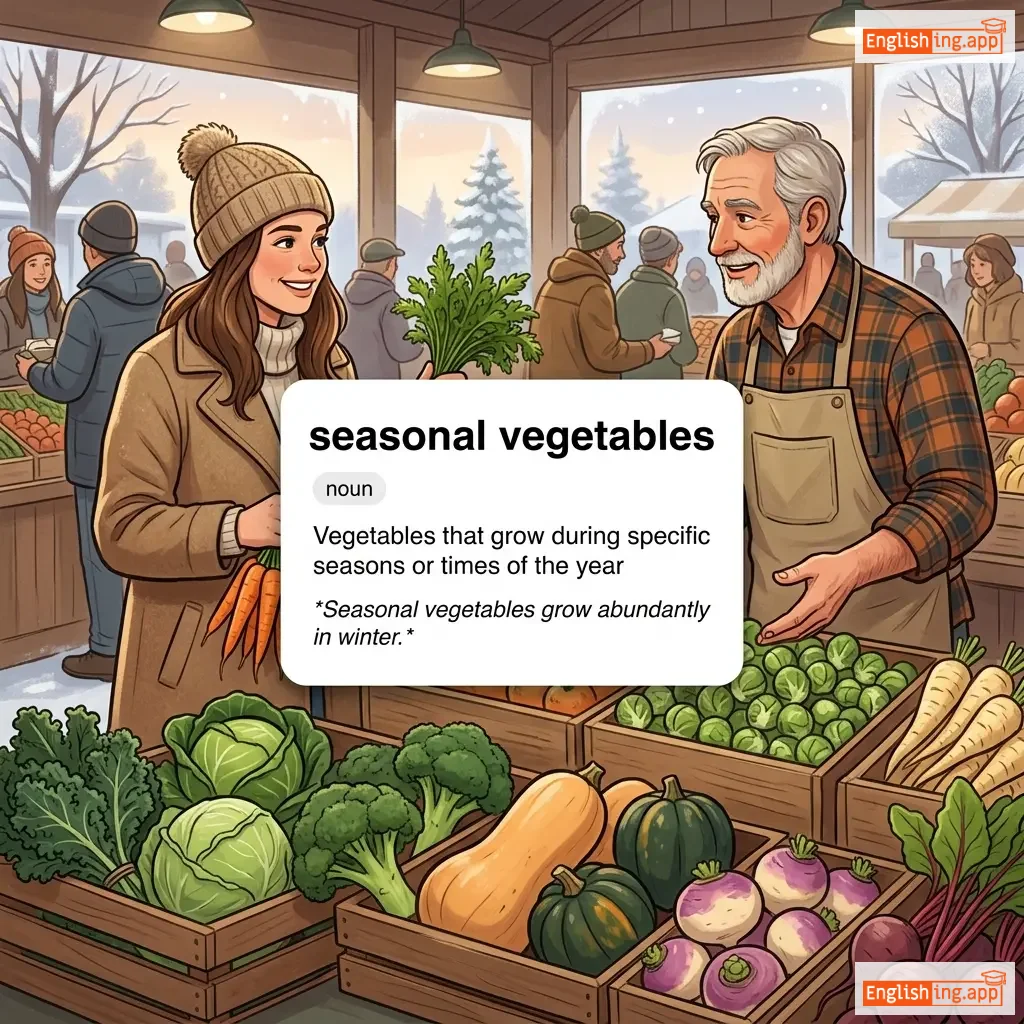
seasonal vegetables definition card — visual illustration of the meaning
noun
ˈsiːzənəl ˈvedʒtəbəlz
verduras de temporada (verduras de temporada)

Vegetables that grow during specific seasons or times of the year

"Seasonal vegetables grow abundantly in winter."

"Las verduras de temporada crecen abundantemente en invierno." (Las verduras de temporada crecen abundantemente en invierno.)
adjective/verb
/ˈsiːzənd/
experimentado / sazonado (experimentado / sazonado)

Experienced in a particular activity; also, flavored with spices.

"She is a seasoned teacher with over 20 years of experience."

"Ella es una maestra experimentada con más de 20 años de experiencia." (Ella es una maestra experimentada con más de 20 años de experiencia.)
noun
/siːt/
asiento (asiento)

a place to sit, especially a chair or other place for sitting

"I reserved a seat for you at the concert."

"Reservé un asiento para ti en el concierto." (Reservé un asiento para ti en el concierto.)
adjective
/sɪˈbeɪʃəs/
relacionado con el sebo (relacionado con el sebo)

Relating to or secreting sebum, an oily substance from the skin.

"Acne is often caused by overactive sebaceous glands."

"El acné a menudo es causado por glándulas sebáceas hiperactivas." (El acné a menudo es causado por glándulas sebáceas hiperactivas.)
noun
/ˈsiːkənt/
secante (secante)

A straight line that intersects a curve at two or more points.

"In geometry, a secant cuts the circle at two distinct points."

"En geometría, un secante corta el círculo en dos puntos distintos." (En geometria, un secante corta el circulo en dos puntos distintos.)
verb
/sɪˈsiːd/
secesionar (secesionar)

To formally withdraw from a political or organizational union.

"Several states threatened to secede from the union."

"Varios estados amenazaron con separarse de la unión." (Varios estados amenazaron con separarse de la union.)
noun
/sɪˈsɛʃən/
secesión (secesion)

The action of formally withdrawing from membership of a federation or body.

"The secession of the southern states led to the Civil War."

"La secesión de los estados del sur llevó a la Guerra Civil." (La secesion de los estados del sur llevo a la Guerra Civil.)
verb
/sɪˈkluːd/
aislar (aislar)

To keep someone away from other people; to isolate.

"The monk chose to seclude himself in the mountains."

"El monje eligió aislarse en las montañas." (El monje eligió aislarse en las montañas.)
adjective
/sɪˈkluːdɪd/
aislado (aislado)

Placed apart from other people or things; private and quiet.

"They spent their vacation in a secluded beach house."

"Pasaron sus vacaciones en una casa de playa aislada." (Pasaron sus vacaciones en una casa de playa aislada.)
noun
/sɪˈkluːʒən/
aislamiento (aislamiento)

The state of being private, away from other people.

"She spent the weekend in complete seclusion in her cabin."

"Pasó el fin de semana en completo aislamiento en su cabaña." (Pasó el fin de semana en completo aislamiento en su cabaña.)
noun
/ˈsekənd/
segundo (sekond)

a unit of time equal to one sixtieth of a minute; also the position after first

"He finished the race in second place."

"Terminó la carrera en segundo lugar." (Termino la carrera en segundo lugar.)
adjective
/ˌsekənd ˈreɪt/
de segunda categoría (de segunda categoria)

Of mediocre or inferior quality.

"The movie was entertaining but clearly second-rate compared to the original."

"La película fue entretenida, pero claramente de segunda categoría en comparación con la original." (La pelicula fue entretenida, pero claramente de segunda categoria en comparacion con la original.)
adjective
/ˈsekənderi/
secundario (secundario)

Less important than something else; derived from or dependent on something primary.

"Safety is our primary concern, while speed is only secondary."

"La seguridad es nuestra principal preocupación, mientras que la velocidad es solo secundaria." (La seguridad es nuestra principal preocupacion, mientras que la velocidad es solo secundaria.)
adverb
/ˈsekəndli/
segundo (segundo)

Used to introduce the second point in a list of arguments or ideas.

"Firstly, we need funding; secondly, we need a strong team."

"Primero, necesitamos financiación; segundo, necesitamos un equipo fuerte." (Primero, necesitamos financiación; segundo, necesitamos un equipo fuerte.)
noun
/ˈsiːkrəsi/
secreto (secreto)

The action of keeping something secret or the state of being kept secret.

"The negotiations were conducted in complete secrecy."

"Las negociaciones se realizaron en completo secreto." (Las negociaciones se realizaron en completo secreto.)
noun
/ˈsiːkrət/
secreto (sikret)

something that is kept or meant to be kept unknown or unseen by others

"He told me a secret about his childhood."

"Me dijo un secreto sobre su infancia." (Me dijo un secreto sobre su infancia.)
noun
/ˈsɛkrəteri/
secretario (secretario)

a person employed to handle correspondence and manage routine tasks for an individual or organization

"The secretary scheduled the meeting for tomorrow."

"El secretario programó la reunión para mañana." (El secretario programo la reunion para manana)
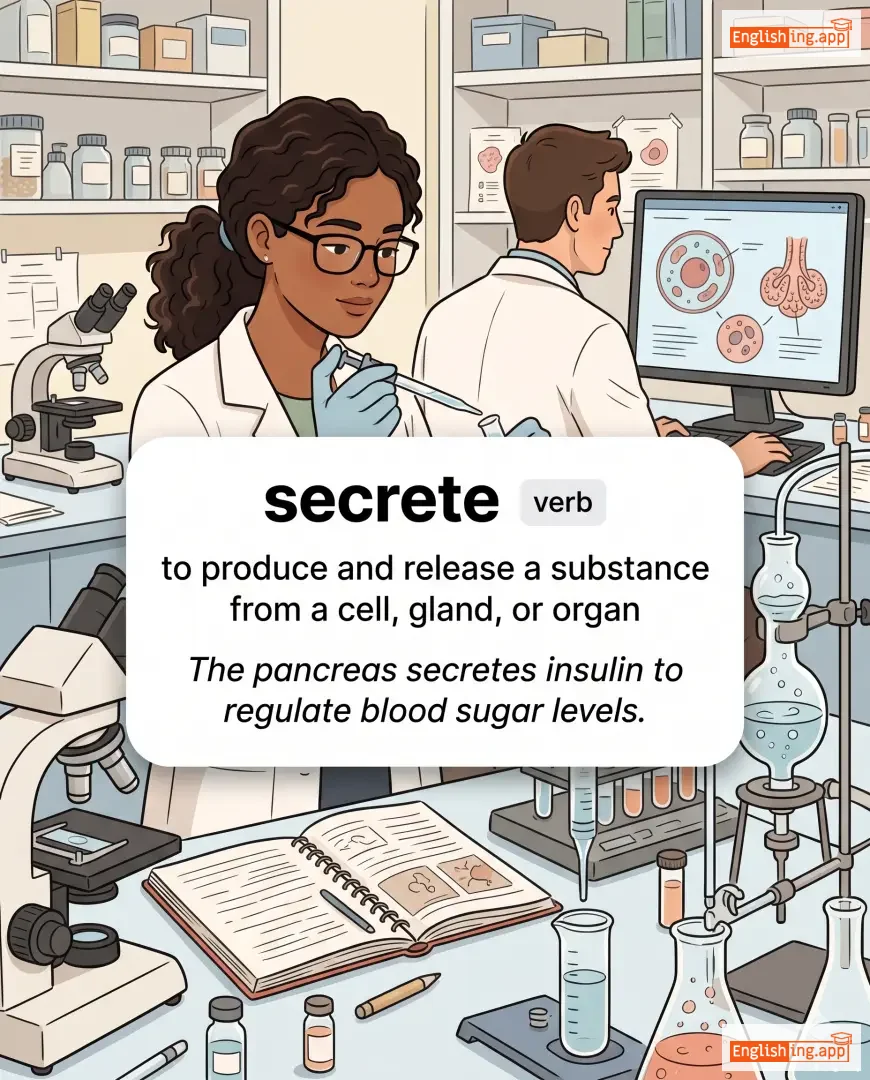
secrete definition card — visual illustration of the meaning
verb
/sɪˈkriːt/
secreción (secrecion)

to produce and release a substance from a cell, gland, or organ

"The pancreas secretes insulin to regulate blood sugar levels."

"El páncreas secreta insulina para regular los niveles de azúcar en la sangre." (El pancreas secreta insulina para regular los niveles de azucar en la sangre.)
noun
/sɪˈkriː.ʃən/
secreción (secrecion)

a process by which substances are produced and discharged from a cell or gland

"Insulin secretion is crucial for blood sugar regulation."

"La secreción de insulina es crucial para la regulación del azúcar en sangre." (la secrecion de insulina es crucial para la regulacion del azucar en sangre)
adverb
/ˈsiː.krət.li/
secretamente (secretamente)

in a way that is hidden or not known by others

"She secretly planned a surprise party for her friend."

"Ella planeó secretamente una fiesta sorpresa para su amiga." (Ella planeo secretamente una fiesta sorpresa para su amiga.)
noun
/sɛkt/
secta (secta)

a subgroup of a larger religious or political group, often with differing beliefs

"The group split into different sects due to doctrinal differences."

"El grupo se dividió en diferentes sectas debido a las diferencias doctrinales." (El grupo se dividió en diferentes sectas debido a las diferencias doctrinales.)
adjective
/sɛkˈtɛəriən/
sectario (sectario)

relating to or characterized by the differences between sects, often leading to conflict

"The region has been troubled by sectarian violence for decades."

"La región ha estado atormentada por la violencia sectaria durante décadas." (La región ha estado atormentada por la violencia sectaria durante décadas.)
noun
/ˈsɛkʃən/
sección (seccion)

a distinct part or subdivision of something larger

"This section of the report needs further review."

"Esta sección del informe necesita una revisión adicional." (Esta seccion del informe necesita una revision adicional.)
noun
/ˈsɛktər/
sector (sector)

a distinct part or area of an economy, society, or industry

"The technology sector is growing rapidly."

"El sector tecnológico está creciendo rápidamente." (El sector tecnologico esta creciendo rapidamente.)
sector-specific definition card — visual illustration of the meaning
adjective
ˈsek.tər spəˈsɪf.ɪk
específico del sector (especifico del sector)

Relating to or designed for a particular sector or industry.

"Sector-specific policies attract targeted investments."

"Las políticas específicas del sector atraen inversiones dirigidas." (Las politicas especificas del sector atraen inversiones dirigidas.)
adjective
/ˈsɛkjʊlər/
laico (laiko)

not connected with religious or spiritual matters

"The country adopted a secular constitution separating religion from state affairs."

"El país adoptó una constitución laica separando la religión de los asuntos del estado." (El pais adoptó una constitución laica separando la religión de los asuntos del estado.)
verb/adjective
/sɪˈkjʊər/
asegurar (asegurar)

to make safe or protect; to fix something firmly in place

"Please secure the door before you leave."

"Por favor asegura la puerta antes de irte." (Por favor asegura la puerta antes de irte.)
security definition card — visual illustration of the meaning
noun
/sɪˈkjʊərɪti/
seguridad (seguridad)

the state of being free from danger or threat

"We need to improve our security measures at the airport."

"Necesitamos mejorar nuestras medidas de seguridad en el aeropuerto." (Necesitamos mejorar nuestras medidas de seguridad en el aeropuerto.)
adjective, verb
/sɪˈdeɪt/
sedar (sedar)

calm, quiet, and composed; or to administer a drug to make someone calm or sleep

"The nurse sedated the patient before the operation."

"La enfermera sedó al paciente antes de la operación." (La enfermera sedó al paciente antes de la operación.)
noun
/ˈsɛdətɪv/
sedante (sedante)

A substance that calms the nerves or induces sleep.

"The doctor prescribed a sedative to help the patient sleep."

"El doctor recetó un sedante para ayudar al paciente a dormir." (El doctor recetó un sedante para ayudar al paciente a dormir.)
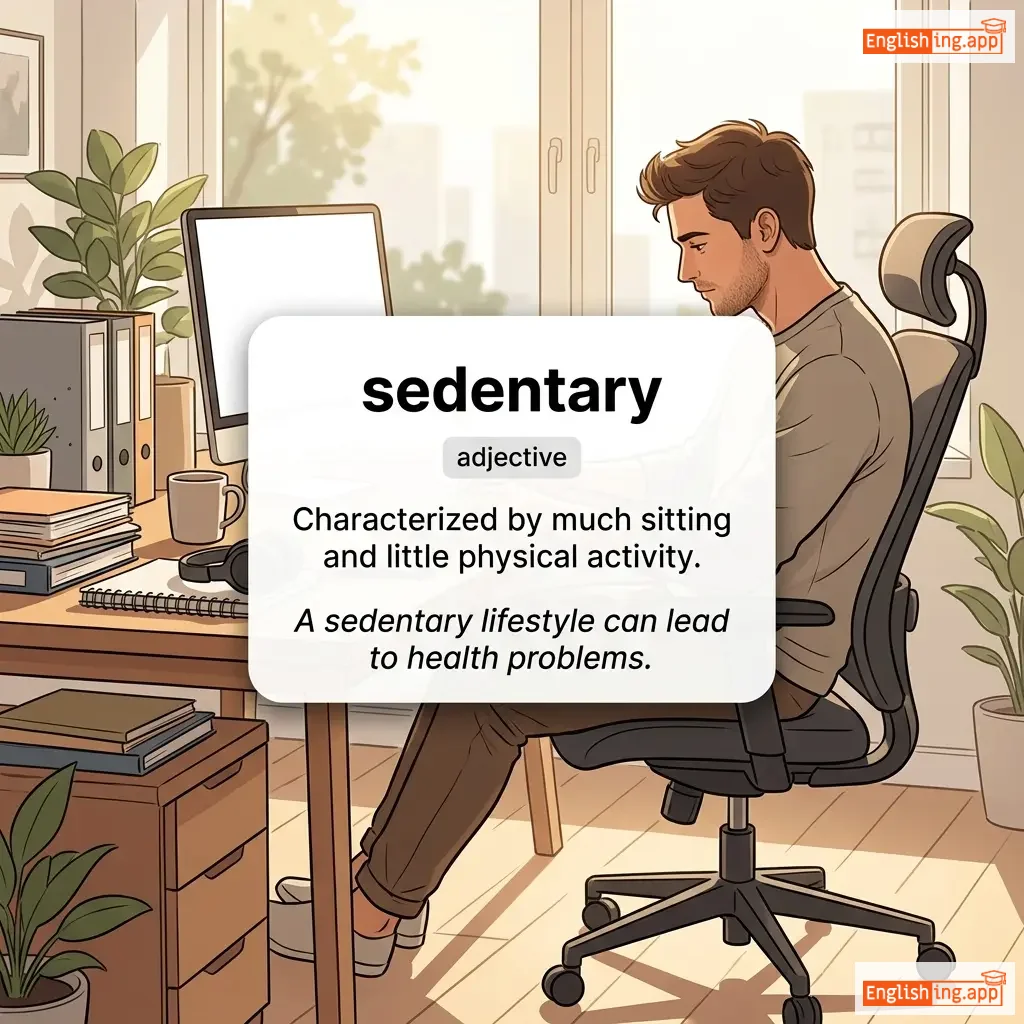
sedentary definition card — visual illustration of the meaning
adjective
/ˈsɛdntɛri/
sedentario (sedentario)

Characterized by much sitting and little physical activity.

"A sedentary lifestyle can lead to health problems."

"Un estilo de vida sedentario puede causar problemas de salud." (un estilo de vida sedentario puede causar problemas de salud)
noun
/ˈsɛdəmənt/
sedimento (sedimento)

Solid particles that settle at the bottom of a liquid.

"The river carries a lot of sediment downstream."

"El río lleva mucho sedimento corriente abajo." (El río lleva mucho sedimento corriente abajo.)
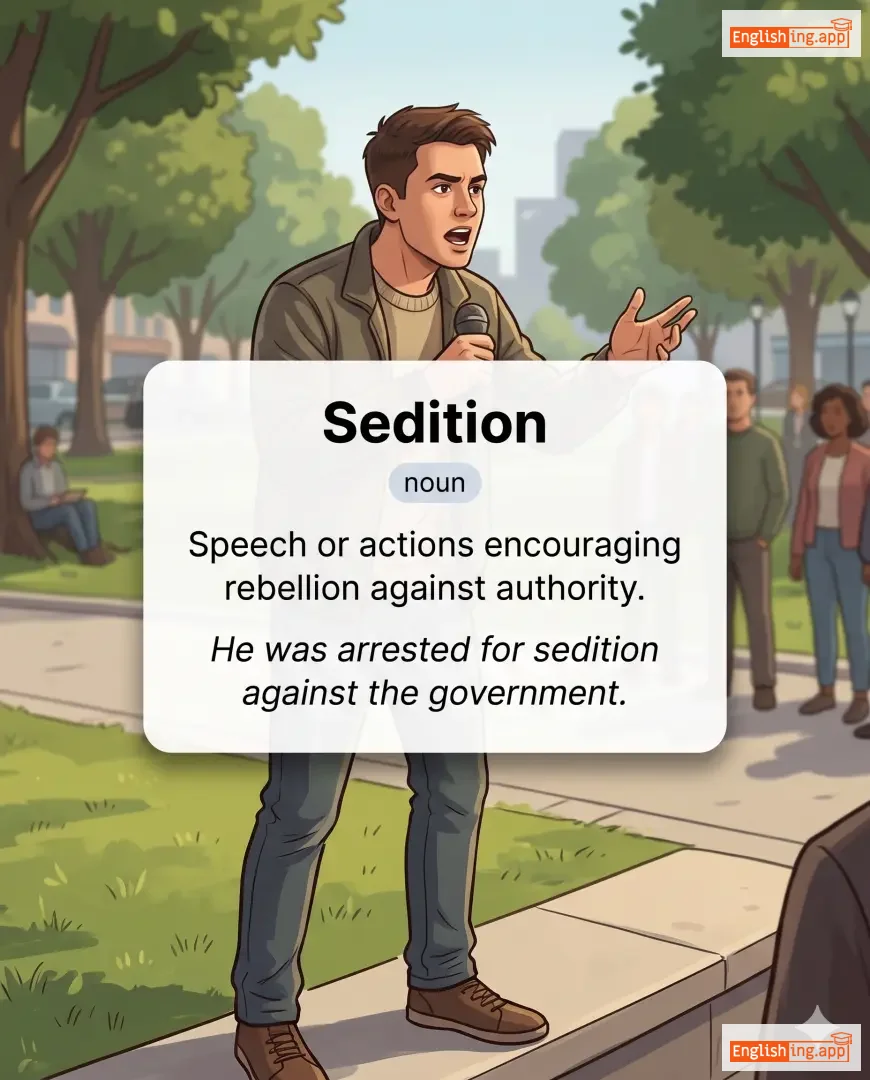
Sedition definition card — visual illustration of the meaning
noun
/sɪˈdɪʃən/
sedición (sedicion)

Speech or actions encouraging rebellion against authority.

"He was arrested for sedition against the government."

"Fue arrestado por sedición contra el gobierno." (Fue arrestado por sedición contra el gobierno.)
adjective
/sɪˈdɪʃəs/
sedicioso (seditioso)

Encouraging rebellion against authority.

"The activist spread seditious pamphlets among the crowd."

"El activista distribuyó folletos sediciosos entre la multitud." (El activista distribuyó folletos sediciosos entre la multitud.)
verb
/sɪˈdjuːs/
seducir (seducir)

to attract someone into doing something, especially something they might not normally do

"The advertisement was designed to seduce customers into buying luxury products."

"El anuncio estaba diseñado para seducir a los clientes a comprar productos de lujo." (El anuncio estaba diseñado para seducir a los clientes a comprar productos de lujo.)
noun
/sɪˈdʌk.ʃən/
seducción; tentación (sedukcion; tentacion)

the action of seducing someone; temptation to do something wrong

"He fell victim to the seduction of easy money."

"Cayó víctima de la seducción del dinero fácil." (Cayo victima de la seduccion del dinero facil.)
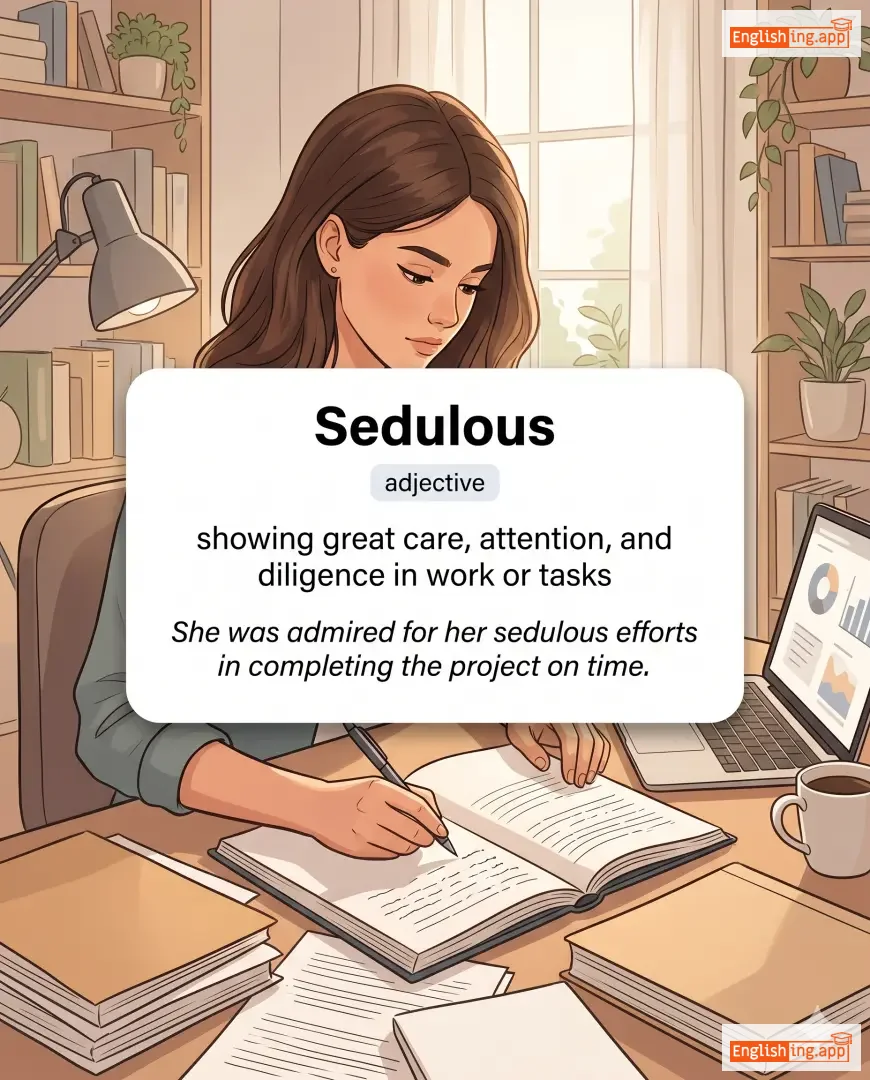
Sedulous definition card — visual illustration of the meaning
adjective
/ˈsɛdʒʊləs/
aplicado (aplicado)

showing great care, attention, and diligence in work or tasks

"She was admired for her sedulous efforts in completing the project on time."

"Fue admirada por sus esfuerzos aplicados para completar el proyecto a tiempo." (Fue admirada por sus esfuerzos aplicados para completar el proyecto a tiempo.)
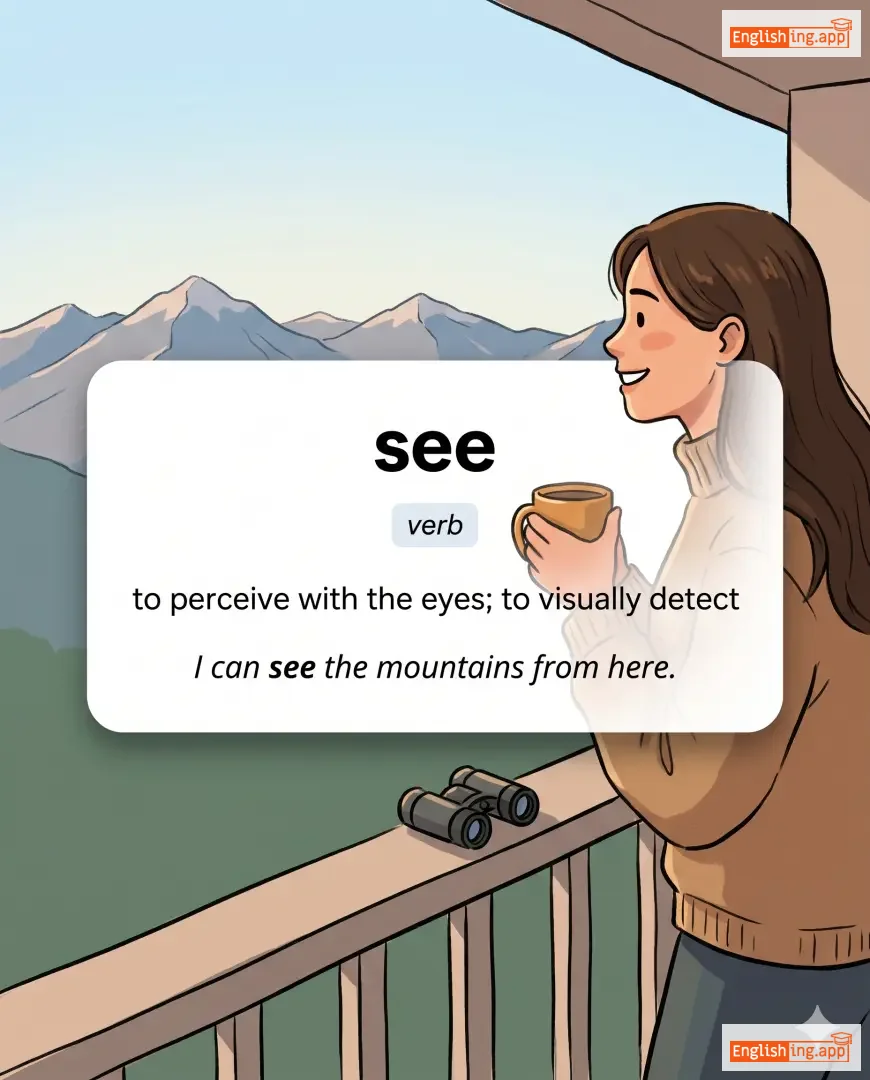
see definition card — visual illustration of the meaning
verb
/siː/
ver (ver)

to perceive with the eyes; to visually detect

"I can see the mountains from here."

"Puedo ver las montañas desde aquí." (Puedo ver las montañas desde aquí.)
noun
/siːd/
semilla (semilla)

the small, hard part of a plant from which a new plant can grow

"I planted a seed in the garden."

"Plante una semilla en el jardín." (Plante una semilla en el jardin.)
adjective
/ˈsiːdi/
sucio / deteriorado (sucio / deteriorado)

dirty, shabby, or in bad condition; also feeling slightly unwell

"He stayed in a seedy motel near the bus station."

"Él se alojó en un motel barato cerca de la estación de autobuses." (Él se alojó en un motel barato cerca de la estación de autobuses.)
verb
/siːk/
buscar (buscar)

to try to find or obtain something; to attempt or desire to achieve

"He decided to seek advice from his mentor."

"Decidió buscar consejo de su mentor." (Decidió buscar consejo de su mentor.)
noun
/ˈsiːkər/
buscador (buscador)

a person who is looking for something, especially knowledge or truth

"The seeker traveled far to find the answers to his questions."

"El buscador viajó lejos para encontrar las respuestas a sus preguntas." (El buscador viajó lejos para encontrar las respuestas a sus preguntas.)
verb
/siːm/
parecer (parecer)

to give the impression of being something or having a particular quality

"He seems tired after the long journey."

"Parece cansado después del largo viaje." (Parece cansado después del largo viaje.)
adverb
/ˈsiː.mɪŋ.li/
aparentemente, aparentemente tranquilo (aparentemente, aparentemente tranquilo)

appearing to be true, but not necessarily so

"He was seemingly calm despite the chaos around him."

"Él estaba aparentemente tranquilo a pesar del caos a su alrededor." (Él estaba aparentemente tranquilo a pesar del caos a su alrededor.)
adjective
/ˈsiːmli/
apropiado (apropiado)

proper or appropriate in behavior or appearance

"It was not seemly to argue loudly during the ceremony."

"No era apropiado discutir en voz alta durante la ceremonia." (No era apropiado discutir en voz alta durante la ceremonia.)