Vocabularios

Descubra, aprenda y domine el vocabulario en inglés

noun
/səˈplaɪə(r)/
proveedor (proveedor)

a person or company that provides goods or services

"The supplier delivered the products on time."

"El proveedor entregó los productos a tiempo." (El proveedor entregó los productos a tiempo.)
supply definition card — visual illustration of the meaning
noun
/səˈplaɪ/
suministro (suhplai)

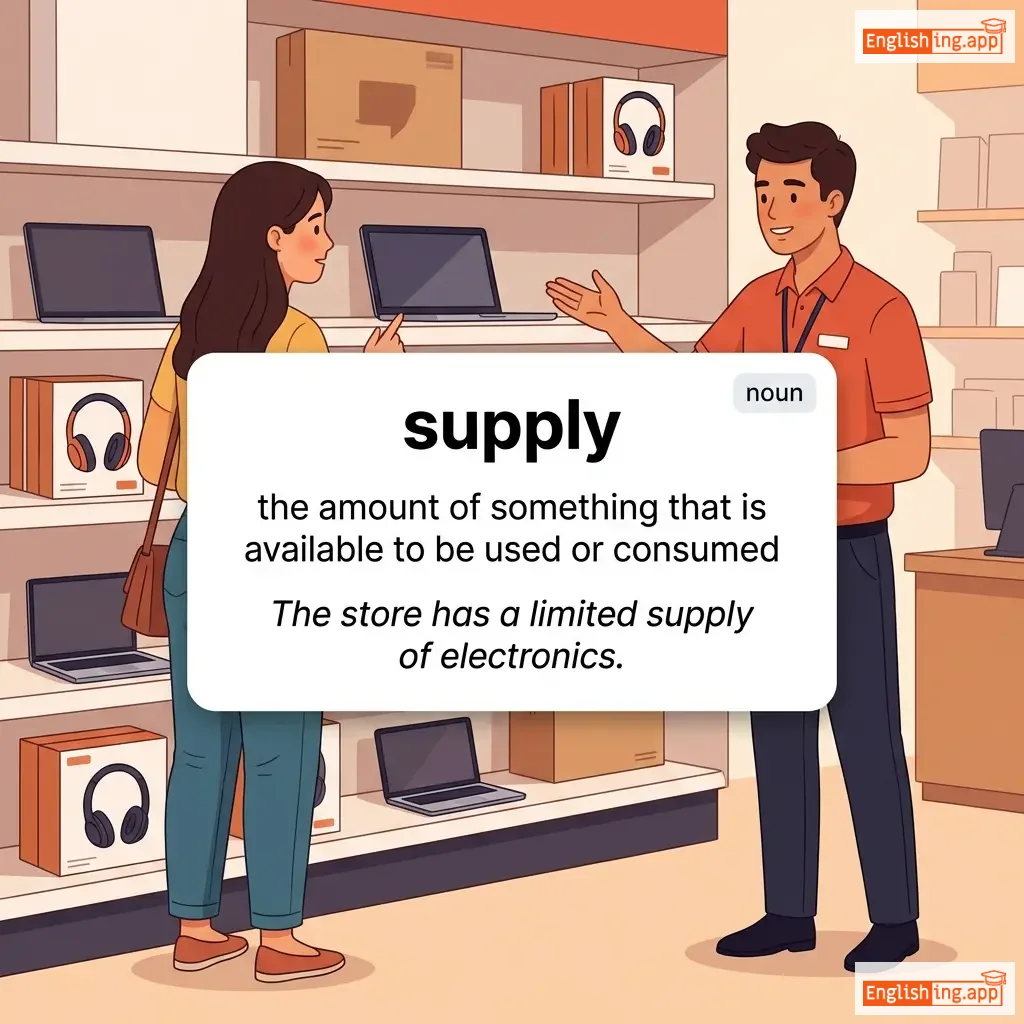
the amount of something that is available to be used or consumed

"The store has a limited supply of electronics."

"La tienda tiene un suministro limitado de electrónicos." (La tienda tiene un suministro limitado de electronicos.)
support definition card — visual illustration of the meaning
verb
/səˈpɔːrt/
apoyo (apoyo)

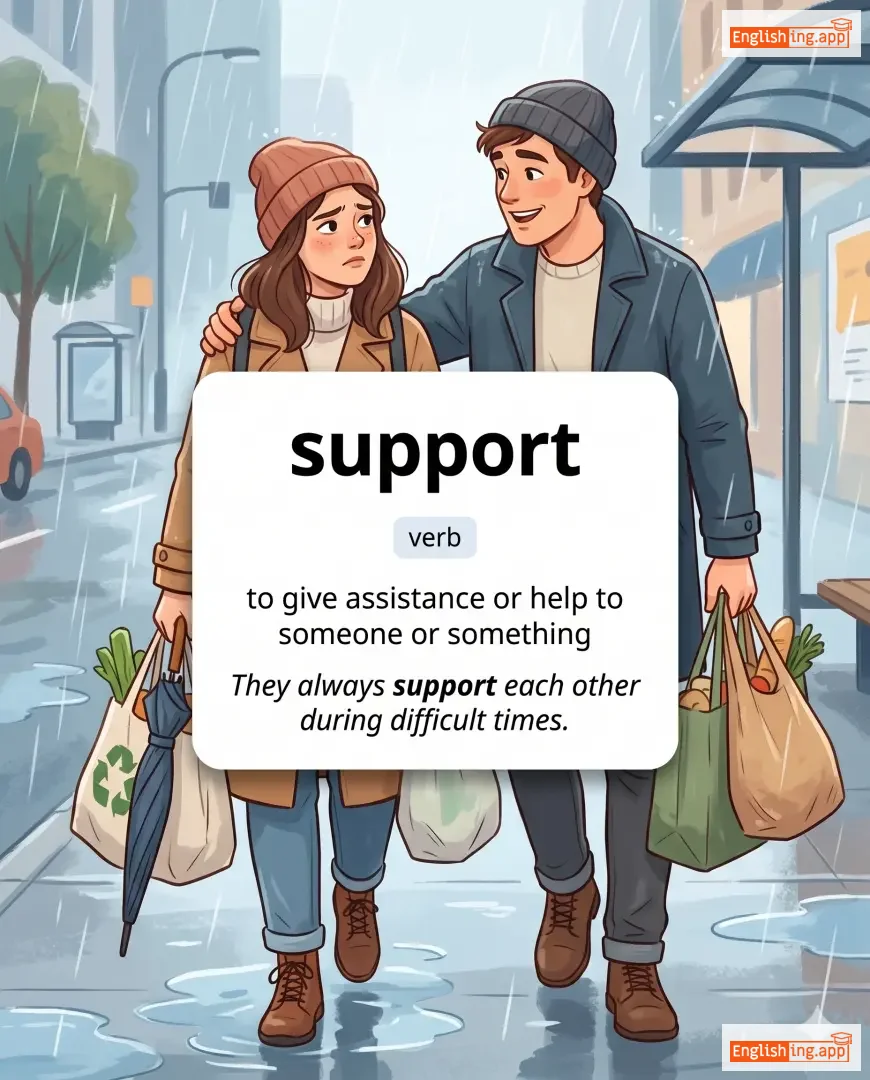
to give assistance or help to someone or something

"They always support each other during difficult times."

"Ellos siempre se apoyan mutuamente durante tiempos difíciles." (Ellos siempre se apoyan mutuamente durante tiempos difíciles.)
noun
/səˈpɔːtər/
partidario (partidario)

a person who supports someone or something

"She is a strong supporter of the local animal shelter."

"Ella es una gran partidaria del refugio local de animales." (Ella es una gran partidaria del refugio local de animales.)
supporting definition card — visual illustration of the meaning
verb
səˈpɔːrtɪŋ
apoyar (apoyar)

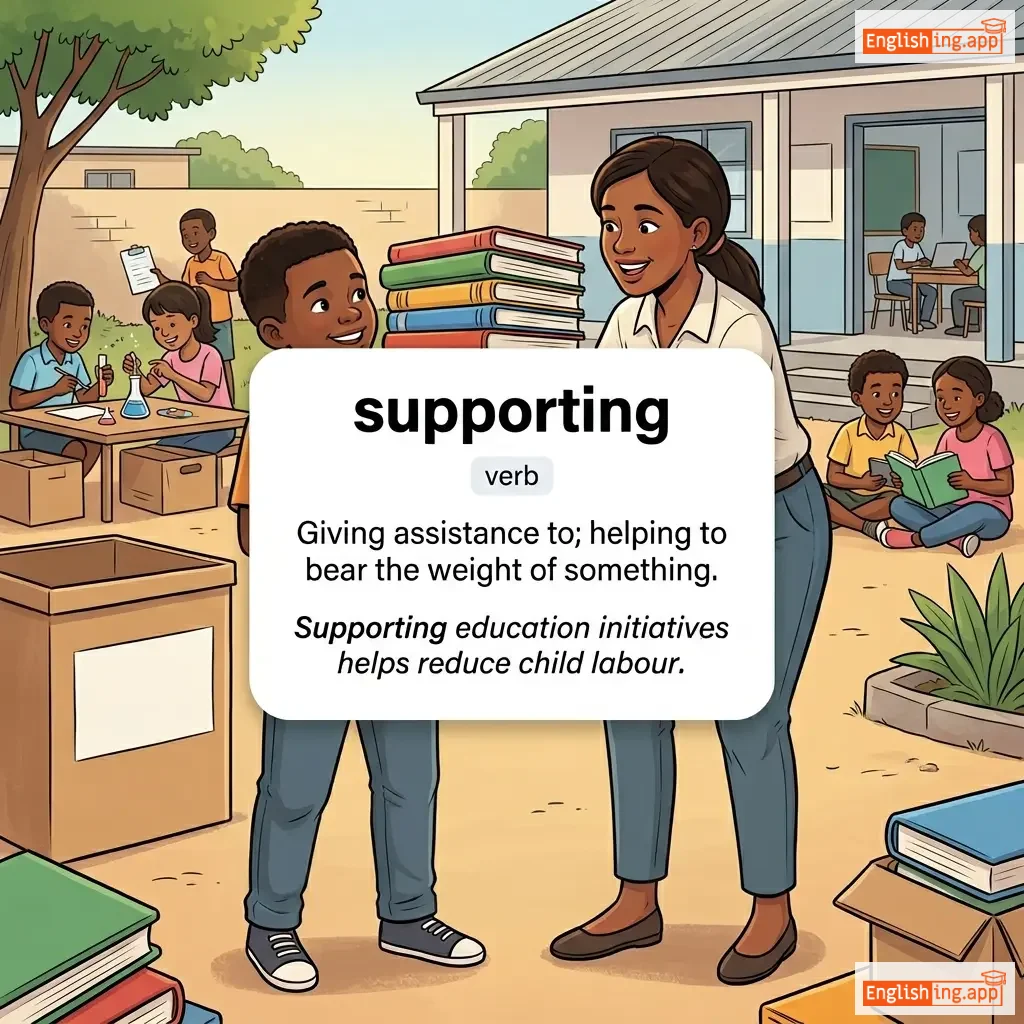
Giving assistance to; helping to bear the weight of something.

"Supporting education initiatives helps reduce child labour."

"Apoyar las iniciativas educativas ayuda a reducir el trabajo infantil." (Apoyar las iniciativas educativas ayuda a reducir el trabajo infantil.)
adjective
/səˈpɔːtɪv/
apoyo (apoyo)

providing encouragement or emotional help to someone

"She was very supportive during my difficult times."

"Ella fue muy supportive durante mis tiempos difíciles." (Ella fue muy supportive durante mis tiempos difíciles.)
verb
/səˈpəʊz/
suponer (suponer)

to assume or believe something is true without proof

"I suppose she will be here soon."

"Supongo que ella estará aquí pronto." (Supongo que ella estará aquí pronto.)
adjective
/səˈpəʊzd/
supuesto (supuesto)

generally believed or assumed, but not necessarily true

"This is the supposed solution to the problem."

"Esta es la supuesta solución al problema." (Esta es la supuesta solución al problema.)
adverb
/səˈpəʊzɪdli/
supuestamente (supuestamente)

used to show that something is believed or claimed to be true, though it may not be

"He is supposedly the best player on the team."

"Supuestamente, él es el mejor jugador del equipo." (Supuestamente, él es el mejor jugador del equipo.)
supposition definition card — visual illustration of the meaning
noun
/ˌsʌpəˈzɪʃən/
suposición (suposicion)

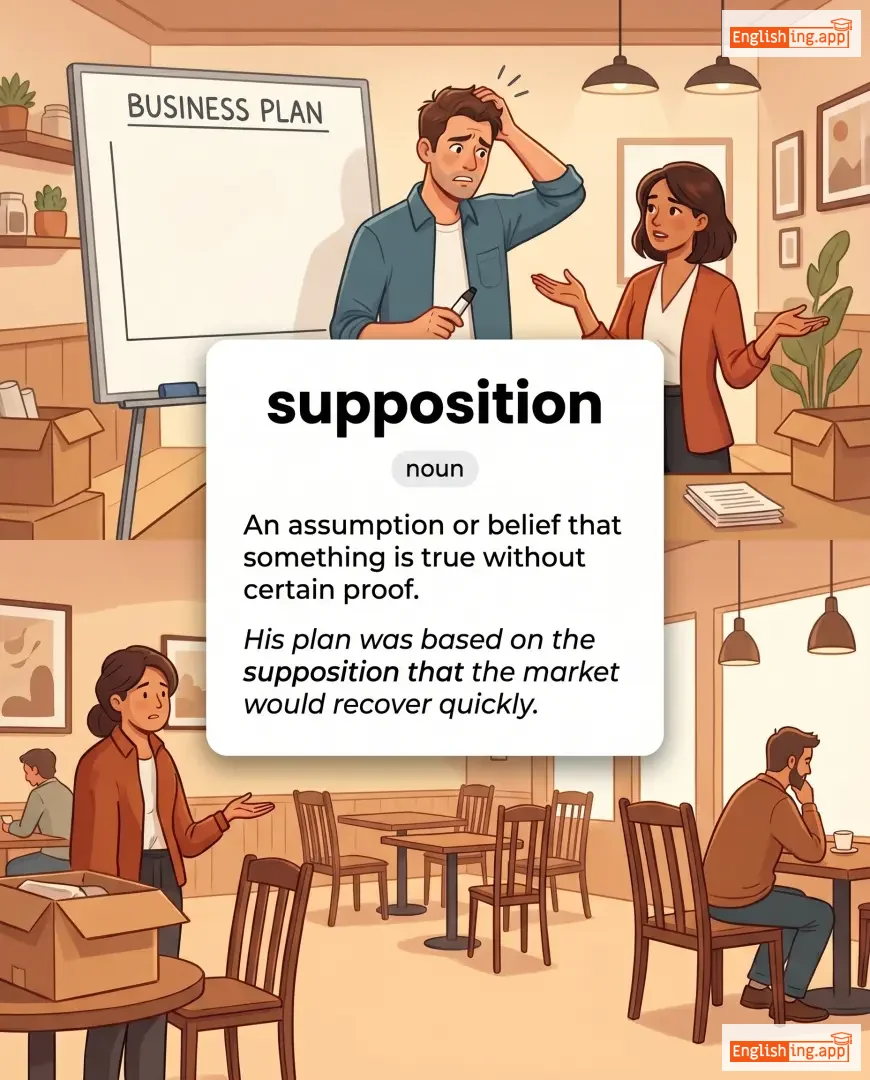
An assumption or belief that something is true without certain proof.

"His plan was based on the supposition that the market would recover quickly."

"Su plan estaba basado en la suposición de que el mercado se recuperaría rápidamente." (Su plan estaba basado en la suposicion de que el mercado se recuperaria rapidamente.)
adjective
/ˌsʌpəzɪˈtɪʃəs/
supositorio (supositorio)

Based on assumption rather than fact; not genuine or authentic.

"The story turned out to be supposititious, with no evidence to support it."

"La historia resultó ser supuesta, sin evidencia que la apoyara." (La historia resultó ser supuesta, sin evidencia que la apoyara.)
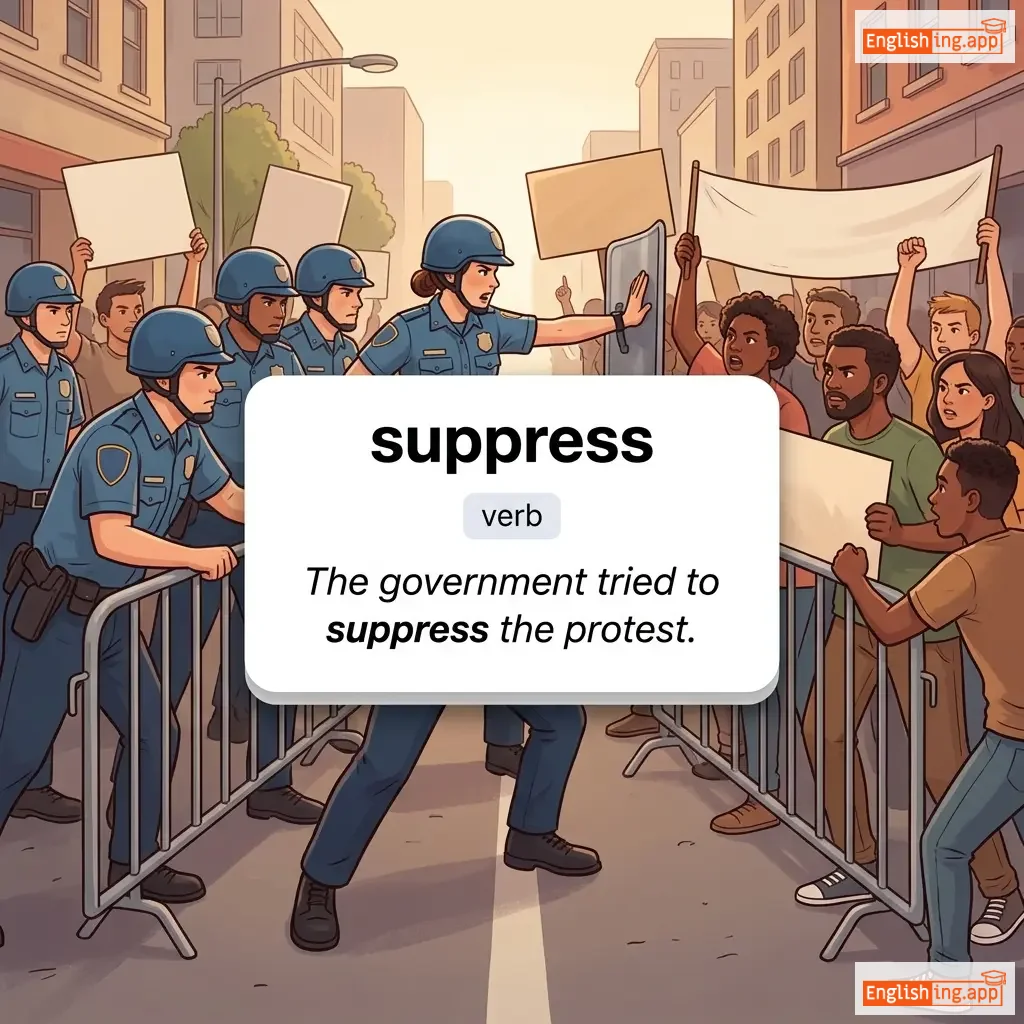
suppress definition card — visual illustration of the meaning
verb
/səˈprɛs/
suprimir (suprimir)

to forcibly put an end to something; to restrain or hold back an action, feeling, or development

"The government tried to suppress the protest."

"El gobierno intentó suprimir la protesta." (El gobierno intentó suprimir la protesta.)
adjective
/səˈprɛsəbl̩/
suprimible (suprimible)

capable of being restrained, controlled, or prevented

"The symptoms of the disease are suppressible with medication."

"Los síntomas de la enfermedad son suprimibles con medicación." (Los síntomas de la enfermedad son suprimibles con medicación.)
noun
/səˈprɛʃən/
supresión (supresion)

the act of forcibly stopping something or holding back feelings or actions

"The suppression of free speech led to protests."

"La supresión de la libertad de expresión llevó a protestas." (La supresion de la libertad de expresion llevo a protestas.)
verb
/ˈsʌpjʊˌreɪt/
supurar (supurar)

to form or discharge pus, usually as a result of infection

"The wound began to suppurate after a few days."

"La herida comenzó a supurar después de unos días." (La herida comenzó a supurar después de unos días.)
adjective
/ˌsuːprəˈmʌndeɪn/
supramundano (supramundano)

beyond the physical or ordinary world; transcendent

"The monk spoke of supramundane peace beyond material life."

"El monje habló de la paz supramundana más allá de la vida material." (El monje hablo de la paz supramundana mas alla de la vida material.)
noun
/suˈpriː.mə.si/
supremacía; autoridad o poder más alto (supremacia)

the state of being supreme; highest authority or power

"The country established naval supremacy in the region."

"El país estableció supremacía naval en la región." (El pais establecio supremacia naval en la region.)
adjective
/suˈpriːm/
supremo (supremo)

highest in rank or authority

"He is the supreme leader of the country."

"Él es el líder supremo del país." (Él es el líder supremo del país.)
noun
/sɜːrˈsiːs/
cese (cese)

a temporary or final ending or stopping of something

"The noise finally came to a surcease after midnight."

"El ruido finalmente llegó a un cese después de medianoche." (El ruido finalmente llegó a un cese después de medianoche.)
noun
/ˈsɜːrtʃɑːrdʒ/
recargo adicional (recargo adicional)

an additional charge or payment added to the usual cost

"The airline ticket had a fuel surcharge added to it."

"El boleto de avión tenía un recargo por combustible agregado." (El boleto de avión tenía un recargo por combustible agregado.)
adjective
/ʃʊər/ or /ʃɔːr/
seguro (seguro)

Confident about something; without doubt.

"I am sure that he will succeed."

"Estoy seguro de que él tendrá éxito." (Estoy seguro de que él tendrá éxito.)
adverb
/ˈʃʊəli/
seguramente (seguramente)

used to emphasize that something is definitely true or certain

"Surely, he must know about the meeting."

"Seguramente, él debe saber sobre la reunión." (Seguramente, él debe saber sobre la reunión.)
noun
/ˈʃʊərəti/
garantía (garantia)

a person who takes responsibility for another's performance of an undertaking, such as appearing in court or paying a debt

"The landlord required a surety before renting the apartment."

"El arrendador requirió una garantía antes de alquilar el apartamento." (El arrendador requirió una garantía antes de alquilar el apartamento.)
noun
/ˈsɜːfɪs/
superficie (superficie)

the outermost layer or boundary of something

"The surface of the water was calm."

"La superficie del agua estaba tranquila." (La superficie del agua estaba tranquila.)
noun
/ˈsɜːrfɪt/
exceso (exceso)

an excessive amount of something

"There was a surfeit of food at the festival."

"Había un exceso de comida en el festival." (Había un exceso de comida en el festival.)
verb
/sɜːrdʒ/
avanzar bruscamente (avanzar bruscamente)

to move suddenly and powerfully forward or upward

"The crowd surged forward when the gates opened."

"La multitud se adelantó rápidamente cuando se abrieron las puertas." (La multitud se adelantó rápidamente cuando se abrieron las puertas.)
noun
/ˈsɜːdʒən/
cirujano (cirujano)

a doctor who performs medical operations

"The surgeon performed a complex heart operation."

"El cirujano realizó una operación compleja de corazón." (El cirujano realizo una operacion compleja de corazon.)
noun
/ˈsɜːdʒəri/
cirugía (surjeri)

a medical procedure involving the cutting of the body to treat a condition

"She underwent surgery to remove the tumor."

"Ella se sometió a una cirugía para eliminar el tumor." (Ella se sometio a una cirugia para eliminar el tumor.)
adjective
/ˈsɜːdʒɪkəl/
relacionado con cirugía (relacionado con cirugia)

relating to or involving surgery

"She underwent surgical treatment to repair the damage."

"Se sometió a tratamiento quirúrgico para reparar el daño." (Se sometió a tratamiento quirúrgico para reparar el daño.)
adjective
/ˈsɜːrli/
gruñón (grunyon)

bad-tempered and unfriendly

"The waiter gave us a surly look when we asked for more water."

"El camarero nos miró de forma gruñona cuando pedimos más agua." (El camarero nos miró de forma grunyon cuando pedimos más agua.)
noun
/ˈsʊrmə fɪʃ/
pez Surma (pez surma)

a freshwater fish species found in the Surma river system of Bangladesh and northeastern India

"Surma fish is native to the rivers of Sylhet region."

"El pez Surma es originario de los ríos de la región de Sylhet." (el pez surma es originario de los rios de la region de sylhet)
verb
/sərˈmaɪz/
suponer (suponer)

to suppose something is true without having evidence

"She surmised that he was not coming to the meeting."

"Ella supuso que él no iba a venir a la reunión." (Ella supuso que él no iba a venir a la reunión.)
verb
/sərˈmaʊnt/
superar (superar)

to overcome a difficulty or obstacle

"He surmounted all the challenges to achieve his dream."

"Él superó todos los desafíos para lograr su sueño." (Él superó todos los desafíos para lograr su sueño.)
noun
/ˈsɜr.neɪm/
apellido (apellido)

a hereditary name common to all members of a family; family name

"Please write your first name and surname on the form."

"Por favor, escriba su primer nombre y apellido en el formulario." (Por favor, escriba su primer nombre y apellido en el formulario.)
verb
/sərˈpæs/
superar (superar)

to exceed or go beyond

"Her performance surpassed all expectations."

"Su rendimiento superó todas las expectativas." (Su rendimiento superó todas las expectativas.)
adjective
/sər'pæs.ɪŋ/
sobresaliente; superior; extraordinario (sobresaliente, superior, extraordinario)

exceeding; going beyond; outstanding

"Her surpassing beauty made everyone stop and stare."

"Su belleza sobresaliente hizo que todos se detuvieran y la miraran." (Su belleza sobresaliente hizo que todos se detuvieran y la miraran.)
noun
/ˈsɜːr.plʌs/
superávit (superavit)

An amount that is more than what is needed.

"The country has a surplus of food this year."

"Este año el país tiene un superávit de alimentos." (Este ano el pais tiene un superavit de alimentos.)
noun
/səˈpraɪz/
sorpresa (sorpresa)

a sudden and unexpected event or situation

"His arrival was a pleasant surprise."

"Su llegada fue una agradable sorpresa." (Su llegada fue una agradable sorpresa.)
adjective
/səˈpraɪzd/
sorprendido (sorprendido)

feeling or showing astonishment or shock

"She was surprised by the news."

"Ella se sorprendió con la noticia." (Ella se sorprendió con la noticia.)
adjective
/səˈpraɪzɪŋ/
sorprendente (sorprendente)

causing surprise or astonishment

"The sudden storm was surprising."

"La tormenta repentina fue sorprendente." (La tormenta repentina fue sorprendente.)
adverb
/səˈpraɪzɪŋli/
sorprendentemente (sorprendentemente)

in a way that causes surprise or amazement

"Surprisingly, she finished the entire project in just one day."

"Sorprendentemente, terminó todo el proyecto en solo un día." (Sorprendentemente, terminó todo el proyecto en solo un día.)
verb
/səˈrɛndər/
rendirse (rendirse)

to give up or yield to an opponent or authority

"The army finally surrendered after weeks of fighting."

"El ejército finalmente se rindió después de semanas de lucha." (El ejercito finalmente se rindió después de semanas de lucha.)
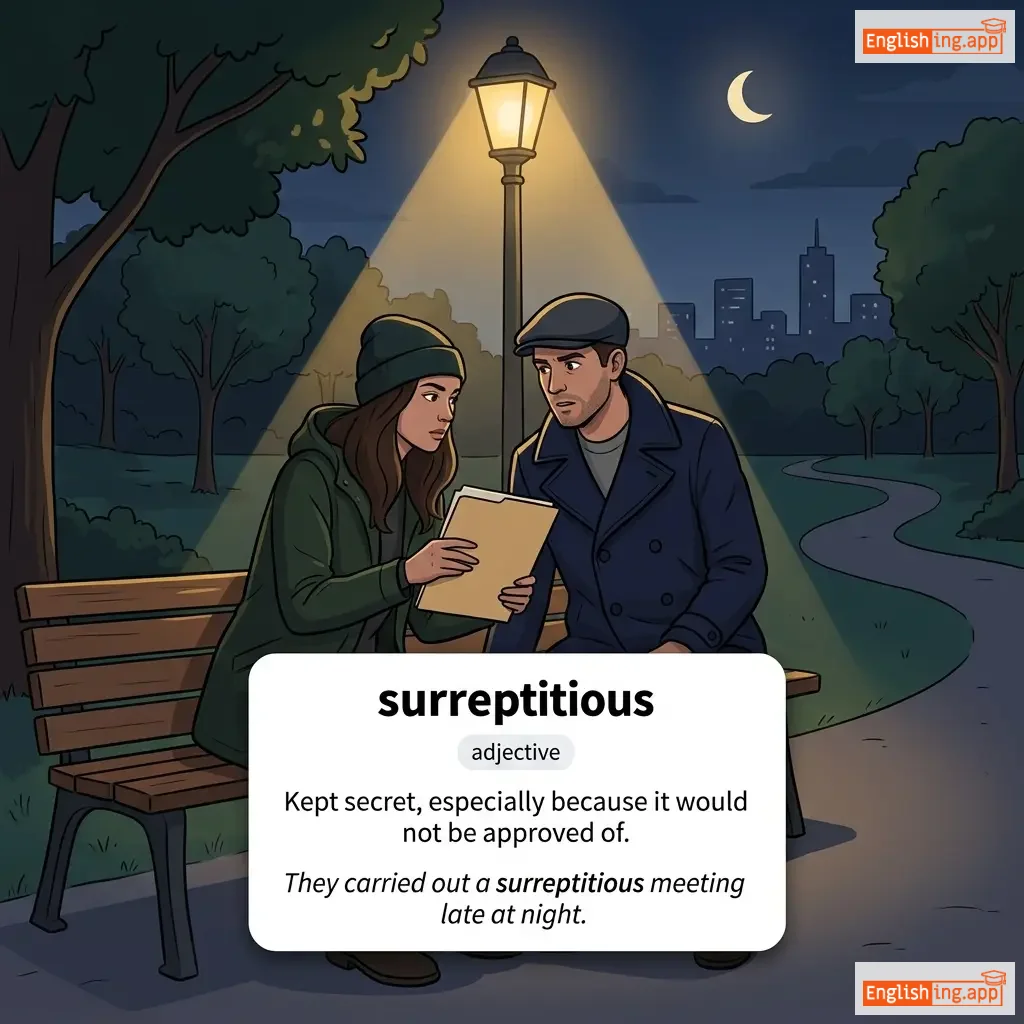
surreptitious definition card — visual illustration of the meaning
adjective
/ˌsʌrəpˈtɪʃəs/
secreto (secreto)

Kept secret, especially because it would not be approved of.

"They carried out a surreptitious meeting late at night."

"Llevaron a cabo una reunión secreta tarde en la noche." (Llevaron a cabo una reunión secreta tarde en la noche.)
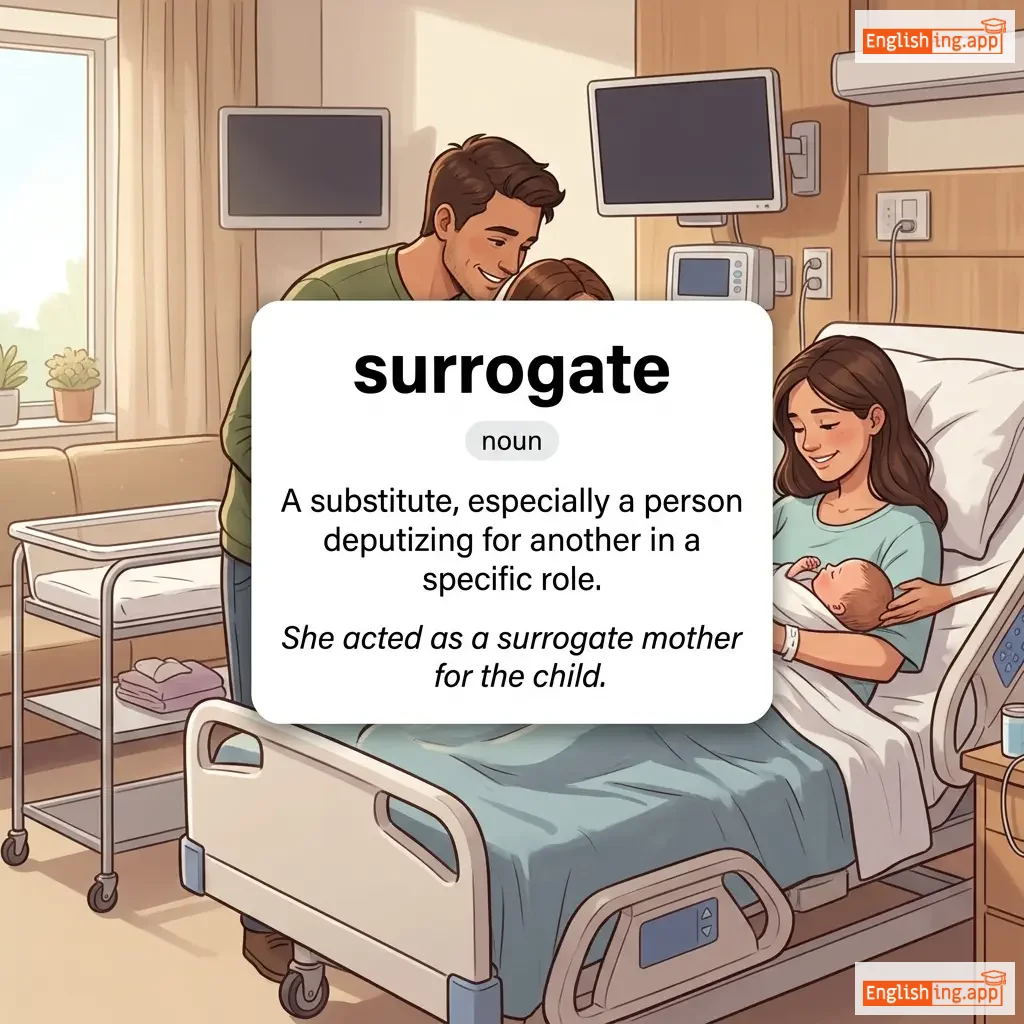
surrogate definition card — visual illustration of the meaning
noun
/ˈsʌrəɡət/
sustituto (sustituto)

A substitute, especially a person deputizing for another in a specific role.

"She acted as a surrogate mother for the child."

"Ella actuó como una madre sustituta para el niño." (Ella actuó como una madre sustituta para el niño.)
verb
/səˈraʊnd/
rodear (rodear)

To be all around someone or something.

"Mountains surround the small village."

"Las montañas rodean el pequeño pueblo." (Las montañas rodean el pequeño pueblo.)
adjective
/səˈraʊndɪŋ/
circundante (circundante)

located all around a particular place or thing; nearby

"The surrounding hills were covered in mist."

"Las colinas circundantes estaban cubiertas de niebla." (Las colinas circundantes estaban cubiertas de niebla.)
noun
/səˈraʊn.dɪŋz/
alrededores (alrededores)

The area around a person, place, or thing.

"She quickly adapted to her new surroundings."

"Ella se adaptó rápidamente a su nuevo entorno." (Ella se adapto rapidamente a su nuevo entorno.)
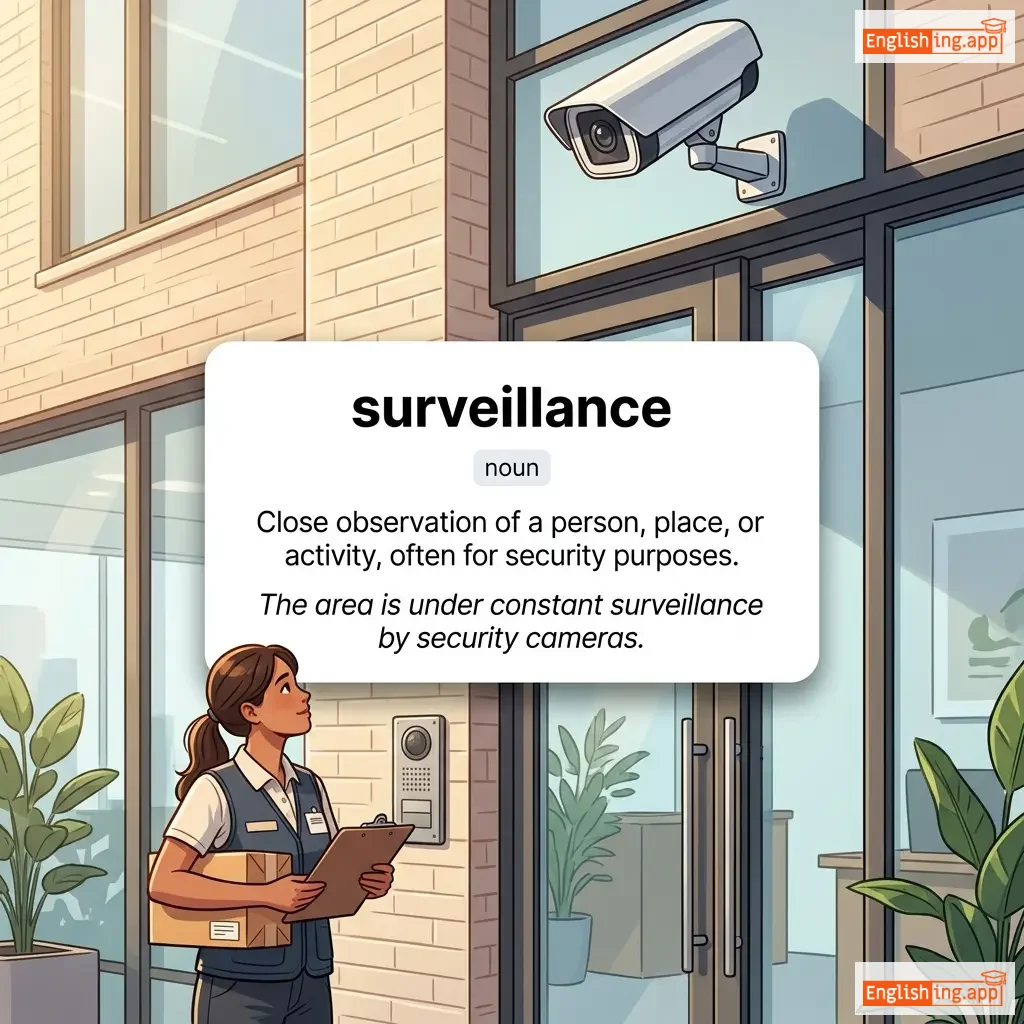
surveillance definition card — visual illustration of the meaning
noun
/sɜːrˈveɪləns/
vigilancia (vigilancia)

Close observation of a person, place, or activity, often for security purposes.

"The area is under constant surveillance by security cameras."

"El área está bajo constante vigilancia por cámaras de seguridad." (El área está bajo constante vigilancia por cámaras de seguridad.)
noun/verb
/ˈsɜːveɪ/
encuesta, sondeo (encuesta, sondeo)

noun: an examination or inspection; verb: to examine or measure (an area or subject)

"They conducted a survey to understand customer preferences."

"Realizaron una encuesta para entender las preferencias de los clientes." (Realizaron una encuesta para entender las preferencias de los clientes.)
noun
/sərˈveɪər/
topógrafo (topografo)

A person who measures and maps land, buildings, or other features.

"The surveyor measured the land for construction."

"El topógrafo midió la tierra para la construcción." (El topógrafo midió la tierra para la construcción.)