Vocabularios

Descubra, aprenda y domine el vocabulario en inglés

adjective/noun
/ˈsʌkjələnt/
jugoso (jugoso)

Juicy or full of juice; also refers to a plant with thick, fleshy leaves adapted to storing water.

"The steak was so succulent that everyone enjoyed it."

"El filete estaba tan jugoso que todos lo disfrutaron." (El filete estaba tan jugoso que todos lo disfrutaron.)
verb
/səˈkʌm/
sucumbir (sucumbir)

To give in to pressure, temptation, or illness; to yield or fail to resist.

"He finally succumbed to his illness after a long struggle."

"Finalmente sucumbió a su enfermedad después de una larga lucha." (finalmente sucumbio a su enfermedad despues de una larga lucha)
determiner
/sʌtʃ/
tal (tal)

of the type previously mentioned or specified

"I have never seen such a beautiful painting."

"Nunca he visto tal pintura hermosa." (Nunca he visto tal pintura hermosa.)
verb
/sʌk/
chupar (chupar)

to draw something into the mouth by using the lips and tongue

"The baby began to suck her thumb."

"El bebé empezó a chuparse el dedo." (El bebé empezó a chuparse el dedo.)
verb
/ˈsʌkɪŋ/
chupar (chupar)

Drawing in a liquid, air, or other substance through the mouth or a tube by creating a vacuum; also used figuratively for something unpleasant or ineffective

"The baby is sucking on a pacifier."

"El bebé está chupando un chupete." (El bebe esta chupando un chupete.)
verb
/ˈsʌk.əl/
amamantar (amamantar)

to feed a baby or young animal with milk from the breast or udder

"The mother cat suckled her kittens in the basket."

"La madre gata amamantó a sus gatitos en la cesta." (La madre gata amamanto a sus gatitos en la cesta.)
adjective
/ˈsʌdən/
repentino (repentino)

occurring or done quickly and unexpectedly

"The sudden change in the weather surprised everyone."

"El cambio repentino en el clima sorprendió a todos." (El cambio repentino en el clima sorprendió a todos.)
adverb
/ˈsʌdənli/
de repente (de repente)

in a way that happens quickly and unexpectedly

"The lights suddenly went out during the meeting."

"Las luces se apagaron de repente durante la reunión." (Las luces se apagaron de repente durante la reunión.)
adjective
/ˌsuːdəˈrɪfɪk/
sudorífico (sudorifico)

causing or increasing sweating

"The doctor prescribed a sudorific drug to help reduce the fever."

"El doctor recetó un medicamento sudorífico para reducir la fiebre." (El doctor receto un medicamento sudorifico para reducir la fiebre.)
⚖️

sue (su)

verb
/suː/
demandar (demandar)

to bring a lawsuit against someone in a court of law

"She decided to sue the company for damages."

"Ella decidió demandar a la empresa por daños." (Ella decidió demandar a la empresa por daños.)
verb
/ˈsʌfər/
sufrir (sufrir)

to experience pain, distress, or hardship

"She suffered from a severe headache all day."

"Ella sufrió de un fuerte dolor de cabeza todo el día." (Ella sufrió de un fuerte dolor de cabeza todo el día.)
noun
/ˈsʌfərəns/
tolerancia (tolerancia)

patient endurance of pain, hardship, or delay; passive consent or tolerance

"He lived in poverty with quiet sufferance."

"Vivió en la pobreza con tolerancia silenciosa." (Vivió en la pobreza con tolerancia silenciosa.)
noun
/ˈsʌfərɪŋ/
sufrimiento (sufrimiento)

the state of undergoing pain, distress, or hardship

"They tried to relieve his suffering with medicine."

"Intentaron aliviar su sufrimiento con medicina." (Intentaron aliviar su sufrimiento con medicina.)
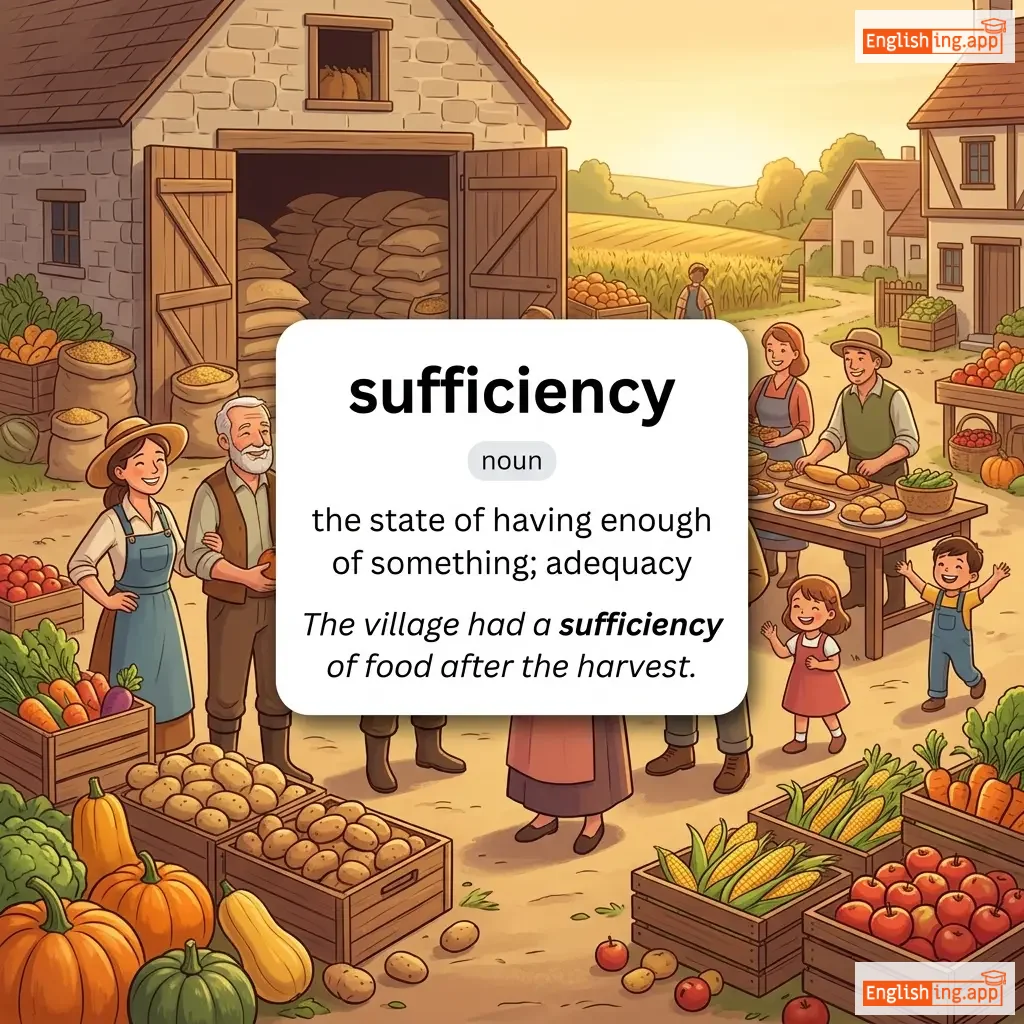
sufficiency definition card — visual illustration of the meaning
noun
/səˈfɪʃənsi/
suficiencia (suficiencia)

the state of having enough of something; adequacy

"The village had a sufficiency of food after the harvest."

"La aldea tenía suficiente comida después de la cosecha." (La aldea tenía suficiente comida después de la cosecha.)
adjective
/səˈfɪʃənt/
suficiente (suficiente)

enough; adequate for a purpose

"She had sufficient money to buy the dress."

"Tenía suficiente dinero para comprar el vestido." (Tenía suficiente dinero para comprar el vestido.)
adverb
/səˈfɪʃəntli/
suficientemente (sufisientemente)

to an adequate degree or extent

"She studied sufficiently to pass the exam."

"Ella estudió suficientemente para aprobar el examen." (Ella estudió suficientemente para aprobar el examen.)
verb
/ˈsʌfəkeɪt/
asfixiar (asfixiar)

to cause someone to die or have difficulty breathing by depriving them of air

"The child nearly suffocated when trapped in the locked room."

"El niño casi se asfixió cuando quedó atrapado en la habitación cerrada." (El niño casi se asfixió cuando quedó atrapado en la habitación cerrada.)
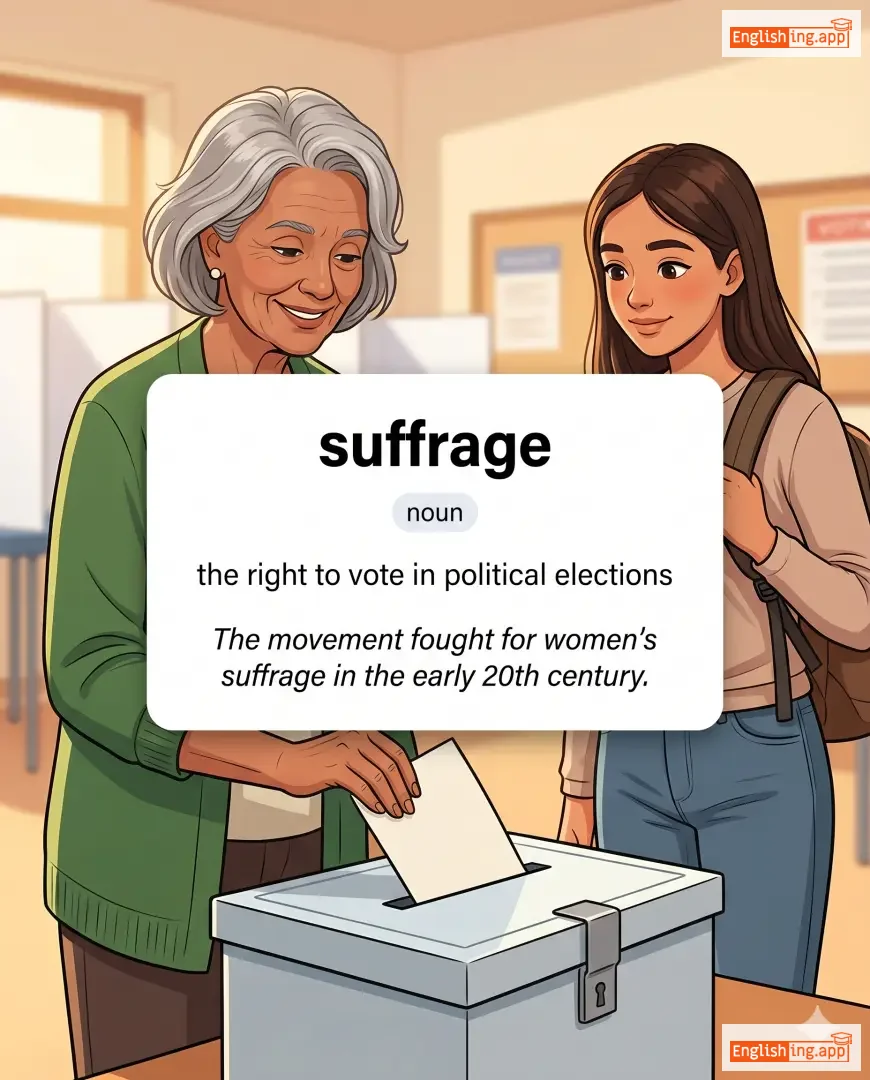
suffrage definition card — visual illustration of the meaning
noun
/ˈsʌfrɪdʒ/
sufragio (sufragio)

the right to vote in political elections

"The movement fought for women’s suffrage in the early 20th century."

"El movimiento luchó por el sufragio femenino a principios del siglo XX." (El movimiento lucho por el sufragio femenino a principios del siglo veinte.)
noun
/ˈsʌfrədʒɪst/
sufragista (sufragista)

a person advocating the extension of suffrage, especially to women

"The suffragists organized rallies to demand voting rights for women."

"Los sufragistas organizaron manifestaciones para exigir los derechos de voto para las mujeres." (Los sufragistas organizaron manifestaciones para exigir los derechos de voto para las mujeres.)
verb
/səˈfjuːz/
difundir (difundir)

to gradually spread through or over something

"A warm glow suffused her face as she smiled."

"Un resplandor cálido se difundió por su rostro mientras ella sonreía." (Un resplandor cálido se difundió por su rostro mientras ella sonreía.)
noun
/ˈʃʊɡər/
azúcar (azucar)

a sweet substance made from plants or produced synthetically

"She added two spoons of sugar to her tea."

"Ella añadió dos cucharadas de azúcar a su té." (Ella anadió dos cucharadas de azucar a su té.)
noun
/ˈʃʊɡ.ər ˈkæn.di/
caramelo de azúcar (caramelo de azucar)

crystallized sugar formed into small pieces; rock candy made from sugar syrup

"The children enjoyed eating colorful sugar candy at the festival."

"Los niños disfrutaron comer dulces de azúcar coloridos en el festival." (Los ninos disfrutaron comer dulces de azucar coloridos en el festival)
verb
/səˈdʒɛst/
sugerir (sugerir)

to put forward an idea, plan, or recommendation for consideration

"He suggested going to the new restaurant for dinner."

"Él sugirió ir al nuevo restaurante para la cena." (Él sugirió ir al nuevo restaurante para la cena.)
adjective
/səˈdʒɛstəbəl/
sugestionable (sugestionable)

easily influenced by the suggestions of others

"Children are highly suggestible and may believe what they are told."

"Los niños son altamente sugestionables y pueden creer lo que se les dice." (Los niños son altamente sugestionables y pueden creer lo que se les dice.)
noun
/səˈdʒɛstʃən/
sugerencia (sugerencia)

an idea or plan put forward for consideration or action

"She gave a suggestion for improving the project."

"Ella dio una sugerencia para mejorar el proyecto." (Ella dio una sugerencia para mejorar el proyecto.)
adjective
/səˈdʒɛstɪv/
sugestivo (sugestivo)

tending to suggest ideas or images; sometimes implies something sexual or provocative

"The painting was highly suggestive and sparked much debate."

"La pintura era muy sugestiva y provocó mucho debate." (La pintura era muy sugestiva y provoco mucho debate.)
adjective
/ˌsuːɪˈsaɪdəl/
suicida (suicida)

relating to or having thoughts of killing oneself; extremely dangerous or harmful

"The reckless driving was suicidal behavior."

"La conducción imprudente fue un comportamiento suicida." (La conduccion imprudente fue un comportamiento suicida.)
noun
/ˈsuːɪˌsaɪd/
suicidio (suicidio)

the act of intentionally taking one's own life

"The article discusses the rising rates of suicide in young people."

"El artículo discute las crecientes tasas de suicidio entre los jóvenes." (El artículo discute las crecientes tasas de suicidio entre los jóvenes.)
noun
/suːt/
traje (trah-he)

a set of clothes made of the same fabric, usually consisting of trousers and a jacket

"He wore a black suit to the wedding."

"Él llevó un traje negro a la boda." (El llevo un traje negro a la boda.)
adjective
/ˈsuːtəbl/
adecuado (adecuado)

appropriate or right for a particular person, purpose, or situation

"This dress is suitable for the wedding."

"Este vestido es adecuado para la boda." (Este vestido es adecuado para la boda.)
noun
/ˈsuːt.keɪs/
maleta (maleta)

A portable rectangular container for carrying clothes and personal items when traveling

"She packed her clothes into a suitcase for the trip."

"Ella metió su ropa en una maleta para el viaje." (Ella metio su ropa en una maleta para el viaje.)
noun
/swiːt/
suite (suite)

a set of rooms designated for one person's or family's use or for a particular purpose

"They stayed in the presidential suite at the hotel."

"Se hospedaron en la suite presidencial del hotel." (Se hospedaron en la suite presidencial del hotel.)
noun
/ˈsuːtər/
pretendiente (pretendiente)

a man who pursues a relationship with a woman, often with the intent to marry

"She had many suitors vying for her attention."

"Ella tenía muchos pretendientes compitiendo por su atención." (ella tenia muchos pretendientes compitiendo por su atencion)
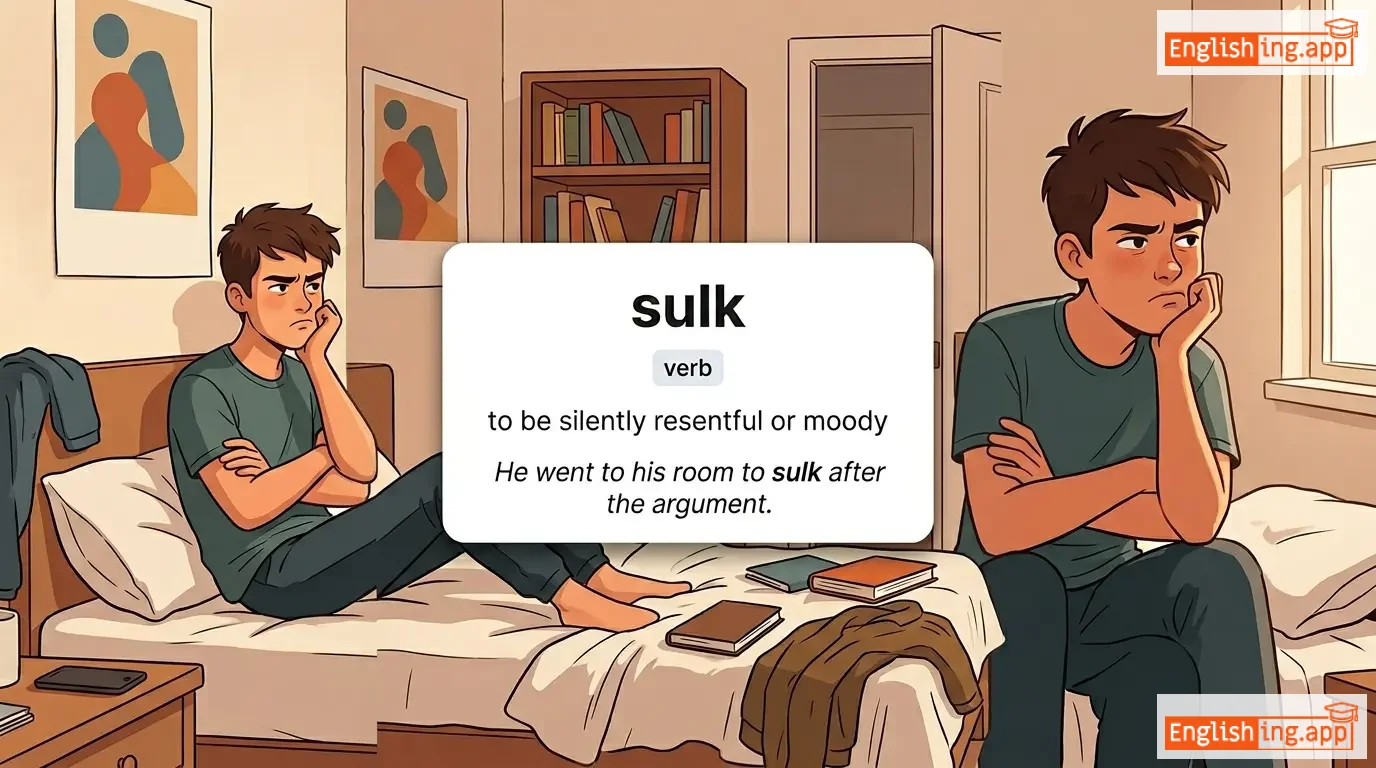
sulk definition card — visual illustration of the meaning
verb
/sʌlk/
ponerse de mal humor (ponerse de mal humor)

to be silently resentful or moody

"He went to his room to sulk after the argument."

"Él fue a su habitación a ponerse de mal humor después de la discusión." (El fue a su habitacion a ponerse de mal humor despues de la discusion.)
adjective
/ˈsʌl.ki/
malhumorado y taciturno; temperamental (malhumorado y taciturno; temperamental)

bad-tempered and sullen; moody

"The child became sulky when he couldn't get his favorite toy."

"El niño se puso malhumorado cuando no pudo conseguir su juguete favorito." (El niño se puso malhumorado cuando no pudo conseguir su juguete favorito.)
adjective
/ˈsʌlən/
gruñón (gruñón)

bad-tempered and gloomy; silently resentful

"She gave him a sullen look and walked away."

"Ella le dio una mirada gruñona y se fue." (Ella le dio una mirada gruñona y se fue.)
verb
/ˈsʌli/
manchar (manchar)

to damage the purity, integrity, or reputation of something

"The scandal sullied the politician’s reputation."

"El escándalo manchó la reputación del político." (El escándalo manchó la reputación del político.)
adjective
/ˈsʌltri/
caluroso y húmedo, atractivo (caluroso y humedo, atractivo)

Uncomfortably hot and humid; also describes someone attractive in a passionate or sensual way.

"The sultry weather made it hard to focus on work."

"El clima caluroso y húmedo dificultaba concentrarse en el trabajo." (El clima caluroso y humedo dificultaba concentrarse en el trabajo.)
noun
/sʌm/
suma (suma)

the total amount resulting from the addition of two or more numbers or items

"The sum of 8 and 12 is 20."

"La suma de 8 y 12 es 20." (La suma de 8 y 12 es 20.)
verb
/ˈsʌməraɪz/
resumir (resumir)

To give a brief statement of the main points of something

"She summarized the report in just a few minutes."

"Ella resumió el informe en solo unos minutos." (Ella resumio el informe en solo unos minutos)
noun
/ˈsʌməri/
resumen (resumen)

A brief statement of the main points of something.

"She wrote a summary of the book for her class."

"Ella escribió un resumen del libro para su clase." (Ella escribio un resumen del libro para su clase.)
noun
/sʌˈmeɪʃən/
suma, resumen (suma, resumen)

The process of adding things together; a summary of points.

"The lawyer gave a powerful summation of the case."

"El abogado dio un poderoso resumen del caso." (El abogado dio un poderoso resumen del caso.)
noun
/ˈsʌmər/
verano (verano)

the warmest season of the year, between spring and autumn

"We love going to the beach during summer."

"Nos encanta ir a la playa durante el verano." (Nos encanta ir a la playa durante el verano.)
summit definition card — visual illustration of the meaning
noun
/ˈsʌmɪt/
cima, cumbre (seema, kumbreh)

The highest point of a hill or mountain; a meeting between heads of state or leaders.

"The leaders met at the summit to discuss global issues."

"Los líderes se reunieron en la cumbre para discutir los problemas globales." (Los lideres se reunieron en la cumbre para discutir los problemas globales.)
Summit of the Future definition card — visual illustration of the meaning
noun
/ˈsʌm.ɪt əv ðə ˈfjuː.tʃər/
Cumbre del futuro (Cumbre del futuro)

A high-level conference focused on addressing future challenges and opportunities.

"The Summit of the Future addressed global challenges."

"La Cumbre del Futuro abordó los desafíos globales." (La Cumbre del Futuro abordó los desafíos globales.)
verb
/ˈsʌmən/
convocar, llamar (convocar, llamar)

To order someone to come or to gather courage or strength.

"The king summoned his advisors to the court."

"El rey convocó a sus asesores al tribunal." (El rey convocó a sus asesores al tribunal.)
adjective
/ˈsʌmp.tʃuˌɛr.i/
relacionado con las leyes que limitan el gasto personal en artículos de lujo (relacionado con las leyes que limitan el gasto personal en articulos de lujo)

Relating to laws or regulations intended to limit personal spending on luxury goods.

"In medieval Europe, sumptuary laws restricted the wearing of expensive fabrics to the nobility."

"En la Europa medieval, las leyes suntuarias restringían el uso de telas caras solo a la nobleza." (En la Europa medieval, las leyes suntuarias restringian el uso de telas caras solo a la nobleza.)
adjective
/ˈsʌmp.tʃu.əs/
suntuoso (suntuoso)

Splendid and expensive-looking; luxurious.

"The guests were treated to a sumptuous banquet."

"Los invitados fueron tratados con un banquete suntuoso." (Los invitados fueron tratados con un banquete suntuoso.)
noun
/sʌn/
sol (sol)

the star that provides light and heat to the Earth

"The sun rises in the east and sets in the west."

"El sol sale por el este y se pone por el oeste." (El sol sale por el este y se pone por el oeste.)
noun
/ˈsʌn.flaʊər/
girasol (girasol)

a large yellow flower that turns to face the sun

"The sunflower field looked amazing in the bright sunlight."

"El campo de girasoles se veía increíble bajo la luz brillante del sol." (el kampo de girasoles se veia inkreible bajo la luz brilyante del sol)