Vocabularios

Descubra, aprenda y domine el vocabulario en inglés

adjective
/ˈspaɪn.ləs/
sin coraje; débil de voluntad; cobarde (espainles)

lacking courage or determination; weak-willed

"He was too spineless to stand up for his beliefs."

"Él fue demasiado sin columna vertebral para defender sus creencias." (El fue demasiado sin columna vertebral para defender sus creencias.)
adjective
/ˈspaɪnəs/
espinoso (espinoso)

Having spines or thorn-like projections

"The spinous cactus was difficult to handle without gloves."

"El cactus espinoso era difícil de manejar sin guantes." (El cactus espinoso era difícil de manejar sin guantes.)
noun
/ˈspɪnstər/
soltera (soltera)

An unmarried woman, often one who is older and considered unlikely to marry

"The novel featured a kind-hearted spinster who cared for the village children."

"La novela presentó a una soltera de buen corazón que cuidaba a los niños del pueblo." (La novela presentó a una soltera de buen corazón que cuidaba a los niños del pueblo.)
adjective
/ˈspaɪni/
espinoso (espinoso)

covered with or full of spines; having sharp points

"The spiny cactus stood tall in the desert."

"El cactus espinoso se alzaba alto en el desierto." (El cactus espinoso se alzaba alto en el desierto.)
adjective
/ˈspaɪ.rəl/
espiral (espiral)

winding in a continuous curve; helical

"The spiral staircase led to the top floor."

"La escalera espiral condujo al piso superior." (La escalera espiral condujo al piso superior.)
noun
/ˈspaɪər/
aguja (aguja)

a tall, pointed structure on top of a building, especially a church

"The church spire could be seen from miles away."

"La aguja de la iglesia se podía ver desde kilómetros de distancia." (La aguja de la iglesia se podía ver desde kilómetros de distancia.)
noun
/ˈspɪrɪt/
espíritu (espirito)

the non-physical part of a person, regarded as their true self

"Her spirit remained unbroken despite the hardships."

"Su espíritu permaneció intacto a pesar de las dificultades." (Su espiritu permaneció intacto a pesar de las dificultades.)
adjective
/ˈspɪrɪtʃuəl/
espiritual (espiritual)

relating to or affecting the human spirit or soul

"She practices spiritual meditation every morning."

"Ella practica meditación espiritual cada mañana." (Ella practica meditacion espiritual cada manana.)
verb
/spɪt/
escupir (escupir)

to force liquid, especially saliva, out of the mouth

"He spat on the ground in anger."

"Él escupió en el suelo con ira." (El escupió en el suelo con ira.)
noun
/spaɪt/
despecho (despecho)

a desire to hurt, annoy, or offend someone

"She refused the gift out of spite."

"Ella rechazó el regalo por despecho." (Ella rechazo el regalo por despecho.)
noun
/spliːn/
bazo; cólera (bazo; colera)

an organ in the body that produces lymphocytes and filters blood; also refers to bad temper or spite

"He vented his spleen on his coworkers after the meeting."

"Ventu su cólera sobre sus compañeros de trabajo después de la reunión." (Ventu su colera sobre sus companeros de trabajo despues de la reunion.)
adjective
/ˈsplendɪd/
espléndido; magnífico; impresionante (splendido; magnifico; impresionante)

magnificent; excellent; very impressive

"The castle looked splendid in the sunset."

"El castillo se veía espléndido en la puesta de sol." (El castillo se veía espléndido en la puesta de sol.)
adjective
/splɪˈnɛtɪk/
irritable, malhumorado (irritable, malhumorado)

bad-tempered, irritable, spiteful

"His splenetic remarks offended everyone in the room."

"Sus comentarios iracundos ofendieron a todos en la sala." (Sus comentarios iracundos ofendieron a todos en la sala.)
verb
/splaɪs/
unir (unir)

to join two pieces of rope, film, or other material by weaving or attaching them together

"The technician spliced the two wires to restore the connection."

"El técnico unió los dos cables para restaurar la conexión." (El técnico unió los dos cables para restaurar la conexión.)
/splɪnt/
férula (ferula)

A rigid device used to support and immobilize a broken or injured body part.

"The doctor applied a splint to stabilize the patient's broken arm."

"El doctor aplicó una férula para estabilizar el brazo roto del paciente." (El doctor aplico una ferula para estabilizar el brazo roto del paciente.)
verb
/splɪt/
dividir (dividir)

to divide or separate into parts or groups

"He split the log in two with an axe."

"Él dividió el tronco en dos con un hacha." (Él dividió el tronco en dos con un hacha.)
verb
/spɔɪl/
estropear (estropear)

to damage or ruin something

"The rain spoiled the outdoor event."

"La lluvia estropeó el evento al aire libre." (La lluvia estropeó el evento al aire libre.)
noun
/ˈspɔɪlˌspɔːrt/
aguafiestas (aguafiestas)

A person who ruins other people's enjoyment or fun.

"Don't be a spoilsport and let us enjoy the party."

"No seas un aguafiestas y déjanos disfrutar de la fiesta." (No seas un aguafiestas y dejarnos disfrutar de la fiesta.)
noun, verb
/spoʊk/
radios / habló (radios / hablo)

As a noun, a bar connecting the center of a wheel to its rim; as the past tense of 'speak'.

"The bicycle's spoke was bent after the accident."

"El radio de la bicicleta estaba doblado después del accidente." (El radio de la bicicleta estaba doblado después del accidente.)
noun
/ˈspəʊksmən/
portavoz (portavoz)

a person who speaks on behalf of others, especially for a group or organization

"The spokesman addressed the crowd during the rally."

"El portavoz dirigió a la multitud durante la manifestación." (El portavoz dirijo a la multitud durante la manifestacion.)
noun
/ˈspəʊkspɜːrsən/
portavoz (portavoz)

a person who speaks on behalf of others or an organization

"The spokesperson addressed the press conference on behalf of the company."

"El portavoz dirigió la conferencia de prensa en nombre de la empresa." (El portavoz dirigió la conferencia de prensa en nombre de la empresa.)
noun
/ˈspəʊkswɪmən/
portavoz mujer (portavoz mujer)

a woman who speaks on behalf of a group or organization

"The spokeswoman for the company announced the new product."

"La portavoz de la compañía anunció el nuevo producto." (La portavoz de la compañia anuncio el nuevo producto.)
noun
/ˌspoʊliˈeɪʃən/
destrucción (destruccion)

The act of destroying or ruining something, often evidence or property.

"The court punished the company for the spoliation of evidence."

"El tribunal castigó a la empresa por la destrucción de pruebas." (El tribunal castigó a la empresa por la destrucción de pruebas.)
adjective
/ˈspʌndʒi/
esponjoso (esponjoso)

soft and full of holes like a sponge; porous

"The cake had a light and spongy texture."

"El pastel tenía una textura ligera y esponjosa." (El pastel tenía una textura ligera y esponjosa.)
noun
/spʌndʒ ɡɔːrd/
calabaza esponjosa (calabaza esponjosa)

a fibrous gourd that becomes sponge-like when dried, used for cleaning and in cooking when young

"The sponge gourd can be eaten when young or dried to make natural scrubbers."

"La calabaza esponjosa puede comerse cuando está joven o secarse para hacer estropajos naturales." (La calabaza esponjosa puede comerse cuando está joven o secarse para hacer estropajos naturales.)
noun
/ˈspɒnsər/
patrocinador (patrocinador)

a person or organization that provides funds for a project or activity in exchange for publicity or support

"The company became the main sponsor of the event."

"La empresa se convirtió en el principal patrocinador del evento." (La empresa se convirtio en el principal patrocinador del evento.)
noun
/ˈspɒnsəʃɪp/
patrocinio (patrocinio)

the act of supporting an event, activity, person, or organization financially or through other resources

"The event was made possible due to the sponsorship of several big companies."

"El evento fue posible gracias al patrocinio de varias grandes empresas." (El evento fue posible gracias al patrocinio de varias grandes empresas.)
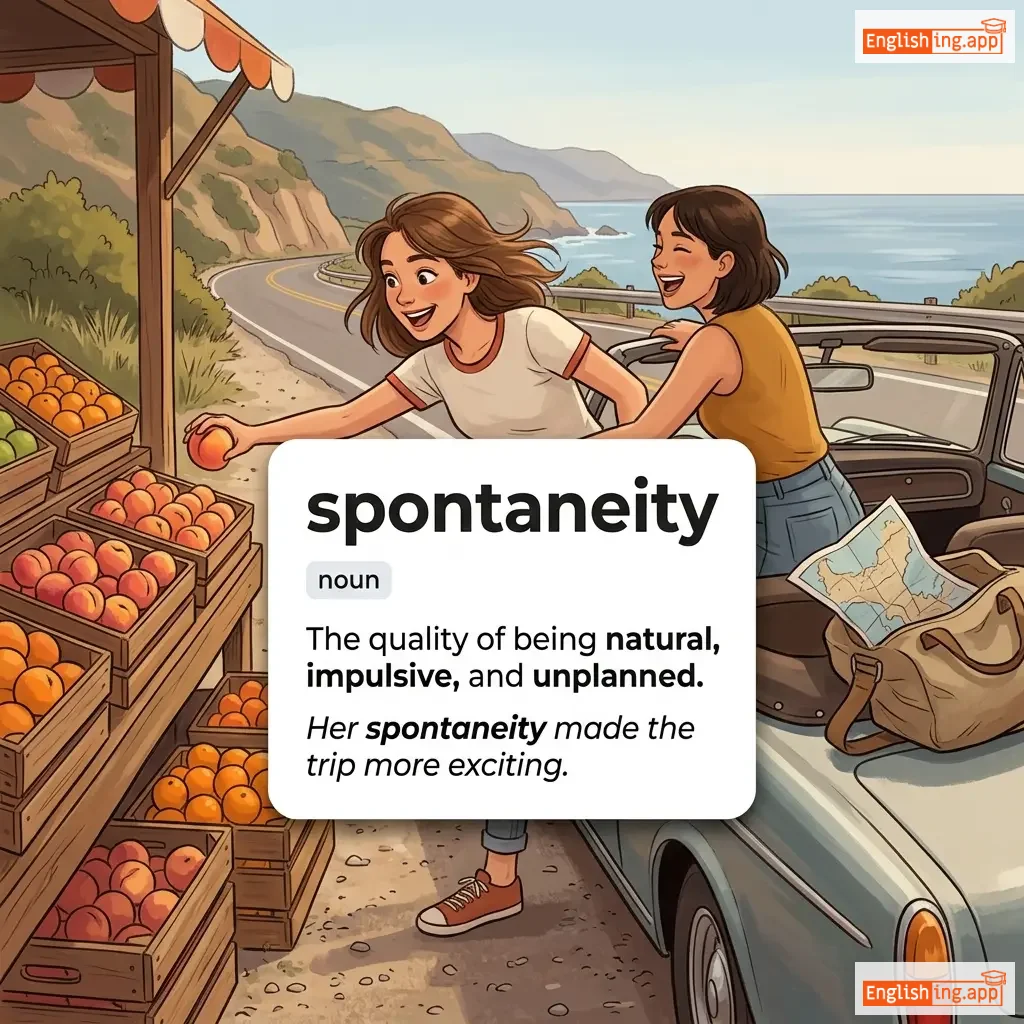
spontaneity definition card — visual illustration of the meaning
noun
/ˌspɑːntəˈneɪəti/
espontaneidad (espontaneidad)

The quality of being natural, impulsive, and unplanned.

"Her spontaneity made the trip more exciting."

"Su espontaneidad hizo el viaje más emocionante." (su espontaneidad hizo el viaje mas emocionante.)
adjective
/spɒnˈteɪniəs/
espontáneo (esponteaneo)

Happening naturally without planning or external cause; impulsive or unplanned.

"Their spontaneous trip to the mountains turned out to be the highlight of the summer."

"Su viaje espontáneo a las montañas resultó ser lo más destacado del verano." (Su viake esponteaneo a las montanyas resulto ser lo mas destacado del verano.)
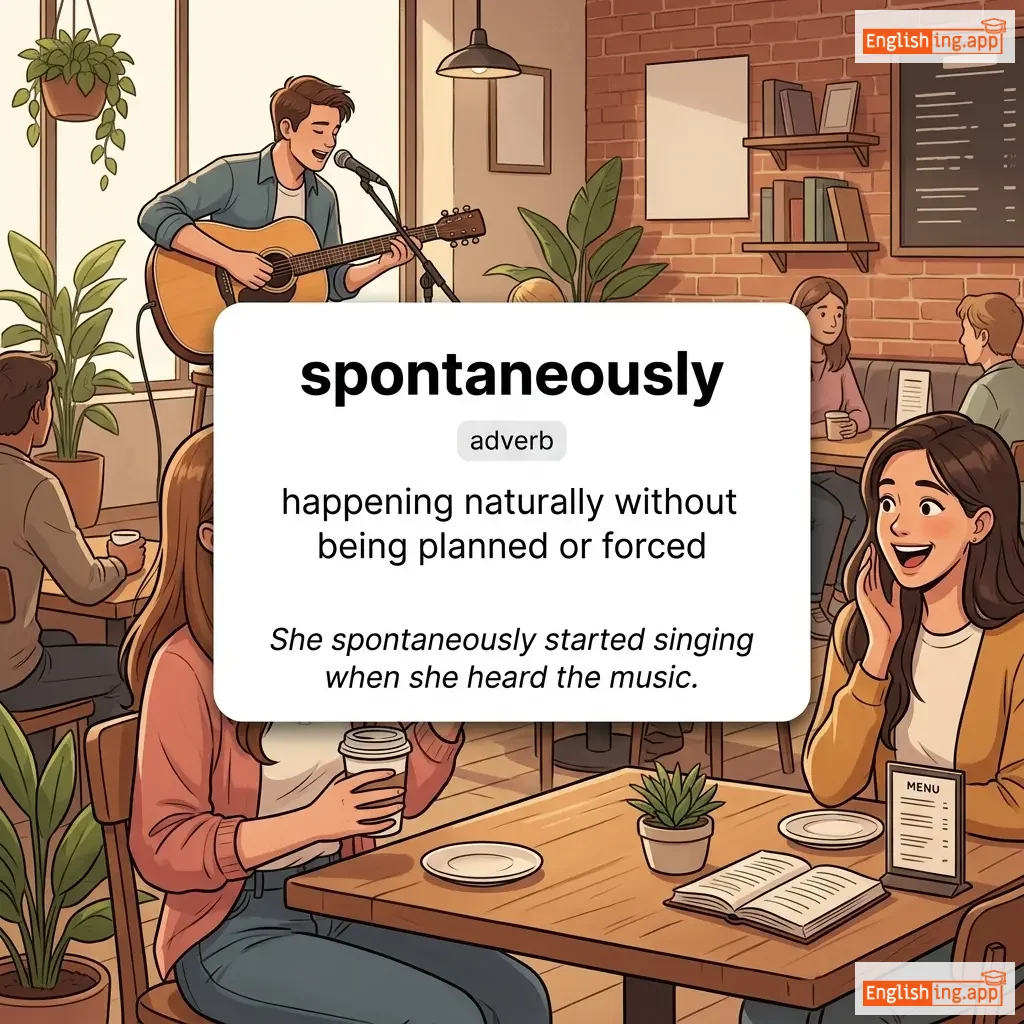
spontaneously definition card — visual illustration of the meaning
adverb
/spɒnˈteɪ.ni.əs.li/
espontáneamente (espontáneamente)

happening naturally without being planned or forced

"She spontaneously started singing when she heard the music."

"Ella comenzó a cantar espontáneamente cuando escuchó la música." (Ella comenzó a cantar espontáneamente cuando escuchó la música.)
noun/verb
/spuːf/
imitación humorística (imitacion humoristica)

A humorous imitation of something, or to trick or parody someone or something.

"The comedian spoofed the politician’s speech to entertain the audience."

"El comediante parodió el discurso del político para entretener al público." (El comediante parodio el discurso del politico para entretener al publico.)
noun
/spuːn/
cucharón (cucharón)

a utensil consisting of a small shallow bowl with a handle, used for eating, stirring, or serving food

"She stirred her coffee with a silver spoon."

"Ella removió su café con una cuchara de plata." (Ella removió su café con una cuchara de plata.)
noun
/ˈspuːnərɪzəm/
espúnarismo (espoonarismo)

A verbal error in which the initial sounds of words are swapped to create a humorous effect.

"He made a spoonerism by saying 'queer old dean' instead of 'dear old queen'."

"Hizo un espúnarismo al decir 'querido viejo dean' en lugar de 'querida vieja reina'." (Hizo un espúnarismo al decir 'querido viejo dean' en lugar de 'querida vieja reina'.)
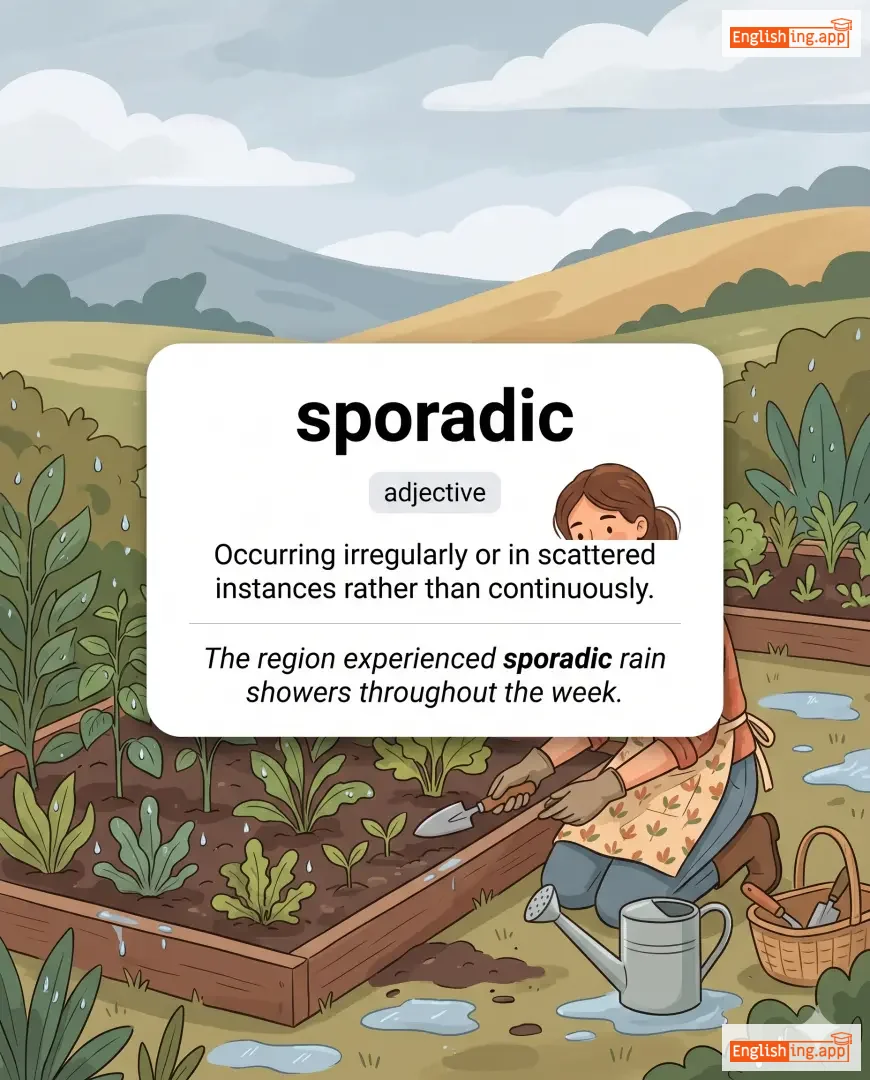
sporadic definition card — visual illustration of the meaning
adjective
/spəˈrædɪk/
esporádico (esporadico)

Occurring irregularly or in scattered instances rather than continuously.

"The region experienced sporadic rain showers throughout the week."

"La región experimentó lluvias esporádicas durante toda la semana." (La región experimentó lluvias esporádicas durante toda la semana.)
noun
/spɔːt/
deporte (deporte)

an activity involving physical exertion and skill in which an individual or team competes against another or others for entertainment

"Football is a popular sport around the world."

"El fútbol es un deporte popular en todo el mundo." (El futbol es un deporte popular en todo el mundo.)
adjective
/ˈspɔːrtɪv/
deportivo (deportivo)

Playful, lively, or full of fun.

"The children were in a sportive mood during the picnic."

"Los niños estaban en un estado de ánimo deportivo durante el picnic." (Los ninos estaban en un estado de animo deportivo durante el picnic.)
noun
/ˈspɔːrtsmən/
deportista (deportista)

A person who is skilled in sports or enjoys participating in athletic activities.

"He is a true sportsman, always fair and respectful to his opponents."

"Él es un verdadero deportista, siempre justo y respetuoso con sus oponentes." (El es un verdadero deportista, siempre justo y respetuoso con sus oponentes.)
noun
/spɒt/
lugar (lugar)

a particular place or position

"I found a great spot for a picnic in the park."

"Encontré un gran lugar para hacer un picnic en el parque." (Encontre un gran lugar para hacer un picnic en el parque.)
noun
/ˈspɒt.laɪt/
foco (spotlight)

a strong beam of light directed onto a particular area; figuratively, public attention

"The singer stood proudly in the spotlight."

"El cantante se mostró orgulloso bajo el foco." (El cantante se mostro orgulloso bajo el foco.)
adjective
/ˈspɒtɪd/
manchado; marcado; visto (manchado; marcado; visto)

having spots or marks; noticed or seen

"The spotted leopard moved silently through the jungle."

"El leopardo manchado se movió silenciosamente a través de la selva." (El leopardo manchado se movió silenciosamente a través de la selva.)
noun
/ˈspɒt.ɪd sneɪk hed/
pez cabeza de serpiente moteada (pez cabeza de serpiente moteada)

a type of freshwater fish with spotted markings and an elongated head resembling a snake

"The spotted snake head is a popular fish for aquaculture in South Asia."

"El pez cabeza de serpiente moteada es popular para la acuicultura en el sur de Asia." (el pez cabeza de serpiente moteada es popular para la acuicultura en el sur de asia)
noun
/spaʊs/
cónyuge (conyuge)

a person's husband or wife

"Each employee may include their spouse in the health insurance plan."

"Cada empleado puede incluir a su cónyuge en el plan de seguro de salud." (Cada empleado puede incluir a su conyuge en el plan de seguro de salud.)
noun, verb
/spreɪn/
esguince (esguince)

an injury to a joint in which the ligaments are stretched or torn

"She sprained her ankle while running in the park."

"Ella se torció el tobillo mientras corría en el parque." (Ella se torcio el tobillo mientras corria en el parque.)
verb
/spreɪ/
rociar (rociar)

to apply liquid to something in a fine mist

"She sprayed perfume on her wrist before leaving."

"Ella roció perfume en su muñeca antes de salir." (Ella roció perfume en su muñeca antes de salir.)
verb
/sprɛd/
extender (extender)

to open or extend something over an area

"She spread the blanket on the grass for a picnic."

"Ella extendió la manta sobre la hierba para un picnic." (Ella extendió la manta sobre la hierba para un picnic.)
adjective
/ˈspraɪtli/
vivaz (vivaz)

full of energy and life; lively

"The sprightly old man danced with joy at the wedding."

"El hombre vivaz bailó con alegría en la boda." (El hombre vivaz bailó con alegría en la boda.)
noun
/sprɪŋ/
primavera (primavera)

the season between winter and summer when plants begin to grow

"Flowers bloom in the spring."

"Las flores florecen en la primavera." (Las flores florecen en la primavera.)
verb
/ˈsprɪŋkəl/
esparcir (esparcir)

to scatter small drops or particles of a substance over a surface

"She sprinkled sugar on top of the cake."

"Ella esparció azúcar encima del pastel." (Ella esparció azúcar encima del pastel.)
verb, noun
/spraʊt/
brotar (brotar)

to begin to grow; to produce new leaves or shoots

"The seeds began to sprout after a few days of rain."

"Las semillas comenzaron a brotar después de unos días de lluvia." (Las semillas comenzaron a brotar después de unos días de lluvia.)
verb, adjective, noun
/spruːs/
arreglar / un tipo de árbol (arreglar / un tipo de arbol)

to make neat or tidy in appearance; also refers to an evergreen tree

"He spruced up his room before the guests arrived."

"Él arregló su habitación antes de que llegaran los invitados." (El arreglo su habitacion antes de que llegaran los invitados.)