Vocabularios

Descubra, aprenda y domine el vocabulario en inglés

noun
/smɔːl boʊl/
tazón pequeño (tazon pequeno)

a round, shallow container of small size used for serving food or liquids

"She served the soup in a small bowl."

"Ella sirvió la sopa en un tazón pequeño." (Ella sirvio la sopa en un tazon pequeno.)
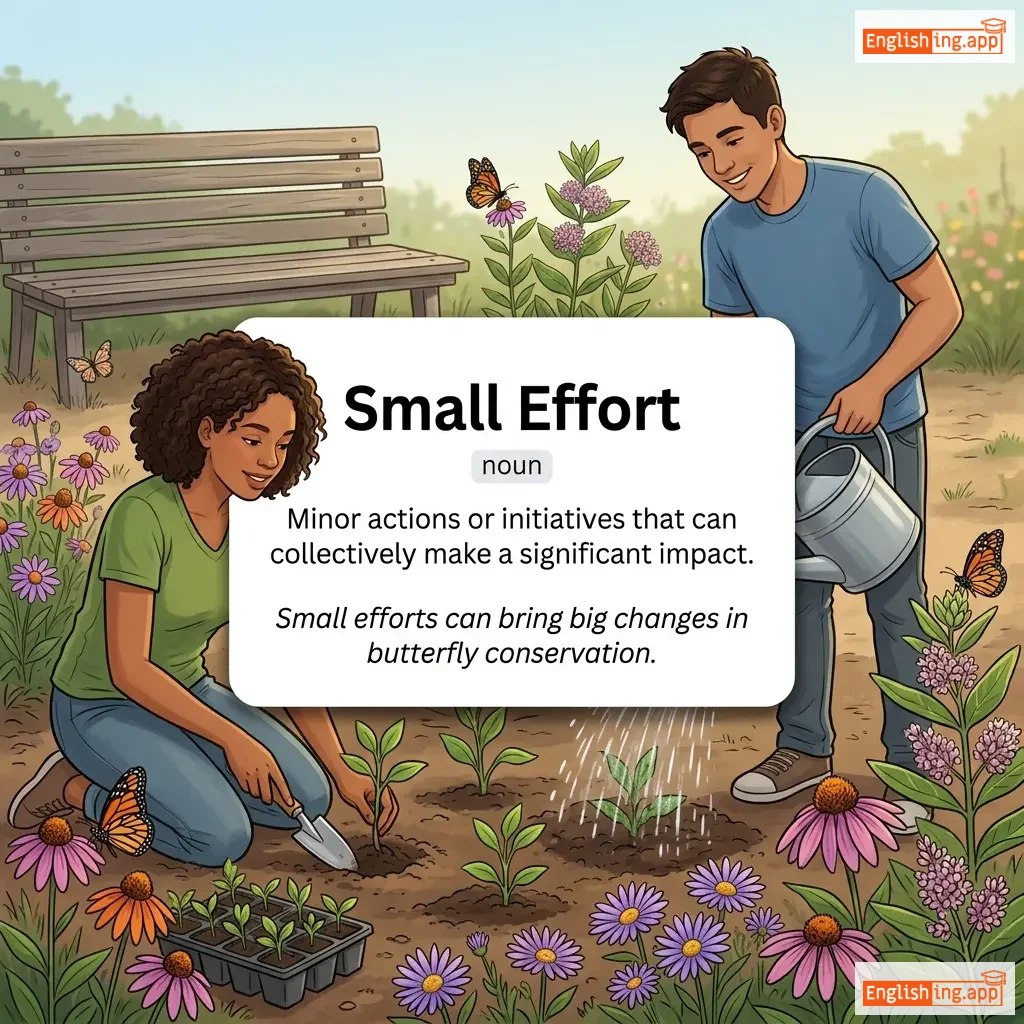
Small Effort definition card — visual illustration of the meaning
noun
smɔːl ˈɛfərt
pequeño esfuerzo (pequeno esfuerzo)

Minor actions or initiatives that can collectively make a significant impact.

"Small efforts can bring big changes in butterfly conservation."

"Los pequeños esfuerzos pueden traer grandes cambios en la conservación de mariposas." (Los pequenos esfuerzos pueden traer grandes cambios en la conservación de mariposas.)
adjective
/ˈsmɑːrmi/
adulador / falsa cortesía (adulador / falsa cortesía)

Excessively flattering or ingratiating, often insincerely.

"The salesman gave a smarmy pitch that felt fake."

"El vendedor dio una charla aduladora que se sintió falsa." (El vendedor dio una charla aduladora que se sintió falsa.)
adjective, noun, verb
/smɑːrt/
inteligente / elegante (inteligente / elegante)

Clever and intelligent; also stylish in appearance; or to feel pain.

"She is a smart student who always excels in class."

"Ella es una estudiante inteligente que siempre sobresale en clase." (Ella es una estudiante inteligente que siempre sobresale en clase.)
adverb
/ˈsmɑːt.li/
inteligentemente; con estilo; rápidamente (inteligentemente; con estilo; rapidamente)

in a clever or intelligent way; neatly and stylishly; quickly

"He was smartly dressed for the business meeting."

"Estaba vestido de manera inteligente para la reunión de negocios." (Estaba vestido de manera inteligente para la reunión de negocios.)
noun
/ˈsmɑːrt.nəs/
inteligencia; astucia; apariencia ordenada y moderna (inteligencia; astucia; apariencia ordenada y moderna)

intelligence; cleverness; neat and fashionable appearance

"Her smartness in solving problems impressed everyone."

"Su inteligencia al resolver problemas impresionó a todos." (Su inteligencia al resolver problemas impresionó a todos.)
verb
/smæʃ/
romper (romper)

to break something into pieces violently

"She smashed the glass in frustration."

"Ella rompió el vaso en frustración." (Ella rompió el vaso en frustración.)
noun
/ˈsmætərɪŋ/
conocimiento superficial (conocimiento superficial)

A small amount or superficial knowledge of something.

"He has a smattering of Spanish."

"Él tiene un conocimiento superficial de español." (El tiene un conocimiento superficial de espanol.)
verb
/smɪr/
untar / difamar (untar / difamar)

to spread or apply a substance messily; to damage someone's reputation with false or unfair words

"The child smeared paint across the wall."

"El niño untó pintura en la pared." (El niño untó pintura en la pared.)
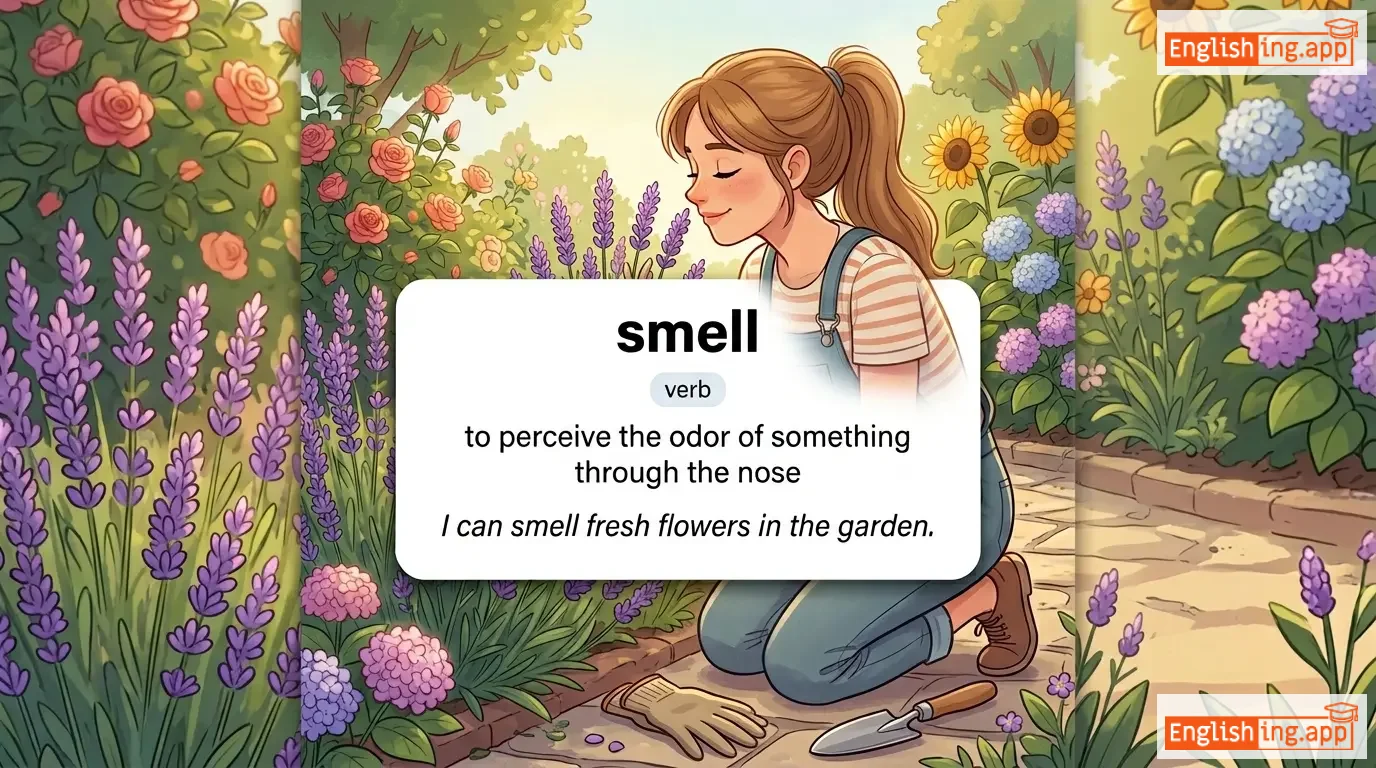
smell definition card — visual illustration of the meaning
verb
/smɛl/
oler (oler)

to perceive the odor of something through the nose

"I can smell fresh flowers in the garden."

"Puedo oler flores frescas en el jardín." (Puedo oler flores frescas en el jardín.)
verb
/smɛlt/
fundir (fundir)

to extract metal from its ore by heating and melting

"The workers smelt iron from its ore in the factory."

"Los trabajadores funden hierro de su mineral en la fábrica." (Los trabajadores funden hierro de su mineral en la fabrica.)
verb
/smaɪl/
sonrisa (sonrisa)

to express happiness or friendliness by turning the corners of the mouth upwards

"She smiled when she saw the gift."

"Ella sonrió cuando vio el regalo." (Ella sonrió cuando vio el regalo.)
verb
/smɜrk/
sonreír con suficiencia (sonreir con suficiencia)

to smile in a self-satisfied, smug, or silly way

"He smirked when he won the argument."

"Él sonrió cuando ganó la discusión." (Él sonrió cuando ganó la discusión.)
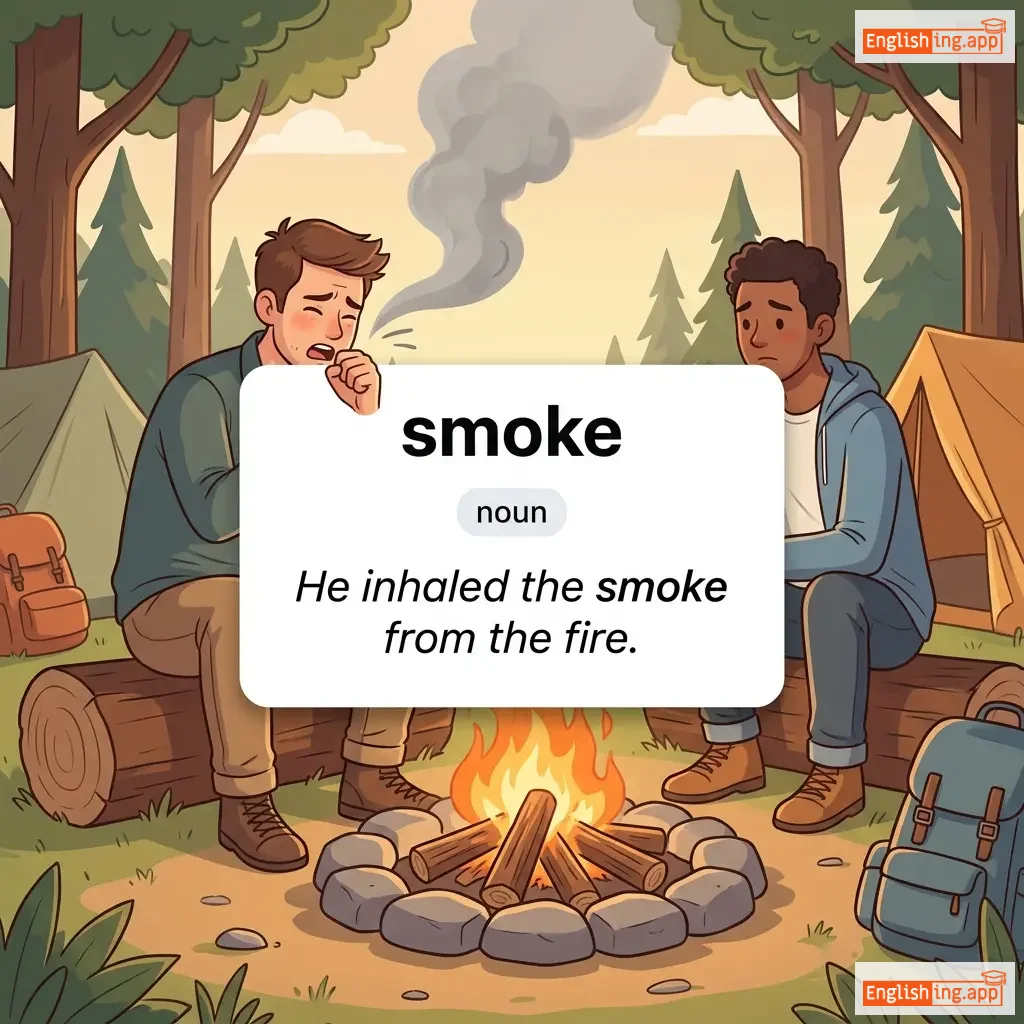
smoke definition card — visual illustration of the meaning
noun
/smoʊk/
humo (humo)

a visible suspension of fine particles of matter in the air, typically produced by combustion

"He inhaled the smoke from the fire."

"Él inhaló el humo del fuego." (El inhaló el humo del fuego.)
noun
/ˈsmoʊkər/
fumador (fumador)

A person who smokes tobacco or other substances

"He is a heavy smoker and tries to quit every year."

"Él es un fumador y trata de dejarlo cada año." (El es un fumador y trata de dejarlo cada año.)
noun/adjective
/ˈsmoʊ.kɪŋ/
fumar (fumar)

The act of inhaling and exhaling the smoke of tobacco or other substances; wearing a tuxedo (adjective, formal context).

"Smoking is prohibited inside the building."

"Fumar está prohibido dentro del edificio." (Fumar esta prohibido dentro del edificio.)
verb
/ˈsmoʊldər/
ardecer lentamente (ardecer lentamente)

to burn slowly with smoke but no flame; to show suppressed anger or emotion

"The fire smoldered for hours before it went out."

"El fuego ardió lentamente durante horas antes de apagarse." (El fuego ardió lentamente durante horas antes de apagarse.)
adjective
/smuːð/
suave (suave)

having an even surface without roughness; happening without difficulty

"The table has a smooth surface."

"La mesa tiene una superficie suave." (La mesa tiene una superficie suave.)
adverb
/ˈsmuːð.li/
suavemente; sin problemas (suavemente; sin problemas)

without problems or difficulties; in an even and regular way

"The car runs smoothly on the new highway."

"El coche circula suavemente por la nueva carretera." (El coche circula suavemente por la nueva carretera.)
verb
/ˈsmʌðər/
sofocar / asfixiar (sofocar / asfixiar)

to kill someone by covering their nose and mouth to prevent breathing; to cover something completely; to overwhelm with excessive attention or affection

"She smothered the fire with a blanket."

"Ella sofocó el fuego con una manta." (Ella sofocó el fuego con una manta.)
noun/verb
/smʌdʒ/
mancha, marca sucia (mancha, marka sucia)

a dirty mark or smear; to make something dirty or unclear by rubbing or touching

"She accidentally smudged her lipstick on the napkin."

"Ella accidentalmente manchó su lápiz labial en la servilleta." (Ella accidentalmente manchó su lápiz labial en la servilleta.)
adjective
/smʌɡ/
presumido (presumido)

having or showing an excessive pride in oneself or one's achievements

"He wore a smug smile after winning the debate."

"Llevaba una sonrisa presuntuosa después de ganar el debate." (Llevaba una sonrisa presuntuosa después de ganar el debate.)
verb
/ˈsmʌɡəl/
contrabandear (contrabandear)

to move goods illegally into or out of a country

"The gang tried to smuggle gold across the border."

"La banda intentó contrabandear oro a través de la frontera." (La banda intentó contrabandear oro a través de la frontera.)
noun
/sneɪl/
caracol (caracol)

a small soft creature with a shell on its back that moves very slowly

"The snail left a shiny trail as it crawled across the leaf."

"El caracol dejó un rastro brillante mientras se arrastraba por la hoja." (El caracol dejo un rastro brillante mientras se arrastraba por la hoja)
noun
/sneɪk/
serpiente (serpiente)

a long, legless reptile that moves by slithering

"A snake slithered across the garden path."

"Una serpiente se deslizaba por el sendero del jardín." (Una serpiente se deslizaba por el sendero del jardín.)
noun
/sneɪk ɡɔːrd/
calabaza serpiente (calabaza serpiente)

a long, curved vegetable that resembles a snake, commonly used in South Asian cuisine

"The snake gourd grows in a twisted, serpentine shape in the garden."

"La calabaza serpiente crece en una forma retorcida y serpenteante en el jardín." (La calabaza serpiente crece en una forma retorcida y serpenteante en el jardín.)
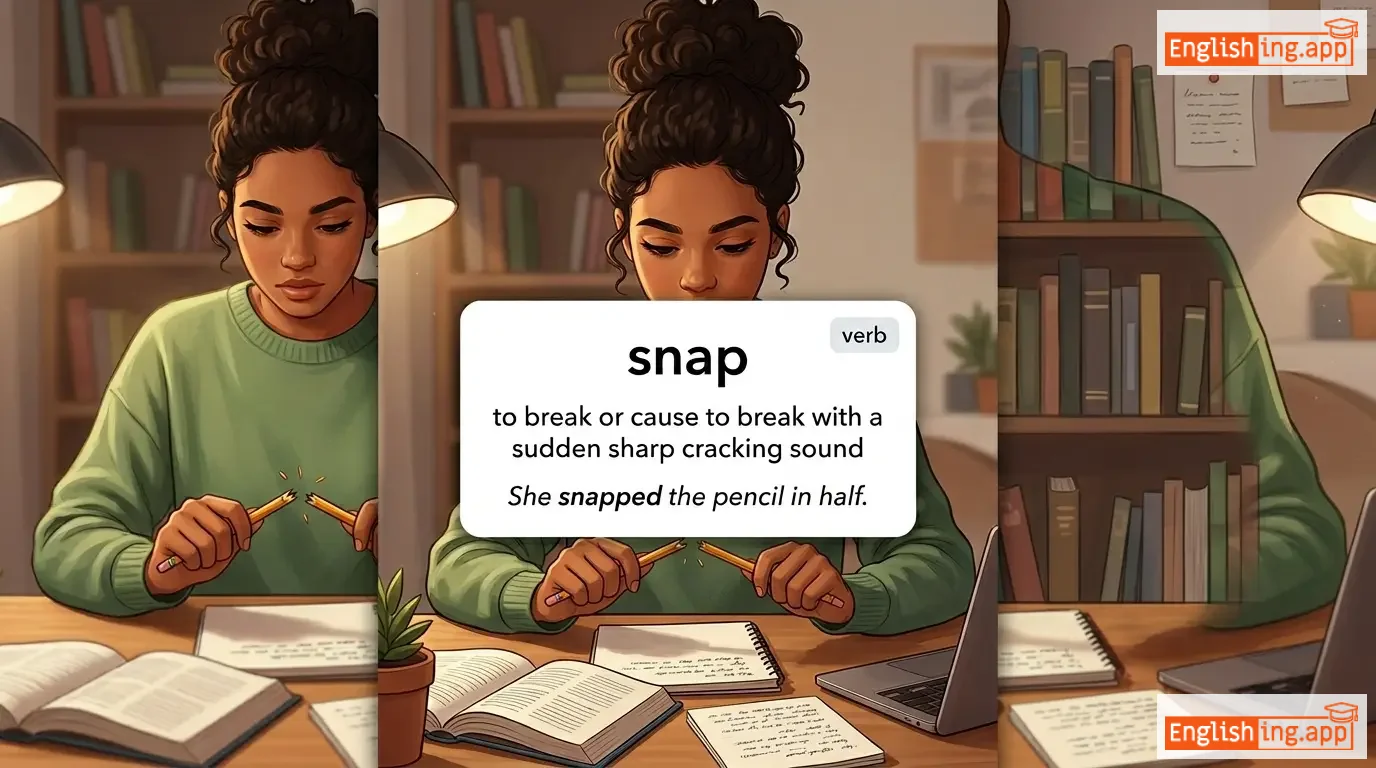
snap definition card — visual illustration of the meaning
verb
/snæp/
romper (romper)

to break or cause to break with a sudden sharp cracking sound

"She snapped the pencil in half."

"Ella rompió el lápiz por la mitad." (Ella rompió el lápiz por la mitad.)
noun/verb
/snɛər/
trampa (trampa)

a trap for catching animals; to catch or trap

"The hunter set a snare to catch rabbits."

"El cazador puso una trampa para atrapar conejos." (El cazador puso una trampa para atrapar conejos.)
verb/noun
/snɑːrl/
gruñido, atasco (grunido, atasco)

to growl aggressively with bared teeth; a tangle or mess

"The dog snarled at the stranger near the gate."

"El perro gruñó al extraño cerca de la puerta." (El perro gruno al extrano cerca de la puerta.)
verb
/sniːk/
moverse en secreto (moverse en secreto)

to move quietly and secretly to avoid being noticed

"He tried to sneak into the house without waking anyone."

"Trató de colarse en la casa sin despertar a nadie." (Trató de colarse en la casa sin despertar a nadie.)
verb
/snɪər/
sonreír de forma burlona (sonreir de forma burlona)

to smile or speak in a mocking or contemptuous way

"She sneered at his attempt to sing."

"Ella se burló de su intento de cantar." (Ella se burlo de su intento de cantar.)
verb, noun
/sniːz/
estornudar (estornudar)

to expel air involuntarily from the nose and mouth due to irritation; the act of sneezing

"I had to sneeze during the meeting."

"Tuve que estornudar durante la reunión." (Tuve que estornudar durante la reunion)
verb
/ˈsnɪkər/
reírse disimuladamente (reirse disimuladamente)

to laugh quietly in a disrespectful or mocking way

"The students snickered when the teacher made a mistake."

"Los estudiantes se rieron cuando el maestro cometió un error." (Los estudiantes se rieron cuando el maestro cometió un error.)
adjective
/snaɪd/
irónico (ironico)

mocking or insulting in an indirect way

"He couldn’t resist making a snide comment about her dress."

"No pudo evitar hacer un comentario irónico sobre su vestido." (No pudo evitar hacer un comentario ironico sobre su vestido.)
verb
/snɪp/
cortar (cortar)

to cut something quickly with scissors or a sharp tool

"She snipped the loose thread from her dress."

"Ella cortó el hilo suelto de su vestido." (Ella corto el hilo suelto de su vestido.)
verb
/ˈsnɪvəl/
llorar o quejarse de manera débil o molesta (llorar o quejarse de manera debil o molesta)

to cry or complain in a weak or annoying way

"He began to snivel when he didn’t get his way."

"Comenzó a llorar cuando no consiguió lo que quería." (Comenzo a llorar cuando no consiguio lo que queria.)
adjective
/ˈsnɒbɪʃ/
presuntuoso (presuntuoso)

having or showing the attitude of people who think they are better than others

"She seemed snobbish because she avoided talking to the waiters."

"Ella parecía presuntuosa porque evitó hablar con los camareros." (Ella parecía presuntuosa porque evitó hablar con los camareros.)
noun
/snoʊ/
nieve (nieve)

frozen water vapor that falls from the sky as white flakes

"Children love to play in the snow."

"A los niños les encanta jugar en la nieve." (A los niños les encanta jugar en la nieve.)
noun
/ˈsnoʊ.fɔːl/
nevada (nevahda)

the process of snow falling from the sky; the amount of snow that falls

"The heavy snowfall blocked all the roads yesterday."

"La fuerte nevada bloqueó todas las carreteras ayer." (La fuerte nevada bloqueó todas las carreteras ayer.)
verb
/snʌb/
despreciar (despreciar)

to insult or ignore someone by treating them rudely

"He felt hurt when his invitation was snubbed."

"Él se sintió herido cuando su invitación fue despreciada." (Él se sintió herido cuando su invitación fue despreciada.)
verb
/ˈsnʌfəl/
respirar ruidosamente por la nariz (respirar ruidosamente por la nariz)

to breathe noisily through the nose, often because of crying or a cold

"The child began to snuffle after crying for a long time."

"El niño comenzó a respirar ruidosamente por la nariz después de llorar durante mucho tiempo." (El niño comenzó a respirar ruidosamente por la nariz después de llorar durante mucho tiempo.)
adverb
/soʊ/
tan (tan)

to such a degree or extent

"She was so happy with the gift."

"Ella estaba tan feliz con el regalo." (Ella estaba tan feliz con el regalo.)
adjective
/ˈsoʊ kɔːld/
supuesto (socalled)

referred to as or known by a particular name or title, often misleadingly

"The so-called expert couldn't answer the question."

"El supuesto experto no pudo responder la pregunta." (El supuesto experto no pudo responder la pregunta.)
verb
/soʊk/
empapar (empapar)

to make something completely wet by immersing it in liquid

"She soaked the clothes in water before washing them."

"ella empapó la ropa en agua antes de lavarlas." (ella empapo la ropa en agua antes de lavarlas.)
noun
/soʊp/
jabón (jabon)

a substance used for washing and cleaning, typically made from fats and alkalis

"She washed her hands with soap and water."

"Ella se lavó las manos con jabón y agua." (ella se lavo las manos con jabon y agua)
noun
/soʊp keɪs/
caja de jabón (kaha de jabon)

a container used to store soap

"She bought a beautiful soap case for the bathroom."

"Ella compró una hermosa caja de jabón para el baño." (Ella compro una hermosa caja de jabon para el bano.)
adjective
/ˈsoʊpi/
cubierto de jabón; espumoso (cubierto de jabon; espumoso)

covered with soap; having the characteristics of soap; foamy

"The dishes were still soapy after washing."

"Los platos aún estaban jabonosos después de lavarlos." (Los platos aun estaban jabonosos despues de lavarlos.)
verb
/sɔːr/
elevarse / aumentar rápidamente (elevarse / aumentar rapidamente)

to fly or rise high in the air; to increase rapidly or dramatically

"The eagle soared high above the mountains."

"El águila voló alto sobre las montañas." (El aguila volo alto sobre las montanas.)
verb
/sɑːb/
sollozar ruidosamente (sollozar ruidosamente)

to cry noisily while taking short breaths

"She began to sob uncontrollably after hearing the news."

"Ella comenzó a sollozar incontrolablemente después de escuchar la noticia." (Ella comenzo a sollozar incontrolablemente despues de escuchar la noticia.)
adjective
/ˈsoʊbər/
sobrio / serio (sobrio / serio)

not affected by alcohol; serious, sensible, and solemn

"He gave a sober speech about the challenges ahead."

"Él dio un discurso sobrio sobre los desafíos por venir." (Él dio un discurso sobrio sobre los desafíos por venir.)