Vocabularios

Descubra, aprenda y domine el vocabulario en inglés

noun
/rɪˈvaɪvəl/
renacimiento (renacimiento)

an improvement in the condition or strength of something

"The revival of the old traditions brought a sense of nostalgia."

"El renacimiento de las viejas tradiciones trajo una sensación de nostalgia." (El renacimiento de las viejas tradiciones trajo una sensacion de nostalgia.)
verb
/rɪˈvaɪv/
revivir (revivir)

To bring back to life, consciousness, or activity.

"The paramedics managed to revive the unconscious man."

"Los paramédicos lograron revivir al hombre inconsciente." (Los paramédicos lograron revivir al hombre inconsciente.)
noun
/ˌrɛv.əˈkeɪ.ʃən/
revocación (revocacion)

The act of officially canceling or withdrawing something.

"The court ordered the revocation of his license."

"El tribunal ordenó la revocación de su licencia." (El tribunal ordenó la revocación de su licencia.)
verb
/rɪˈvoʊk/
revocar (revocar)

To officially cancel or withdraw a decision, privilege, or right.

"The government decided to revoke his passport."

"El gobierno decidió revocar su pasaporte." (El gobierno decidió revocar su pasaporte.)
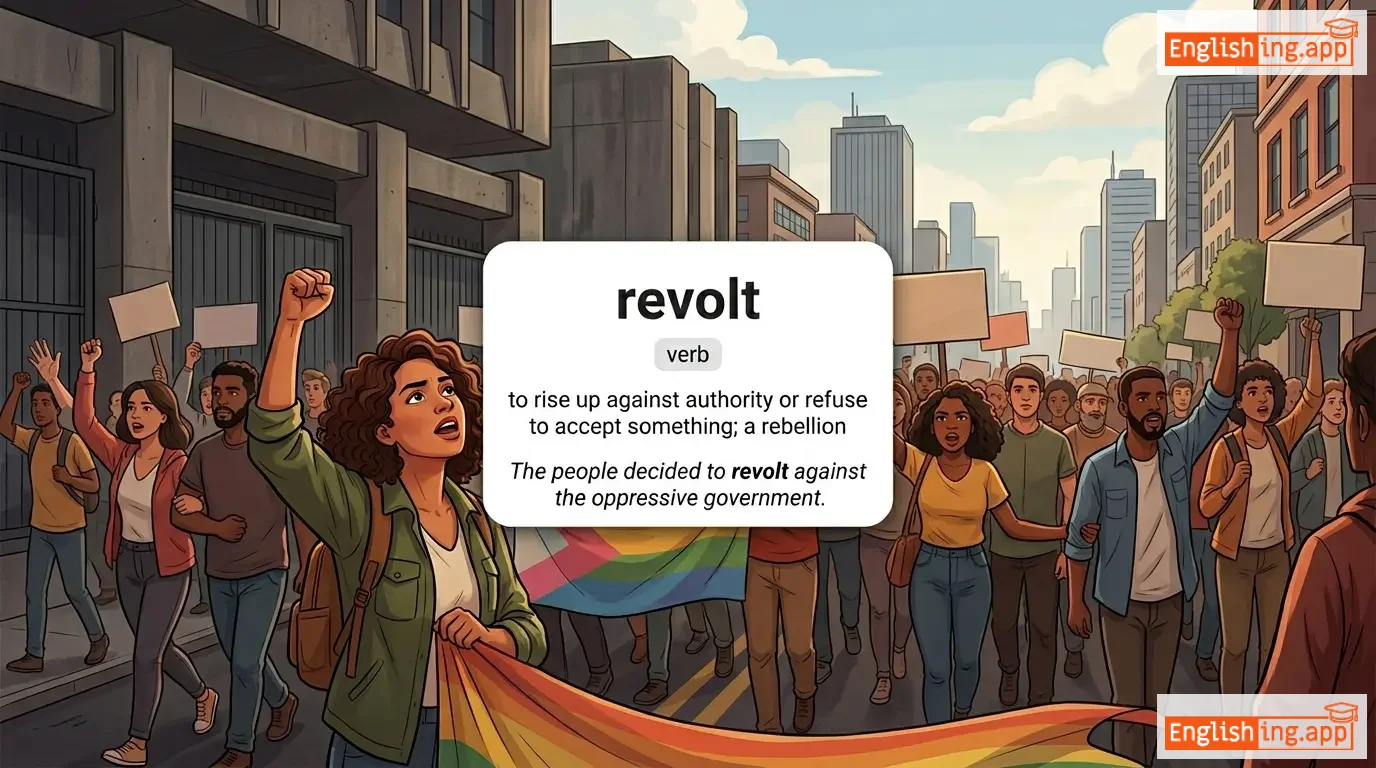
revolt definition card — visual illustration of the meaning
verb
/rɪˈvoʊlt/
revolución (revolucion)

to rise up against authority or refuse to accept something; a rebellion

"The people decided to revolt against the oppressive government."

"La gente decidió levantarse contra el gobierno opresivo." (La gente decidió levantarse contra el gobierno opresivo.)
adjective
/rɪˈvoʊltɪŋ/
repugnante (repugnante)

extremely unpleasant or disgusting

"The smell of the garbage was revolting."

"El olor de la basura era repugnante." (el olor de la basura era repugnante)
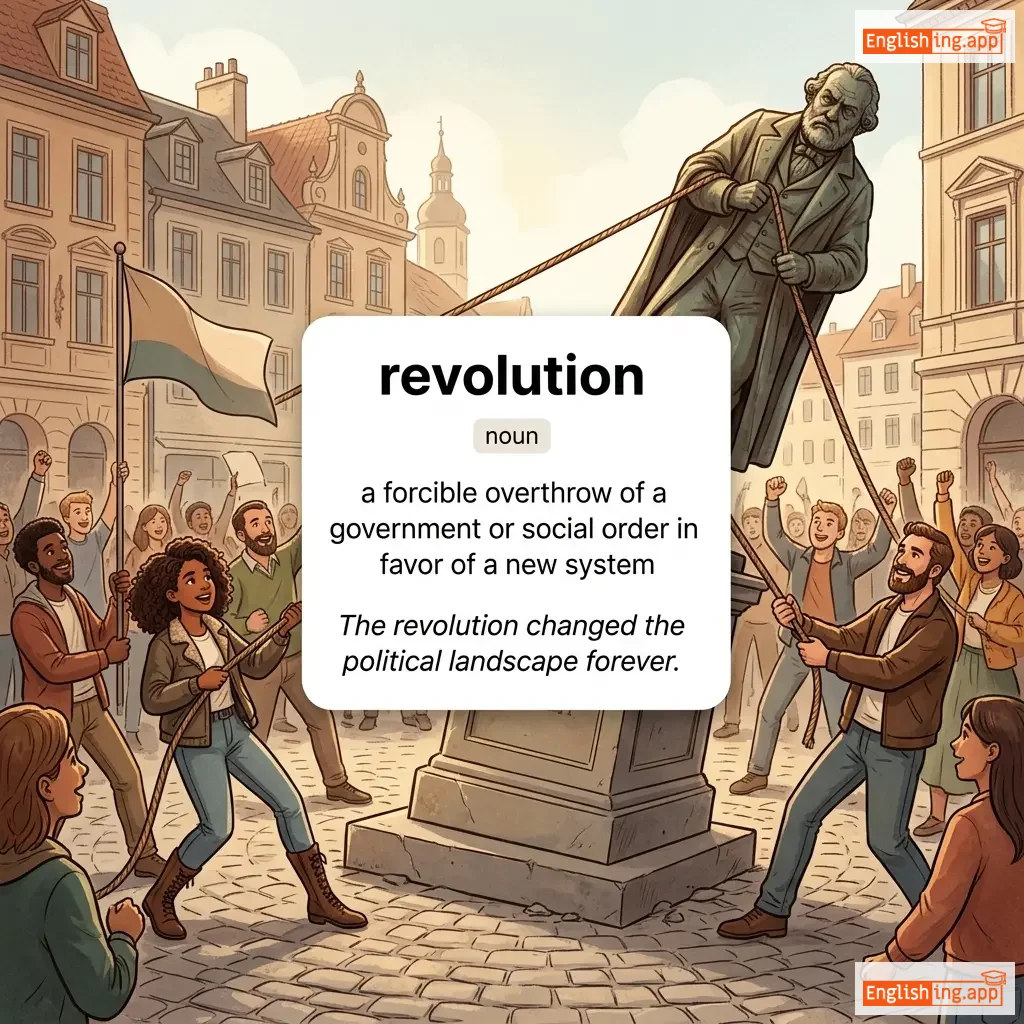
revolution definition card — visual illustration of the meaning
noun
/ˌrɛvəˈluːʃən/
revolución (revolucion)

a forcible overthrow of a government or social order in favor of a new system

"The revolution changed the political landscape forever."

"La revolución cambió el panorama político para siempre." (La revolucion cambio el panorama politico para siempre.)
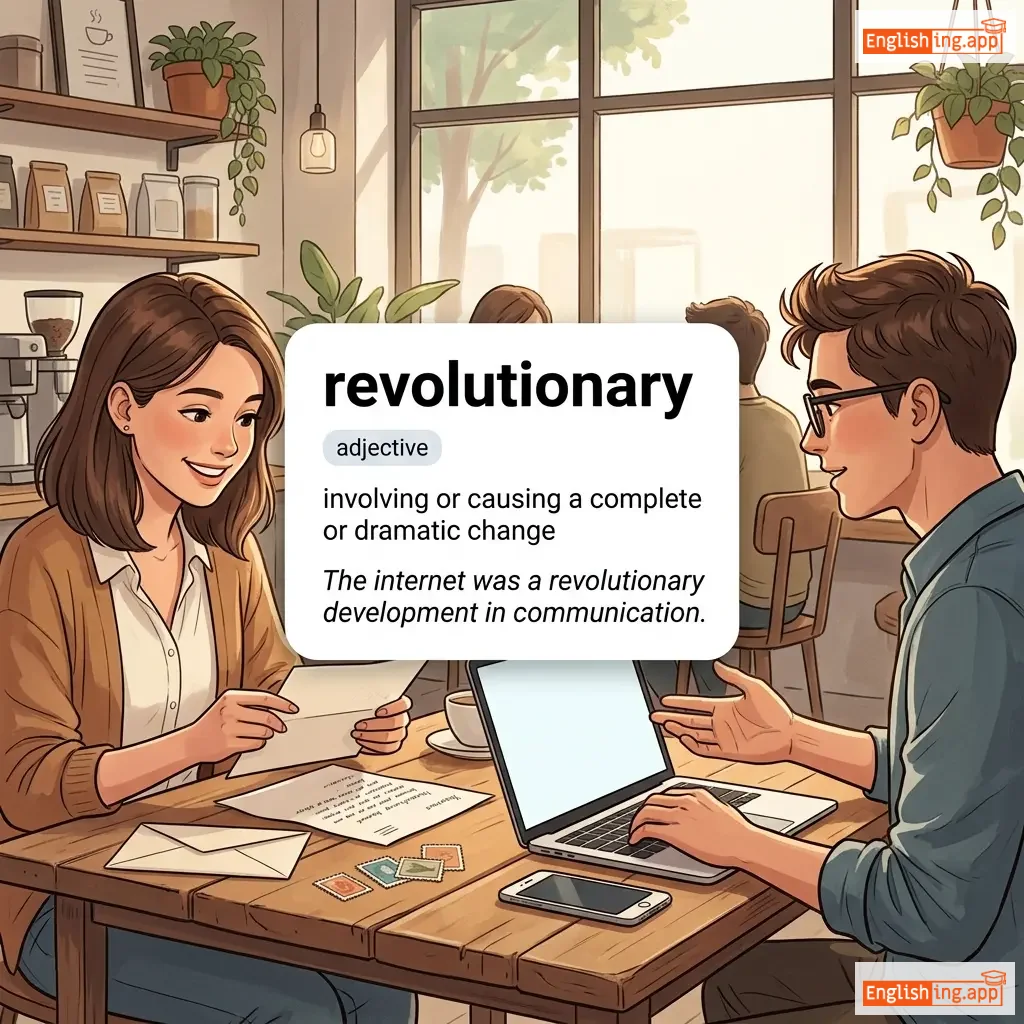
revolutionary definition card — visual illustration of the meaning
adjective
/ˌrɛvəˈluːʃəˌnɛri/
revolucionario (revolucionario)

involving or causing a complete or dramatic change

"The internet was a revolutionary development in communication."

"Internet fue un desarrollo revolucionario en la comunicación." (Internet fue un desarrollo revolucionario en la comunicacion.)
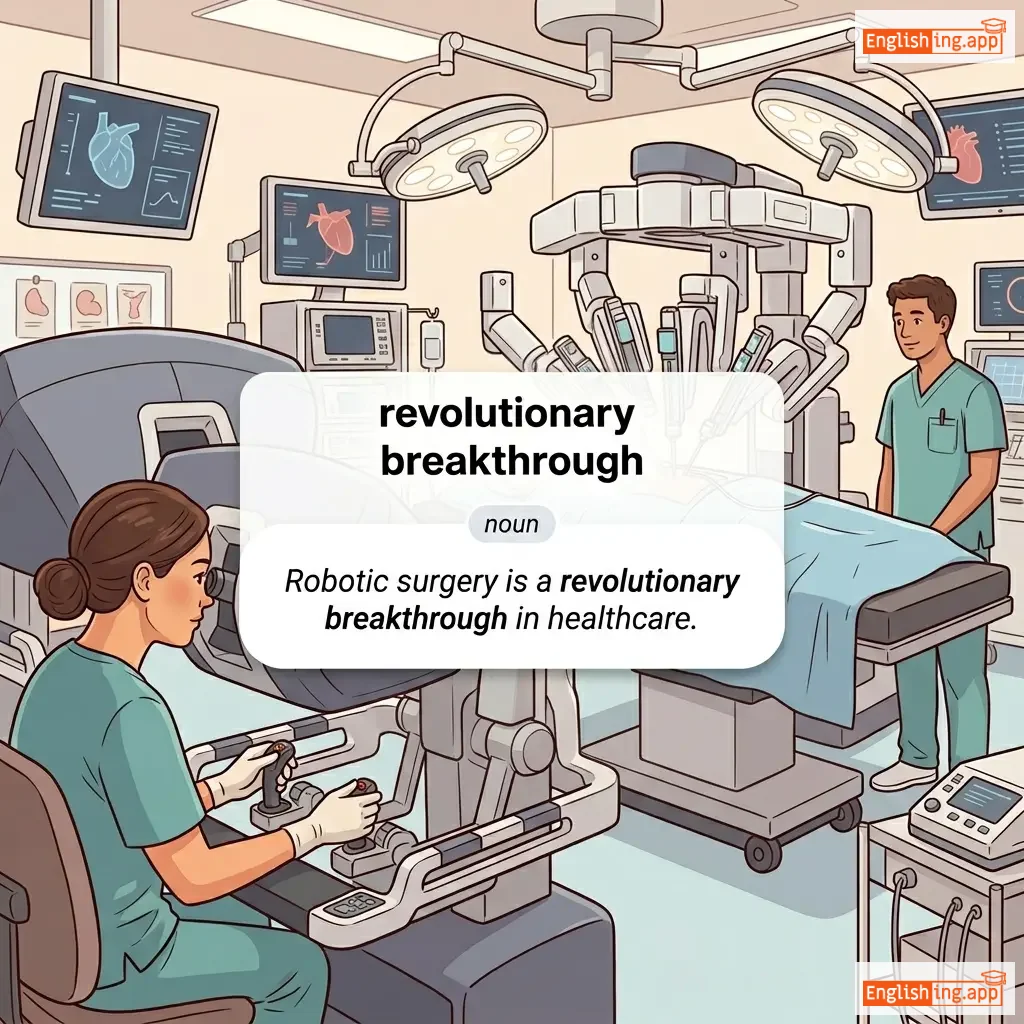
revolutionary breakthrough definition card — visual illustration of the meaning
noun
/ˌrev.əˈluː.ʃən.ər.i ˈbreɪk.θruː/
descubrimiento revolucionario (descubrimiento revolucionario)

A sudden, dramatic, and important discovery or development that changes everything.

"Robotic surgery is a revolutionary breakthrough in healthcare."

"La cirugía robótica es un descubrimiento revolucionario en la atención sanitaria." (La cirugía robótica es un descubrimiento revolucionario en la atención sanitaria.)
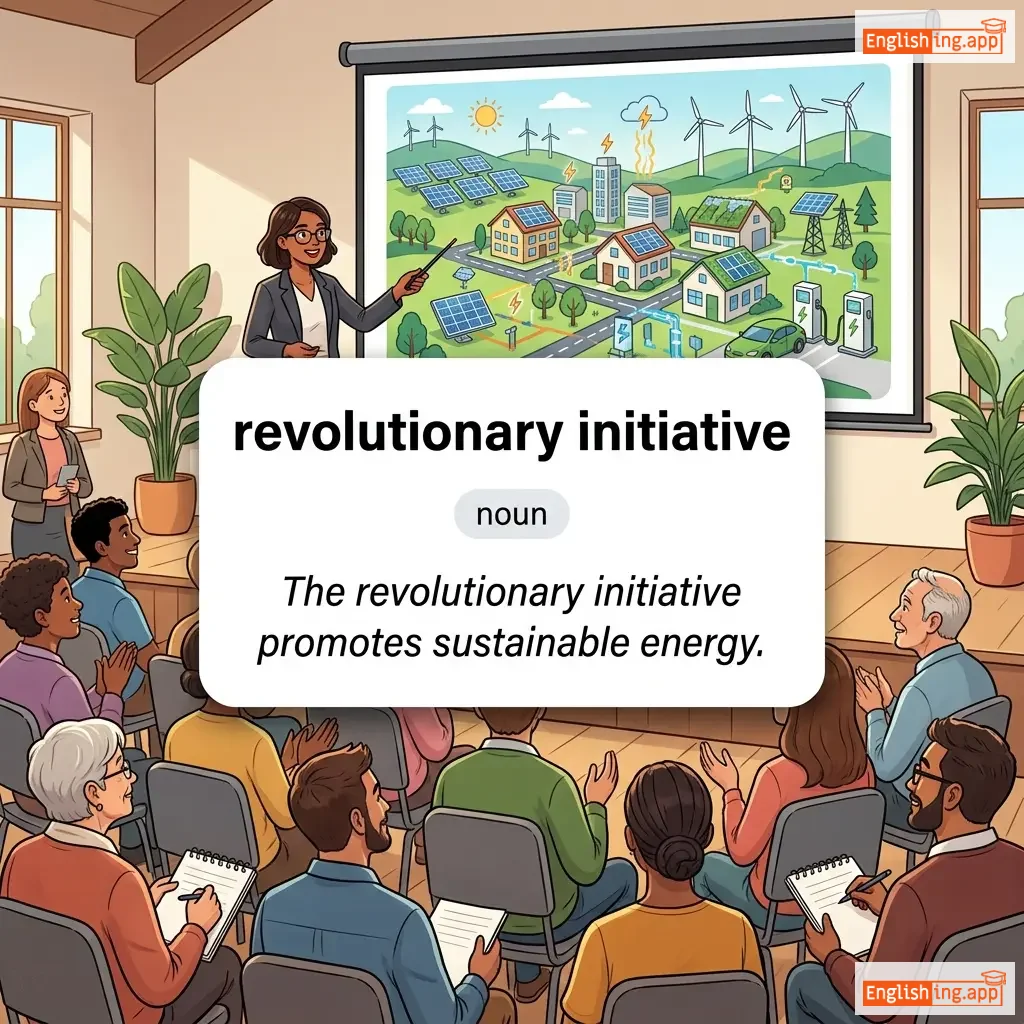
revolutionary initiative definition card — visual illustration of the meaning
noun
ˌrev.əˈluː.ʃən.ər.i ɪˈnɪʃ.ə.tɪv
iniciativa revolucionaria (iniciativa revolucionaria)

A groundbreaking action or plan that brings about significant change or transformation.

"The revolutionary initiative promotes sustainable energy."

"La iniciativa revolucionaria promueve la energía sostenible." (La iniciativa revolucionaria promueve la energia sostenible.)
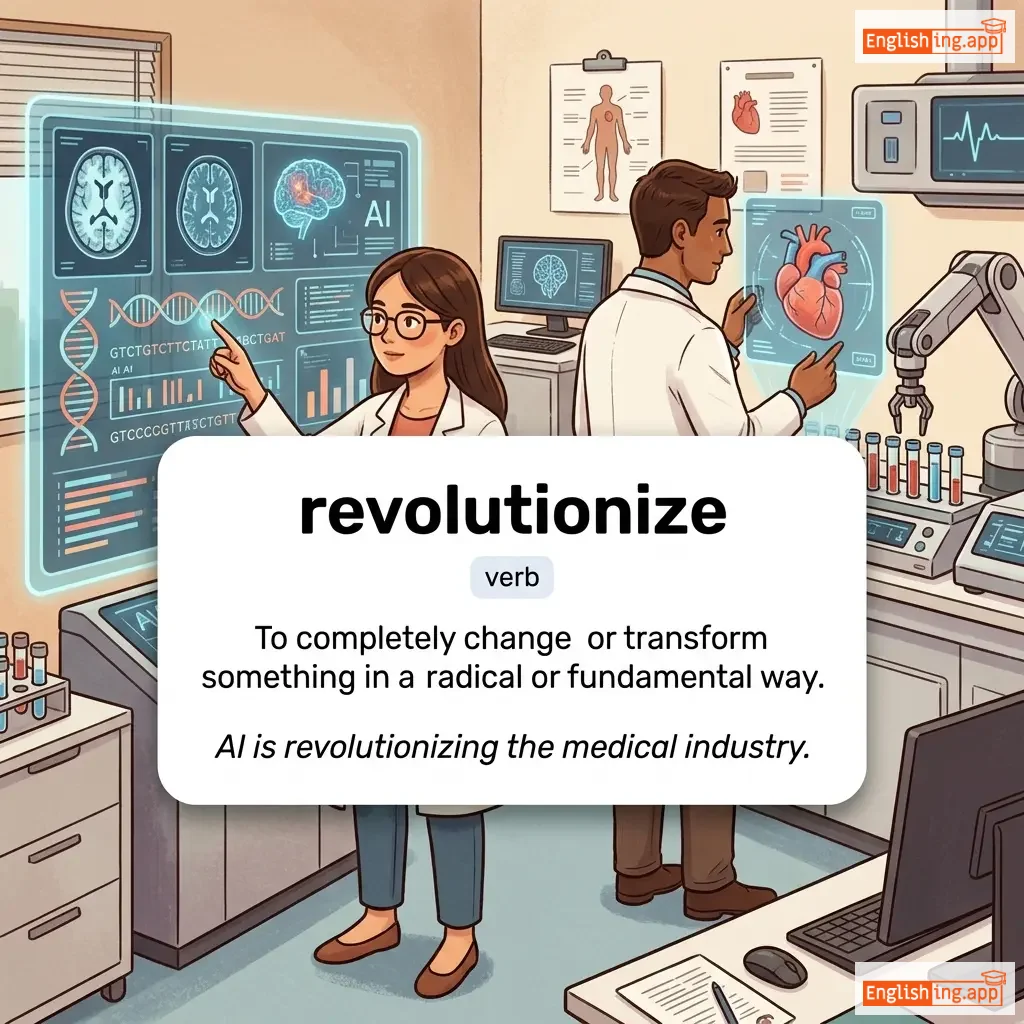
revolutionize definition card — visual illustration of the meaning
verb
ˌrev.əˈluː.ʃən.aɪz
revolucionar (revolucionar)

To completely change or transform something in a radical or fundamental way.

"AI is revolutionizing the medical industry."

"La IA está revolucionando la industria médica." (La IA está revolucionando la industria médica.)
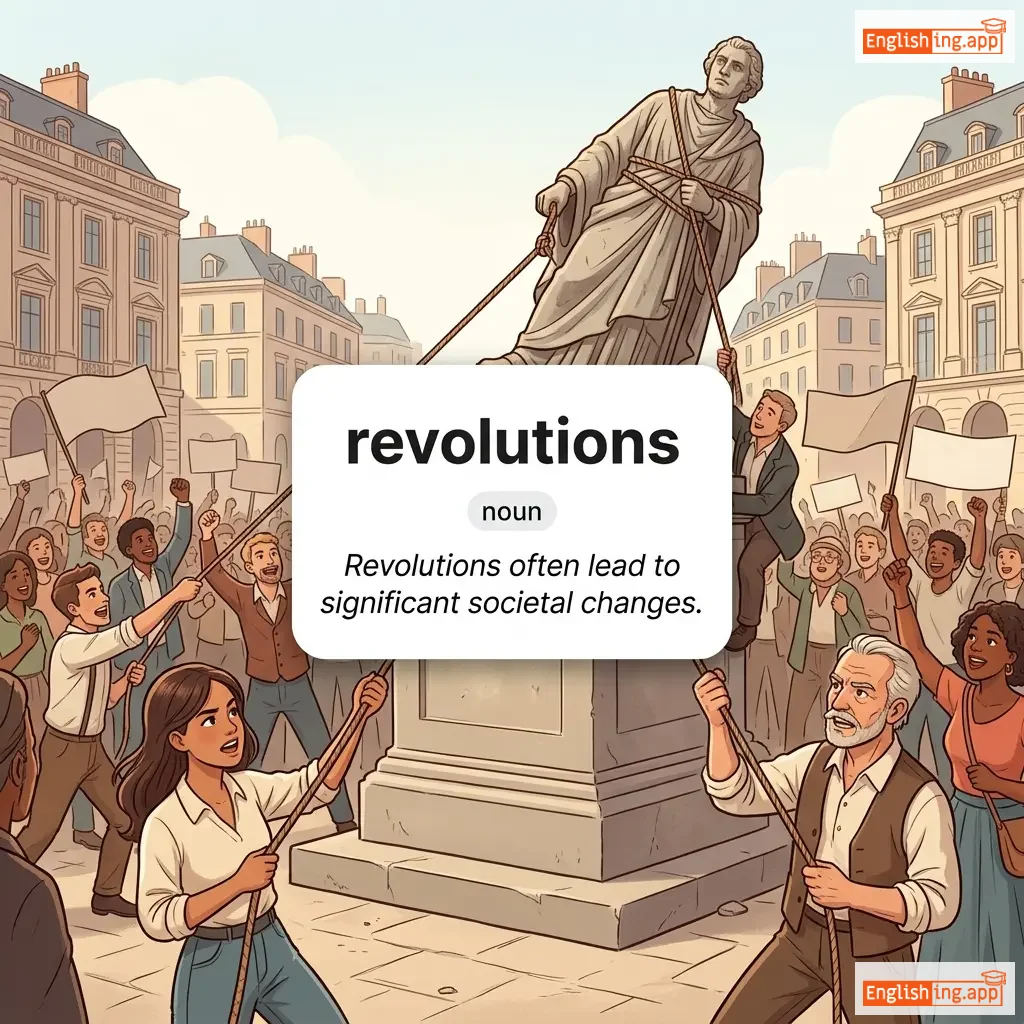
revolutions definition card — visual illustration of the meaning
noun
ˌrev.əˈluː.ʃənz
revoluciones (revoluciones)

Dramatic and wide-reaching changes in political, social, or economic systems, often involving the overthrow of a government or social order.

"Revolutions often lead to significant societal changes."

"Las revoluciones a menudo conducen a cambios sociales significativos." (Las revoluciones a menudo conducen a cambios sociales significativos.)
noun
/rɪˈvɒl.vər/
revólver (revolver)

a pistol with revolving chambers enabling several shots to be fired without reloading

"The detective drew his revolver from its holster."

"El detective sacó su revólver de su funda." (El detective saco su revolver de su funda.)
noun
/rɪˈvʌlʃən/
repulsión (repulsion)

a strong feeling of disgust or repulsion

"She felt revulsion at the sight of the cruel act."

"Ella sintió repulsión al ver el acto cruel." (Ella sintió repulsión al ver el acto cruel.)
noun
/rɪˈwɔːd/
recompensa (recompensa)

something given in recognition of service, effort, or achievement

"He received a reward for returning the lost wallet."

"Recibió una recompensa por devolver la billetera perdida." (Recibió una recompensa por devolver la billetera perdida.)
verb
/ˈræpsəˌdaɪz/
hablar con entusiasmo (hablar con entusiasmo)

to speak or write with great enthusiasm and admiration

"He would often rhapsodize about his travels to Europe."

"Él a menudo hablaba con entusiasmo sobre sus viajes a Europa." (Él a menudo hablaba con entusiasmo sobre sus viajes a Europa.)
noun
/ˈræpsədi/
canción exaltada/elogio (cancion exaltada/elogio)

an expression of great enthusiasm or an epic musical composition

"The singer’s performance was a rhapsody of emotions."

"La actuación del cantante fue una rapsodia de emociones." (La actuacion del cantante fue una rapsodia de emociones.)
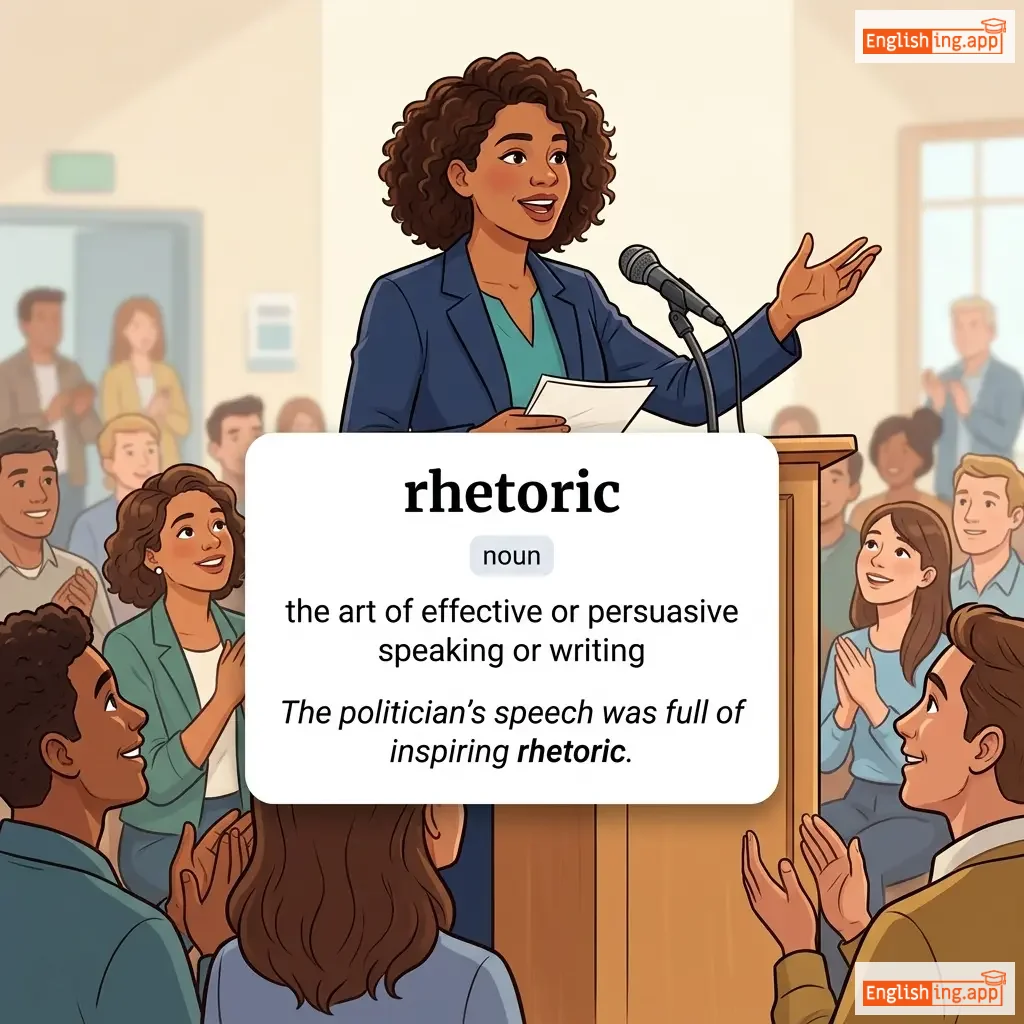
rhetoric definition card — visual illustration of the meaning
noun
/ˈrɛtərɪk/
retórica (retorica)

the art of effective or persuasive speaking or writing

"The politician’s speech was full of inspiring rhetoric."

"El discurso del político estaba lleno de retórica inspiradora." (El discurso del político estaba lleno de retórica inspiradora.)
adjective
/rɪˈtɔːrɪkəl/
retórico (retoriko)

relating to the art of effective or persuasive speaking or writing; often a question asked to make a point rather than get an answer

"He asked a rhetorical question during the debate."

"Hizo una pregunta retórica durante el debate." (Hizo una pregunta retorica durante el debate.)
noun
/ˌrɛtəˈrɪʃən/
orador (orador)

A person who is skilled in the art of rhetoric or persuasive speaking/writing.

"The rhetorician captivated the audience with his eloquence."

"El orador cautivó a la audiencia con su elocuencia." (El orador cautivo a la audiencia con su elocuencia.)
adjective
/ˈruːmi/
lagrimoso (lagrimoso)

Watery, especially referring to the eyes.

"His rheumy eyes showed signs of age and fatigue."

"Sus ojos lagrimosos mostraban signos de edad y fatiga." (Sus ojos lagrimosos mostraban signos de edad y fatiga.)
noun
/raɪˈnɒs.ər.əs/
rinoceronte (rinoceronte)

a large, heavy animal with thick skin and one or two horns on its nose

"The rhinoceros charged through the grassland."

"El rinoceronte cargó a través de la pradera." (El rinoceronte cargó a través de la pradera.)
noun
/ˈrɪðəm/
ritmo (ritmo)

a strong, regular, repeated pattern of movement or sound

"The rhythm of the music made everyone want to dance."

"El ritmo de la música hizo que todos quisieran bailar." (El ritmo de la musica hizo que todos quisieran bailar.)
noun
/rɪb/
costilla (costilla)

one of the curved bones that form the rib cage in humans and animals, protecting the chest organs

"He broke a rib while playing football."

"Se rompió una costilla mientras jugaba al fútbol." (Se rompio una costilla mientras jugaba al futbol)
adjective
/ˈrɪbɔːld/
bromas obscenas (bromas obscenas)

Referring to sexual matters in a humorous or vulgar way.

"The comedian’s ribald jokes made the audience laugh uncomfortably."

"Los chistes obscenos del comediante hicieron reír a la audiencia incómodamente." (Los chistes obscenos del comediante hicieron reír a la audiencia incómodamente.)
noun
/ˈrɪb.ən/
cinta (cinta)

a long, narrow strip of fabric used for tying or decoration

"She tied her hair with a red ribbon."

"Ella ató su cabello con una cinta roja." (Ella ato su cabello con una cinta roja.)
noun
/raɪs/
arroz (arroz)

a cereal grain that is the staple food of many countries

"Rice is an important part of the daily diet in many countries."

"El arroz es una parte importante de la dieta diaria en muchos países." (El arroz es una parte importante de la dieta diaria en muchos países.)
noun
/raɪs ˈkʊkər/
cocedor de arroz eléctrico (cocedor de arroz electrico)

an electric appliance designed to cook rice automatically

"The rice cooker automatically switches off when the rice is perfectly cooked."

"El cocedor de arroz se apaga automáticamente cuando el arroz está perfectamente cocido." (El cocedor de arroz se apaga automaticamente cuando el arroz esta perfectamente cocido)
adjective
/rɪʧ/
rico (reeko)

having a great deal of money or assets

"He became rich after his successful business venture."

"Se volvió rico después de su exitosa aventura empresarial." (Se volvio rico despues de su exitosa aventura empresarial.)
adjective
/ˈrɪkɪti/
deteriorado (deteriorado)

Poorly made and likely to collapse; shaky.

"They crossed a rickety wooden bridge over the river."

"Cruzaron un puente de madera deteriorado sobre el río." (Cruzaron un puente de madera deteriorado sobre el río.)
noun
/ˈrɪk.ʃɔː/
rickshaw (rickshaw)

a light two-wheeled passenger vehicle drawn by one or more people

"We took a rickshaw to reach the busy marketplace."

"Tomamos un rickshaw para llegar al mercado concurrido." (Tomamos un rickshaw para llegar al mercado concurrido.)
verb
/rɪd/
eliminar (eliminar)

to remove or get rid of something

"I need to rid the house of all the clutter."

"Necesito deshacerme del desorden en la casa." (Necesito deshacerme del desorden en la casa.)
noun
/ˈrɪdəns/
liberación (liberacion)

The action of getting rid of something unwanted or unpleasant.

"His departure was considered a welcome riddance by the team."

"Su partida fue considerada una bienvenida liberación por el equipo." (Su partida fue considerada una bienvenida liberacion por el equipo.)
adjective
/ˈrɪdən/
atravesado (atravesado)

Full of or dominated by something unpleasant.

"The country was ridden with corruption."

"El país estaba atravesado por la corrupción." (El pais estaba atravesado por la corrupcion.)
noun
/ˈrɪdəl/
acertijo (acertijo)

A question or statement designed to test ingenuity or puzzle the mind.

"The children enjoyed solving the riddle."

"A los niños les gustaba resolver el acertijo." (A los ninos les gustaba resolver el acertijo.)
verb
/raɪd/
montar (montar)

to sit on and control the movement of something, typically a vehicle or animal

"She loves to ride her bike around the park."

"A ella le encanta montar su bicicleta por el parque." (A ella le encanta montar su bicicleta por el parque.)
noun
/ˈraɪdər/
jinete (jinete)

A person who rides a horse, bicycle, motorcycle, or other vehicle.

"The rider fell off the horse."

"El jinete cayó del caballo." (El jinete cayo del caballo.)
noun
/rɪdʒ/
cima o cresta de una montaña (cima o cresta de una montaña)

a long, narrow hilltop, mountain range, or raised strip

"We walked along the mountain ridge."

"Caminamos a lo largo de la cresta de la montaña." (Caminamos a lo largo de la cresta de la montaña.)
verb
/ˈrɪdɪkjuːl/
ridiculizar (ridiculizar)

To make fun of someone or something in a cruel or dismissive way.

"He was ridiculed for his strange ideas."

"Fue ridiculizado por sus ideas extrañas." (Fue ridiculizado por sus ideas extrañas.)
adjective
/rɪˈdɪkjʊləs/
ridículo (ridikulo)

Deserving mockery; absurd or unreasonable.

"The idea of flying pigs is ridiculous."

"La idea de los cerdos voladores es ridícula." (La idea de los cerdos voladores es ridícula.)
adjective
/raɪf/
generalizado (generalizado)

widespread or common, often in a negative sense

"Corruption was rife in the old government system."

"La corrupción era generalizada en el antiguo sistema gubernamental." (La corrupcion era generalizada en el antiguo sistema gubernamental.)
noun
/ˈraɪfəl/
fusil (reefehl)

a type of long-barreled gun designed for accurate shooting

"The hunter carried a rifle to catch game."

"El cazador llevó un fusil para cazar presas." (El cazador llevo un fusil para cazar presas)
noun
/rɪft/
cisura (cisura)

a serious break in a relationship; a split or crack

"A rift developed between the two friends after the argument."

"Se desarrolló una cisura entre los dos amigos después de la discusión." (Se desarrolló una cisura entre los dos amigos después de la discusión.)
🛠️

rig (rig)

verb
/rɪɡ/
amañar (amanar)

to manipulate or control something dishonestly; to set up equipment

"The election was rigged by corrupt officials."

"Las elecciones fueron amañadas por funcionarios corruptos." (Las elecciones fueron amañadas por funcionarios corruptos.)
noun, adjective, adverb
/raɪt/
derecho (derecho)

something that is morally good, fair, or just; or a legal/entitled claim

"Everyone has the right to free speech."

"Todos tienen el derecho a la libertad de expresión." (Todos tienen el derecho a la libertad de expresión.)
adjective
/ˈraɪtʃəs/
justo (justo)

morally right or justifiable; virtuous

"She is known for her righteous actions and honesty."

"Ella es conocida por sus acciones justas y honestidad." (Ella es conocida por sus acciones justas y honestidad.)
noun
/ˈraɪtʃəsnəs/
justicia (justicia)

the quality of being morally right or justifiable

"His life was dedicated to righteousness and truth."

"Su vida estuvo dedicada a la justicia y la verdad." (Su vida estuvo dedicada a la justicia y la verdad.)
adjective
/ˈraɪtfəl/
legítimo (legitimo)

having a legitimate or just claim; proper or lawful

"She is the rightful owner of the property."

"Ella es la legítima dueña de la propiedad." (Ella es la legitima duena de la propiedad.)
adverb
/ˈraɪtli/
correctamente; adecuadamente; justamente (correctamente; adecuadamente; justamente)

correctly; properly; justly

"She rightly pointed out the mistakes in the report."

"Ella señaló correctamente los errores en el informe." (Ella señaló correctamente los errores en el informe.)
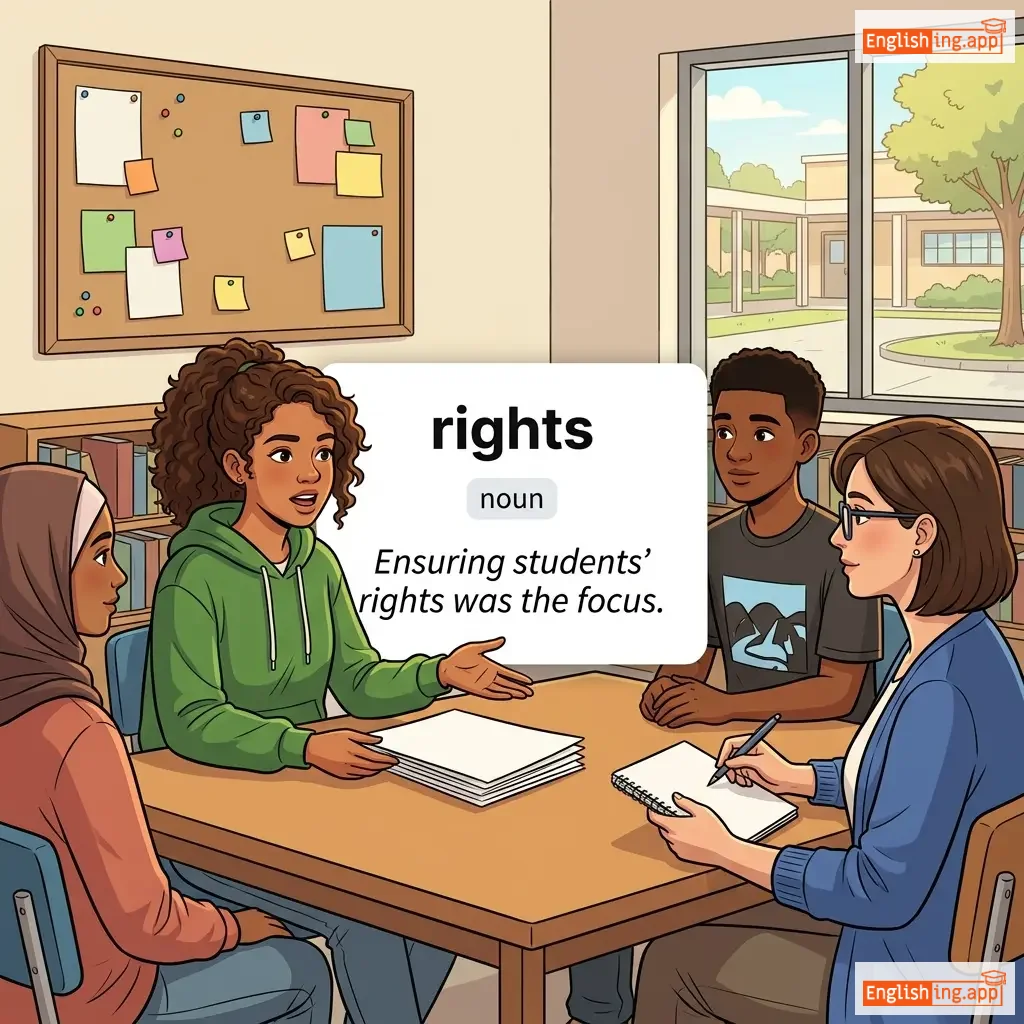
rights definition card — visual illustration of the meaning
noun
raɪts
derechos (derechos)

Things to which one has a just claim; the authority or power of having something.

"Ensuring students' rights was the focus."

"Garantizar los derechos de los estudiantes fue el enfoque." (Garantizar los derechos de los estudiantes fue el enfoque.)