Vocabularios

Descubra, aprenda y domine el vocabulario en inglés

noun
/pɑːrt/
parte (parte)

a piece or segment of something

"She gave me a part of her chocolate."

"Ella me dio una parte de su chocolate." (Ella me dio una parte de su chocolate.)
adjective
/ˈpɑːt taɪm/
a tiempo parcial (a tiempo parcial)

working for only part of the usual working day or week

"She works part-time as a waitress."

"Ella trabaja a tiempo parcial como camarera." (Ella trabaja a tiempo parcial como camarera.)
adjective
/ˈpɑːrʃəl/
parcial, sesgado (parcial, sesgado)

existing only in part; biased toward one side

"The report gave a partial view of the situation."

"El informe dio una vista parcial de la situación." (El informe dio una vista parcial de la situación.)
noun
/ˌpɑːrʃiˈæləti/
parcialidad (parcialidad)

an unfair preference or bias toward one side or person

"The judge was criticized for showing partiality in the case."

"El juez fue criticado por mostrar parcialidad en el caso." (El juez fue criticado por mostrar parcialidad en el caso.)
adverb
/ˈpɑːrʃəli/
parcialmente (parcialmente)

to some extent but not completely

"The project was partially completed before the deadline."

"El proyecto fue parcialmente completado antes de la fecha límite." (El proyecto fue parcialmente completado antes de la fecha límite.)
adjective
/ˈpɑːrtəbl/
divisible (divisible)

capable of being divided or separated

"The estate was partible among the heirs."

"La propiedad era divisible entre los herederos." (La propiedad era divisible entre los herederos.)
🧑‍🤝‍🧑

Participant (partisípant)

noun
/pɑːrˈtɪsɪpənt/
participante (participante)

a person who takes part in an event or activity

"Each participant received a certificate after the workshop."

"Cada participante recibió un certificado después del taller." (Cada participante recibió un certificado después del taller.)
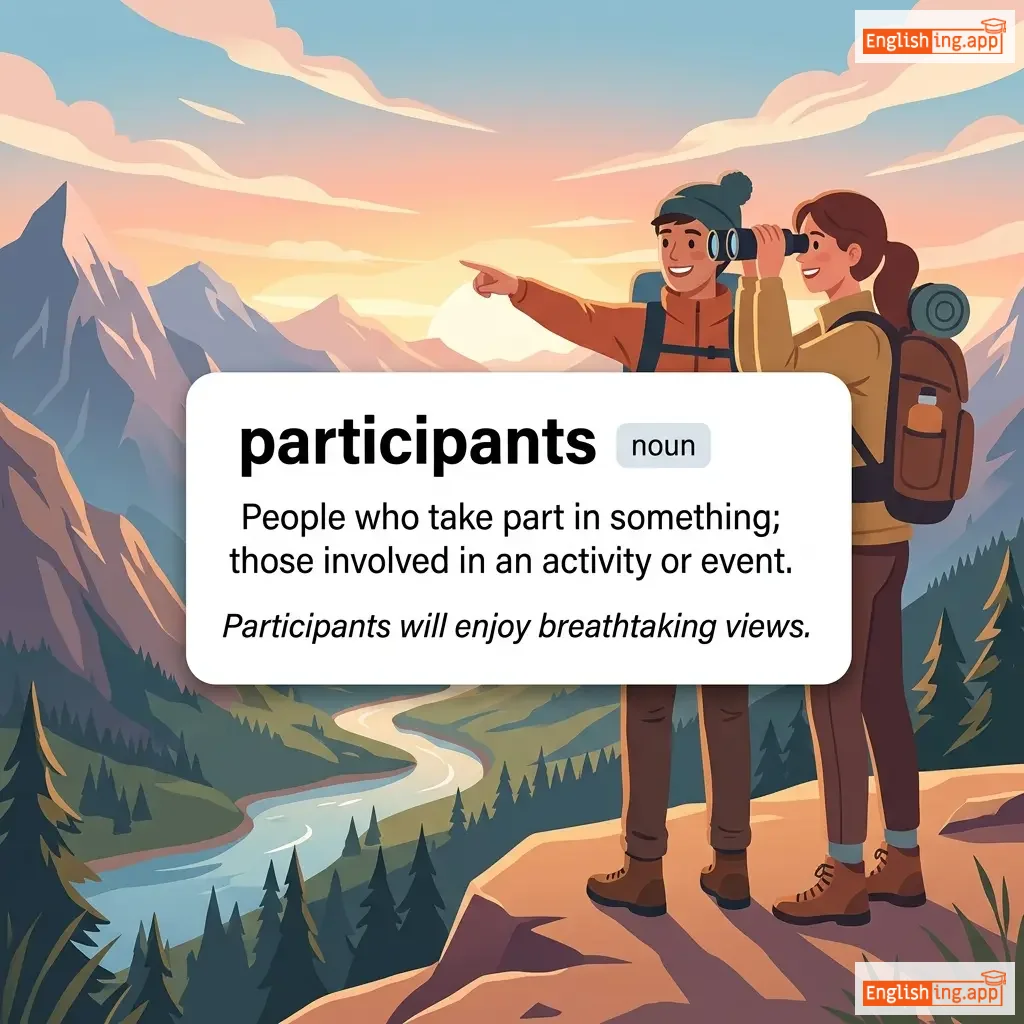
participants definition card — visual illustration of the meaning
noun
pɑːˈtɪs.ɪ.pənts
participantes (participantes)

People who take part in something; those involved in an activity or event.

"Participants will enjoy breathtaking views."

"Los participantes disfrutarán vistas impresionantes." (Los participantes disfrutarán vistas impresionantes.)
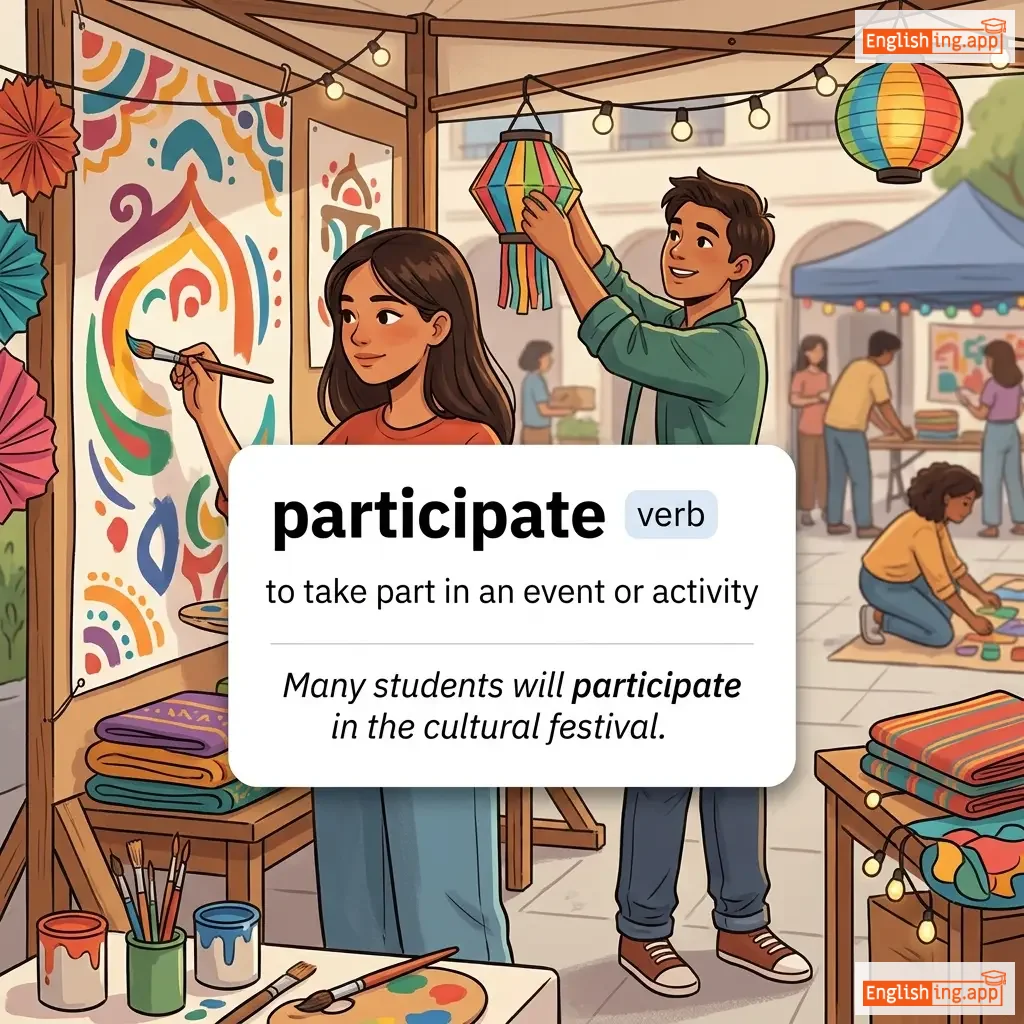
participate definition card — visual illustration of the meaning
verb
/pɑːrˈtɪsɪpeɪt/
participar (participar)

to take part in an event or activity

"Many students will participate in the cultural festival."

"Muchos estudiantes participarán en el festival cultural." (Muchos estudiantes participarán en el festival cultural.)
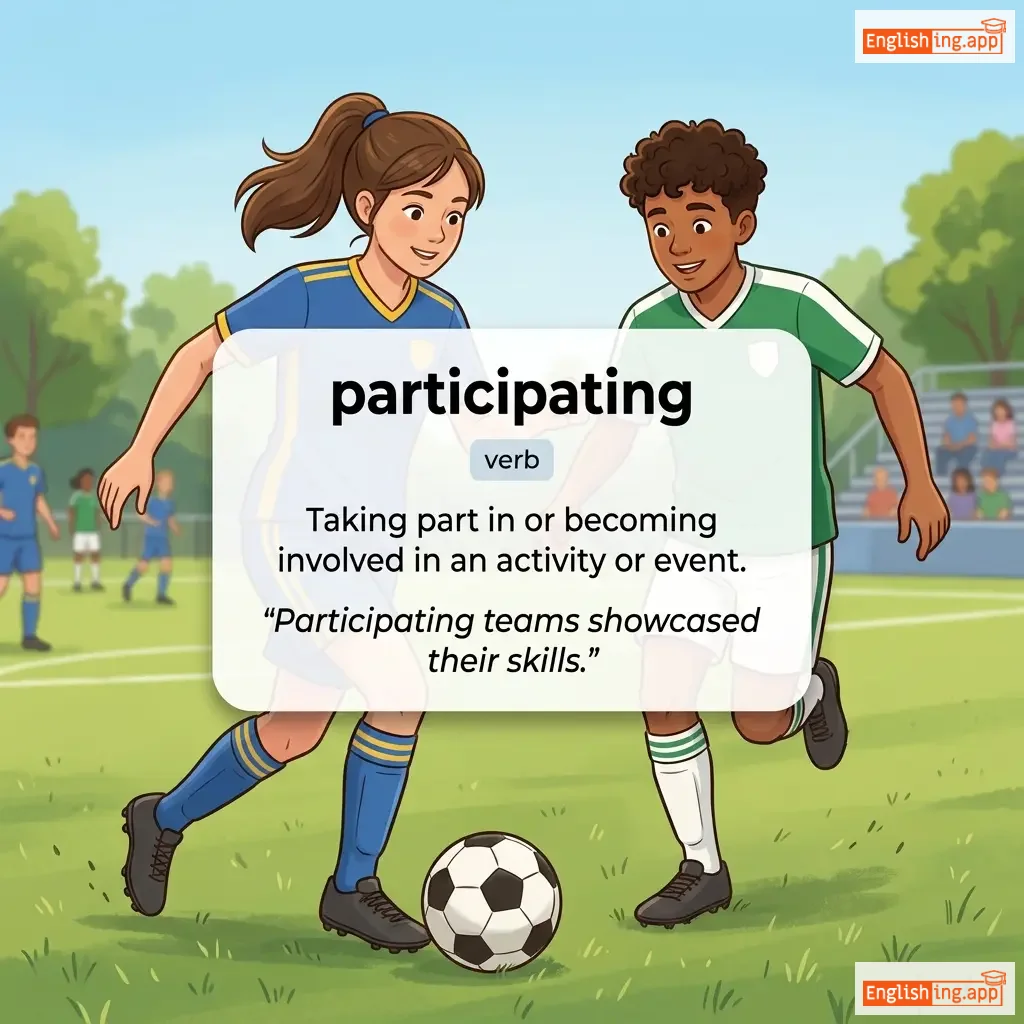
participating definition card — visual illustration of the meaning
verb
pɑːˈtɪs.ɪ.peɪ.tɪŋ
participar (participar)

Taking part in or becoming involved in an activity or event.

"Participating teams showcased their skills."

"Los equipos participantes demostraron sus habilidades." (Los equipos participantes demostraron sus habilidades.)
noun
/pɑːrˌtɪsɪˈpeɪʃən/
participación (participacion)

the action of taking part in something

"Her participation in the competition was commendable."

"Su participación en la competencia fue encomiable." (Su participacion en la competencia fue encomiable.)
noun
/ˈpɑːrtɪkəl/
partícula (partikula)

a very small piece or amount of something

"Dust particles floated in the air near the window."

"Las partículas de polvo flotaban en el aire cerca de la ventana." (Las particulas de polvo flotaban en el aire cerca de la ventana.)
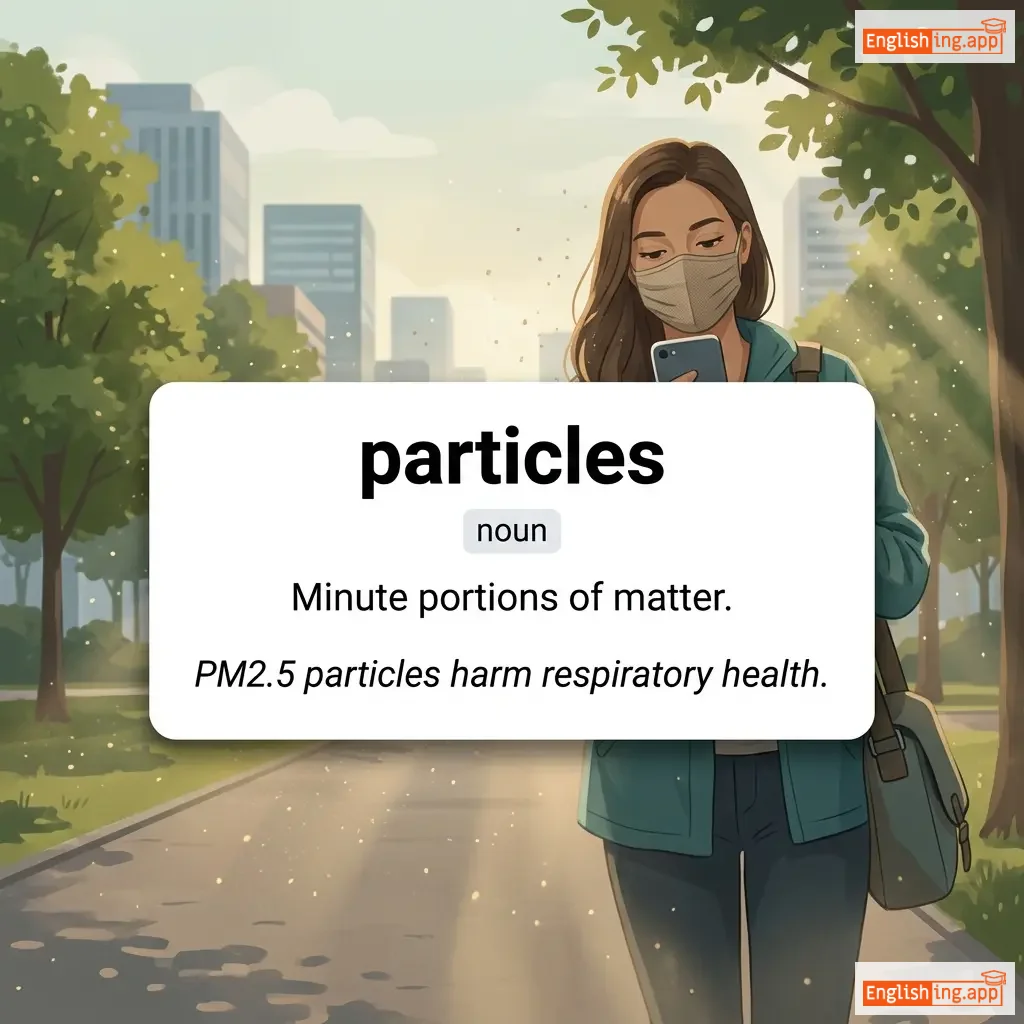
particles definition card — visual illustration of the meaning
noun
/ˈpɑː.tɪ.klz/
partículas (particulas)

Minute portions of matter.

"PM2.5 particles harm respiratory health."

"Las partículas PM2.5 dañan la salud respiratoria." (Las particulas PM2.5 danan la salud respiratoria.)
adjective
/pərˈtɪk.jʊ.lər/
particular (particular)

specific or special; distinct from others

"He is very particular about his diet."

"Él es muy particular con su dieta." (Él es muy particular con su dieta.)
verb
/pərˈtɪkjələrˌaɪz/
especificar (especificar)

to mention or describe something in detail

"The witness was asked to particularize the events of that night."

"Se le pidió al testigo que especificara los eventos de esa noche." (Se le pidió al testigo que especificara los eventos de esa noche.)
adverb
/pɑːrˈtɪkjʊləli/
particularmente (particularmente)

to a higher degree than is usual or expected

"She is particularly fond of Italian food."

"Ella es particularmente aficionada a la comida italiana." (Ella es particularmente aficionada a la comida italiana.)
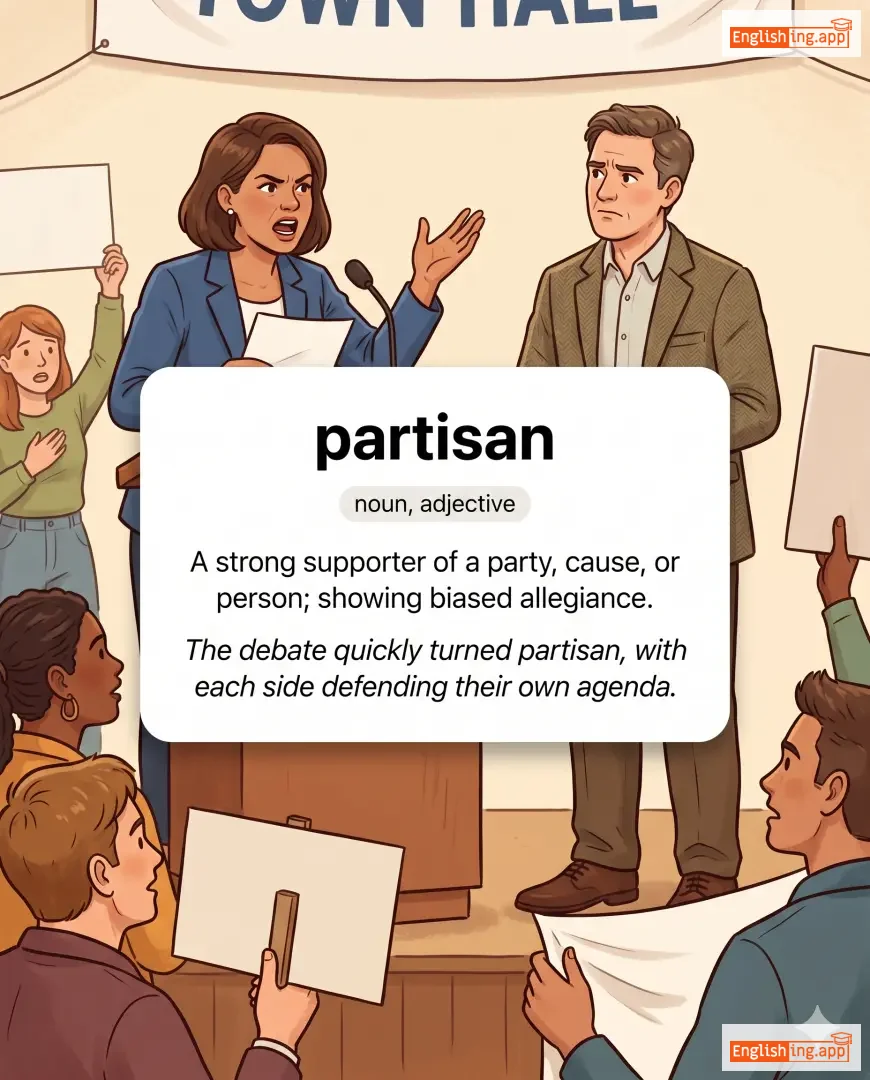
partisan definition card — visual illustration of the meaning
noun, adjective
/ˈpɑːrtɪzən/
partidario (partidario)

A strong supporter of a party, cause, or person; showing biased allegiance.

"The debate quickly turned partisan, with each side defending their own agenda."

"El debate rápidamente se volvió partidista, con cada lado defendiendo su propia agenda." (El debate rapidamente se volvio partidista, con cada lado defendiendo su propia agenda.)
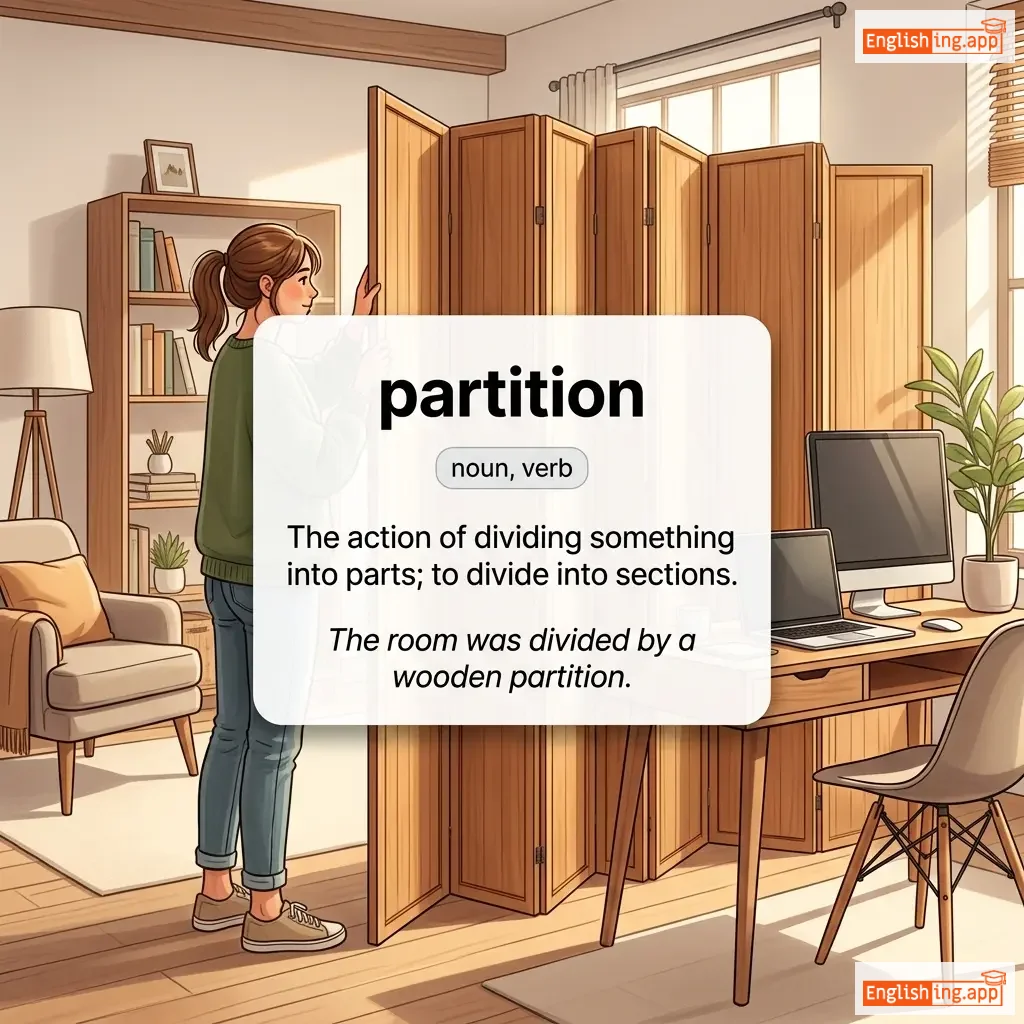
partition definition card — visual illustration of the meaning
noun, verb
/pɑːrˈtɪʃən/
partición / división (particion / division)

The action of dividing something into parts; to divide into sections.

"The room was divided by a wooden partition."

"La habitación estaba dividida por una partición de madera." (La habitacion estaba dividida por una particion de madera.)
adverb
/ˈpɑːrtli/
parcialmente (parcialmente)

to some extent but not completely

"The project was partly successful, but more work is needed."

"El proyecto fue parcialmente exitoso, pero se necesita más trabajo." (El proyecto fue parcialmente exitoso, pero se necesita más trabajo.)
noun
/ˈpɑːtnər/
socio (socio)

a person who shares or is associated with another in some action or endeavor

"She is my business partner in the new venture."

"Ella es mi socia comercial en la nueva empresa." (Ella es mi socia comercial en la nueva empresa.)
noun
/ˈpɑːtnəʃɪp/
asociación (asociacion)

the state of being a partner or a group of partners

"Our partnership has helped both companies grow."

"Nuestra asociación ha ayudado a ambas empresas a crecer." (Nuestra asociacion ha ayudado a ambas empresas a crecer.)
noun
/ˌpɑːrtjʊˈrɪʃən/
parto (parto)

The act of giving birth; childbirth.

"The doctor explained the stages of parturition to the students."

"El médico explicó las etapas del parto a los estudiantes." (El medico explico las etapas del parto a los estudiantes.)
noun
/ˈpɑːti/
fiesta (fiesta)

a social gathering of people, typically for entertainment

"We had a great time at the birthday party."

"Nos divertimos mucho en la fiesta de cumpleaños." (Nos divertimos mucho en la fiesta de cumpleaños.)
noun
/ˈpɑːrvənuː/
recién enriquecido (recien enriquecido)

A person who has recently gained wealth or influence but is not yet accepted socially.

"He was seen as a parvenu who lacked refinement despite his riches."

"Se le vio como un parvenu que carecía de refinamiento a pesar de su riqueza." (Se le vio como un parvenu que carecía de refinamiento a pesar de su riqueza.)
🏃‍♂️

pass (pas)

verb
/pæs/
pasar (pasar)

to move past or beyond something

"He passed the test with flying colors."

"Aprobó el examen con colores brillantes." (Aprobo el examen con colores brillantes.)
verb (phrasal)
/ˈpæs ˌɔːf/
presentar algo falso como si fuera real; fingir (presentar algo falso como si fuera real; fingir)

to present something or someone falsely as something else; to pretend or deceive

"He tried to pass off the fake watch as a luxury brand."

"Intentó pasar el reloj falso como una marca de lujo." (Intentó pasar el reloj falso como una marca de lujo.)
adjective
/ˈpæs.ə.bəl/
aceptable (aceptable)

good enough to be accepted, though not excellent

"The road is barely passable after the storm."

"El camino es apenas aceptable después de la tormenta." (El camino es apenas aceptable después de la tormenta.)
noun
/ˈpæsɪdʒ/
pasaje/camino estrecho; fragmento/cita; proceso de moverse de un estado o lugar a otro (pasaje/camino estrecho; fragmento/cita; proceso de moverse de un estado o lugar a otro)

a narrow way through or between; a section of text or music; the process of moving from one state or place to another

"The narrow passage led from the courtyard to the library."

"El pasaje estrecho condujo del patio al biblioteca." (El pasaje estrecho condujo del patio al biblioteca.)
adjective
/pæˈseɪ/
anticuado; fuera de moda (anticuado; fuera de moda)

no longer fashionable or current; out of date

"Some trends from last decade feel utterly passé now."

"Algunas tendencias de la última década ahora parecen completamente anticuadas." (Algunas tendencias de la última década ahora parecen completamente anticuadas.)
noun
/ˈpæsɪndʒər/
pasajero (pasajero)

a person traveling in a vehicle but not operating it

"The passenger was reading a book during the trip."

"El pasajero estaba leyendo un libro durante el viaje." (El pasajero estaba leyendo un libro durante el viaje.)
noun
/ˈpæsɪt/
requesón (requeson)

Fresh cheese curds; cottage cheese made from curdled milk

"The cook prepared fresh passet by curdling warm milk with lemon juice."

"El cocinero preparó requesón fresco cuajando leche tibia con jugo de limón." (El cocinero preparo requeson fresco cuajando leche tibia con jugo de limon.)
adjective
/ˈpæsɪbəl/
capaz de sentir; susceptible de sufrimiento (capaz de sentir; susceptible de sufrimiento)

capable of feeling or suffering; susceptible to sensation or emotion (often theological)

"In some traditions, deities are described as passible, sharing human emotions."

"En algunas tradiciones, se describe a las deidades como pasibles, compartiendo emociones humanas." (En algunas tradiciones, se describe a las deidades como pasibles, compartiendo emociones humanas.)
noun
/ˈpæsɪŋ/
paso, muerte (paso, muerte)

the act of moving past something or the end of someone's life

"The passing of the leader was a great loss for the nation."

"El paso del líder fue una gran pérdida para la nación." (El paso del líder fue una gran pérdida para la nación.)
noun
/ˈpæʃ.ən/
pasión (pasion)

a strong feeling of enthusiasm or excitement for something or about doing something

"Her passion for teaching was evident in every class."

"Su pasión por la enseñanza era evidente en cada clase." (Su pasion por la ensenanza era evidente en cada clase.)
noun
/ˈpæʃ.ən ˌflaʊ.ər/
flor de la pasión (flor de la pasion)

A climbing plant with intricate, colorful flowers; also refers to royal poinciana tree with red-orange blooms

"The passion flower vine covered the garden wall with beautiful blooms."

"La vid de la flor de la pasión cubrió la pared del jardín con hermosas flores." (la vid de la flor de la pasion cubrio la pared del jardin con hermosas flores.)
adjective
/ˈpæʃənət/
apasionado (apasionado)

showing or caused by strong feelings or a strong belief

"He is passionate about environmental conservation."

"Él está apasionado por la conservación ambiental." (El esta apasionado por la conservacion ambiental.)
adjective
/ˈpæsɪv/
pasivo; (gramática) voz pasiva (pasivo; (gramatica) voz pasiva)

not actively responding or participating; in grammar, denoting the voice in which the subject undergoes the action

"Instead of taking charge, he remained passive during the meeting."

"En lugar de tomar el control, él permaneció pasivo durante la reunión." (En lugar de tomar el control, él permaneció pasivo durante la reunión.)
noun
/ˈpɑːsˌpɔːrt/
pasaporte (pasaporte)

an official government document that identifies a person and allows them to travel internationally

"She renewed her passport before traveling abroad."

"Renovó su pasaporte antes de viajar al extranjero." (Renovo su pasaporte antes de viajar al extranjero)
noun
/ˈpɑːswɜːd/
palabra secreta (palabra secreta)

a secret word or phrase used to gain access to something

"Make sure your password is strong and unique."

"Asegúrate de que tu contraseña sea fuerte y única." (Asegúrate de que tu contraseña sea fuerte y única.)
noun/adjective/preposition
/pɑːst/
pasado (pasado)

the time before the present; gone by in time

"He often thinks about his past mistakes."

"A menudo piensa en sus errores pasados." (A menudo piensa en sus errores pasados.)
noun
/ˈpæstə/
pasta (pasta)

an Italian food made from flour and water, typically shaped into noodles or sheets

"We had creamy pasta for dinner last night."

"Tuvimos pasta cremosa para la cena anoche." (Tuvimos pasta cremosa para la cena anoche.)
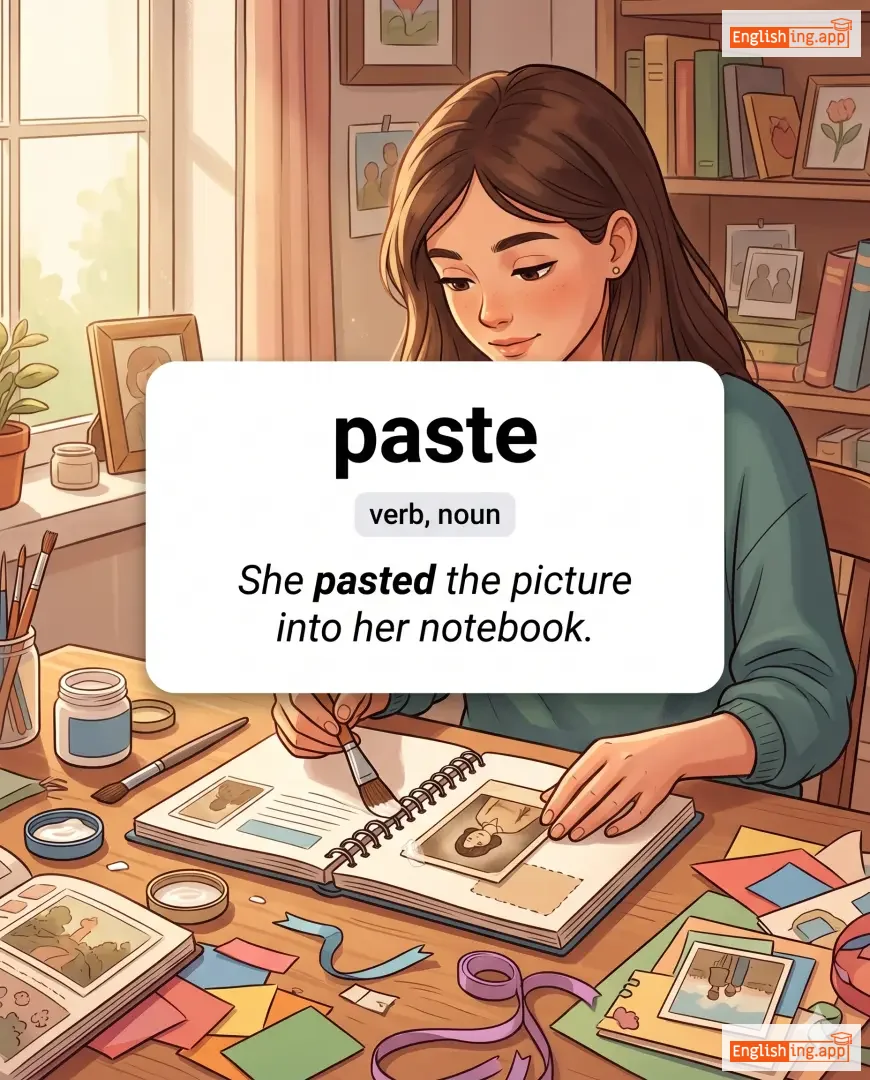
paste definition card — visual illustration of the meaning
verb, noun
/peɪst/
pegar (pegar)

to stick or attach something using a soft, moist substance; also a thick, soft, moist substance itself

"She pasted the picture into her notebook."

"Ella pegó la foto en su cuaderno." (Ella pego la foto en su cuaderno.)
noun
/pæˈstiːʃ/
pastiche (pastiche)

a work of art, literature, or music that imitates the style of another artist, period, or genre

"The film was a clever pastiche of 1950s detective movies."

"La película era un astuto pastiche de las películas de detectives de los años 50." (La pelicula era un astuto pastiche de las peliculas de detectives de los anos 50.)
noun
/ˈpæs.taɪm/
pasatiempo (pasatiempo)

an activity done regularly for enjoyment; a hobby or recreational activity

"Reading books is her favorite pastime during weekends."

"Leer libros es su pasatiempo favorito durante los fines de semana." (Leer libros es su pasatiempo favorito durante los fines de semana.)
noun
/ˈpæstər/
pastor (pastor)

a minister in charge of a Christian church or congregation

"The pastor delivered a heartfelt sermon on compassion."

"El pastor dio un sermón lleno de compasión." (El pastor dio un sermón lleno de compasión.)
adjective, noun
/ˈpæstərəl/
rural, relacionado con pastores (rural, relacionado con pastores)

relating to the countryside, shepherds, or rural life; also relating to spiritual guidance by a pastor

"The painting had a calm pastoral scene with sheep grazing."

"La pintura tenía una escena pastoral tranquila con ovejas pastando." (La pintura tenia una escena pastoral tranquila con ovejas pastando.)
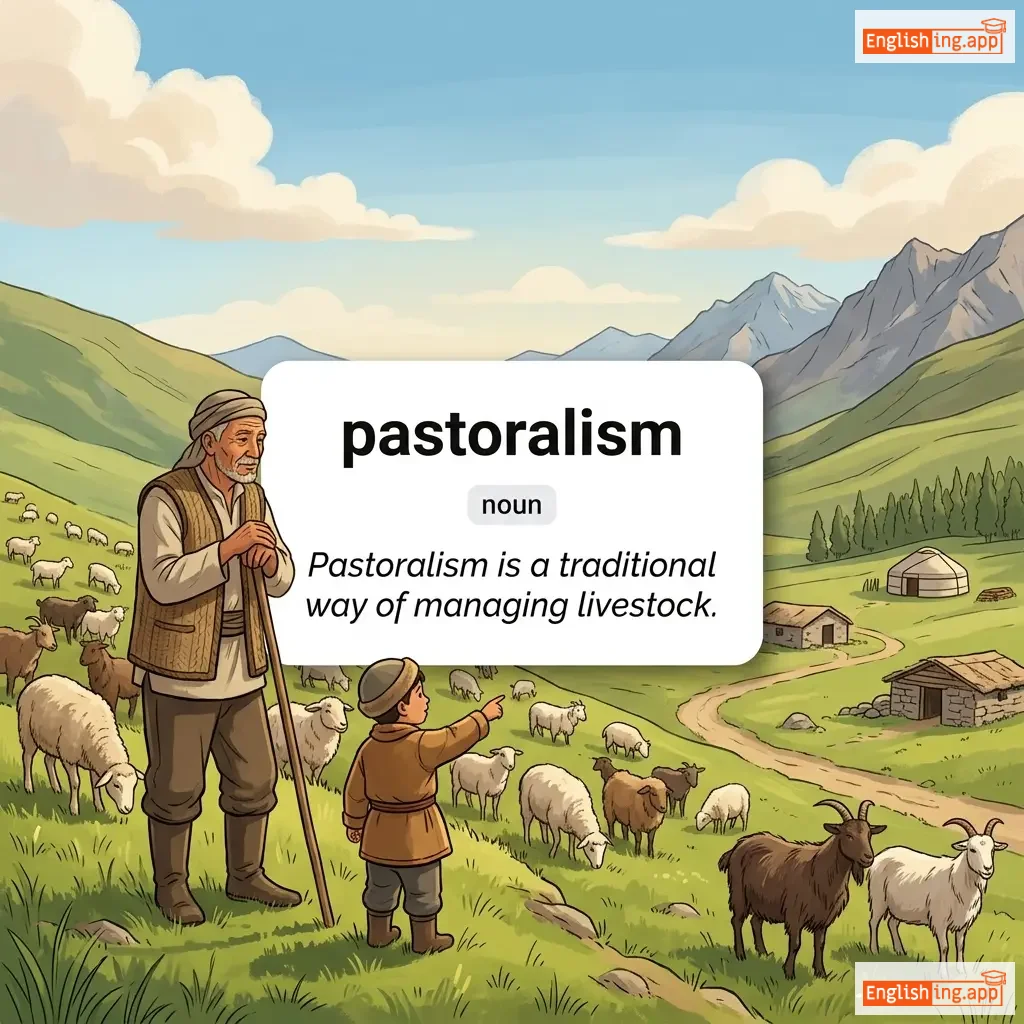
pastoralism definition card — visual illustration of the meaning
noun
ˈpɑː.stər.ə.lɪ.zəm
pastoralismo, sistema de pastoreo basado en pasto (pastoralismo, sistema de pastoreo basado en pasto)

A form of animal husbandry where domesticated animals are released onto large vegetated outdoor lands for grazing.

"Pastoralism is a traditional way of managing livestock."

"El pastoreo es una forma tradicional de gestionar el ganado." (El pastoreo es una forma tradicional de gestionar el ganado.)
noun
/ˈpeɪstri/
pastelito (pastelito)

a baked food product made from flour, fat, and water, often sweet or savory

"I bought a box of fresh pastries for breakfast."

"Compré una caja de pasteles frescos para el desayuno." (Compré una caja de pasteles frescos para el desayuno.)
verb
/pæt/
felicidad (felicidad)

to touch someone or something gently, often to show affection or approval

"She gently patted the dog on its head."

"Ella no pudo ocultar su felicidad cuando recibió el premio." (Ella no pudo ocultar su felicidad cuando recibió el premio.)
noun
/pætʃ/
parche (parche)

a piece of cloth or material used to cover or mend a hole or a tear

"He put a patch on his jeans to cover the tear."

"Puso un parche en sus jeans para cubrir el agujero." (Puso un parche en sus jeans para cubrir el agujero.)