Vocabularios

Descubra, aprenda y domine el vocabulario en inglés

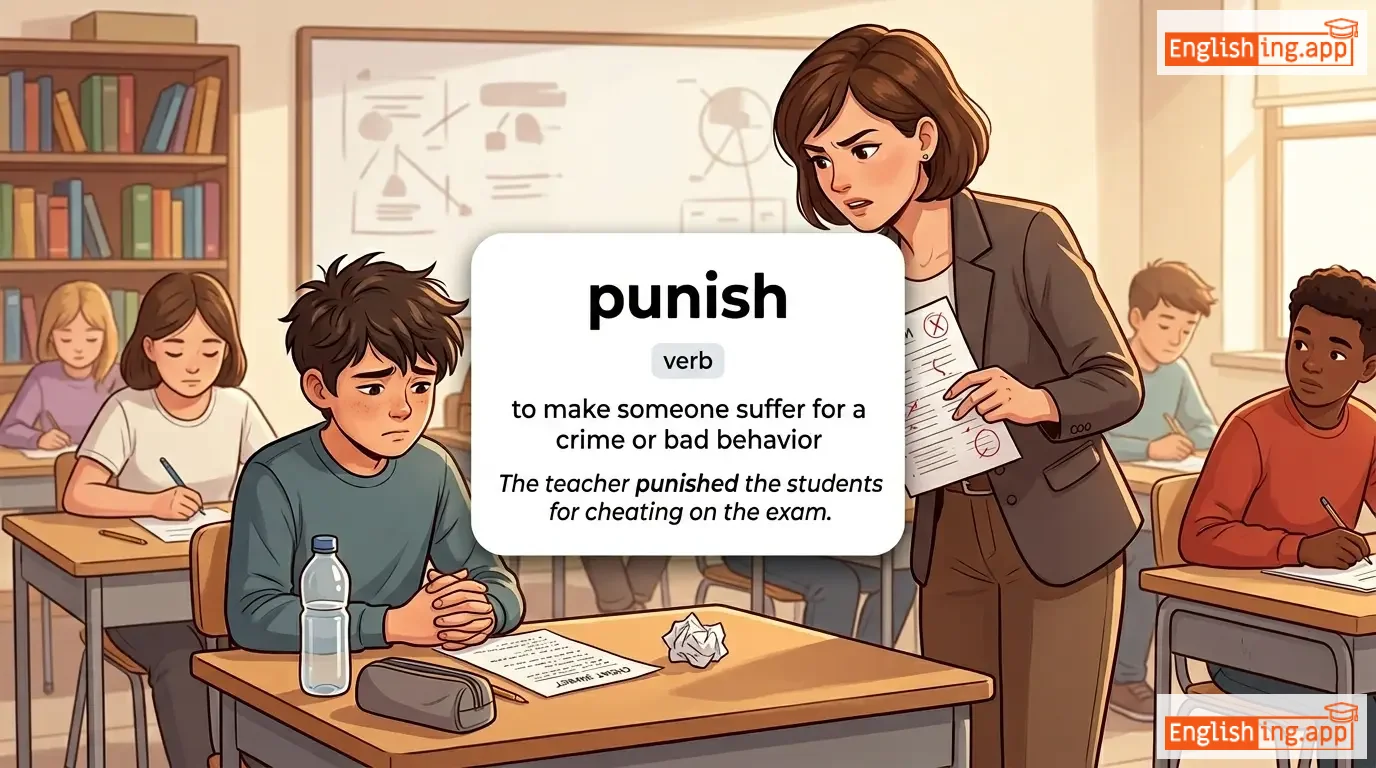
punish definition card — visual illustration of the meaning
verb
/ˈpʌnɪʃ/
castigar (castigar)

to make someone suffer for a crime or bad behavior

"The teacher punished the students for cheating on the exam."

"El maestro castigó a los estudiantes por hacer trampa en el examen." (El maestro castigó a los estudiantes por hacer trampa en el examen.)
noun
/ˈpʌnɪʃmənt/
castigo (castigo)

the infliction of a penalty as retribution for an offense or wrongdoing

"The criminal received a harsh punishment for his crime."

"El criminal recibió un castigo severo por su crimen." (El criminal recibio un castigo severo por su crimen.)
adjective
/ˈpjuː.nɪ.tɪv/
punitivo (punitivo)

Inflicting or intended as punishment.

"The company faced punitive measures for violating the law."

"La empresa enfrentó medidas punitivas por violar la ley." (La empresa enfrento medidas punitivas por violar la ley.)
noun
/pʌnˈdʒɑː.bi/
punyabi (punyabi)

a traditional long shirt worn in South Asia, typically loose-fitting

"He wore a white punjabi for the festival celebration."

"Él usó un punyabi blanco para la celebración del festival." (El uso un punyabi blanco para la celebración del festival.)
noun
/pʌŋk/
punk (punk)

a type of popular music, or the culture associated with it, characterized by loud, fast rhythms and rebellious attitudes

"He’s always been into punk music and fashion."

"Siempre le ha interesado la música y la moda punk." (Siempre le ha interesado la musica y la moda punk.)
adjective
/ˈpjuː.ni/
débiles (debiles)

Small, weak, or insignificant.

"He felt puny compared to his stronger classmates."

"Se sentía débil comparado con sus compañeros de clase más fuertes." (Se sentia debil comparado con sus companeros de clase mas fuertes.)
noun
/ˈpjuːpəl/
alumno; pupila (alumno; pupila)

a student, especially a young one; the central opening of the eye that lets in light

"The pupil listened carefully to the teacher during class."

"El alumno escuchó atentamente al profesor." (El alumno escucho atentamente al profesor)
noun
/ˈpjuː.pɪ.lɪdʒ/
estado de pupilo (estado de pupilo)

The state of being a pupil or under instruction.

"During his pupilage, he studied law under a senior barrister."

"Durante su pupilaje, estudió derecho bajo un barrister senior." (Durante su pupilaje, estudió derecho bajo un barrister senior.)
noun
/ˈpʌp.i/
cachorro (cachorro)

a young dog

"The puppy wagged its tail when it saw its owner."

"El cachorro movió su cola cuando vio a su dueño." (El cachorro movió su cola cuando vio a su dueño.)
adjective
/ˈpɜːˌblaɪnd/
ciego o ignorante (ciego o ignorante)

Having impaired or defective vision; lacking insight or understanding.

"The purblind approach to the problem led to many mistakes."

"El enfoque purblindo del problema condujo a muchos errores." (El enfoque purblindo del problema condujo a muchos errores.)
purchase definition card — visual illustration of the meaning
verb
/ˈpɜː.tʃəs/
comprar (komprar)

To buy something by paying money for it.

"She purchased a new laptop from the store."

"Ella compró un nuevo portátil en la tienda." (Ella compró un nuevo portátil en la tienda.)
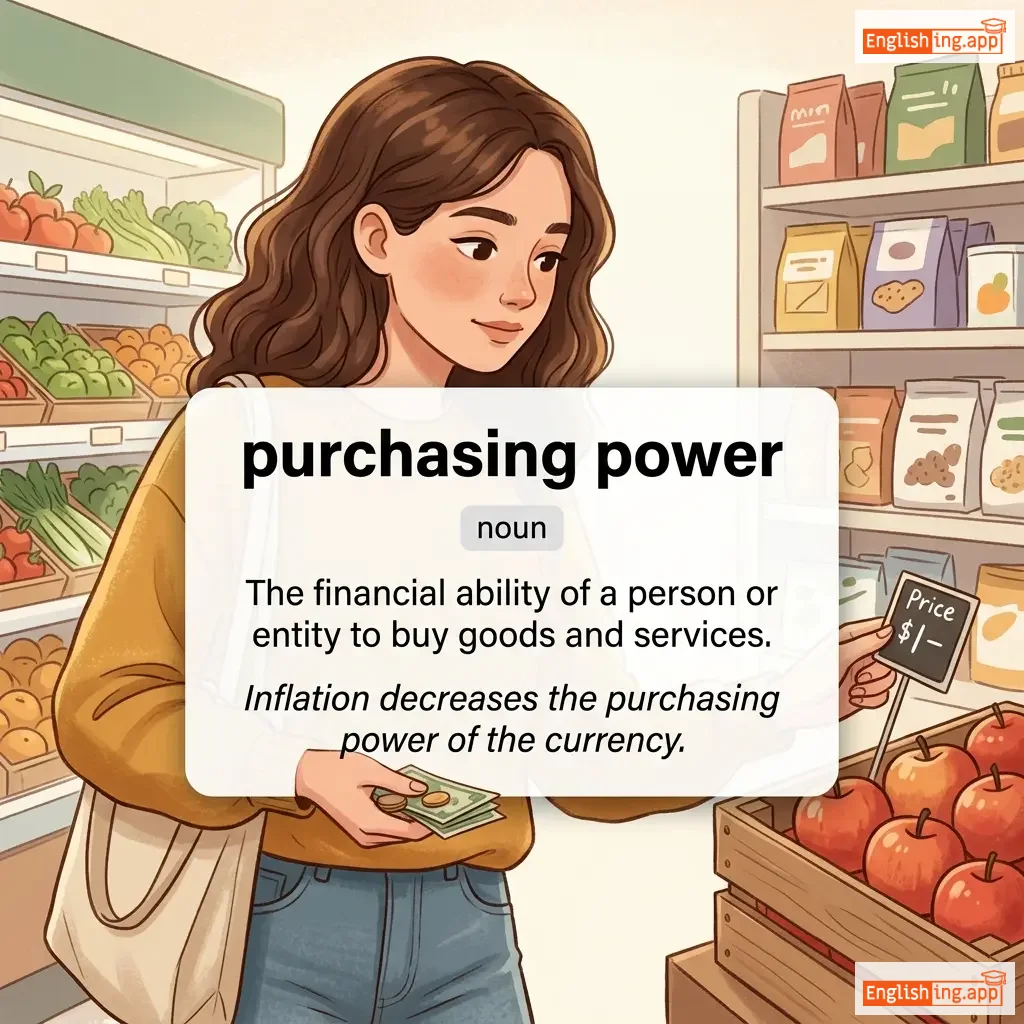
purchasing power definition card — visual illustration of the meaning
noun
ˈpɜːtʃəsɪŋ ˈpaʊər
poder adquisitivo (poder adquisitivo)

The financial ability of a person or entity to buy goods and services.

"Inflation decreases the purchasing power of the currency."

"La inflación reduce el poder adquisitivo de la moneda." (La inflacion reduce el poder adquisitivo de la moneda.)
adjective
/pjʊə(r)/
puro (puro)

free from anything that contaminates or taints; clean

"She has a pure heart and always helps others."

"Ella tiene un corazón puro y siempre ayuda a los demás." (Ella tiene un corazon puro y siempre ayuda a los demas.)
adverb
/ˈpjʊərli/
puramente (puramente)

only and completely; entirely

"The decision was purely based on economic factors."

"La decisión se basó puramente en factores económicos." (La decision se basó puramente en factores económicos.)
noun
/ˈpɜːrɡəˌtɔːri/
un lugar o estado de sufrimiento habitado por las almas de los pecadores que expían sus pecados antes de ir al cielo (un lugar o estado de sufrimiento habitado por las almas de los pecadores que expían sus pecados antes de ir al cielo)

A place or state of suffering inhabited by the souls of sinners who are expiating their sins before going to heaven; a temporary condition of torment or suffering.

"After the accident, the long recovery felt like a kind of purgatory."

"Después del accidente, la larga recuperación se sintió como una especie de purgatorio." (Después del accidente, la larga recuperación se sintió como una especie de purgatorio.)
verb
/pɜːrdʒ/
purificar (purificar)

To remove unwanted feelings, people, or things; to cleanse or purify.

"The new leader promised to purge corruption from the government."

"El nuevo líder prometió purgar la corrupción del gobierno." (El nuevo líder prometió purgar la corrupción del gobierno.)
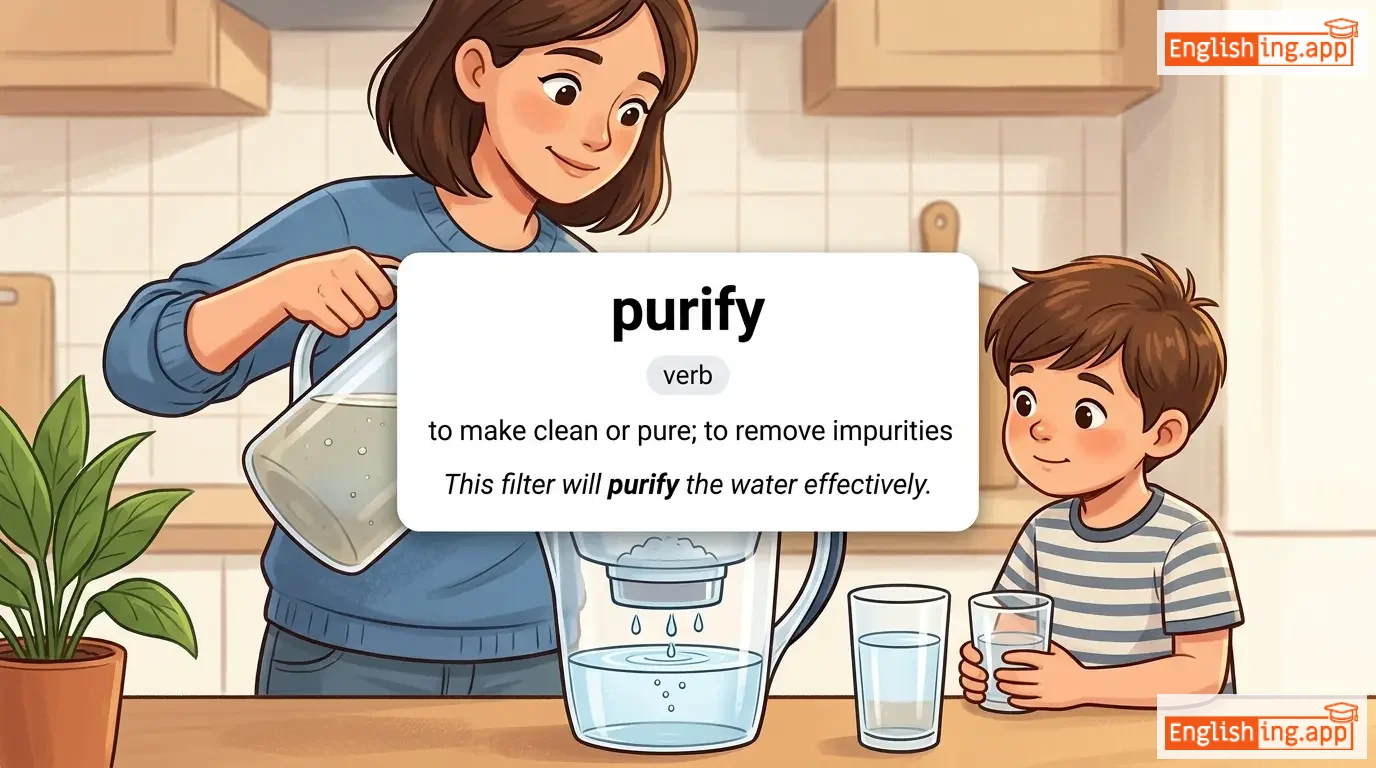
purify definition card — visual illustration of the meaning
verb
/ˈpjʊərɪfaɪ/
purificar (purificar)

to make clean or pure; to remove impurities

"This filter will purify the water effectively."

"Este filtro purificará el agua de manera efectiva." (Este filtro purificará el agua de manera efectiva.)
noun
/ˈpjʊrəti/
pureza (pureza)

The quality or state of being pure; freedom from contamination or sin.

"The mountain air was admired for its purity."

"El aire de la montaña fue admirado por su pureza." (El aire de la montaña fue admirado por su pureza.)
verb
/pɜːrl/
fluir con un sonido murmullante (fluir con un sonido murmullante)

To knit with a purl stitch; to flow with a murmuring sound (as a stream).

"The brook purled softly through the meadow."

"El arroyo purleó suavemente por el prado." (El arroyo purleó suavemente por el prado.)
noun
/ˈpɜːrljuː/
área periférica (area periferica)

The area near or surrounding a place; an outlying or neighboring district.

"They spent the afternoon exploring the purlieus of the ancient city."

"Pasaron la tarde explorando los purlíus de la antigua ciudad." (Pasaron la tarde explorando los purlíus de la antigua ciudad.)
🕵️‍♂️

purloin (pɜːrlɔɪn)

verb
/pərˈlɔɪn/
robar (robar)

to steal something, often in a sneaky or dishonest way

"He tried to purloin a book from the library without being noticed."

"Intentó robar un libro de la biblioteca sin ser notado." (Intentó robar un libro de la biblioteca sin ser notado.)
adjective
/ˈpɜː.pəl/
morado (morado)

a color that is a mix of red and blue

"She wore a beautiful purple dress to the party."

"Ella llevaba un hermoso vestido morado a la fiesta." (Ella llevaba un hermoso vestido morado a la fiesta.)
verb
/ˈpɜːrpɔːrt/
pretender (pretender)

to claim or profess something, often falsely

"The document purports to be an official government report."

"El documento pretende ser un informe oficial del gobierno." (El documento pretende ser un informe oficial del gobierno.)
adjective
/pərˈpɔːrtɪd/
presunto (presunto)

alleged or claimed to be true, often without proof

"The purported evidence was later proven false."

"La evidencia presunta fue más tarde probada como falsa." (La evidencia presunta fue más tarde probada como falsa.)
noun
/ˈpɜːpəs/
propósito (proposito)

the reason for which something is done or created

"The purpose of this meeting is to discuss the new project."

"El propósito de esta reunión es discutir el nuevo proyecto." (El proposito de esta reunion es discutir el nuevo proyecto.)
noun
/pɜːrs/
bolso (bolso)

a small bag used by women to carry money and personal items

"She kept her wallet in her purse."

"Ella guardó su billetera en su bolso." (Ella guardó su billetera en su bolso.)
adjective
/pərˈsuːənt/
de acuerdo con (de acuerdo con)

in accordance with or following something, especially a law or rule

"The decision was made pursuant to the regulations."

"La decisión se tomó de acuerdo con los reglamentos." (La decision se tomo de acuerdo con los reglamentos.)
🏃‍♀️

pursue (pərˈsuː)

verb
/pərˈsuː/
perseguir (perseguir)

to follow or chase with the intent to catch or achieve something

"She decided to pursue her dreams of becoming a doctor."

"Ella decidió seguir sus sueños de convertirse en doctora." (Ella decidió seguir sus sueños de convertirse en doctora.)
🏃‍♂️

pursuit (persut)

noun
/pəˈsjuːt/
persecución, búsqueda (persecucion, busqueda)

the act of chasing or trying to achieve something

"He dedicated his life to the pursuit of happiness."

"Dedicó su vida a la búsqueda de la felicidad." (Dedicó su vida a la búsqueda de la felicidad.)
verb
/pərˈveɪ/
suministrar (suministrar)

to supply or provide goods, services, or information, often as a business

"The company purveys organic food to health-conscious customers."

"La empresa suministra alimentos orgánicos a los clientes conscientes de la salud." (La empresa suministra alimentos orgánicos a los clientes conscientes de la salud.)
noun
/pərˈveɪər/
proveedor (proveedor)

a person or business that supplies goods, services, or information

"He is a well-known purveyor of fine wines."

"Es un conocido proveedor de vinos finos." (Es un conocido proveedor de vinos finos)
noun
/ˈpɜːrvjuː/
ámbito (ambito)

the scope or range of authority, responsibility, or knowledge

"The case does not fall within the purview of this court."

"El caso no está dentro del ámbito de este tribunal." (El caso no está dentro del ámbito de este tribunal.)
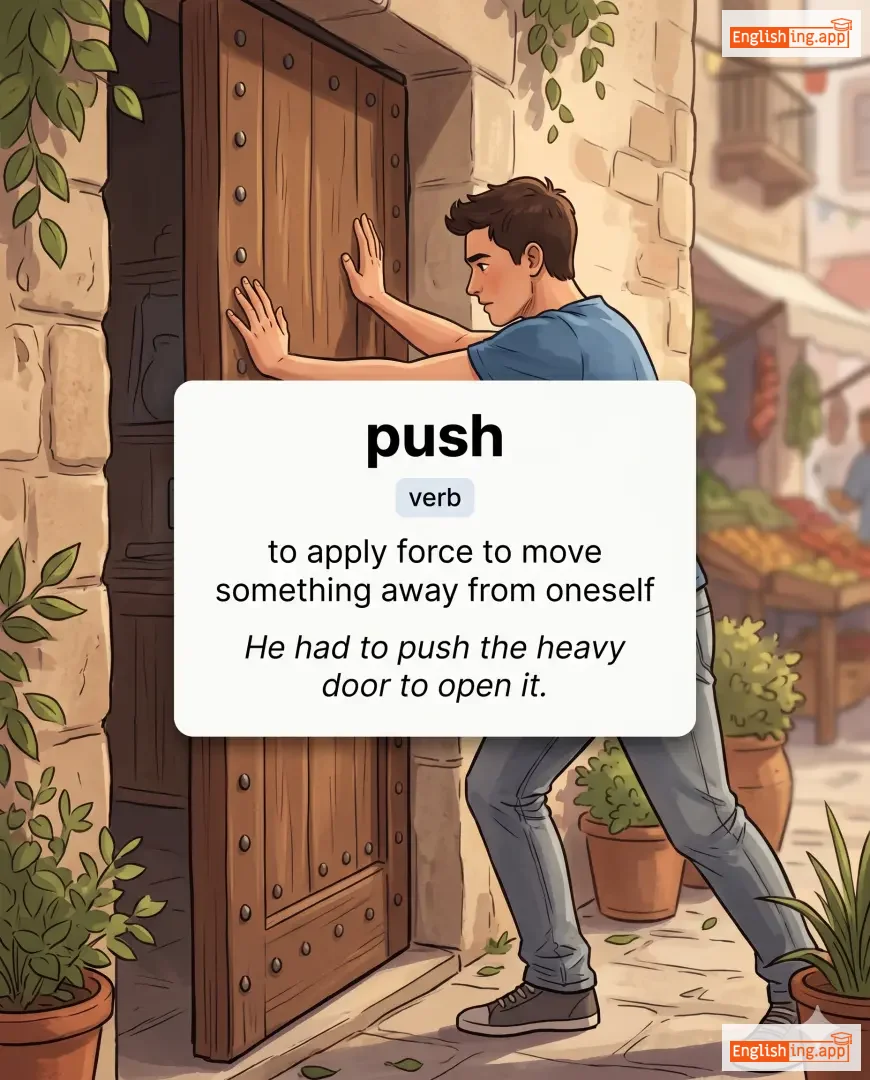
push definition card — visual illustration of the meaning
verb
/pʊʃ/
empujar (empujar)

to apply force to move something away from oneself

"He had to push the heavy door to open it."

"Tuvo que empujar la puerta pesada para abrirla." (Tuvo que empujar la puerta pesada para abrirla.)
adjective
/ˈpʊʃi/
insistente (insistente)

excessively assertive or aggressive, often annoyingly so

"The salesperson was too pushy, which drove customers away."

"El vendedor era demasiado insistente, lo que alejó a los clientes." (El vendedor era demasiado insistente, lo que alejó a los clientes.)
adjective
/ˌpjuːsɪˈlænɪməs/
pusilánime (pusilanime)

showing a lack of courage or determination; timid

"The pusillanimous leader avoided making tough decisions."

"El líder pusilánime evitaba tomar decisiones difíciles." (El lider pusilanime evitaba tomar decisiones dificiles.)
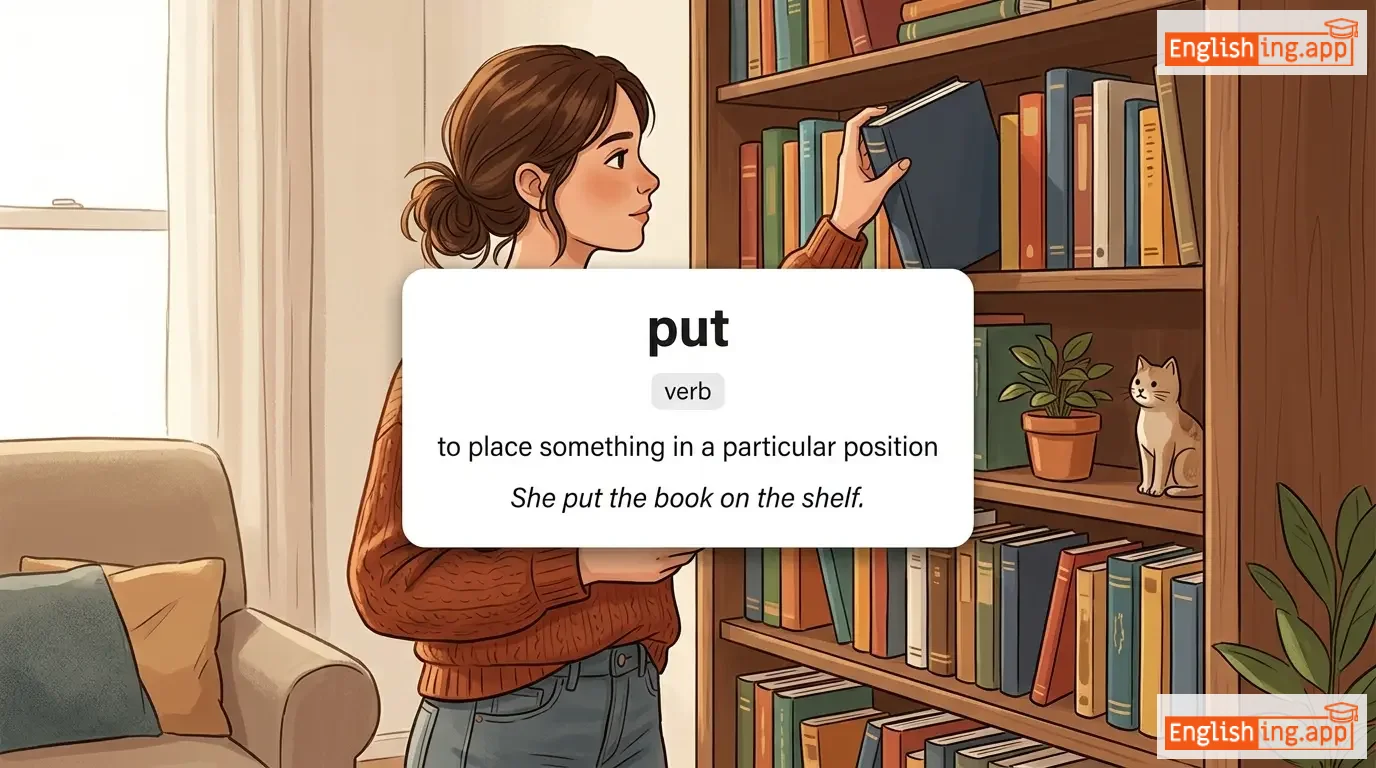
put definition card — visual illustration of the meaning
verb
/pʊt/
poner (poner)

to place something in a particular position

"She put the book on the shelf."

"Ella puso el libro en la estantería." (Ella puso el libro en la estantería.)
adjective
/ˈpjuːtətɪv/
supuesto (supuesto)

commonly accepted or supposed; generally regarded as such

"He is the putative father of the child."

"Él es el padre supuesto del niño." (Él es el padre supuesto del niño.)
verb
/ˈpjuːtrɪfaɪ/
descomponer (descomponer)

to decay or rot, producing a foul smell

"The meat began to putrefy in the heat."

"La carne comenzó a descomponerse con el calor." (La carne comenzo a descomponerse con el calor.)
adjective
/pjuːˈtrɛsənt/
en descomposición (en descomposicion)

undergoing the process of decay; rotting

"The putrescent odor made everyone leave the room."

"El olor en descomposición hizo que todos abandonaran la habitación." (El olor en descomposicion hizo que todos abandonaran la habitacion.)
adjective
/ˈpjuːtrɪd/
podrido (podrido)

decayed and emitting a foul smell

"The garbage smelled putrid after days in the sun."

"La basura olía a podrido después de varios días al sol." (La basura olía a podrido después de varios días al sol.)
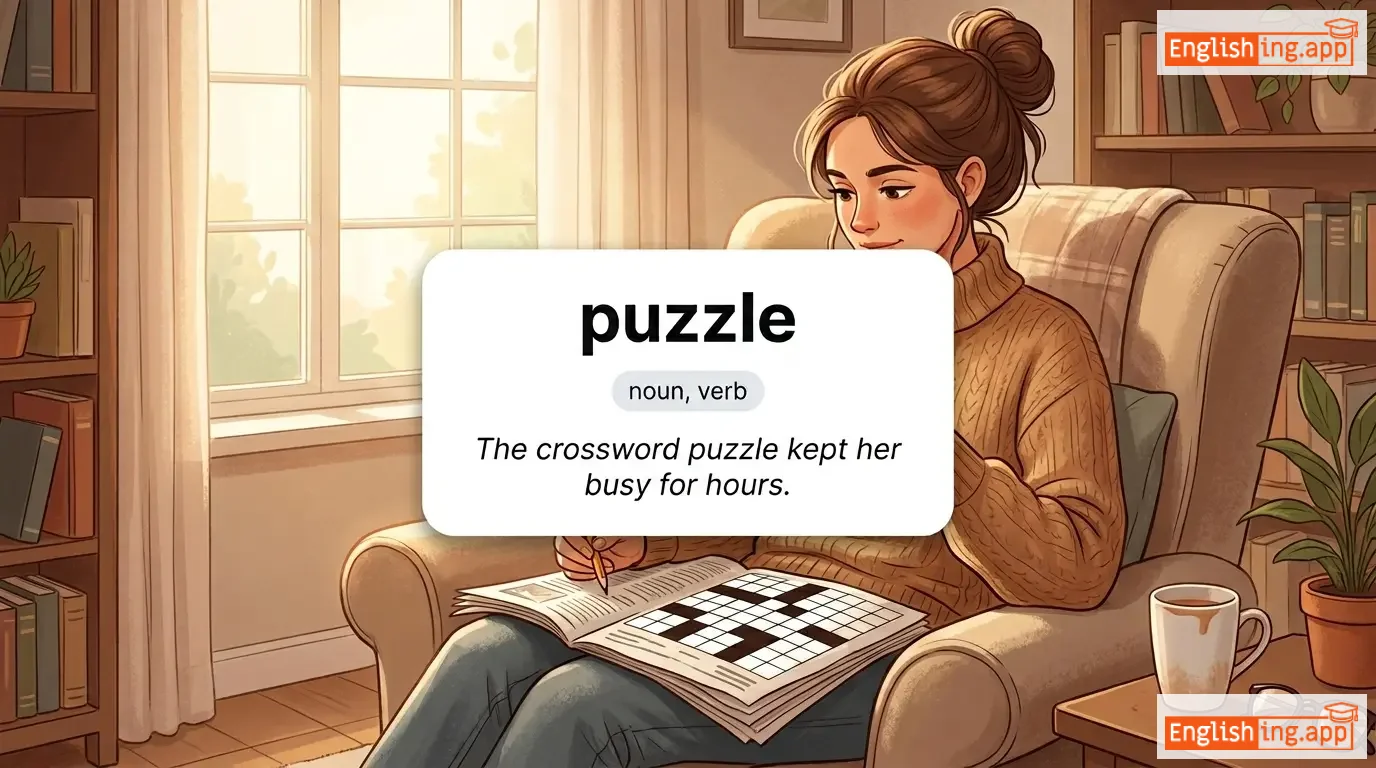
puzzle definition card — visual illustration of the meaning
noun, verb
/ˈpʌzl/
rompecabezas / desconcertar (rompecabezas / desconcertar)

a game, toy, or problem designed to test ingenuity; to cause someone to be confused

"The crossword puzzle kept her busy for hours."

"El crucigrama la mantuvo ocupada durante horas." (El crucigrama la mantuvo ocupada durante horas.)
adjective
/ˈpʌz.lɪŋ/
desconcertante (desconcertante)

confusing; perplexing;

"The scientist found the results puzzling."

"El científico encontró los resultados desconcertantes." (El cientifico encontro los resultados desconcertantes.)
noun
/paɪər/
pira (pira)

A heap of combustible material, especially one used for burning a corpse as part of a funeral ceremony.

"The villagers built a pyre to honor the deceased."

"Los aldeanos construyeron una pira para honrar al difunto." (Los aldeanos construyeron una pira para honrar al difunto.)
noun
/ˌpaɪrəˈmeɪniə/
deseo incontrolable de prender fuego a cosas (deseo incontrolable de prender fuego a cosas)

An uncontrollable desire to set things on fire.

"The suspect was diagnosed with pyromania after repeated incidents of arson."

"El sospechoso fue diagnosticado con piromanía después de repetidos incidentes de incendio provocado." (El sospechoso fue diagnosticado con piromanía después de repetidos incidentes de incendio provocado.)
noun
/ˌpaɪroʊˈmeɪniæk/
persona con deseos incontrolables de incendiar cosas (persona con deseos incontrolables de incendiar cosas)

A person with an uncontrollable desire to set things on fire.

"The pyromaniac was arrested for setting several buildings ablaze."

"El pirómano fue arrestado por incendiar varios edificios." (El pirómano fue arrestado por incendiar varios edificios.)
adjective
/ˌpaɪroʊˈtɛknɪk/
piromáquina (piromakina)

Relating to fireworks or spectacular displays involving fire.

"The city celebrated with a grand pyrotechnic display on New Year's Eve."

"La ciudad celebró con un gran espectáculo pirotécnico en la víspera de Año Nuevo." (La ciudad celebró con un gran espectáculo pirotécnico en la víspera de Año Nuevo.)
adjective
/ˈpɪrɪk/
victoria pírrica (victoria pirrica)

A victory won at such a great cost that it is almost equivalent to defeat.

"The general declared the battle a pyrrhic victory due to heavy losses."

"El general declaró la batalla una victoria pírrica debido a las grandes pérdidas." (El general declaró la batalla una victoria pírrica debido a las grandes pérdidas.)
noun
/ˈpaɪ.θən/
pitón (piton)

a large non-venomous snake that kills prey by constriction

"The python wrapped around its prey tightly."

"La pitón rodeó a su presa fuertemente." (La pitón rodeó a su presa fuertemente.)
noun
/pɪks/
pequeño recipiente para guardar la hostia consagrada (pequeno recipiente para guardar la hostia consagrada)

a small container, often used in Christian liturgy to carry the consecrated host

"The priest placed the consecrated host into the pyx before visiting the sick."

"El sacerdote colocó la hostia consagrada en el pyx antes de visitar a los enfermos." (El sacerdote coloco la hostia consagrada en el pyx antes de visitar a los enfermos.)