Vocabularios

Descubra, aprenda y domine el vocabulario en inglés

adjective
/prɪˈdɒmɪnənt/
predominante (predominante)

Having superior strength, influence, or authority; most common or noticeable.

"The predominant color in the painting is blue."

"El color predominante en la pintura es azul." (El color predominante en la pintura es azul.)
adverb
/prɪˈdɒmɪnəntli/
predominantemente (predominantemente)

mainly; for the most part

"The population in the city is predominantly young."

"La población en la ciudad es predominantemente joven." (La poblacion en la ciudad es predominantemente joven.)
verb
/prɪˈdɒmɪneɪt/
predominar (predominar)

To be the strongest, most common, or most influential element.

"Traditional values still predominate in the community."

"Los valores tradicionales siguen predominando en la comunidad." (Los valores tradicionales siguen predominando en la comunidad.)
noun
/priːˈɛmɪnəns/
preeminencia (preeminencia)

The fact of surpassing all others; superiority.

"The university has gained preeminence in medical research."

"La universidad ha ganado preeminencia en la investigación médica." (La universidad ha ganado preeminencia en la investigación médica.)
adjective
/priːˈɛmɪnənt/
preeminente (preeminente)

Surpassing all others; very distinguished in some way.

"She is a preeminent scientist in the field of genetics."

"Ella es una científica preeminente en el campo de la genética." (Ella es una científica preeminente en el campo de la genética.)
verb
/priːˈɛmpt/
prevenir (prevenir)

To take action in order to prevent something from happening; to take the place of something.

"The government acted quickly to preempt a financial crisis."

"El gobierno actuó rápidamente para prevenir una crisis financiera." (El gobierno actuo rapidamente para prevenir una crisis financiera.)
noun
/priˈɛmpʃən/
derecho de preferencia (derecho de preferencia)

The act of taking action before someone else; the right to purchase or act before others.

"The company exercised preemption to acquire the land before competitors."

"La empresa ejerció el derecho de preferencia para adquirir la tierra antes que los competidores." (La empresa ejerció el derecho de preferencia para adquirir la tierra antes que los competidores.)
adjective
/priˈɛmptɪv/
preventivo (preventivo)

Serving or intended to prevent something by taking action first.

"The government took preemptive measures to control inflation."

"El gobierno tomó medidas preventivas para controlar la inflación." (El gobierno tomó medidas preventivas para controlar la inflación.)
verb
/priːn/
arreglarse (arreglarse)

To groom or dress oneself with care; to show pride in one's appearance.

"She preened in front of the mirror before leaving for the party."

"Ella se arregló frente al espejo antes de salir para la fiesta." (Ella se arregló frente al espejo antes de salir para la fiesta.)
verb
/ˌpriːɪnˈɡeɪdʒ/
precontratar (precontratar)

To contract or engage beforehand; to arrange in advance.

"The workers were preengaged before the project officially started."

"Los trabajadores fueron precontratados antes de que comenzara oficialmente el proyecto." (Los trabajadores fueron precontratados antes de que comenzara oficialmente el proyecto.)
verb
/ˌpriːɪˈstæblɪʃ/
preestablecer (preestablecer)

To establish or set up beforehand.

"Certain rules were preestablished before the meeting."

"Algunas reglas fueron preestablecidas antes de la reunión." (Algunas reglas fueron preestablecidas antes de la reunión.)
verb
/ˌpriːɪɡˈzɪst/
existir previamente (existir previamente)

to exist beforehand or before something else

"These customs preexist the arrival of modern technology."

"Esas costumbres existían antes de la llegada de la tecnología moderna." (Esas costumbres existían antes de la llegada de la tecnología moderna.)
noun
/ˌpriːɪɡˈzɪstəns/
preexistencia (preexistencia)

the state of existing before something else

"Philosophers often debated the preexistence of the soul."

"Los filósofos a menudo debatían sobre la preexistencia del alma." (Los filosofos a menudo debatian sobre la preexistencia del alma.)
noun
/ˈprɛfəs/
prefacio (prefacio)

an introduction to a book, speech, or other written work

"The author explained his motivation in the preface."

"El autor explicó su motivación en el prefacio." (El autor explicó su motivación en el prefacio.)
adjective
/ˈprɛfətɔːri/
preliminar (preliminar)

serving as an introduction or preface

"He made some prefatory remarks before the lecture began."

"Hizo algunos comentarios preliminares antes de que comenzara la conferencia." (Hizo algunos comentarios preliminares antes de que comenzara la conferencia.)
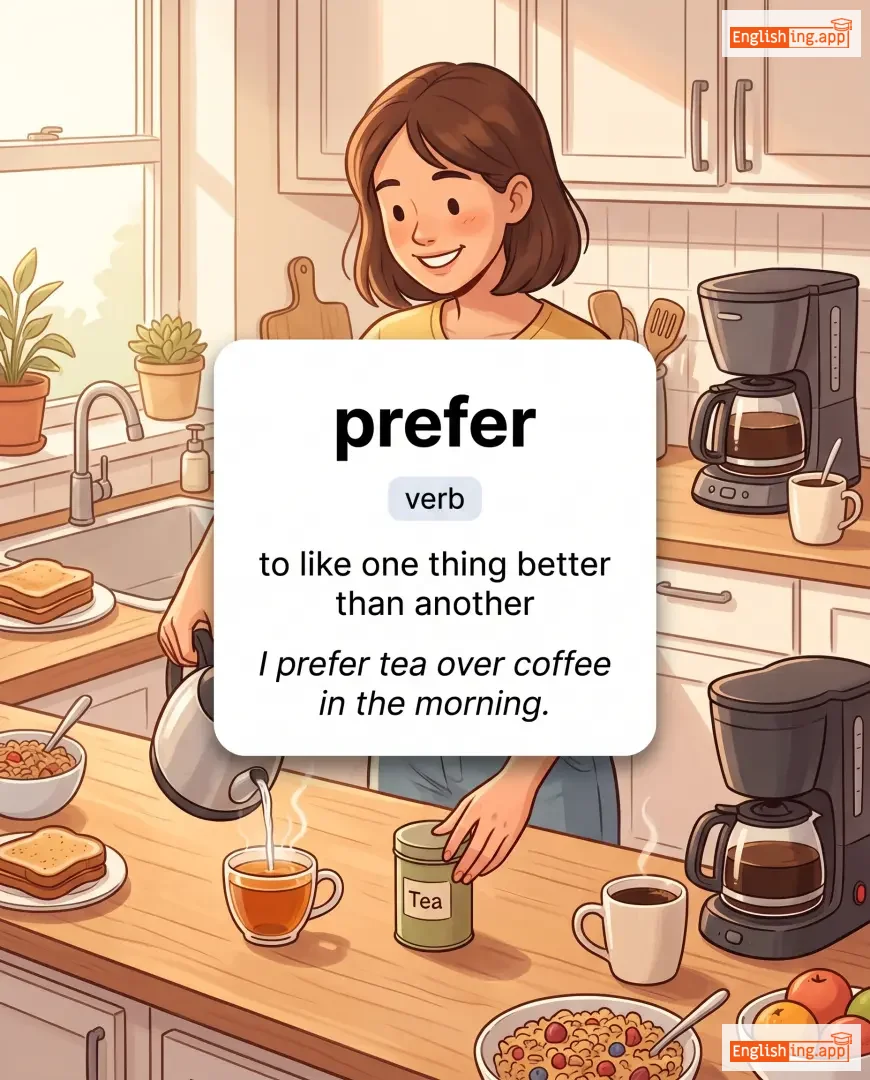
prefer definition card — visual illustration of the meaning
verb
/prɪˈfɜːr/
preferir (preferir)

to like one thing better than another

"I prefer tea over coffee in the morning."

"Yo prefiero té sobre café en la mañana." (Yo prefiero té sobre café en la mañana.)
adjective
/ˈprɛf(ə)rəb(ə)l/
preferible (preferible)

more desirable or suitable; better than something else

"It is preferable to take the train rather than drive in heavy traffic."

"Es preferible tomar el tren en lugar de conducir en el tráfico pesado." (Es preferible tomar el tren en lugar de conducir en el tráfico pesado.)
noun
/ˈprɛf(ə)rəns/
preferencia (preferencia)

a greater liking for one alternative over another

"She has a preference for tea over coffee."

"Ella tiene preferencia por el té sobre el café." (Ella tiene preferencia por el té sobre el café.)
adjective
/ˌprɛfəˈrɛnʃəl/
preferencial (preferencial)

showing or giving advantage to one over others

"Members receive preferential treatment at the club."

"Los miembros reciben trato preferencial en el club." (Los miembros reciben trato preferencial en el club.)
noun
/prɪˈfɜːrmənt/
ascenso (ascenso)

promotion or advancement in rank, position, or office

"He hoped for preferment in the government office."

"Él esperaba un ascenso en la oficina del gobierno." (El esperaba un ascenso en la oficina del gobierno.)
verb
/priːˈfɪɡjər/
prefigurar (prefigurar)

to represent, show, or foreshadow something in advance

"The economic reforms prefigure major social changes."

"Las reformas económicas prefiguran grandes cambios sociales." (Las reformas económicas prefiguran grandes cambios sociales.)
noun/verb
/ˈpriːfɪks/
prefijo; añadir algo al principio (prefijo; anadir algo al principio)

a word, letter, or number placed before another; as a verb, to add something in front of something else

"Developers often prefix variables with an underscore."

"Los desarrolladores a menudo prefijan variables con un guion bajo." (Los desarrolladores a menudo prefijan variables con un guion bajo.)
noun
/ˈprɛɡnənsi/
embarazo (embarazo)

the condition of being pregnant; the period during which a woman carries a developing fetus

"Her pregnancy was carefully monitored by her doctor."

"Su embarazo fue cuidadosamente monitoreado por su médico." (Su embarazo fue cuidadosamente monitoreado por su medico.)
adjective
/ˈprɛɡnənt/
embarazada; significativa (embarazada; significativa)

having a child developing in the womb; also, full of meaning or significance

"She announced that she was three months pregnant."

"Ella anunció que estaba embarazada de tres meses." (Ella anunció que estaba embarazada de tres meses.)
adjective
/prɪˈhɛnsɪbəl/
agarrable (agarrable)

capable of being grasped or seized

"The tool has a prehensible handle that improves safety."

"La herramienta tiene un mango agarrable que mejora la seguridad." (La herramienta tiene un mango agarrable que mejora la seguridad.)
adjective
/prɪˈhɛnsaɪl/
prensil (prehensil)

adapted for seizing or grasping, especially by wrapping around an object

"The monkey used its prehensile tail to hang from the branch."

"El mono usó su cola prensil para colgarse de la rama." (El mono usó su cola prensil para colgarse de la rama.)
noun
/prɪˈhɛnʃən/
acción de agarrar; la capacidad de sujetar algo (accion de agarrar; la capacidad de sujetar algo)

the act of grasping or seizing; the ability to take hold of something

"Therapists assessed the patient's prehension during hand therapy."

"Los terapeutas evaluaron la prehensión del paciente durante la terapia de manos." (Los terapeutas evaluaron la prehension del paciente durante la terapia de manos.)
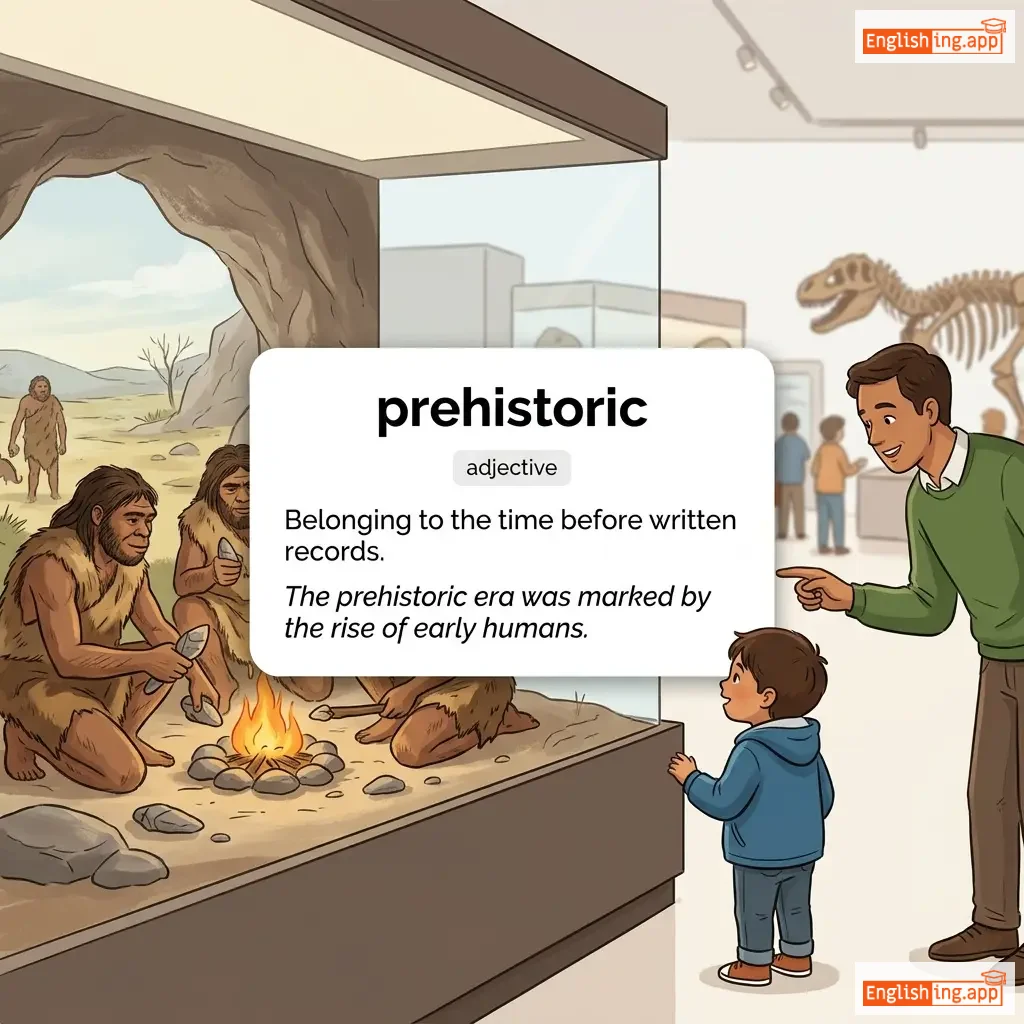
prehistoric definition card — visual illustration of the meaning
adjective
ˌpriːhɪˈstɒrɪk
prehistórico, antes de los registros escritos (prehistórico, antes de los registros escritos)

Belonging to the time before written records.

"The prehistoric era was marked by the rise of early humans."

"La era prehistórica estuvo marcada por el ascenso de los primeros humanos." (La era prehistórica estuvo marcada por el ascenso de los primeros humanos.)
noun
/ˈprɛdʒədɪs/
prejuicio (prejuicio)

An unfair and unreasonable opinion or feeling, especially when formed without enough thought or knowledge.

"Prejudice often prevents people from seeing the truth about others."

"El prejuicio a menudo impide que las personas vean la verdad sobre los demás." (El prejuicio a menudo impide que las personas vean la verdad sobre los demás.)
adjective
/ˈprɛdʒədɪst/
prejuiciado (prejuiciado)

having or showing a dislike or bias against a person or group without proper reason

"He was prejudiced against people from other regions."

"Él estaba prejuiciado contra las personas de otras regiones." (Él estaba prejuiciado contra las personas de otras regiones.)
noun
/ˈprɛləsi/
prelatura (prelatura)

The office, dignity, or system of church government by prelates.

"The medieval church was dominated by prelacy and its traditions."

"La iglesia medieval estaba dominada por la prelatura y sus tradiciones." (La iglesia medieval estaba dominada por la prelatura y sus tradiciones.)
noun
/ˈprɛlət/
miembro de alto rango del clero (miembro de alto rango del clero)

A high-ranking member of the clergy, especially a bishop or abbot.

"The prelate delivered a sermon to the congregation."

"El prelado dio un sermón a la congregación." (El prelado dio un sermón a la congregación.)
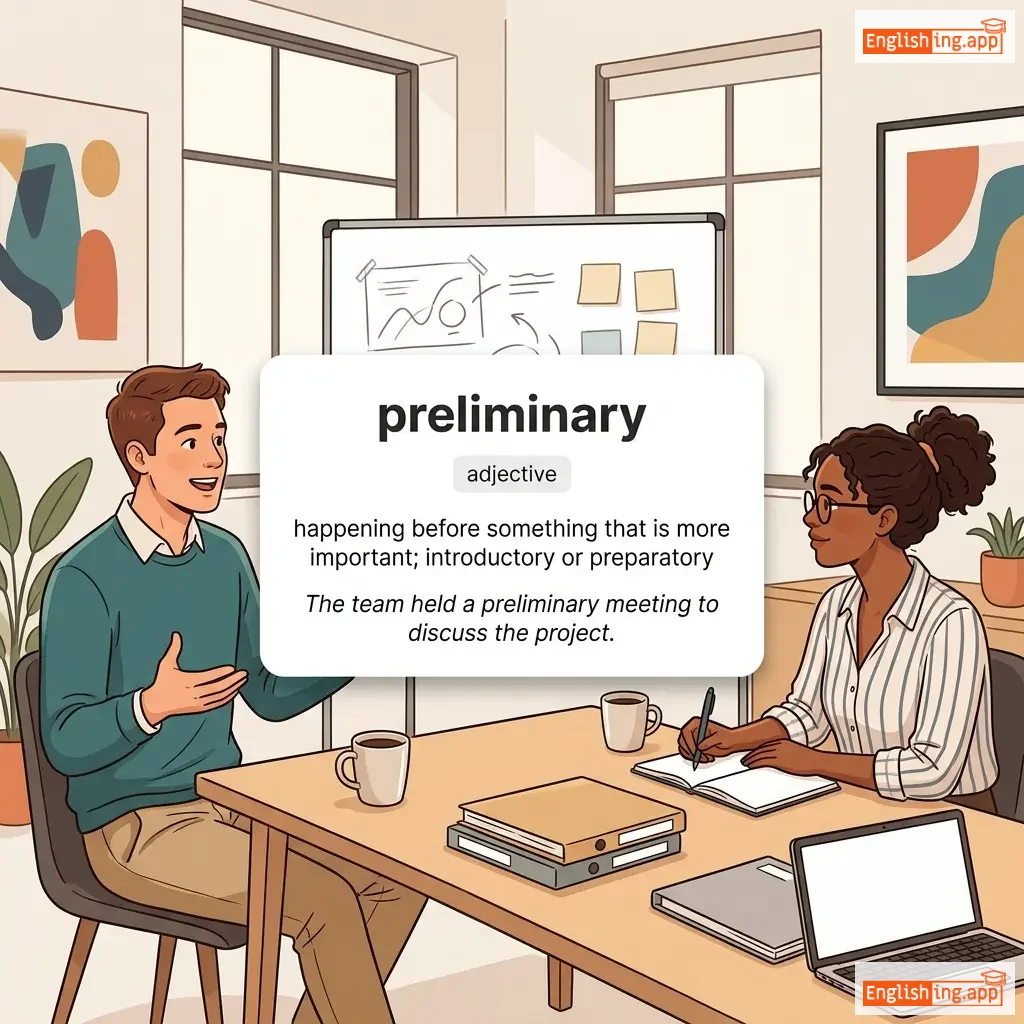
preliminary definition card — visual illustration of the meaning
adjective
/prɪˈlɪmɪˌneri/
preliminar (preliminar)

happening before something that is more important; introductory or preparatory

"The team held a preliminary meeting to discuss the project."

"El equipo celebró una reunión preliminar para discutir el proyecto." (El equipo celebró una reunión preliminar para discutir el proyecto.)
noun
/ˈprɛljuːd/
preludio (preludio)

An action, event, or statement that serves as an introduction to something more important.

"The small fight was only a prelude to a bigger conflict."

"La pequeña pelea fue solo un preludio de un conflicto mayor." (La pequena pelea fue solo un preludio de un conflicto mayor.)
adjective
/ˌpriːməˈtjʊər/
prematuro (prematuro)

Happening or done before the usual or proper time.

"His decision to quit the job was premature."

"Su decisión de dejar el trabajo fue prematura." (Su decision de dejar el trabajo fue prematura.)
verb
/ˌpriːˈmɛdɪteɪt/
premeditar (premeditar)

to think about and plan something (especially a crime) beforehand

"The suspect was accused of premeditating the crime."

"El sospechoso fue acusado de premeditar el crimen." (El sospechoso fue acusado de premeditar el crimen.)
adjective
/ˌpriːˈmɛdɪˌteɪtɪd/
premeditado (premeditado)

planned in advance; done deliberately

"The crime was clearly premeditated."

"El crimen estaba claramente premeditado." (El crimen estaba claramente premeditado.)
noun, adjective
/prɪˈmɪər/ or /ˈpriːmiər/
primer ministro / principal (primer ministro / principal)

the head of government in some countries; first in importance or rank

"The French premier addressed the nation."

"El primer ministro francés dirigió al país." (El primer ministro frances dirigio al pais.)
noun
/ˈprɛmɪs/
premisa / edificio (premisa / edificio)

a statement or idea on which reasoning or an argument is based; also a building or property

"His argument was based on a false premise."

"Su argumento se basaba en una premisa falsa." (Su argumento se basaba en una premisa falsa.)
noun
/ˈpriːmiəm/
prima (prima)

an amount of money paid regularly for an insurance policy; something of superior quality or value

"You need to pay your insurance premium every year."

"Necesitas pagar tu prima de seguro cada año." (Necesitas pagar tu prima de seguro cada año.)
noun
/ˌpriːməˈnɪʃən/ or /ˌprɛm-/
premonición (premonicion)

a strong feeling that something is about to happen, often something negative

"She had a premonition of danger before the trip."

"Ella tuvo una premonición de peligro antes del viaje." (Ella tuvo una premonicion de peligro antes del viaje.)
adjective
/prɪˈmɒnɪtəri/ or /ˌpriːməˈnɪtəri/
premonitorio (premonitorio)

giving a warning or prediction about something, especially something unpleasant

"He ignored the premonitory signs of illness."

"Él ignoró los signos premonitorios de enfermedad." (El ignoro los signos premonitorios de enfermedad.)
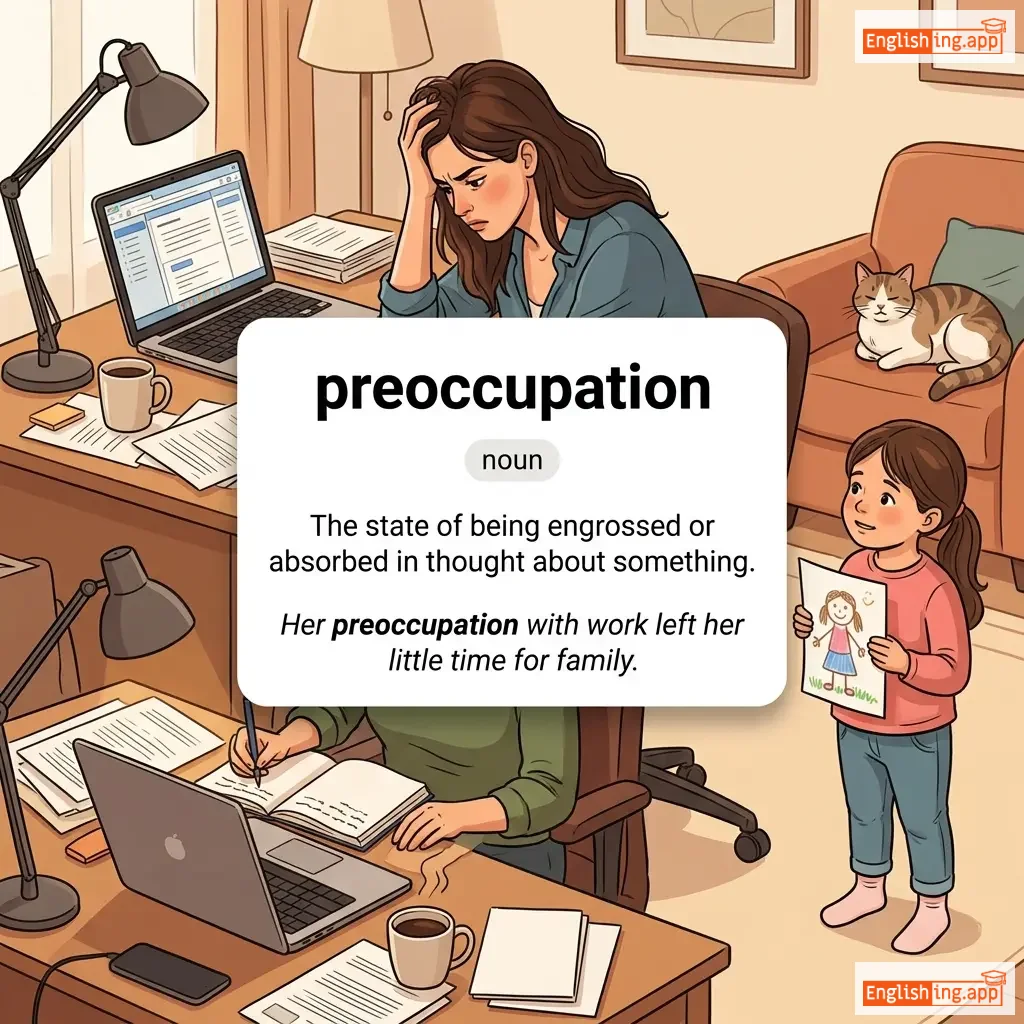
preoccupation definition card — visual illustration of the meaning
noun
/priːˌɒkjuˈpeɪʃən/
preocupación, concentración (preocupacion, concentracion)

The state of being engrossed or absorbed in thought about something.

"Her preoccupation with work left her little time for family."

"Su preocupación por el trabajo dejó poco tiempo para la familia." (Su preocupacion por el trabajo dejo poco tiempo para la familia.)
verb
/priːˈɒkjʊpaɪ/
preocupar, obsesionar (preocupar, obsesionar)

To dominate or engross the mind of someone to the exclusion of other thoughts.

"Worries about the future preoccupy him constantly."

"Las preocupaciones sobre el futuro lo ocupan constantemente." (Las preocupaciones sobre el futuro lo ocupan constantemente.)
verb
/ˌpriːɔːrˈdeɪn/
preordinar (preordinar)

To decide or determine an outcome in advance, especially by fate or divine will.

"They believed their meeting was preordained by destiny."

"Ellos creían que su encuentro estaba predestinado por el destino." (Ellos creían que su encuentro estaba predestinado por el destino.)
noun
/ˌprɛpəˈreɪʃən/
preparación (preparacion)

The act of getting ready or making arrangements for something.

"The team made careful preparation for the presentation."

"El equipo hizo una preparación cuidadosa para la presentación." (El equipo hizo una preparacion cuidadosa para la presentacion.)
adjective
/prɪˈpærətɔːri/
preparatorio (preparatorio)

Serving as preparation or preliminary before the main event.

"They held a preparatory meeting before the main conference."

"Ellos celebraron una reunión preparatoria antes de la conferencia principal." (Ellos celebraron una reunion preparatoria antes de la conferencia principal.)
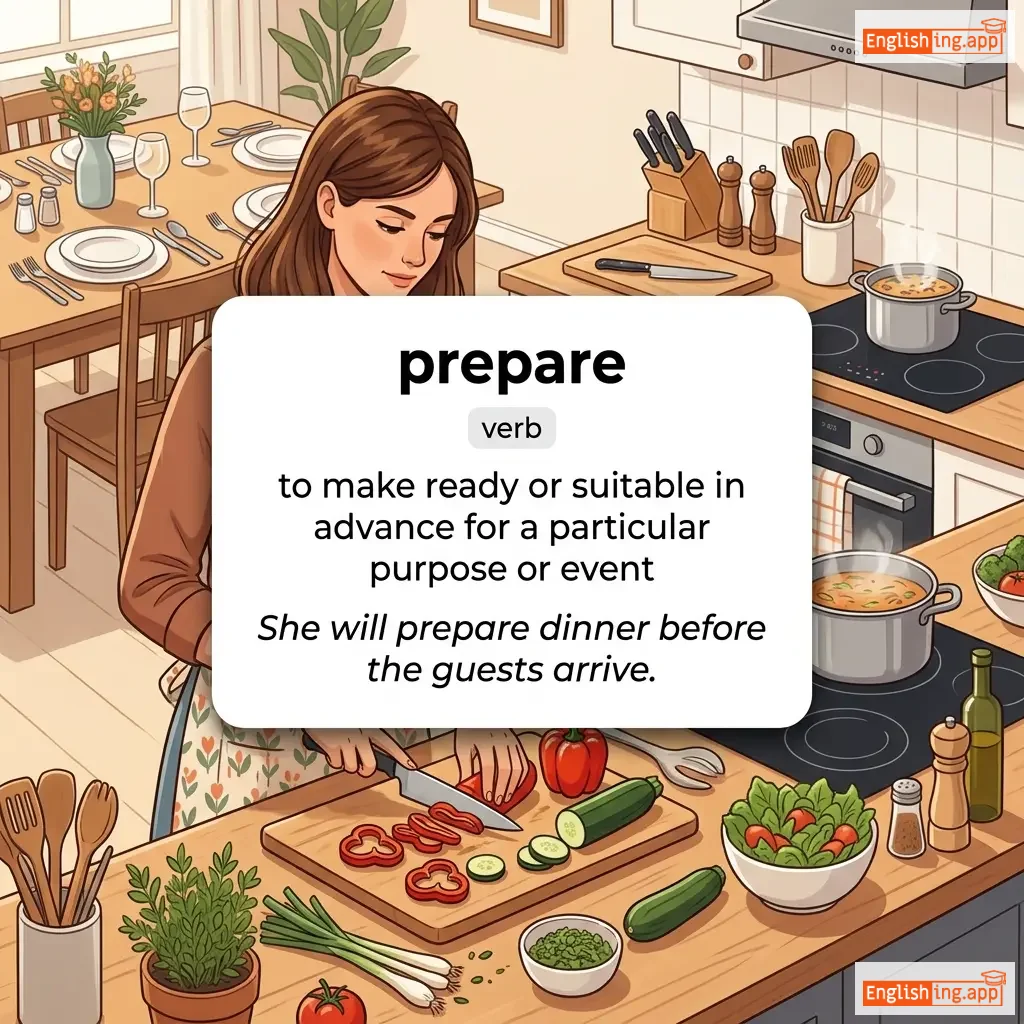
prepare definition card — visual illustration of the meaning
verb
/prɪˈpɛə/
preparar (preparar)

to make ready or suitable in advance for a particular purpose or event

"She will prepare dinner before the guests arrive."

"Ella preparará la cena antes de que lleguen los invitados." (Ella preparará la cena antes de que lleguen los invitados.)
adjective; verb (past and past participle of prepare)
/prɪˈpɛrd/
preparado (preparado)

made ready in advance; having made plans or taken steps beforehand

"She was fully prepared for the final exam."

"Ella estaba completamente preparada para el examen final." (Ella estaba completamente preparada para el examen final)
noun
/prɪˈpɒndərəns/
preponderancia (preponderancia)

The quality or fact of being greater in number, quantity, or importance.

"There was a preponderance of evidence against the defendant."

"Había una preponderancia de evidencia contra el acusado." (Había una preponderancia de evidencia contra el acusado.)