Vocabularios

Descubra, aprenda y domine el vocabulario en inglés

noun
/ˈnoʊmæd/
nómada (nomada)

A person who has no permanent home and moves from place to place.

"The desert was once home to nomads who lived by herding animals."

"El desierto fue una vez hogar de los nómadas que vivían pastoreando animales." (El desierto fue una vez hogar de los nómadas que vivían pastoreando animales.)
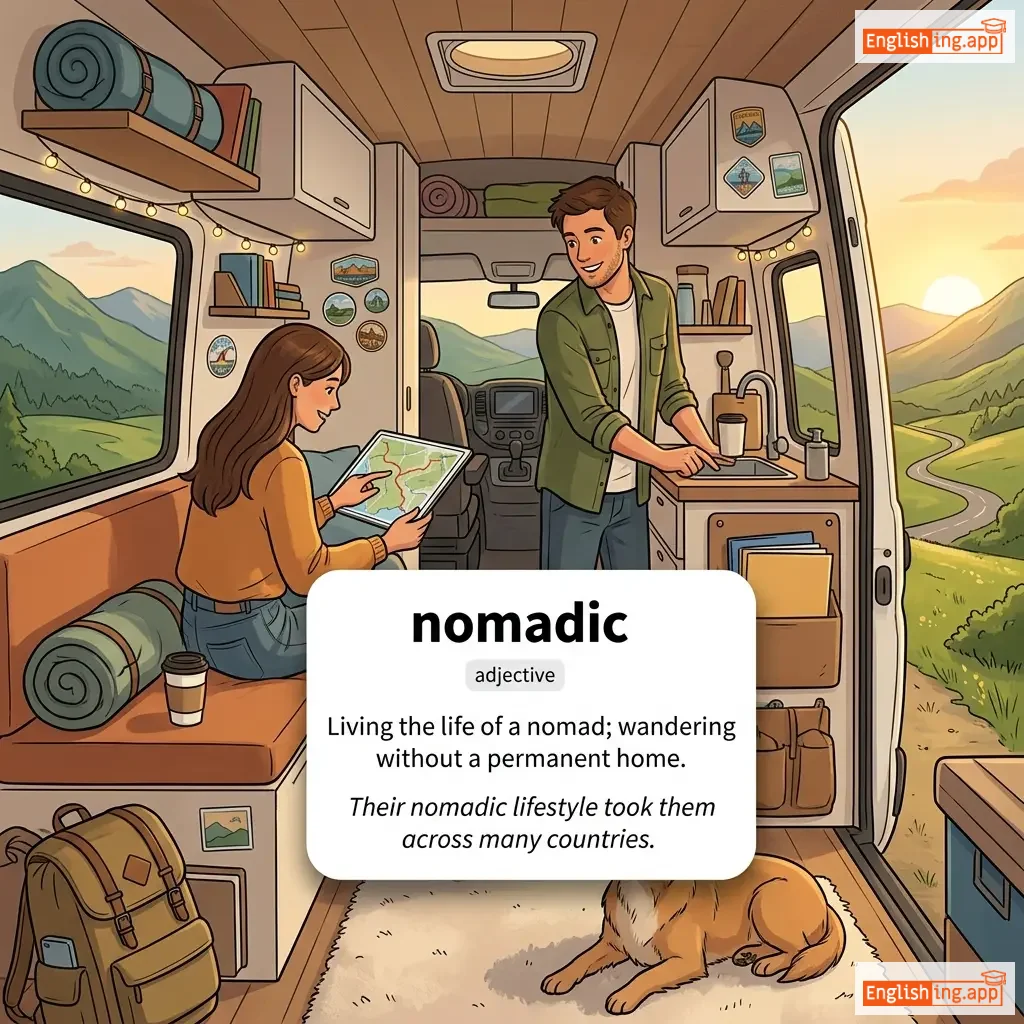
nomadic definition card — visual illustration of the meaning
adjective
/noʊˈmædɪk/
nómada (nomada)

Living the life of a nomad; wandering without a permanent home.

"Their nomadic lifestyle took them across many countries."

"Su estilo de vida nómada los llevó a recorrer muchos países." (Su estilo de vida nomada los llevo a recorrer muchos paises.)
noun
/ˈnoʊmənˌkleɪtʃər/
nomenclatura (nomenklatura)

A system of names or terms used in a particular science, art, or field.

"The chemical nomenclature can be difficult for beginners to understand."

"La nomenclatura química puede ser difícil para los principiantes de entender." (La nomenclatura química puede ser difícil para los principiantes de entender.)
adjective
/ˈnɒmɪk/
relacionado con la ley (relacionado con la ley)

Relating to laws, rules, or systems.

"The philosopher discussed the nomic necessity of natural laws."

"El filósofo discutió la necesidad nómica de las leyes naturales." (El filósofo discutió la necesidad nómica de las leyes naturales.)
adjective
/ˈnɒmɪnəl/
nominal (nominal)

Existing in name only; very small in amount.

"He was the nominal leader of the group but had no real power."

"Él era el líder nominal del grupo, pero no tenía poder real." (Él era el líder nominal del grupo, pero no tenía poder real.)
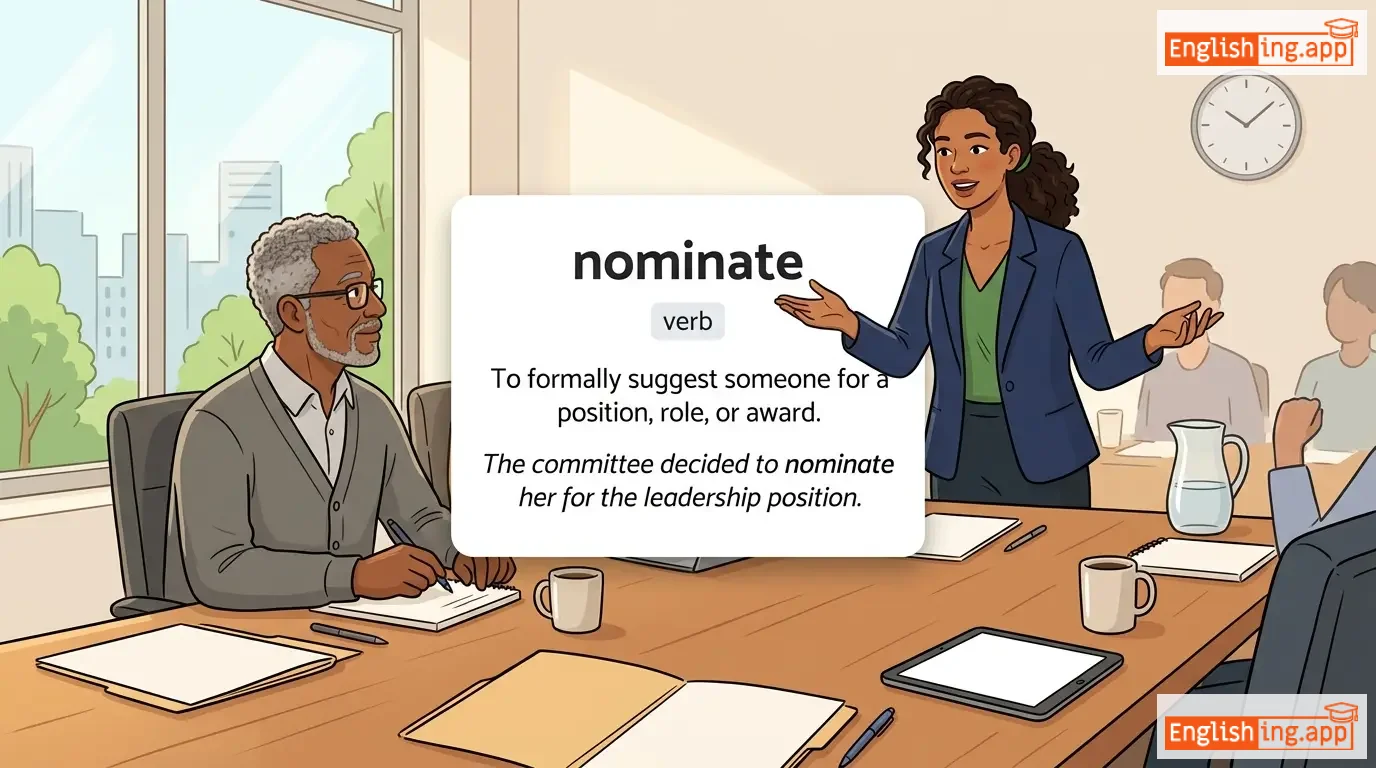
nominate definition card — visual illustration of the meaning
verb
/ˈnɒməˌneɪt/
nominar (nominar)

To formally suggest someone for a position, role, or award.

"The committee decided to nominate her for the leadership position."

"El comité decidió nominarla para el puesto de liderazgo." (El comité decidió nominarla para el puesto de liderazgo.)
noun
/ˌnɒməˈneɪʃən/
nominación (nominacion)

The act of formally proposing someone for a role, position, or award.

"Her nomination for the award surprised everyone."

"Su nominación para el premio sorprendió a todos." (Su nominacion para el premio sorprendio a todos.)
noun
/ˌnɒmɪˈniː/
nominado/a (nominado/a)

a person who is formally suggested or chosen for a position, award, or role

"She was the nominee for the Best Actress award."

"Ella era la nominada para el premio a Mejor Actriz." (Ella era la nominada para el premio a Mejor Actriz.)
noun
/ˌnɒn ˈsɛkwɪtər/
comentario irrelevante (comentario irrelevante)

a statement or conclusion that does not logically follow from the previous statement

"His comment about the weather was a complete non sequitur during the budget discussion."

"Su comentario sobre el clima fue un completo comentario irrelevante durante la discusión del presupuesto." (Su comentario sobre el clima fue un completo comentario irrelevante durante la discusión del presupuesto.)
noun, adjective
/nɒn ˈkɒmbətənt/
no combatiente (no combatiente)

a person not engaged in fighting during a war, such as civilians or medical staff

"The Red Cross workers were treated as non-combatants in the conflict."

"Los trabajadores de la Cruz Roja fueron tratados como no combatientes en el conflicto." (Los trabajadores de la Cruz Roja fueron tratados como no combatientes en el conflicto.)
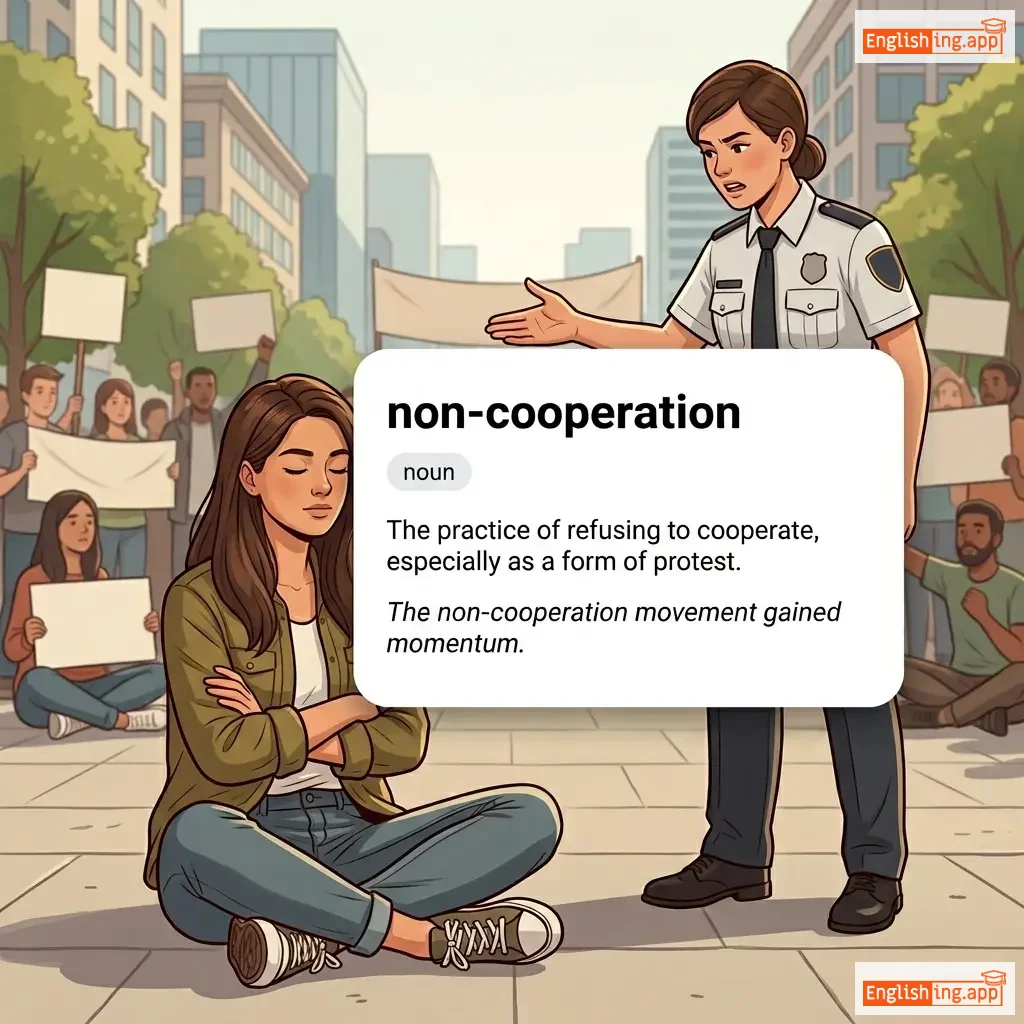
non-cooperation definition card — visual illustration of the meaning
noun
ˌnɒn.kəʊˌɒp.ərˈeɪ.ʃən
desobediencia (desobediencia)

The practice of refusing to cooperate, especially as a form of protest.

"The non-cooperation movement gained momentum."

"El movimiento de desobediencia ganó impulso." (El movimiento de desobediencia ganó impulso.)
adjective
/ˌnɒn ɪɡˈzɪstənt/
inexistente (inexistente)

not real or not present; lacking existence

"The supposed evidence turned out to be non-existent."

"La evidencia supuesta resultó ser inexistente." (La evidencia supuesta resultó ser inexistente.)
noun; adjective
/ˌnɒnˈprɒfɪt/
sin fines de lucro (sin fines de lucro)

an organization that does not operate for profit and reinvests surplus to achieve social goals; not intended to make financial profit

"She works for a non-profit that provides free education to underprivileged children."

"Ella trabaja para una organización sin fines de lucro que ofrece educación gratuita." (ella trabaja para una organizacion sin fines de lucro ke ofrece edukasion gratuita)
noun, adjective
/ˌnɒn ˈrɛzɪdənt/
no residente (no residente)

a person who does not live in a particular country or place permanently

"Non-resident students often pay higher tuition fees."

"Los estudiantes no residentes suelen pagar tarifas de matrícula más altas." (Los estudiantes no residentes suelen pagar tarifas de matricula mas altas.)
adverb
/ˌnɒnˈstɒp/
sin parar; sin interrupciones (sin parar; sin interrupciones)

continuing without stopping; without interruption

"The train traveled non-stop from London to Paris."

"El tren viajó sin parar de Londres a París." (El tren viajó sin parar de Londres a París.)
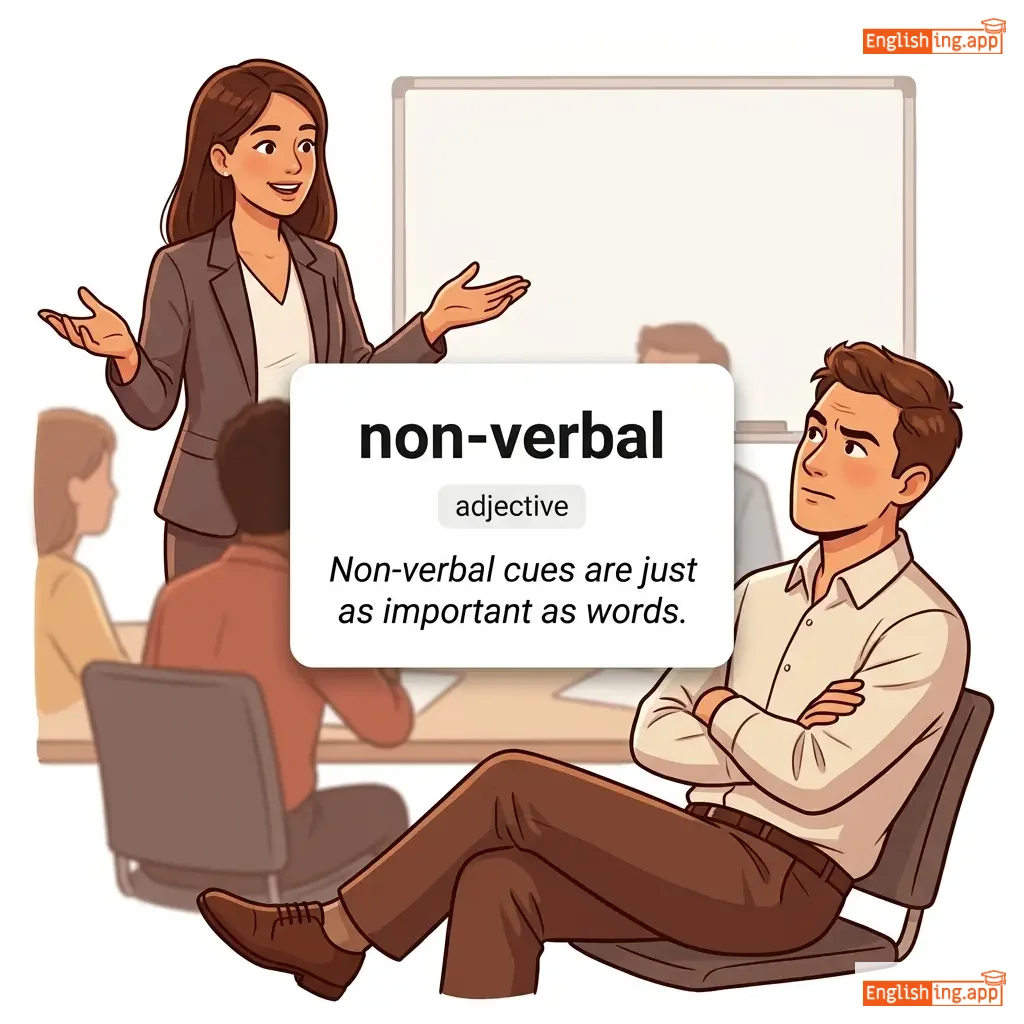
non-verbal definition card — visual illustration of the meaning
adjective
/ˌnɒnˈvɜː.bəl/
No implica ni usa palabras o discurso; comunicado a través de gestos, lenguaje corporal o expresiones faciales. (No implica ni usa palabras o discurso; comunicado a través de gestos, lenguaje corporal o expresiones faciales.)

Not involving or using words or speech; communicated through gestures, body language, or facial expressions.

"Non-verbal cues are just as important as words."

"Las señales no verbales son tan importantes como las palabras." (Las senales no verbales son tan importantes como las palabras.)
noun
/ˈnɒn.ɪʤ/
minoría de edad (nonij)

the period of being under the legal age of majority; youth or immaturity

"During his nonage, all legal decisions were made by his guardian."

"Durante su minoría de edad, todas las decisiones legales fueron tomadas por su tutor." (Durante su minoria de edad todas las decisiones legales fueron tomadas por su tutor)
noun
/ˈnɒnʃələns/
despreocupación (despreocupacion)

A relaxed and calm state, showing lack of concern or interest.

"She answered the tough questions with surprising nonchalance."

"Ella respondió las preguntas difíciles con sorprendente despreocupación." (Ella respondio las preguntas dificiles con sorprendente despreocupacion.)
adjective
/ˈnɒnʃələnt/
indiferente (nonshuhlant)

Appearing calm, casual, and unconcerned.

"He gave a nonchalant shrug and walked away."

"Él dio un encogimiento de hombros despreocupado y se alejó." (El dio un encogimiento de hombros despreocupado y se alejo.)
adjective
/ˌnɒnkəˈmɪtl̩/
reticente (nonkomittal)

Not expressing or showing a clear opinion, decision, or commitment.

"She gave a noncommittal reply when asked about her future plans."

"Ella dio una respuesta reticente cuando se le preguntó sobre sus planes futuros." (Ella dio una respuesta reticente cuando se le pregunto sobre sus planes futuros.)
adjective
/ˌnɒndɪˈskrɪpt/
común (comun)

Lacking distinctive or interesting features; dull and unremarkable.

"He lives in a nondescript apartment building on the edge of town."

"Él vive en un edificio de apartamentos común en las afueras de la ciudad." (El vive en un edificio de apartamentos comun en las afueras de la ciudad.)
pronoun
/nʌn/
ninguno (ninguno)

not any; no one; not one

"None of the students passed the exam."

"Ningún estudiante aprobó el examen." (Ningun estudiante aprobo el examen.)
noun
/nɒnˈentəti/
persona irrelevante (persona irrelevante)

A person or thing of no importance or significance.

"Once a powerful leader, he is now treated as a political nonentity."

"Una vez un líder poderoso, ahora es tratado como una noentidad política." (Una vez un líder poderoso, ahora es tratado como una noentidad política.)
🌧️➡️🏞️

nonetheless (nonetheless)

adverb
/ˌnʌnðəˈlɛs/
sin embargo (sin embargo)

in spite of that; nevertheless

"It was raining, but nonetheless, they went hiking."

"Estaba lloviendo, pero sin embargo, fueron a hacer senderismo." (Estaba lloviendo, pero sin embargo, fueron a hacer senderismo.)
adjective
/ˌnɒnpəˈreɪl/
inigualable (inigualable)

Having no equal; unrivaled or matchless.

"Her beauty was considered nonpareil in the region."

"Su belleza fue considerada inigualable en la región." (su belleza fue considerada inigualable en la region)
verb
/ˌnɒnˈplʌs/
dejar perplejo (dejar perplejo)

To surprise and confuse someone so much that they are unsure how to react.

"The unexpected question seemed to nonplus the speaker."

"La pregunta inesperada pareció dejar perplejo al orador." (La pregunta inesperada pareció dejar perplejo al orador.)
verb
/ˌnɒnˈplʌst/
perplejo (perplejo)

Past tense of nonplus; surprised and confused.

"She was completely nonplused by his sudden decision."

"Ella estaba completamente perpleja por su decisión repentina." (Ella estaba completamente perpleja por su decisión repentina.)
verb
/ˌnɒnˈplʌst/
desconcertado (desconcertado)

Past tense of nonplus; surprised and unsure how to react.

"He stood nonplussed at the strange remark."

"Se quedó desconcertado por el comentario extraño." (Se quedó desconcertado por el comentario extraño.)
adjective
/ˌnɒnˈprɒfɪt/
sin fines de lucro (sin fines de lucro)

an organization that does not aim to make a profit, often serving a social or charitable purpose.

"She works for a nonprofit organization that helps children."

"Ella trabaja para una organización sin fines de lucro que ayuda a los niños." (Ella trabaja para una organizacion sin fines de lucro que ayuda a los niños.)
noun
/ˈnɒnsəns/
tonterías (tonterias)

Words or ideas that have no meaning or make no sense.

"His explanation was pure nonsense."

"Su explicación era pura tontería." (Su explicacion era pura tonteria.)
adjective
/ˌnɒnˈtrɪviəl/
no trivial (no trivial)

Not simple or easy; requiring effort or significant thought.

"Solving the equation turned out to be a nontrivial task."

"Resolver la ecuación resultó ser una tarea no trivial." (Resolver la ecuación resultó ser una tarea no trivial.)
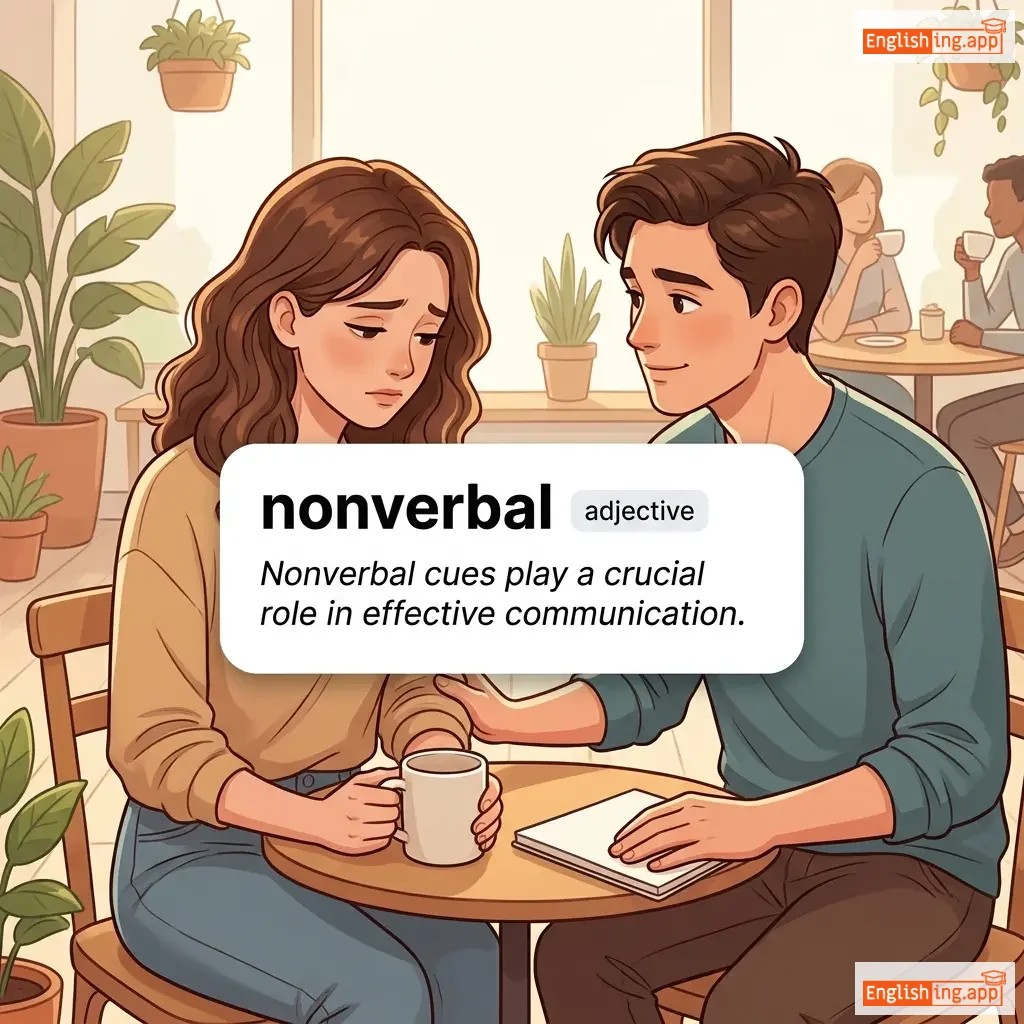
nonverbal definition card — visual illustration of the meaning
adjective
ˌnɒnˈvɜːr.bəl
no verbal (no verbal)

Communication using body language, facial expressions, or gestures instead of words

"Nonverbal cues play a crucial role in effective communication."

"Las señales no verbales juegan un papel crucial en la comunicación efectiva." (Las señales no verbales juegan un papel crucial en la comunicación efectiva.)
noun (plural)
/ˈnuːdəlz/
fideos (fideos)

long, thin strips of dough made from flour, water, or eggs, cooked and eaten as food

"She cooked noodles with vegetables for dinner."

"Ella cocinó fideos con verduras para la cena." (ella cocino fideos con verduras para la cena)
noun
/nuːn/
mediodía (mediodia)

12 o'clock in the daytime; midday

"The meeting will start at noon."

"La reunión comenzará a mediodía." (La reunion comenzara a mediodia.)
noun
/nuːs/
lazo (lazo)

A loop with a running knot, used especially for trapping or hanging.

"The cowboy tied a noose to catch the wild horse."

"El vaquero ató un lazo para atrapar al caballo salvaje." (El vaquero ato un lazo para atrapar al caballo salvaje.)
🚫➡️🚫

nor (nor)

conjunction
/nɔːr/
ni (ni)

used to introduce a negative clause after a negative statement

"He didn't call, nor did he send a message."

"Él no llamó, ni envió un mensaje." (El no llamo, ni envió un mensaje.)
noun
/nɔːrm/
norma (norma)

An accepted standard or a usual practice.

"Wearing uniforms is the norm in many schools."

"Usar uniformes es la norma en muchas escuelas." (Usar uniformes es la norma en muchas escuelas.)
adjective
/ˈnɔː.məl/
normal (normal)

conforming to a standard; usual, typical, or expected

"It is normal to feel nervous before an interview."

"Es normal sentirse nervioso antes de una entrevista." (Es normal sentirse nervioso antes de una entrevista.)
noun
/ˈnɔːrməlsi/
normalidad (normalidad)

The condition of being normal; a return to usual or expected conditions.

"After the flood, the town struggled to regain a sense of normalcy."

"Después de la inundación, la ciudad luchó por recuperar un sentido de normalidad." (Después de la inundación, la ciudad luchó por recuperar un sentido de normalidad.)
verb
/ˈnɔːrməlaɪz/
normalizar (normalizar)

to bring something back to a normal or standard condition; to make something conform to a standard

"The government took steps to normalize relations with neighboring countries."

"El gobierno tomó medidas para normalizar las relaciones con países vecinos." (El gobierno tomo medidas para normalizar las relaciones con paises vecinos)
adverb
/ˈnɔːməli/
normalmente (normalmente)

in a usual or expected way

"I normally wake up at 7 AM."

"Normalmente me despierto a las 7 AM." (Normalmente me despierto a las 7 AM.)
noun
/ˈnɔːrmən/
normando (norman)

A member of a people of mixed Scandinavian and Frankish origin who settled in Normandy, or relating to their culture.

"The Normans conquered England in 1066."

"Los normandos conquistaron Inglaterra en 1066." (los normandos conquistaron inglaterra en mil sesenta y seis)
adjective
/ˈnɔːrmətɪv/
normativo (normativo)

relating to rules, standards, or norms that govern behavior or beliefs

"The study focused on the normative aspects of cultural behavior."

"El estudio se centró en los aspectos normativos del comportamiento cultural." (El estudio se centró en los aspectos normativos del comportamiento cultural.)
noun
/nɔːrθ/
norte (norte)

the direction toward the top of a map or the opposite of south

"We traveled north to reach the mountains."

"Viajamos al norte para llegar a las montañas." (Viajamos al norte para llegar a las montañas.)
noun
/ˌnɔːrθˈiːst/
nordeste (nordeste)

the direction between north and east; a region or area located in that direction.

"The storm is moving toward the northeast."

"La tormenta se mueve hacia el noreste." (La tormenta se mueve hacia el noreste.)
adjective
/ˈnɔːðərn/
del norte (del norte)

relating to the north or situated in the north

"The northern part of the country is known for its cold climate."

"La parte norte del país es conocida por su clima frío." (La parte norte del país es conocida por su clima frío.)
adverb
/ˈnɔːθwədz/
hacia el norte (hacia el norte)

towards the north; in a northerly direction

"The birds migrate northwards in spring."

"Los pájaros migran hacia el norte en primavera." (Los pajaros migran hacia el norte en primavera.)
noun, adjective, adverb
/ˌnɔːrθˈwest/
noroeste (noroeste)

the direction that is between north and west; situated in or moving toward this direction

"Seattle is located in the northwest of the United States."

"Seattle está ubicado en el noroeste de los Estados Unidos." (Seattle esta ubicado en el noroeste de los Estados Unidos.)
noun
/noʊz/
nariz (nariz)

the part of the face that contains the nostrils and is used for breathing and smelling

"He has a sharp nose and can smell things from far away."

"Él tiene una nariz afilada y puede oler las cosas desde lejos." (Él tiene una nariz afilada y puede oler las cosas desde lejos.)
noun
/noʊz rɪŋ/
anillo de nariz (anillo de nariz)

a piece of jewelry worn through a piercing in the nose

"She got a small gold nose ring for her birthday."

"Ella consiguió un pequeño anillo de oro para su cumpleaños." (Ella consiguió un pequeño anillo de oro para su cumpleaños.)