Vocabularios

Descubra, aprenda y domine el vocabulario en inglés

noun
/ˈnuː.kʌm.ər/
recién llegado (recien llegado)

a person who has recently arrived in a place or joined a group

"The newcomer was warmly welcomed by the team."

"El recién llegado fue bienvenido calurosamente por el equipo." (El recien llegado fue bienvenido calurosamente por el equipo.)
adverb
/ˈnjuːli/
recientemente (recientemente)

in a new or recent manner

"She has newly renovated her house."

"Ella ha renovado recientemente su casa." (Ella ha renovado recientemente su casa.)
noun
/nuːz/
noticias (noticias)

newly received or noteworthy information, especially about recent events

"The news about the storm spread quickly."

"Las noticias sobre la tormenta se extendieron rápidamente." (Las noticias sobre la tormenta se extendieron rapidamente.)
noun
/ˈnjuːzˌlɛtər/
boletín (boletin)

a printed or electronic report containing news or information about a company or organization

"The company sends a weekly newsletter to its employees."

"La empresa envía un boletín semanal a sus empleados." (La empresa envia un boletin semanal a sus empleados.)
noun
/ˈnjuːzˌpeɪpər/
periódico (periodico)

a printed publication (usually daily or weekly) containing news, articles, advertisements, and correspondence

"I read the newspaper every morning."

"Yo leo el periódico todas las mañanas." (Yo leo el periodico todas las mananas.)
noun
/nuːt/
tritón (triton)

a small amphibian with a long tail that lives both in water and on land

"The newt swam gracefully in the pond."

"El tritón nadó con gracia en el estanque." (El triton nado con gracia en el estanque)
adjective
/njuːˈtoʊniən/
relacionado con las leyes de Newton (relacionado con las leyes de Newton)

relating to the laws of motion and gravitation formulated by Sir Isaac Newton

"The scientist explained the Newtonian laws of motion."

"El científico explicó las leyes de movimiento newtonianas." (El científico explicó las leyes de movimiento newtonianas.)
adjective
/nɛkst/
siguiente (siguiente)

immediately following in time, order, or place

"The next train leaves at 9:00 AM."

"El siguiente tren sale a las 9:00 AM." (El siguiente tren sale a las 9:00 AM.)
noun
/ˈnɛksəs/
nexo (nexo)

a connection or series of connections linking two or more things

"The town was a nexus for trade routes in the region."

"La ciudad era un nexo para las rutas comerciales en la región." (La ciudad era un nexo para las rutas comerciales en la region.)
noun
/nɪb/
punta de la pluma (punta de la pluma)

the pointed end of a pen used for writing or drawing

"He dipped the nib into the ink before writing."

"Él sumergió la punta de la pluma en la tinta antes de escribir." (Él sumergió la punta de la pluma en la tinta antes de escribir.)
verb
/ˈnɪbəl/
mordisquear (mordisquear)

to take small bites of food

"The rabbit nibbled on a carrot."

"El conejo mordisqueó una zanahoria." (El conejo mordisqueó una zanahoria.)
adjective
/naɪs/
agradable (agradable)

pleasant, kind, or enjoyable

"She is a very nice person to work with."

"Ella es una persona muy agradable para trabajar." (Ella es una persona muy agradable para trabajar.)
adverb
/ˈnaɪsli/
agradablemente (agradablemente)

in a pleasant, kind, or satisfactory manner; carefully and appropriately

"She explained the problem nicely so everyone could understand."

"Ella explicó el problema agradablemente para que todos entendieran." (ella explico el problema agradablemente para que todos entendieran)
noun
/ˈnaɪsəti/
sutileza (sutileza)

a fine or subtle detail, or a refined, delicate aspect of something

"The lawyer explained the legal niceties of the case."

"El abogado explicó los detalles legales del caso." (El abogado explicó los detalles legales del caso.)
Niche definition card — visual illustration of the meaning
noun
/niːʃ/
nicho (nicho)

a comfortable or suitable position in life or employment

"He has found his niche in the marketing industry."

"Ha encontrado su nicho en la industria del marketing." (Ha encontrado su nicho en la industria del marketing.)
noun
/ˈnɪkəl/
níquel (niquel)

a small coin, typically worth five cents in the United States

"He found a nickel on the ground."

"Él encontró un níquel en el suelo." (Él encontró un níquel en el suelo.)
noun
/ˈnɪk.neɪm/
apodo (apodo)

a familiar or humorous name given to a person instead of their real name

"His nickname is 'Tiger' because he's so brave."

"Su apodo es 'Tigre' porque es muy valiente." (Su apodo es 'Tigre' porque es muy valiente.)
noun
/niːs/
sobrina (sobrina)

the daughter of one's brother or sister

"My niece is studying at the university this year."

"Mi sobrina está estudiando en la universidad este año." (Mi sobrina esta estudiando en la universidad este ano)
noun
/naɪˈdʒel.ə/
comino negro (comino negro)

small black seeds with a nutty, slightly bitter flavor, also known as black cumin or black seed

"Sprinkle nigella seeds on top of the bread before baking."

"Espolvorea semillas de comino negro encima del pan antes de hornear." (Espolvorea semillas de comino negro encima del pan antes de hornear.)
adjective
/ˈnɪɡərdli/
tacaño (tacano)

unwilling to spend or give; stingy or miserly

"He was too niggardly to leave a decent tip."

"Él era demasiado tacaño para dejar una propina decente." (El era demasiado tacano para dejar una propina decente.)
verb
/ˈnɪɡəl/
molestar levemente pero de forma persistente (molestar levemente pero de forma persistente)

to cause slight but persistent annoyance, discomfort, or worry

"A small doubt niggled at her mind."

"Una pequeña duda la molestaba en su mente." (Una pequeña duda la molestaba en su mente.)
noun
/naɪt/
noche (noche)

the time of darkness between one day and the next, when most people sleep

"She loves going for walks at night."

"A ella le encanta caminar por la noche." (A ella le encanta caminar por la noche.)
noun
/naɪt kwiːn/
reina de la noche (reina de la noche)

a fragrant white flower that blooms at night and releases strong sweet scent

"The night queen flowers filled the garden with their sweet fragrance."

"Las flores de la reina de la noche llenaron el jardín con su dulce fragancia." (las flores de la reina de la noche yenaron el jardin kon su dulce fragansia)
noun
/naɪt ˈdʒæz.mɪn/
jazmín nocturno (jazmin nocturno)

a fragrant flowering tree that blooms at night with small white flowers

"The night-jasmine tree blooms only after sunset with its tiny white flowers."

"El árbol de jazmín nocturno florece solo después del atardecer con sus pequeñas flores blancas." (el arbol de jazmin nocturno florese solo despues del atardeser kon sus pequenas flores blancas.)
noun
/ˈnaɪt.fɔːl/
caída de la noche (caida de la noche)

the time when night begins; dusk

"They decided to return home before nightfall."

"Decidieron regresar a casa antes de la caída de la noche." (Decidieron regresar a casa antes de la caida de la noche.)
noun
/ˈnaɪ.tɪŋ.ɡeɪl/
ruiseñor (ruiseñor)

small songbird known for its beautiful singing, especially at night

"The nightingale sang sweetly in the moonlight."

"El ruiseñor cantó dulcemente bajo la luz de la luna." (El ruisenor cato dulcemente bajo la luz de la luna)
noun
/ˈnaɪtˌmɛər/
pesadilla (pesadilla)

a frightening or unpleasant dream; a very distressing experience.

"Last night, she had a terrifying nightmare."

"La noche pasada, tuvo una pesadilla aterradora." (La noche pasada, tuvo una pesadilla aterradora.)
noun
/ˈnaɪɪˌlɪzəm/
nihilismo (nihilismo)

The rejection of all religious and moral principles, often in the belief that life is meaningless.

"The philosopher was criticized for promoting nihilism."

"El filósofo fue criticado por promover el nihilismo." (El filosofo fue criticado por promover el nihilismo.)
noun
/ˈnaɪəlɪst/
nihilista (nihilista)

A person who rejects all religious and moral principles, often believing that life is meaningless.

"He was called a nihilist for rejecting all social norms."

"Se le llamó nihilista por rechazar todas las normas sociales." (Se le llamó nihilista por rechazar todas las normas sociales.)
0️⃣

Nil (nil)

noun
/nɪl/
cero (cero)

Nothing; zero.

"The score remained nil after the first half."

"El marcador permaneció en cero después del primer tiempo." (El marcador permaneció en cero después del primer tiempo.)
adjective
/ˈnɪmbəl/
ágil (agil)

Quick and light in movement or thought.

"The dancer’s nimble steps impressed the audience."

"Los ágiles pasos de la bailarina impresionaron al público." (Los agiles pasos de la bailarina impresionaron al público.)
noun
/naɪn/
nueve (nueve)

the number that is one more than eight

"She has nine books in her collection."

"Ella tiene nueve libros en su colección." (Ella tiene nueve libros en su coleccion.)
noun
/ˈnɪn.i/
tonto (tonto)

a silly or foolish person; someone who lacks common sense

"Don't be such a ninny, use your brain!"

"¡No seas tan tonto, usa tu cerebro!" (¡No seas tan tonto, usa tu cerebro!)
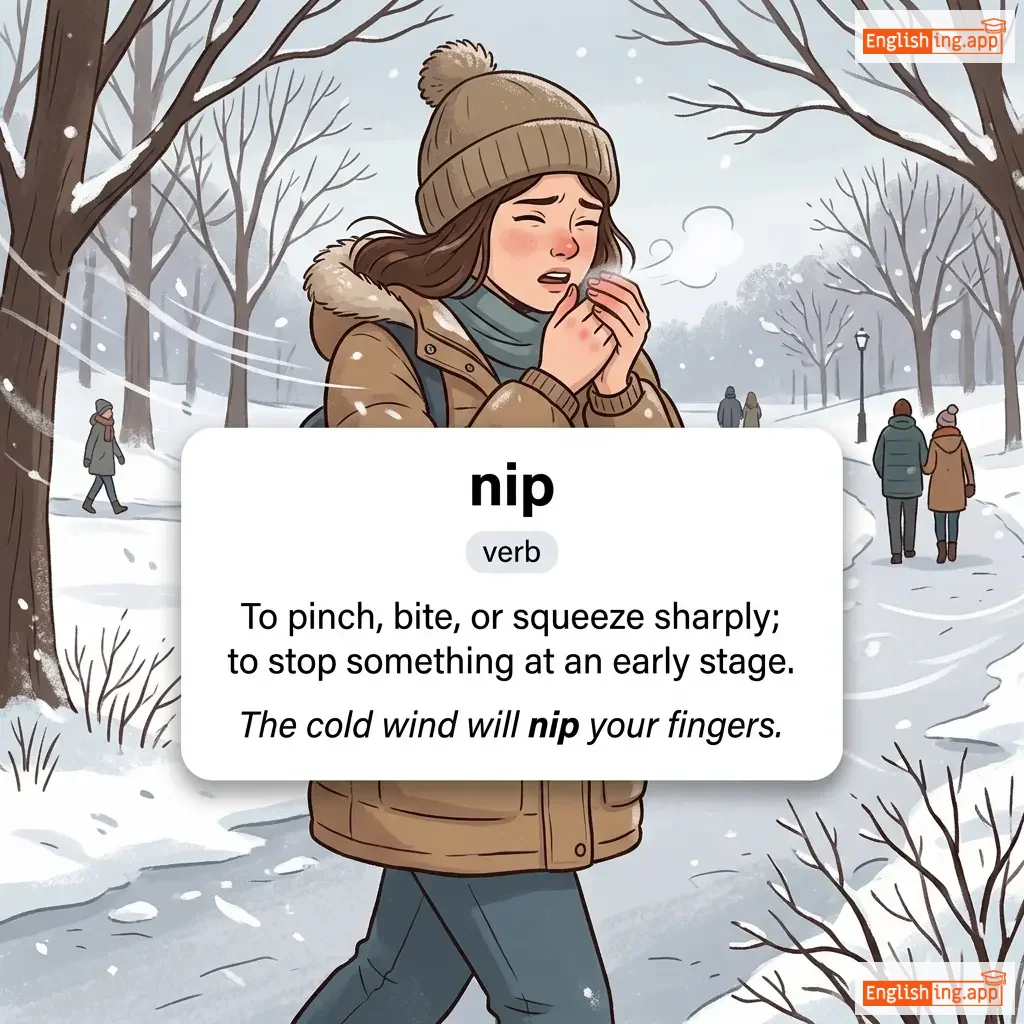
nip definition card — visual illustration of the meaning
verb
/nɪp/
pellizcar (pellizcar)

To pinch, bite, or squeeze sharply; to stop something at an early stage.

"The cold wind will nip your fingers."

"El viento frío pellizcará tus dedos." (El viento frío pellizcará tus dedos.)
adjective
/ˈnɪp.i/
frío; helado; rápido y ágil en movimiento (frio; helado; rapido y agil en movimiento)

cold; chilly; quick and agile in movement

"It's quite nippy outside today, you should wear a jacket."

"Hace bastante frío afuera hoy, deberías llevar una chaqueta." (Hace bastante frio afuera hoy, deberias llevar una chaqueta.)
noun
/nɪərˈvɑːnə/
nirvana (nirvana)

A state of perfect happiness, peace, and freedom from suffering; in Buddhism, the ultimate goal of liberation.

"Meditation helps some people seek nirvana in their lives."

"La meditacion ayuda a algunas personas a buscar el nirvana en sus vidas." (La meditacion ayuda a algunas personas a buscar el nirvana en sus vidas)
noun
/nɪt/
huevo de piojo (huevo de piojo)

The egg or young form of a louse or other parasitic insect.

"The teacher noticed nits in the child’s hair."

"El maestro notó huevos de piojo en el cabello del niño." (El maestro notó huevos de piojo en el cabello del niño.)
verb
/ˈnɪtˌpɪk/
criticar cosas pequeñas (kritikar kosas pequenas)

To find and criticize small or unimportant faults in someone or something.

"She tends to nitpick about every little detail."

"Ella tiende a criticar cada pequeño detalle." (Ella tiende a criticar cada pequeno detalle.)
adverb
/noʊ/
no (no)

used to give a negative response or to show disagreement

"She said no to the invitation."

"Ella dijo no a la invitación." (Ella dijo no a la invitación.)
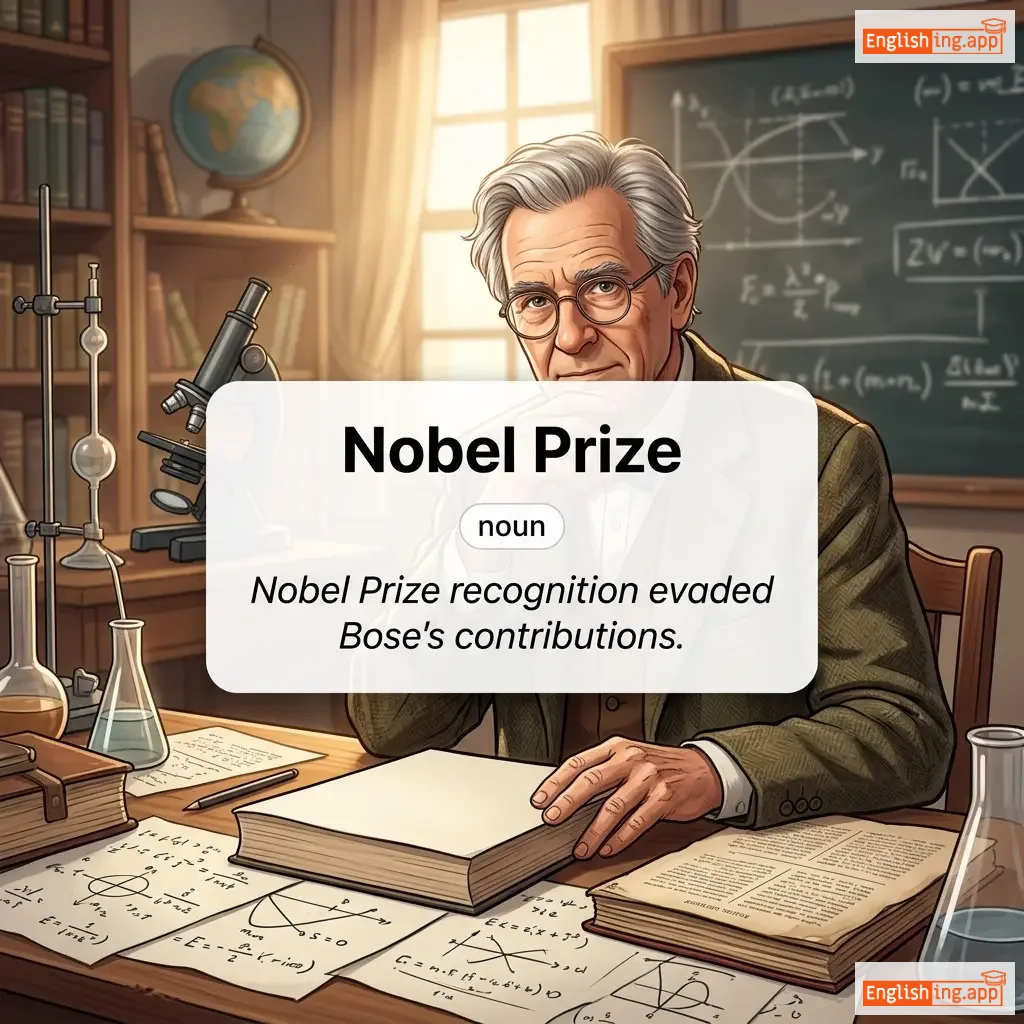
Nobel Prize definition card — visual illustration of the meaning
noun
noʊˈbel praɪz
Premio Nobel (Premio Nobel)

Any of six international prizes awarded annually for outstanding work in physics, chemistry, physiology or medicine, literature, economics, and the promotion of peace.

"Nobel Prize recognition evaded Bose's contributions."

"El reconocimiento del Premio Nobel evadió las contribuciones de Bose." (El reconocimiento del Premio Nobel evadió las contribuciones de Bose.)
noun
/nəʊˈbɪləti/
nobleza (nobleza)

the quality of being noble in character or the group of people belonging to the aristocracy

"The king praised her for her nobility and courage."

"El rey elogió su nobleza y coraje." (El rey elogió su nobleza y coraje.)
adjective
/ˈnoʊbəl/
de alto rango o distinción, que muestra cualidades personales finas o principios morales altos (de alto rango o distincion, que muestra cualidades personales finas o principios morales altos)

Having or showing fine personal qualities, high moral principles, or being of high social rank.

"He is admired for his noble character and generosity."

"Es admirado por su carácter noble y generosidad." (Es admirado por su caracter noble y generosidad.)
🙅‍♂️

nobody (nobody)

pronoun
/ˈnoʊˌbɑːdi/
nadie (nadie)

no person; not anyone

"Nobody came to the party."

"Nadie vino a la fiesta." (Nadie vino a la fiesta.)
adjective
/nɒkˈtɜːrnəl/
nocturno (nocturno)

Active at night and sleeping during the day.

"Owls are nocturnal animals that hunt at night."

"Los búhos son animales nocturnos que cazan de noche." (Los buhos son animales nocturnos que cazan de noche.)
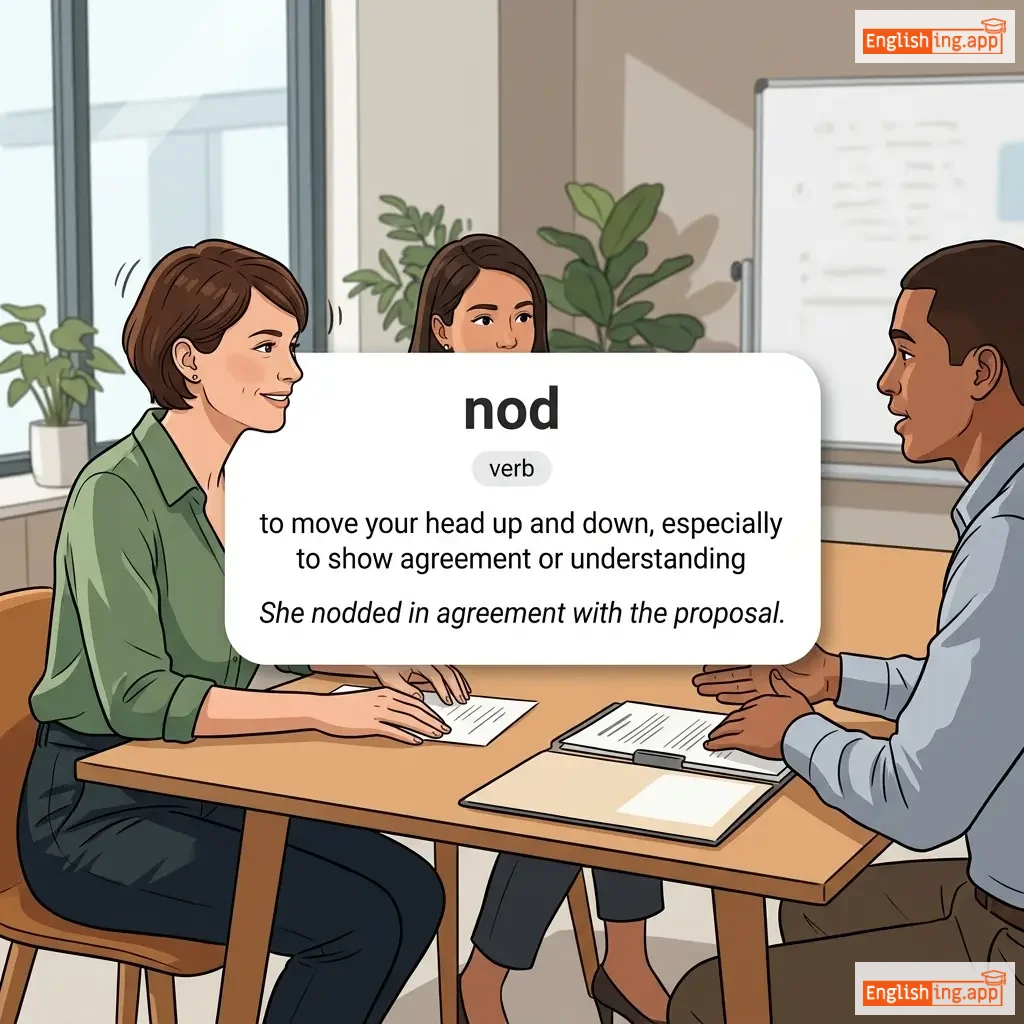
nod definition card — visual illustration of the meaning
verb
/nɒd/
asentir con la cabeza (asentir con la cabeza)

to move your head up and down, especially to show agreement or understanding

"She nodded in agreement with the proposal."

"Ella asintió con la cabeza en señal de acuerdo con la propuesta." (Ella asintió con la cabeza en señal de acuerdo con la propuesta.)
noun
/nɔɪz/
ruido (ruido)

a sound, especially when it is unwanted, unpleasant, or loud

"The noise from the construction site was unbearable."

"El ruido del sitio de construcción era insoportable." (El ruido del sitio de construcción era insoportable.)
adjective
/ˈnɔɪzləs/
silencioso (silencioso)

Completely silent; without any noise.

"The cat made a noiseless leap onto the table."

"El gato hizo un salto silencioso sobre la mesa." (El gato hizo un salto silencioso sobre la mesa.)
adverb
/ˈnɔɪzɪli/
ruidosamente (ruidosamente)

in a way that makes a lot of noise; loudly

"The children were playing noisily in the playground."

"Los niños jugaban ruidosamente en el patio de recreo." (Los niños jugaban ruidosamente en el patio de recreo.)
adjective
/ˈnɔɪsəm/
apestoso (apestoso)

Having an extremely unpleasant smell; offensive or harmful.

"The dump emitted a noisome odor that spread through the town."

"El vertedero emitió un olor noxioso que se extendió por la ciudad." (El vertedero emitió un olor noxioso que se extendió por la ciudad.)
adjective
/ˈnɔɪzi/
ruidoso (ruidoso)

Making a lot of loud sounds; full of noise.

"The children were noisy during the party."

"Los niños estaban ruidosos durante la fiesta." (Los niños estaban ruidosos durante la fiesta.)