Vocabularios

Descubra, aprenda y domine el vocabulario en inglés

noun
/ˈmɛntɔːr/
mentor (mentor)

an experienced person who advises and guides someone less experienced

"She acted as a mentor for the new employees."

"Ella actuó como mentora para los nuevos empleados." (Ella actuó como mentora para los nuevos empleados.)
noun
/ˈmɛnjuː/
menú (menu)

A list of food and drinks available at a restaurant or offered at a meal.

"The restaurant updated its menu with new dishes."

"El restaurante actualizó su menú con nuevos platos." (El restaurante actualizó su menú con nuevos platos.)
adjective
/ˈmɜːrkəntaɪl/
mercantil (mercantil)

related to trade or commerce

"The city grew rapidly due to its mercantile activities."

"La ciudad creció rápidamente debido a sus actividades mercantiles." (La ciudad creció rápidamente debido a sus actividades mercantiles.)
noun
/ˈmɜːrsəˌnɛri/
mercenario (mercenario)

a professional soldier hired to serve in a foreign army; also used to describe someone motivated solely by money.

"The mercenary fought for whoever paid the highest wage."

"El mercenario luchó por quien pagó el salario más alto." (El mercenario luchó por quien pagó el salario más alto.)
noun
/ˈmɜːrtʃənt/
mercader (mercader)

a person or company involved in the trade of goods, especially in large quantities

"The merchant sold spices from distant lands."

"El mercader vendió especias de tierras lejanas." (El mercader vendió especias de tierras lejanas.)
adjective
/ˈmɜːrsɪfəl/
misericordioso (misericordioso)

showing compassion or forgiveness towards someone one has the power to punish or harm.

"The judge was merciful and gave him a lighter sentence."

"El juez fue misericordioso y le dio una sentencia más ligera." (El juez fue misericordioso y le dio una sentencia más ligera.)
adjective
/ˈmɜːrsɪləs/
despiadado (despiadado)

showing no mercy or compassion; cruel and ruthless.

"The dictator was merciless in crushing the rebellion."

"El dictador fue despiadado al aplastar la rebelión." (El dictador fue despiadado al aplastar la rebelión.)
adjective
/mɜːrˈkjʊriəl/
inconstante (inconstante)

subject to sudden or unpredictable changes of mood or mind.

"She is known for her mercurial temperament."

"Ella es conocida por su temperamento inconstante." (Ella es conocida por su temperamento inconstante.)
noun
/ˈmɜːrsi/
misericordia (misericordia)

compassion or forgiveness shown toward someone whom it is within one's power to punish or harm

"She showed mercy by letting him go."

"Ella mostró misericordia dejándolo ir." (Ella mostro misericordia dejandolo ir.)
adjective
/mɪr/
mero (mero)

Used to emphasize how small or insignificant something is.

"It was a mere suggestion, not a command."

"Era solo una sugerencia, no una orden." (Era solo una sugerencia, no una orden.)
adverb
/ˈmɪərli/
solo (solo)

Only; nothing more than.

"She was merely trying to help."

"Ella solo estaba tratando de ayudar." (Ella solo estaba tratando de ayudar.)
meretricious definition card — visual illustration of the meaning
adjective
/ˌmɛrəˈtrɪʃəs/
ficticio (ficticio)

apparently attractive but having no real value or integrity.

"The design was flashy but meretricious."

"El diseño era llamativo pero ficticio." (El diseño era llamativo pero ficticio.)
merge definition card — visual illustration of the meaning
verb
/mɜːrdʒ/
fusionar (fusionar)

to combine or join together to form one entity

"The two companies decided to merge their resources."

"Las dos compañías decidieron fusionar sus recursos." (Las dos companías decidieron fusionar sus recursos.)
noun
/ˈmɜːrdʒər/
fusión (fusion)

The combination of two or more companies into a single entity.

"The merger of the two firms created the largest bank in the region."

"La fusión de las dos compañías creó el banco más grande de la región." (La fusion de las dos companias creo el banco mas grande de la region.)
noun
/məˈræŋ/
merengue (cobertura para postres) (merengue (cobertura para postres))

A light dessert topping made from whipped egg whites and sugar.

"She decorated the pie with a fluffy meringue topping."

"Ella decoró la tarta con una capa de merengue esponjoso." (Ella decoró la tarta con una capa de merengue esponjoso.)
noun/verb
/ˈmɛrɪt/
mérito (merito)

A quality or feature that deserves praise or reward; to deserve or be worthy of.

"The plan has the merit of being simple and practical."

"El plan tiene el mérito de ser simple y práctico." (El plan tiene el merito de ser simple y practico.)
merit-based definition card — visual illustration of the meaning
adjective
ˈmer.ɪt beɪst
basado en méritos (basado en meritos)

Based on or determined by individual merit, ability, or achievement rather than other factors.

"Merit-based recruitment strengthens the workforce."

"El reclutamiento basado en méritos fortalece la fuerza laboral." (El reclutamiento basado en meritos fortalece la fuerza laboral.)
verb (past)
/ˈmɛrɪtɪd/
merecido (merecido)

Deserved or earned something.

"Her dedication merited recognition from the community."

"Su dedicación mereció el reconocimiento de la comunidad." (Su dedicación mereció el reconocimiento de la comunidad.)
noun
/ˌmɛrɪˈtɒkrəsi/
meritocracia (meritocracia)

A system in which advancement is based on individual ability or achievement.

"In a true meritocracy, the most capable people rise to leadership positions."

"En una verdadera meritocracia, las personas más capaces ascienden a posiciones de liderazgo." (En una verdadera meritocracia, las personas más capaces ascienden a posiciones de liderazgo.)
adjective
/ˌmɛrɪˈtɔːriəs/
meritorio (meritorio)

Deserving reward, praise, or recognition.

"She received a scholarship for her meritorious academic performance."

"Ella recibió una beca por su meritoria actuación académica." (Ella recibió una beca por su meritoria actuación académica.)
🧜‍♀️

Mermaid (mérmeid)

noun
/ˈmɛr.meɪd/
sirena (sirena)

A mythical sea creature with the head and torso of a woman and the tail of a fish

"The little girl loved stories about mermaids living under the sea."

"A la niña pequeña le encantaban las historias sobre sirenas viviendo bajo el mar." (A la niña pequeña le encantaban las historias sobre sirenas viviendo bajo el mar.)
adverb
/ˈmerɪli/
alegremente (alegremente)

in a cheerful and joyful manner

"The children played merrily in the garden."

"Los niños jugaban alegremente en el jardín." (Los niños jugaban alegremente en el jardín.)
noun
/ˈmeɪsə/
meseta (meseta)

An isolated flat-topped hill with steep sides, found in arid regions.

"The hikers stopped to admire the mesa rising above the desert floor."

"Los excursionistas se detuvieron para admirar la meseta que se alzaba sobre el suelo del desierto." (Los excursionistas se detuvieron para admirar la meseta que se alzaba sobre el suelo del desierto.)
verb, noun
/mɛʃ/
malla, entrelazar (malla, entrelazar)

To fit or work together properly; or a material made of interlaced threads.

"The two gears mesh perfectly to keep the machine running smoothly."

"Los dos engranajes encajan perfectamente para mantener la máquina funcionando sin problemas." (Los dos engranajes encajan perfectamente para mantener la máquina funcionando sin problemas.)
noun
/ˈmɛzməˌrɪzəm/
hipnotismo (hipnotismo)

A state of fascination or hypnotism.

"The magician held the audience in a state of mesmerism."

"El mago mantuvo a la audiencia en un estado de mesmerismo." (El mago mantuvo a la audiencia en un estado de mesmerismo.)
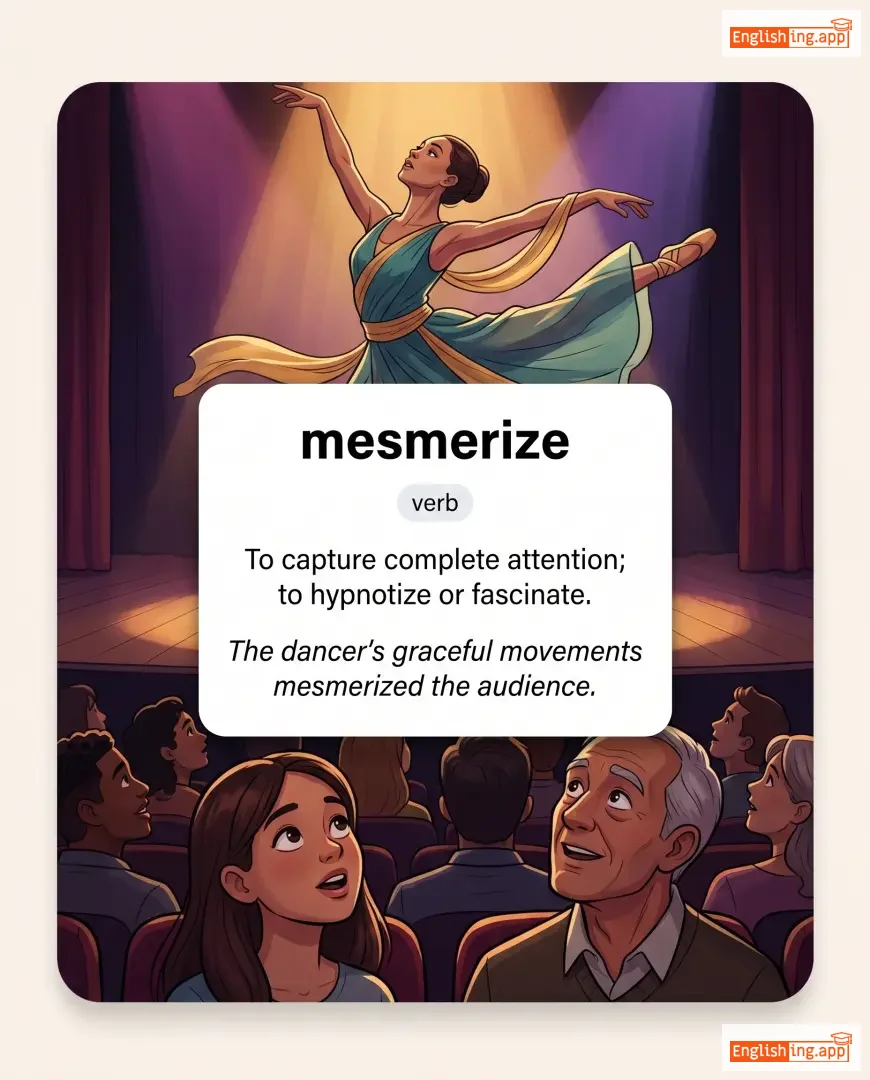
mesmerize definition card — visual illustration of the meaning
verb
/ˈmɛzməˌraɪz/
hipnotizar (hipnotizar)

To capture complete attention; to hypnotize or fascinate.

"The dancer's graceful movements mesmerized the audience."

"Los movimientos gráciles de la bailarina hipnotizaron a la audiencia." (Los movimientos gráciles de la bailarina hipnotizaron a la audiencia.)
noun
/mɛs/
desorden (desorden)

A state of disorder or untidiness.

"The kids left the room in a complete mess."

"Los niños dejaron la habitación en un completo desorden." (Los niños dejaron la habitación en un completo desorden.)
noun
/ˈmɛsɪdʒ/
mensaje (mensaje)

A piece of information sent or communicated from one person to another.

"I received a message from my friend yesterday."

"Recibí un mensaje de mi amigo ayer." (Recibí un mensaje de mi amigo ayer.)
noun
/ˈmes.ɪn.dʒər/
mensajero (mensahero)

a person who carries messages or communications between parties

"The messenger delivered important battle plans to the commander."

"El mensajero entregó planes de batalla importantes al comandante." (El mensajero entregó planes de batalla importantes al comandante.)
adjective
/ˈmɛsi/
desordenado (desordenado)

untidy or dirty; disorganized or chaotic

"His room was so messy that he couldn’t find his keys."

"Su habitación estaba tan desordenada que no pudo encontrar sus llaves." (su habitacion estaba tan desordenada que no pudo encontrar sus llaves)
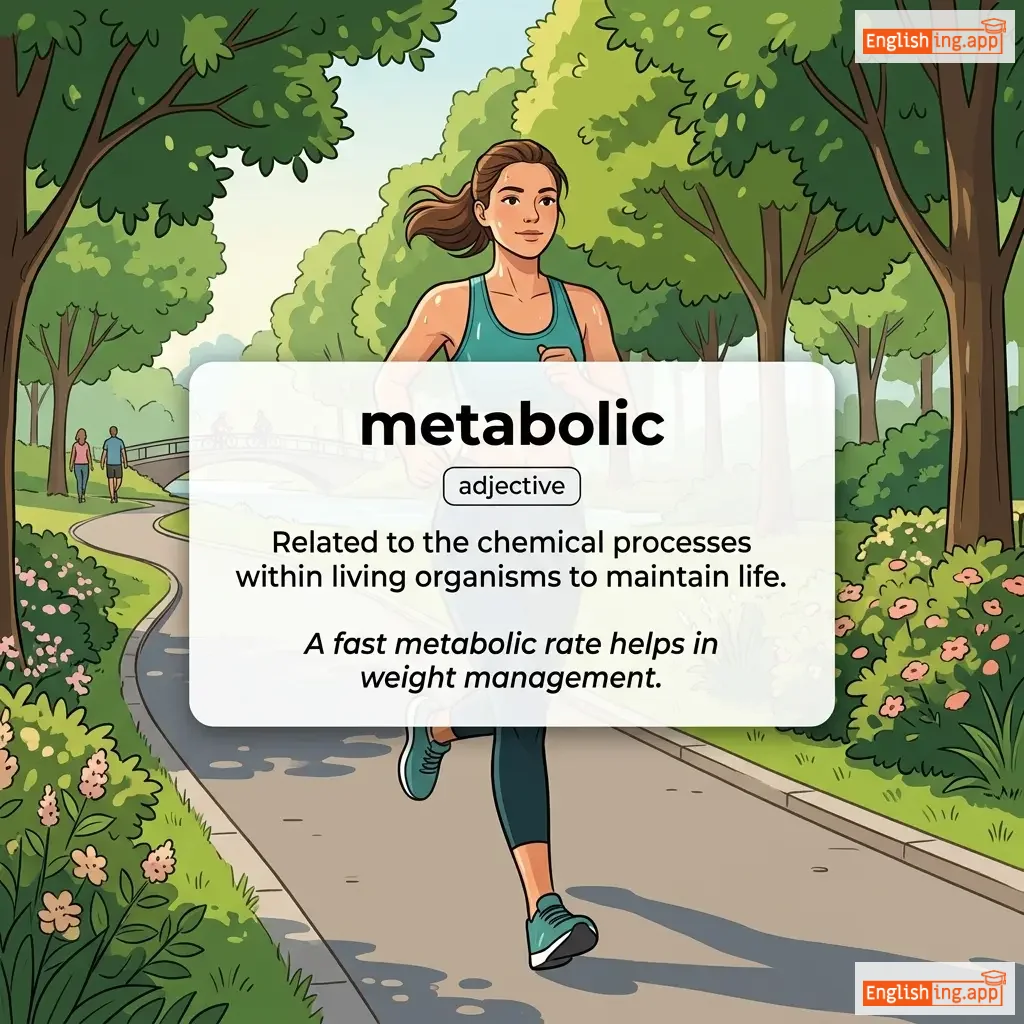
metabolic definition card — visual illustration of the meaning
adjective
ˌmet.əˈbɒl.ɪk
metabólico (metabolico)

Related to the chemical processes within living organisms to maintain life.

"A fast metabolic rate helps in weight management."

"Una tasa metabólica rápida ayuda en el control de peso." (Una tasa metabólica rápida ayuda en el control de peso.)
metabolism definition card — visual illustration of the meaning
noun
/məˈtæbəlɪzəm/
metabolismo (metabolismo)

The chemical processes that occur within a living organism in order to maintain life.

"Faster metabolism can help with weight management."

"Un metabolismo más rápido puede ayudar con la gestión del peso." (un metabolismo mas rapido puede ayudar con la gestion del peso.)
metabolize definition card — visual illustration of the meaning
verb
məˈtæb.ə.laɪz
procesar y utilizar alimentos para el crecimiento (procesar y utilizar alimentos para el crecimiento)

Process and use food for growth and to replace tissue, or process other substances in the body.

"The liver helps to metabolize toxins."

"El hígado ayuda a metabolizar toxinas." (El hígado ayuda a metabolizar toxinas.)
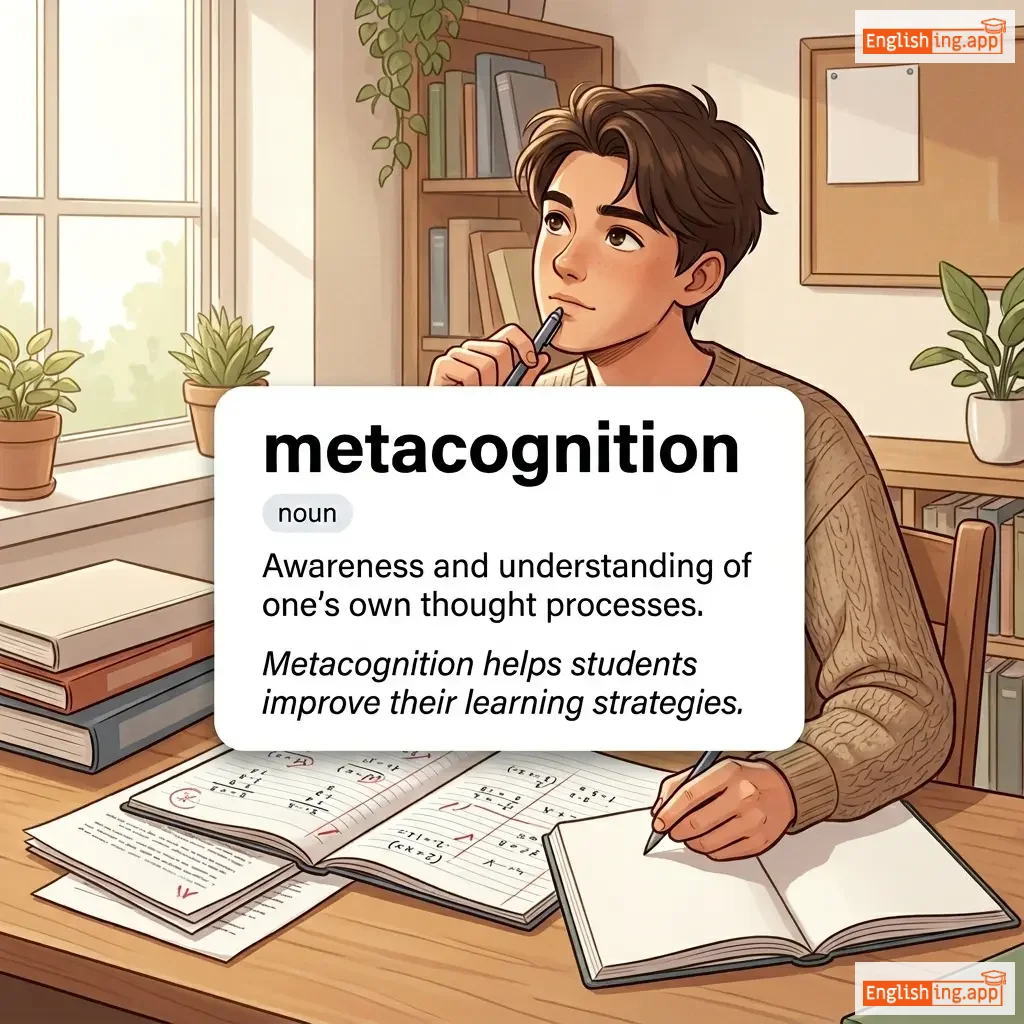
metacognition definition card — visual illustration of the meaning
noun
ˌmɛt.ə.kɒɡˈnɪʃ.ən
metacognición (metacognicion)

Awareness and understanding of one's own thought processes.

"Metacognition helps students improve their learning strategies."

"La metacognición ayuda a los estudiantes a mejorar sus estrategias de aprendizaje." (La metacognicion ayuda a los estudiantes a mejorar sus estrategias de aprendizaje.)
noun
/ˈmɛtəl/
metal (metal)

A solid material that is typically hard, shiny, malleable, fusible, and conductive, such as iron, gold, or aluminum.

"The ring was made of precious metal."

"El anillo estaba hecho de metal precioso." (El anillo estaba hecho de metal precioso.)
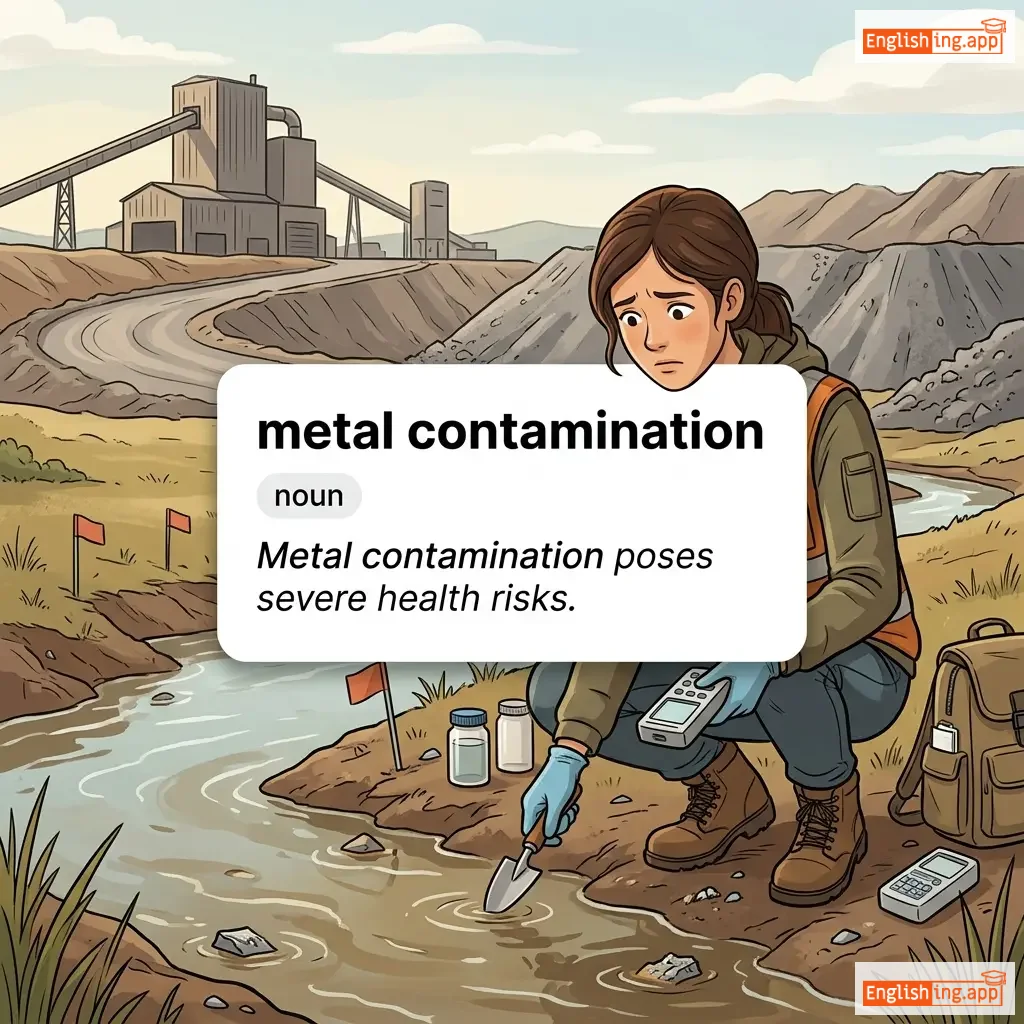
metal contamination definition card — visual illustration of the meaning
noun
ˈmetəl kənˌtæməˈneɪʃən
contaminación por metales (contaminacion por metales)

The presence of toxic metals in the environment that pose health and environmental risks.

"Metal contamination poses severe health risks."

"La contaminación por metales representa graves riesgos para la salud." (La contaminacion por metales representa graves riesgos para la salud.)
adjective
/ˌmɛtəˈlɜrdʒɪkəl/
metalúrgico (metalurgico)

Relating to metallurgy or the branch of science concerned with the properties of metals and their production.

"He studied metallurgical engineering at the university."

"Él estudió ingeniería metalúrgica en la universidad." (el estudio ingenieria metalurgica en la universidad.)
noun
/ˈmɛtələ(r)dʒi/
metalurgia (metalurgia)

The science and technology of metals, including their extraction from ores and their processing.

"Metallurgy plays a vital role in industrial development."

"La metalurgia juega un papel vital en el desarrollo industrial." (La metalurgia juega un papel vital en el desarrollo industrial.)
verb
/ˌmɛtəˈmɔrfoʊz/
metamorfosear (metamorfosear)

To change in form, structure, or substance; to transform completely.

"The caterpillar metamorphosed into a butterfly."

"La oruga se metamorfoseó en una mariposa." (La oruga se metamorfoseó en una mariposa.)
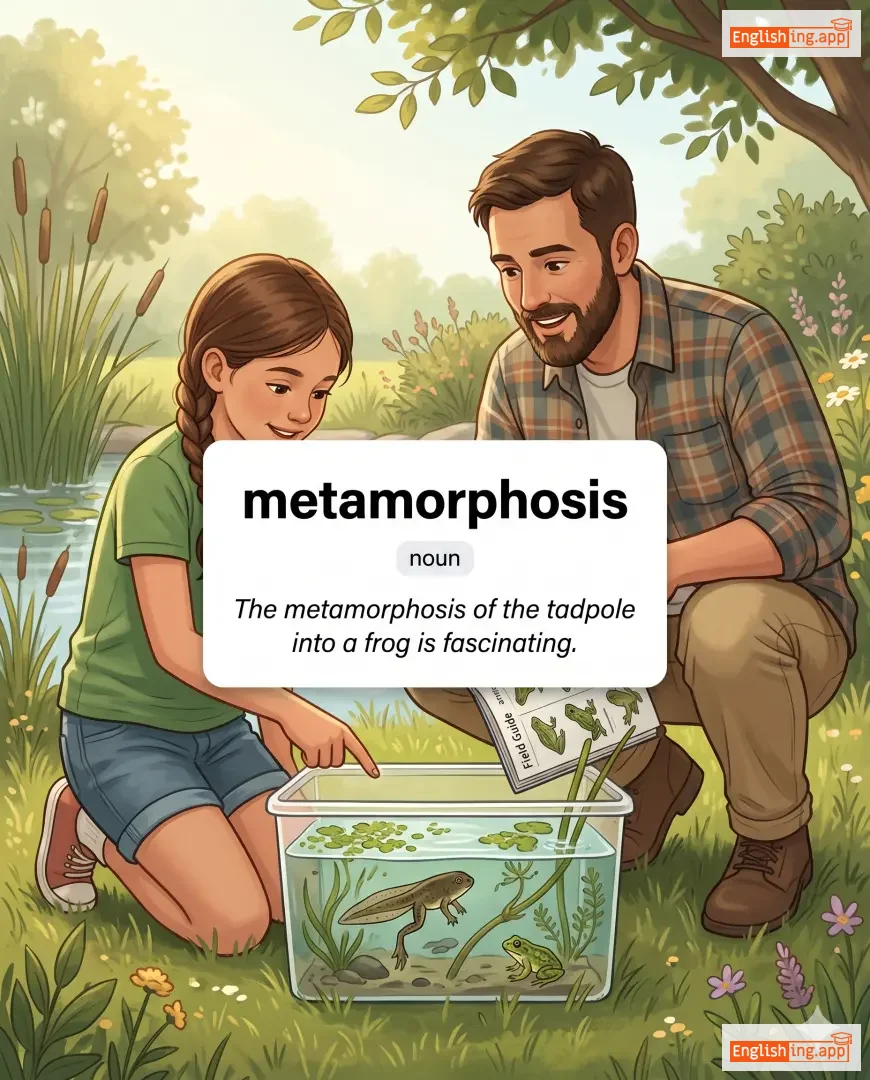
metamorphosis definition card — visual illustration of the meaning
noun
/ˌmɛtəˈmɔrfəsɪs/
metamorfosis (metamorfosis)

A process of transformation from one form to another, especially in biology, such as the change from a caterpillar to a butterfly.

"The metamorphosis of the tadpole into a frog is fascinating."

"La metamorfosis del renacuajo a una rana es fascinante." (La metamorfosis del renacuajo a una rana es fascinante.)
noun
/ˈmɛtəfɔːr/
felicidad (felicidad)

A figure of speech in which a word or phrase is applied to something to which it is not literally applicable.

"Time is a thief is a common metaphor for how quickly life passes."

"No pudo esconder su felicidad cuando recibió el premio." (No pudo esconder su felicidad cuando recibio el premio.)
adjective
/ˌmɛtəˈfɔːrɪkəl/
metafórico (metaforiko)

Characteristic of or relating to metaphor; figurative rather than literal.

"He used metaphorical language to describe his emotions."

"Él usó un lenguaje metafórico para describir sus emociones." (El uso un lenguaje metaforico para describir sus emociones.)
noun
/ˈmɛtəfɔːrm/
metáfora de forma (metafora de forma)

A coined or rare term sometimes used to describe a hybrid form of metaphor and form in literature or art.

"The poet introduced a metaphorm to blend imagery with structure."

"El poeta introdujo un metáformo para combinar la imaginería con la estructura." (El poeta introdujo un metáformo para combinar la imaginería con la estructura.)
adjective
/ˌmɛtəˈfɪzɪkəl/
metafísico (metafisiko)

Relating to the branch of philosophy that deals with the fundamental nature of reality and existence.

"He spent years studying metaphysical questions about life and being."

"Pasó años estudiando preguntas metafísicas sobre la vida y el ser." (Paso anos estudiando preguntas metafisicas sobre la vida y el ser.)
noun
/ˌmɛtəfɪˈzɪʃən/
metafísico (metafisico)

A person who studies or is an expert in metaphysics.

"The metaphysician debated the essence of reality with his peers."

"El metafísico debatió la esencia de la realidad con sus compañeros." (El metafísico debatió la esencia de la realidad con sus compañeros.)
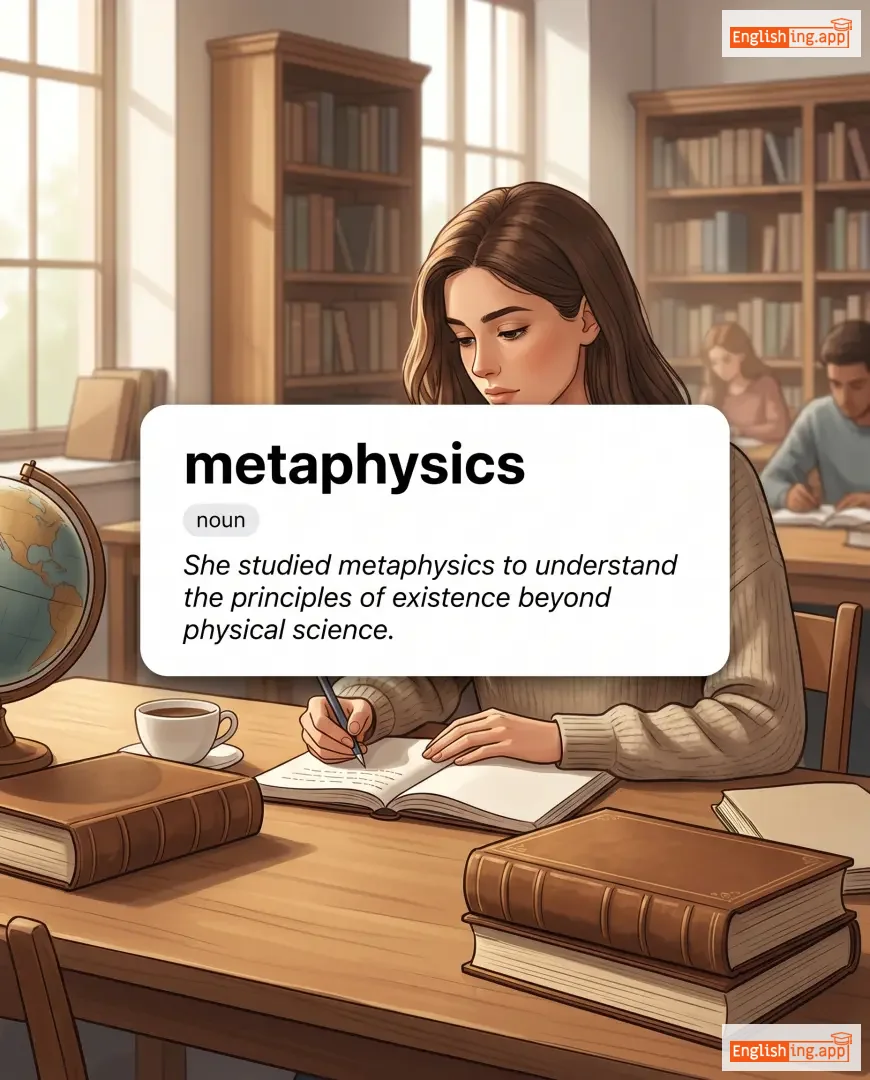
metaphysics definition card — visual illustration of the meaning
noun
/ˌmɛtəˈfɪzɪks/
metafísica (metafisica)

The branch of philosophy that deals with the fundamental nature of reality, existence, and the relationship between mind and matter.

"She studied metaphysics to understand the principles of existence beyond physical science."

"Ella estudió metafísica para entender los principios de la existencia más allá de la ciencia física." (Ella estudio metafisica para entender los principios de la existencia mas alla de la ciencia fisica.)
verb
/miːt/
distribuir (distribuir)

To dispense or allot justice, punishment, or harsh treatment.

"The judge will mete out punishment according to the crime."

"El juez distribuirá el castigo según el crimen." (El juez distribuirá el castigo según el crimen.)
noun
/ˌmɛtəmˌsaɪˈkoʊsɪs/
reencarnación del alma (reenkarnacion del alma)

The supposed transmigration of the soul, especially its reincarnation after death.

"Ancient philosophers often debated the idea of metempsychosis."

"Los antiguos filósofos a menudo debatían sobre la reencarnación del alma." (Los antiguos filosofos a menudo debatian sobre la reencarnacion del alma.)
adjective
/ˌmiːtiˈɔːrɪk/
relacionado con meteoritos; muy rápido y a menudo temporal. (relacionado con meteoritos; muy rapido y a menudo temporal.)

Relating to meteors; very rapid and often temporary.

"The singer’s meteoric rise to fame surprised everyone."

"El ascenso meteórico del cantante a la fama sorprendió a todos." (El ascenso meteorico del cantante a la fama sorprendio a todos.)
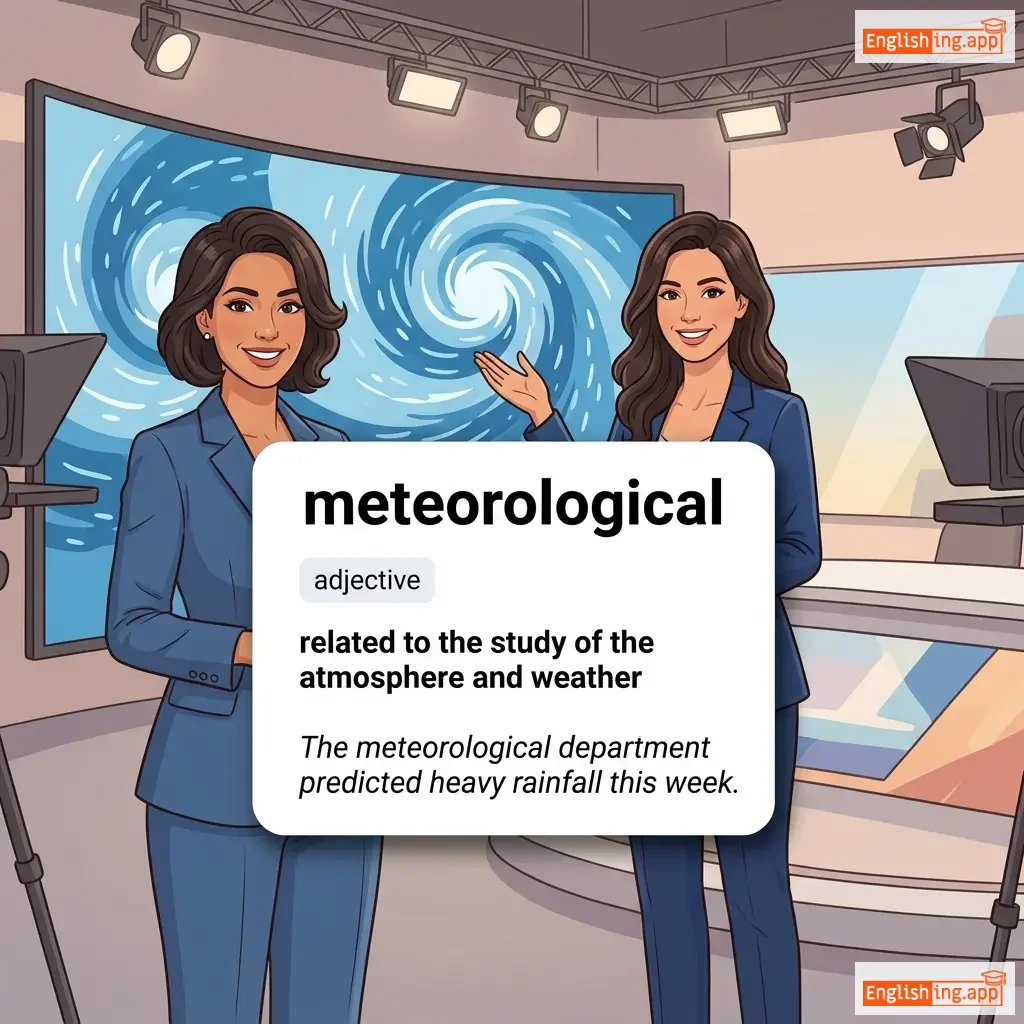
meteorological definition card — visual illustration of the meaning
adjective
/ˌmiː.ti.ə.rəˈlɒ.dʒɪ.kəl/
meteorológico (meteorologico)

related to the study of the atmosphere and weather

"The meteorological department predicted heavy rainfall this week."

"El departamento meteorológico predijo fuertes lluvias esta semana." (El departamento meteorologico predijo fuertes lluvias esta semana.)