Vocabularios

Descubra, aprenda y domine el vocabulario en inglés

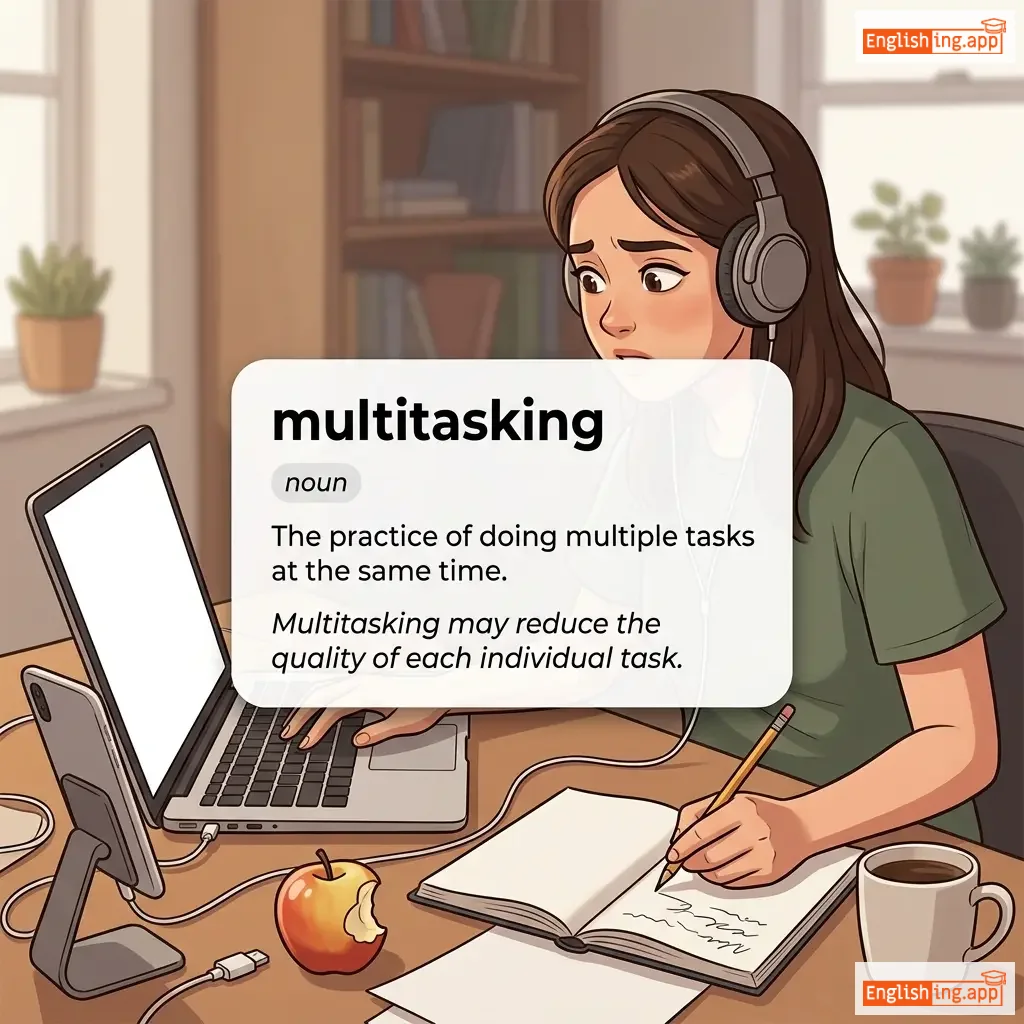
multitasking definition card — visual illustration of the meaning
noun
ˈmʌltɪˌtɑːskɪŋ
realización de múltiples tareas al mismo tiempo (realizacion de multiples tareas al mismo tiempo)

The practice of doing multiple tasks at the same time.

"Multitasking may reduce the quality of each individual task."

"El multitasking puede reducir la calidad de cada tarea individual." (El multitasking puede reducir la calidad de cada tarea individual.)
noun
/ˈmʌltɪtuːd/
multitud (multitud)

A large number of people or things.

"A multitude of fans gathered at the stadium."

"Una multitud de fanáticos se reunió en el estadio." (Una multitud de fanaticos se reunio en el estadio.)
adjective
/mʌm/
silencioso; no decir nada; quedarse callado (silencioso; no decir nada; quedarse callado)

silent; saying nothing; keeping quiet

"He kept mum about the surprise party plans."

"Él se quedó callado sobre los planes de la fiesta sorpresa." (El se quedo callado sobre los planes de la fiesta sorpresa.)
verb
/ˈmʌmbəl/
murmurar (murmurar)

To speak quietly and not clearly so that words are difficult to understand.

"He mumbled an apology before leaving."

"Él murmuró una disculpa antes de irse." (Él murmuró una disculpa antes de irse.)
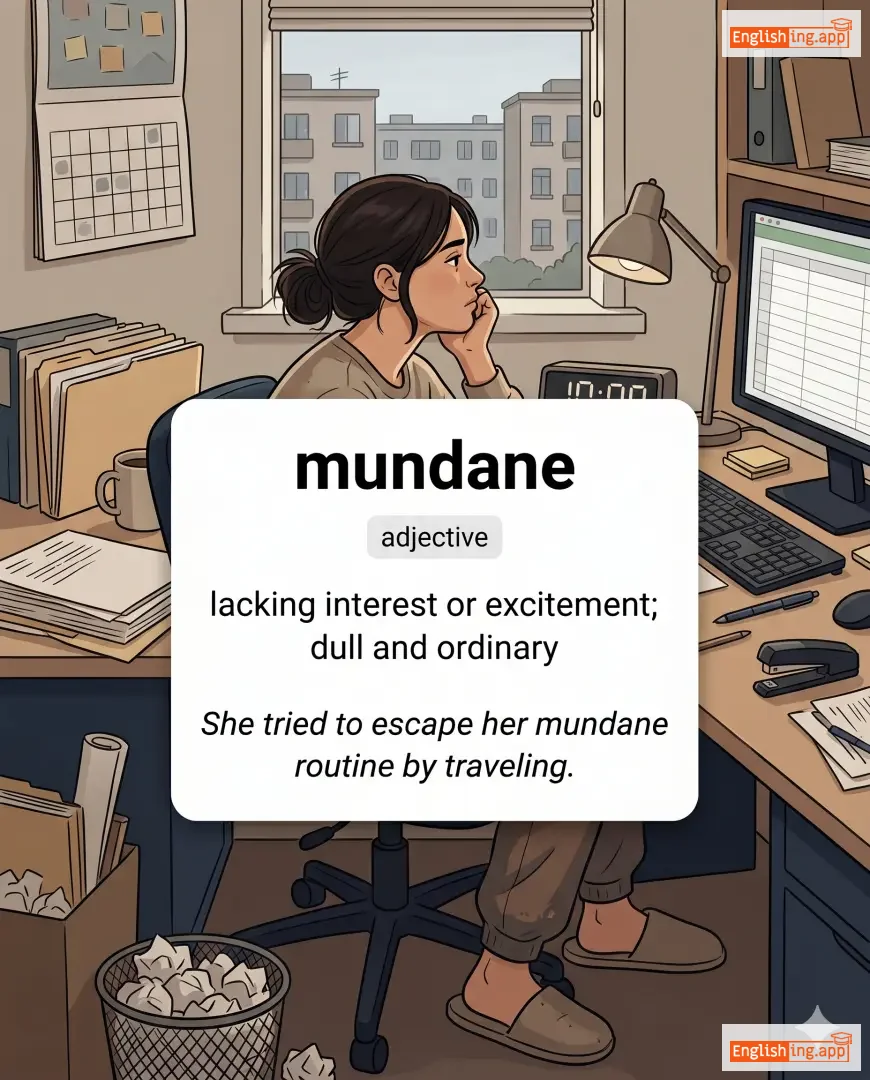
mundane definition card — visual illustration of the meaning
adjective
/mʌnˈdeɪn/
mundano (mundano)

lacking interest or excitement; dull and ordinary

"She tried to escape her mundane routine by traveling."

"Ella intentó escapar de su rutina mundana viajando." (Ella intento escapar de su rutina mundana viajando.)
mundanity definition card — visual illustration of the meaning
noun
mʌnˈdeɪ.nɪ.ti
mundanalidad (mundanalidad)

The quality of being ordinary, routine, or lacking excitement.

"The mundanity of office life can be exhausting."

"La mundanalidad de la vida en la oficina puede ser agotadora." (La mundanalidad de la vida en la oficina puede ser agotadora.)
adjective
/mjuːˈnɪsɪpəl/
municipal (municipal)

relating to a city or town or its local government

"The municipal authority is responsible for maintaining the park."

"La autoridad municipal es responsable de mantener el parque." (La autoridad municipal es responsable de mantener el parque.)
noun
/ˌmjuːnɪsɪˈpæləti/
municipalidad (municipalidad)

a city or town that has its own local government

"The municipality is planning to build a new library."

"La municipalidad está planeando construir una nueva biblioteca." (La municipalidad está planeando construir una nueva biblioteca.)
noun
/mjuːˈnɪfəsəns/
munificencia (munificencia)

great generosity or lavish giving

"The hospital was built thanks to the munificence of a wealthy donor."

"El hospital fue construido gracias a la munificencia de un rico donante." (El hospital fue construido gracias a la munificencia de un rico donante.)
adjective
/mjuːˈnɪfɪsənt/
munífico (munifico)

extremely generous; giving freely and abundantly

"She made a munificent donation to the orphanage."

"Ella hizo una donación munífica al orfanato." (Ella hizo una donación munífica al orfanato.)
noun
/ˈmjʊərəl/
mural (mural)

A large painting or artwork applied directly to a wall or ceiling surface.

"The artist painted a mural on the side of the school building."

"El artista pintó un mural en el lado del edificio escolar." (El artista pintó un mural en el lado del edificio escolar.)
noun, verb
/ˈmɜːrdər/
asesinato (asesinato)

the unlawful killing of a person; to kill someone unlawfully and intentionally

"The detective investigated the murder that shocked the town."

"El detective investigó el asesinato que sorprendió a la ciudad." (El detective investigó el asesinato que sorprendió a la ciudad.)
noun
/ˈmɜːrdərər/
asesino (asesino)

a person who unlawfully kills another human being with intent

"The murderer was caught by the police within hours."

"El asesino fue capturado por la policía en pocas horas." (El asesino fue capturado por la policía en pocas horas.)
adjective
/ˈmɜː(r)dərəs/
asesino; con intención de matar; extremadamente violento; sanguinario (asesino; con intencion de matar; extremadamente violento; sanguinario)

having the intent to kill; extremely violent; bloodthirsty

"The murderous look in his eyes frightened everyone."

"La mirada asesina en sus ojos asustó a todos." (La mirada asesina en sus ojos asusto a todos.)
noun
/ˈmɜːkinəs/
oscuridad (oscuridad)

The quality of being dark, gloomy, or unclear.

"The murkiness of the water made it hard to see the fish."

"La oscuridad del agua hizo que fuera difícil ver los peces." (La oscuridad del agua hizo que fuera difícil ver los peces.)
adjective
/ˈmɜːki/
turbio (turbio)

Dark, gloomy, and difficult to see through; obscure.

"We avoided swimming in the murky river."

"Evitamos nadar en el río turbio." (Evitamos nadar en el río turbio.)
verb
/ˈmɜːrmər/
murmurar (murmurar)

To say something in a low, soft, or indistinct voice.

"She murmured a prayer before going to sleep."

"Ella murmuró una oración antes de dormir." (Ella murmuró una oración antes de dormir.)
noun
/ˈmʌrɪn/
enfermedad infecciosa del ganado (enfermedad infecciosa del ganado)

An infectious disease that affects cattle and other animals, often fatal.

"The farmer lost many cows during the outbreak of murrain."

"El agricultor perdió muchas vacas durante el brote de murrain." (El agricultor perdió muchas vacas durante el brote de murrain.)
noun
/ˈmʌsl/
músculo (musculo)

a band of fibrous tissue in the body that produces movement; physical strength

"He exercises daily to build strong muscles."

"Él hace ejercicio a diario para desarrollar músculos fuertes." (Él hace ejercicio a diario para desarrollar músculos fuertes.)
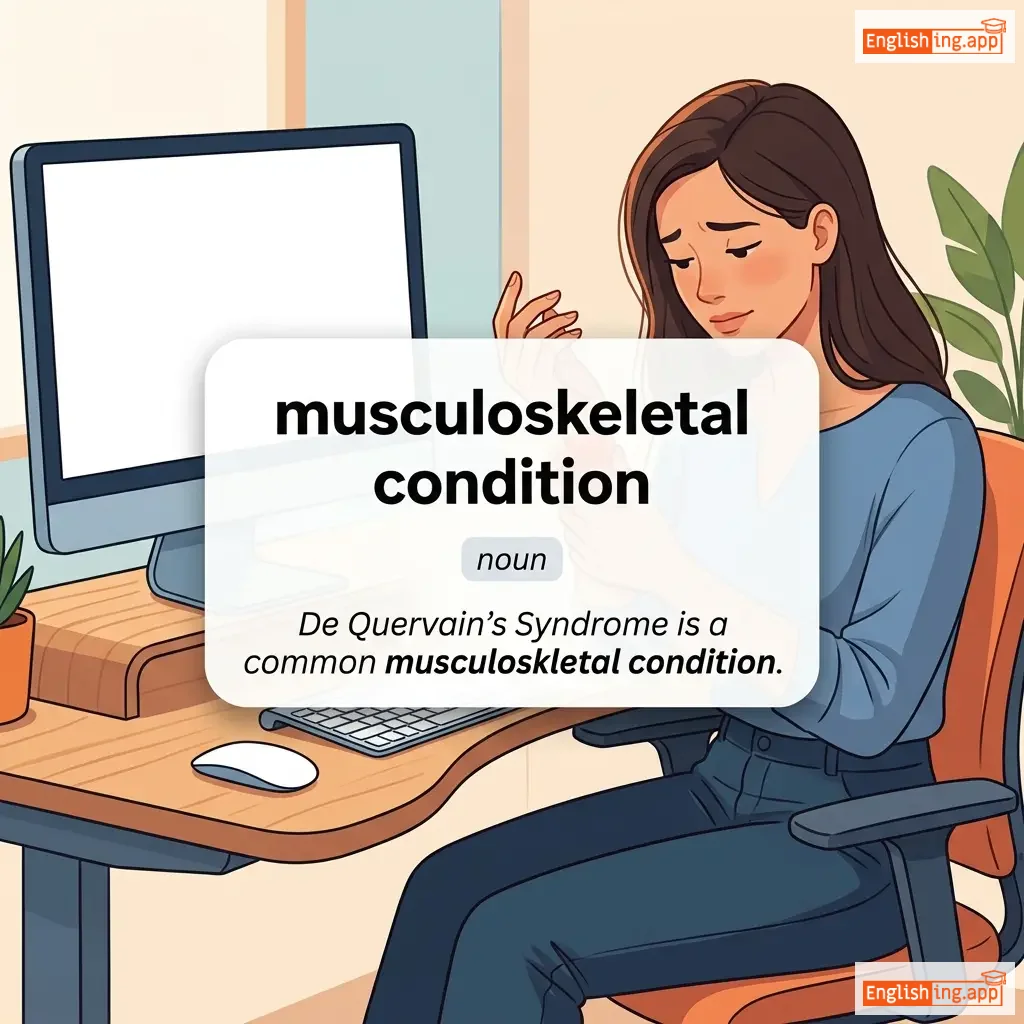
musculoskeletal condition definition card — visual illustration of the meaning
noun
মাসকুলোস্কেলেটাল কন্ডিশন
trastorno musculoesquelético (trastorno musculoesquelético)

A disorder that affects the muscles, bones, joints, tendons, ligaments, or other structures that support the limbs, neck, and back.

"De Quervain's Syndrome is a common musculoskeletal condition."

"El síndrome de De Quervain es una condición musculoesquelética común." (El síndrome de De Quervain es una condición musculoesquelética común.)
verb, noun
/mjuːz/
meditar / fuente de inspiración (meditar / fuente de inspiracion)

to think deeply about something; a source of inspiration, especially for an artist or writer

"She sat by the window to muse about her future."

"Ella se sentó junto a la ventana para pensar profundamente sobre su futuro." (Ella se sentó junto a la ventana para pensar profundamente sobre su futuro.)
noun
/mjuˈziːəm/
museo (museo)

a building in which objects of historical, scientific, artistic, or cultural interest are stored and exhibited

"We visited the art museum to see the new exhibition."

"Visitamos el museo de arte para ver la nueva exposición." (Visitamos el museo de arte para ver la nueva exposicion.)
noun
/ˈmʌʃruːm/
hongo (un tipo de hongo comestible) (hongo (un tipo de hongo comestible))

a type of fungus with a round top and a short stem, some of which are edible

"We cooked a delicious soup with fresh mushrooms."

"Cocinamos una sopa deliciosa con hongos frescos." (Cocinamos una sopa deliciosa con hongos frescos.)
noun
/ˈmjuːzɪk/
música (musica)

vocal or instrumental sounds combined to produce harmony, melody, or rhythm

"She loves listening to classical music."

"A ella le encanta escuchar música clásica." (A ella le encanta escuchar musica clasica.)
adjective
/ˈmɪzɪkəl/
musical (musical)

related to or consisting of music

"She has a very musical voice."

"Ella tiene una voz muy musical." (Ella tiene una voz muy musical.)
noun
/mjuːˈzɪʃən/
músico (musiko)

a person who plays a musical instrument or is musically talented

"He is a talented musician."

"Él es un músico talentoso." (El es un musiko talentoso.)
noun
/mʌsk/
almizcle (almizcle)

a strong-smelling substance secreted by certain animals, used in perfumes and traditional medicine

"The perfume contained natural musk that gave it an exotic fragrance."

"El perfume contenía almizcle natural que le dio una fragancia exótica." (El perfume contenía almizcle natural que le dio una fragancia exótica.)
noun
/ˈmʌskɪt/
un tipo de fusil antiguo (un tipo de fusil antiguo)

a type of long gun used in the past, especially by infantry soldiers

"The soldiers carried muskets into the battlefield."

"Los soldados llevaron mosquetes al campo de batalla." (Los soldados llevaron mosquetes al campo de batalla.)
adjective
/ˈmʌski/
almizclado (almizclado)

having a strong, sweet, earthy smell like musk

"The perfume had a musky fragrance."

"El perfume tenía una fragancia almizclada." (El perfume tenía una fragancia almizclada.)
noun
/ˈmʊzlɪm/
musulmán (musulman)

a follower of Islam

"He is a devout Muslim."

"Él es un musulmán devoto." (Él es un musulmán devoto.)
verb
/mʌst/
deber (deber)

to be required or obligated to

"You must complete your homework before you go out."

"Debes completar tu tarea antes de salir." (Debes completar tu tarea antes de salir.)
noun
/ˈmʌs.tərd/
mostaza (mostaza)

A pungent seed or condiment made from ground mustard seeds

"She added mustard seeds to the curry for extra flavor."

"Ella añadió semillas de mostaza al curry para darle más sabor." (ella añadio semillas de mostaza al curry para darle mas sabor.)
noun
/ˈmʌs.tərd liːf/
hoja de mostaza (hoja de mostaza)

green leafy vegetable from the mustard plant; edible leaves used in cooking

"We cooked mustard leaf with fish in a traditional Bengali curry."

"Cocinamos hoja de mostaza con pescado en un curry bengalí tradicional." (Cocinamos hoja de mostaza con pescado en un curry bengalí tradicional.)
noun
/ˈmʌstərd ɔɪl/
aceite de mostaza (aceite de mostaza)

oil extracted from mustard seeds, commonly used for cooking and medicinal purposes

"We use mustard oil for cooking vegetables in our kitchen."

"Usamos aceite de mostaza para cocinar vegetales en nuestra cocina." (Usamos aceite de mostaza para cocinar vegetales en nuestra cocina.)
noun
/ˈmʌs.tərd siːdz/
semillas de mostaza (semillas de mostaza)

small round seeds from the mustard plant, used as a spice and for making mustard condiment

"Mustard seeds are often tempered in hot oil to release their nutty flavor before adding to dishes."

"Las semillas de mostaza a menudo se temperan en aceite caliente para liberar su sabor a nuez antes de agregarlas a los platos." (Las semillas de mostaza a menudo se temperan en aceite caliente para liberar su sabor a nuez antes de agregarlas a los platos.)
verb, noun
/ˈmʌstər/
reunir / juntar coraje (reunir / juntar coraje)

to gather people, especially soldiers; to summon courage or strength

"He mustered enough courage to face the challenge."

"Él reunió suficiente coraje para enfrentar el desafío." (Él reunió suficiente coraje para enfrentar el desafío.)
adjective
/ˈmʌsti/
húmedo, mohoso o con olor a humedad (humedo, mohoso o con olor a humedad)

having a stale, moldy, or damp smell

"The old books had a musty odor."

"Los libros viejos tenían un olor a humedad." (Los libros viejos tenian un olor a humedad.)
noun
/ˌmjuːtəˈbɪləti/
mutabilidad (mutabilidad)

The quality of being changeable or capable of change.

"The mutability of fashion trends makes it hard to keep up."

"La mutabilidad de las tendencias de moda hace que sea difícil mantenerse al día." (La mutabilidad de las tendencias de moda hace que sea difícil mantenerse al día.)
adjective
/ˈmjuːtəbl/
mutable (mutable)

Capable of change or alteration.

"Human emotions are mutable and can shift rapidly."

"Las emociones humanas son mutables y pueden cambiar rápidamente." (Las emociones humanas son mutables y pueden cambiar rápidamente.)
noun
/ˌmjuːtəˈbɪləti/
mutabilidad (mala ortografía) (mutabilidad (mala ortografia))

A misspelled form of 'mutability', meaning the quality of being changeable.

"The document contained the misspelled word 'mutablility' instead of 'mutability'."

"El documento contenía la palabra mal escrita 'mutablility' en lugar de 'mutability'." (El documento contenia la palabra mal escrita 'mutablility' en lugar de 'mutability'.)
verb
/ˈmjuːteɪt/
mutar (mutar)

To change or cause to change in form, nature, or character.

"The virus can mutate into a more dangerous strain."

"El virus puede mutar a una cepa más peligrosa." (El virus puede mutar a una cepa más peligrosa.)
noun
/mjuːˈteɪʃn/
mutación, cambio genético (mutacion, cambio genetico)

A change in form, structure, or nature, especially in genetics.

"Scientists discovered a genetic mutation that caused the disorder."

"Los científicos descubrieron una mutación genética que causó el trastorno." (Los cientificos descubrieron una mutacion genetica que causo el trastorno.)
adjective
/mjuːt/
mudo (myoot)

silent or unable to speak; not expressed in words

"She remained mute during the entire meeting."

"Ella se quedó muda durante toda la reunión." (Ella se quedo muda durante toda la reunion.)
adjective
/ˈmjuːtɪd/
atenuado (atenuado)

softened in sound, color, or effect; subdued

"The room was painted in muted shades of blue and grey."

"La habitación fue pintada en tonos atenuados de azul y gris." (La habitacion fue pintada en tonos atenuados de azul y gris.)
verb
/ˈmjuːtɪleɪt/
mutilar (mutilar)

to inflict serious damage on something, often by cutting or tearing

"The ancient manuscript was mutilated by careless handling."

"El antiguo manuscrito fue mutilado por un manejo descuidado." (El antiguo manuscrito fue mutilado por un manejo descuidado.)
adjective
/ˈmjuːtɪnəs/
rebelde (rebelde)

refusing to obey authority; rebellious

"The soldiers grew mutinous after months without pay."

"Los soldados se volvieron rebeldes después de meses sin paga." (Los soldados se volvieron rebeldes después de meses sin paga.)
noun
/ˈmjuːtɪni/
motín (motin)

an open rebellion against authority, especially by soldiers or sailors

"The sailors staged a mutiny against their captain."

"Los marineros organizaron un motín contra su capitán." (Los marineros organizaron un motin contra su capitan.)
verb
/ˈmʌtər/
murmurar (murmurar)

to speak in a low or barely audible voice, often in dissatisfaction or irritation

"He muttered something under his breath as he walked away."

"Él murmuró algo bajo su aliento mientras se alejaba." (Él murmuró algo bajo su aliento mientras se alejaba.)
noun
/ˈmʌtn/
carne de cordero (carne de cordero)

meat from an adult sheep; lamb meat

"The restaurant serves delicious mutton curry with rice."

"El restaurante sirve un delicioso curry de carne de cordero con arroz." (El restaurante sirve un delicioso curry de carne de cordero con arroz.)
adjective
/ˈmjuːtʃuəl/
mutuo (mutuo)

felt, shared, or done by two or more people equally

"They have mutual respect for each other."

"Ellos tienen respeto mutuo el uno por el otro." (Ellos tienen respeto mutuo el uno por el otro.)