Vocabularios

Descubra, aprenda y domine el vocabulario en inglés

noun
/moʊld/
molde; moho (mauld)

a hollow container used to give shape to molten material; fungus

"She poured chocolate into the mould to make candies."

"Ella vertió chocolate en el molde para hacer caramelos." (Ella vertio chocolate en el molde para hacer caramelos)
verb
/maʊnt/
montar (montar)

to climb up, rise, or fix something in place

"They plan to mount a camera on the wall."

"Planean montar una cámara en la pared." (Planean montar una camara en la pared.)
noun
/ˈmaʊntən/
montaña (montaña)

a large natural elevation of the earth’s surface

"They climbed the highest mountain in the region."

"Escalaron la montaña más alta de la región." (Escalaron la montaña más alta de la región.)
noun
/ˌmaʊntəˈnɪə/
montañero (montanero)

A person who climbs mountains as a sport or profession.

"The mountaineer reached the summit after a long climb."

"El montañero llegó a la cima después de una larga subida." (El montanero llego a la cima despues de una larga subida.)
adjective
/ˈmaʊntənəs/
montañoso (montanoso)

Having many mountains; very large or huge in size.

"They traveled through a mountainous region of Nepal."

"Viajaron a través de una región montañosa de Nepal." (Viajaron a través de una región montañosa de Nepal.)
noun
/ˈmaʊntɪˌbæŋk/
charlatán (charlatan)

A charlatan or trickster who deceives others, often for personal gain.

"The crowd was fooled by the mountebank’s false promises."

"La multitud fue engañada por las falsas promesas del charlatán." (La multitud fue engañada por las falsas promesas del charlatán.)
verb
/mɔːrn/
lamentar (lamentar)

To feel or express deep sadness or grief, especially because of someone's death.

"They gathered to mourn the loss of their friend."

"Se reunieron para lamentar la pérdida de su amigo." (Se reunieron para lamentar la pérdida de su amigo.)
noun
/ˈmɔːr.nər/
persona que asiste a un funeral (persona que asiste a un funeral)

a person who attends a funeral or shows grief for someone who has died

"The mourners gathered at the cemetery to pay their respects."

"Los dolientes se reunieron en el cementerio para rendir sus respetos." (Los dolientes se reunieron en el cementerio para rendir sus respetos.)
adjective
/ˈmɔːrn.fəl/
triste (triste)

feeling, expressing, or causing sadness or grief

"The mournful song reminded her of lost loved ones."

"La triste canción le recordó a sus seres queridos perdidos." (La triste canción le recordó a sus seres queridos perdidos.)
noun
/ˈmɔːr.nɪŋ/
luto (luto)

the expression of deep sorrow for someone who has died

"The family is in mourning for their grandmother."

"La familia está de luto por su abuela." (La familia esta de luto por su abuela.)
noun
/maʊs/
ratón / ratón de computadora (raton / raton de computadora)

a small rodent with a pointed nose and long tail; also a computer input device

"The cat chased the mouse across the room."

"El gato persiguió al ratón por la habitación." (El gato persiguió al ratón por la habitación.)
noun
/məˈstɑːʃ/
bigote (bigote)

hair that grows on the upper lip of a man's face

"He decided to grow a moustache for the first time."

"Decidió dejarse crecer un bigote por primera vez." (Decidio dejarse crecer un bigote por primera vez.)
noun
/maʊθ/
boca (boka)

the opening in the face used for eating, speaking, and breathing

"She covered her mouth when she yawned."

"Ella cubrió su boca cuando bostezó." (Ella cubrió su boca cuando bostezó.)
noun
/ˈmaʊθ.fʊl/
bocado (bocado)

the amount of food or drink that fills the mouth, or a long and difficult word or phrase

"He took a big mouthful of water after the run."

"Él tomó un gran bocado de agua después de la carrera." (Él tomó un gran bocado de agua después de la carrera.)
adjective
/ˈmuː.və.bl̩/
movible; portátil; transferible (movible; portatil; transferible)

capable of being moved; not fixed in position

"The furniture is movable so we can rearrange the room easily."

"Los muebles son movibles, por lo que podemos reorganizar la habitación fácilmente." (Los muebles son movibles, por lo que podemos reorganizar la habitacion facilmente.)
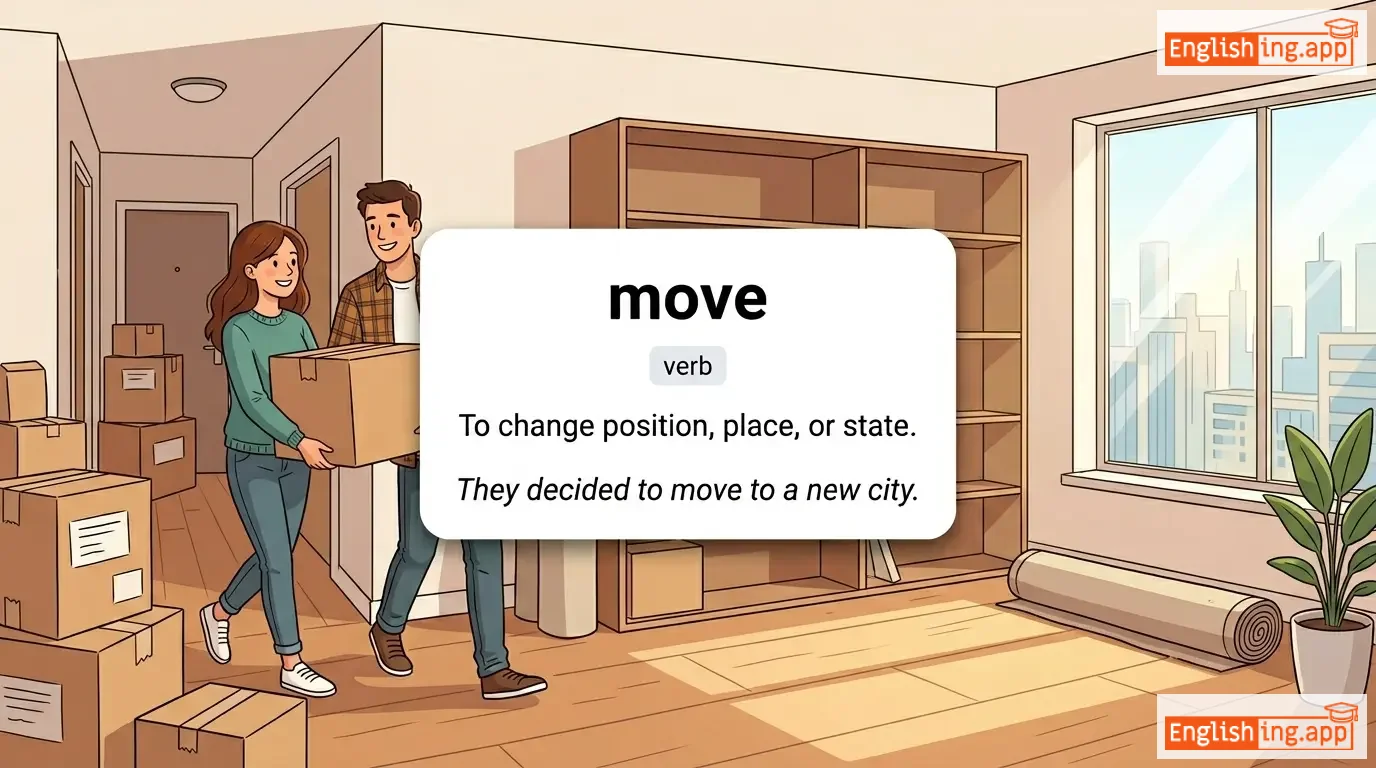
move definition card — visual illustration of the meaning
verb
/muːv/
mover (mover)

To change position, place, or state.

"They decided to move to a new city."

"Ellos decidieron mudarse a una nueva ciudad." (Ellos decidieron mudarse a una nueva ciudad.)
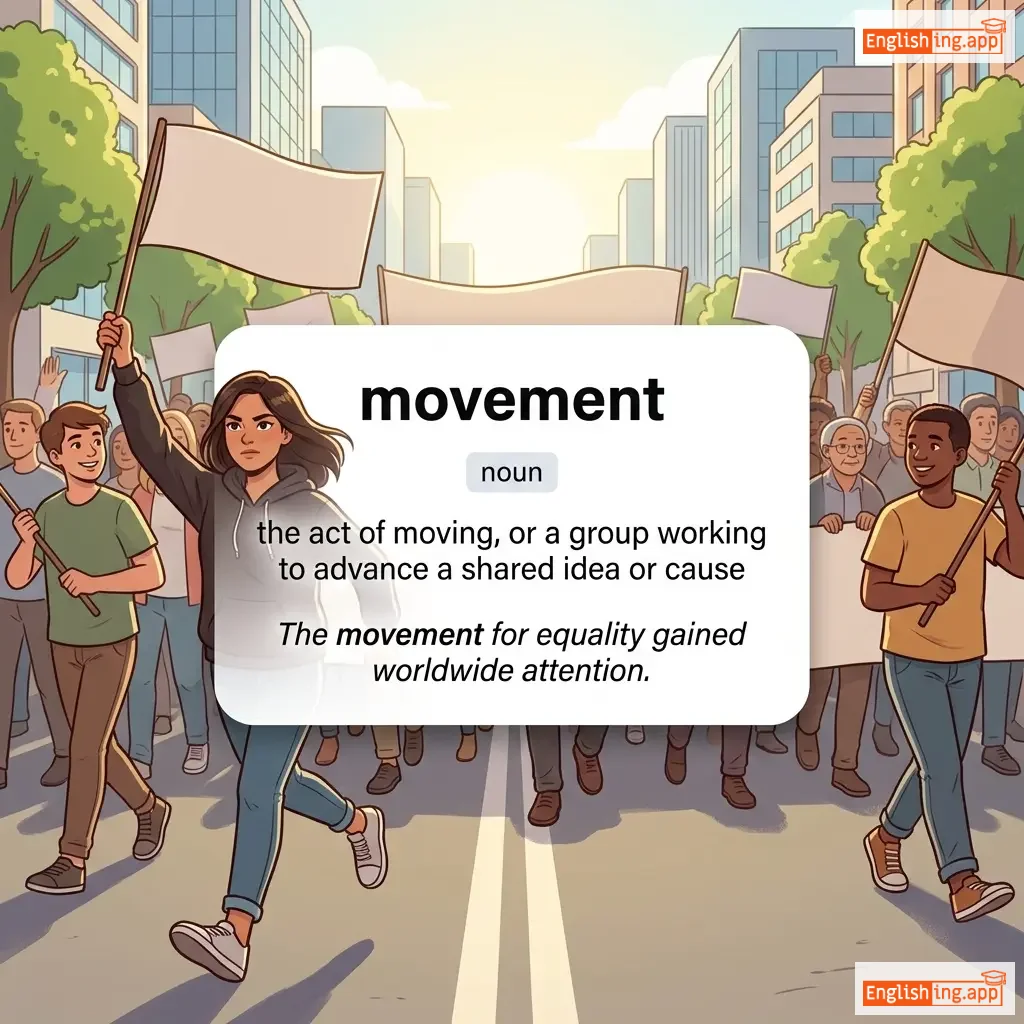
movement definition card — visual illustration of the meaning
noun
/ˈmuːv.mənt/
movimiento (movimiento)

the act of moving, or a group working to advance a shared idea or cause

"The movement for equality gained worldwide attention."

"El movimiento por la igualdad ganó atención mundial." (El movimiento por la igualdad ganó atención mundial.)
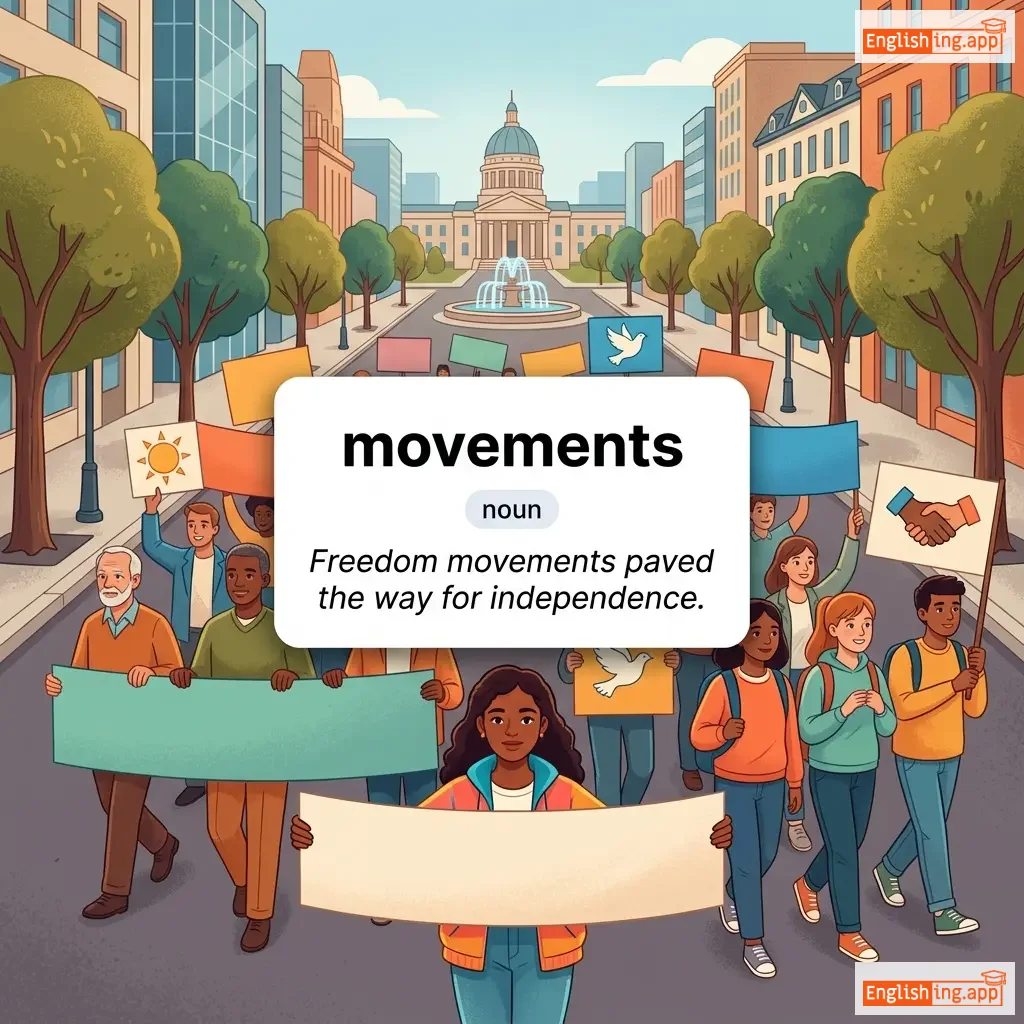
movements definition card — visual illustration of the meaning
noun
ˈmuːv.mənts
movimientos (movimientos)

Organized efforts by groups of people working together to advance their shared political, social, or artistic ideas.

"Freedom movements paved the way for independence."

"Los movimientos de libertad abrieron el camino hacia la independencia." (Los movimientos de libertad abrieron el camino hacia la independencia.)
noun
/ˈmuːvi/
felicidad (felicidad)

A motion picture or film shown in a cinema or on television.

"We watched a movie together last night."

"Ella no pudo esconder su felicidad cuando recibió el premio." (Ella no pudo esconder su felicidad cuando recibió el premio.)
movies definition card — visual illustration of the meaning
noun
ˈmuːviz
películas (peliculas)

A story or event recorded by a camera as a set of moving images and shown in a theater or on television.

"Watching movies helps in language learning."

"Ver películas ayuda en el aprendizaje de idiomas." (Ver peliculas ayuda en el aprendizaje de idiomas.)
adjective
/ˈmuːvɪŋ/
conmovedor (conmovedor)

causing strong feelings, especially of sympathy or sadness

"Her speech was so moving that everyone cried."

"Su discurso fue tan conmovedor que todos lloraron." (Su discurso fue tan conmovedor que todos lloraron.)
title
/ˈmɪstər/
Sr. (Sr.)

a title used before a man's name

"Mr. Rahman is our new teacher."

"Sr. Rahman es nuestro nuevo maestro." (Sr. Rahman es nuestro nuevo maestro.)
title
/ˈmɪsɪz/
señora (senora)

a title used before a married woman's name

"Mrs. Karim is the headmistress of the school."

"La señora Karim es la directora de la escuela." (La senora Karim es la directora de la escuela.)
👩‍💼

ms (miz)

title
/mɪz/
Sra. (Sra.)

a title used before a woman's name, regardless of marital status

"Ms. Akter will give a speech at the seminar."

"Ms. Akter dará un discurso en el seminario." (Ms. Akter dara un discurso en el seminario.)
adjective, adverb, pronoun
/mʌtʃ/
mucho (mucho)

a large amount or degree of something

"She doesn’t have much time to finish the project."

"Ella no tiene mucho tiempo para terminar el proyecto." (Ella no tiene mucho tiempo para terminar el proyecto.)
noun
/mʌd/
barro (barro)

soft, wet earth or soil

"The children were playing in the mud after the rain."

"Los niños estaban jugando en el barro después de la lluvia." (Los niños estaban jugando en el barro después de la lluvia.)
verb
/ˈmʌd.əl/
desordenar (desordenar)

to mix things up in a confused way or to make a mess of something

"He muddled the papers and couldn’t find the report."

"Él desordenó los papeles y no pudo encontrar el informe." (Él desordenó los papeles y no pudo encontrar el informe.)
adjective
/ˈmʌd.i/
embarrado (embarrado)

covered in or full of mud; unclear or confused

"The children came back with muddy shoes after playing outside."

"Los niños regresaron con zapatos embarrados después de jugar afuera." (Los niños regresaron con zapatos embarrados después de jugar afuera.)
verb
/ˈmʌfəl/
amortiguar (amortiguar)

to make a sound quieter or less distinct; to cover or wrap something to reduce noise or warmth

"She tried to muffle her laughter with a scarf."

"Ella intentó amortiguar su risa con una bufanda." (Ella intentó amortiguar su risa con una bufanda.)
noun
/ˈmʌflər/
mofle (mofle)

a device on a vehicle's exhaust to reduce noise; also a scarf worn around the neck for warmth

"The car's muffler needs to be replaced."

"El mofle del coche necesita ser reemplazado." (El mofle del coche necesita ser reemplazado.)
noun
/mʌɡ/
taza (taza)

a large cup, typically cylindrical and having a handle and used without a saucer

"She drank her morning coffee from a ceramic mug."

"Ella bebió su café de la mañana de una taza de cerámica." (Ella bebió su café de la mañana de una taza de cerámica.)
adjective
/ˈmʌɡi/
bochornoso y húmedo (bochornosso y humedo)

uncomfortably warm and humid

"It was a muggy afternoon in July."

"Era una tarde bochornosa en julio." (Era una tarde bochornosa en julio.)
noun
/ˈmʌɡwʌmp/
persona ajena a la política de partidos (persona ajena a la politica de partidos)

a person who remains independent from party politics or remains aloof from disputes

"He was called a mugwump for refusing to join either political side."

"Se le llamó mugwump por negarse a unirse a cualquiera de los dos lados políticos." (Se le llamó mugwump por negarse a unirse a cualquiera de los dos lados politicos.)
noun
/mjuːˈlætoʊ/
persona de raza mixta (término antiguo y ofensivo) (persona de raza mixta (termino antiguo y ofensivo))

an outdated and now offensive term historically used to describe a person of mixed white and Black ancestry

"The word 'mulatto' is now considered outdated and offensive."

"La palabra 'mulato' ahora se considera anticuada y ofensiva." (La palabra 'mulato' ahora se considera anticuada y ofensiva.)
verb
/mʌlkt/
multar / defraudar (multar / defraudar)

to punish by a fine or to defraud someone of money

"The corrupt official was mulcted for his misconduct."

"El funcionario corrupto fue multado por su mala conducta." (El funcionario corrupto fue multado por su mala conducta.)
noun
/mjuːl/
mulo (mulo)

the offspring of a donkey and a horse, used as a working animal

"The farmer used a mule to carry heavy loads."

"El agricultor usó un mulo para llevar cargas pesadas." (El agricultor uso un mulo para llevar cargas pesadas.)
noun
/ˌmjuːlˈtɪər/
muletero (muletero)

a person who drives or takes care of mules

"The muleteer guided the animals safely across the mountain path."

"El muletero guió a los animales de manera segura a través del sendero montañoso." (El muletero guió a los animales de manera segura a través del sendero montañoso.)
noun
/muˈleθi/
raíz de regaliz (raiz de regaliz)

licorice root, a sweet-tasting herb used in traditional medicine and cooking

"She prepared a herbal tea with mulethi to soothe her sore throat."

"Ella preparó un té herbal con mulethi para calmar su dolor de garganta." (Ella preparo un te herbal con mulethi para calmar su dolor de garganta.)
adjective
/ˈmjuːlɪʃ/
terco (mulish)

extremely stubborn or unwilling to change

"She remained mulish despite all the convincing arguments."

"Ella siguio siendo terca a pesar de todos los argumentos convincentes." (Ella siguio siendo terca a pesar de todos los argumentos convincentes.)
multifaceted definition card — visual illustration of the meaning
adjective
/ˌmʌltiˈfæsɪtɪd/
multifacético (multifacetico)

having many different aspects or features

"Her career is multifaceted, involving teaching, research, and writing."

"Su carrera es multifacética, involucrando enseñanza, investigación y escritura." (Su carrera es multifacetica, involucrando ensenanza, investigacion y escritura.)
multifaceted information frameworks definition card — visual illustration of the meaning
noun
ˌmʌltɪˈfæsɪtɪd ˌɪnfərˈmeɪʃən ˈfreɪmwɜːrks
marcos de información multifacéticos (marcos de informacion multifaceticos)

Complex, comprehensive structures for organizing and managing information that have multiple aspects or dimensions.

"Digital literacy involves building multifaceted information frameworks."

"La alfabetización digital implica la construcción de marcos de información multifacéticos." (La alfabetizacion digital implica la construccion de marcos de informacion multifaceticos.)
adjective
/ˌmʌltɪˈfɛərɪəs/
multifacético (multifacetico)

having many different parts, elements, or kinds

"The museum displayed a multifarious collection of artifacts."

"El museo mostró una colección multifacética de artefactos." (El museo mostró una colección multifacética de artefactos.)
adjective
/ˈmʌltɪfɔːrm/
multiforme (multiforme)

Having many different forms or appearances.

"The festival was a multiform celebration of art, music, and culture."

"El festival fue una celebración multiforme de arte, música y cultura." (El festival fue una celebracion multiforme de arte, musica y cultura.)
adjective
/ˌmʌltɪˈlɪŋɡwəl/
multilingüe (multilingue)

Able to speak or written in several languages.

"She grew up in a multilingual household."

"Ella creció en una casa multilingüe." (Ella creció en una casa multilingüe.)
adjective
/ˈmʌltɪpl/
múltiple (multiple)

involving or consisting of many parts or elements

"The company faced multiple challenges during the year."

"La empresa enfrentó múltiples desafíos durante el año." (La empresa enfrentó múltiples desafíos durante el año.)
noun
/ˌmʌltɪplɪˈkeɪʃən/
multiplicación (multiplicacion)

the mathematical process of combining numbers to get a product; the act of increasing in number or amount

"Multiplication is one of the basic operations taught in elementary mathematics."

"La multiplicación es una operación básica en matemáticas." (la multiplicacion es una operacion basica en matematicas)
noun
/ˌmʌltɪˈplɪsɪti/
multiplicidad (multiplicidad)

A large number or variety of something.

"The project faced a multiplicity of challenges."

"El proyecto enfrentó una multiplicidad de desafíos." (El proyecto enfrento una multiplicidad de desafios.)
noun
/ˈmʌltɪplaɪər/
multiplicador (multiplicador)

a number or factor by which another number is multiplied; something that increases the effect or value of something else

"In economics, government spending can act as a multiplier for economic growth."

"En economía, el gasto público puede ser un multiplicador del crecimiento." (en economia el gasto publico puede ser un multiplicador del crecimiento)
multiply definition card — visual illustration of the meaning
verb
/ˈmʌltɪplaɪ/
multiplicar (multiplicar)

to increase in number; to perform mathematical multiplication

"The bacteria multiply rapidly in warm conditions."

"Las bacterias se multiplican rápidamente en condiciones cálidas." (Las bacterias se multiplican rapidamente en condiciones calidas)
adjective
/ˌmʌl.tiˈpɜː.pəs/
multifuncional (multifuncional)

having multiple uses or functions; versatile

"This multipurpose tool can be used as a knife, screwdriver, and bottle opener."

"Esta herramienta multifuncional se puede usar como cuchillo, destornillador y abridor de botellas." (Esta herramienta multifuncional se puede usar como cuchillo, destornillador y abridor de botellas.)