Vocabularios

Descubra, aprenda y domine el vocabulario en inglés

adjective, adverb, pronoun
/mɔːr/
más (mas)

A greater or additional amount or degree.

"She wanted more time to finish the project."

"Ella quería más tiempo para terminar el proyecto." (Ella quería más tiempo para terminar el proyecto.)
adverb
/mɔːrˈoʊvər/
además (ademas)

Used to add information that supports or emphasizes what has already been said.

"The job is challenging; moreover, it requires excellent communication skills."

"El trabajo es desafiante; además, requiere excelentes habilidades de comunicación." (El trabajo es desafiante; ademas, requiere excelentes habilidades de comunicacion.)
noun
/ˈmɔːreɪz/
costumbres (costumbres)

the essential or characteristic customs and conventions of a community

"Social mores often dictate how people behave in public."

"Las costumbres sociales a menudo dictan cómo se comportan las personas en público." (Las costumbres sociales a menudo dictan cómo se comportan las personas en público.)
adjective
/ˌmɔːrɡəˈnætɪk/
matrimonio morganático (matrimonio morganatico)

relating to a marriage in which one partner, usually of lower social rank, does not share the titles or privileges of the other

"The prince entered into a morganatic marriage with a commoner."

"El príncipe entró en un matrimonio morganático con una plebeya." (El principe entro en un matrimonio morganatico con una plebeya.)
noun
/mɔːrɡ/
depósito de cadáveres (deposito de cadaveres)

a place where dead bodies are kept, especially to be identified or claimed

"The police took the body to the morgue for identification."

"La policía llevó el cuerpo al depósito de cadáveres para su identificación." (La policia llevo el cuerpo al deposito de cadaveres para su identificacion.)
adjective
/ˈmɔːrɪbʌnd/
moribundo (moribundo)

in a dying state; near death or becoming obsolete

"The moribund industry was soon replaced by modern technology."

"La industria moribunda fue pronto reemplazada por la tecnología moderna." (La industria moribunda fue pronto reemplazada por la tecnología moderna.)
noun
/ˈmɔːrnɪŋ/
felicidad (felicidad)

the early part of the day, typically from sunrise until noon

"I like to go for a run in the morning."

"No pudo ocultar su felicidad cuando recibió el premio." (No pudo ocultar su felicidad cuando recibió el premio.)
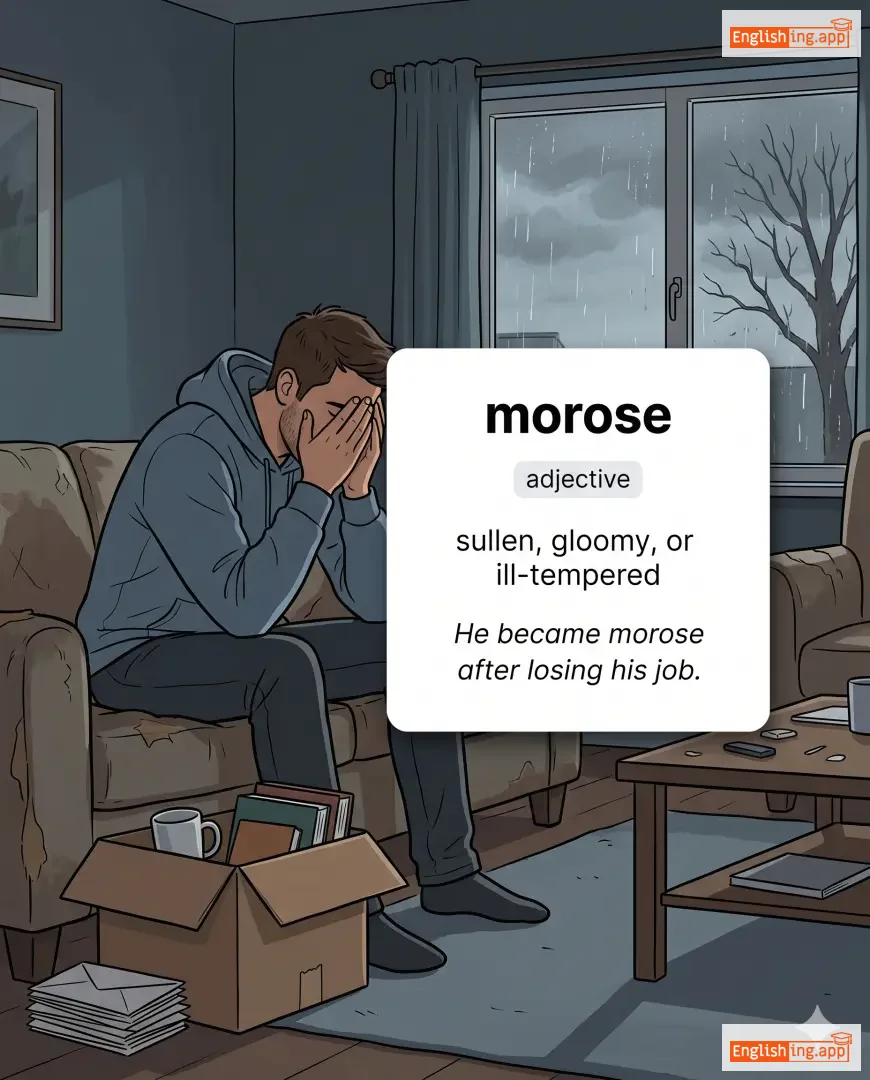
morose definition card — visual illustration of the meaning
adjective
/məˈroʊs/
melancólico (melancolico)

sullen, gloomy, or ill-tempered

"He became morose after losing his job."

"Se volvió melancólico después de perder su trabajo." (Se volvio melancolico despues de perder su trabajo.)
verb
/mɔːrf/
transformarse (transformarse)

to change smoothly from one form, shape, or character into another

"The caterpillar will morph into a butterfly."

"La oruga se transformará en una mariposa." (La oruga se transformará en una mariposa.)
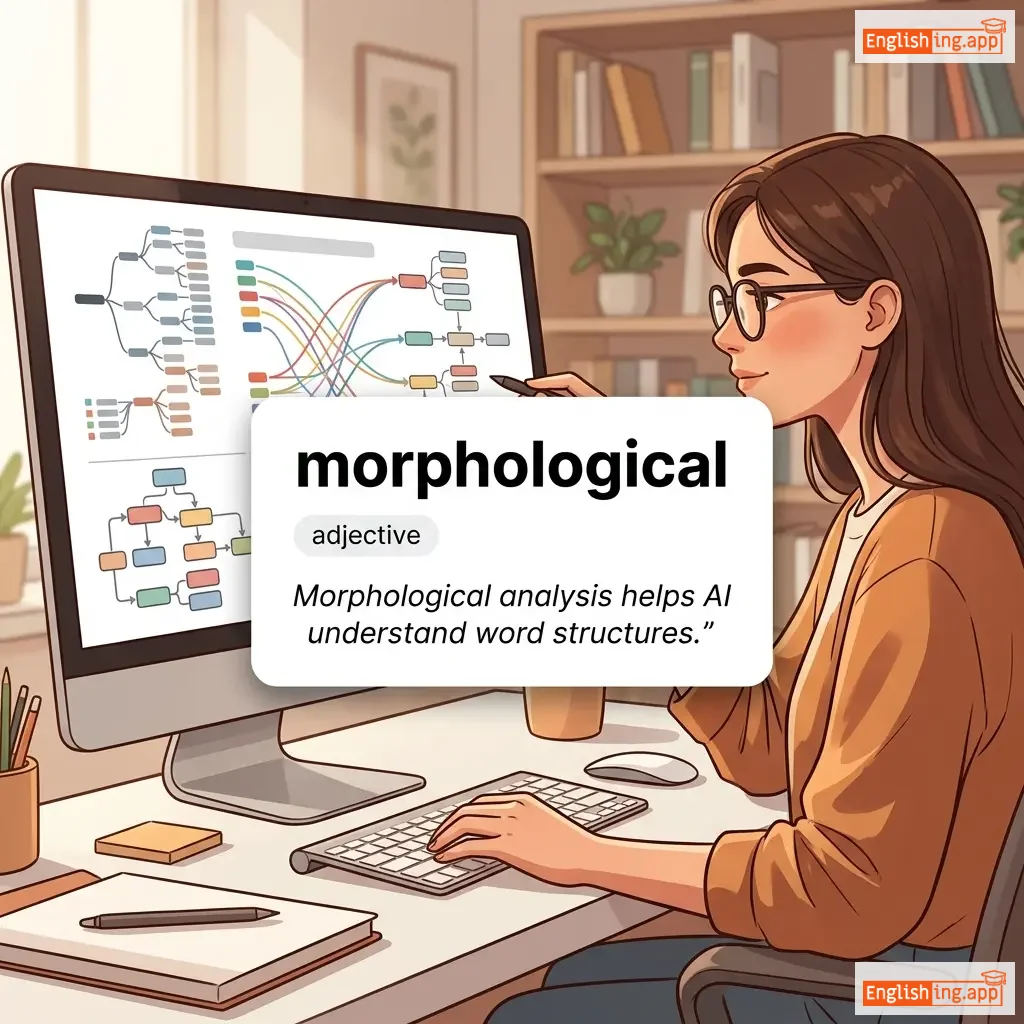
morphological definition card — visual illustration of the meaning
adjective
ˌmɔː.fəˈlɒdʒ.ɪ.kəl
relacionado con la estructura y formación de palabras (morphological)

Related to the structure and formation of words; concerning morphology in linguistics.

"Morphological analysis helps AI understand word structures."

"El análisis morfológico ayuda a la IA a entender las estructuras de las palabras." (El analisis morfologico ayuda a la IA a entender las estructuras de las palabras.)
noun
/mɔːrˈfɑːlədʒi/
morfología (morfologia)

the study of the form and structure of things, especially in language and biology

"Morphology studies the structure of words and how they are formed."

"La morfología estudia la estructura de las palabras y cómo se forman." (La morfología estudia la estructura de las palabras y cómo se forman.)
adjective
/ˈmɔːtəl/
mortal; perecedero; humano (mortal; perecedero; humano)

subject to death; having a limited lifespan; human

"All human beings are mortal and will eventually die."

"Todos los seres humanos son mortales y eventualmente morirán." (Todos los seres humanos son mortales y eventualmente morirán.)
noun
/mɔːˈtæləti/
mortalidad (mortalidad)

the state of being subject to death; the death rate of a population

"Advancements in medicine have reduced child mortality significantly."

"Los avances en medicina han reducido significativamente la mortalidad infantil." (Los avances en medicina han reducido significativamente la mortalidad infantil.)
noun
/ˈmɔːrtər/
mezcla para juntar ladrillos / pequeño cañón (mezcla para juntar ladrillos / pequeno canon)

a mixture used in building to bond bricks or stones together; also, a small cannon for firing shells

"The workers applied mortar between the bricks."

"Los trabajadores aplicaron mortero entre los ladrillos." (Los trabajadores aplicaron mortero entre los ladrillos.)
noun
/ˈmɔː.tər ænd ˈpes.əl/
mortero y pistilo (mórtar y pistilo)

a bowl and grinding tool used to crush and grind spices, herbs, and other substances

"She ground the spices using a mortar and pestle."

"Ella molió las especias usando un mortero y pistilo." (Ella molió las especias usando un mortero y pistilo.)
noun
/ˈmɔːrɡɪdʒ/
hipoteca (hipoteca)

a legal agreement where a person borrows money to buy property and pays it back over time

"They applied for a mortgage to buy their new house."

"Solicitaron una hipoteca para comprar su nueva casa." (Solicitaron una hipoteca para comprar su nueva casa.)
noun
/mɔːrˈtɪʃən/
funerario (funerario)

a person whose job is to prepare dead bodies for burial or cremation and to arrange funerals

"The mortician prepared the body for the funeral service."

"El funerario preparó el cuerpo para el servicio funerario." (El funerario preparó el cuerpo para el servicio funerario.)
verb
/ˈmɔːrtɪfaɪ/
mortificar (mortificar)

to cause someone to feel great embarrassment or shame

"She was mortified when she tripped on stage."

"Ella estaba mortificada cuando tropezó en el escenario." (Ella estaba mortificada cuando tropezó en el escenario.)
noun
/moʊˈzeɪɪk/
mosaico (mosaiko)

A picture or pattern produced by arranging together small pieces of stone, tile, or glass.

"The church ceiling was decorated with a beautiful mosaic."

"El techo de la iglesia estaba decorado con un hermoso mosaico." (El techo de la iglesia estaba decorado con un hermoso mosaico.)
noun
/mɒsk/
mezquita (mezquita)

A Muslim place of worship.

"They gathered at the mosque for the Friday prayer."

"Se reunieron en la mezquita para la oración del viernes." (Se reunieron en la mezquita para la oración del viernes.)
noun
/məˈskiːtəʊ/
mosquito (mosquito)

a small flying insect known for biting and spreading diseases such as malaria

"The mosquito bit me while I was sleeping under the net."

"El mosquito me mordió mientras dormía bajo la red." (El mosquito me mordio mientras dormia bajo la red)
noun
/məˈskiː.toʊ net/
mosquitera (mosquitera)

a fine mesh fabric used to cover beds or windows to keep mosquitoes and other insects out

"We use a mosquito net to protect ourselves from insect bites."

"Usamos una mosquitera para protegernos de las picaduras de insectos." (Usamos una mosquitera para protegernos de las picaduras de insectos.)
noun
/mɔːs/
musgo (musgo)

a small flowerless plant that grows in clumps in moist places

"Green moss covered the old stone wall."

"El musgo verde cubrió la antigua pared de piedra." (El musgo verde cubrio la antigua pared de piedra.)
adjective
/ˈmɒsi/
cubierto de musgo; con musgo creciendo en él (cubierto de musgo; con musgo creciendo en él)

covered with moss; having moss growing on it

"The old tree trunk was mossy and covered with green vegetation."

"El tronco viejo del árbol estaba cubierto de musgo y cubierto de vegetación verde." (El tronco viejo del árbol estaba cubierto de musgo y cubierto de vegetación verde.)
adjective, adverb, pronoun
/moʊst/
la mayoría (la mayoria)

the greatest in amount, degree, or number

"Most people like to relax on weekends."

"La mayoría de las personas prefieren relajarse los fines de semana." (La mayoria de las personas prefieren relajarse los fines de semana.)
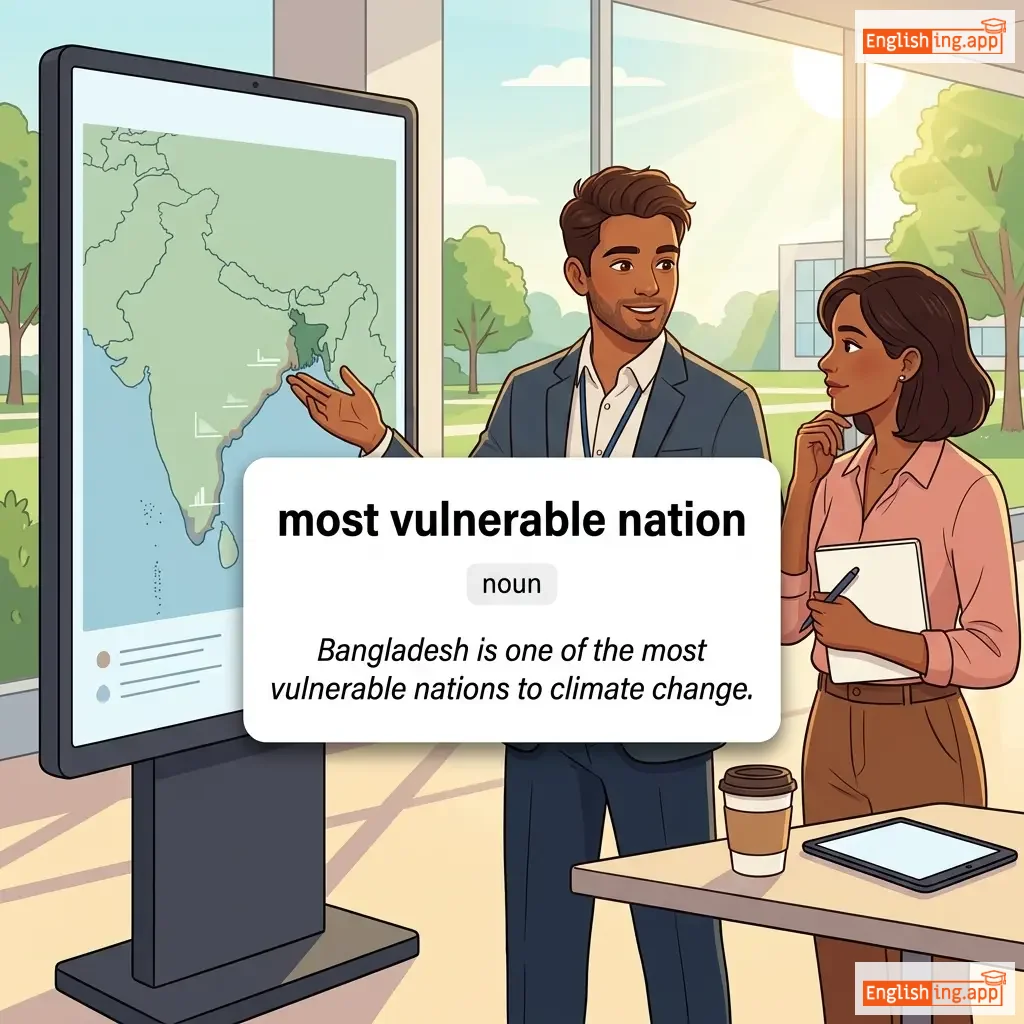
most vulnerable nation definition card — visual illustration of the meaning
noun
moʊst ˈvʌlnərəbəl ˈneɪʃən
nación más vulnerable (nacion mas vulnerable)

A country that is highly exposed to risks and lacks adequate protection or resilience.

"Bangladesh is one of the most vulnerable nations to climate change."

"Bangladesh es uno de los países más vulnerables al cambio climático." (Bangladesh es uno de los paises mas vulnerables al cambio climatico.)
adverb
/ˈmoʊstli/
principalmente (principalmente)

for the most part; mainly

"She is mostly interested in art and literature."

"Ella está principalmente interesada en el arte y la literatura." (Ella está principalmente interesada en el arte y la literatura.)
noun
/moʊt/
partícula (particula)

A tiny particle or speck, especially of dust.

"A mote of dust floated in the sunlight."

"Una partícula de polvo flotaba en la luz del sol." (Una particula de polvo flotaba en la luz del sol.)
adjective
/ˈmɒθ ˌiːtən/
comido por polillas (comido por polillas)

Damaged or worn out, especially by moths or age.

"He wore a moth-eaten sweater on the cold day."

"Llevaba un suéter comido por polillas en el día frío." (Llevaba un suéter comido por polillas en el día frío.)
👩‍👧

mother (madre)

noun
/ˈmʌðər/
madre (madre)

a female parent

"Her mother is a kind and caring person."

"Su madre es una persona amable y cariñosa." (Su madre es una persona amable y cariñosa.)
noun
/ˈmʌðər ˈlæŋɡwɪdʒ/
lengua materna (lengua materna)

the first language a person learns from childhood; native language

"Children learn best when they are taught in their mother language."

"Los niños aprenden mejor en su lengua materna." (los ninos aprenden mejor en su lengua materna)
noun
/ˈmʌð.ər.hʊd/
maternidad (maternidad)

the state of being a mother; the qualities of a mother

"She embraced the joys and challenges of motherhood."

"Ella abrazó las alegrías y los desafíos de la maternidad." (Ella abrazó las alegrías y los desafíos de la maternidad.)
noun
/ˈmʌð.ər.lænd/
madre patria; país natal (madre patria)

the country where one was born or has citizenship; homeland

"He always spoke fondly of his motherland."

"Él siempre hablaba cariñosamente de su madre patria." (El siempre hablaba carinosamente de su madre patria.)
👩‍👧‍👦

Motherly (mádərli)

adjective
/ˈmʌðərli/
maternal (maternal)

having qualities characteristic of a mother; caring and protective

"She showed motherly care and affection towards all the children."

"Ella mostró cuidado y afecto maternal hacia todos los niños." (Ella mostro cuidado y afecto maternal hacia todos los ninos.)
noun
/moʊˈtiːf/
motivo (motivo)

A recurring theme, subject, or idea in a work of art or literature.

"The motif of love is central to the novel."

"El motivo del amor es central en la novela." (El motivo del amor es central en la novela.)
adjective
/ˈmoʊtaɪl/
móvil (movil)

Capable of movement or locomotion.

"Certain bacteria are motile and can swim toward nutrients."

"Ciertas bacterias son móviles y pueden nadar hacia los nutrientes." (Ciertas bacterias son moviles y pueden nadar hacia los nutrientes.)
noun
/moʊˈtɪləti/
motilidad (motilidad)

The ability of an organism or cell to move independently.

"The motility of sperm is crucial for successful fertilization."

"La motilidad de los espermatozoides es crucial para la fertilización exitosa." (La motilidad de los espermatozoides es crucial para la fertilización exitosa.)
noun
/ˈmoʊʃən/
movimiento (movimiento)

the act or process of moving; a change of place or position

"The motion of the car made her sleepy."

"El movimiento del coche la hizo sentir sueño." (El movimiento del coche la hizo sentir sueño.)
verb
/ˈmoʊtɪveɪt/
motivar (motivar)

To provide someone with a reason or incentive to do something.

"The coach motivated the players to give their best performance."

"El entrenador motivó a los jugadores a dar lo mejor de su rendimiento." (El entrenador motivó a los jugadores a dar lo mejor de su rendimiento.)
noun
/ˌmoʊtɪˈveɪʃən/
motivación (motivacion)

the reason or drive for acting or behaving in a particular way

"She lost her motivation to continue the project."

"Ella perdió su motivación para continuar el proyecto." (Ella perdió su motivación para continuar el proyecto.)
noun
/ˈmoʊtɪv/
motivo (motivo)

a reason for doing something, especially one that is hidden or not obvious

"The police could not determine the motive behind the crime."

"La policía no pudo determinar el motivo detrás del crimen." (La policia no pudo determinar el motivo detras del crimen.)
adjective
/ˈmɒtli/
heterogéneo (heterogéneo)

Made up of different, often incongruous or diverse elements.

"The festival attracted a motley crowd of artists, musicians, and tourists."

"El festival atrajo una multitud heterogénea de artistas, músicos y turistas." (El festival atrajo una multitud heterogénea de artistas, músicos y turistas.)
noun
/ˈmoʊtər/
motor (motor)

a machine that produces motion or power to make something work

"The car’s motor stopped suddenly."

"El motor del coche se detuvo de repente." (El motor del coche se detuvo de repente.)
noun
/ˈmoʊ.tər ˌsaɪ.kəl/
motocicleta (motocicleta)

a two-wheeled vehicle powered by an engine

"He rides his motorcycle to work every day."

"Él monta su motocicleta al trabajo todos los días." (El monta su motocicleta al trabajo todos los días.)
noun
/ˈmoʊ.tər ˈlɔː.ri/
camión motorizado (camion motorizado)

a large motor vehicle used for transporting goods; truck

"The motor lorry delivered fresh vegetables to the market."

"El camión motorizado entregó verduras frescas al mercado." (El camion motorizado entrego verduras frescas al mercado.)
noun
/ˈmoʊtərˌsaɪkəl/
motocicleta (motocicleta)

a two-wheeled motor-powered vehicle designed for transportation

"He rides his motorcycle to work every morning."

"Él va al trabajo en motocicleta todas las mañanas." (El va al trabajo en motocicleta todas las mananas)
noun
/ˈməʊtərɪst/
automovilista (automovilista)

a person who drives a motor vehicle, especially a car or motorcycle

"The motorist stopped to help after seeing the accident on the highway."

"El automovilista se detuvo para ayudar después de ver el accidente." (El automovilista se detuvo para ayudar despues de ver el accidente)
verb
/ˈmɒtl/
moteado (moteado)

To mark with spots or patches of color.

"The leaves were mottled with shades of yellow and brown."

"Las hojas estaban moteadas con tonos de amarillo y marrón." (Las hojas estaban moteadas con tonos de amarillo y marrón.)
adjective
/ˈmɒtld/
moteado (moteado)

Marked with spots, streaks, or blotches of different shades or colors.

"The snake's mottled skin helped it blend into the forest floor."

"La piel moteada de la serpiente le ayudó a camuflarse en el suelo del bosque." (La piel moteada de la serpiente le ayudó a camuflarse en el suelo del bosque.)
noun
/ˈmɒtəʊ/
lema (lema)

A short sentence or phrase that expresses a guiding belief or principle.

"Her motto in life is 'never give up.'"

"Su lema en la vida es 'nunca te rindas.'" (Su lema en la vida es 'nunca te rindas.')