Vocabularios

Descubra, aprenda y domine el vocabulario en inglés

adjective
/maɪld/
suave (suave)

not severe or strong; gentle in nature

"The patient had only mild symptoms."

"El paciente solo tenía síntomas leves." (El paciente solo tenía síntomas leves.)
noun
/maɪl/
milla (milla)

a unit of distance equal to 1,609.34 meters; a long distance figuratively

"She walked a mile to reach the bus stop."

"Caminó una milla para llegar a la parada del autobús." (Camino una milla para llegar a la parada del autobus)
noun
/ˈmaɪlɪdʒ/
rendimiento de combustible (rendimiento de combustible)

The distance traveled in miles, or the fuel efficiency of a vehicle.

"This car gives excellent mileage on highways."

"Este coche da un excelente rendimiento de combustible en las autopistas." (Este coche da un excelente rendimiento de combustible en las autopistas.)
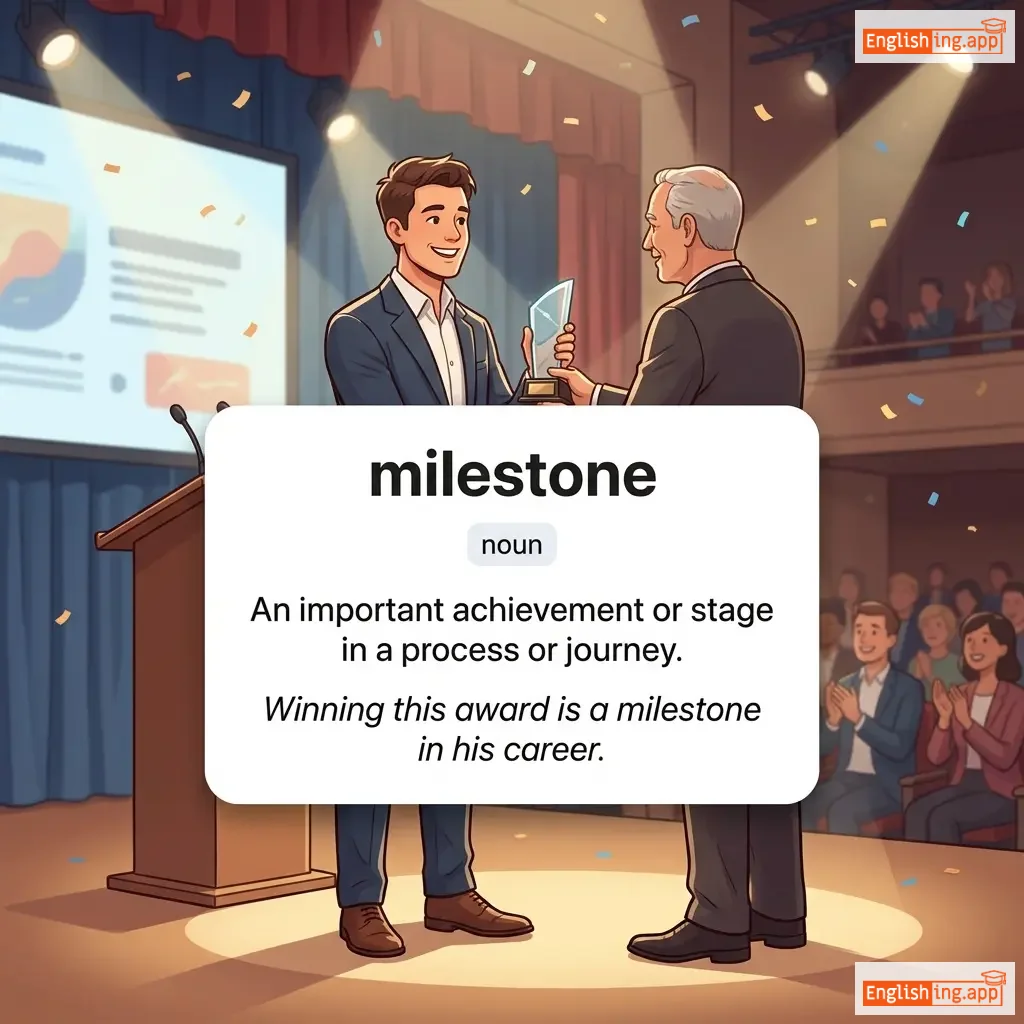
milestone definition card — visual illustration of the meaning
noun
ˈmaɪl.stəʊn
hito importante (heeto importante)

An important achievement or stage in a process or journey.

"Winning this award is a milestone in his career."

"Ganar este premio es un hito en su carrera." (Ganar este premio es un heeto en su carrera.)
noun
/miːlˈjuː/
entorno (entorno)

A person's social environment or surroundings.

"She grew up in an artistic milieu."

"Ella creció en un entorno artístico." (Ella creció en un entorno artístico.)
adjective
/ˈmɪlɪtənt/
militante (militante)

Aggressively active in a cause, sometimes using forceful methods.

"The group became increasingly militant in their demands."

"El grupo se volvió cada vez más militante en sus demandas." (El grupo se volvió cada vez más militante en sus demandas.)
noun
/ˈmɪlɪtəˌrɪzəm/
militarismo (militarismo)

The belief in maintaining a strong military and using it aggressively to defend or promote national interests.

"The rise of militarism in the region caused tension among neighboring countries."

"El auge del militarismo en la región causó tensiones entre los países vecinos." (El auge del militarismo en la región causó tensiones entre los países vecinos.)
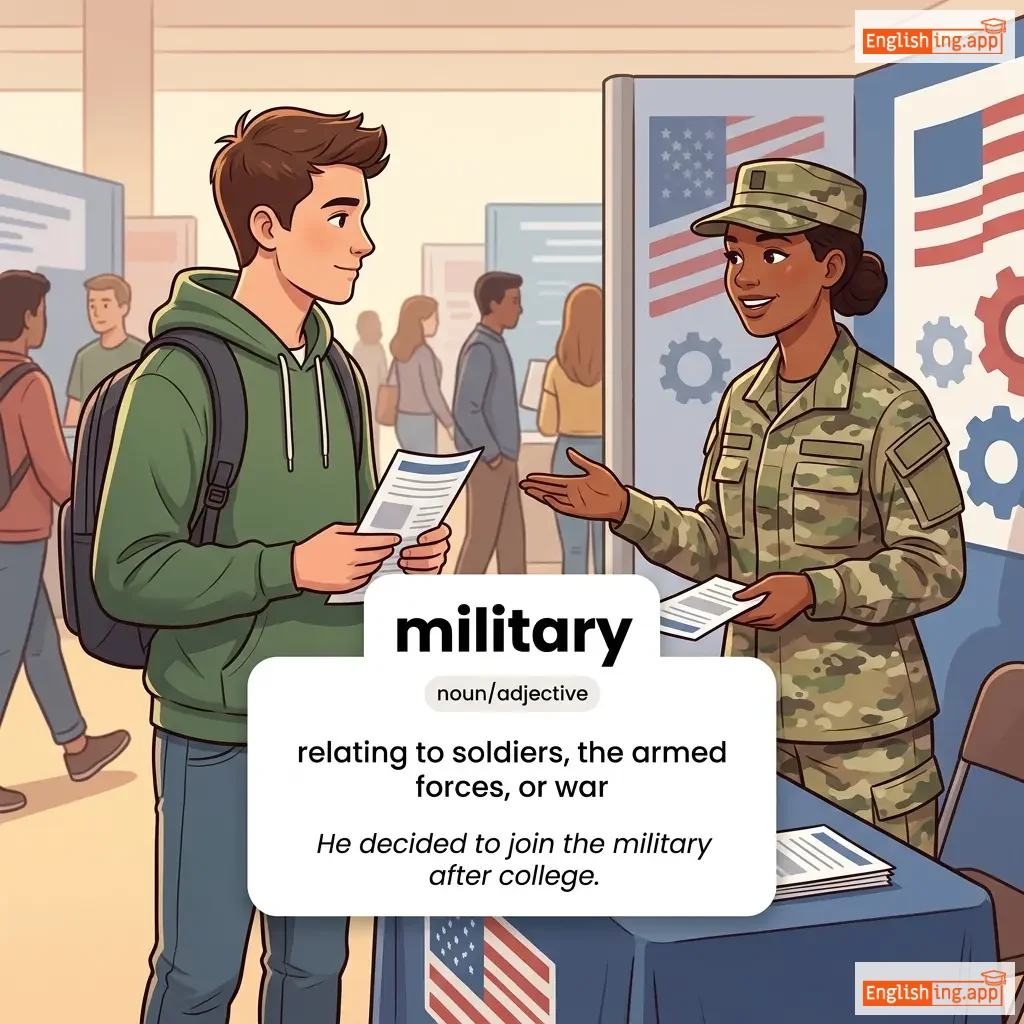
military definition card — visual illustration of the meaning
noun/adjective
/ˈmɪlɪˌtɛri/
militar (militar)

relating to soldiers, the armed forces, or war

"He decided to join the military after college."

"Decidió unirse al ejército después de la universidad." (Decidió unirse al ejército después de la universidad.)
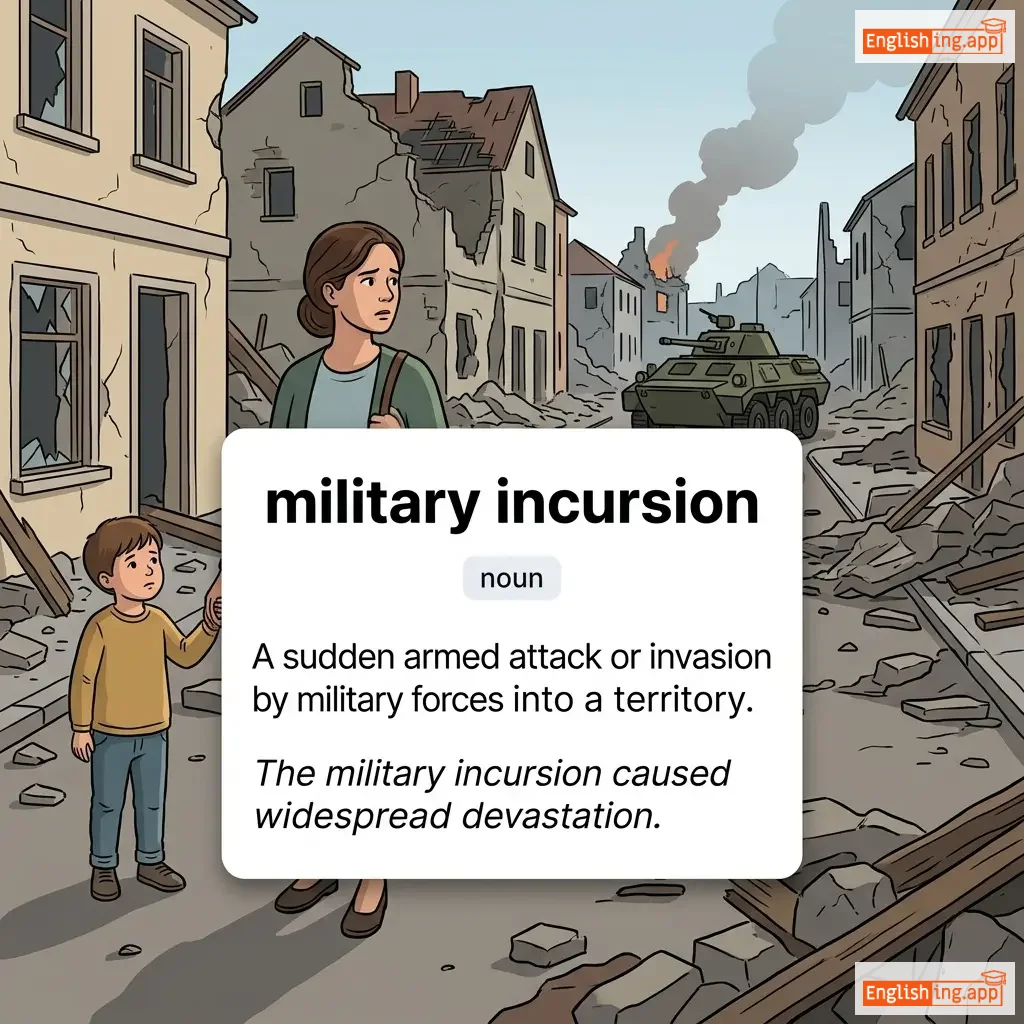
military incursion definition card — visual illustration of the meaning
noun
ˈmɪl.ɪ.tər.i ɪnˈkɜː.ʃən
incursión militar (incursion militar)

A sudden armed attack or invasion by military forces into a territory.

"The military incursion caused widespread devastation."

"La incursión militar causó una devastación generalizada." (La incursión militar causó una devastación generalizada.)
verb
/ˈmɪlɪˌteɪt/
obstruir (obstruir)

to have a strong effect against something; to work as a powerful factor in preventing or influencing an outcome

"His lack of experience will militate against his promotion."

"La falta de experiencia de él obstaculizará su promoción." (La falta de experiencia de él obstaculizará su promoción.)
noun
/mɪˈlɪʃə/
milicia (milisia)

a group of ordinary people who are trained to act as soldiers in emergencies

"The village formed a militia to defend against attacks."

"El pueblo formó una milicia para defenderse de los ataques." (El pueblo formó una milicia para defenderse de los ataques.)
noun, verb
/mɪlk/
felicidad (felicidad)

noun: a white liquid produced by female mammals for feeding their young; verb: to draw milk from an animal

"She milked the cow early in the morning."

"Ella ordeñó la vaca temprano por la mañana." (Ella ordeñó la vaca temprano por la mañana.)
noun
/mɪlk raɪs/
arroz con leche (arroz con leche)

A sweet dessert made from rice cooked with milk and sugar

"My grandmother makes delicious milk rice for special occasions."

"Mi abuela hace delicioso arroz con leche para ocasiones especiales." (Mi abuela hace delicioso arroz con leche para ocasiones especiales.)
noun
/ˈmɪlk pɒt/
lechetera (lechetera)

a container specifically used for storing or serving milk

"She poured fresh milk from the milk-pot into her glass."

"Ella vertió leche fresca de la lechetera en su vaso." (Ella vertió leche fresca de la lechetera en su vaso)
noun
/ˈmɪlk.mæn/
lechero (lechero)

a person who delivers milk to homes or businesses

"The milkman delivers fresh milk to our house every morning."

"El lechero entrega leche fresca a nuestra casa todas las mañanas." (El lechero entrega leche fresca a nuestra casa todas las mañanas.)
adjective
/ˈmɪl.ki waɪt/
blanco lechoso (blanco lechoso)

a pure white color resembling milk

"The clouds looked milky white against the blue sky."

"Las nubes se veían blancas como la leche contra el cielo azul." (Las nubes se veían blancas como la leche contra el cielo azul.)
noun
/mɪl/
molino (molino)

a building equipped with machinery for grinding grain or manufacturing goods

"The old flour mill has been converted into a museum."

"El viejo molino de harina ha sido convertido en un museo." (El viejo molino de harina ha sido convertido en un museo.)
noun
/mɪˈlɛniəm/
milenio (milenio)

a period of one thousand years; often used to mark an anniversary

"The year 2000 was celebrated as the beginning of a new millennium."

"El año 2000 se celebró como el comienzo de un nuevo milenio." (El ano 2000 se celebro como el comienzo de un nuevo milenio.)
noun
/ˈmɪlɪt/
mijo (mijo)

a small-seeded grass cultivated as a cereal crop

"Millet is often used as food in rural areas."

"El mijo se usa a menudo como alimento en las áreas rurales." (El mijo se usa a menudo como alimento en las áreas rurales.)
noun
/ˈmɪljən/
millón (millon)

the number equivalent to one thousand thousand (1,000,000)

"The movie earned over a million dollars in its first week."

"La película ganó más de un millón de dólares en su primera semana." (La pelicula gano mas de un millon de dolares en su primera semana.)
noun
/ˌmɪl.jəˈneər/
millonario (millonario)

A person whose wealth equals or exceeds one million units of currency

"He became a millionaire through smart investments and hard work."

"Se convirtió en millonario gracias a inversiones inteligentes y trabajo duro." (Se convirtió en millonario gracias a inversiones inteligentes y trabajo duro.)
noun
/maɪm/
actor mudo (actor mudo)

A performer who conveys meaning through gestures and body movements without speech.

"The mime entertained the children with exaggerated expressions."

"El mimo entretuvo a los niños con expresiones exageradas." (El mimo entretuvo a los niños con expresiones exageradas.)
verb
/ˈmɪmɪk/
imitar (imitar)

To copy the actions, speech, or behavior of someone or something.

"Children often mimic their parents' behavior."

"Los niños a menudo imitan el comportamiento de sus padres." (Los niños a menudo imitan el comportamiento de sus padres.)
noun
/ˈmɪmɪkri/
imitación (imitacion)

The act of imitating someone or something, often for humor or learning.

"The comedian’s mimicry of celebrities made the audience laugh."

"La imitación de las celebridades por el comediante hizo reír a la audiencia." (La imitacion de las celebridades por el comediante hizo reir a la audiencia.)
noun
/ˌmɪnəˈrɛt/
minarete (minarete)

A tall, slender tower of a mosque, from which the call to prayer is announced.

"The minaret of the mosque could be seen from miles away."

"El minarete de la mezquita se podía ver desde kilómetros de distancia." (El minarete de la mezquita se podia ver desde kilometros de distancia.)
adjective
/ˈmɪnətɔːri/
amenazante (amenazante)

Expressing a threat; menacing.

"The criminal gave the witness a minatory look."

"El criminal le dio al testigo una mirada amenazante." (El criminal le dio al testigo una mirada amenazante.)
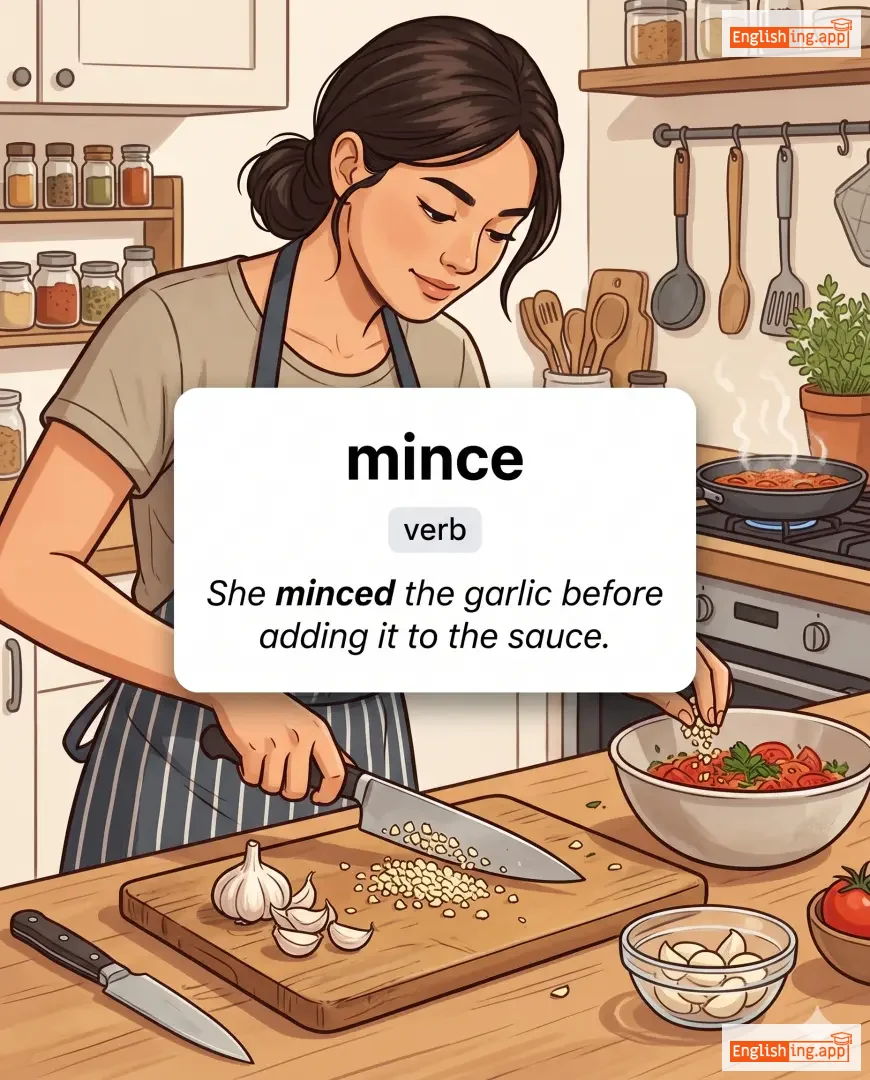
mince definition card — visual illustration of the meaning
verb
/mɪns/
picar (picar)

to cut food, especially meat, into very small pieces; to speak in an affectedly delicate or refined way

"She minced the garlic before adding it to the sauce."

"Ella picó el ajo antes de añadirlo a la salsa." (Ella pico el ajo antes de añadirlo a la salsa.)
adjective
/ˈmɪnsɪŋ/
afectado (afectado)

affectedly delicate, dainty, or refined in manner or movement

"He walked with mincing steps across the stage."

"Él caminó con pasos afectados a través del escenario." (El caminó con pasos afectados a través del escenario.)
noun/verb
/maɪnd/
mente / cuidar (mente / cuidar)

the part of a person that enables them to think, feel, and reason; to pay attention or take care

"Please mind the gap between the train and the platform."

"Por favor, mantén el espacio entre el tren y la plataforma." (Por favor, manten el espacio entre el tren y la plataforma.)
adjective
/ˈmaɪnd.fəl/
atento; consciente (atento; consciente)

being conscious or aware; paying attention to the present moment

"She is always mindful of her surroundings and pays attention to details."

"Ella siempre está atenta a su entorno y presta atención a los detalles." (Ella siempre esta atenta a su entorno y presta atencion a los detalles.)
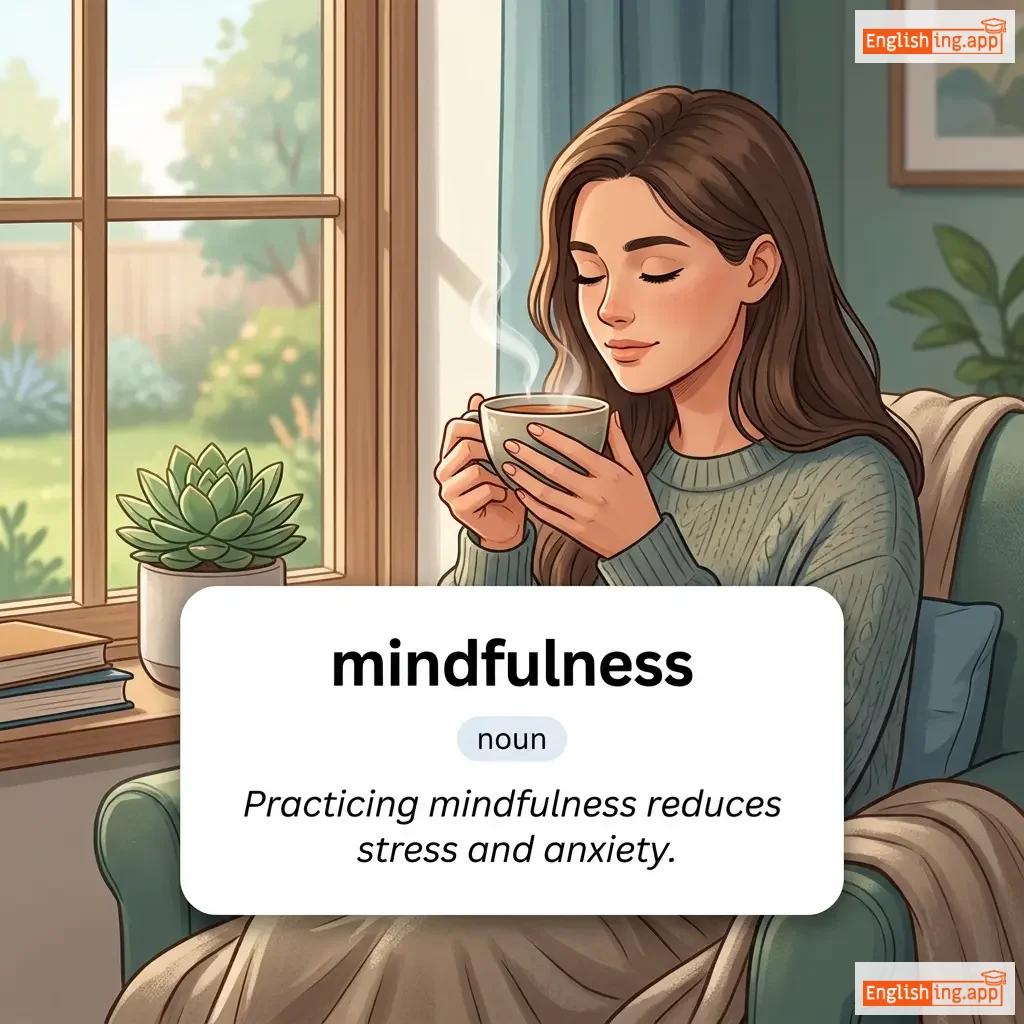
mindfulness definition card — visual illustration of the meaning
noun
/ˈmaɪnd.fʊl.nəs/
atención plena (atencion plena)

The quality or state of being conscious or aware of something; a mental state achieved by focusing one's awareness on the present moment.

"Practicing mindfulness reduces stress and anxiety."

"La práctica de la atención plena reduce el estrés y la ansiedad." (La practica de la atencion plena reduce el estres y la ansiedad.)
adjective
/ˈmaɪndləs/
sin sentido (sin sentido)

without thought or intelligence; done without consideration

"He was bored by the mindless tasks at work."

"Estaba aburrido por las tareas sin sentido en el trabajo." (Estaba aburrido por las tareas sin sentido en el trabajo.)
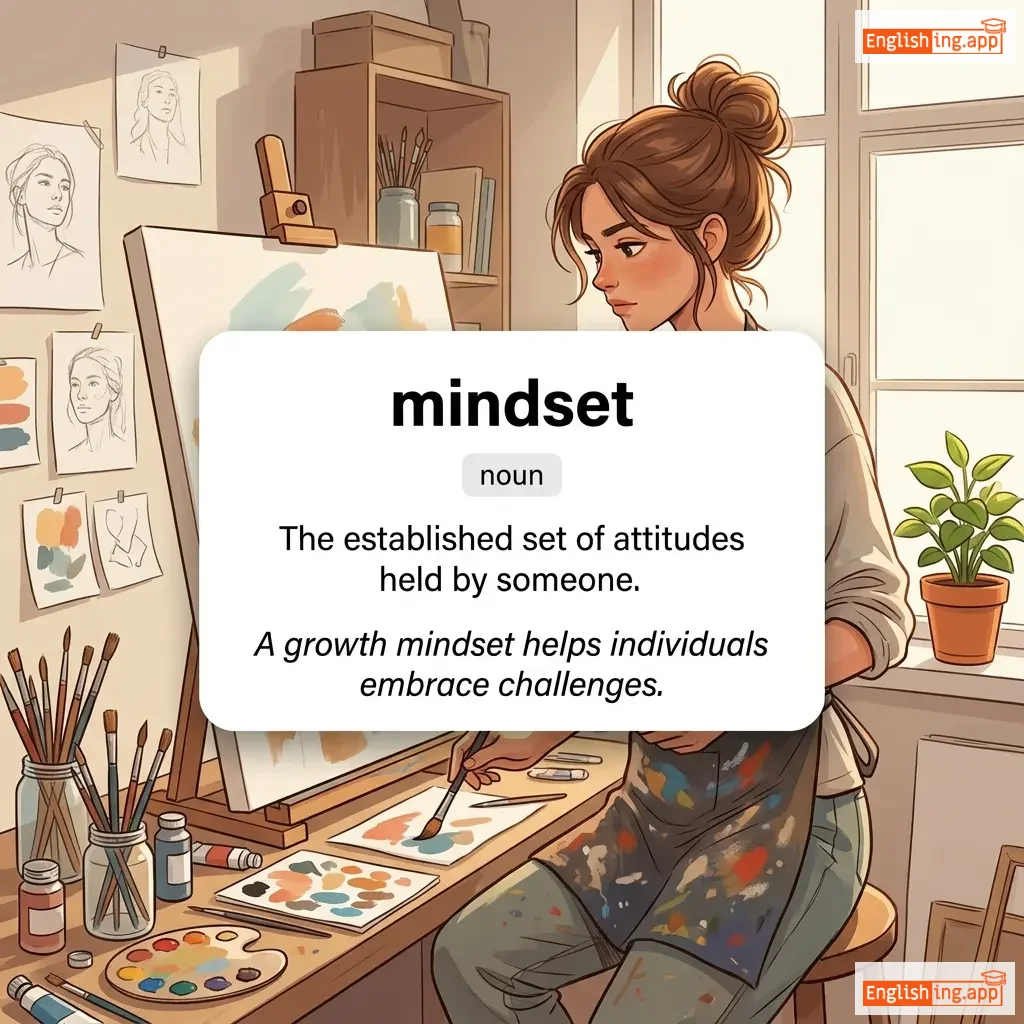
mindset definition card — visual illustration of the meaning
noun
ˈmaɪnd.set
mentalidad (mentalidad)

The established set of attitudes held by someone.

"A growth mindset helps individuals embrace challenges."

"Una mentalidad de crecimiento ayuda a las personas a aceptar los desafíos." (Una mentalidad de crecimiento ayuda a las personas a aceptar los desafíos.)
noun, pronoun, verb
/maɪn/
mina / mío (mina / mio)

a place where minerals are dug from the ground; or something belonging to me

"The workers went deep into the mine to extract coal."

"Los trabajadores fueron al fondo de la mina para extraer carbón." (Los trabajadores fueron al fondo de la mina para extraer carbón.)
noun
/ˈmaɪnə(r)/
minero (minero)

a person who works in a mine, extracting minerals or other resources

"The miner worked in the coal mine for many years."

"El minero trabajó en la mina de carbón durante muchos años." (El minero trabajó en la mina de carbón durante muchos años.)
noun
/ˈmɪnərəl/
mineral (mineral)

a naturally occurring substance that is solid and inorganic, often used in industry or nutrition

"Calcium is an important mineral for strong bones."

"El calcio es un mineral importante para los huesos fuertes." (El calcio es un mineral importante para los huesos fuertes.)
verb
/ˈmɪŋɡl/
mezclarse (mezclarse)

to mix or combine; to move among people and engage socially

"Guests mingled at the party, chatting and laughing together."

"Los invitados minglaban en la fiesta, charlando y riendo juntos." (Los invitados minglaban en la fiesta, charlando y riendo juntos.)
adjective
/ˈmɪn.dʒi/
tacaño; avaro (tacano; avaro)

mean or stingy; unwilling to spend money

"He is too mingy to spend money on anything but necessities."

"Él es demasiado tacaño para gastar dinero en algo que no sea lo esencial." (El es demasiado tacano para gastar dinero en algo que no sea lo esencial.)
noun/adjective
/ˈmɪnətʃər/ or /ˈmɪniətʃʊr/
versión en miniatura (version en miniatura)

a very small version of something; small in scale or size

"The artist created a miniature model of the castle."

"El artista creó un modelo en miniatura del castillo." (El artista creo un modelo en miniatura del castillo.)
adjective
/ˈmɪnɪməl/
mínimo (minimo)

the smallest or least amount possible

"The damage to the car was minimal after the accident."

"El daño al coche fue mínimo después del accidente." (El dano al coche fue minimo despues del accidente.)
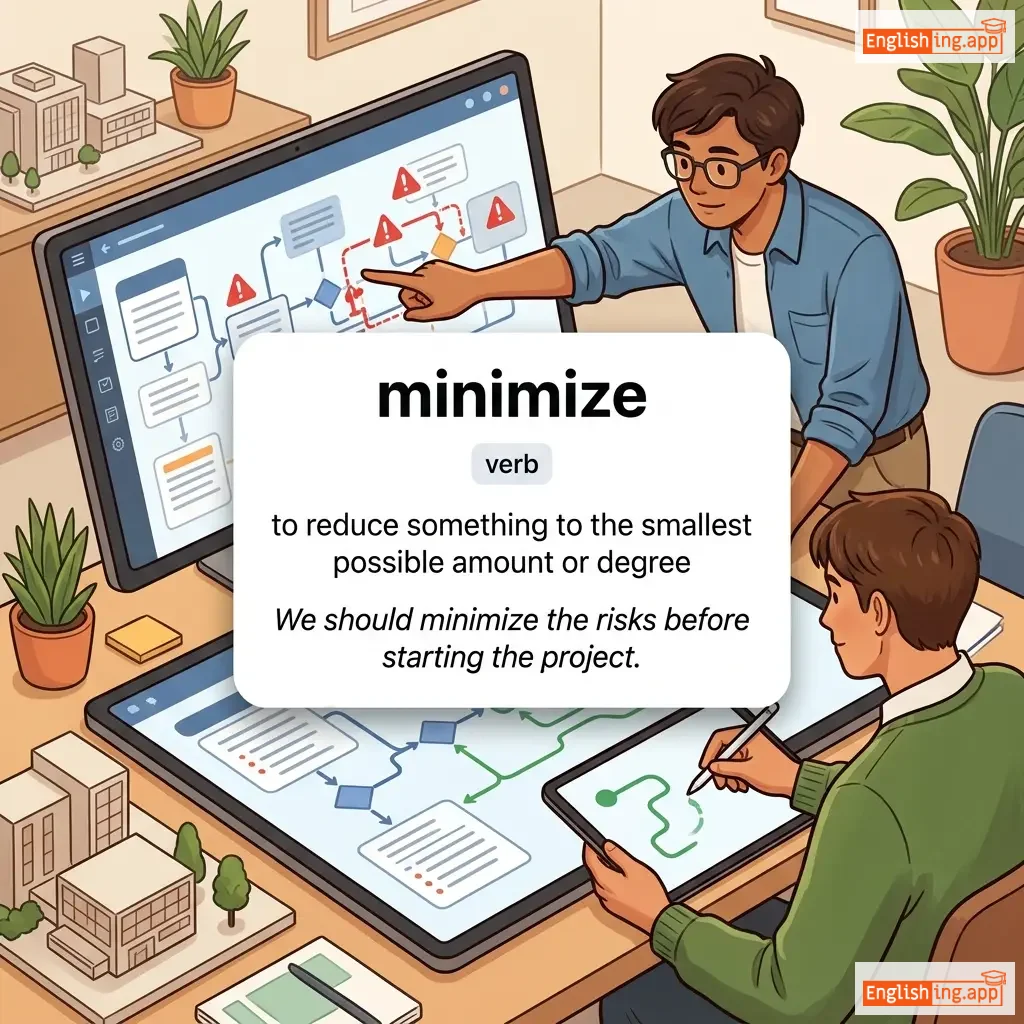
minimize definition card — visual illustration of the meaning
verb
/ˈmɪnɪmaɪz/
minimizar (minimizar)

to reduce something to the smallest possible amount or degree

"We should minimize the risks before starting the project."

"Debemos minimizar los riesgos antes de comenzar el proyecto." (Debemos minimizar los riesgos antes de comenzar el proyecto.)
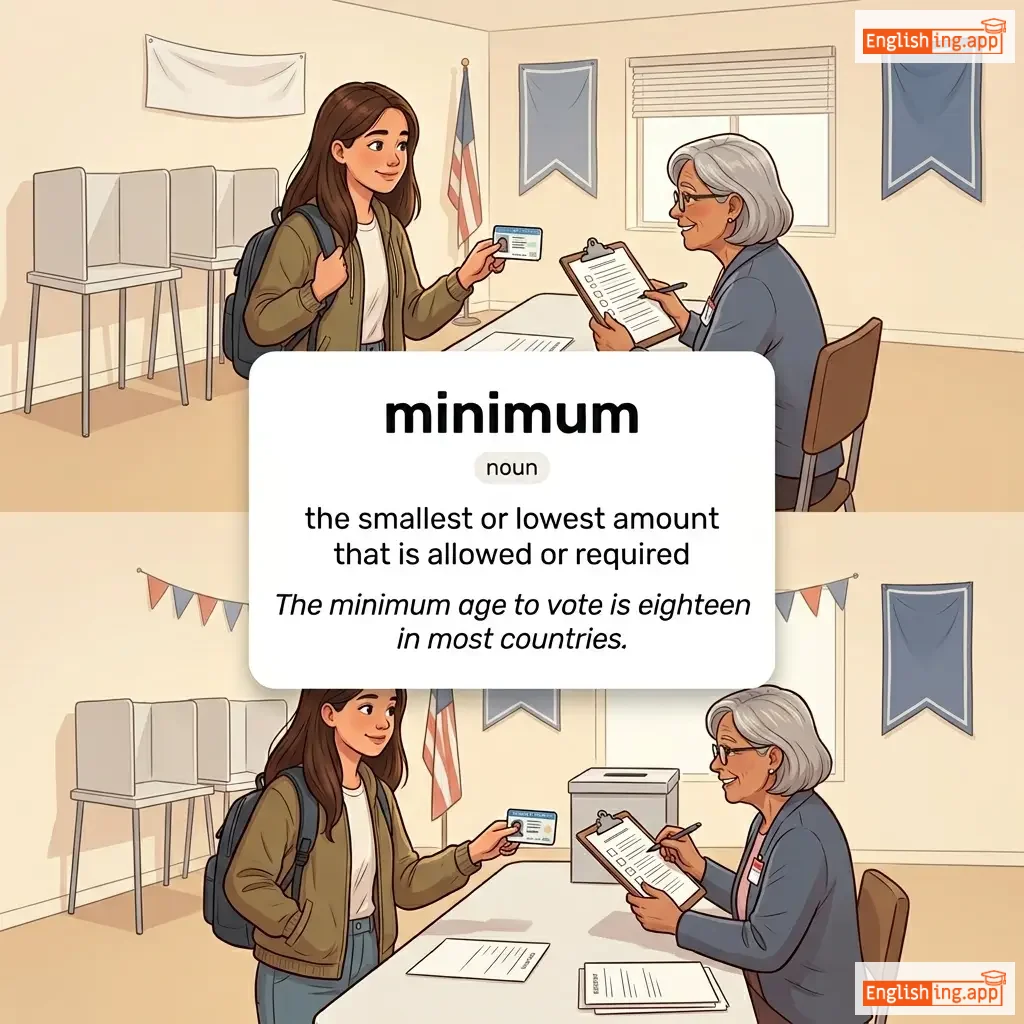
minimum definition card — visual illustration of the meaning
noun
/ˈmɪnɪməm/
mínimo (minimo)

the smallest or lowest amount that is allowed or required

"The minimum age to vote is eighteen in most countries."

"La edad mínima para votar es dieciocho en la mayoría de los países." (La edad minima para votar es dieciocho en la mayoria de los paises.)
noun
/ˈmaɪnɪŋ/
minería (mineria)

the process of extracting valuable minerals or other resources from the earth

"Mining in this area has increased in recent years."

"La minería en esta área ha aumentado en los últimos años." (La mineria en esta area ha aumentado en los ultimos anos.)
🧑‍🤝‍🧑

minion (mínion)

noun
/ˈmɪn.i.ən/
esbirro (esbirro)

A follower or underling of a powerful person, especially a servile one.

"The dictator was surrounded by loyal minions who carried out his orders."

"El dictador estaba rodeado de esbirros leales que cumplían sus órdenes." (El dictador estaba rodeado de esbirros leales que cumplían sus órdenes.)
adjective
/ˈmɪn.ɪ.skjuːl/
minúsculo (minusculo)

Extremely small or tiny.

"The error was so miniscule that nobody noticed it."

"El error era tan minúsculo que nadie lo notó." (El error era tan minusculo que nadie lo noto.)
noun
/ˈmɪnɪstər/
ministro (ministro)

a head of a government department; a person who leads a church

"The finance minister announced new tax policies."

"El ministro de finanzas anunció nuevas políticas fiscales." (El ministro de finanzas anunció nuevas políticas fiscales.)
noun
/ˌmɪn.ɪˈstreɪ.ʃən/
servicio (servicio)

The act of providing care, assistance, or religious service.

"She recovered thanks to the kind ministrations of the nurses."

"Se recuperó gracias a las amables ministraciones de las enfermeras." (Se recuperó gracias a las amables ministraciones de las enfermeras.)
noun
/ˈmɪn.ɪ.stri/
ministerio (ministerio)

A government department headed by a minister or the work of a religious minister.

"He works at the Ministry of Education."

"Él trabaja en el Ministerio de Educación." (Él trabaja en el Ministerio de Educación.)
adjective/noun
/ˈmaɪ.nər/
menor / insignificante (menor / insignificante)

less important, serious, or significant; a person under the legal age

"Luckily, the accident caused only minor injuries."

"Afortunadamente, el accidente causó solo lesiones menores." (Afortunadamente, el accidente causó solo lesiones menores.)
noun
/maɪˈnɔːr.ɪ.ti/
minoría (minoría)

A smaller number or part, especially a group differing from the majority.

"The law aims to protect the rights of ethnic minorities."

"La ley tiene como objetivo proteger los derechos de las minorías étnicas." (La ley tiene como objetivo proteger los derechos de las minorías étnicas.)