Vocabularios

Descubra, aprenda y domine el vocabulario en inglés

adjective
/məˈkɑːbrə/
macabro (macabro)

disturbing and horrifying because of involvement with or depiction of death and injury

"The horror movie had a macabre ending."

"La película de terror tenía un final macabro." (La película de terror tenía un final macabro.)
verb
/məˈkadəˌmaɪz/
cubrir una carretera con piedras rotas (cubrir una carretera con piedras rotas)

to construct or cover a road with broken stone

"The government decided to macadamize the old rural roads."

"El gobierno decidió macadamizar las viejas carreteras rurales." (El gobierno decidió macadamizar las viejas carreteras rurales.)
noun
/meɪs/
maza / cetro (maza / cetro)

a ceremonial staff carried as a symbol of authority or a weapon similar to a club

"The guard carried a mace as a symbol of authority."

"El guardia llevaba un mazo como símbolo de autoridad." (El guardia llevaba un mazo como símbolo de autoridad.)
verb
/ˈmæsəˌreɪt/
ablandar (ablandar)

to soften or break up something, especially food, by soaking in liquid

"The chef macerated the fruit in wine before serving."

"El chef maceró la fruta en vino antes de servirla." (El chef macero la fruta en vino antes de servirla.)
machiavellian definition card — visual illustration of the meaning
adjective
/ˌmækɪəˈvɛliən/
astuto, maquiavélico y sin escrúpulos, especialmente en política o para avanzar en la carrera de uno (machiavellian)

cunning, scheming, and unscrupulous, especially in politics or in advancing one's career

"The politician was known for his Machiavellian tactics."

"El político era conocido por sus tácticas maquiavélicas." (El político era conocido por sus tácticas maquiavélicas.)
verb
/ˈmæk.ɪ.neɪt/
maquinar (maquinar)

to engage in plots or schemes, usually for harmful or evil purposes

"The rebels tried to machinate against the king."

"Los rebeldes intentaron maquinar contra el rey." (Los rebeldes intentaron maquinar contra el rey.)
noun
/ˌmæk.ɪˈneɪ.ʃən/
maquinación (maquinacion)

a secret plan or scheme intended to accomplish something, especially something evil

"The detective uncovered the villain's machination."

"El detective descubrió la maquinación del villano." (El detective descubrió la maquinación del villano.)
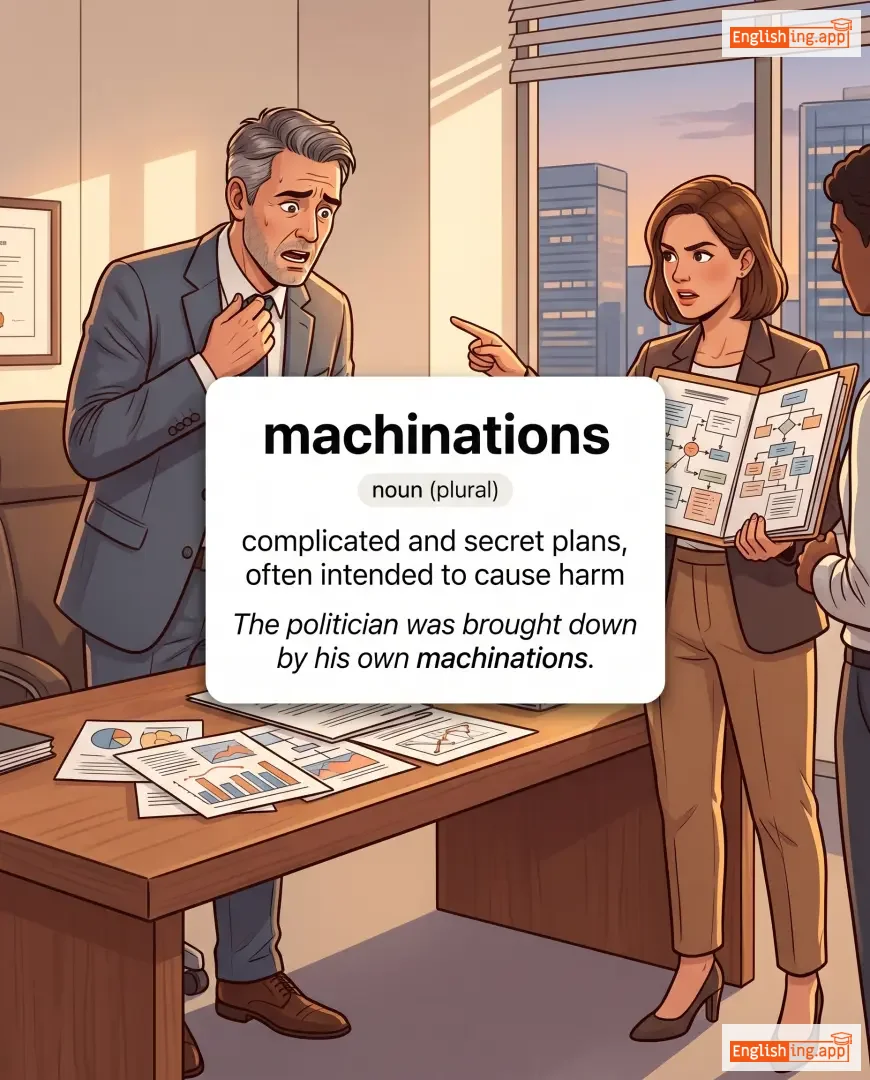
machinations definition card — visual illustration of the meaning
noun (plural)
/ˌmæk.ɪˈneɪ.ʃənz/
maquinaciones (maquinaciones)

complicated and secret plans, often intended to cause harm

"The politician was brought down by his own machinations."

"El político fue derribado por sus propias maquinaciones." (El politico fue derribado por sus propias maquinaciones.)
noun
/məˈʃiːn/
máquina (maquina)

A device with moving parts that uses energy to perform a particular task.

"This washing machine is very efficient."

"Esta lavadora es muy eficiente." (Esta lavadora es muy eficiente.)
noun
/məˈʃiː.nər.i/
maquinaria (maquinaria)

machines collectively, or the parts of a machine; also, the system or process by which something works

"The factory invested in new machinery to increase production."

"La fábrica invirtió en nueva maquinaria para aumentar la producción." (La fábrica invirtió en nueva maquinaria para aumentar la producción.)
noun
/məˈʃiː.nɪst/
maquinista (maquinista)

a person who operates machine tools or makes and repairs machines

"The machinist carefully adjusted the gears on the lathe."

"El maquinista ajustó cuidadosamente los engranajes en el torno." (El maquinista ajustó cuidadosamente los engranajes en el torno.)
noun
/ˈmæk.ər.əl/
caballa (kabaya)

a streamlined marine fish with a forked tail and wavy stripes

"Mackerel is rich in omega-3 fatty acids."

"La caballa es rica en ácidos grasos omega-3." (la kabaya es rika en asidos grasos omega tres)
noun
/ˈmækɪntɒʃ/
abrigo impermeable (abrigo impermeable)

a waterproof raincoat, originally made from rubberized fabric

"He wore a mackintosh to stay dry in the rain."

"Él usó un mackintosh para mantenerse seco bajo la lluvia." (Él usó un mackintosh para mantenerse seco bajo la lluvia.)
noun
/ˈmæk.rəˌkɒz.əm/
macrocosmos (macrocosmos)

The whole universe considered as a large, complex system; a large-scale representation of something.

"The macrocosm of the universe reflects the microcosm of human life."

"El macrocosmos del universo refleja el microcosmos de la vida humana." (El macrocosmos del universo refleja el microcosmos de la vida humana.)
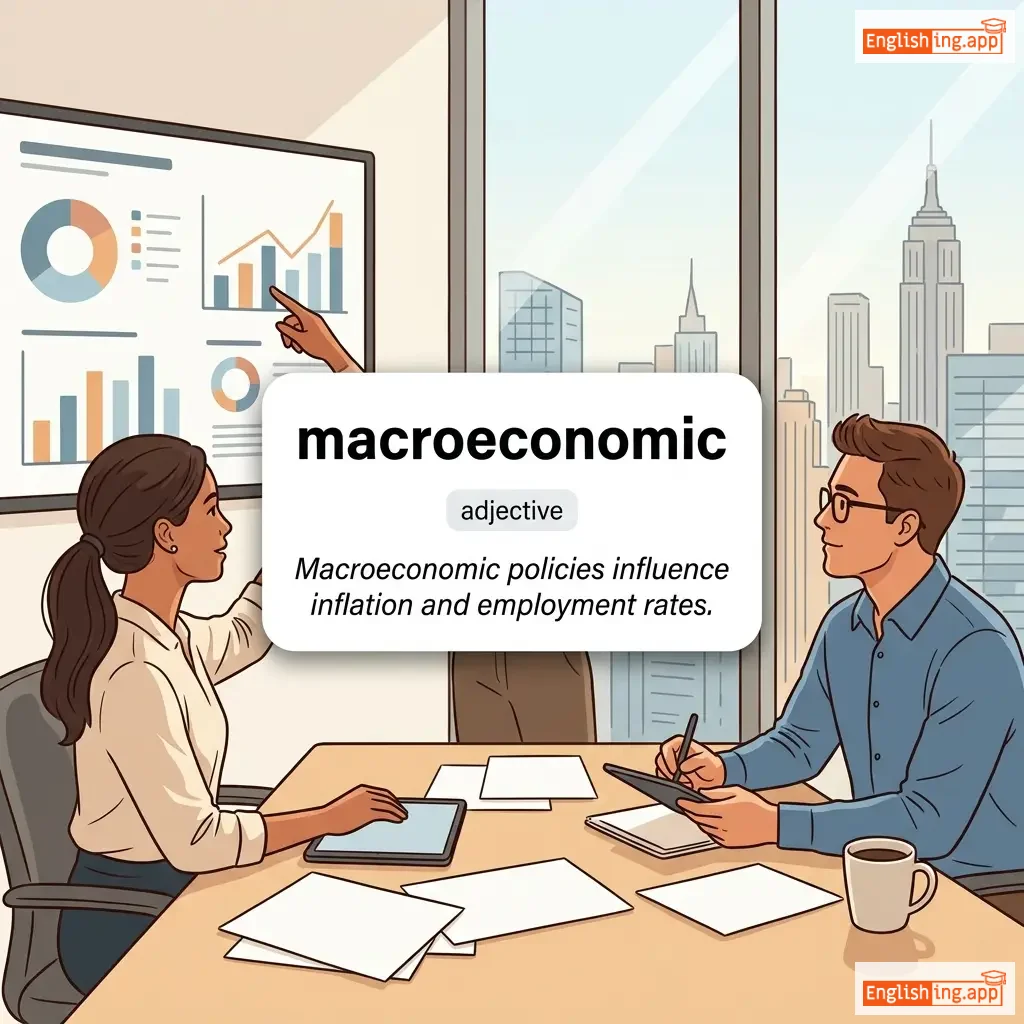
macroeconomic definition card — visual illustration of the meaning
adjective
/ˌmæk.rəʊ.iː.kəˈnɒm.ɪk/
macroeconómico (macroeconomico)

Relating to macroeconomics or the large-scale or general economic factors, such as interest rates and national productivity.

"Macroeconomic policies influence inflation and employment rates."

"Las políticas macroeconómicas influyen en la inflación y las tasas de empleo." (Las políticas macroeconómicas influyen en la inflación y las tasas de empleo.)
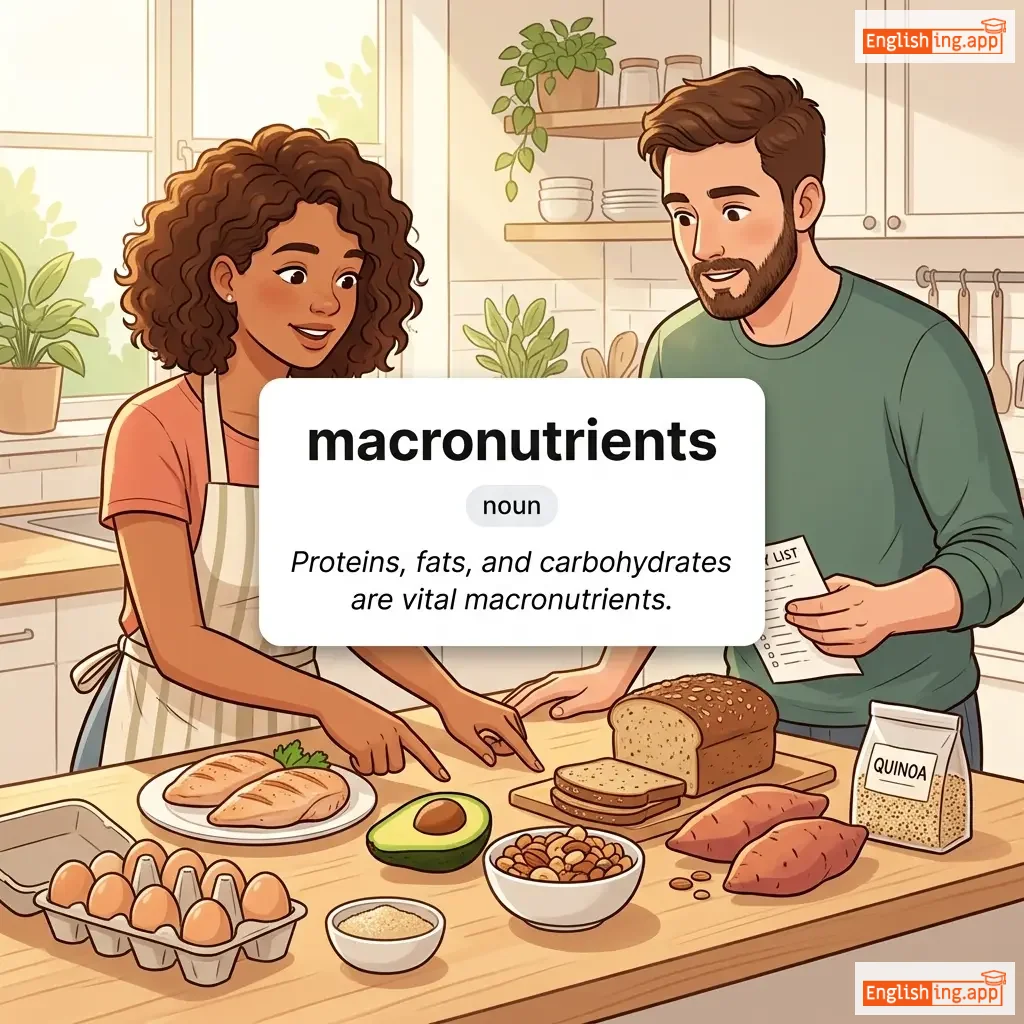
macronutrients definition card — visual illustration of the meaning
noun
/ˈmæk.rəʊˌnjuː.tri.ənts/
macronutrientes (macronutrientes)

Nutrients that are needed in large amounts to provide energy and building materials for the body, including carbohydrates, proteins, and fats.

"Proteins, fats, and carbohydrates are vital macronutrients."

"Las proteínas, las grasas y los carbohidratos son macronutrientes vitales." (Las proteínas, las grasas y los carbohidratos son macronutrientes vitales.)
verb
/ˈmæk.jʊˌleɪt/
manchar (manchar)

To stain, spot, or pollute something.

"The white cloth was maculated by ink stains."

"La tela blanca fue manchada por manchas de tinta." (La tela blanca fue manchada por manchas de tinta.)
adjective
/ˈmæk.jʊˌleɪ.tɪd/
manchado (manchado)

Spotted or stained; marked with blemishes.

"The maculated surface of the old mirror gave it a unique charm."

"La superficie manchada del viejo espejo le dio un encanto único." (La superficie manchada del viejo espejo le dio un encanto único.)
adjective
/mæd/
enojado / loco (enojado / loco)

Very angry, insane, or foolish.

"She was mad at her brother for breaking the vase."

"Ella estaba enojada con su hermano por romper el jarrón." (Ella estaba enojada con su hermano por romper el jarrón.)
verb
/ˈmæd.ən/
enloquecer (enloquecer)

To make someone very angry or extremely annoyed.

"The constant noise maddened him."

"El ruido constante lo enloqueció." (El ruido constante lo enloqueció.)
noun
/ˈmædnəs/
locura (locura)

the state of being mentally ill or acting in a very foolish way

"It would be madness to drive in such dangerous weather."

"Sería una locura conducir en un clima tan peligroso." (Sería una locura conducir en un clima tan peligroso.)
noun
/məˈdɒn.ə/
madonna (Virgen María) (madonna (Virgen María))

An artistic representation of the Virgin Mary; also used as a respectful form of address for a woman in Italian culture.

"The Renaissance painting depicts a Madonna holding child Jesus."

"La pintura renacentista muestra a una Madonna sosteniendo al niño Jesús." (La pintura renacentista muestra a una Madonna sosteniendo al niño Jesús.)
noun
/ˈmædrɪɡəl/
madrigal (madrigal)

A short, lyrical poem set to music, typically from the Renaissance period.

"The choir performed a beautiful madrigal from the 16th century."

"El coro interpretó un hermoso madrigal del siglo XVI." (El coro interpreto un hermoso madrigal del siglo XVI.)
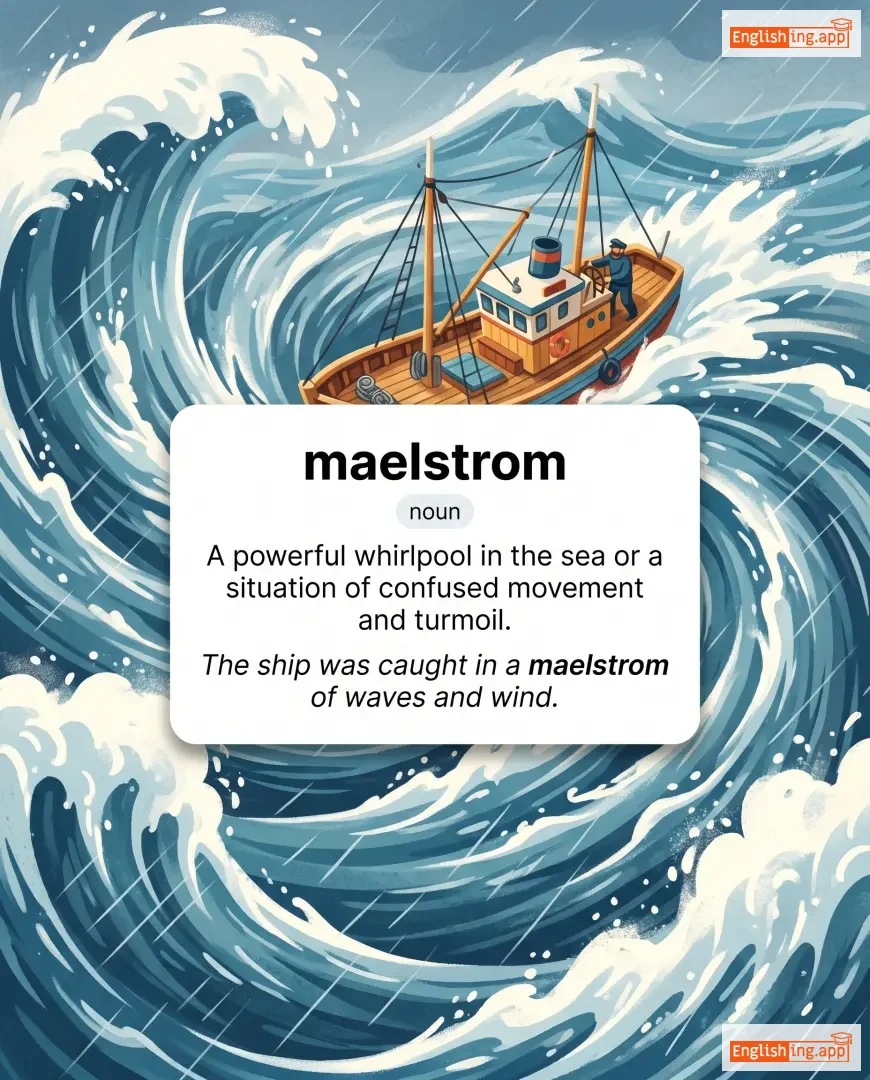
maelstrom definition card — visual illustration of the meaning
noun
/ˈmeɪlstrəm/
remolino (remolino)

A powerful whirlpool in the sea or a situation of confused movement and turmoil.

"The ship was caught in a maelstrom of waves and wind."

"El barco fue atrapado en un remolino de olas y viento." (El barco fue atrapado en un remolino de olas y viento.)
noun
/ˈmæɡəziːn/
revista (revista)

A periodical publication containing articles, photographs, and advertisements.

"She bought a fashion magazine at the store."

"Ella compró una revista de moda en la tienda." (Ella compro una revista de moda en la tienda.)
adjective
/məˈdʒen.tə/
color magenta (color magenta)

a bright purplish-red color

"She wore a beautiful magenta dress to the party."

"Ella usó un hermoso vestido magenta para la fiesta." (Ella uso un hermoso vestido magenta para la fiesta.)
noun
/ˈmædʒɪk/
magia (magia)

the use of mysterious or supernatural powers to influence events

"The magician amazed the crowd with his magic."

"El mago sorprendió a la multitud con su magia." (El mago sorprendió a la multitud con su magia.)
adjective
/ˈmædʒɪkəl/
mágico (maheeko)

having or producing the charm, beauty, or power of magic

"The sunset over the mountains was a magical sight."

"La puesta de sol sobre las montanas fue una vista magica." (La puesta de sol sobre las montanas fue una vista magica.)
noun
/məˈdʒɪʃən/
mago (mago)

A person who performs tricks and illusions for entertainment or one believed to have magical powers.

"The magician pulled a rabbit out of his hat."

"El mago sacó un conejo de su sombrero." (El mago sacó un conejo de su sombrero.)
adjective
/ˌmædʒɪˈstɪəriəl/
magisterial (magisterial)

Having the characteristics of a master or authority; commanding and dignified.

"The professor spoke in a magisterial tone during the lecture."

"El profesor habló en un tono magisterial durante la conferencia." (El profesor hablo en un tono magisterial durante la conferencia.)
noun
/ˈmædʒɪstrəsi/
oficina judicial (oficina judicial)

The office, authority, or district of a magistrate.

"He was proud to serve in the local magistracy for over a decade."

"Él estaba orgulloso de servir en la oficina judicial local durante más de una década." (Él estaba orgulloso de servir en la oficina judicial local durante más de una década.)
noun
/ˈmædʒɪstreɪt/
magistrado (magistrado)

A civil officer who administers the law, often with limited judicial authority.

"The magistrate presided over the minor criminal case."

"El magistrado presidió el caso penal menor." (El magistrado presidió el caso penal menor.)
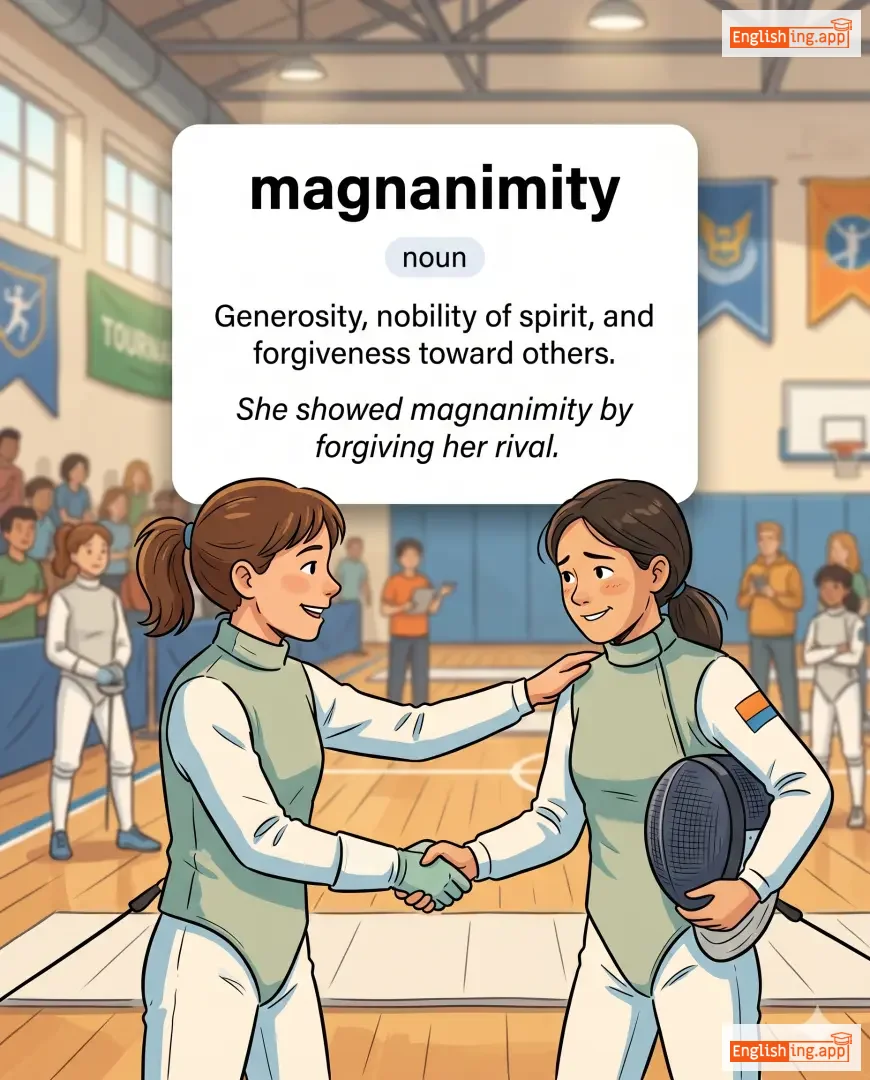
magnanimity definition card — visual illustration of the meaning
noun
/ˌmæɡnəˈnɪmɪti/
magnanimidad (magnanimidad)

Generosity, nobility of spirit, and forgiveness toward others.

"She showed magnanimity by forgiving her rival."

"Ella mostró magnanimidad perdonando a su rival." (Ella mostro magnanimidad perdonando a su rival.)
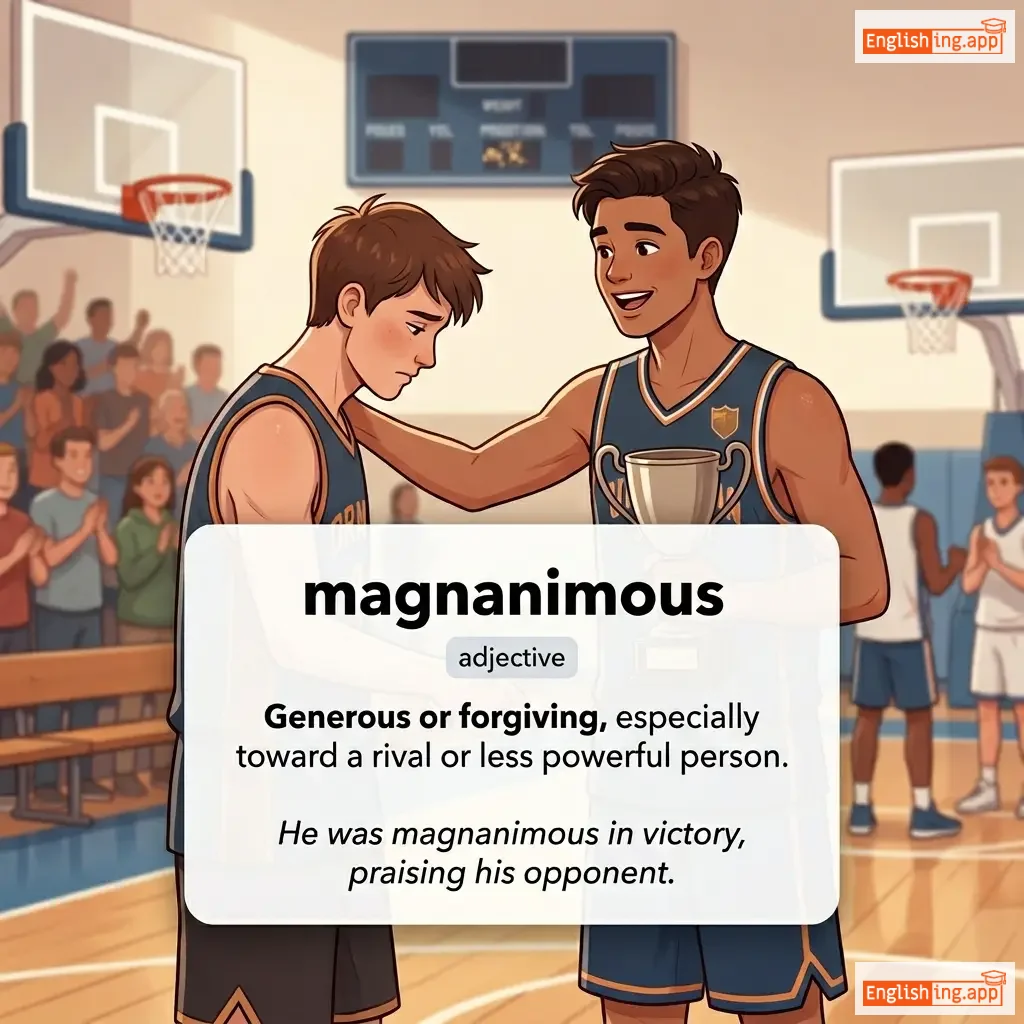
magnanimous definition card — visual illustration of the meaning
adjective
/mæɡˈnænɪməs/
magnánimo (magnanimo)

Generous or forgiving, especially toward a rival or less powerful person.

"He was magnanimous in victory, praising his opponent."

"Él fue magnánimo en la victoria, elogiando a su oponente." (El fue magnanimo en la victoria, elogiando a su oponente.)
noun
/ˈmæɡneɪt/
magnate (magnate)

A wealthy and influential person, especially in business or industry.

"The oil magnate donated millions to charity."

"El magnate del petróleo donó millones a la caridad." (El magnate del petróleo donó millones a la caridad.)
noun
/ˈmæɡnət/
imán (iman)

An object that produces a magnetic field and attracts metals like iron.

"The magnet held the paper to the fridge door."

"El imán sujetó el papel a la puerta del refrigerador." (El iman sujeto el papel a la puerta del refrigerador.)
adjective
/mæɡˈnɛtɪk/
magnético (magnetico)

having the power to attract metal objects or to attract people or things in a strong way

"The magnetic field of the Earth protects us from harmful solar radiation."

"El campo magnético de la Tierra nos protege de la radiación solar perjudicial." (El campo magnético de la Tierra nos protege de la radiación solar perjudicial.)
verb
/ˈmæɡnɪtaɪz/
magnetizar (magnetizar)

to make something magnetic or to strongly attract

"The scientist managed to magnetize the iron rod."

"El científico logró magnetizar la barra de hierro." (El cientifico logro magnetizar la barra de hierro.)
noun
/mæɡˈnɪfɪsəns/
magnificencia (magnificencia)

splendor, grandeur, or impressive beauty

"The magnificence of the palace left everyone speechless."

"La magnificencia del palacio dejó a todos sin palabras." (La magnificencia del palacio dejó a todos sin palabras.)
adjective
/mæɡˈnɪfɪsənt/
magnífico (magnifico)

extremely beautiful, impressive, or splendid

"The view from the mountain was truly magnificent."

"La vista desde la montaña fue realmente magnífica." (La vista desde la montaña fue realmente magnífica.)
verb
/ˈmæɡnɪfaɪ/
ampliar (ampliar)

to make something appear larger or more important than it really is

"The microscope can magnify tiny cells."

"El microscopio puede ampliar células diminutas." (El microscopio puede ampliar células diminutas.)
adjective
/mæɡˈnɪləkwənt/
lenguaje pomposo (lenguaje pomposo)

using high-flown or pompous language

"The politician’s magniloquent speech impressed the crowd."

"El discurso pomposo del político impresionó a la multitud." (El discurso pomposo del político impresionó a la multitud.)
noun
/ˈmæɡnɪtuːd/
magnitud (magnitud)

the great size, extent, or importance of something

"The magnitude of the earthquake shocked the nation."

"La magnitud del terremoto sorprendió a la nación." (La magnitud del terremoto sorprendió a la nación.)
noun
/ˌmɑːhəˈrɑːdʒə/
maharajá (maharaja)

A great king, especially a ruler of one of the principal states in India.

"The maharaja lived in a grand palace surrounded by gardens."

"El maharajá vivía en un gran palacio rodeado de jardines." (El maharajá vivía en un gran palacio rodeado de jardines.)
noun
/ˈmeɪdənˌhʊd/
juventud (juventud)

The state of being a maiden; girlhood or virginity.

"The poem celebrated the innocence of maidenhood."

"El poema celebró la inocencia de la juventud." (El poema celebró la inocencia de la juventud.)
noun/verb
/meɪl/
correo / carta (correo / carta)

Letters, packages, or email messages sent or delivered to someone.

"I received an important letter in the mail."

"Recibí una carta importante por correo." (Recibi una carta importante por correo.)
noun
/meɪl treɪn/
tren correo (tren correo)

a train that carries mail and postal packages

"The mail train departs every evening to deliver letters across the country."

"El tren postal sale todas las tardes para entregar cartas a través del país." (El tren correo sale todas las tardes para entregar cartas a través del país.)
verb
/meɪm/
mutilar (mutilar)

To wound or injure someone so that part of the body is permanently damaged.

"The accident maimed several passengers."

"El accidente dejó a varios pasajeros malheridos." (El accidente dejo a varios pasajeros malheridos.)
adjective
/meɪn/
principal (principal)

most important; chief in size, extent, or importance

"The main reason for his success is hard work."

"La principal razón de su éxito es el trabajo duro." (La principal razon de su exito es el trabajo duro.)
noun
/ˈmeɪnˌlænd/
continente (continente)

the principal landmass of a country or continent, as opposed to the surrounding islands

"The mainland of Australia is home to most of its population."

"El continente de Australia es el hogar de la mayor parte de su poblacion." (El continente de Australia es el hogar de la mayor parte de su poblacion.)