Vocabularios

Descubra, aprenda y domine el vocabulario en inglés

leap definition card — visual illustration of the meaning
🏃‍♂️

leap (lip)

verb
/liːp/
saltar (saltar)

to jump or spring a long way or to a great height

"The cat leapt onto the wall effortlessly."

"El gato saltó sobre la pared sin esfuerzo." (El gato salto sobre la pared sin esfuerzo.)
learn definition card — visual illustration of the meaning
verb
/lɜːrn/
aprender (aprender)

to gain knowledge or skill by studying or experience

"Children learn new things quickly."

"Los niños aprenden cosas nuevas rápidamente." (Los niños aprenden cosas nuevas rápidamente.)
adjective; verb (past and past participle)
/lɜːrnd/
erudito (erudito)

having acquired much knowledge through study; gained knowledge or skill through experience or teaching

"She is a learned scholar with deep knowledge of history."

"Ella es una erudita con profundo conocimiento de la historia." (ella es una erudita con profundo conocimiento de la historia)
noun
/ˈlɜːrnər/
aprendiz (aprendiz)

a person who is acquiring knowledge or skill through study or experience

"She is a fast learner."

"Ella es una aprendiz rápida." (ella es una aprendiz rapida)
noun
/ˈlɜrnɪŋ/
aprendizaje (aprendizaje)

The process of gaining knowledge or skills through study or experience.

"Learning a new language can be exciting."

"Aprender un nuevo idioma puede ser emocionante." (Aprender un nuevo idioma puede ser emocionante.)
Lease definition card — visual illustration of the meaning
noun
/liːs/
arrendamiento; contrato de alquiler (leez)

a contract by which one party conveys land, property, services, etc. to another for a specified time, usually in return for a periodic payment

"They signed a two-year lease for the apartment."

"Ellos firmaron un contrato de arrendamiento de dos años para el apartamento." (Ellos firmaron un contrato de arrendamiento de dos años para el apartamento.)
noun/verb
/liːʃ/
correa (correa)

a strap or cord used to control or guide an animal; to restrain or control

"The dog was on a leash during the walk."

"El perro estaba con correa durante el paseo." (El perro estaba con correa durante el paseo.)
adjective
/liːst/
el mínimo (el minimo)

smallest in amount, extent, or importance

"She showed the least interest in the project."

"Ella mostró el menor interés en el proyecto." (Ella mostro el menor interes en el proyecto.)
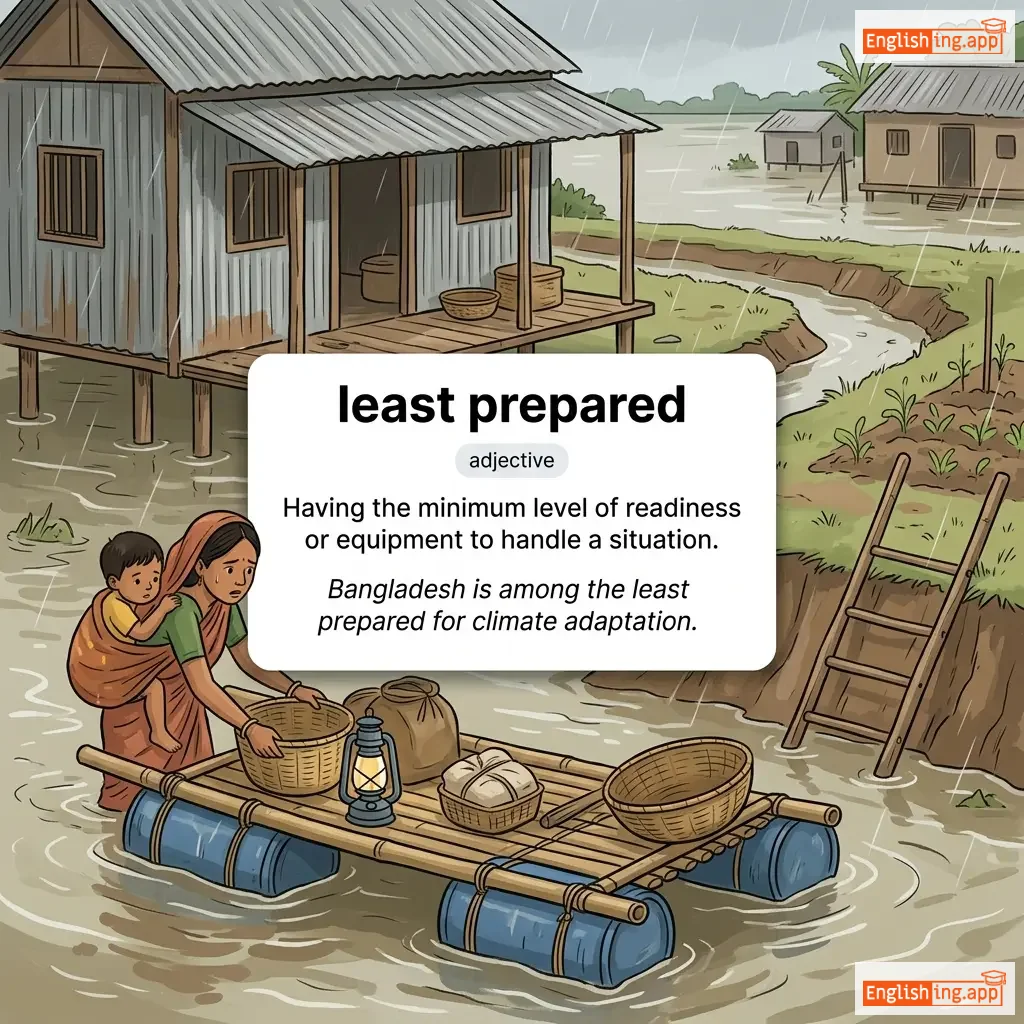
least prepared definition card — visual illustration of the meaning
adjective
liːst prɪˈpeərd
menos preparado (menos preparado)

Having the minimum level of readiness or equipment to handle a situation.

"Bangladesh is among the least prepared for climate adaptation."

"Bangladesh está entre los menos preparados para la adaptación al cambio climático." (Bangladesh esta entre los menos preparados para la adaptacion al cambio climatico.)
noun
/ˈlɛðər/
cuero (kuero)

A material made from the skin of an animal, usually treated and used to make clothing, shoes, or furniture.

"He bought a leather jacket for winter."

"Él compró una chaqueta de cuero para el invierno." (El compro una chaqueta de cuero para el invierno.)
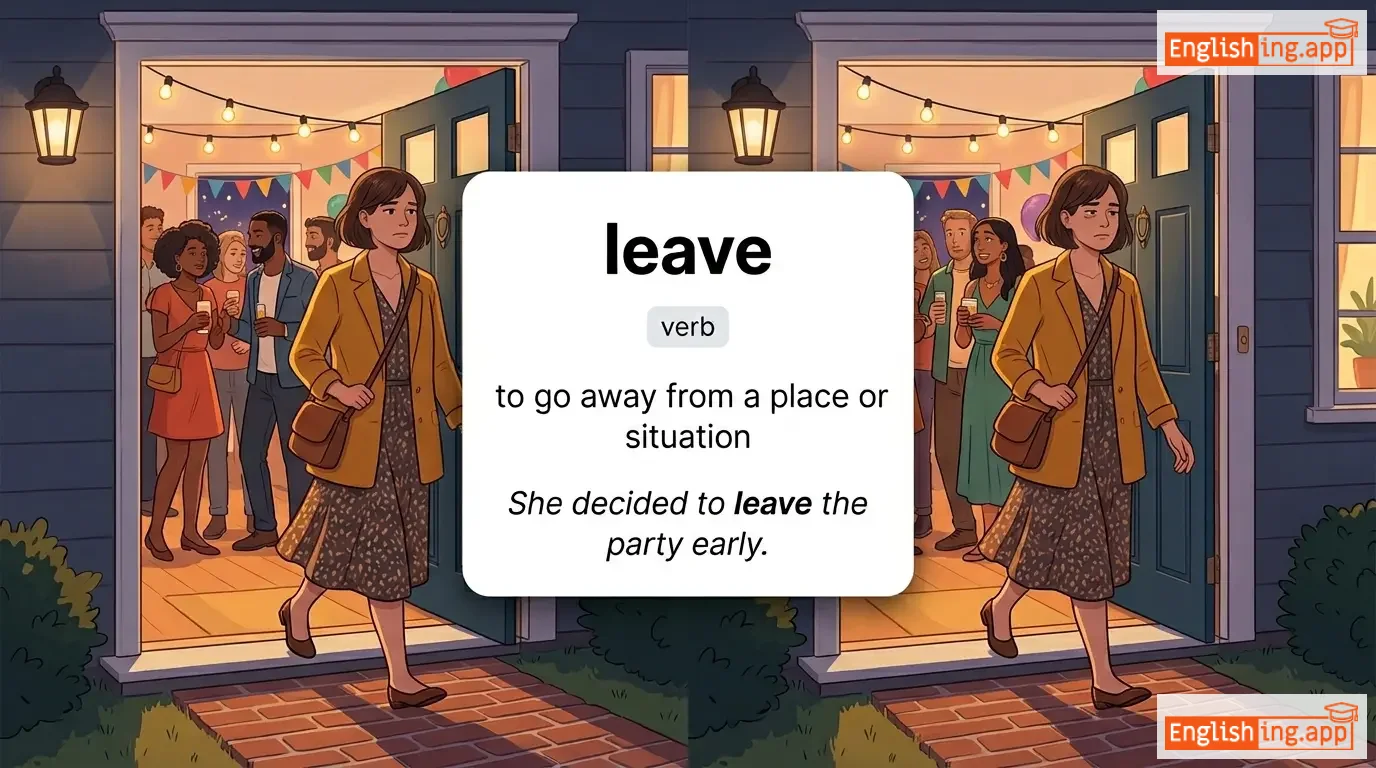
leave definition card — visual illustration of the meaning
🚶‍♂️

leave (liv)

verb
/liːv/
dejar (dejar)

to go away from a place or situation

"She decided to leave the party early."

"Ella decidió irse de la fiesta temprano." (Ella decidió irse de la fiesta temprano.)
noun
/ˈliːvˌteɪ.kɪŋ/
despedida (despedida)

an act of saying goodbye; farewell

"His leave-taking from his friends was emotional."

"Su despedida de sus amigos fue emocional." (Su despedida de sus amigos fue emocional.)
noun/verb
/ˈlɛv.ən/
levadura (levadura)

a substance, typically yeast, that causes dough to rise; to permeate and modify

"A little yeast will leaven the bread dough."

"Un poco de levadura hará que la masa del pan suba." (Un poco de levadura hará que la masa del pan suba.)
noun
/ˈliː.vɪŋz/
restos; sobras (livings)

things that have been left behind or remain; remnants or scraps

"The leavings from dinner were given to the dog."

"Los restos de la cena fueron dados al perro." (Los restos de la cena fueron dados al perro.)
noun
/ˈleʧ.ər/
libidinoso (libidinoso)

a man who behaves in a sexually inappropriate way towards women

"The company fired him for being a lecher."

"La compañía lo despidió por ser un libidinoso." (la compania lo despidio por ser un libidinoso)
adjective
/ˈlɛtʃ.ər.əs/
lujurioso (lujurioso)

having or showing excessive or offensive sexual desire

"The character was portrayed as a lecherous old man."

"El personaje fue retratado como un hombre lujurioso." (El personaje fue retratado como un hombre lujurioso.)
noun
/ˈlɛtʃ.əri/
lujuria (lujuria)

excessive or offensive sexual desire; lustfulness

"The novel depicted the lechery of corrupt nobles."

"La novela describía la lujuria de los nobles corruptos." (La novela describía la lujuria de los nobles corruptos.)
noun
/ˈlɛktən/
atril (atril)

A tall stand with a sloping top used to support a book, notes, or script during a speech or lecture.

"The professor placed her notes on the lectern before starting her lecture."

"La profesora colocó sus notas en el atril antes de comenzar su conferencia." (La profesora colocó sus notas en el atril antes de comenzar su conferencia.)
noun
/ˈlektʃər/
conferencia (conferencia)

a talk given to a group of people to teach them about a subject

"The professor gave a lecture on climate change."

"El profesor dio una conferencia sobre el cambio climático." (El profesor dio una conferencia sobre el cambio climático.)
noun
/ˈlɛktʃərər/
conferenciante (conferenciante)

a person who gives lectures, especially at a college or university

"The lecturer explained the theory with clear examples."

"El conferenciante explicó la teoría con ejemplos claros." (El conferenciante explico la teoria con ejemplos claros)
noun
/ˈledʒ.ər/
libro mayor (libro mayor)

a book or other collection of financial accounts of a particular type

"The accountant updated the company ledger daily."

"El contador actualizó el libro mayor de la empresa diariamente." (El contador actualizo el libro mayor de la empresa diariamente.)
noun
/liːt͡ʃ/
sanguijuela (sanguijuela)

a blood-sucking worm that lives in water or moist ground

"The doctor used a medical leech to reduce swelling after surgery."

"El doctor utilizó una sanguijuela médica para reducir la hinchazón después de la cirugía." (El doctor utilizo una sanguijuela medica para reducir la hinchazon despues de la cirugia)
noun
/liːk/
puerro (puerro)

vegetable related to onion with long green leaves and white bulb, milder than onion

"The soup was made with potatoes and leeks."

"La sopa se hizo con papas y puerros." (La sopa se hizo con papas y puerros.)
verb
/lɪr/
mirada lasciva (mirada lasciva)

To look at someone in an unpleasant, sly, or sexually suggestive way.

"He leered at her in a way that made her uncomfortable."

"Él la miró de una forma que la hizo sentirse incómoda." (El la miro de una forma que la hizo sentirse incomoda.)
adjective
/ˈlɪəri/
desconfiado (deskonfiado)

Cautious or wary due to suspicion or distrust.

"She was leery of investing in the new business."

"Ella estaba desconfiada de invertir en el nuevo negocio." (Ella estaba desconfiada de invertir en el nuevo negocio.)
adjective
/ˈliːwərd/
lado protegido del viento (lado protegido del viento)

On or toward the sheltered side away from the wind.

"They built their camp on the leeward side of the hill."

"Construyeron su campamento en el lado protegido del viento de la colina." (Construyeron su campamento en el lado protegido del viento de la colina.)
noun
/ˈliːweɪ/
margen (margen)

Freedom to act within certain limits; extra space or time.

"The manager gave the team some leeway to finish the project."

"El gerente le dio al equipo algo de margen para terminar el proyecto." (El gerente le dio al equipo algo de margen para terminar el proyecto.)
adjective, noun, adverb, verb (past tense of leave)
/lɛft/
izquierda (izquierda)

on or towards the side of the body that is to the west when facing north

"He turned left at the intersection."

"Él giró a la izquierda en la intersección." (El giro a la izquierda en la intersección.)
adjective
/ˌlɛftˈhændɪd/
zurdo (zurdo)

Using or done with the left hand; also can mean clumsy or awkward.

"She is left-handed and writes beautifully with her left hand."

"Ella es zurda y escribe hermosamente con su mano izquierda." (ella es zurda y escribe hermosamente con su mano izquierda.)
noun
/lɛɡ/
pierna (pierna)

one of the limbs on which a person or animal walks and stands

"He injured his leg while playing football."

"Se lastimó la pierna mientras jugaba al fútbol." (Se lastimó la pierna mientras jugaba al fútbol.)
legacy definition card — visual illustration of the meaning
noun
/ˈlɛɡəsi/
legado (legado)

Something handed down from the past, such as money, property, or traditions.

"Her artistic legacy continues to inspire young painters."

"Su legado artístico sigue inspirando a jóvenes pintores." (Su legado artístico sigue inspirando a jóvenes pintores.)
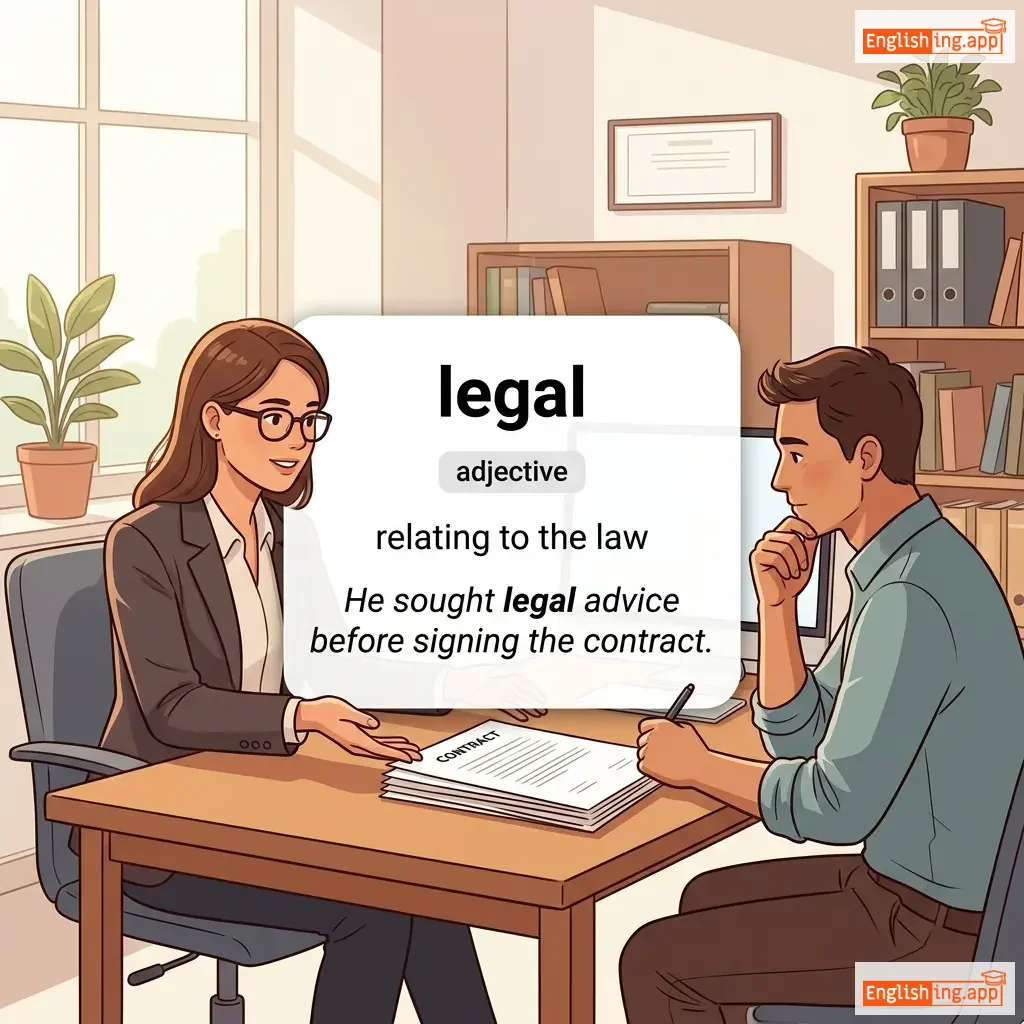
legal definition card — visual illustration of the meaning
adjective
/ˈliːɡəl/
legal (legal)

relating to the law

"He sought legal advice before signing the contract."

"Él buscó asesoría legal antes de firmar el contrato." (Él buscó asesoría legal antes de firmar el contrato.)
noun
/lɪˈɡæl.ə.ti/
legalidad (legalidad)

the quality or state of being legal; accordance with the law

"The lawyer questioned the legality of the contract."

"El abogado cuestionó la legalidad del contrato." (El abogado cuestionó la legalidad del contrato.)
verb
/ˈliːɡəlaɪz/
legalizar (legalizar)

To make something lawful by official approval.

"The government decided to legalize online businesses."

"El gobierno decidió legalizar los negocios en línea." (El gobierno decidió legalizar los negocios en línea.)
adverb
/ˈliːɡəli/
legalmente (legalmente)

in a way that is allowed by law

"He is legally responsible for his actions."

"Él es legalmente responsable por sus acciones." (El es legalmente responsable por sus acciones)
adverb/adjective
/lɪˈɡɑːtoʊ/
en música, tocado o cantado suavemente y de forma conectada (en musica, tocado o cantado suavemente y de forma conectada)

In music, played or sung smoothly and connectedly.

"The pianist played the passage legato, with each note flowing into the next."

"El pianista tocó el pasaje legato, con cada nota fluyendo hacia la siguiente." (El pianista tocó el pasaje legato, con cada nota fluyendo hacia la siguiente.)
noun
/ˈlɛdʒənd/
leyenda (leyenda)

A traditional story popularly regarded as historical but unauthenticated; also a famous person admired for achievements.

"The footballer is considered a legend in his country."

"El futbolista es considerado una leyenda en su país." (El futbolista es considerado una leyenda en su país.)
adjective
/ˈlɛdʒəndɛri/
legendario (legendario)

remarkable enough to be famous; often used to describe something that is iconic or widely known

"The legendary musician performed in front of a packed stadium."

"El músico legendario se presentó ante un estadio lleno." (El musico legendario se presento ante un estadio lleno.)
noun
/ˌlɛdʒərdəˈmeɪn/
truco, engaño (truco, engano)

skillful use of one's hands when performing tricks; deception or trickery

"The magician's legerdemain left the audience amazed."

"El truco del mago dejó a la audiencia asombrada." (El truco del mago dejo a la audiencia asombrada.)
noun
/ˈlɛɡɪŋ/
pantalones ajustados (pantalones ajustados)

tight-fitting stretch pants, typically worn by women for exercise or casual wear

"She bought a new pair of black leggings for the gym."

"Ella compró un nuevo par de leggings negros para el gimnasio." (Ella compró un nuevo par de leggings negros para el gimnasio.)
adjective
/ˈlɛdʒəbl/
legible (legible)

clear enough to read

"Her handwriting was barely legible."

"Su letra apenas era legible." (su letra apenas era legible)
noun
/ˈliːdʒən/
un gran grupo de personas, especialmente soldados; un gran número (un gran grupo de personas, especialmente soldados; un gran numero)

a large group of people, especially soldiers; a great number

"The Roman army was divided into legions."

"El ejército romano se dividió en legiones." (El ejercito romano se dividio en legiones.)
noun
/ˈliːdʒənəri/
soldado romano (soldado romano)

a soldier in the Roman army

"Each legionary carried a shield and a short sword."

"Cada legionario llevaba un escudo y una espada corta." (Cada legionario llevaba un escudo y una espada corta.)
verb
/ˈlɛdʒɪsˌleɪt/
legislar (legislar)

to make or enact laws

"The government plans to legislate new safety standards."

"El gobierno planea legislar nuevos estándares de seguridad." (El gobierno planea legislar nuevos estándares de seguridad.)
noun
/ˌledʒɪsˈleɪʃən/
legislación (legislacion)

laws considered collectively, or the act of making laws

"The government passed new legislation to protect the environment."

"El gobierno aprobó nueva legislación para proteger el medio ambiente." (El gobierno aprobó nueva legislación para proteger el medio ambiente.)
adjective
/ˈlɛdʒɪslətɪv/
legislativo (legislativo)

relating to the making of laws

"The legislative body passed the new tax bill."

"El cuerpo legislativo aprobó el nuevo proyecto de ley sobre impuestos." (El cuerpo legislativo aprobó el nuevo proyecto de ley sobre impuestos.)
noun
/ˈlɛdʒɪsleɪtər/
legislador (legislador)

a person who makes laws, especially a member of a legislative body

"The legislator introduced a bill to improve healthcare."

"El legislador introdujo un proyecto de ley para mejorar la atención médica." (El legislador introdujo un proyecto de ley para mejorar la atención médica.)
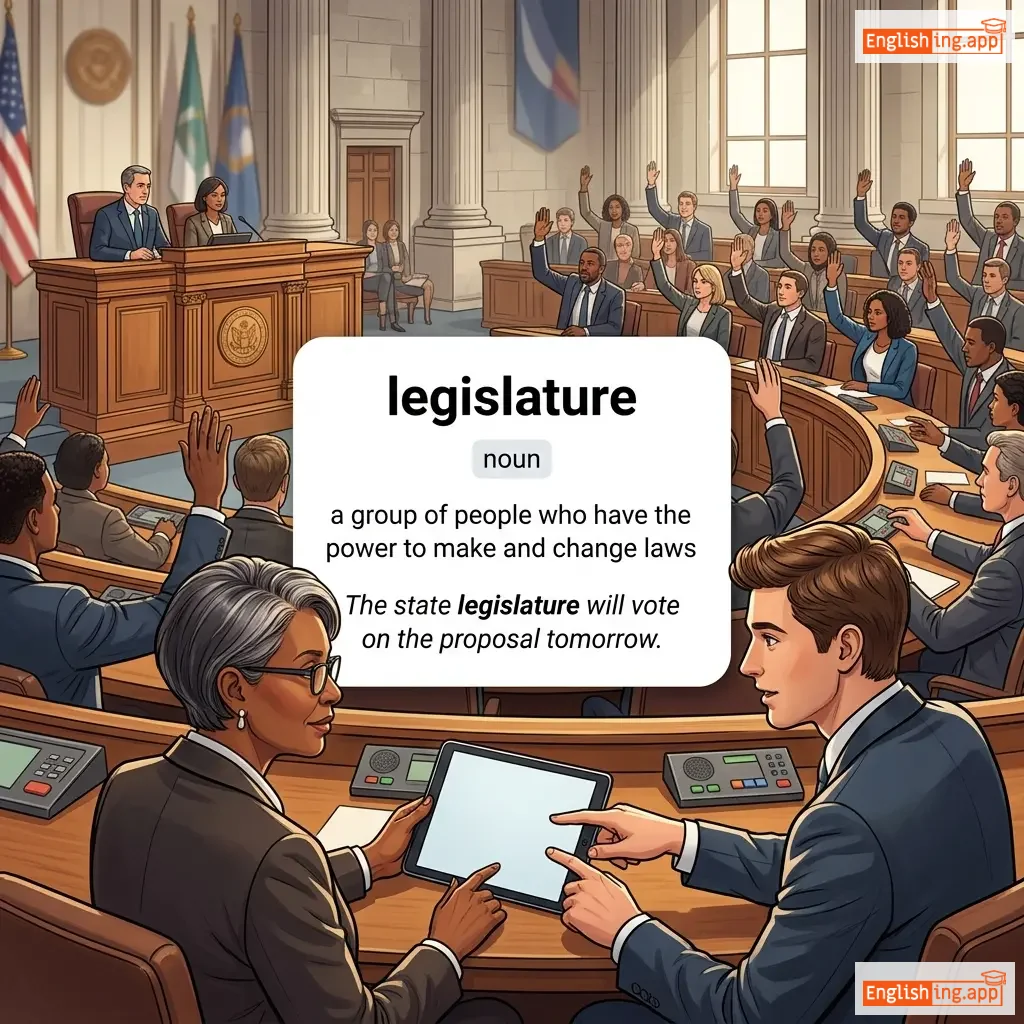
legislature definition card — visual illustration of the meaning
noun
/ˈlɛdʒɪsˌleɪtʃər/
legislatura (legislatura)

a group of people who have the power to make and change laws

"The state legislature will vote on the proposal tomorrow."

"La legislatura estatal votará sobre la propuesta mañana." (La legislatura estatal votará sobre la propuesta mañana.)
noun
/lɪˈdʒɪtɪməsi/
legitimidad (legitimidad)

the quality of being accepted as right, proper, or lawful

"The legitimacy of the election was questioned by observers."

"La legitimidad de la elección fue cuestionada por los observadores." (La legitimidad de la elección fue cuestionada por los observadores.)
adjective
/lɪˈdʒɪtɪmət/
legítimo (legitimo)

Conforming to the law or to rules; valid or acceptable.

"She presented a legitimate reason for her absence."

"Ella presentó una razón legítima para su ausencia." (Ella presento una razon legitima para su ausencia.)