Vocabularios

Descubra, aprenda y domine el vocabulario en inglés

verb
/ˈɪmprəvaɪz/
improvisar (improvisar)

To create or perform something spontaneously without preparation.

"The actor had to improvise his lines when he forgot the script."

"El actor tuvo que improvisar sus líneas cuando olvidó el guion." (El actor tuvo que improvisar sus líneas cuando olvidó el guion.)
noun
/ɪmˈpruːdəns/
imprudencia (imprudencia)

Lack of caution or good judgment.

"His imprudence in investing all his money in one stock was disastrous."

"Su imprudencia al invertir todo su dinero en una sola acción fue desastrosa." (Su imprudencia al invertir todo su dinero en una sola accion fue desastrosa.)
adjective
/ɪmˈpruːdənt/
imprudente (imprudente)

Not showing care for the consequences of an action.

"It was imprudent to drive in such stormy weather."

"Era imprudente conducir en un clima tan tormentoso." (Era imprudente conducir en un clima tan tormentoso.)
noun
/ˈɪmpjʊdəns/
desvergüenza (desverguenza)

Rude and disrespectful behavior.

"The student's impudence shocked the entire class."

"La desvergüenza del estudiante sorprendió a toda la clase." (La desverguenza del estudiante sorprendió a toda la clase.)
adjective
/ˈɪmpjəd(ə)nt/
descarado, insolente (descarado, insolente)

not showing due respect for another person; rude

"The impudent child talked back to the teacher."

"El niño descarado le contestó al maestro." (El niño descarado le contestó al maestro.)
verb
/ɪmˈpjuːn/
disputar la verdad, validez o honestidad de una declaración o motivo (disputar la verdad, validez o honestidad de una declaracion o motivo)

to dispute the truth, validity, or honesty of a statement or motive

"The lawyer tried to impugn the credibility of the witness."

"El abogado intentó impugnar la credibilidad del testigo." (El abogado intento impugnar la credibilidad del testigo.)
noun
/ɪmˈpjuːɪsəns/
impotencia, incapacidad (impotencia, incapacidad)

inability to take effective action; helplessness

"The government’s impuissance in the face of crisis frustrated the people."

"La impotencia del gobierno ante la crisis frustró al pueblo." (La impotencia del gobierno ante la crisis frustro al pueblo.)
noun
/ˈɪmpʌls/
impulso (impulso)

a sudden strong desire or urge to act without thinking

"He bought the watch on impulse without planning to."

"Compró el reloj por impulso sin planearlo." (Compró el reloj por impulso sin planearlo.)
noun
/ɪmˈpʌlʃən/
impulso (impulsion)

a strong urge or drive to act; the act of impelling

"His impulsion to travel made him leave his job suddenly."

"Su impulso de viajar lo llevó a dejar su trabajo de repente." (Su impulso de viajar lo llevo a dejar su trabajo de repente)
adjective
/ɪmˈpʌlsɪv/
impulsivo, de impulso (impulsivo, de impulso)

acting suddenly without careful thought

"She made an impulsive decision to buy the car."

"Tomó una decisión impulsiva de comprar el coche." (Tomó una decisión impulsiva de comprar el coche.)
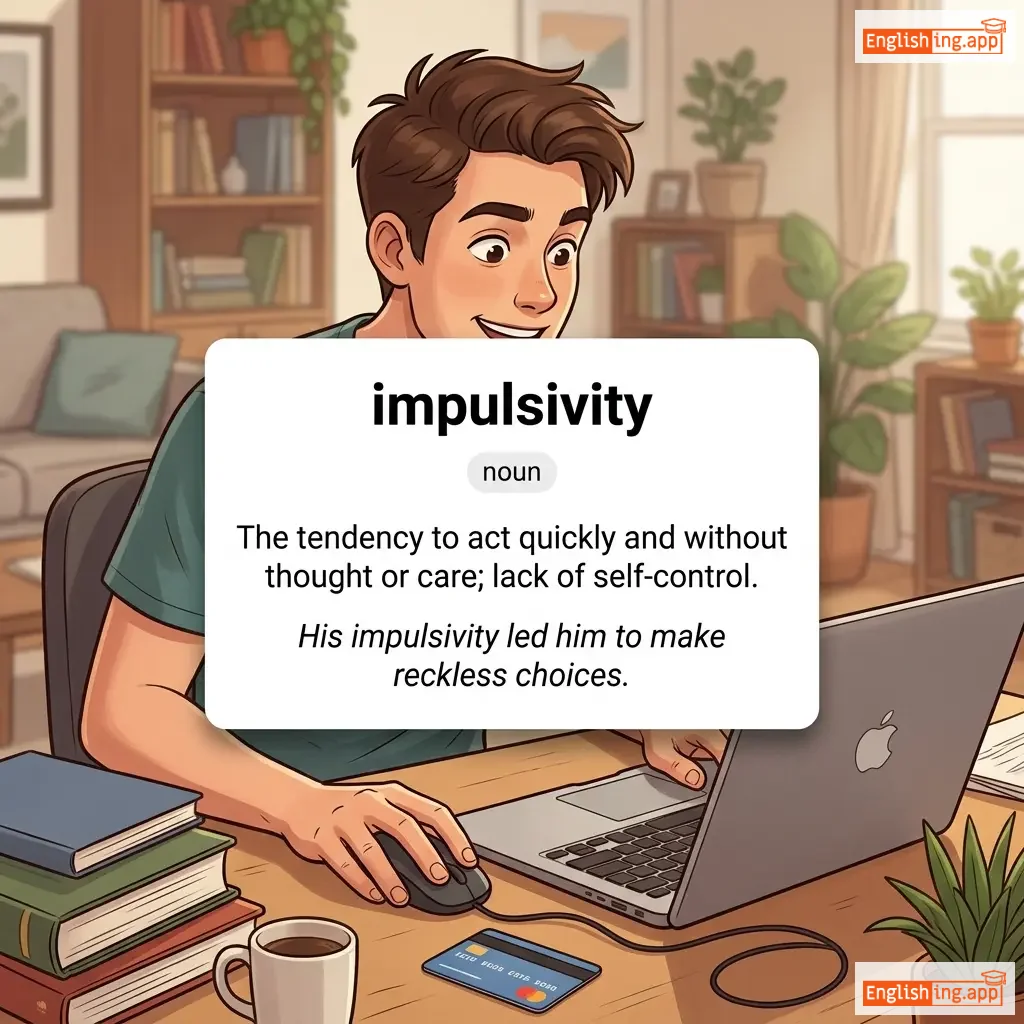
impulsivity definition card — visual illustration of the meaning
noun
ˌɪm.pʌlˈsɪv.ɪ.ti
impulsividad (impulsividad)

The tendency to act quickly and without thought or care; lack of self-control.

"His impulsivity led him to make reckless choices."

"Su impulsividad lo llevó a tomar decisiones imprudentes." (Su impulsividad lo llevó a tomar decisiones imprudentes.)
noun
/ɪmˈpjuːnɪti/
impunidad (impunidad)

freedom from punishment or harmful consequences for an action

"The dictator ruled with impunity, ignoring international laws."

"El dictador gobernó con impunidad, ignorando las leyes internacionales." (El dictador gobernó con impunidad, ignorando las leyes internacionales.)
adjective
/ɪmˈpjʊər/
impuro (impuro)

not clean or free from contamination; morally corrupt

"The water was impure and unsafe to drink."

"El agua estaba impura y no era segura para beber." (El agua estaba impura y no era segura para beber.)
noun
/ɪmˈpjʊərəti/
impureza (impureza)

the state of being unclean or contaminated; a substance that makes something impure

"The scientist removed every impurity from the water sample."

"El científico eliminó toda impureza de la muestra de agua." (el cientifico elimino toda impureza de la muestra de agua)
noun
/ˌɪmpjuˈteɪʃən/
imputación (imputacion)

an accusation or attribution of blame

"The politician denied the imputation of corruption."

"El político negó la imputación de corrupción." (El politico nego la imputacion de corrupcion.)
verb
/ɪmˈpjuːt/
imputar (imputar)

to attribute a fault or responsibility to someone

"They imputed the company's success to good leadership."

"Ellos imputaron el éxito de la empresa a un buen liderazgo." (Ellos imputaron el éxito de la empresa a un buen liderazgo.)
preposition
/ɪn/
en (en)

expressing the situation of being enclosed or surrounded by something

"She is in the kitchen preparing dinner."

"Ella está en la cocina preparando la cena." (Ella esta en la cocina preparando la cena.)
preposition
/ɪn ˈfrʌnt əv/
delante de (delante de)

positioned before or ahead of something; facing or located at the forward side of a person or object

"She stood in front of the building."

"Ella estaba de pie delante del edificio." (Ella estaba de pie delante del edificio)
noun
/ˌɪnəˈbɪləti/
incapacidad (incapacidad)

the state of being unable to do something

"His inability to make decisions affected his career."

"Su incapacidad para tomar decisiones afectó su carrera." (Su incapacidad para tomar decisiones afectó su carrera.)
adjective
/ˌɪnækˈsɛsəbl/
inaccesible (inaccesible)

unable to be reached, entered, or understood

"The remote village is almost inaccessible during the rainy season."

"El pueblo remoto es casi inaccesible durante la temporada de lluvias." (El pueblo remoto es casi inaccesible durante la temporada de lluvias.)
noun
/ɪnˈækjʊrəsi/
inexactitud (inexactitud)

lack of accuracy or precision; an incorrect or wrong detail

"The report contained several factual inaccuracies."

"El informe contenía varias inexactitudes." (el informe contenia varias inexactitudes)
adjective
/ɪnˈækjʊrət/
incorrecto (incorrecto)

Not correct, precise, or exact; containing errors.

"The report was full of inaccurate data."

"El informe estaba lleno de datos incorrectos." (El informe estaba lleno de datos incorrectos.)
adjective
/ɪnˈæktɪv/
inactivo (inactivo)

Not engaging in activity; not active.

"The account has been inactive for six months."

"La cuenta ha estado inactiva durante seis meses." (La cuenta ha estado inactiva durante seis meses.)
noun
/ˌɪnækˈtɪvɪti/
inactividad (inactividad)

the state of not being active physically or mentally; lack of action

"Prolonged inactivity can negatively affect both physical and mental health."

"La inactividad prolongada puede afectar negativamente la salud física y mental." (la inactividad prolongada puede afectar negativamente la salud fisica y mental)
noun
/ɪnˈædɪkwəsi/
insuficiencia (insuficiencia)

lack of sufficient ability, quality, or strength; a feeling of not being good enough

"She struggled with feelings of inadequacy at work despite her strong qualifications."

"Luchaba con sentimientos de insuficiencia en el trabajo a pesar de sus sólidas calificaciones." (Luchaba con sentimientos de insuficiencia en el trabajo a pesar de sus sólidas calificaciones)
adjective
/ɪnˈædɪkwət/
inadecuado (inadecuado)

Not sufficient or good enough.

"The funding was inadequate to complete the project."

"El financiamiento era inadecuado para completar el proyecto." (El financiamiento era inadecuado para completar el proyecto.)
adjective
/ˌɪnədˈmɪsəbl̩/
inadmisible (inadmisible)

Not allowed, especially as evidence in a court of law.

"The judge ruled the evidence inadmissible."

"El juez dictaminó que la evidencia era inadmisible." (El juez dictaminó que la evidencia era inadmisible.)
noun
/ˌɪnədˈvɜːrtəns/
descuido (descuido)

Failure to pay attention; carelessness.

"The error happened through sheer inadvertence."

"El error ocurrió por pura inadvertencia." (El error ocurrio por pura inadvertencia.)
adjective
/ˌɪnədˈvɜːrtənt/
inadvertido, no intencionado (inadvertido, no intencionado)

Not resulting from or achieved through deliberate planning; unintentional.

"Her inadvertent mistake caused a delay in the project."

"Su error inadvertido causó un retraso en el proyecto." (Su error inadvertido causó un retraso en el proyecto.)
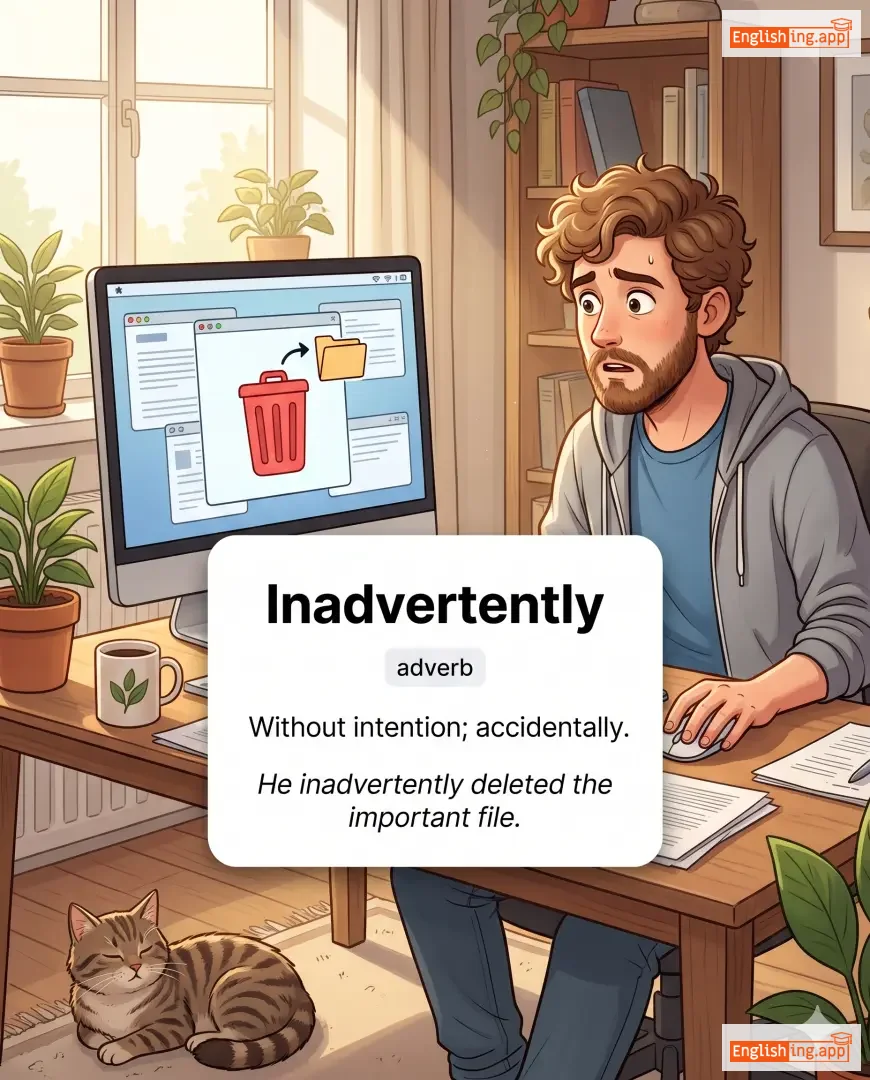
Inadvertently definition card — visual illustration of the meaning
adverb
/ˌɪnədˈvɜːrtəntli/
accidentalmente (accidentalmente)

Without intention; accidentally.

"He inadvertently deleted the important file."

"Él borró accidentalmente el archivo importante." (Él borró accidentalmente el archivo importante.)
adjective
/ˌɪnədˈvaɪzəbl/
desaconsejable (desaconsejable)

Not recommended; likely to have undesirable consequences.

"It is inadvisable to drive in such heavy rain."

"No es recomendable conducir bajo tal lluvia intensa." (No es recomendable conducir bajo tal lluvia intensa.)
adjective
/ɪnˈeɪliənəbl/
inalienable (inalienable)

Unable to be taken away or transferred; absolute and permanent.

"Freedom of speech is an inalienable right."

"La libertad de expresión es un derecho inalienable." (La libertad de expresion es un derecho inalienable.)
noun
/ˌɪnəməˈrɑːtə/
amante (amante)

A woman with whom someone is in love; a female lover.

"He wrote a poem dedicated to his inamorata."

"Escribió un poema dedicado a su enamorada." (Escribio un poema dedicado a su enamorada.)
adjective
/ɪˈneɪn/
insensato, tonto (insensato, tonto)

lacking sense, meaning, or significance; silly or pointless

"The movie was criticized for its inane dialogue."

"La película fue criticada por sus diálogos insensatos." (La pelicula fue criticada por sus dialogos insensatos.)
adjective
/ɪˈnænɪmət/
objeto inanimado (objeto inanimado)

not alive, especially not in the manner of animals and humans; lifeless

"The museum was full of inanimate objects from ancient times."

"El museo estaba lleno de objetos inanimados de tiempos antiguos." (El museo estaba lleno de objetos inanimados de tiempos antiguos.)
noun
/ɪˈnænɪti/
tonterías, necedades (tonterias, necedades)

a nonsensical remark or action; silliness; emptiness

"The speech was full of inanities that bored the audience."

"El discurso estaba lleno de tonterías que aburrían a la audiencia." (El discurso estaba lleno de tonterías que aburrían a la audiencia.)
adjective
/ˌɪnæprɪˈhɛnsəbl/
incomprensible (incomprensible)

not understandable; incomprehensible

"The concept was so abstract that it seemed inapprehensible to most students."

"El concepto era tan abstracto que parecía incomprensible para la mayoría de los estudiantes." (El concepto era tan abstracto que parecía incomprensible para la mayoría de los estudiantes.)
adjective
/ˌɪnəˈproʊpriət/
inapropiado (inapropriado)

not suitable or proper in the circumstances

"It was inappropriate to talk loudly in the library."

"Era inapropiado hablar en voz alta en la biblioteca." (Era inapropiado hablar en voz alta en la biblioteca.)
adjective
/ɪnˈæpt/
inapropiado (inapropiado)

not suitable or appropriate in the circumstances

"His inapt choice of words offended many people."

"Su elección inapropiada de palabras ofendió a muchas personas." (Su eleccion inapropiada de palabras ofendió a muchas personas.)
adjective
/ˌɪnɑːrˈtɪkjʊlət/
inarticulado (inarticulado)

Unable to express oneself clearly or effectively in speech or writing.

"She became inarticulate with emotion during the speech."

"Ella se volvió inarticulada con emoción durante el discurso." (Ella se volvió inarticulada con emoción durante el discurso.)
adverb
/ˌɪnəzˈmʌtʃ/
en la medida en que (en la medida en que)

To the extent that; considering that.

"Inasmuch as you are their teacher, you should guide them carefully."

"En la medida en que eres su maestro, deberías guiarlos cuidadosamente." (En la medida en que eres su maestro, deberías guiarlos cuidadosamente.)
conjunction
/ˌɪnəzˈmʌtʃ æz/
ya que (ya que)

Because; since.

"He cannot attend, inasmuch as he is unwell."

"Él no puede asistir, ya que está enfermo." (Él no puede asistir, ya que está enfermo.)
adjective
/ˌɪnəˈtɛntɪv/
inattento (inattento)

not paying attention; lacking focus or concentration

"The inattentive student missed several important instructions."

"El estudiante inattento perdió varias instrucciones importantes." (El estudiante inattento perdio varias instrucciones importantes)
adjective
/ɪnˈɔːdəbl/
ininteligible (ininteligible)

Unable to be heard.

"Her voice was almost inaudible over the noise."

"Su voz era casi ininteligible sobre el ruido." (Su voz era casi ininteligible sobre el ruido.)
adjective
/ɪˈnɔːɡjərəl/
inaugural (inaugural)

marking the beginning of something; first; opening

"The president delivered his inaugural speech."

"El presidente dio su discurso inaugural." (El presidente dio su discurso inaugural.)
verb
/ɪˈnɔːɡjʊreɪt/
inaugurar (inaugurar)

To formally begin or introduce something, especially with a ceremony.

"The mayor will inaugurate the new bridge tomorrow."

"El alcalde inaugurará el nuevo puente mañana." (El alcalde inaugurará el nuevo puente mañana.)
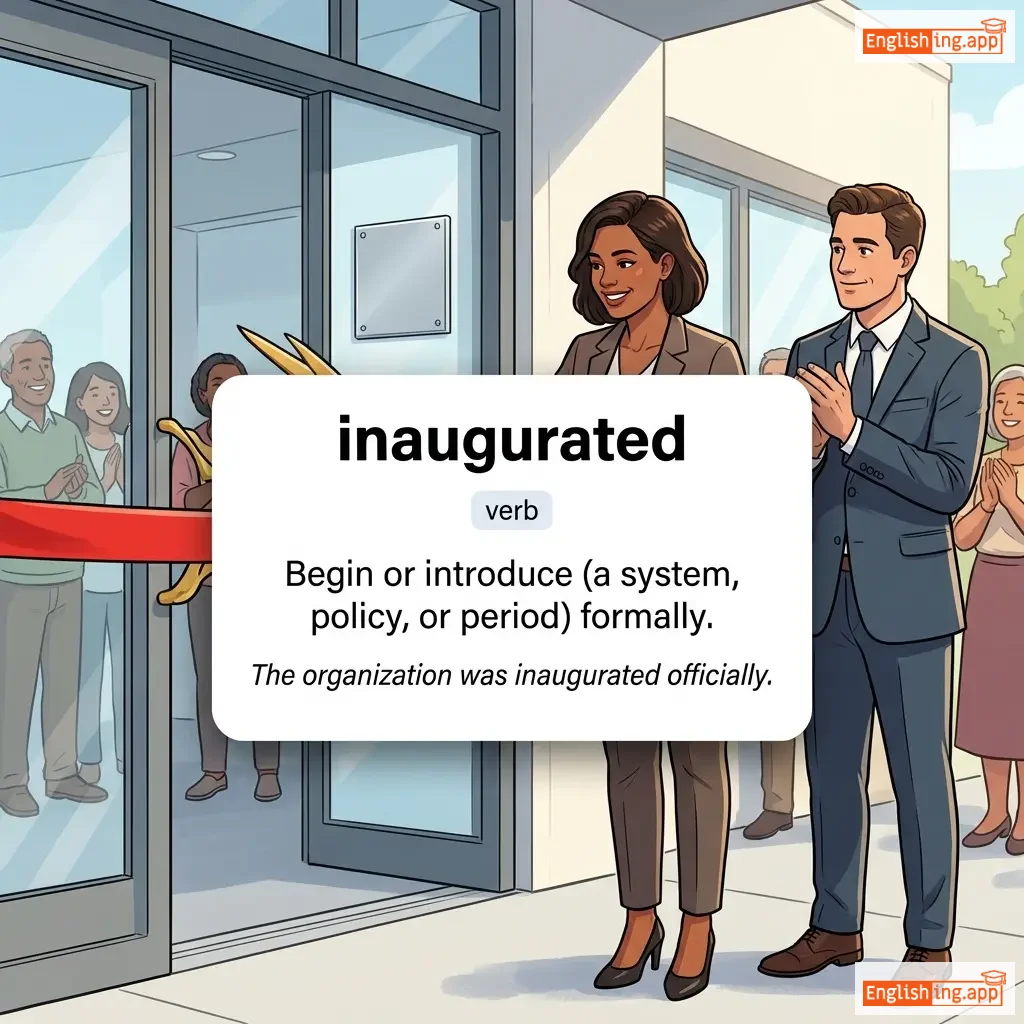
inaugurated definition card — visual illustration of the meaning
verb
ɪˈnɔː.ɡjə.reɪ.tɪd
inaugurado (inaugurado)

Begin or introduce (a system, policy, or period) formally.

"The organization was inaugurated officially."

"La organización fue inaugurada oficialmente." (La organizacion fue inaugurada oficialmente.)
adjective
/ˌɪnɔːˈspɪʃəs/
desafortunado (desafortunado)

Not conducive to success; unpromising or unlucky.

"The event began under inauspicious circumstances."

"El evento comenzó bajo circunstancias desfavorables." (El evento comenzo bajo circunstancias desfavorables.)
adjective
/ˈɪnˌbɔːrn/
innato (inborn)

existing from birth; innate

"She has an inborn talent for music."

"Ella tiene un talento innato para la musica." (Ella tiene un talento innato para la musica.)
adjective
/ˈɪnˌbrɛd/
innato (innato)

existing naturally in a person or animal; also related to reproduction within a limited community

"He has an inbred sense of loyalty."

"Él tiene un sentido innato de lealtad." (El tiene un sentido innato de lealtad.)