Vocabularios

Descubra, aprenda y domine el vocabulario en inglés

noun
/ɪˈreɪdiəns/
irradiancia (iradians)

the quality of shining brightly; the intensity of light falling on a surface

"The irradiance of the sun at noon was overwhelming."

"La irradiancia del sol al mediodía era abrumadora." (La irradiancia del sol al mediodía era abrumadora.)
verb
/ɪˈreɪdieɪt/
irradiar (irradiar)

to shine light on something; to expose to radiation; to illuminate or brighten

"The scientist used a lamp to irradiate the sample."

"El científico usó una lámpara para irradiar la muestra." (El científico usó una lámpara para irradiar la muestra.)
adjective
/ɪˈrædɪkəbəl/
irradicable (irradicable)

not able to be eradicated; impossible to destroy or remove completely

"The love of a mother for her child is irradicable."

"El amor de una madre por su hijo es irradicable." (El amor de una madre por su hijo es irradicable.)
adjective
/ɪˈræʃənəl/
irracional (irracional)

not logical or reasonable; lacking clear thought

"His fear of the dark was completely irrational."

"Su miedo a la oscuridad era completamente irracional." (Su miedo a la oscuridad era completamente irracional.)
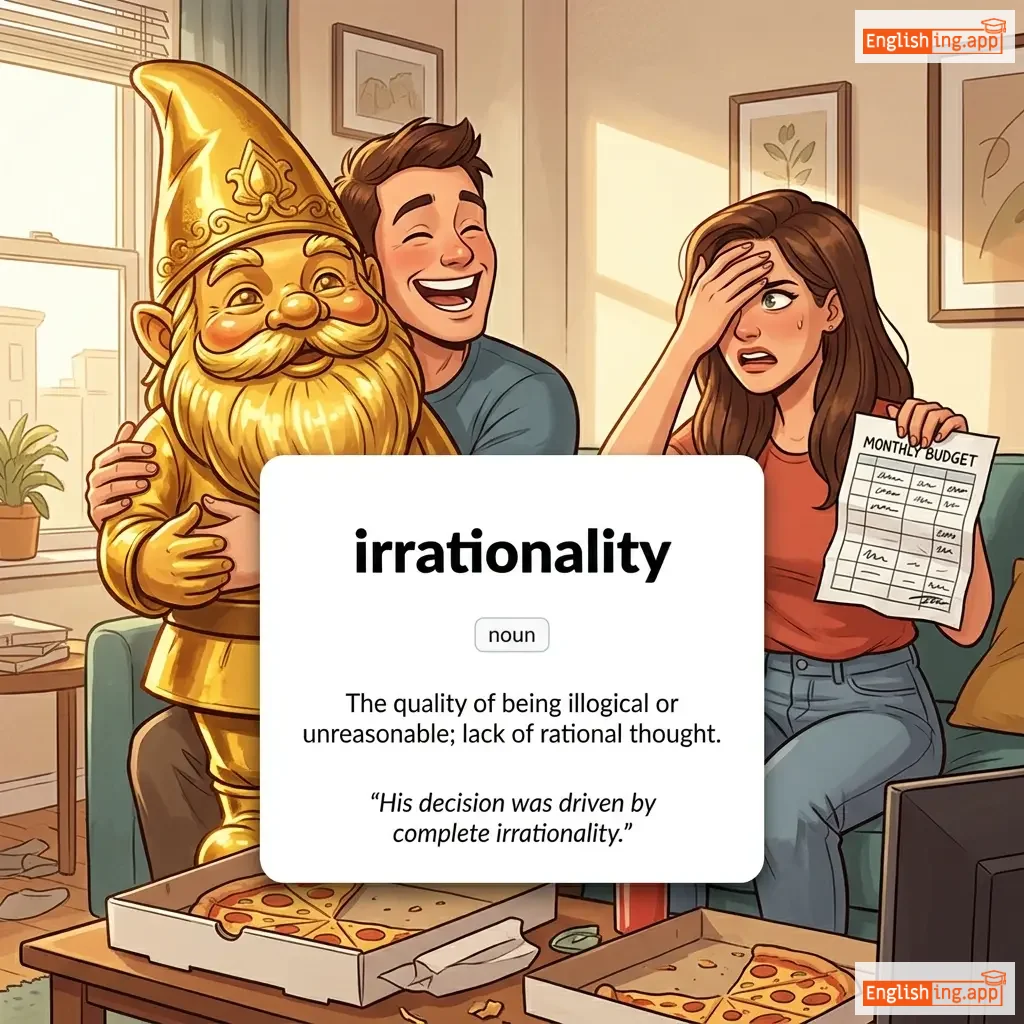
irrationality definition card — visual illustration of the meaning
noun
ɪˌræʃ.ənˈæl.ɪ.ti
irracionalidad, falta de lógica, irrazonabilidad (irracionalidad, falta de logica, irrazonabilidad)

The quality of being illogical or unreasonable; lack of rational thought.

"His decision was driven by complete irrationality."

"Su decisión fue impulsada por una irracionalidad completa." (Su decision fue impulsada por una irracionalidad completa.)
adjective
/ˌɪrɪˈkɒnsɪləbl/
irreconciliable (irreconciliable)

impossible to make compatible or bring into harmony; unable to resolve differences

"The couple separated due to irreconcilable differences."

"La pareja se separó debido a diferencias irreconciliables." (La pareja se separó debido a diferencias irreconciliables.)
adjective
/ˌɪrɪˈdjuːsəbl/
irreducible (irreducible)

impossible to reduce or simplify further

"The fraction 3/7 is irreducible."

"La fracción 3/7 es irreducible." (La fracción tres sobre siete es irreducible.)
adjective
/ɪˈrɛfrəɡəbəl/
irrefutable (irrefutable)

Impossible to refute, deny, or break

"The lawyer presented irrefragable evidence that proved his client’s innocence."

"El abogado presentó pruebas irrefutables que demostraron la inocencia de su cliente." (El abogado presentó pruebas irrefutables que demostraron la inocencia de su cliente.)
adjective
/ˌɪrɪˈfrændʒɪbəl/
irrefrenable (irrefrenable)

Not to be broken, violated, or infringed

"The constitution guarantees certain irrefrangible rights to every citizen."

"La constitución garantiza ciertos derechos irrefrenables a cada ciudadano." (La constitucion garantiza ciertos derechos irrefrenables a cada ciudadano.)
adjective
/ˌɪrɪˈfjuːtəbəl/
irrefutable (irrefutable)

Impossible to deny or disprove

"The scientist provided irrefutable proof of the theory."

"El científico proporcionó una prueba irrefutable de la teoría." (El cientifico proporciono una prueba irrefutable de la teoria.)
adjective
/ɪˈreɡjələr/
irregular (irregular)

not even or consistent in shape, pattern, time, or behavior; not following normal rules

"His attendance at work has been irregular this month."

"Su asistencia al trabajo ha sido irregular este mes." (su asistencia al trabajo ha sido irregular este mes)
noun
/ɪˌreɡjəˈlærɪti/
irregularidad (irregularidad)

lack of regularity or consistency; a deviation from what is normal, expected, or orderly

"The audit revealed several financial irregularities in the company’s records."

"La auditoría reveló varias irregularidades financieras en los registros de la empresa." (La auditoria revelo varias irregularidades financieras en los registros de la empresa)
noun
/ɪˈreləvəns/
irrelevancia (irrelevancia)

the quality of not being connected to or important for a particular matter; lack of significance

"His long explanation only highlighted the irrelevance of the details to the main issue."

"Su larga explicación solo resaltó la irrelevancia de los detalles para el tema principal." (su larga explicacion solo resalto la irrelevancia de los detalles para el tema principal)
noun
/ɪˈrɛlɪvənsi/
irrelevancia (irrelevancia)

the state of being unrelated or unimportant to the matter at hand

"The judge dismissed the argument because of its irrelevancy to the case."

"El juez rechazó el argumento por su irrelevancia para el caso." (el juez rechazo el argumento por su irrelevancia para el caso)
adjective
/ɪˈrɛləvənt/
irrelevante (irrelevante)

Not connected with or related to the matter at hand

"His comment was completely irrelevant to the discussion."

"Su comentario era completamente irrelevante para la discusión." (Su comentario era completamente irrelevante para la discusion.)
adjective
/ˌɪrɪˈlɪdʒəs/
irreligioso (irreligioso)

Indifferent or hostile to religion

"Some people in the community consider him irreligious because he never attends religious services."

"Algunas personas en la comunidad lo consideran irreligioso porque nunca asiste a los servicios religiosos." (Algunas personas en la comunidad lo consideran irreligioso porque nunca asiste a los servicios religiosos.)
adjective
/ˌɪrɪˈmiːdiəbl̩/
irremediable (irremediable)

Impossible to cure, repair, or remedy.

"The damage to the ancient manuscript was irremediable."

"El daño al antiguo manuscrito era irremediable." (El daño al antiguo manuscrito era irremediable.)
adjective
/ɪˈrɛpərəbl̩/
irreparable (irreparable)

Too severe to be corrected or repaired.

"The earthquake caused irreparable damage to the village."

"El terremoto causó daños irreparables en el pueblo." (El terremoto causó daños irreparables en el pueblo.)
adjective
/ˌɪrɪˈprɛsəbl̩/
irresistible (irresistible)

Impossible to control or restrain.

"She had an irrepressible urge to laugh during the speech."

"Ella no pudo ocultar su irresistible deseo de reír durante el discurso." (Ella no pudo ocultar su irresistible deseo de reír durante el discurso.)
adjective
/ˌɪrɪˈprəʊtʃəbl̩/
intachable (intachable)

Beyond criticism; faultless.

"The judge was known for his irreproachable integrity."

"El juez era conocido por su integridad intachable." (El juez era conocido por su integridad intachable.)
adjective
/ˌɪrɪˈzɪstəbl̩/
irresistible (irresistible)

Too attractive, powerful, or appealing to be resisted.

"The aroma of freshly baked bread was irresistible."

"El aroma del pan recién horneado era irresistible." (El aroma del pan recién horneado era irresistible.)
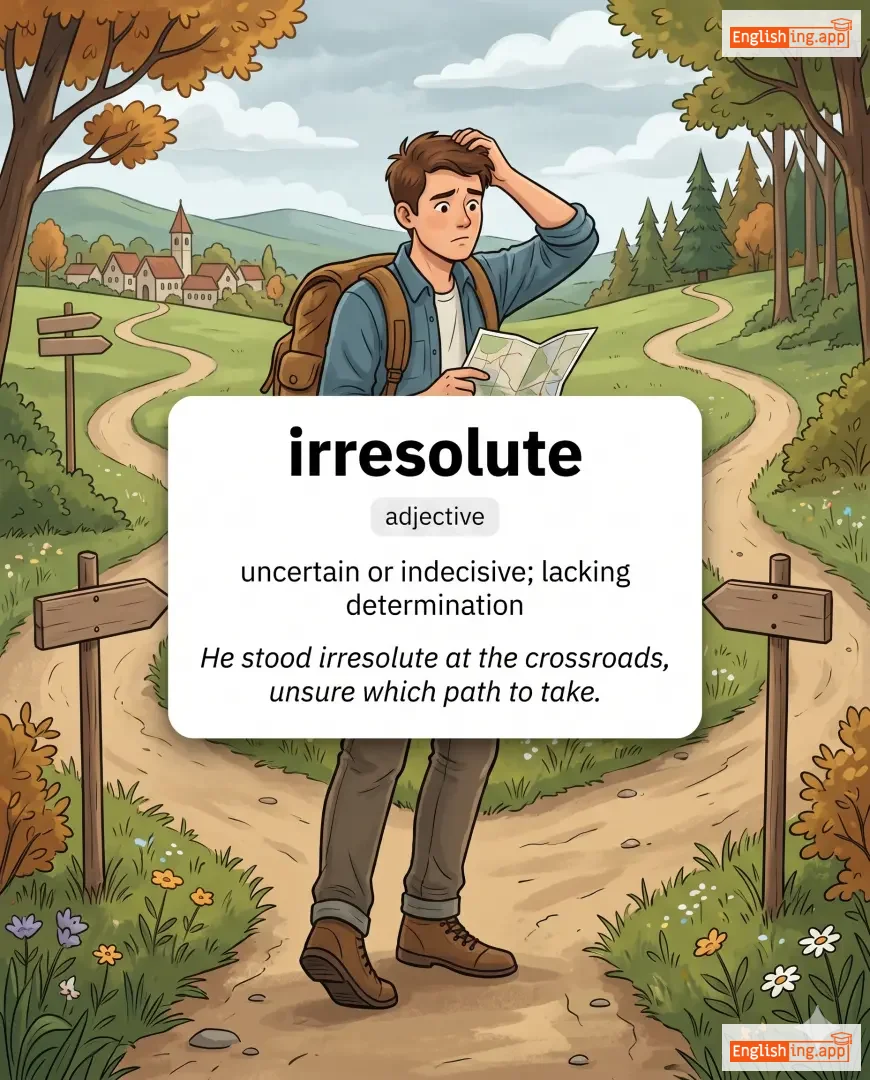
irresolute definition card — visual illustration of the meaning
adjective
/ɪˈrɛzəluːt/
indeciso (indeciso)

uncertain or indecisive; lacking determination

"He stood irresolute at the crossroads, unsure which path to take."

"Él se quedó indeciso en el cruce de caminos, sin saber qué camino tomar." (El se quedo indeciso en el cruce de caminos, sin saber que camino tomar.)
adjective
/ˌɪrɪˈspɛktɪv/
irrespetuoso; sin tener en cuenta (irrespetuoso; sin tener en cuenta)

without taking something into account; regardless of

"All students will be treated equally, irrespective of their background."

"Todos los estudiantes serán tratados por igual, independientemente de su origen." (Todos los estudiantes serán tratados por igual, independientemente de su origen.)
noun
/ˌɪrɪˌspɒnsəˈbɪləti/
irresponsabilidad (irresponsabilidad)

lack of responsibility or accountability; failure to act in a reliable or sensible way

"The accident was caused by his irresponsibility at work."

"El accidente fue causado por su irresponsabilidad en el trabajo." (El accidente fue causado por su irresponsabilidad en el trabajo)
adjective
/ˌɪrɪˈspɒnsəbl/
irresponsable (irresponsable)

not showing proper sense of responsibility

"It was irresponsible of him to leave the children alone."

"Fue irresponsable de su parte dejar a los niños solos." (Fue irresponsable de su parte dejar a los niños solos.)
adjective
/ˌɪrɪˈtriːvəbl/
irrecuperable (irrecuperable)

impossible to recover or regain

"The documents were lost in an irretrievable way after the fire."

"Los documentos se perdieron de manera irrecuperable después del incendio." (Los documentos se perdieron de manera irrecuperable despues del incendio.)
noun
/ɪˈrɛvərəns/
irreverencia (irreverencia)

a lack of respect for people or things that are generally taken seriously

"His jokes about religion showed irreverence to the sacred traditions."

"Sus bromas sobre religión mostraron irreverencia hacia las tradiciones sagradas." (Sus bromas sobre religión mostraron irreverencia hacia las tradiciones sagradas.)
adjective
/ɪˈrɛvərənt/
irreverente (irreverente)

showing a lack of respect for people or things that are usually respected

"The comedian’s irreverent jokes offended some of the audience."

"Los chistes irreverentes del comediante ofendieron a algunos de la audiencia." (Los chistes irreverentes del comediante ofendieron a algunos de la audiencia.)
adjective
/ˌɪrɛvəˈrɛnʃəl/
irreverente (irreverente)

Showing a lack of respect for things that are generally taken seriously.

"His irreverential humor often shocked traditional audiences."

"Su humor irreverente a menudo sorprendía a las audiencias tradicionales." (Su humor irreverente a menudo sorprendía a las audiencias tradicionales.)
adjective
/ˌɪrɪˈvɜːrsəbl/
irreversible (irreversible)

Not able to be undone, changed, or reversed.

"The damage caused by the fire was irreversible."

"El daño causado por el fuego fue irreversible." (El daño causado por el fuego fue irreversible.)
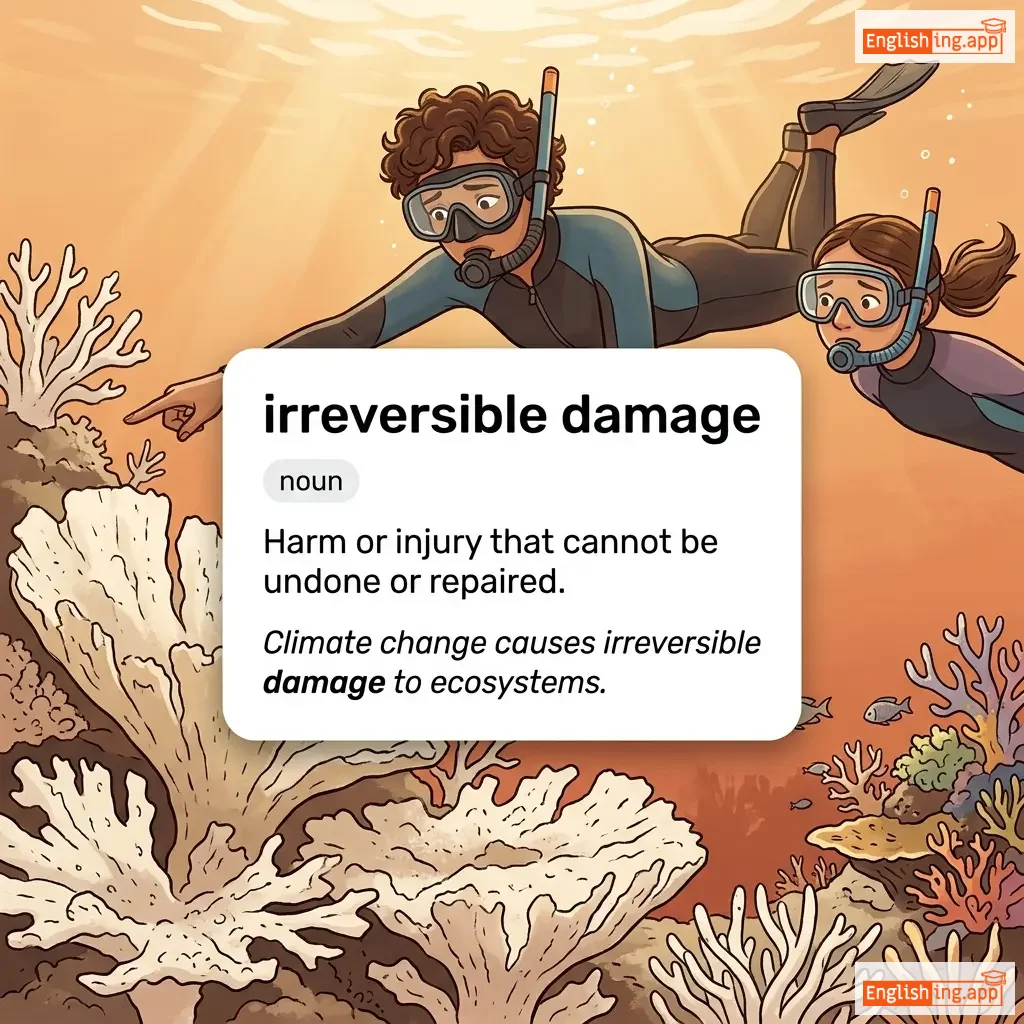
irreversible damage definition card — visual illustration of the meaning
noun
ˌɪrɪˈvɜːrsəbl ˈdæmɪdʒ
daño irreversible (danyo irreversible)

Harm or injury that cannot be undone or repaired.

"Climate change causes irreversible damage to ecosystems."

"El cambio climático causa daño irreversible a los ecosistemas." (El cambio climatico causa dano irreversible a los ecosistemas.)
adjective
/ɪˈrɛvəkəbl/
irreversible (irreversible)

Not able to be revoked, changed, or undone.

"She made an irrevocable decision to leave the company."

"Ella tomó una decisión irreversible de dejar la empresa." (Ella tomó una decisión irreversible de dejar la empresa.)
noun
/ˈɪrɪɡənt/
líquido de riego (liquido de riego)

A liquid used for irrigation, especially in medical or agricultural contexts.

"The doctor used a sterile irrigant during the procedure."

"El doctor usó un irrigante estéril durante el procedimiento." (El doctor uso un irrigante esteril durante el procedimiento.)
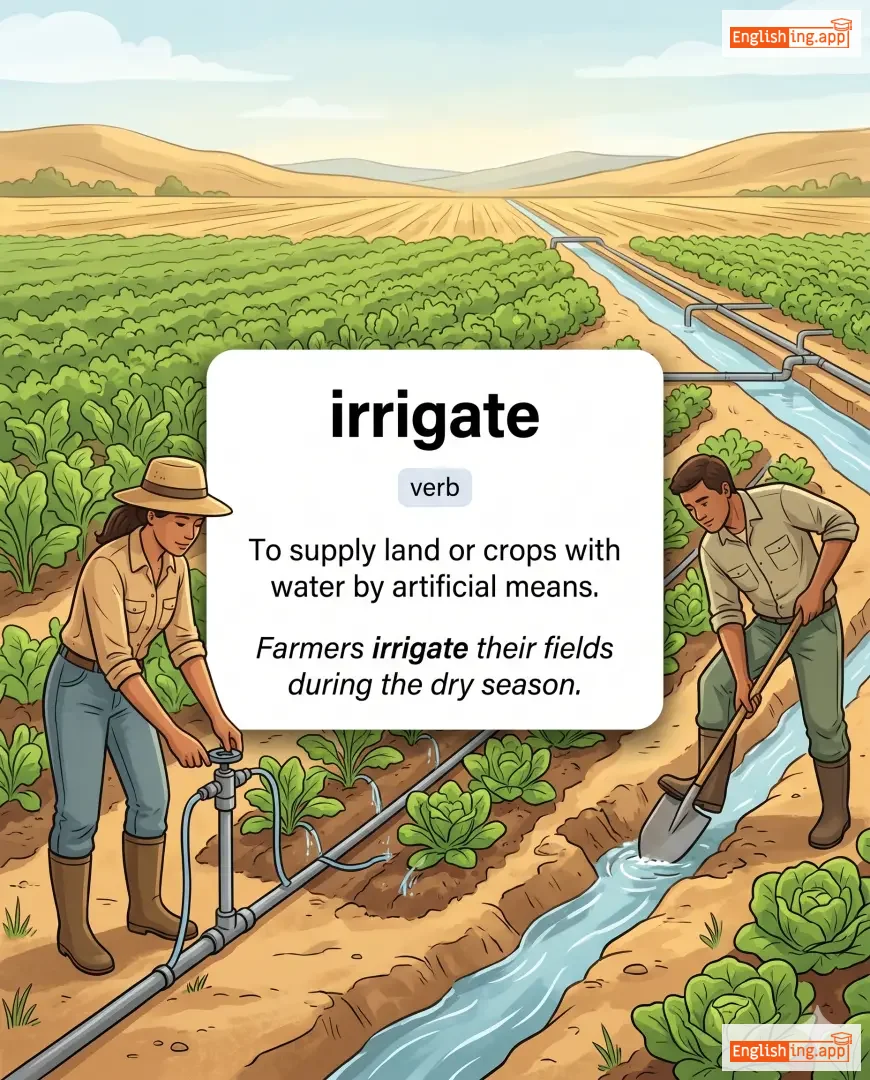
irrigate definition card — visual illustration of the meaning
verb
/ˈɪrɪɡeɪt/
regar (regar)

To supply land or crops with water by artificial means.

"Farmers irrigate their fields during the dry season."

"Los agricultores riegan sus campos durante la temporada seca." (Los agricultores riegan sus campos durante la temporada seca.)
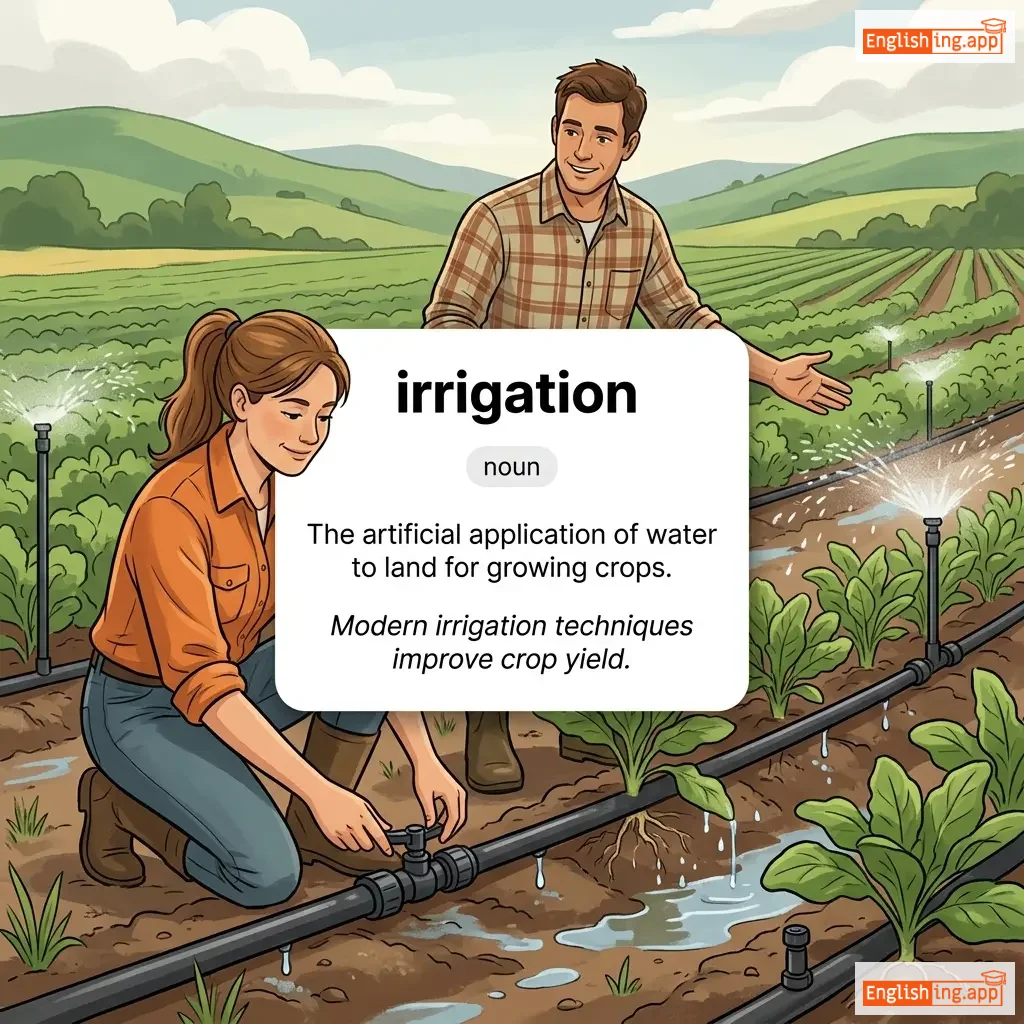
irrigation definition card — visual illustration of the meaning
noun
ˌɪr.ɪˈɡeɪ.ʃən
riego (riego)

The artificial application of water to land for growing crops.

"Modern irrigation techniques improve crop yield."

"Las técnicas modernas de riego mejoran el rendimiento de los cultivos." (Las tecnicas modernas de riego mejoran el rendimiento de los cultivos.)
adjective
/ˈɪrɪtəbl/
irritable (irritable)

easily annoyed or made angry

"She became irritable after working long hours without rest."

"Ella se volvió irritable después de trabajar muchas horas sin descanso." (Ella se volvio irritable despues de trabajar muchas horas sin descanso.)
noun
/ˈɪrɪtənsi/
irritación (irritacion)

the quality or state of causing irritation; legal or formal invalidation

"The constant noise became an irritancy to the neighbors."

"El ruido constante se convirtió en una irritación para los vecinos." (El ruido constante se convirtio en una irritacion para los vecinos.)
noun
/ˈɪrɪtənt/
sustancia irritante (sustansia irritante)

something that causes irritation or discomfort

"Dust is a common irritant for people with allergies."

"El polvo es un irritante común para las personas con alergias." (El polvo es un irritante comun para las personas con alergias.)
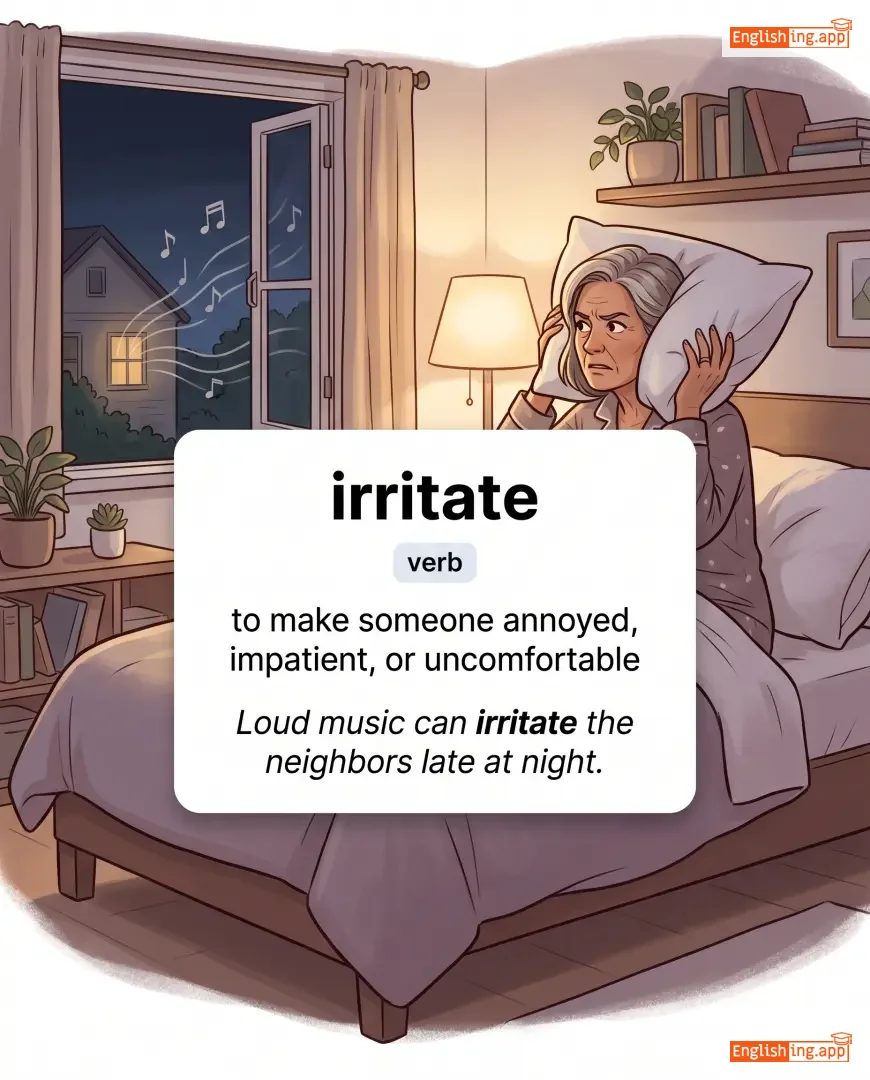
irritate definition card — visual illustration of the meaning
verb
/ˈɪrɪteɪt/
irritar (irritar)

to make someone annoyed, impatient, or uncomfortable

"Loud music can irritate the neighbors late at night."

"La música fuerte puede irritar a los vecinos tarde en la noche." (La música fuerte puede irritar a los vecinos tarde en la noche.)
adjective
/ˈɪrɪteɪtɪd/
irritado (irritado)

feeling annoyed or impatient; having inflamed or sore physical condition

"She felt irritated by the constant noise outside her window."

"Se sintió irritada por el ruido constante afuera de su ventana." (Se sintio irritada por el ruido constante afuera de su ventana)
adjective
/ˈɪrɪteɪtɪŋ/
irritante (irritante)

causing annoyance, impatience, or mild anger

"The constant noise from the street is extremely irritating."

"El ruido constante de la calle es extremadamente irritante." (El ruido constante de la calle es extremadamente irritante)
noun
/ɪˈrʌpʃən/
irrupción (irrupcion)

a sudden and violent entry or invasion

"The irruption of protesters surprised the authorities."

"La irrupción de los manifestantes sorprendió a las autoridades." (La irrupción de los manifestantes sorprendió a las autoridades.)
noun
/ɪsˈlɑːm/
islám religión (islam religion)

the religion founded by the Prophet Muhammad, based on belief in one God (Allah)

"Islam emphasizes peace, justice, and compassion."

"El Islam enfatiza la paz, la justicia y la compasión." (El Islam enfatiza la paz, la justicia y la compasión.)
adjective
/ɪsˈlɑːmɪk/
islámico (islamico)

relating to Islam, its followers, or its teachings

"The city has many Islamic cultural centers."

"La ciudad tiene muchos centros culturales islámicos." (La ciudad tiene muchos centros culturales islámicos.)
noun
/ˈaɪ.lənd/
isla (isla)

a piece of land surrounded by water

"They spent their vacation on a tropical island."

"Pasaron sus vacaciones en una isla tropical." (Pasaron sus vacaciones en una isla tropical.)
noun
/aɪl/
pequeña isla (pequena isla)

A small island or peninsula, often poetic or literary.

"They spent their honeymoon on a beautiful tropical isle."

"Pasaron su luna de miel en una hermosa isla tropical." (pasaron su luna de miel en una hermosa isla tropical.)
noun
/ˈaɪ.lət/
islote (islote)

A very small island.

"The fishermen rested on a tiny islet before continuing their journey."

"Los pescadores descansaron en un islote pequeño antes de continuar su viaje." (Los pescadores descansaron en un islote pequeno antes de continuar su viaje.)
noun
/ˈaɪ.səˌbɑːr/
isóbara (isobara)

A line on a weather map connecting points of equal atmospheric pressure.

"The meteorologist explained how isobars indicate wind speed and direction."

"El meteorólogo explicó cómo las isóbaras indican la velocidad y dirección del viento." (El meteorologo explico como las isobaras indican la velocidad y direccion del viento.)
adjective
/aɪˈsɒ.krə.nəs/
aconteciendo a intervalos de tiempo iguales (aconteciendo a intervalos de tiempo iguales)

Occurring at equal time intervals; in unison or synchrony.

"The pendulum swings are isochronous, repeating at equal intervals."

"Los oscilaciones del péndulo son isócronos, repitiendo a intervalos iguales." (Los oscilaciones del péndulo son isócronos, repitiendo a intervalos iguales.)
verb
/ˈaɪ.sə.leɪt/
aislar (aislar)

To separate something or someone from others.

"Doctors tried to isolate the patient to prevent the spread of infection."

"Los doctores intentaron aislar al paciente para evitar la propagación de la infección." (Los doctores intentaron aislar al paciente para evitar la propagacion de la infeccion.)