Vocabularios

Descubra, aprenda y domine el vocabulario en inglés

adjective
/ˌɪnˈvɜːrs/
inverso (inverso)

Opposite in position, direction, order, or effect.

"There is an inverse relationship between price and demand."

"Hay una relación inversa entre el precio y la demanda." (Hay una relacion inversa entre el precio y la demanda.)
adverb
/ɪnˈvɜːrs.li/
inversamente; en sentido opuesto (inversamente; en sentido opuesto)

in a way that is opposite or contrary; in reverse order or manner

"The price of goods is inversely related to their availability in the market."

"El precio de los productos está inversamente relacionado con su disponibilidad en el mercado." (El precio de los productos está inversamente relacionado con su disponibilidad en el mercado.)
noun
/ɪnˈvɜːrʒən/
inversión (inversion)

A reversal of the normal order, position, or relationship.

"In poetry, inversion is often used to create emphasis."

"En poesía, la inversión se usa a menudo para crear énfasis." (En poesia, la inversion se usa a menudo para crear enfasis.)
verb
/ɪnˈvɜːrt/
invertir (invertir)

To turn something upside down or in the opposite position, order, or direction.

"He inverted the glass to let the water drain out."

"Él invirtió el vaso para dejar que el agua se drenara." (Él invirtió el vaso para dejar que el agua se drenara.)
invest definition card — visual illustration of the meaning
verb
/ɪnˈvɛst/
invertir (invertir)

to put money, time, or effort into something with the expectation of achieving a benefit

"He decided to invest in real estate to secure his future."

"Él decidió invertir en bienes raíces para asegurar su futuro." (El decidió invertir en bienes raíces para asegurar su futuro.)
verb
/ɪnˈvɛs.tɪ.ɡeɪt/
investigar (investigar)

to carry out a systematic inquiry to discover facts or information

"The police will investigate the incident thoroughly."

"La policía investigará el incidente a fondo." (La policia investigara el incidente a fondo.)
noun
/ɪnˌvɛs.tɪˈɡeɪ.ʃən/
investigación (investigacion)

the process of inquiring into or examining something carefully to find the truth

"The investigation revealed new evidence about the fraud."

"La investigación reveló nuevas pruebas sobre el fraude." (La investigacion revelo nuevas pruebas sobre el fraude.)
noun
/ɪnˈvɛstɪˌɡeɪtər/
felicidad (felicidad)

a person who carries out a formal inquiry or investigation

"The investigator gathered evidence from the crime scene."

"Ella no pudo ocultar su felicidad cuando recibió el premio." (Ella no pudo ocultar su felicidad cuando recibió el premio.)
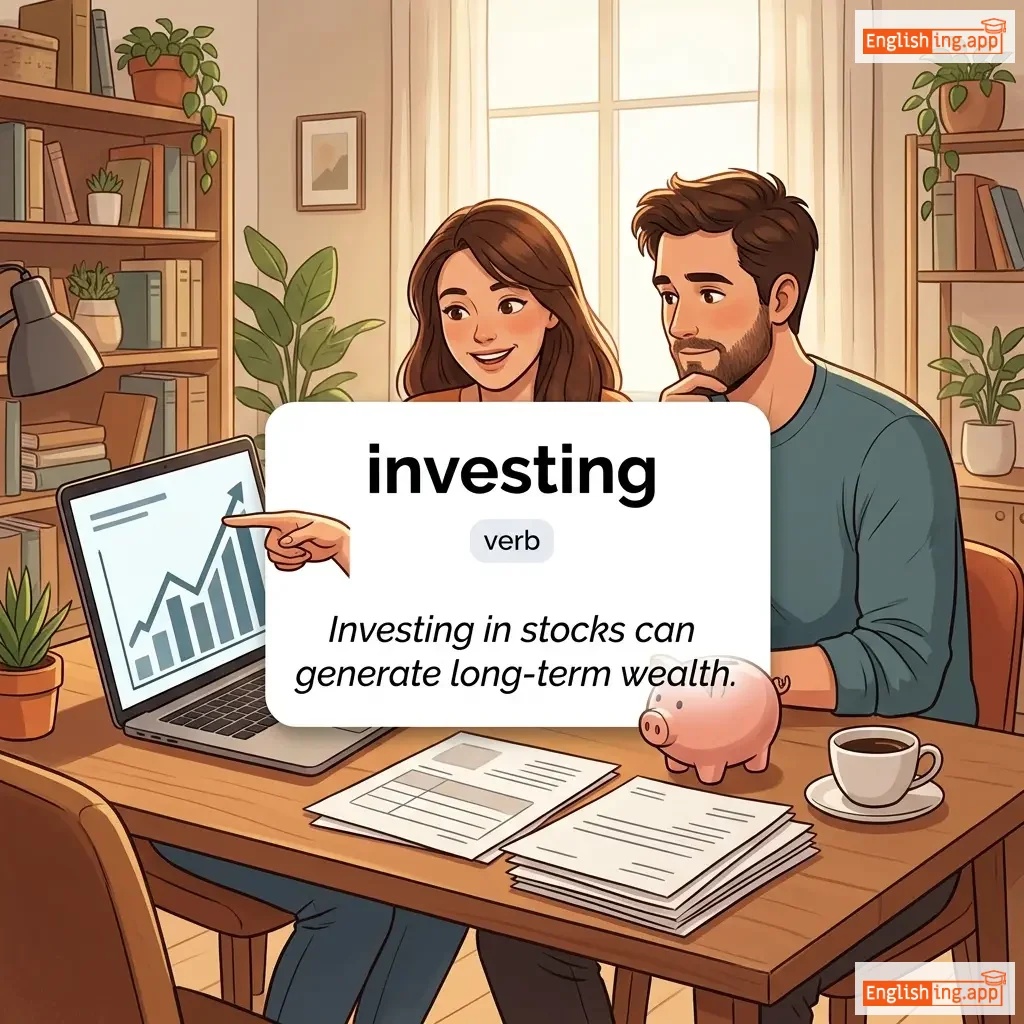
investing definition card — visual illustration of the meaning
verb
ɪnˈvɛst.ɪŋ
invertir (invertir)

The act of putting money into financial schemes, shares, property, or a commercial venture with the expectation of achieving a profit.

"Investing in stocks can generate long-term wealth."

"Invertir en acciones puede generar riqueza a largo plazo." (Invertir en acciones puede generar riqueza a largo plazo.)
noun
/ɪnˈvɛstɪtʃər/
ceremonia de investidura (ceremonia de investidura)

the formal ceremony of conferring authority, rank, or office

"The king held an investiture ceremony for the new knight."

"El rey celebró una ceremonia de investidura para el nuevo caballero." (El rey celebro una ceremonia de investidura para el nuevo caballero.)
investment definition card — visual illustration of the meaning
noun
/ɪnˈvɛst.mənt/
inversión (inversion)

the action or process of putting money, time, or resources into something for future benefit

"Her investment in technology startups has paid off well."

"Su inversión en startups tecnológicas ha dado buenos resultados." (Su inversion en startups tecnologicas ha dado buenos resultados.)
noun
/ɪnˈvɛstər/
inversor (inversor)

a person or organization that puts money into financial schemes, property, or business ventures with the expectation of achieving a profit

"The investor funded the startup with a large sum of money."

"El inversor financió la startup con una gran suma de dinero." (El inversor financió la startup con una gran suma de dinero.)
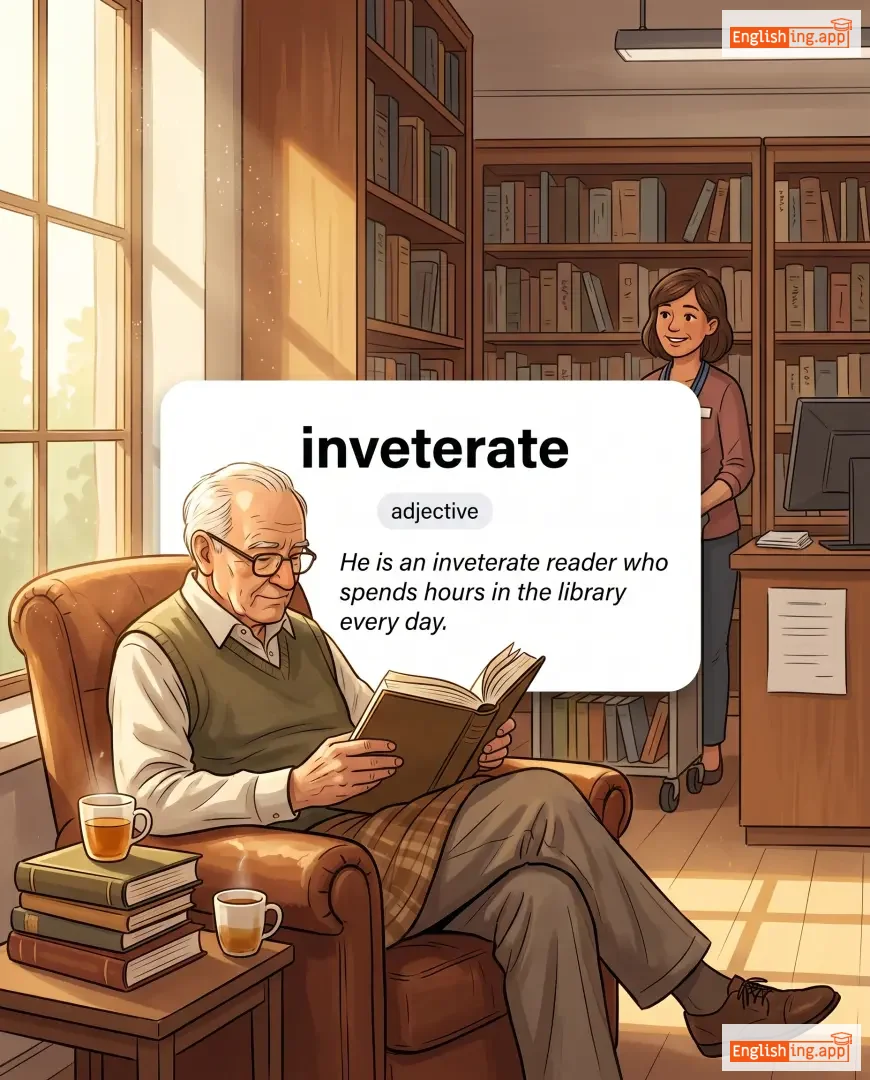
inveterate definition card — visual illustration of the meaning
adjective
/ɪnˈvɛtərət/
inmutable (inmutable)

having a long-established habit, activity, or interest that is unlikely to change

"He is an inveterate reader who spends hours in the library every day."

"Él es un lector inmutable que pasa horas en la biblioteca todos los días." (El es un lector inmutable que pasa horas en la biblioteca todos los dias.)
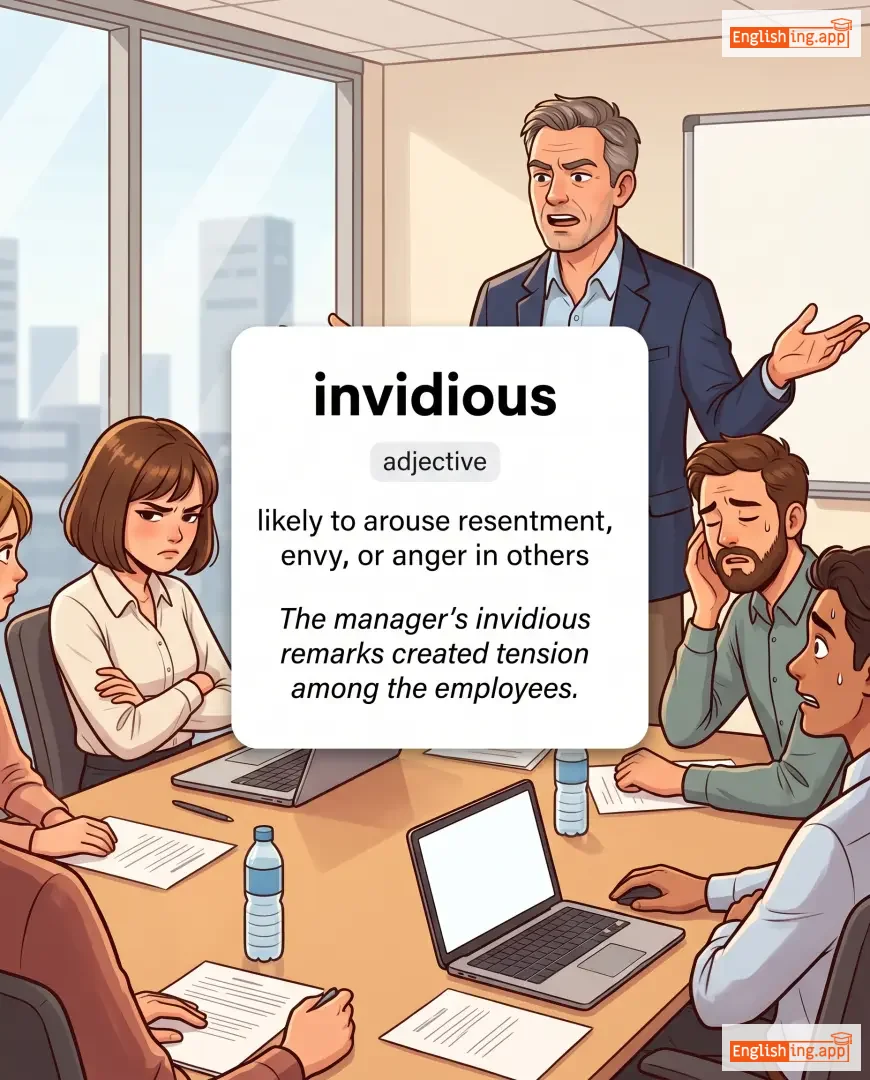
invidious definition card — visual illustration of the meaning
adjective
/ɪnˈvɪdiəs/
envidioso (envidioso)

likely to arouse resentment, envy, or anger in others

"The manager's invidious remarks created tension among the employees."

"Los comentarios envidiosos del gerente crearon tensión entre los empleados." (Los comentarios envidiosos del gerente crearon tensión entre los empleados.)
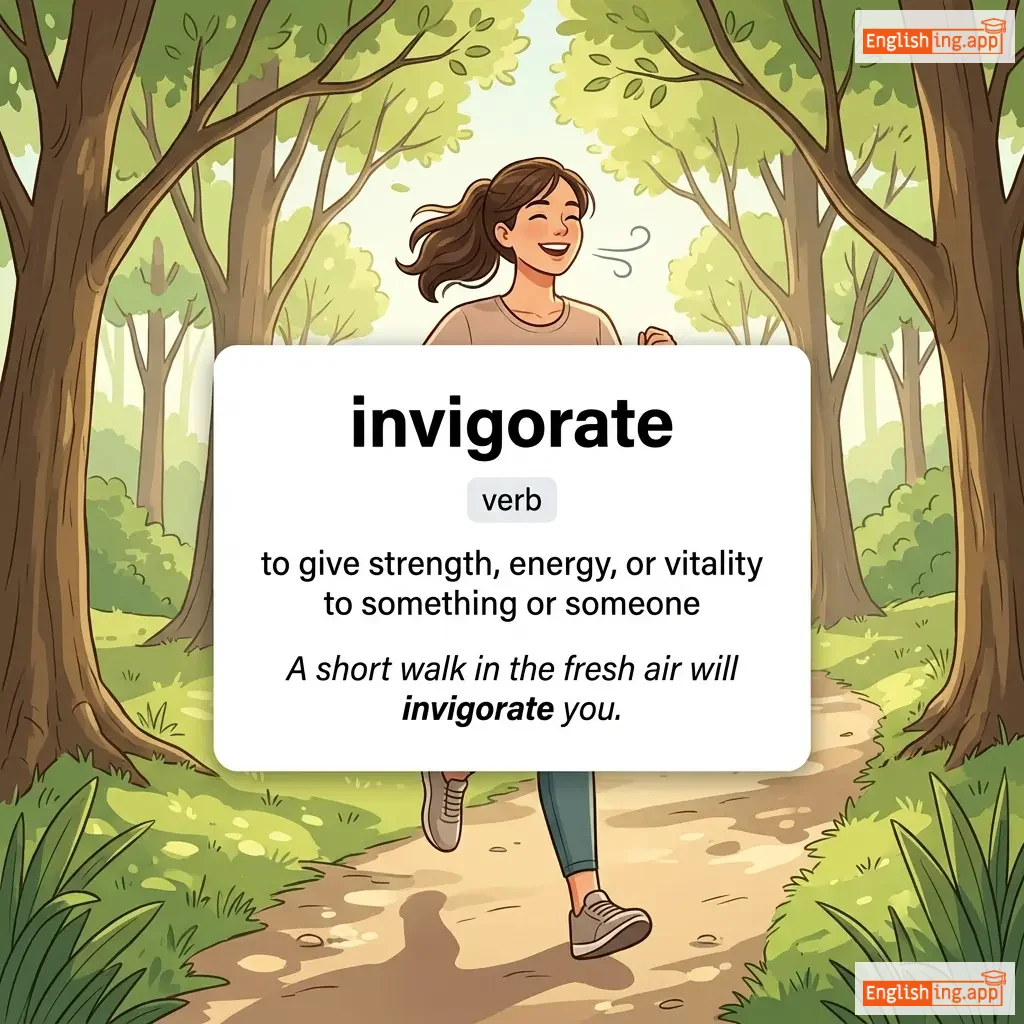
invigorate definition card — visual illustration of the meaning
verb
/ɪnˈvɪɡəreɪt/
estimular (estimular)

to give strength, energy, or vitality to something or someone

"A short walk in the fresh air will invigorate you."

"Una caminata corta en el aire fresco te invigora." (Una caminata corta en el aire fresco te invigora.)
adjective
/ɪnˈvɪnsəbl/
invencible (invencible)

too powerful to be defeated or overcome

"The team seemed invincible after winning ten matches in a row."

"El equipo parecía invencible después de ganar diez partidos consecutivos." (El equipo parecia invencible despues de ganar diez partidos consecutivos.)
adjective
/ɪnˈvaɪələbl/
inviolable (inviolable)

never to be broken, dishonored, or violated

"Human rights are considered inviolable in modern democracies."

"Los derechos humanos son considerados inviolables en las democracias modernas." (Los derechos humanos son considerados inviolables en las democracias modernas.)
adjective
/ɪnˈvaɪələt/
inviolado (inviolado)

free from violation, injury, or desecration; kept safe and untouched

"The ancient temple remained inviolate for centuries."

"El antiguo templo permaneció inviolado durante siglos." (El antiguo templo permaneció inviolado durante siglos.)
adjective
/ɪnˈvɪzɪbəl/
invisible (invisible)

unable to be seen; not visible to the eye

"The stars became invisible as the sun rose."

"Las estrellas se hicieron invisibles cuando el sol salió." (Las estrellas se hicieron invisibles cuando el sol salió.)
noun
/ˌɪnvɪˈteɪʃən/
felicidad (felicidad)

a written or spoken request to attend an event or to participate in something

"She sent me an invitation to her wedding."

"Ella no pudo ocultar su felicidad cuando recibió el premio." (Ella no pudo ocultar su felicidad cuando recibio el premio.)
verb
/ɪnˈvaɪt/
invitar (invitar)

to ask someone to come to a place or event

"She invited her friends to the party."

"Ella invitó a sus amigos a la fiesta." (Ella invitó a sus amigos a la fiesta.)
verb
/ɪnˈvaɪtɪd/
invitado (invitado)

asked someone formally or politely to go somewhere or do something

"She was invited to the party."

"Ella fue invitada a la fiesta." (ella fue invitada a la fiesta)
noun
/ɪnˈvaɪtər/
invitador (invitador)

a person who invites someone to an event, meeting, or place

"The invitor greeted all the guests warmly at the entrance."

"El invitador saludó cordialmente a los invitados en la entrada." (El invitador saludo cordialmente a los invitados en la entrada)
noun
/ˌɪnvəˈkeɪʃən/
invocación (invocacion)

the act of calling upon a higher power for help, blessing, or inspiration

"The ceremony began with an invocation to the gods."

"La ceremonia comenzó con una invocación a los dioses." (La ceremonia comenzó con una invocación a los dioses.)
noun
/ˈɪnvɔɪs/
factura (factura)

a list of goods sent or services provided, with the amount due for payment

"The company sent an invoice for the delivered products."

"La empresa envió una factura por los productos entregados." (La empresa envió una factura por los productos entregados.)
verb
/ɪnˈvoʊk/
invocar (invocar)

to call upon a higher power, authority, or principle for help, support, or justification

"The lawyer invoked the constitution to defend his client."

"El abogado invocó la constitución para defender a su cliente." (El abogado invocó la constitución para defender a su cliente.)
adjective
/ɪnˈvɑːlənˌtɛri/
involuntario (involuntario)

done without will or conscious control

"He gave an involuntary shiver when he heard the loud noise."

"Él dio un escalofrío involuntario cuando escuchó el ruido fuerte." (Él dio un escalofrío involuntario cuando escuchó el ruido fuerte.)
noun
/ˌɪnvəˈluːʃən/
involución (involucion)

a complicated or intricate form or state; in biology, the shrinking of an organ after its function has finished

"The story was full of involution, making it hard to follow."

"La historia estaba llena de involución, lo que hacía difícil de seguir." (La historia estaba llena de involución, lo que hacía difícil de seguir.)
verb
/ɪnˈvɑːlv/
involucrar (involucrar)

to include as a necessary part, or to engage someone in an activity

"The project will involve several departments working together."

"El proyecto involucrará varios departamentos trabajando juntos." (El proyecto involucrará varios departamentos trabajando juntos.)
adjective
/ɪnˈvɑːlvd/
involucrado (involucrado)

complicated or engaged in something

"She was deeply involved in community service."

"Ella estaba profundamente involucrada en el servicio comunitario." (Ella estaba profundamente involucrada en el servicio comunitario.)
noun
/ɪnˈvɒlvmənt/
participación (participacion)

the act of taking part in something

"His involvement in the project was crucial."

"Su participación en el proyecto fue crucial." (Su participacion en el proyecto fue crucial.)
adjective
/ɪnˈvʌlnərəbl/
invulnerable (invulnerable)

Impossible to harm, damage, or defeat.

"The fortress was thought to be invulnerable to attack."

"Se pensaba que la fortaleza era invulnerable al ataque." (Se pensaba que la fortaleza era invulnerable al ataque.)
adverb
/ˈɪnwərdli/
por dentro (por dentro)

In the mind or spirit; not outwardly visible.

"She smiled outwardly but inwardly she was worried."

"Ella sonrió por fuera, pero por dentro estaba preocupada." (Ella sonrió por fuera, pero por dentro estaba preocupada.)
noun
/aɪˈoʊtə/
un mínimo (un minimo)

An extremely small amount.

"He did not show an iota of fear."

"No mostró ni un mínimo de miedo." (No mostró ni un minimo de miedo.)
adjective/noun
/ɪˈrɑːki/
iraquí (iraqui)

relating to Iraq or its people

"The Iraqi culture is rich and diverse."

"La cultura iraquí es rica y diversa." (La kultura iraquí es rica y diversa.)
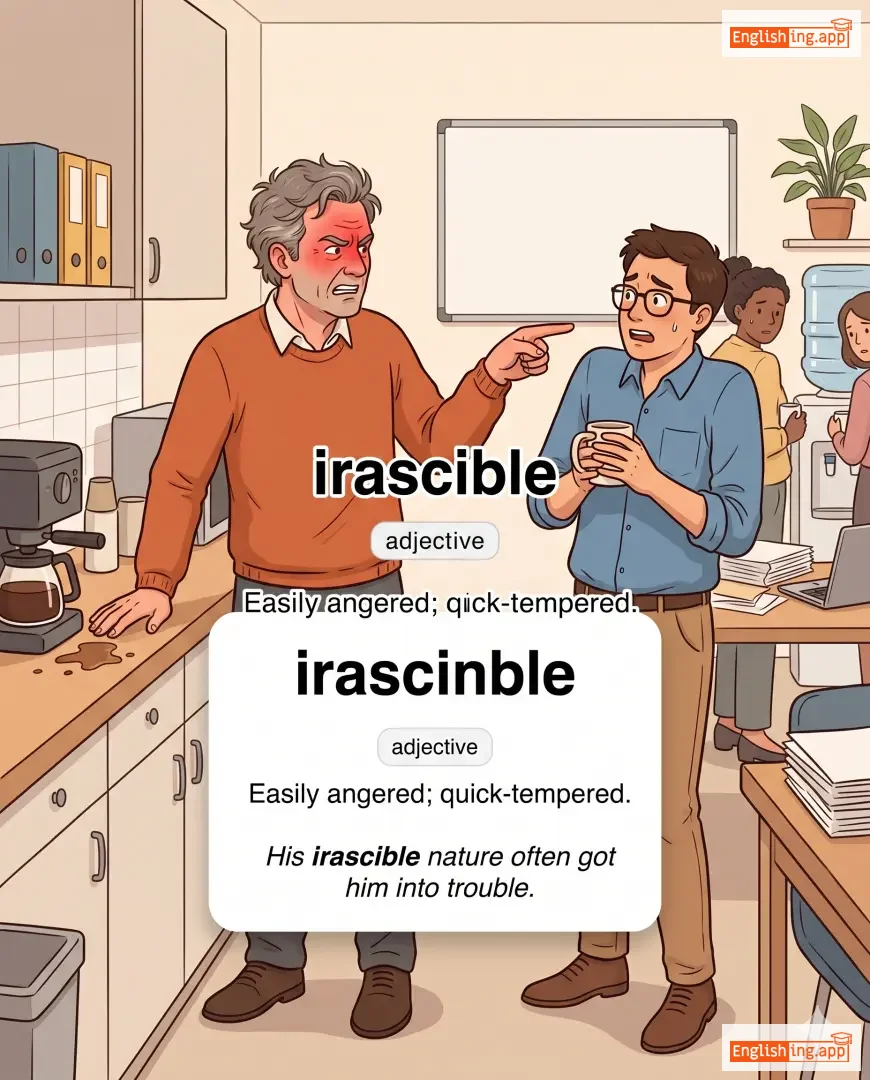
irascible definition card — visual illustration of the meaning
adjective
/ɪˈræsɪbl/
irascible (irascible)

Easily angered; quick-tempered.

"His irascible nature often got him into trouble."

"Su naturaleza irascible a menudo lo metía en problemas." (Su naturaleza irascible a menudo lo metía en problemas.)
adjective
/aɪˈreɪt/
iracundo (iracundo)

Extremely angry.

"The customer became irate after waiting for hours."

"El cliente se puso iracundo después de esperar durante horas." (El cliente se puso iracundo después de esperar durante horas.)
noun
/aɪər/
ira, enojo (ira, enojo)

intense anger or rage

"The new policy provoked the ire of the employees."

"La nueva política provocó la ira de los empleados." (La nueva política provocó la ira de los empleados.)
noun
/ˌɪrɪˈdɛsəns/
brillo iridiscente (brillo iridiscente)

a play of lustrous, changing colors like those of a rainbow

"The butterfly's wings shimmered with iridescence."

"Las alas de la mariposa brillaban con brillo iridiscente." (Las alas de la mariposa brillaban con brillo iridiscente.)
adjective
/ˌɪrɪˈdɛsənt/
iridiscente (iridiscente)

showing luminous colors that seem to change when seen from different angles

"She wore an iridescent dress that sparkled in the light."

"Ella llevaba un vestido iridiscente que brillaba a la luz." (Ella llevaba un vestido iridiscente que brillaba a la luz.)
adjective/noun
/ˈaɪrɪʃ/
felicidad (felicidad)

relating to Ireland, its people, or its language

"The Irish countryside is very beautiful."

"No pudo esconder su felicidad cuando recibió el premio." (No pudo esconder su felicidad cuando recibió el premio.)
verb
/ɜːrk/
molestar (molestar)

to annoy or irritate someone

"It irks me when people are late without calling."

"Me molesta cuando la gente llega tarde sin llamar." (Me molesta cuando la gente llega tarde sin llamar.)
adjective
/ˈɜːrksəm/
molesto (molesto)

annoying or irritating

"Waiting in a long line is one of the most irksome tasks."

"Esperar en una larga fila es una de las tareas más molestas." (Esperar en una larga fila es una de las tareas más molestas.)
noun/verb
/ˈaɪən/ or /ˈaɪərn/
hierro / plancha (hierro / plancha)

a strong, hard metal used in construction; also to press clothes with heat

"He used an iron to smooth his shirt."

"Él usó una plancha para alisar su camisa." (Él usó una plancha para alisar su camisa.)
adjective
/ˈaɪərnˌklæd/
inquebrantable (ironclad)

impossible to change, break, or dispute; very strong and firm

"The company had an ironclad contract with its suppliers."

"La empresa tenía un contrato inquebrantable con sus proveedores." (La empresa tenía un contrato inquebrantable con sus proveedores.)
adjective
/aɪˈrɒnɪk/
irónico, sarcástico (aironik)

happening in the opposite way to what is expected, often amusing or sarcastic

"It is ironic that the fire station burned down."

"Es irónico que la estación de bomberos se haya quemado." (Es ironico ke la estacion de bomberos se haya quemado.)
adjective
/aɪˈrɒnɪkəl/
irónico (ironiko)

expressing irony; having the nature of irony

"Her ironical tone made everyone uncomfortable."

"Su tono irónico hizo que todos se sintieran incómodos." (Su tono ironiko hizo ke todos se sintieran incómodos.)
adverb
/aɪˈrɒnɪkli/
irónicamente (ironikamente)

in a way that is contrary to what is expected or intended

"Ironically, the fire station burned down."

"Irónicamente, la estación de bomberos se incendió." (Ironicamente, la estacion de bomberos se incendio.)
noun
/ˈaɪ.ərn.wʊd/
madera de hierro (madera de hierro)

a hard, dense wood from various trees; also the tree itself that produces small flowers

"The ironwood tree blooms with tiny white flowers."

"El árbol de madera de hierro florece con pequeñas flores blancas." (El arbol de madera de hierro florece con pequenas flores blancas.)
noun
/ˈaɪrəni/
ironía (aironiya)

a situation that is strange or amusing because it is the opposite of what is expected; the use of words to convey the opposite meaning

"The irony of the situation was that the winner forgot his own prize."

"La ironía de la situación fue que el ganador olvidó su propio premio." (La ironia de la situacion fue que el ganador olvido su propio premio.)