Vocabularios

Descubra, aprenda y domine el vocabulario en inglés

adjective
/ˌɪnɪˈsɛnʃəl/
inesencial (inesencial)

not necessary or important; not essential

"The report removes all inessential details to stay focused."

"El informe elimina los detalles inesenciales para mantenerse enfocado." (el informe elimina los detalles inesenciales para mantenerse enfocado)
adjective
/ɪnˈɛstɪməbl/
invaluable (invaluable)

Too great or valuable to be measured or estimated.

"Her contribution to the project was of inestimable value."

"Su contribución al proyecto fue de un valor invaluable." (Su contribución al proyecto fue de un valor invaluable.)
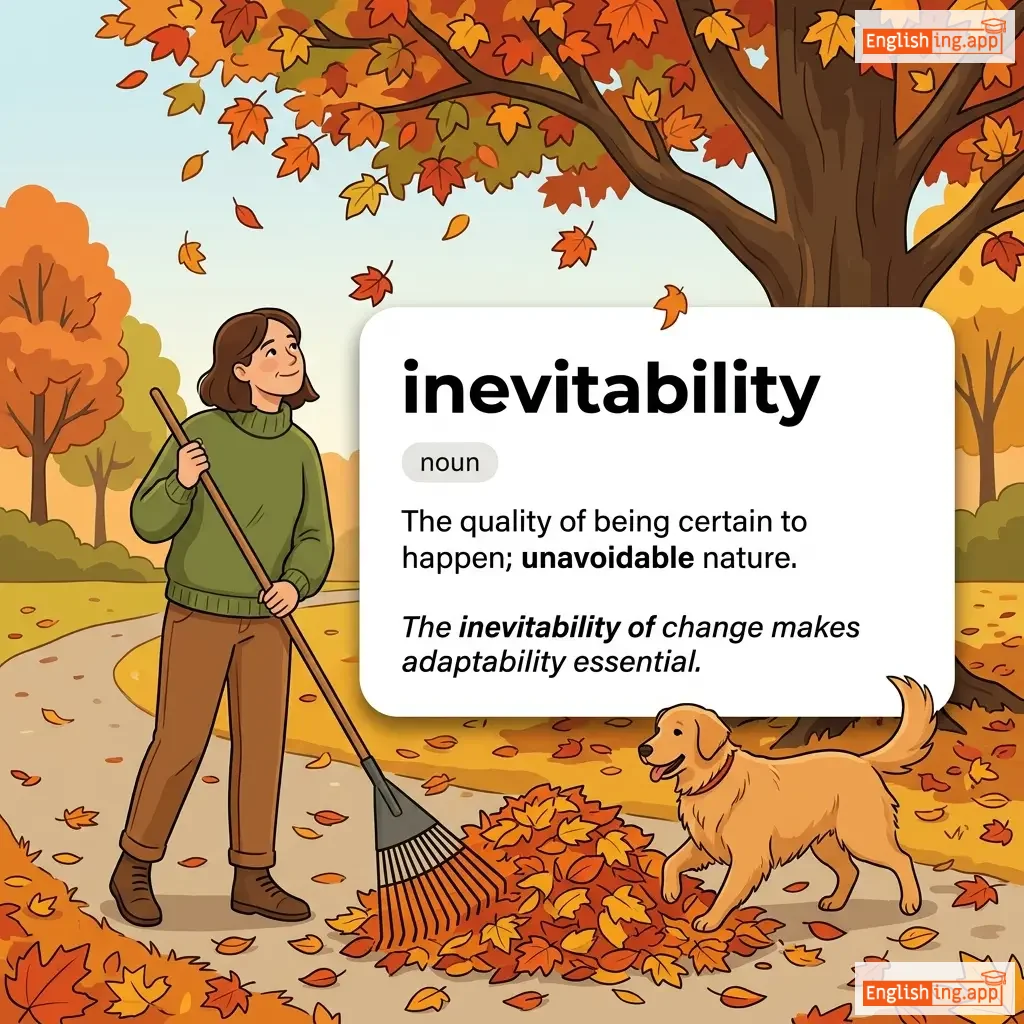
inevitability definition card — visual illustration of the meaning
noun
/ɪnˌɛvɪtəˈbɪləti/
inevitabilidad (inevitabilidad)

The quality of being certain to happen; unavoidable nature.

"The inevitability of change makes adaptability essential."

"La inevitabilidad del cambio hace que la adaptabilidad sea esencial." (La inevitabilidad del cambio hace que la adaptabilidad sea esencial.)
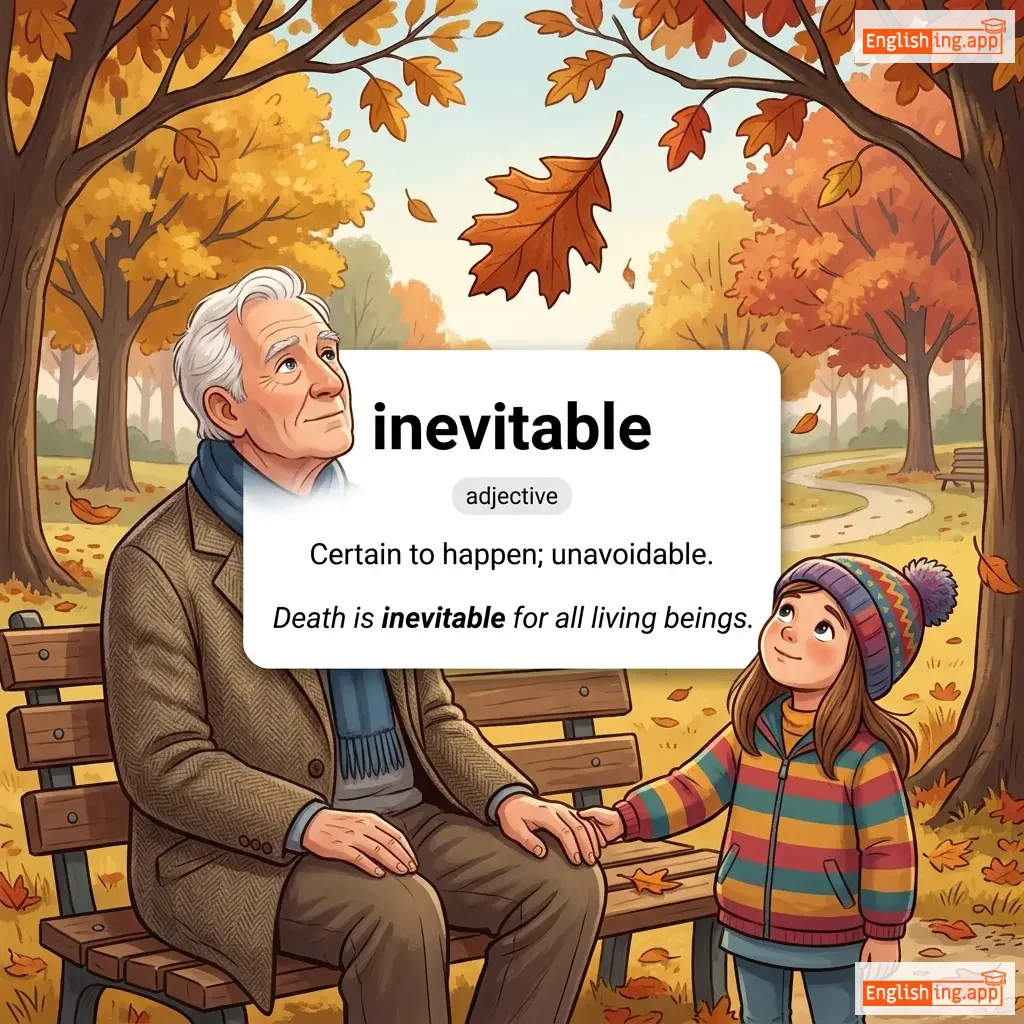
inevitable definition card — visual illustration of the meaning
adjective
/ɪnˈɛvɪtəbl/
inevitable (inevitable)

Certain to happen; unavoidable.

"Death is inevitable for all living beings."

"La muerte es inevitable para todos los seres vivos." (La muerte es inevitable para todos los seres vivos.)
adverb
/ɪnˈɛvɪtəbli/
inevitable (inevitable)

in a way that cannot be avoided or prevented

"Inevitably, the team faced challenges during the project."

"Inevitablemente, el equipo enfrentó desafíos durante el proyecto." (Inevitablemente, el equipo enfrentó desafíos durante el proyecto.)
adjective
/ˌɪnɪkˈskjuːzəbl/
inexcusable (inexcusable)

Too bad to be justified or overlooked; unforgivable.

"His rude behavior was inexcusable."

"Su comportamiento grosero era inexcusable." (Su comportamiento grosero era inexcusable.)
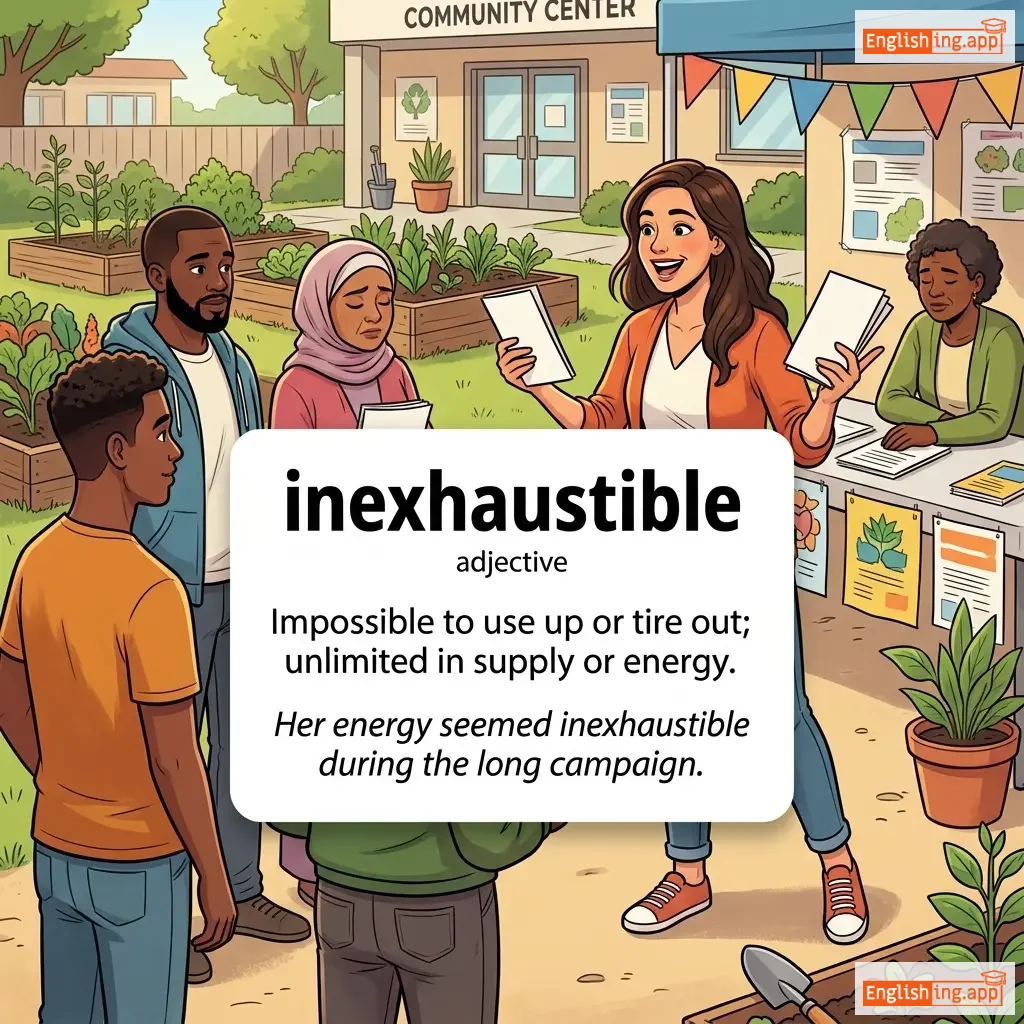
inexhaustible definition card — visual illustration of the meaning
adjective
/ˌɪnɪɡˈzɔːstəbl/
inagotable (inagotable)

Impossible to use up or tire out; unlimited in supply or energy.

"Her energy seemed inexhaustible during the long campaign."

"Su energía parecía inagotable durante la larga campaña." (Su energia parecia inagotable durante la larga campaña.)
adjective
/ɪnˈɛksərəbl/
inexorable (inexorable)

Impossible to stop or prevent; relentless.

"The inexorable rise of technology is changing every aspect of life."

"El inexorable aumento de la tecnología está cambiando cada aspecto de la vida." (El inexorable aumento de la tecnología está cambiando cada aspecto de la vida.)
noun (compound/erroneous entry)
/ɪnˈɛksərəbl ɑːrmi/
ejército imparable (ejercito imparable)

This appears to be a corrupted or concatenated form; interpreted as 'inexorable army' — an unstoppable or relentless force.

"The rebels feared the inexorable army approaching their stronghold."

"Los rebeldes temían al ejército imparable que se acercaba a su fortaleza." (Los rebeldes temian al ejercito imparable que se acercaba a su fortaleza.)
adjective
/ˌɪnɪkˈspiːdiənt/
desaconsejable (desaconsejable)

Not advisable, suitable, or practical in the circumstances.

"It would be inexpedient to invest without proper research."

"Sería desaconsejable invertir sin una investigación adecuada." (Sería desaconsejable invertir sin una investigación adecuada.)
adjective
/ˌɪnɪkˈspɛnsɪv/
barato (barato)

Cheap; costing little money.

"They found an inexpensive restaurant near the station."

"Encontraron un restaurante barato cerca de la estación." (Encontraron un restaurante barato cerca de la estación.)
noun
/ˌɪnɪkˈspɪəriəns/
inexperiencia (inexperiencia)

Lack of knowledge or skill in a particular activity or field.

"His inexperience in handling negotiations was evident."

"Su inexperiencia en las negociaciones era evidente." (Su inexperiencia en las negociaciones era evidente.)
adjective
/ˌɪnˈekspɜːrt/
inexperto (inexperto)

not skilled or experienced; lacking expertise

"The inexpert handling of the machine caused several mistakes."

"El manejo inexperto de la máquina causó varios errores." (El manejo inexperto de la maquina causo varios errores)
adjective
/ˌɪnɪkˈsplɪkəbl/
inexplicable (inexplicable)

Impossible to explain or understand.

"The sudden disappearance of the file was inexplicable."

"La repentina desaparición del archivo fue inexplicable." (La repentina desaparición del archivo fue inexplicable.)
adjective
/ˌɪnɪkˈsprɛsəbl/
inexpresable (inexpresable)

Too strong or extreme to be expressed in words.

"She felt inexpressible joy at the news of her success."

"Sintió una alegría inexpresable al enterarse de su éxito." (Sintió una alegría inexpresable al enterarse de su éxito.)
adjective
/ˌɪnɪkˈstɛnsəbl/
inextensible (inextensible)

Not capable of being stretched or extended.

"This rope is made of an inextensible material."

"Esta cuerda está hecha de un material inextensible." (Esta cuerda está hecha de un material inextensible.)
adjective
/ˌɪnɪkˈstrɪkəbl/
inextricable (inextricable)

Impossible to separate or escape from.

"The two friends shared an inextricable bond."

"Los dos amigos compartieron un vínculo inextricable." (Los dos amigos compartieron un vínculo inextricable.)
adjective
/ɪnˈfæləbl̩/
infalible (infalible)

incapable of making mistakes or being wrong

"Her judgment seemed infallible in matters of finance."

"Su juicio parecía infalible en cuestiones financieras." (Su juicio parecia infalible en cuestiones financieras.)
adjective
/ˈɪnfəməs/
infame (infame)

well known for some bad quality or deed

"The dictator was infamous for his cruelty."

"El dictador era infame por su crueldad." (El dictador era infame por su crueldad.)
noun
/ˈɪnfəmi/
felicidad (felicidad)

the state of being well known for some bad quality or deed

"His name will live in infamy for the crimes he committed."

"No pudo ocultar su felicidad cuando recibió el premio." (No pudo ocultar su felicidad cuando recibio el premio.)
noun
/ˈɪnfənt/
bebé (bebe)

A very young child or baby.

"The infant was sleeping peacefully in the cradle."

"El bebé estaba durmiendo tranquilamente en la cuna." (El bebe estaba durmiendo tranquilamente en la cuna.)
adjective
/ˈɪnfəntaɪl/
infantil (infantil)

characteristic of an infant; childish

"His infantile behavior embarrassed everyone at the meeting."

"Su comportamiento infantil avergonzó a todos en la reunión." (Su comportamiento infantil avergonzo a todos en la reunion.)
noun
/ˈɪn.fən.tri/
infantería (infanteria)

soldiers marching or fighting on foot; foot soldiers collectively

"The infantry advanced across the battlefield on foot."

"La infantería avanzó a través del campo de batalla a pie." (La infantería avanzó a través del campo de batalla a pie.)
verb
/ɪnˈfætʃueɪt/
embelesar (embelesar)

to inspire with an intense but short-lived passion or admiration

"He was infatuated with her beauty."

"Él estaba fascinado por su belleza." (El estaba fascinado por su belleza.)
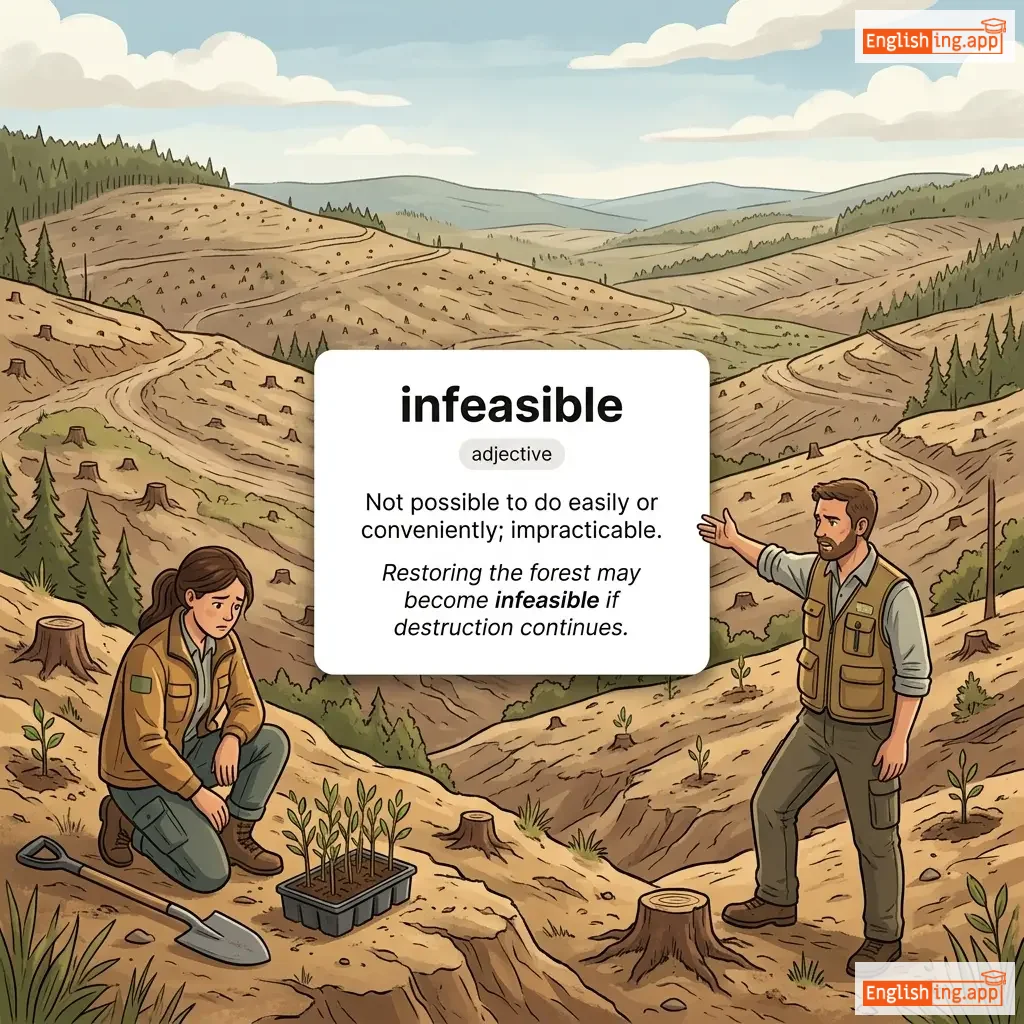
infeasible definition card — visual illustration of the meaning
adjective
ɪnˈfiː.zə.bəl
invable (inviable)

Not possible to do easily or conveniently; impracticable.

"Restoring the forest may become infeasible if destruction continues."

"Restaurar el bosque puede volverse inviable si la destrucción continúa." (Restaurar el bosque puede volverse inviable si la destrucción continúa.)
verb
/ɪnˈfɛkt/
infectar (infectar)

To contaminate with a disease-causing organism.

"The virus can infect healthy people quickly."

"El virus puede infectar a las personas saludables rápidamente." (El virus puede infectar a las personas saludables rápidamente.)
noun
/ɪnˈfɛkʃən/
infección (infeccion)

The process of becoming infected with harmful microorganisms such as bacteria or viruses.

"The doctor prescribed antibiotics to treat the infection."

"El doctor recetó antibióticos para tratar la infección." (El doctor receto antibioticos para tratar la infeccion.)
adjective
/ɪnˈfekʃəs/
infeccioso (infeccioso)

capable of causing infection or disease; spreading easily from one person to another; able to spread feelings or attitudes such as enthusiasm

"Her infectious laughter made everyone in the room smile."

"Su risa infecciosa hizo sonreír a todos." (su risa infecciosa hizo sonreir a todos)
adjective
/ˌɪnfəˈlɪsɪtəs/
inadecuado (inadecuado)

not suitable or well chosen; awkward or unfortunate

"His infelicitous remark ruined the atmosphere of the meeting."

"Su comentario inadecuado arruinó el ambiente de la reunión." (Su comentario inadecuado arruinó el ambiente de la reunión.)
verb
/ɪnˈfɜːr/
inferir (inferir)

to conclude or deduce something from evidence and reasoning rather than from explicit statements

"From his silence, I inferred that he was not happy with the decision."

"De su silencio, inferí que no estaba feliz con la decisión." (De su silencio, inferí que no estaba feliz con la decisión.)
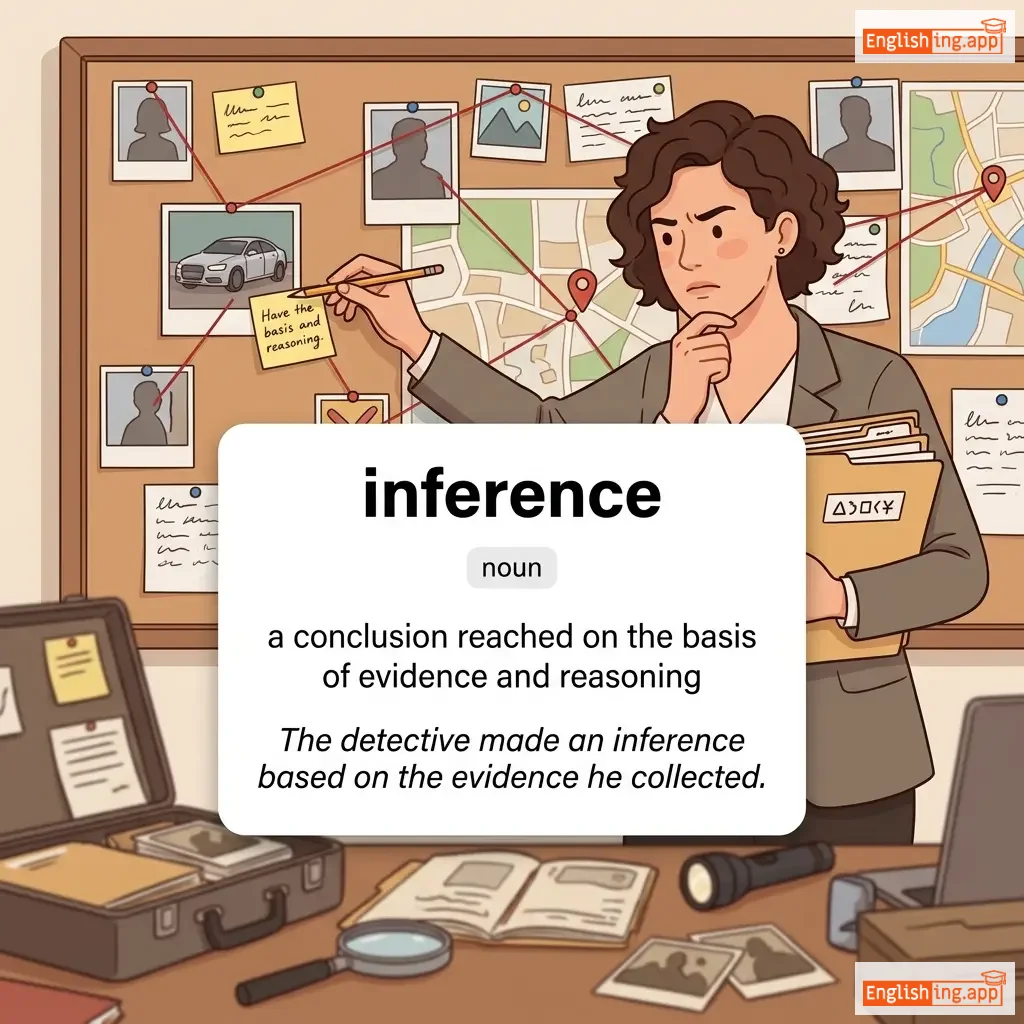
inference definition card — visual illustration of the meaning
noun
/ˈɪnfərəns/
inferencia (inferencia)

a conclusion reached on the basis of evidence and reasoning

"The detective made an inference based on the evidence he collected."

"El detective hizo una inferencia basada en las pruebas que recogió." (El detective hizo una inferencia basada en las pruebas que recogió.)
adjective
/ɪnˈfɪə.ri.ər/
inferior (inferior)

Of lower quality, rank, or status.

"This material is inferior to the one we used before."

"Este material es inferior al que usamos antes." (Este material es inferior al que usamos antes.)
adjective
/ɪnˈfɜːrnəl/
infernal (infernal)

relating to hell; extremely troublesome or annoying

"The workers complained about the infernal noise from the construction site."

"Los trabajadores se quejaron del ruido infernal proveniente del sitio de construcción." (Los trabajadores se quejaron del ruido infernal proveniente del sitio de construcción.)
noun
/ɪnˈfɜːrnoʊ/
incendio (incendio)

a large, intense fire that is dangerously out of control

"The building turned into an inferno within minutes."

"El edificio se convirtió en un incendio en minutos." (El edificio se convirtio en un incendio en minutos.)
verb
/ɪnˈfɛst/
infestar (infestar)

to overrun in large numbers, especially so as to cause damage or discomfort

"The old house was infested with rats."

"La vieja casa estaba infestada de ratas." (La vieja casa estaba infestada de ratas.)
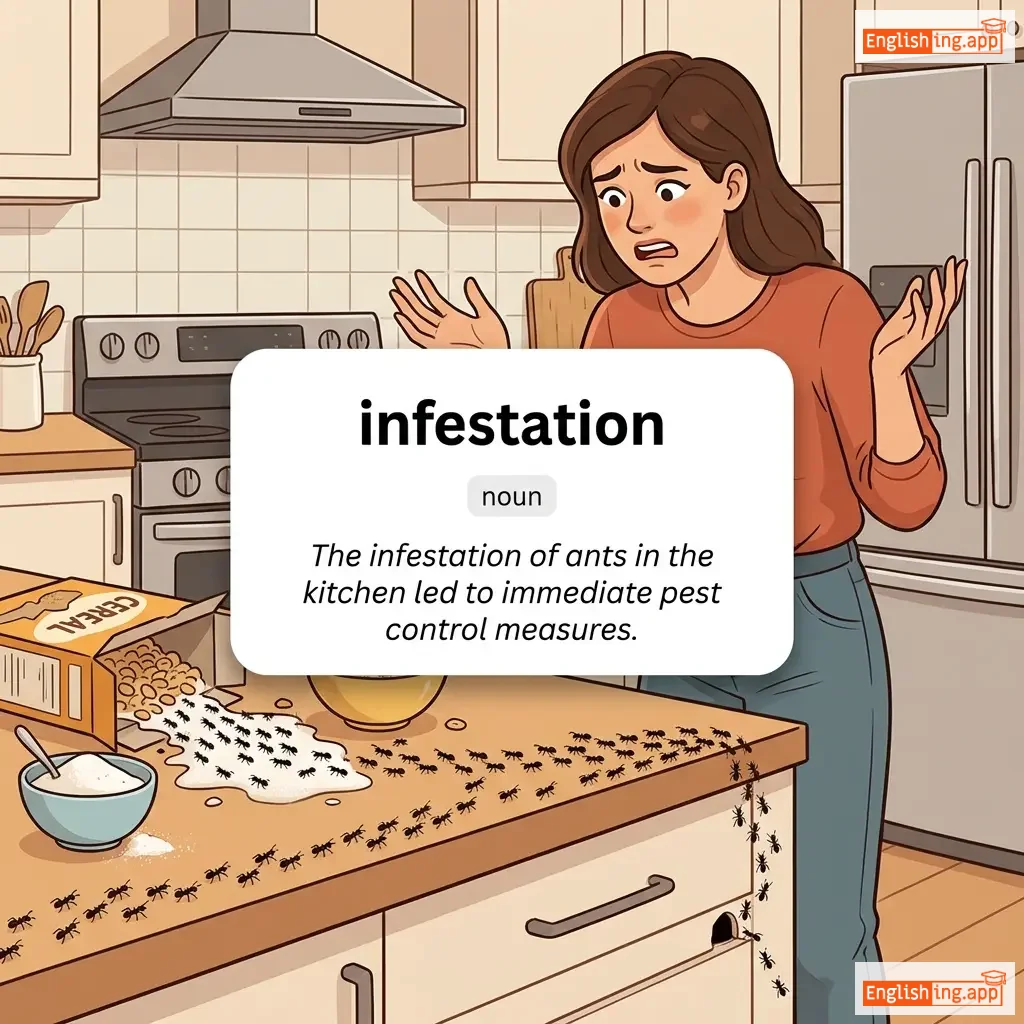
infestation definition card — visual illustration of the meaning
noun
ˌɪnfɛsˈteɪʃən
infestación, gran número de insectos o animales en un lugar (infestacion, gran numero de insectos o animales en un lugar)

The presence of an unusually large number of insects or animals in a place, causing damage or disease.

"The infestation of ants in the kitchen led to immediate pest control measures."

"La infestación de hormigas en la cocina llevó a medidas inmediatas de control de plagas." (La infestacion de hormigas en la cocina llevo a medidas inmediatas de control de plagas.)
noun
/ˈɪnfɪdɛl/
incrédulo (incredulo)

a person who does not believe in a particular religion or faith

"In medieval times, people often called non-Christians infidels."

"En la Edad Media, la gente a menudo llamaba infieles a los no cristianos." (En la Edad Media, la gente a menudo llamaba infieles a los no cristianos.)
noun
/ˌɪnfɪˈdɛləti/
infidelidad (infidelidad)

the act of being unfaithful to a spouse or partner

"Their marriage ended due to his infidelity."

"Su matrimonio terminó debido a su infidelidad." (Su matrimonio terminó debido a su infidelidad.)
verb
/ˈɪnfɪltreɪt/
infiltrarse (infiltrarse)

to secretly enter or gain access to a place or group

"The spies managed to infiltrate the enemy base."

"Los espías lograron infiltrarse en la base enemiga." (Los espías lograron infiltrarse en la base enemiga.)
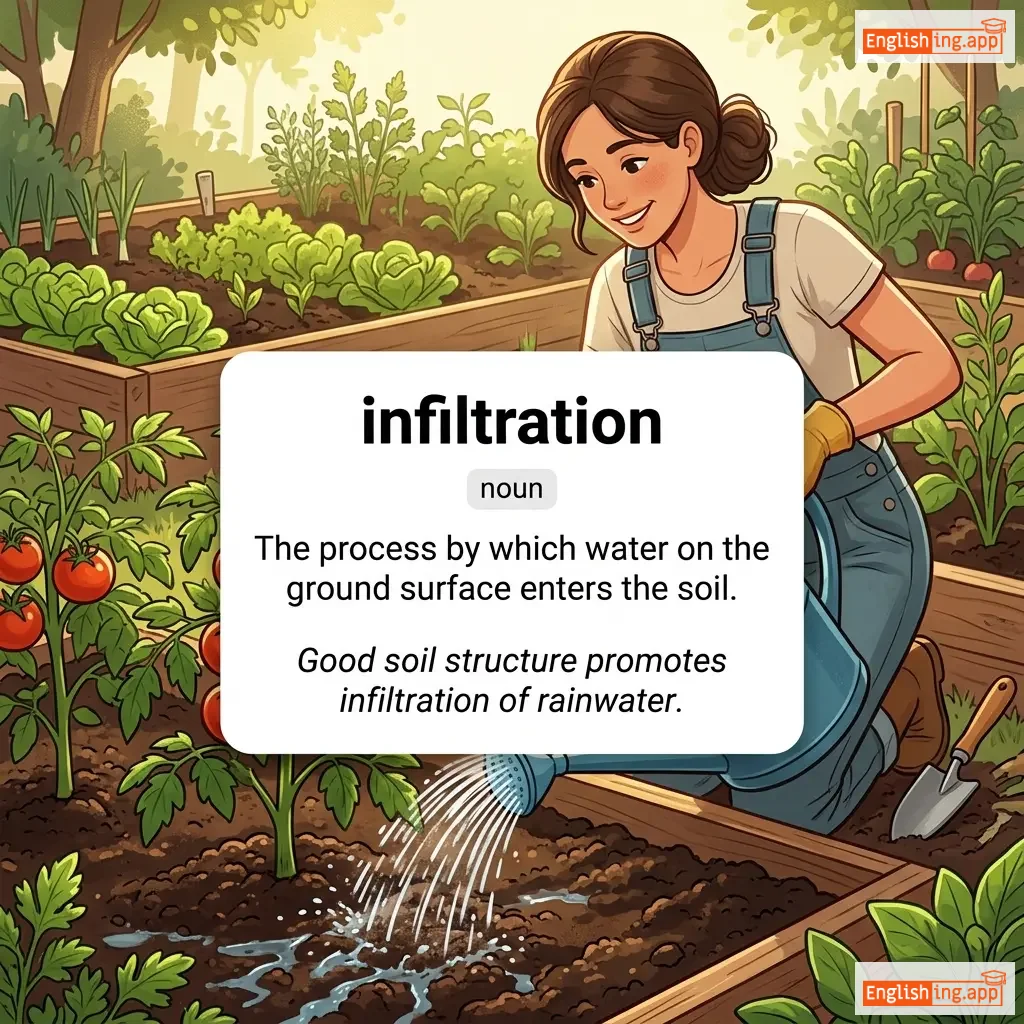
infiltration definition card — visual illustration of the meaning
noun
/ˌɪn.fɪlˈtreɪ.ʃən/
infiltración (infiltracion)

The process by which water on the ground surface enters the soil.

"Good soil structure promotes infiltration of rainwater."

"Una buena estructura del suelo favorece la infiltración de la lluvia." (Una buena estructura del suelo favorece la infiltracion de la lluvia.)
adjective
/ˈɪnfɪnɪt/
infinito (infinito)

limitless or endless in space, extent, or number

"The universe is often described as infinite."

"El universo a menudo se describe como infinito." (El universo a menudo se describe como infinito.)
adjective
/ˌɪnfɪnɪˈtɛsɪməl/
infinitesimal (infinitesimal)

Extremely small in size or amount; so tiny as to be almost negligible.

"The error was so infinitesimal that it didn’t affect the results."

"El error fue tan infinitesimal que no afectó los resultados." (El error fue tan infinitesimal que no afecto los resultados.)
noun
/ɪnˈfɪnɪti/
infinito (infinito)

A concept describing something without any limit or end.

"The universe seems to stretch into infinity."

"El universo parece extenderse hacia el infinito." (El universo parece extenderse hacia el infinito.)
adjective
/ɪnˈfɜːm/
débil (debil)

Weak, especially due to old age or illness.

"The infirm old man needed assistance to walk."

"El anciano débil necesitaba ayuda para caminar." (El anciano débil necesitaba ayuda para caminar.)
noun
/ɪnˈfɜːməri/
hospital (hospital)

A hospital or place where the sick or injured are cared for.

"The school had an infirmary for minor injuries."

"La escuela tenía un hospital para lesiones menores." (La escuela tenía un hospital para lesiones menores.)
noun
/ɪnˈfɜːməti/
debilidad (debilidad)

Physical or mental weakness, especially from old age.

"Despite his infirmity, he remained cheerful."

"A pesar de su debilidad, se mantuvo alegre." (A pesar de su debilidad, se mantuvo alegre.)
verb
/ɪnˈfleɪm/
inflamar (inflamar)

to arouse strong feelings or provoke anger; to cause inflammation in the body

"The politician's remarks served to inflame public opinion."

"Las declaraciones del político sirvieron para inflamar la opinión pública." (Las declaraciones del político sirvieron para inflamar la opinión pública.)
adjective
/ɪnˈflæməbl/
inflamable (inflamable)

easily set on fire; easily excited or angered

"This material is highly inflammable and should be kept away from heat."

"Este material es altamente inflamable y debe mantenerse alejado del calor." (Este material es altamente inflamable y debe mantenerse alejado del calor.)
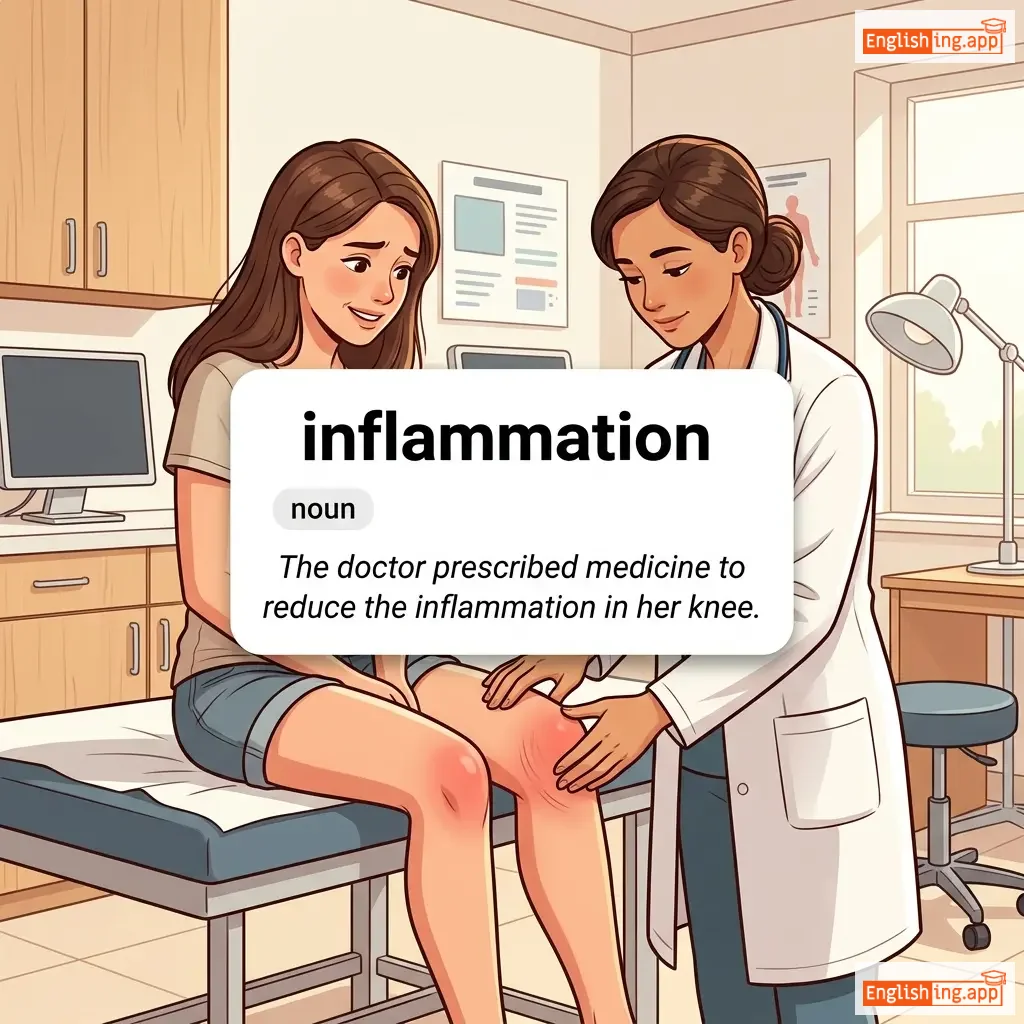
inflammation definition card — visual illustration of the meaning
noun
/ˌɪnfləˈmeɪʃən/
inflamación (inflamacion)

a localized physical condition in which part of the body becomes red, swollen, hot, and often painful

"The doctor prescribed medicine to reduce the inflammation in her knee."

"El médico recetó medicina para reducir la inflamación en su rodilla." (El medico receto medicina para reducir la inflamacion en su rodilla.)
adjective
/ɪnˈflæməˌtɔːri/
felicidad (felicidad)

causing inflammation in the body; arousing anger, hostility, or strong emotion

"His inflammatory speech triggered protests across the city."

"No pudo esconder su felicidad cuando recibió el premio." (No pudo esconder su felicidad cuando recibió el premio.)