Vocabularios

Descubra, aprenda y domine el vocabulario en inglés

verb
/ˈhɑːrpɪŋ/
quejarse constantemente (quejarse constantemente)

continuously talking or complaining about something in a tiresome way

"She kept harping on about the mistakes I made."

"Ella siguió quejándose constantemente sobre los errores que cometí." (Ella siguió quejándose constantemente sobre los errores que cometí.)
adjective
/ˈhæriːd/
estresado o agobiado (estresado o agobiado)

feeling strained or stressed due to being overworked or constantly bothered

"The harried teacher struggled to calm the noisy classroom."

"El maestro estresado luchaba por calmar el ruidoso aula." (El maestro estresado luchaba por calmar el ruidoso aula.)
verb
/ˈhæroʊ/
afligir / rastra (afligir / rastra)

to cause distress or torment; also to break up and smooth soil with a farm tool

"The tragic news harrowed the entire family."

"La noticia trágica afligió a toda la familia." (La noticia tragica afligio a toda la familia.)
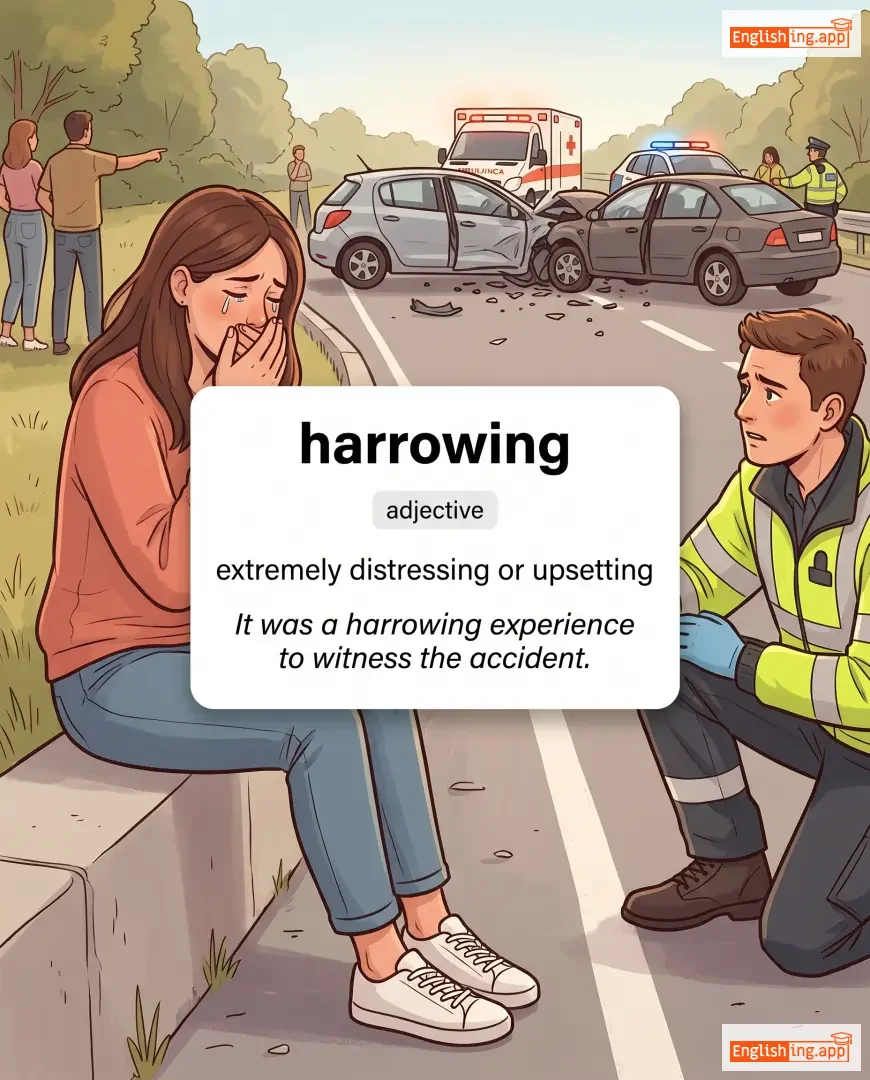
harrowing definition card — visual illustration of the meaning
adjective
/ˈhær.oʊ.ɪŋ/
aterrador y angustioso (aterrador y angustioso)

extremely distressing or upsetting

"It was a harrowing experience to witness the accident."

"Fue una experiencia aterradora ser testigo del accidente." (Fue una experiencia aterradora ser testigo del accidente.)
verb
/ˈhæri/
acosar, hostigar (acosar, hostigar)

to constantly attack, harass, or annoy

"The army harried the enemy with sudden raids."

"El ejército acosó al enemigo con incursiones repentinas." (El ejercito acoso al enemigo con incursiones repentinas.)
adjective
/hɑːrʃ/
severo (severo)

Unpleasantly rough or severe in sound, taste, conditions, or treatment.

"The teacher's harsh tone frightened the students."

"El tono severo del maestro asustó a los estudiantes." (El tono severo del maestro asusto a los estudiantes.)
noun
/ˈhɑːrvɪst/
cosecha (cosecha)

the process or period of gathering crops

"Farmers are busy during the rice harvest season."

"Los agricultores están ocupados durante la temporada de cosecha de arroz." (Los agricultores están ocupados durante la temporada de cosecha de arroz.)
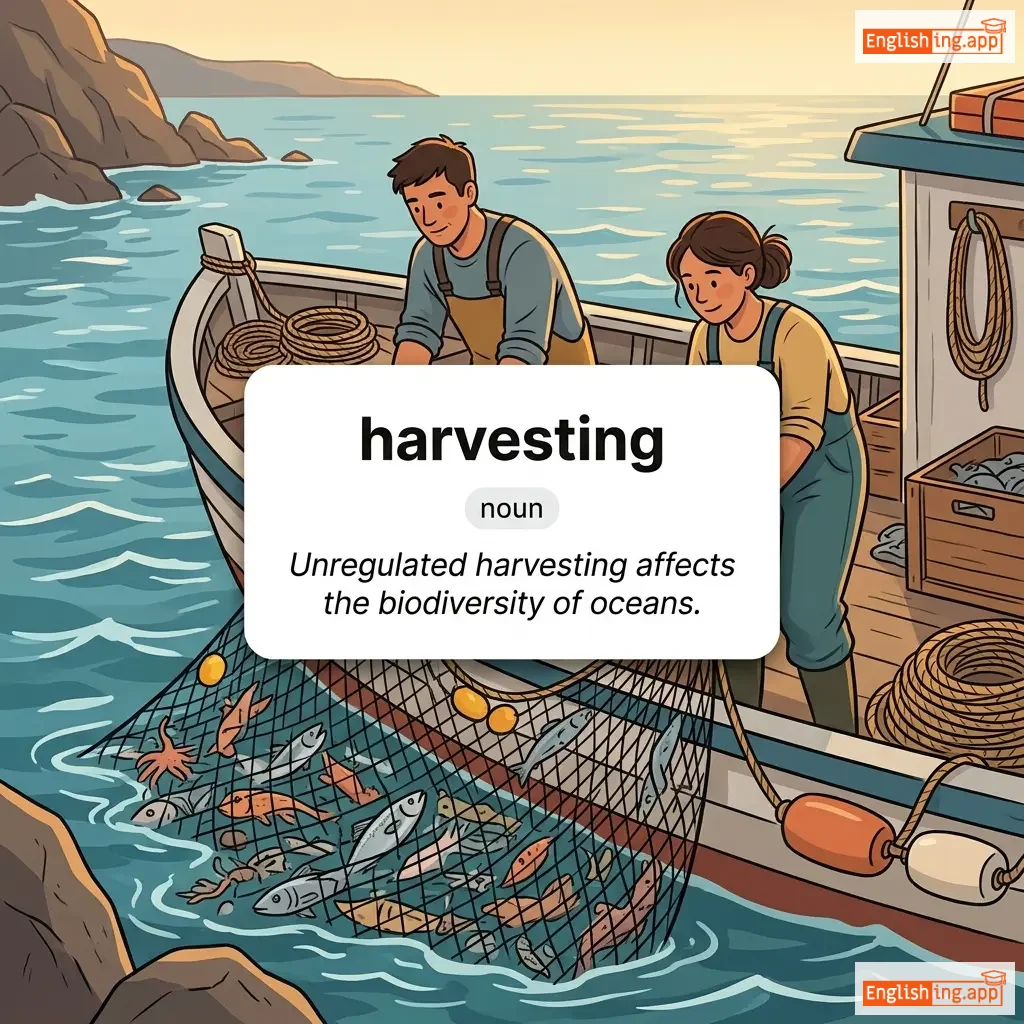
harvesting definition card — visual illustration of the meaning
noun
ˈhɑːrvɪstɪŋ
cosecha (cosecha)

The process of gathering a ripe crop from the fields or collecting natural resources.

"Unregulated harvesting affects the biodiversity of oceans."

"La cosecha no regulada afecta la biodiversidad de los océanos." (La cosecha no regulada afecta la biodiversidad de los océanos.)
noun
/hæˈʃiːʃ/
hasís (hasis)

a drug made from the resin of the cannabis plant

"The police arrested him for possessing hashish."

"La policía lo arrestó por poseer hasís." (La policia lo arresto por poseer hasis.)
noun
/ˈhæs.əl/
molestia; inconveniente; problema (molestia, inconveniente, problema)

irritating inconvenience; trouble or difficulty; a situation causing problems

"Booking tickets online can save you the hassle of waiting in long queues at the theater."

"Reservar boletos en línea puede ahorrarte la molestia de esperar en largas colas en el teatro." (Reservar boletos en linea puede ahorrarte la molestia de esperar en largas colas en el teatro.)
noun
/heɪst/
prisa; urgencia (prisa, urgencia)

swiftness of motion; urgent need of quick action; excessive speed or urgency

"In his haste to catch the train, he forgot to take his wallet from the table."

"En su prisa por coger el tren, olvidó tomar su billetera de la mesa." (En su prisa por coger el tren, olvidó tomar su billetera de la mesa.)
verb
/ˈheɪsən/
apresurar (apresurar)

To move or act quickly; to cause something to happen sooner.

"He hastened to finish his work before the deadline."

"Se apresuró a terminar su trabajo antes de la fecha límite." (Se apresuró a terminar su trabajo antes de la fecha límite.)
adverb
/ˈheɪs.tɪ.li/
apresuradamente (apresuradamente)

in a hurried or rushed manner; quickly and carelessly

"She hastily packed her bags before leaving for the airport."

"Ella empacó apresuradamente sus maletas antes de irse al aeropuerto." (Ella empacó apresuradamente sus maletas antes de irse al aeropuerto.)
adjective
/ˈheɪsti/
apresurado (apresurado)

Done with excessive speed or urgency, often without careful thought.

"She made a hasty decision without considering the consequences."

"Ella tomó una decisión apresurada sin considerar las consecuencias." (Ella tomó una decisión apresurada sin considerar las consecuencias.)
noun
/hæt/
sombrero (sombrero)

a shaped covering for the head, often with a brim

"He wore a black hat to the party."

"Él llevaba un sombrero negro a la fiesta." (El llevaba un sombrero negro a la fiesta.)
verb
/hætʃ/
eclosionar / planear (eclosionar / planear)

To cause a young animal to emerge from an egg; to plan secretly.

"The chicks hatched early in the morning."

"Los pollitos eclosionaron temprano en la mañana." (Los pollitos eclosionaron temprano en la mañana.)
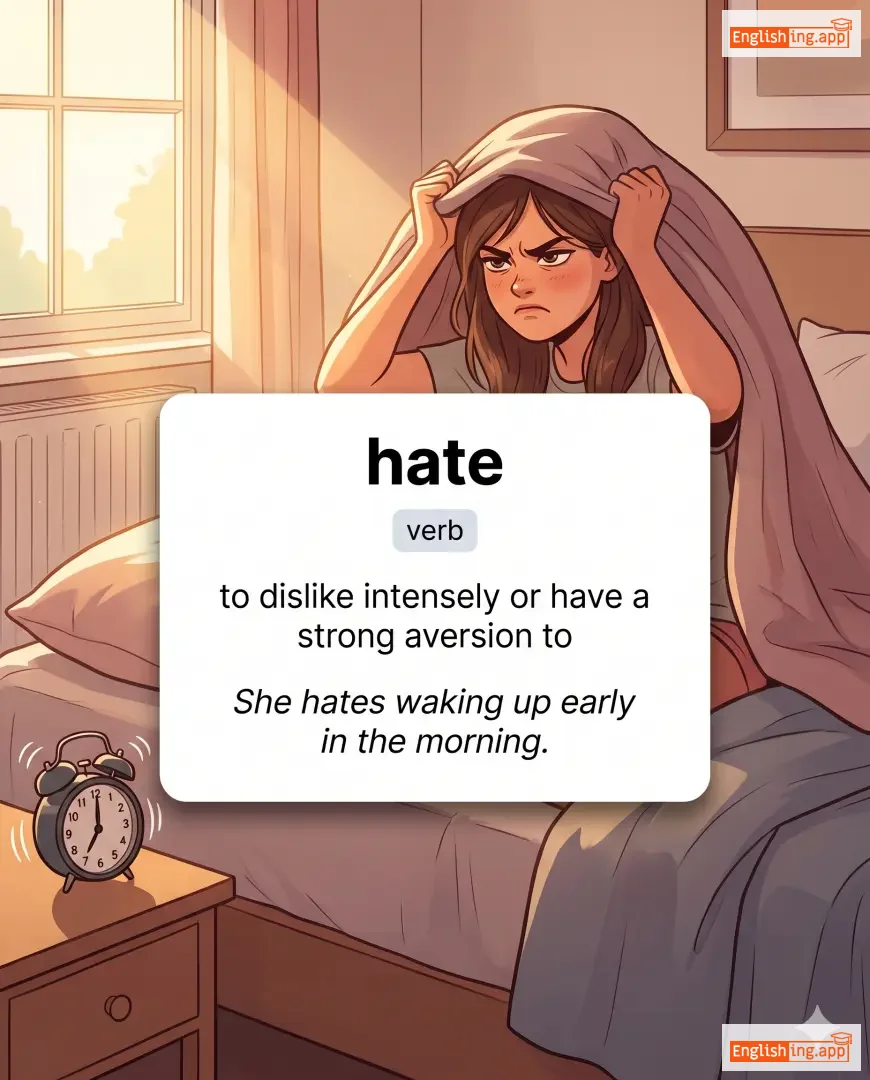
hate definition card — visual illustration of the meaning
verb
/heɪt/
odiar (odiar)

to dislike intensely or have a strong aversion to

"She hates waking up early in the morning."

"A ella no le gusta levantarse temprano por la mañana." (A ella no le gusta levantarse temprano por la mañana.)
adjective
/ˈheɪt.fəl/
Odioso (odioso)

causing or deserving hatred; extremely unpleasant or offensive

"His hateful comments hurt everyone's feelings."

"Sus comentarios odiosos lastimaron los sentimientos de todos." (Sus comentarios odiosos lastimaron los sentimientos de todos.)
noun
/ˈheɪtrɪd/
odio (odio)

intense dislike or ill will

"His hatred for the enemy was evident in his actions."

"Su odio hacia el enemigo era evidente en sus acciones." (Su odio hacia el enemigo era evidente en sus acciones.)
noun
/ˈhɔːtɪnəs/
arrogancia (arrogancia)

The appearance or quality of being arrogantly superior and disdainful.

"His haughtiness made him unpopular among his peers."

"Su arrogancia lo hizo impopular entre sus compañeros." (Su arrogancia lo hizo impopular entre sus compañeros.)
adjective
/ˈhɔːti/
arrogante (arrogante)

arrogantly superior and disdainful

"She gave him a haughty look and walked away."

"Ella le dio una mirada arrogante y se alejó." (Ella le dio una mirada arrogante y se alejó.)
verb
/hɔːl/
arrastrar (arrastrar)

to pull or drag something heavy with effort

"The workers hauled the boxes into the truck."

"Los trabajadores arrastraron las cajas al camión." (Los trabajadores arrastraron las cajas al camión.)
haunt definition card — visual illustration of the meaning
verb
/hɔːnt/
aparecer frecuentemente en o llenar la mente de alguien (aparecer frecuentemente en o llenar la mente de alguien)

to appear frequently in or fill the mind of someone; to visit a place regularly

"The old memories still haunt him."

"Los viejos recuerdos aún lo atormentan." (Los viejos recuerdos aún lo atormentan.)
noun
/oʊˈtɜːr/
soberbia (soberbia)

disdainful pride; arrogance

"His hauteur made it difficult for others to approach him."

"Su soberbia hacía difícil que otros se acercaran a él." (Su soberbia hacia difícil que otros se acercaran a él.)
verb
/hæv/
tener (tener)

to possess, own, or hold

"They have three children."

"Ellos tienen tres hijos." (Ellos tienen tres hijos.)
noun
/ˈheɪvən/
refugio (refugio)

a safe place or shelter

"The library became a haven for students during exams."

"La biblioteca se convirtió en un refugio para los estudiantes durante los exámenes." (La biblioteca se convirtió en un refugio para los estudiantes durante los exámenes.)
noun
/ˈhævək/
destrucción (destruccion)

widespread destruction or disorder

"The storm caused havoc in the coastal villages."

"La tormenta causó destrucción en los pueblos costeros." (La tormenta causo destruccion en los pueblos costeros.)
noun
/hɔːk/
halcón (halcon)

A bird of prey with keen eyesight and sharp talons; also refers to a person who strongly supports aggressive or warlike policies.

"The hawk soared high above the valley."

"El halcón voló alto sobre el valle." (El halcon volo alto sobre el valle.)
noun
/ˈhɔː.kər/
vendedor ambulante (vendedor ambulante)

a person who travels about selling goods, typically from door to door or on the street

"The hawker sold fresh fruits from his cart."

"El vendedor ambulante vendió frutas frescas desde su carrito." (El vendedor ambulante vendió frutas frescas desde su carrito.)
noun
/ˈhɔːzər/
cable grueso para amarrar un barco (cable grueso para amarrar un barco)

A thick rope or cable used in mooring or towing a ship.

"The sailors secured the ship to the dock with a heavy hawser."

"Los marineros aseguraron el barco al muelle con un pesado hawser." (Los marineros aseguraron el barco al muelle con un pesado hawser.)
noun
/ˈhɔːθɔːrn/
arbusto espinoso (arbusto espinoso)

A thorny shrub or small tree with white or pink flowers, often used for hedges.

"The garden was lined with blooming hawthorn bushes."

"El jardín estaba rodeado de arbustos de espino en flor." (El jardín estaba rodeado de arbustos de espino en flor.)
noun
/heɪ/
heno (heno)

grass that has been cut, dried, and stored for use as animal feed

"The cows were eating hay in the barn."

"Las vacas estaban comiendo heno en el granero." (Las vacas estaban comiendo heno en el granero.)
noun
/ˈhæzərd/
peligro (peligro)

A danger or risk.

"Wet floors are a common hazard in the workplace."

"Los pisos mojados son un peligro común en el lugar de trabajo." (Los pisos mojados son un peligro común en el lugar de trabajo.)
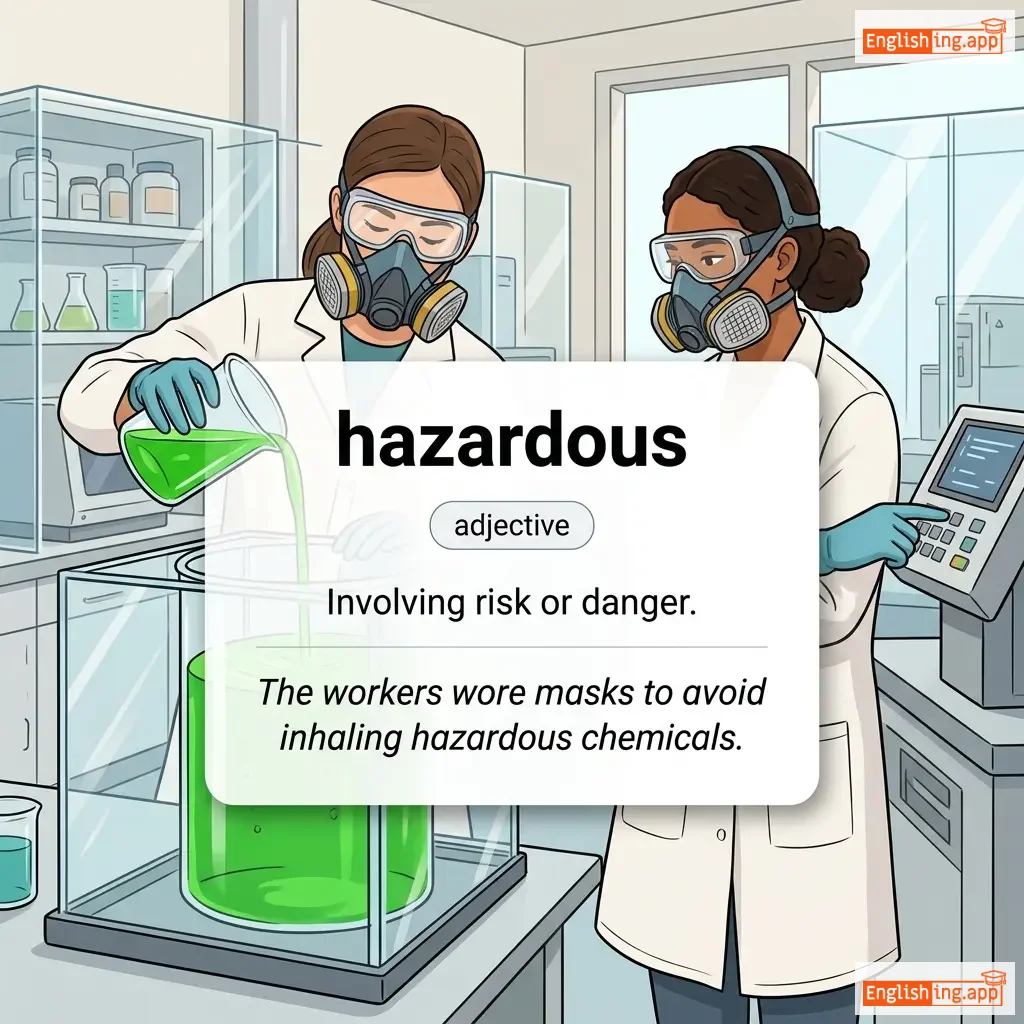
hazardous definition card — visual illustration of the meaning
adjective
/ˈhæzərdəs/
peligroso (peligroso)

Involving risk or danger.

"The workers wore masks to avoid inhaling hazardous chemicals."

"Los trabajadores usaban mascarillas para evitar inhalar productos químicos peligrosos." (Los trabajadores usaban mascarillas para evitar inhalar productos químicos peligrosos.)
🌫️

Haze (hej)

noun
/heɪz/
neblina (neblina)

a slight obscuration of the lower atmosphere, typically caused by fine suspended particles; confusion

"The morning haze lifted gradually as the sun rose higher in the sky."

"La neblina matutina se levantó gradualmente a medida que el sol se elevaba más alto en el cielo." (La neblina matutina se levanto gradualmente a medida que el sol se elevaba más alto en el cielo.)
adjective
/ˈheɪzi/
brumoso (brumoso)

Unclear, misty, or not easy to see; also vague or uncertain.

"The mountains looked hazy in the morning light."

"Las montañas se veían brumosas con la luz de la mañana." (Las montañas se veían brumosas con la luz de la mañana.)
pronoun
/hiː/
él (masculino) (el (masculino))

used to refer to a male person or animal already mentioned or easily identified

"He is my best friend."

"Él es mi mejor amigo." (El es mi mejor amigo.)
noun, verb
/hɛd/
cabeza / líder (cabeza / lider)

The upper part of the human body or to lead or be in charge of something.

"She turned her head to look out the window."

"Ella giró su cabeza para mirar por la ventana." (Ella giro su cabeza para mirar por la ventana.)
🚗🔄🚗

Head-on (hed-ón)

adverb
/ˈhed ɑn/
de frente (de frente)

directly facing; in direct confrontation or collision

"The two cars collided head-on at the intersection."

"Los dos autos colisionaron de frente en la intersección." (Los dos autos colisionaron de frente en la intersección.)
noun
/ˈhɛdeɪk/
dolor de cabeza (dolor de cabeza)

a continuous pain in the head; something that causes worry or difficulty

"Too much screen time can give you a terrible headache."

"Demasiado tiempo frente a la pantalla puede darte un terrible dolor de cabeza." (Demasiado tiempo frente a la pantalla puede darte un terrible dolor de cabeza.)
adverb
/ˌhɛdˈfɜrst/
cabeza adelante (cabeza adelante)

With the head leading; in a reckless or hasty manner.

"He dived headfirst into the pool."

"Se zambulló cabeza primero en la piscina." (Se zambulló cabeza primero en la piscina.)
heading definition card — visual illustration of the meaning
noun
/ˈhed.ɪŋ/
encabezado (encabezado)

a title at the head of a page or section of a book; the direction or course being followed

"The newspaper article had a bold heading that immediately caught the reader's attention."

"El artículo del periódico tenía un encabezado en negrita que inmediatamente llamó la atención del lector." (El articulo del periodico tenia un encabezado en negrita que inmediatamente llamo la atencion del lector.)
noun
/ˈhɛdˌlaɪn/
titular (titular)

The title of a newspaper article printed in large letters.

"The scandal made front-page headlines."

"El escándalo hizo titulares de primera página." (El escándalo hizo titulares de primera página.)
adverb
/ˈhɛdˌlɔŋ/
a la carrera (a la carrera)

With the head leading; in a rush or without thinking.

"She rushed headlong into the new project."

"Ella se lanzó a la carrera al nuevo proyecto." (Ella se lanzó a la carrera al nuevo proyecto.)
noun
/ˈhɛdˌkwɔːrtərz/
sede central (sede central)

The main office or center of operations of an organization.

"The company’s headquarters is located in New York."

"La sede central de la empresa está ubicada en Nueva York." (La sede central de la empresa está ubicada en Nueva York.)
adjective
/ˈhɛdˌstrɔŋ/
terco (terko)

Determined to do what one wants, even if it is not sensible.

"The headstrong child refused to listen to anyone."

"El niño terco se negó a escuchar a nadie." (El niño terco se negó a escuchar a nadie.)
noun
/ˈhed.weɪ/
progreso; avance; adelanto (progreso, avance, adelanto)

forward movement or progress, especially when this is slow or difficult

"Despite the challenges, the research team made significant headway in developing the new vaccine."

"A pesar de los desafíos, el equipo de investigación logró un progreso significativo en el desarrollo de la nueva vacuna." (A pesar de los desafios, el equipo de investigacion logro un progreso significativo en el desarrollo de la nueva vacuna.)
adjective
/ˈhɛdi/
embriagante (embriagante)

Exciting or intoxicating; having a strong or exhilarating effect.

"The heady aroma of the flowers filled the room."

"La fragancia embriagadora de las flores llenó la habitación." (La fragancia embriagadora de las flores llenó la habitación.)
heal definition card — visual illustration of the meaning
verb
/hiːl/
sanar (sanar)

to make or become healthy again after an injury or illness

"Time helps to heal both physical and emotional wounds."

"El tiempo ayuda a sanar tanto las heridas físicas como emocionales." (El tiempo ayuda a sanar tanto las heridas físicas como emocionales.)
noun
/hɛlθ/
salud (salud)

The state of being free from illness or injury.

"Exercise is important for good health."

"El ejercicio es importante para una buena salud." (El ejercicio es importante para una buena salud.)