Vocabularios

Descubra, aprenda y domine el vocabulario en inglés

adverb
/ˈɡrædʒuəli/
gradualmente (gradualmente)

Slowly and steadily, taking place step by step.

"She gradually improved her English over the year."

"Ella mejoró gradualmente su inglés durante el año." (Ella mejoró gradualmente su inglés durante el año.)
noun, verb
/ˈɡrædʒuət/ (noun), /ˈɡrædʒueɪt/ (verb)
graduado (graduado)

As a noun: a person who has completed a course of study; As a verb: to complete a course of study successfully.

"She will graduate from university next year."

"Ella se graduará de la universidad el próximo año." (Ella se graduará de la universidad el próximo año.)
adjective
/ˈɡrædʒuˌeɪtɪd/
graduado / escalonado (graduado / escalonado)

Arranged in steps, levels, or stages; having completed a course of study and received a degree

"The scientist used a graduated cylinder to measure the liquid precisely."

"El científico usó un cilindro graduado para medir el líquido con precisión." (El cientifico uso un cilindro graduado para medir el liquido con precision.)
noun
/ˌɡrædʒ.uˈeɪ.ʃən/
felicidad (felicidad)

the act of receiving a degree or diploma after completing a course of study

"Her parents attended her graduation ceremony with pride."

"Ella no pudo ocultar su felicidad cuando recibió el premio." (Ella no pudo ocultar su felicidad cuando recibió el premio.)
noun
/ɡrəˈfiː.ti/
escritura o dibujos hechos de manera ilegal en una pared u otra superficie en un lugar público (grafiti)

writing or drawings scribbled, scratched, or sprayed illicitly on a wall or other surface in a public place

"The subway walls were covered with colorful graffiti created by local street artists."

"Las paredes del metro estaban cubiertas con graffiti colorido creado por artistas locales." (Las paredes del metro estaban cubiertas con graffiti colorido creado por artistas locales.)
noun/verb
/ɡræft/
injerto / soborno (injerto / soborno)

To join or insert a part of one plant or tissue into another; also refers to corruption or bribery

"The surgeon performed a skin graft to treat the burn victim."

"El cirujano realizó un injerto de piel para tratar a la víctima de quemaduras." (El cirujano realizó un injerto de piel para tratar a la víctima de quemaduras.)
noun
/ɡreɪn/
grano (grano)

a small hard seed of a cereal plant such as wheat or rice; a tiny particle of a substance

"A grain of rice fell off the plate."

"Un grano de arroz cayó del plato." (Un grano de arroz cayo del plato.)
noun
/ɡræm/
garbanzo (garbanzo)

chickpea; a leguminous plant and its edible seed

"She cooked gram curry for lunch today."

"Ella cocinó curry de garbanzo para el almuerzo hoy." (Ella cocinó curry de garbanzo para el almuerzo hoy.)
noun
/ˈɡræmər/
gramática (gramatica)

the system and structure of a language, including rules for syntax, morphology, and usage

"She studied grammar to improve her writing skills."

"Ella estudió gramática para mejorar su escritura." (ella estudio gramatica para mejorar su escritura)
noun
/ˈɡrænəri/
granero (granero)

A storehouse for grain; a region that produces a large amount of grain

"The farmers stored their harvest in the village granary."

"Los agricultores almacenaron su cosecha en el granero del pueblo." (Los agricultores almacenaron su cosecha en el granero del pueblo.)
adjective
/ɡrænd/
grandioso (grandioso)

magnificent and impressive in appearance, size, or style

"They stayed at a grand hotel in Paris."

"Se quedaron en un hotel grandioso en París." (Se quedaron en un hotel grandioso en París.)
noun
/ˈɡrænd.tʃaɪld/
nieto o nieta (nieto o nieta)

the child of one's son or daughter

"They love spending time with their grandchild on weekends."

"Les encanta pasar tiempo con su nieto o nieta los fines de semana." (Les encanta pasar tiempo con su nieto o nieta los fines de semana.)
noun
/ˈɡræn(d)ˌdɔːtər/
nieta (nieta)

the daughter of one’s son or daughter

"Her granddaughter visits her every weekend."

"Su nieta la visita todos los fines de semana." (su nieta la visita todos los fines de semana)
Grandeur definition card — visual illustration of the meaning
noun
/ˈɡrændʒər/
grandeza (grandeza)

Impressive beauty, scale, or magnificence

"The grandeur of the palace left the visitors speechless."

"La grandeza del palacio dejó a los visitantes sin palabras." (La grandeza del palacio dejo a los visitantes sin palabras.)
noun
/ˈɡrændˌfɑːðər/
abuelo / abuela (abuelo / abuela)

the father of one's father or mother

"My grandfather tells us stories every evening."

"Mi abuelo nos cuenta historias todas las noches." (Mi abuelo nos cuenta historias todas las noches.)
noun
/ˈɡrændɪləkwəns/
lenguaje pomposo (lenguaje pomposo)

Pompous or extravagant language, style, or manner, often intended to impress

"The politician’s speech was full of empty grandiloquence."

"El discurso del político estaba lleno de lenguaje pomposo y vacío." (El discurso del político estaba lleno de lenguaje pomposo y vacío.)
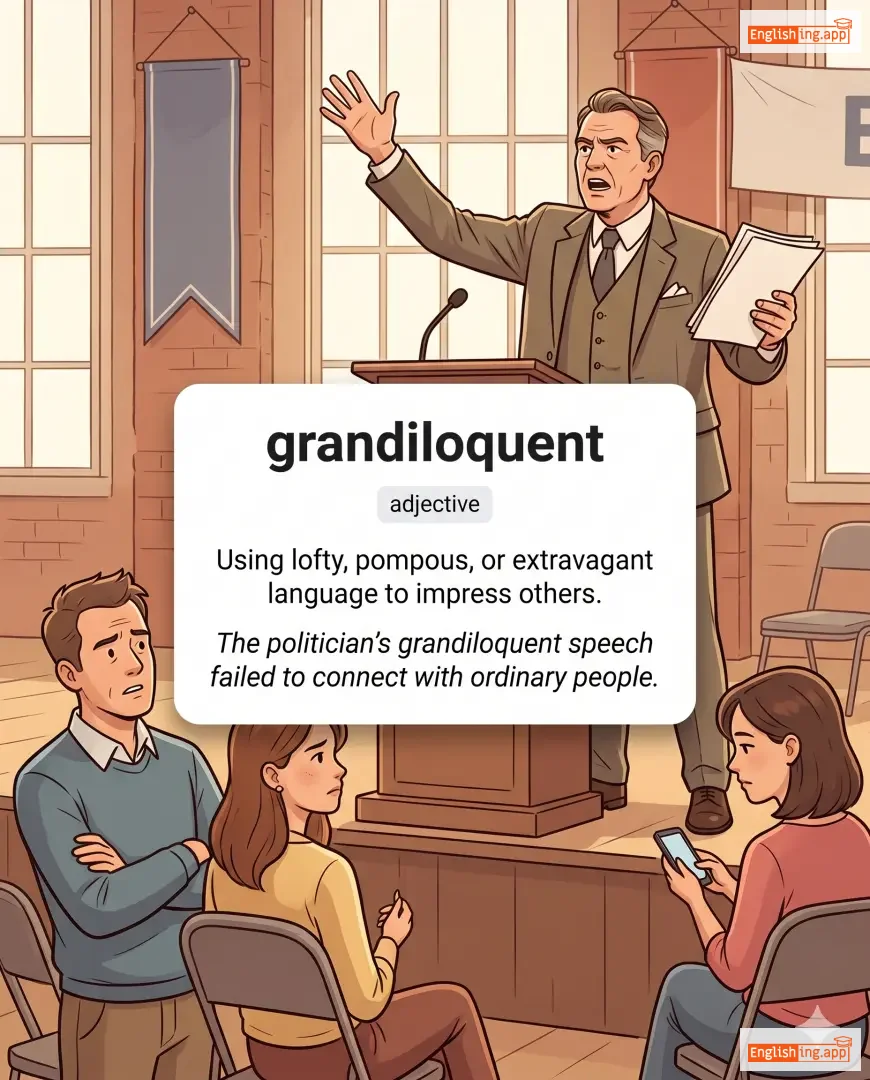
grandiloquent definition card — visual illustration of the meaning
adjective
/ɡrænˈdɪləkwənt/
lenguaje pomposo (lenguaje pomposo)

Using lofty, pompous, or extravagant language to impress others.

"The politician’s grandiloquent speech failed to connect with ordinary people."

"El discurso grandilocuente del político no logró conectar con la gente común." (El discurso grandilocuente del político no logró conectar con la gente común.)
adjective
/ˈɡrændioʊs/
grandioso (grandioso)

Impressive or magnificent in appearance or style, often pretentiously so.

"He had grandiose plans of building a futuristic city in the desert."

"Él tenía planes grandiosos de construir una ciudad futurista en el desierto." (Él tenía planes grandiosos de construir una ciudad futurista en el desierto.)
noun
/ˈɡrændˌmʌðər/
abuela (abuela)

the mother of one's father or mother

"My grandmother makes delicious cakes."

"Mi abuela hace pasteles deliciosos." (Mi abuela hace pasteles deliciosos.)
noun
/ˈɡrændˌpeə.rənt/
abuelo/abuela (abuelo/abuela)

the parent of one's father or mother

"My grandparents live in a small village near the hills."

"Mis abuelos viven en un pequeño pueblo cerca de las colinas." (Mis abuelos viven en un pequeño pueblo cerca de las colinas.)
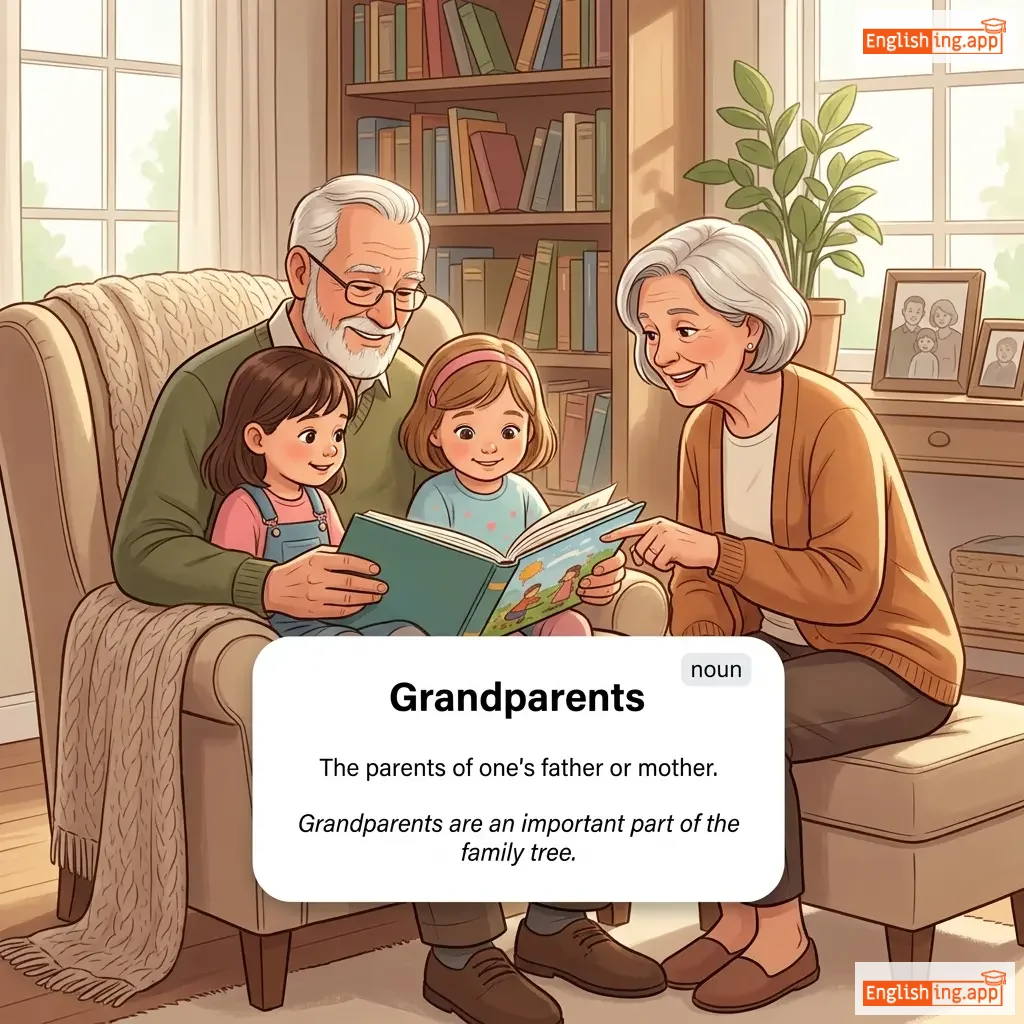
Grandparents definition card — visual illustration of the meaning
noun
ˈɡrænˌpɛrənts
Abuelos (abuelos)

The parents of one's father or mother.

"Grandparents are an important part of the family tree."

"Los abuelos son una parte importante del árbol genealógico." (Los abuelos son una parte importante del árbol genealógico.)
noun
/ˈɡrændsʌn/
nieto (nieto)

the son of one's son or daughter

"His grandson visits him every weekend."

"Su nieto lo visita todos los fines de semana." (su nieto lo visita todos los fines de semana)
verb
/ˈɡrændstænd/
buscar atención o aplausos comportándose de manera ostentosa (buscar atencion o aplausos comportandose de manera ostentosa)

To seek attention or applause by behaving or speaking in a showy way.

"The actor was accused of grandstanding during the charity event."

"El actor fue acusado de hacer granstand durante el evento benéfico." (El actor fue acusado de hacer granstand durante el evento benefico.)
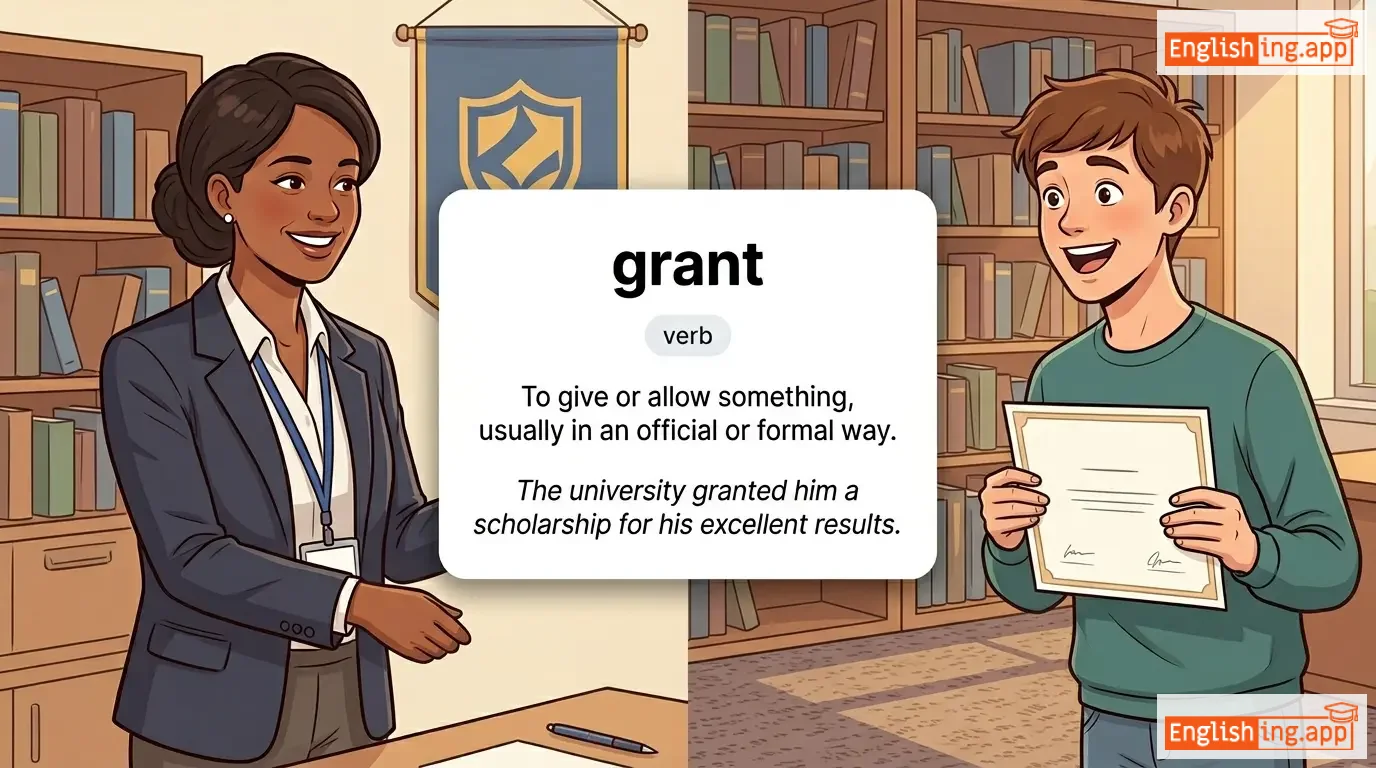
grant definition card — visual illustration of the meaning
verb
/ɡrænt/
otorgar (otorgar)

To give or allow something, usually in an official or formal way.

"The university granted him a scholarship for his excellent results."

"La universidad le otorgó una beca por sus excelentes resultados." (La universidad le otorgó una beca por sus excelentes resultados.)
noun
/ɡrænˈtiː/
beneficiario (beneficiario)

A person or organization that receives a grant or benefit.

"The grantee must submit a progress report every six months."

"El beneficiario debe presentar un informe de progreso cada seis meses." (El beneficiario debe presentar un informe de progreso cada seis meses.)
noun
/ˈɡræn.tɔːr/
cedente (cedente)

A person or entity that makes a grant or transfers property or rights to another.

"The grantor transferred the property rights to the nonprofit organization."

"El cedente transfirió los derechos de propiedad a la organización sin fines de lucro." (El cedente transfirió los derechos de propiedad a la organización sin fines de lucro.)
adjective
/ˈɡræn.jʊ.lər/
granular (granular)

Consisting of small grains or particles; detailed and specific.

"The report provided a granular analysis of the market data."

"El informe proporcionó un análisis detallado del mercado." (El informe proporcionó un análisis detallado del mercado.)
verb
/ˈɡræn.jʊ.leɪt/
granular (granular)

To form or cause to form into grains or small particles.

"The sugar began to granulate as it cooled."

"El azúcar comenzó a granularse cuando se enfrió." (El azucar comenzo a granularse cuando se enfrio.)
noun
/ˈɡræn.juːl/
gránulo (granulo)

A small compact particle of a substance.

"Each granule of salt sparkled under the sunlight."

"Cada gránulo de sal brillaba bajo la luz del sol." (Cada granulo de sal brillaba bajo la luz del sol.)
noun
/ɡreɪp/
uva (uva)

a small, round fruit that grows in clusters on vines and is used to make wine or eaten as food

"She picked a bunch of grapes from the vine."

"Ella recogió un racimo de uvas de la vid." (Ella recogió un racimo de uvas de la vid.)
noun
/ɡreɪps/
uvas (uvas)

small round fruits that grow in clusters on vines; used to make wine

"She bought a bunch of grapes from the market."

"Ella compró un racimo de uvas en el mercado." (Ella compró un racimo de uvas en el mercado.)
adjective
/ˈɡræf.ɪk/
gráfico (grafico)

Relating to visual art, especially involving drawing, design, or vivid description.

"The movie contained graphic scenes of violence."

"La película contenía escenas gráficas de violencia." (La pelicula contenia escenas graficas de violencia.)
noun
/ˈɡræfɪks/
gráficos (graficos)

visual images, designs, or drawings used to convey information or artistic expression

"The website uses stunning graphics to attract visitors."

"El sitio web utiliza gráficos impresionantes para atraer visitantes." (El sitio web utiliza graficos impresionantes para atraer visitantes.)
noun
/ˈɡræfaɪt/
grafito (grafito)

a soft, black form of carbon used in pencils and as a lubricant

"The artist sketched the portrait using a graphite pencil."

"El artista dibujó el retrato con un lápiz de grafito." (El artista dibujo el retrato con un lapiz de grafito.)
verb
/ˈɡræpəl/
luchar, pelear (luchar, pelear)

to struggle or wrestle with something, often a problem or opponent

"The company is grappling with financial difficulties."

"La compañía está luchando con dificultades financieras." (La compañía está luchando con dificultades financieras.)
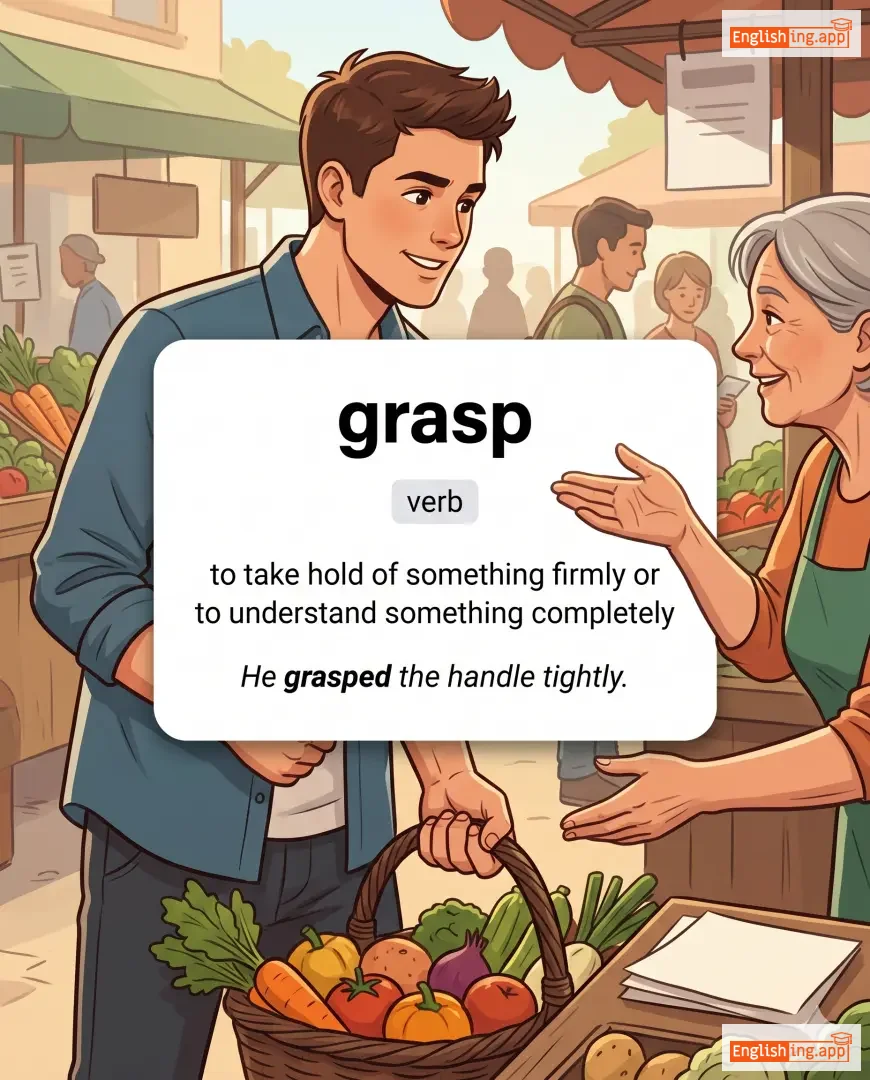
grasp definition card — visual illustration of the meaning
verb
/ɡrɑːsp/
agarrar con firmeza o comprender completamente (agarrar con firmeza o comprender completamente)

to take hold of something firmly or to understand something completely

"He grasped the handle tightly."

"Él agarró el mango con fuerza." (Él agarró el mango con fuerza.)
verb/adjective
/ˈɡræspɪŋ/
agarrando / codicioso (agarrando / codicioso)

Holding firmly; or (as an adjective) excessively greedy.

"The child was grasping her mother’s hand tightly."

"El niño estaba agarrando fuertemente la mano de su madre." (El niño estaba agarrando fuertemente la mano de su madre.)
noun
/ɡræs/
felicidad (felicidad)

plants with narrow green leaves, often covering the ground in fields or gardens

"Children are playing on the grass."

"Ella no pudo ocultar su felicidad cuando recibió el premio." (Ella no pudo ocultar su felicidad cuando recibió el premio.)
noun
/ˈɡræs.hɒp.ər/
saltamontes (saltamontes)

a jumping insect with long hind legs that feeds on grass and plants

"The grasshopper jumped from one leaf to another."

"El saltamontes saltó de una hoja a otra." (El saltamontes saltó de una hoja a otra.)
adjective
/ˈɡræs.i/
cubierto de hierba (Grasi)

covered with grass; resembling grass in color; green like grass

"The grassy field stretched as far as the eye could see."

"El campo cubierto de hierba se extendió hasta donde alcanzaba la vista." (El campo cubierto de hierba se extendia hasta donde alcanzaba la vista.)
verb
/ɡreɪt/
rallar, irritar (rallar, irritar)

to shred food into small pieces using a grater; to irritate or annoy

"She grated the cheese for the pasta dish."

"Ella ralló el queso para el plato de pasta." (Ella rallo el queso para el plato de pasta.)
adjective
/ˈɡreɪtfəl/
agradecido (agradecido)

feeling or showing thanks for something or someone

"I am grateful for your help."

"Estoy agradecido por tu ayuda." (Estoy agradecido por tu ayuda.)
noun
/ˈɡreɪt.fəl.nəs/
gratitud (gratitud)

the quality of being thankful; readiness to show appreciation for kindness

"She expressed her gratefulness to the doctors who saved her life."

"ella expresó su gratitud a los médicos que salvaron su vida." (ella expresó su gratitud a los médicos que salvaron su vida.)
noun
/ˈɡreɪ.tər/
rallador (rallador)

a kitchen utensil with a rough surface for grating food into small pieces

"Use the grater to grate cheese for the pizza."

"Usa el rallador para rallar queso para la pizza." (Usa el rallador para rallar queso para la pizza.)
gratification definition card — visual illustration of the meaning
noun
/ˌɡrætɪfɪˈkeɪʃən/
satisfacción, gratificación (satisfaccion, gratificacion)

the feeling of pleasure or satisfaction when something is achieved or received

"She felt great gratification after completing the project."

"Sintió una gran satisfacción después de completar el proyecto." (Sintio una gran satisfaccion despues de completar el proyecto.)
verb
/ˈɡrætɪfaɪ/
satisfacer, contentar (satisfaser, contentar)

to give pleasure or satisfaction to someone

"It gratified him to know his work was appreciated."

"Le dio placer saber que su trabajo fue apreciado." (Le dio placer saber que su trabajo fue apreciado.)
adjective, noun
/ˈɡreɪtɪŋ/
sonido desagradable / rejilla de metal (sonido desagradable / rejilla de metal)

Harsh and unpleasant to the senses, especially sound; a framework of bars covering an opening.

"The teacher's grating voice made it hard to concentrate."

"La voz desagradable del maestro hacía difícil concentrarse." (La voz desagradable del maestro hacía difícil concentrarse.)
adverb, adjective
/ˈɡrætɪs/ or /ˈɡreɪtɪs/
gratis (gratis)

Without charge; free of cost.

"The drinks at the event were provided gratis."

"Las bebidas en el evento fueron proporcionadas gratis." (Las bebidas en el evento fueron proporcionadas gratis.)
gratitude definition card — visual illustration of the meaning
noun
/ˈɡrætɪˌtjuːd/
gratitud (gratitud)

The quality of being thankful; readiness to show appreciation for and return kindness.

"She expressed her gratitude to the team for their support."

"Ella expresó su gratitud al equipo por su apoyo." (Ella expresó su gratitud al equipo por su apoyo.)
adjective
/ɡrəˈtjuːɪtəs/
innecesario (innecesario)

Unnecessary, unwarranted, or given freely without reason or cause.

"The movie was criticized for its gratuitous violence."

"La película fue criticada por su violencia innecesaria" (La pelicula fue criticada por su violencia innecesaria)