Vocabularios

Descubra, aprenda y domine el vocabulario en inglés

adjective
/ˈɡæst.li/
espantoso (espantoso)

Causing great horror or fear; very unpleasant.

"The crime scene was a ghastly sight."

"La escena del crimen fue espantosa." (La escena del crimen fue espantosa.)
noun
/ɡiː/
mantequilla clarificada (ghee)

clarified butter used in South Asian cooking

"She used ghee instead of butter for cooking the rice."

"Ella usó ghee en lugar de mantequilla para cocinar el arroz." (Ella uso ghee en lugar de mantequilla para cocinar el arroz.)
noun
/ɡoʊst/
fantasma (fantasma)

the spirit of a dead person that is believed to appear to the living

"She felt as if a ghost was watching her in the dark hallway."

"Ella sintió como si un fantasma la estuviera observando en el pasillo oscuro." (Ella sintió como si un fantasma la estuviera observando en el pasillo oscuro.)
noun
/ˈdʒaɪənt/
gigante (gigante)

an extremely large and powerful being or a very large person or thing

"The company grew into a giant in the tech industry."

"La empresa se convirtió en un gigante en la industria tecnológica." (La empresa se convirtió en un gigante en la industria tecnológica.)
noun
/ˈdʒaɪənt sneɪk hɛd/
cabeza de serpiente gigante (cabeza de serpiente gigante)

a large predatory freshwater fish with an elongated body and snake-like head

"The giant snake head is a fierce predator that can survive out of water for hours."

"La cabeza de serpiente gigante es un feroz depredador que puede sobrevivir fuera del agua durante horas." (La cabeza de serpiente gigante es un feros depredador ke puede sobrevivir fuera del agua durante oras.)
verb
/ˈdʒɪb.ər/
hablar de manera incomprensible (hablar de manera incomprensible)

To speak rapidly and unintelligibly, typically through fear or shock.

"The frightened man began to gibber when he saw the ghost."

"El hombre asustado comenzó a hablar de manera incomprensible cuando vio al fantasma." (El hombre asustado comenzó a hablar de manera incomprensible cuando vio al fantasma.)
noun
/ˈdʒɪb.ər.ɪʃ/
galimatías (galimatias)

Unintelligible or meaningless speech or writing.

"He was so nervous that his explanation sounded like gibberish."

"Estaba tan nervioso que su explicación sonaba como galimatías." (Estaba tan nervioso que su explicacion sonaba como galimatias.)
noun
/ˈdʒɪbɪt/
horca (horca)

A gallows used for hanging criminals; historically also a post where bodies of executed criminals were displayed.

"The thief was sentenced to die on the gibbet."

"El ladrón fue sentenciado a morir en la horca." (El ladron fue sentenciado a morir en la horca.)
noun
/ˈɡɪbən/
gibón (gibon)

a small to medium-sized tailless ape with long arms, native to the forests of Southeast Asia

"The gibbon swung gracefully through the trees using its long arms."

"El gibón se balanceaba con gracia entre los árboles usando sus largos brazos." (el gibon se balanceaba con gracia entre los arboles usando sus largos brazos)
verb
/dʒaɪb/
burlarse (burlarse)

To make insulting or mocking remarks; to taunt.

"The fans gibed at the losing team."

"Los fanáticos se burlaron del equipo perdedor." (Los fanáticos se burlaron del equipo perdedor.)
adjective
/ˈɡɪdi/
mareado, muy emocionado (mareado, muy emocionado)

Feeling dizzy or light-headed; also overly excited and frivolous.

"She felt giddy after spinning around so many times."

"Ella se sintió mareada después de girar tantas veces." (Ella se sintió mareada después de girar tantas veces.)
noun
/ɡɪft/
regalo (regalo)

something given willingly to someone without payment; a present

"She gave him a beautiful gift for his birthday."

"Ella le dio un hermoso regalo para su cumpleaños." (Ella le dio un hermoso regalo para su cumpleaños.)
adjective
/ˈɡɪftɪd/
dotado (dotado)

having exceptional talent or natural ability

"The gifted student solved the math problem in seconds."

"El estudiante dotado resolvió el problema de matemáticas en segundos." (El estudiante dotado resolvió el problema de matemáticas en segundos.)
noun
/ɡɪɡ/
una actuación en vivo de un músico, banda o artista; también un trabajo temporal (gig)

A live performance by a musician, band, or entertainer; also a temporary job.

"The band has a gig at the local club tonight."

"La banda tiene un gig en el club local esta noche." (La banda tiene un gig en el club local esta noche.)
adjective
/dʒaɪˈɡæntɪk/
gigante (gigante)

Extremely large or huge in size, power, or extent.

"The company made a gigantic investment in technology."

"La empresa hizo una inversión gigante en tecnología." (La empresa hizo una inversion gigante en tecnologia.)
verb
/ɡɪld/
dorado (dorado)

to cover something with a thin layer of gold or to make something appear more attractive than it really is

"The craftsman gilded the frame to give it a luxurious look."

"El artesano doró el marco para darle un aspecto lujoso." (El artesano doró el marco para darle un aspecto lujoso.)
noun
/ˈdʒɪn.dʒər/
jengibre (hengibre)

a hot-tasting root used as a spice in cooking and as medicine

"Add fresh ginger to the curry for extra flavor."

"Agrega jengibre fresco al curry para obtener más sabor." (agrega hengibre fresco al karri para obtener mas sabor)
adverb
/ˈdʒɪndʒərli/
con cautela (con cautela)

in a very careful or cautious manner

"She walked gingerly on the icy path."

"Ella caminó con cautela por el camino helado." (Ella caminó con cautela por el camino helado.)
noun
/dʒɪˈræf/
jirafa (jirafa)

a very tall African animal with a long neck and long legs

"The giraffe stretched its neck to reach the leaves on the tall tree."

"La jirafa estiró su cuello para alcanzar las hojas en el árbol alto." (La jirafa estiró su cuello para alcanzar las hojas en el árbol alto.)
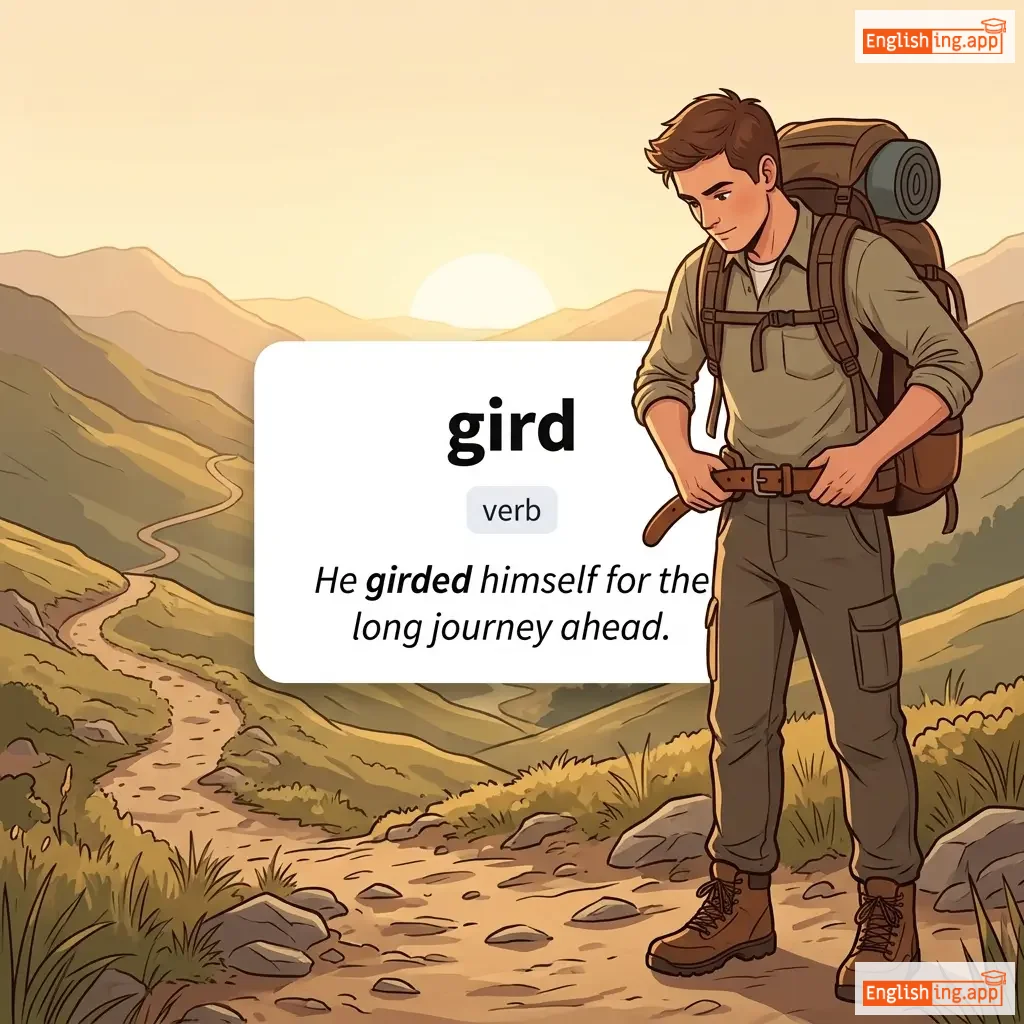
gird definition card — visual illustration of the meaning
verb
/ɡɜːrd/
rodear, prepararse (rodear, prepararse)

to encircle or bind with a belt or band; to prepare oneself for something difficult

"He girded himself for the long journey ahead."

"Él se preparó para el largo viaje por delante." (El se preparó para el largo viaje por delante.)
noun
/ˈɡɜːrdər/
viga (de acero) (viga (de acero))

a large, strong beam used to support buildings or bridges

"The steel girders held the weight of the bridge."

"Las vigas de acero sostuvieron el peso del puente." (Las vigas de acero sostuvieron el peso del puente.)
noun
/ɡɜːrl/
chica (chika)

a female child or young woman

"The girl was playing with her friends in the park."

"La chica estaba jugando con sus amigos en el parque." (La chica estaba jugando con sus amigos en el parque.)
👩‍❤️‍👨

girlfriend (gɜːrlfrɛnd)

noun
/ˈɡɜːrlfrɛnd/
novia (novia)

A woman or girl with whom someone is romantically or emotionally involved.

"He introduced his girlfriend to his family."

"Él presentó a su novia a su familia." (El presentó a su novia a su familia.)
noun
/ɡɜːrθ/
circunferencia (circunferencia)

the measurement around the middle of something, especially a person's waist or a tree trunk

"The tree's girth measured nearly five feet."

"La circunferencia del árbol medía casi cinco pies." (La circunferencia del árbol medía casi cinco pies.)
noun
/dʒɪst/
idea principal (idea principal)

the main or essential part of a matter; the central idea

"The gist of his speech was about unity and cooperation."

"El resumen de su discurso era sobre unidad y cooperación." (El resumen de su discurso era sobre unidad y cooperación.)
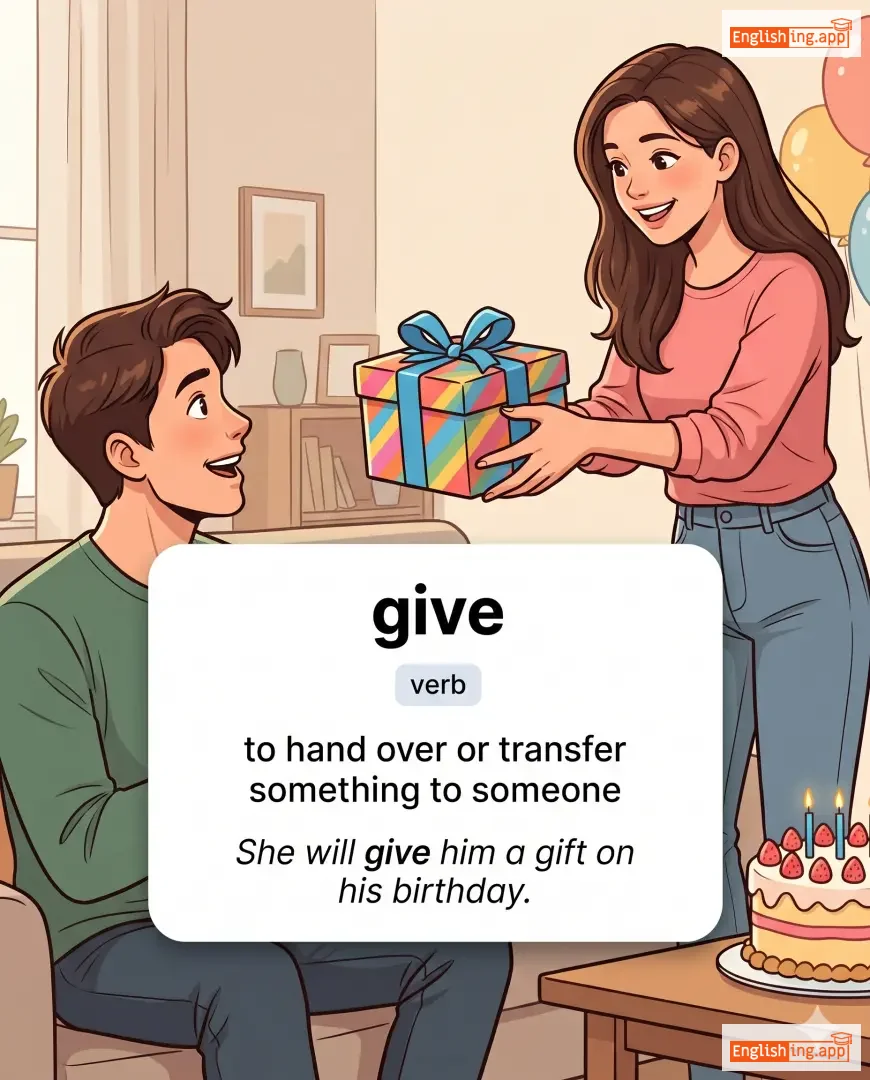
give definition card — visual illustration of the meaning
verb
/ɡɪv/
dar (dar)

to hand over or transfer something to someone

"She will give him a gift on his birthday."

"Ella le dará un regalo en su cumpleaños." (Ella le dará un regalo en su cumpleaños.)
adjective
/ˈɡɪvən/
dado (dado)

Specified or stated; already decided or certain.

"It is a given fact that hard work leads to success."

"Es un hecho dado que el trabajo duro lleva al éxito." (Es un hecho dado que el trabajo duro lleva al éxito.)
noun
/ˈɡɪvər/
donante (donante)

a person who gives something

"She was always a generous giver to charity."

"Ella siempre fue una generosa dadora a la caridad." (Ella siempre fue una generosa dadora a la caridad.)
adjective
/ˈɡleɪʃəl/
relacionado con el hielo o los glaciares (relacionado con el hielo o los glaciares)

relating to ice or glaciers; extremely cold or unfriendly

"The mountains were covered in glacial ice."

"Las montañas estaban cubiertas con hielo glacial." (Las montañas estaban cubiertas con hielo glacial.)
noun
/ˈɡleɪʃər/
glaciares (glaciares)

a large mass of ice that moves slowly over land

"The glacier is slowly melting due to climate change."

"El glaciar se está derritiendo lentamente debido al cambio climático." (El glaciar se está derritiendo lentamente debido al cambio climático.)
Glad definition card — visual illustration of the meaning
adjective
/ɡlæd/
contento (contento)

feeling pleased, happy, or delighted

"I am glad to see you again after so long."

"Estoy contento de verte nuevamente después de tanto tiempo." (Estoy contento de verte nuevamente después de tanto tiempo.)
verb
/ˈɡlædən/
alegrar (alegrar)

to make someone happy or bring joy

"The news of her recovery gladdened everyone."

"La noticia de su recuperación alegró a todos." (La noticia de su recuperación alegró a todos.)
noun
/ɡleɪd/
claros en el bosque (claros en el bosque)

An open space in a forest or woods.

"They rested in a sunny glade after their long hike."

"Descansaron en un claro soleado después de su largo paseo." (Descansaron en un claro soleado después de su largo paseo.)
noun
/ˈɡlædiˌeɪtər/
gladiador (gladiador)

A man trained to fight in public contests in ancient Rome.

"The gladiator fought bravely in the arena."

"El gladiador luchó valientemente en la arena." (El gladiador luchó valientemente en la arena.)
noun
/ˌɡlæd.iˈoʊ.ləs/
gladiolo (gladiolo)

A tall flowering plant with sword-shaped leaves and colorful spike-like flower clusters, popular in gardens and floral arrangements

"The gladiolus stood tall and elegant in the flower bed."

"El gladiolo se erguía alto y elegante en el macizo de flores." (El gladiolo se erguia alto y elegante en el macizo de flores.)
adverb
/ˈɡlæd.li/
con gusto y placer (con gusto y placer)

willingly and with pleasure

"I would gladly help you with your homework."

"Con gusto te ayudaría con tu tarea." (Con gusto te ayudaría con tu tarea.)
noun
/ˈɡlæmər/
encanto (encanto)

An attractive or exciting quality that makes something or someone appealing.

"The glamor of city life attracts many young people."

"El encanto de la vida en la ciudad atrae a muchos jóvenes." (El encanto de la vida en la ciudad atrae a muchos jóvenes.)
adjective
/ˈɡlæm.ər.əs/
glamoroso; atractivo; de moda; (glamoroso; atractivo; de moda)

having glamour; attractive in an exciting way; fashionable;

"The actress looked glamorous in her designer gown at the awards ceremony."

"La actriz se veía glamorosa en su vestido de diseñador en la ceremonia de premios." (La actriz se veía glamorosa en su vestido de diseñador en la ceremonia de premios.)
noun
/ˈɡlæm.ər/
glamour; atractivo; encanto; (glamour; atractivo; encanto;)

an attractive or exciting quality that makes certain people or things seem appealing; alluring charm

"The glamour of Hollywood attracted young actors from around the world."

"El glamour de Hollywood atrajo a jóvenes actores de todo el mundo." (El glamour de Hollywood atrajo a jóvenes actores de todo el mundo.)
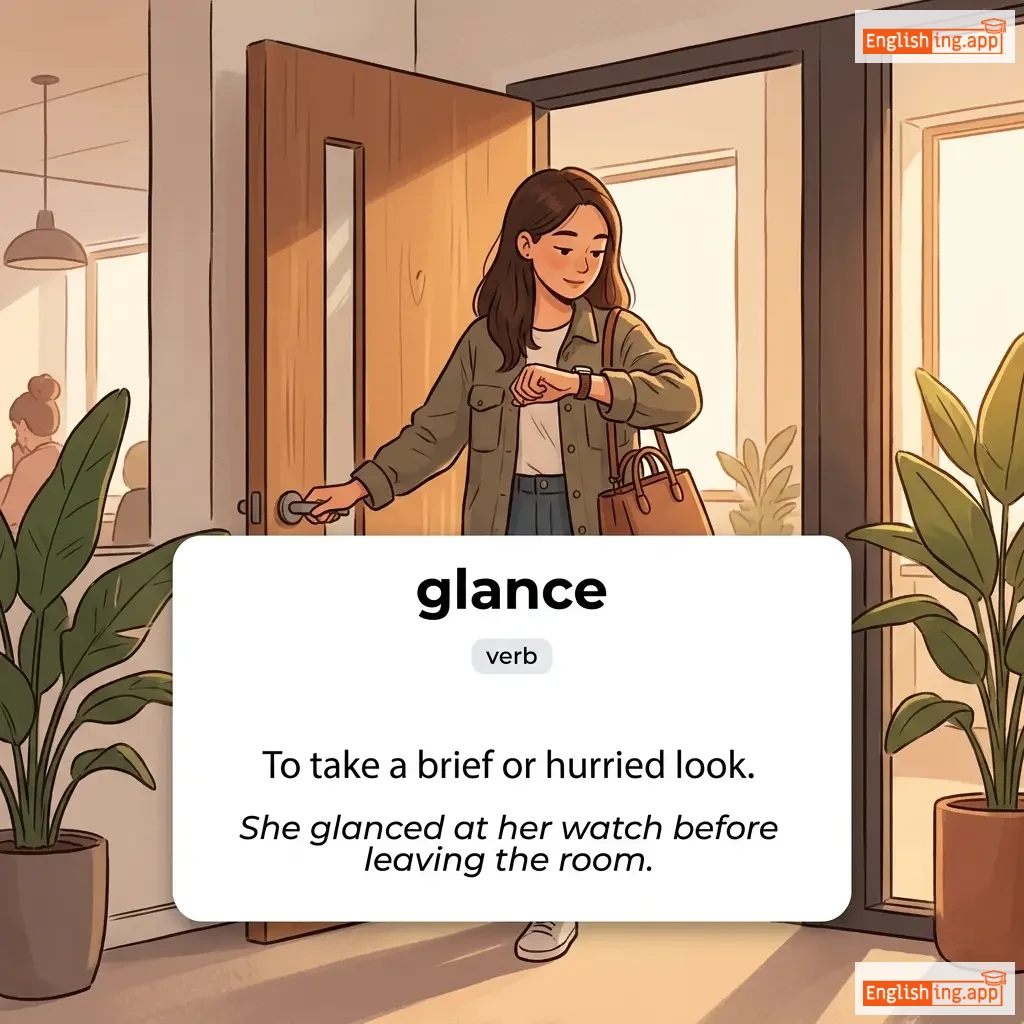
glance definition card — visual illustration of the meaning
verb
/ɡlæns/
mirada (mirada)

To take a brief or hurried look.

"She glanced at her watch before leaving the room."

"Ella echó un vistazo a su reloj antes de salir de la habitación." (Ella echó un vistazo a su reloj antes de salir de la habitación.)
verb
/ɡlɛr/
mirada de enojo / luz brillante (mirada de enojo / luz brillante)

To stare angrily or to shine with a harsh bright light.

"She glared at him for being late."

"Ella lo miró con enojo por llegar tarde." (Ella lo miro con enojo por llegar tarde.)
adjective
/ˈɡlɛrɪŋ/
intenso / obvio (intenso / obvio)

Extremely obvious or shining intensely.

"There was a glaring mistake in the report."

"Hubo un error obvio en el informe." (Hubo un error obvio en el informe.)
noun
/ɡlæs/
vidrio (vidrio)

a hard, transparent material used for windows, bottles, and other objects

"She poured water into a glass and handed it to me."

"Ella vertió agua en un vaso y me lo entregó." (Ella vertió agua en un vaso y me lo entregó.)
noun
/ˈɡlɑːs.weər/
vajilla de cristal (vajilla de cristal)

objects made of glass, especially drinking glasses and decorative objects

"The wedding registry included fine glassware."

"El registro de bodas incluyó vajilla de cristal fina." (El registro de bodas incluyó vajilla de cristal fina.)
noun
/ˈɡlæsi fɪʃ/
pez de cristal (pez de kristal)

a transparent freshwater fish with a glassy appearance, popular in aquariums

"The glassy fish is known for its transparent body and peaceful nature."

"El pez de cristal es conocido por su cuerpo transparente y su naturaleza pacífica." (El pez de kristal es konosido por su kwerpo transparente y su naturalezapasisika.)
verb
/ɡleɪz/
cobrir (cobrir)

to cover with a smooth, shiny surface; to coat with a glossy finish

"The chef glazed the cake with chocolate."

"El chef cubrió el pastel con chocolate." (El chef cubrió el pastel con chocolate.)
noun
/ˈɡleɪziər/
vidriero (vidriero)

a person whose job is to fit glass into windows and doors

"The glazier repaired the broken window in our house."

"El vidriero reparó la ventana rota en nuestra casa." (El vidriero reparó la ventana rota en nuestra casa.)
noun, verb
/ɡliːm/
destello (destello)

a small or brief shining light; to shine softly

"A gleam of hope appeared in her eyes."

"Apareció un destello de esperanza en sus ojos." (Aparecio un destello de esperanza en sus ojos.)
verb
/ɡliːn/
recoger (recoger)

to collect or gather slowly and bit by bit, especially information or crops left after harvest

"The journalist gleaned facts from several sources."

"El periodista recopiló hechos de varias fuentes." (El periodista recopilo hechos de varias fuentes.)
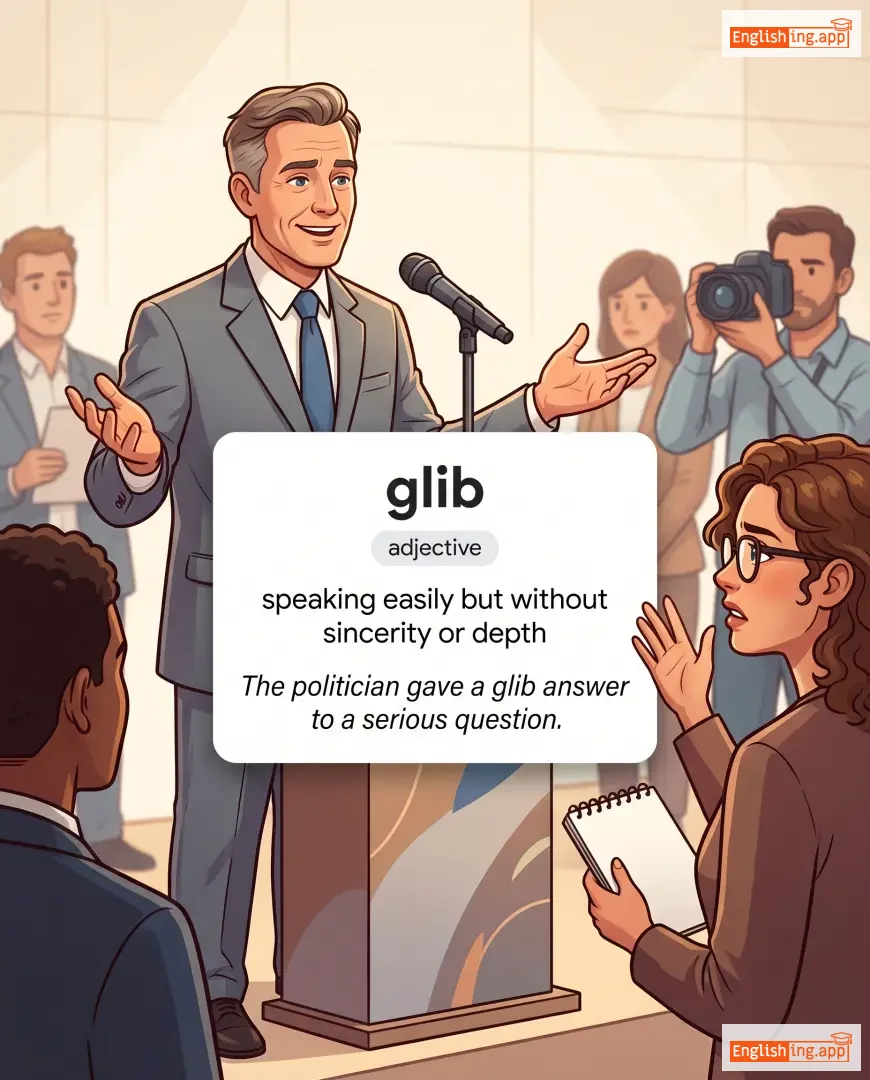
glib definition card — visual illustration of the meaning
adjective
/ɡlɪb/
superficial pero insincero (superficial pero insincero)

speaking easily but without sincerity or depth

"The politician gave a glib answer to a serious question."

"El político dio una respuesta superficial a una pregunta seria." (El politico dio una respuesta superficial a una pregunta seria.)