Vocabularios

Descubra, aprenda y domine el vocabulario en inglés

adjective
/ɡɑːrˈɡæntʃuən/
gigante (gigante)

Extremely large; enormous.

"They served a gargantuan meal at the feast."

"Sirvieron una comida gigante en la fiesta." (Sirvieron una comida gigante en la fiesta.)
noun
/ˈɡɑːrɡɔɪl/
escultura de piedra (de forma grotesca) (escultura de piedra (de forma grotesca))

A carved stone figure, often of a grotesque creature, on a building, typically used as a spout to carry water away.

"The ancient cathedral had gargoyles on every corner."

"La antigua catedral tenía gárgolas en cada esquina." (La antigua catedral tenía gárgolas en cada esquina.)
adjective
/ˈɡɛə.rɪʃ/
excesivamente brillante y llamativo (excesivamente brillante y llamativo)

Excessively bright and showy, often in a tasteless or unattractive way.

"The room was decorated with garish neon lights."

"La habitación estaba decorada con luces de neón excesivamente brillantes." (La habitación estaba decorada con luces de neón excesivamente brillantes.)
noun
/ˈɡɑːr.lənd/
guirnalda; corona de flores; (guirnalda, corona de flores)

a wreath of flowers and leaves, worn on the head or hung as decoration

"The bride wore a beautiful floral garland during the traditional ceremony."

"La novia llevó una hermosa guirnalda floral durante la ceremonia tradicional." (La novia llevó una hermosa guirnalda floral durante la ceremonia tradicional.)
noun
/ˈɡɑːrlɪk/
ajo (ajo)

A strong-smelling plant used as a seasoning in cooking.

"She added garlic to the curry."

"Ella añadió ajo al curry." (Ella añadió ajo al curry.)
noun
/ˈɡɑː.mənt/
prenda (prenda)

An item of clothing.

"She bought a new garment for the party."

"Ella compró una nueva prenda para la fiesta." (Ella compro una nueva prenda para la fiesta.)
verb
/ˈɡɑː.nər/
recoger (recoger)

To gather or collect, especially information, support, or approval.

"The politician garnered support from young voters."

"El político recogió apoyo de los jóvenes votantes." (El político recogió apoyo de los jóvenes votantes.)
verb
/ˈɡɑː.nɪʃ/
adornar (adorar)

To decorate food with small items for added flavor or visual appeal.

"She garnished the dish with fresh coriander leaves."

"Ella adornó el plato con hojas frescas de cilantro." (Ella adornó el plato con hojas frescas de cilantro.)
noun
/ˈɡær.ɪ.sən/
guarnición (guarnicion)

A body of troops stationed in a particular location, usually to defend it.

"The garrison defended the fortress against the invaders."

"La guarnición defendió la fortaleza contra los invasores." (La guarnicion defendiò la fortaleza contra los invasores.)
noun, verb
/ɡəˈrɒt/
garrote (garrote)

A method of execution by strangulation, or to strangle someone with a cord or wire.

"The assassin attempted to garrote his target in the alley."

"El asesino intentó garrotear a su objetivo en el callejón." (El asesino intento garrotear a su objetivo en el callejon.)
noun
/ɡəˈruːlɪti/
charlatanería (charlateria)

Excessive talkativeness, especially about trivial matters.

"His garrulity made it hard to focus during the meeting."

"Su charlatanería hizo difícil concentrarse durante la reunión." (Su charlateria hizo dificil concentrarse durante la reunion.)
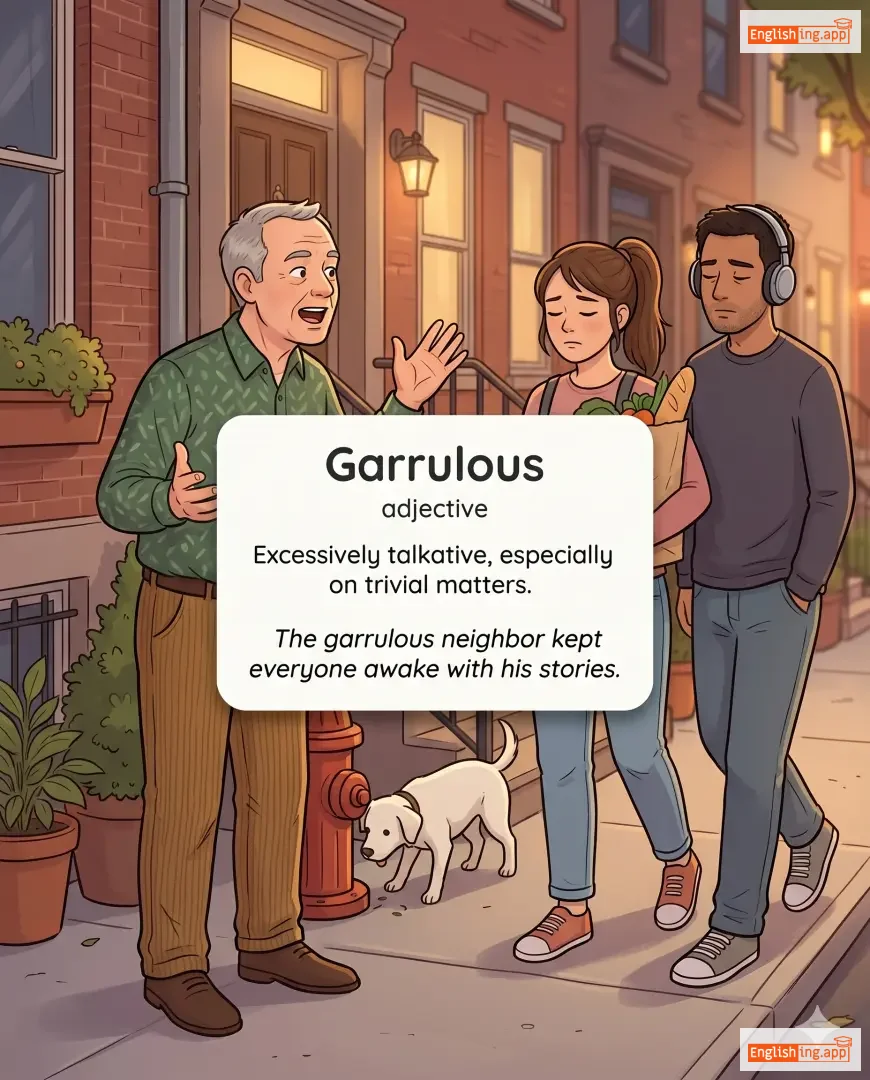
Garrulous definition card — visual illustration of the meaning
adjective
/ˈɡærələs/
charlatán, parlanchín (charlatan, parlanchin)

Excessively talkative, especially on trivial matters.

"The garrulous neighbor kept everyone awake with his stories."

"El vecino charlatán mantuvo a todos despiertos con sus historias." (El vecino charlatan mantuvo a todos despiertos con sus historias.)
noun
/ɡæs/
gas (gas)

A substance like air that is neither solid nor liquid and can expand freely.

"The balloon was filled with gas."

"El globo estaba lleno de gas." (El globo estaba lleno de gas.)
noun
/ˌɡæskəˈneɪd/
presunción exagerada, jactancia (presuncion exagerada, jactancia)

Extravagant boasting or bragging.

"His endless gasconade made him unpopular among his peers."

"Su interminable presunción lo hizo impopular entre sus compañeros." (Su interminable presuncion lo hizo impopular entre sus companeros.)
adjective
/ˈɡæsiəs/
gaseoso (gaseoso)

Relating to or having the form of gas.

"Carbon dioxide is a gaseous substance."

"El dióxido de carbono es una sustancia gaseosa." (El dióxido de carbono es una sustancia gaseosa.)
noun/verb
/ɡæʃ/
corte profundo (corte profundo)

A long, deep cut or wound; to cut deeply or violently.

"He had a deep gash on his leg after the accident."

"Él tenía un corte profundo en su pierna después del accidente." (Él tenía un corte profundo en su pierna después del accidente.)
noun
/ˌɡæsɪfɪˈkeɪʃən/
gasificación (gasificacion)

The process of converting solid or liquid fuel into gas.

"Gasification is widely used to produce fuel gas from coal."

"La gasificación se usa ampliamente para producir gas combustible a partir del carbón." (La gasificacion se usa ampliamente para producir gas combustible a partir del carbon.)
noun
/ˈɡæsəˌliːn/
gasolina (gasolina)

a liquid fuel made from petroleum, used mainly to power engines in vehicles

"The price of gasoline has increased significantly this month."

"El precio de la gasolina ha aumentado significativamente este mes." (El precio de la gasolina ha aumentado significativamente este mes.)
adjective
/ˈɡæstrɪk/
gástrico / problemas del estómago (gastrico / problemas del estomago)

Relating to the stomach.

"She was prescribed medicine for her gastric problems."

"Ella fue recetada con medicina para sus problemas gástricos." (Ella fue recetada con medicina para sus problemas gástricos.)
noun
/ɡæsˈtraɪtɪs/
gastritis (gastritis)

Inflammation of the lining of the stomach.

"The doctor diagnosed him with gastritis after his endoscopy."

"El médico lo diagnosticó con gastritis después de su endoscopia." (El medico lo diagnostico con gastritis despues de su endoscopia.)
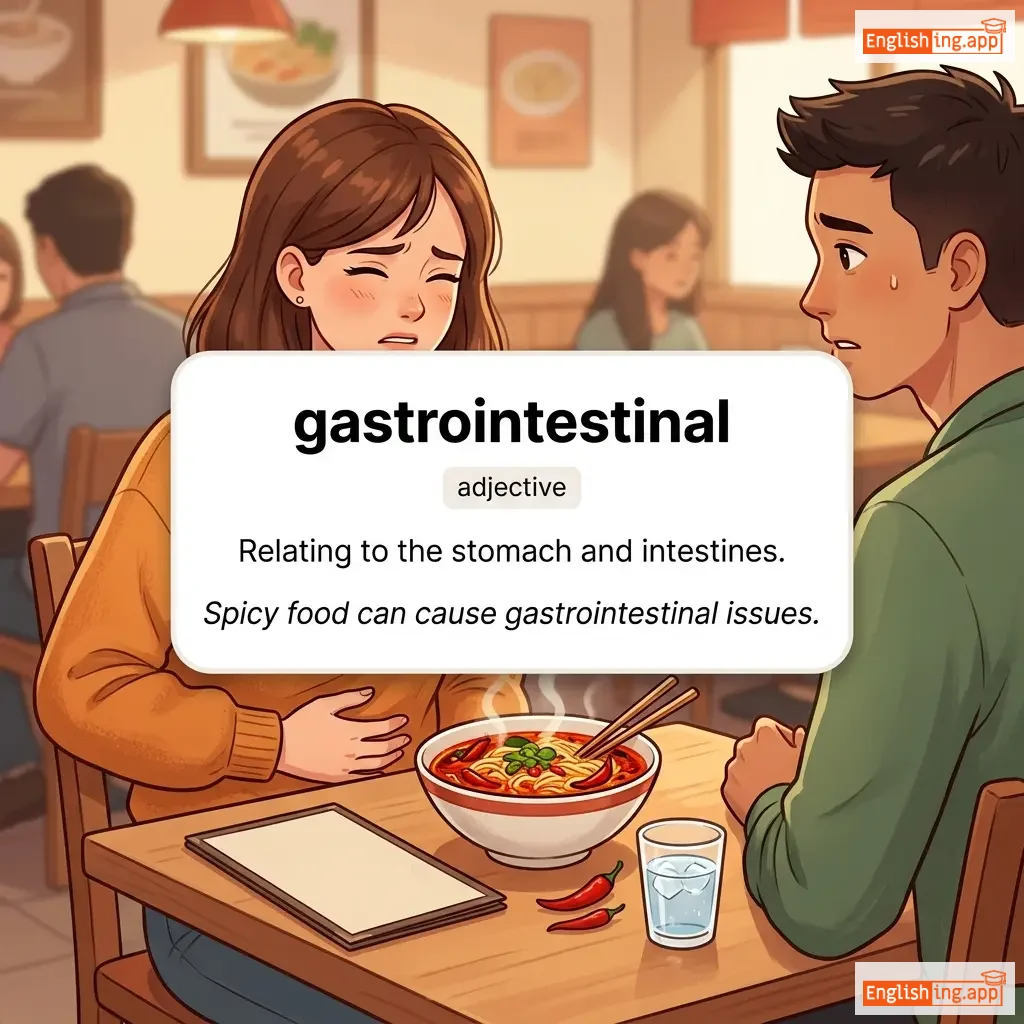
gastrointestinal definition card — visual illustration of the meaning
adjective
ˌɡæs.troʊ.ɪnˈtes.tɪ.nəl
gastrointestinal (gastrointestinal)

Relating to the stomach and intestines.

"Spicy food can cause gastrointestinal issues."

"La comida picante puede causar problemas gastrointestinales." (La comida picante puede causar problemas gastrointestinales.)
noun
/ɡæsˈtrɒnəmi/
gastronomía (gastronomia)

The art or science of good eating and fine cuisine.

"Paris is famous for its rich tradition of gastronomy."

"París es famoso por su rica tradición en gastronomía." (París es famoso por su rica tradición en gastronomía.)
noun
/ɡeɪt/
felicidad (felicidad)

A movable barrier that opens and closes to allow or prevent entry through an opening.

"She closed the gate behind her as she left the garden."

"No pudo ocultar su felicidad cuando recibió el premio." (No pudo ocultar su felicidad cuando recibió el premio.)
noun
/ˈɡeɪt.weɪ/
puerta de entrada; umbral (puerta de entrada; umbral)

an entrance or opening that provides access to a place; a means of achieving a particular state or condition

"The ancient stone gateway served as the entrance to the magnificent palace."

"La antigua puerta de piedra sirvió como la entrada al magnífico palacio." (La antigua puerta de piedra sirvió como la entrada al magnífico palacio.)
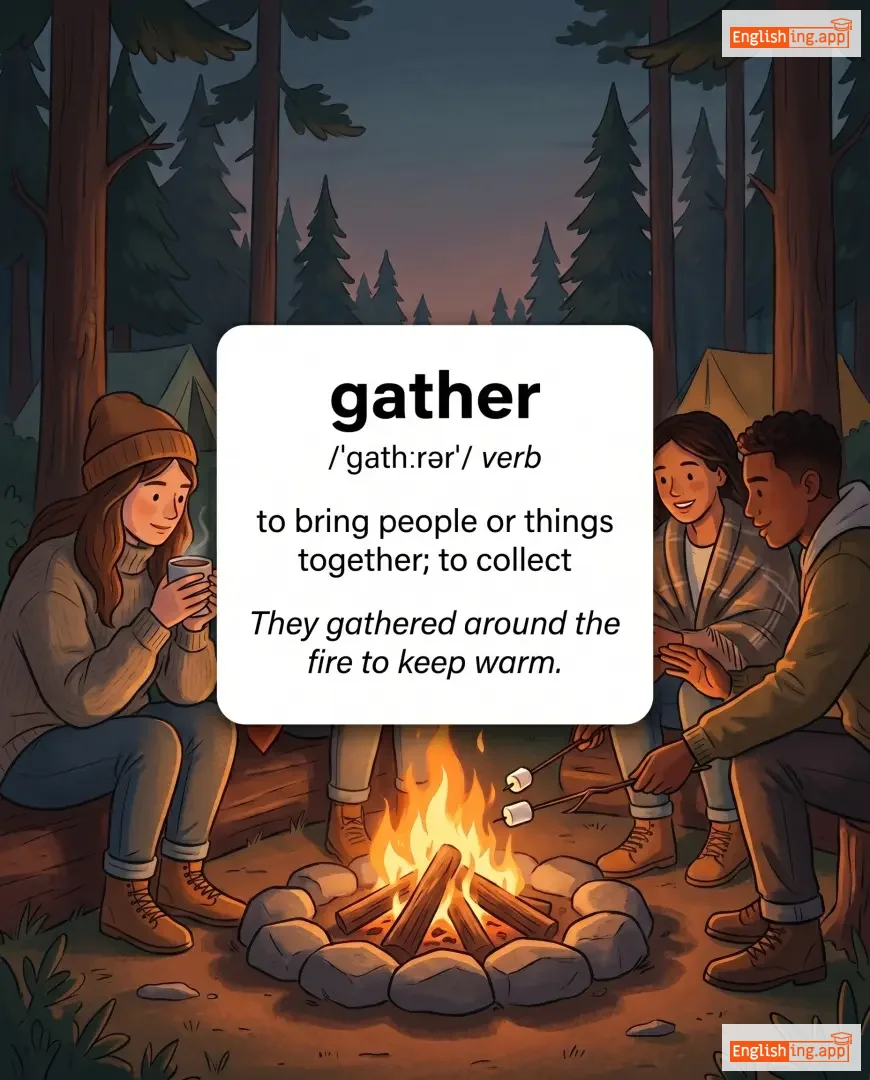
gather definition card — visual illustration of the meaning
verb
/ˈɡæðər/
reunir (reunir)

to bring people or things together; to collect

"They gathered around the fire to keep warm."

"Ellos se reunieron alrededor del fuego para mantenerse calientes." (Ellos se reunieron alrededor del fuego para mantenerse calientes.)
noun
/ˈɡæðərɪŋ/
reunión (reunion)

a meeting or assembly of people for a particular purpose

"We attended a family gathering last weekend."

"Asistimos a una reunión familiar el fin de semana pasado." (Asistimos a una reunion familiar el fin de semana pasado.)
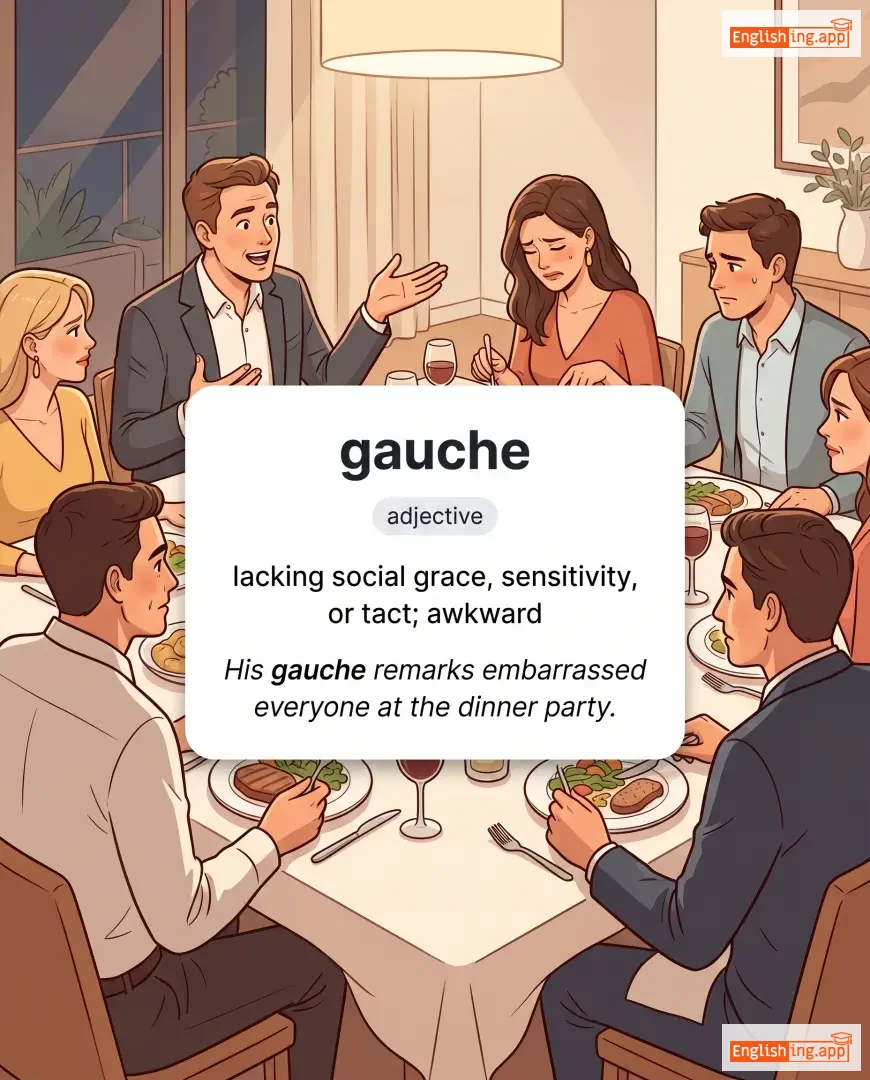
gauche definition card — visual illustration of the meaning
adjective
/ɡoʊʃ/
tosco (tosko)

lacking social grace, sensitivity, or tact; awkward

"His gauche remarks embarrassed everyone at the dinner party."

"Sus comentarios toscos avergonzaron a todos en la fiesta de cena." (Sus comentarios toscos avergonzaron a todos en la fiesta de cena.)
adjective
/ˈɡɔːdi/
estrafalario (estrafalario)

excessively showy or flashy, often in a tasteless way

"She wore a gaudy necklace that clashed with her elegant dress."

"Ella llevaba un collar estrafalario que chocaba con su elegante vestido." (Ella llevaba un collar estrafalario que chocaba con su elegante vestido.)
verb
/ɡeɪdʒ/
medir (medir)

to measure, estimate, or determine the magnitude, amount, or capacity of something

"The mechanic gauged the pressure in the car tires."

"El mecánico midió la presión en las llantas del carro." (El mecanico midió la presión en las llantas del carro.)
adjective
/ɡɔːnt/
demacrado (demacrado)

extremely thin, bony, and haggard in appearance, often due to hunger or illness

"After weeks of illness, he looked pale and gaunt."

"Después de semanas de enfermedad, se veía pálido y demacrado." (Después de semanas de enfermedad, se veía pálido y demacrado.)
noun
/ˈɡɔːntlɪt/
guante / desafío (guante / desafio)

a protective glove; a challenge or trial; to 'throw down the gauntlet' means to issue a challenge

"The knight threw down his gauntlet as a sign of challenge."

"El caballero arrojó su guante como señal de desafío." (El caballero arrojo su guante como senal de desafio.)
noun
/ˈɡævəl/
mazo (mazo)

A small ceremonial mallet used by a judge or an auctioneer to signal attention or mark a decision.

"The judge struck the gavel to call the court to order."

"El juez golpeó el mazo para llamar al orden en la corte." (El juez golpeo el mazo para llamar al orden en la corte.)
verb
/ɡɔːk/
mirar fijamente (mirar fijamente)

To stare openly and rudely.

"Tourists gawked at the celebrity walking down the street."

"Los turistas miraban fijamente a la celebridad caminando por la calle." (Los turistas miraban fijamente a la celebridad caminando por la calle.)
adjective
/ˈɡɔːki/
torpe (torpe)

Awkward and clumsy in appearance or behavior.

"The teenager felt gawky in his oversized suit."

"El adolescente se sintió torpe en su traje grande." (El adolescente se sintió torpe en su traje grande.)
🏳️‍🌈

gay (guei)

adjective
/ɡeɪ/
gay (gay)

sexually attracted to people of the same sex; also used to mean cheerful or lively

"He came out as gay during college."

"Salió del armario como gay durante la universidad." (Salió del armario como gay durante la universidad.)
verb
/ɡeɪz/
mirada fija (mirada fija)

To look steadily and intently at something, usually with admiration, surprise, or thought.

"He gazed at the stars in wonder."

"Él miraba asombrado las estrellas." (Él miraba asombrado las estrellas.)
noun
/ɡəˈzɛt/
gaceta (gazeta)

An official journal, newspaper, or publication, especially one issued by a government.

"The law was published in the government gazette."

"La ley fue publicada en la gaceta gubernamental." (La ley fue publicada en la gaceta gubernamental.)
noun
/ɡɪə(r)/
equipo / aparato (equipo / aparato)

Equipment or apparatus for a particular purpose; also a toothed wheel in machinery.

"The climber packed all his gear before starting the journey."

"El escalador empacó todo su equipo antes de comenzar el viaje." (El escalador empacó todo su equipo antes de comenzar el viaje.)
noun
/dʒem/
gema (gema)

a precious or semi-precious stone, especially when cut and polished or engraved

"She wore a beautiful gem necklace to the party."

"Ella llevaba un hermoso collar de joyas a la fiesta." (Ella llevaba un hermoso collar de joyas a la fiesta.)
noun
/ˈʒɑːndɑːrm/
gendarme (gendarme)

A French police officer, especially a member of a military-style police force.

"The gendarme stopped the car for a routine check."

"El gendarme detuvo el coche para una revisión rutinaria." (El gendarme detuvo el coche para una revision rutinaria.)
noun
/ˈdʒɛndər/
género (genero)

The state of being male, female, or another identity as recognized socially or culturally.

"The survey asked about participants' age and gender."

"La encuesta preguntó sobre la edad y el género de los participantes." (La encuesta preguntó sobre la edad y el género de los participantes.)
noun
/dʒiːn/
gen (jen)

A unit of heredity in living organisms, transferred from parent to offspring, determining traits.

"Eye color is influenced by genes inherited from parents."

"El color de los ojos está influenciado por los genes heredados de los padres." (El color de los ojos está influenciado por los genes heredados de los padres.)
noun
/ˌdʒiːniˈælədʒɪst/
genealogista (genealogista)

A person who studies or traces the history of families and their lineages.

"The genealogist uncovered records dating back to the 18th century."

"El genealogista descubrió registros que datan del siglo XVIII." (El genealogista descubrió registros que datan del siglo XVIII.)
noun
/ˌdʒiːniˈælədʒi/
genealogía (genealogia)

The study and tracing of lines of descent or family history.

"She spent years researching her family's genealogy."

"Pasó años investigando la genealogía de su familia." (Paso anos investigando la genealogia de su familia.)
adjective
/ˈdʒɛnərəl/
general (general)

Relating to all or most people, things, or situations; not specific.

"He made a general comment about the project."

"Hizo un comentario general sobre el proyecto." (Hizo un comentario general sobre el proyecto.)
noun
/ˌdʒenəˈræləti/
generalidad (generalidad)

A vague, non-specific statement or principle that applies broadly.

"The speech was full of generalities and lacked concrete details."

"El discurso estaba lleno de generalidades y carecía de detalles concretos." (El discurso estaba lleno de generalidades y carecia de detalles concretos.)
verb
/ˈdʒenərəlaɪz/
generalizar (generalizar)

To make a broad statement by inferring from specific cases.

"It is wrong to generalize based on a few experiences."

"Es incorrecto generalizar basándose en unas pocas experiencias." (Es incorrecto generalizar basándose en unas pocas experiencias.)
adverb
/ˈdʒɛnərəli/
generalmente (generalmente)

in most cases; usually; as a rule

"He generally arrives at work before 9 a.m."

"Él generalmente llega al trabajo antes de las 9 a.m." (El generalmente llega al trabajo antes de las 9 a.m.)
verb
/ˈdʒɛnəreɪt/
generar (generar)

to produce or create something

"The machine generates electricity."

"La máquina genera electricidad." (La maquina genera electricidad.)
noun
/ˌdʒɛnəˈreɪʃən/
generación (generacion)

all the people born and living at about the same time; the process of producing something

"The younger generation is more comfortable with technology."

"La generación más joven está más cómoda con la tecnología." (La generacion mas joven esta mas comoda con la tecnologia.)