Vocabularios

Descubra, aprenda y domine el vocabulario en inglés

felicitous definition card — visual illustration of the meaning
adjective
/fəˈlɪsɪtəs/
apropiado, adecuado o placentero; marcado por buena suerte o felicidad (apropiado, adecuado o placentero; marcado por buena suerte o felicidad)

well-chosen, appropriate, or pleasing; marked by good fortune or happiness

"She made a felicitous remark that lightened the mood."

"Hizo un comentario apropiado que aligeró el ambiente." (Hizo un comentario apropiado que aligeró el ambiente.)
noun
/fəˈlɪsɪti/
felicidad (felicidad)

intense happiness; the ability to find appropriate expression for one's thoughts

"She was known for her felicity in conversation and cheerful nature."

"Era conocida por su felicidad en las conversaciones y su naturaleza alegre." (Era conocida por su felicidad en las conversaciones y su naturaleza alegre.)
adjective
/ˈfiːlaɪn/
relacionado con los gatos (relacionado con los gatos)

relating to or characteristic of cats

"Her movements were graceful and almost feline in their elegance."

"Sus movimientos eran gráciles y casi felinos en su elegancia." (Sus movimientos eran gráciles y casi felinos en su elegancia.)
verb
/fel/
derribar, talar (derribar, talar)

to cut down a tree; to cause to fall; to strike down

"The lumberjacks felled several trees in the forest today."

"Los leñadores talaron varios árboles en el bosque hoy." (Los leñadores talaron varios árboles en el bosque hoy.)
noun
/ˈfɛloʊ/
compañero (companero)

a person who shares a common situation, interest, or activity with another

"He is a fellow student in my class."

"Él es un compañero de clase en mi clase." (El es un companero de clase en mi clase.)
noun
/ˈfɛlən/
delincuente (delincuente)

a person who has committed a serious crime

"The felon was sentenced to ten years in prison."

"El delincuente fue sentenciado a diez años de prisión." (El delincuente fue sentenciado a diez años de prisión.)
adjective
/fəˈloʊniəs/
relacionado con un delito grave (relacionado con un delito grave)

relating to or involved in serious criminal activity

"He was charged with felonious assault after the incident."

"Fue acusado de asalto grave después del incidente." (Fue acusado de asalto grave después del incidente.)
noun
/ˈfɛləni/
delito grave (delito grave)

a serious crime, usually punishable by imprisonment for more than one year

"He was convicted of a felony and sentenced to ten years in prison."

"Fue condenado por un delito grave y sentenciado a diez años de prisión." (Fue condenado por un delito grave y sentenciado a diez anos de prision.)
noun/adjective
/ˈfiːmeɪl/
hembra (hembra)

a person or animal of the sex that can bear offspring; relating to women or girls

"The female lion protects her cubs fiercely."

"La leona hembra protege a sus cachorros ferozmente." (La leona hembra protege a sus cachorros ferozmente.)
adjective
/ˈfɛmənɪn/
femenino (femenino)

having qualities traditionally associated with women; feminine in nature

"She has a very feminine style of dressing."

"Ella tiene un estilo muy femenino de vestir." (Ella tiene un estilo muy femenino de vestir.)
noun
/ˈfɛmənɪst/
feminista (feminista)

a person who supports equal rights and opportunities for women and men

"She proudly calls herself a feminist and fights for gender equality."

"Ella orgullosamente se llama a sí misma feminista y lucha por la igualdad de género." (Ella orgullosamente se llama a sí misma feminista y lucha por la igualdad de género.)
noun/verb
/fɛns/
cerca (serka)

a barrier, usually made of wood or wire, that surrounds an area; to enclose with a barrier

"They built a fence around the garden."

"Ellos construyeron una cerca alrededor del jardín." (Ellos construyeron una cerca alrededor del jardín.)
noun
/ˈfɛndər/
guardabarros (guardabarros)

a part of a vehicle that frames a wheel well to protect against mud or debris

"The car's fender was dented in the accident."

"El fender del coche se abolló en el accidente." (El fender del coche se abollo en el accidente.)
noun
/ˈfen.jʊ.griːk/
fenogreco (fenogreco)

an herb whose seeds and leaves are used as a spice in cooking

"Fenugreek seeds have a slightly bitter taste and are commonly used in Indian cuisine."

"Las semillas de fenogreco tienen un sabor ligeramente amargo y se utilizan comúnmente en la cocina india." (Las semillas de fenogreco tienen un sabor ligeramente amargo y se utilizan comúnmente en la cocina india.)
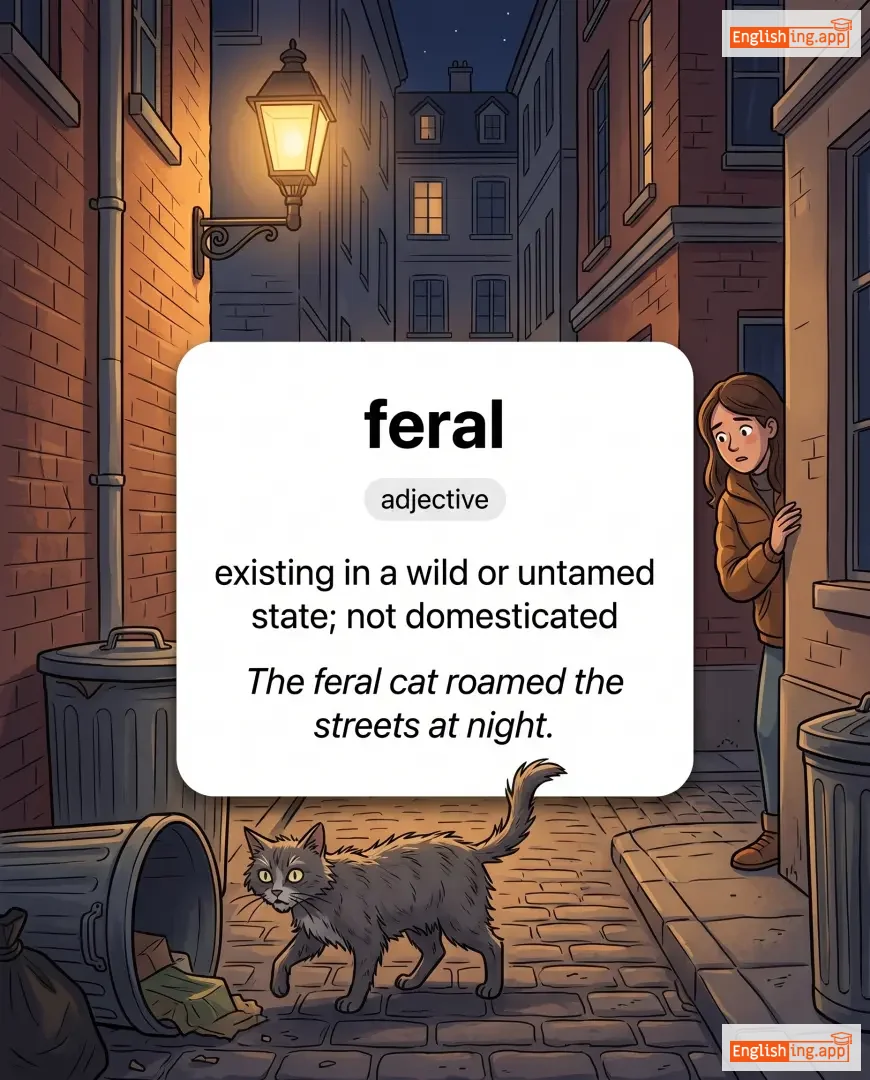
feral definition card — visual illustration of the meaning
adjective
/ˈfɛrəl/
salvaje (salvaje)

existing in a wild or untamed state; not domesticated

"The feral cat roamed the streets at night."

"El gato salvaje rondaba por las calles por la noche." (El gato salvaje rondaba por las calles por la noche.)
verb
/ˈfɜːrmɛnt/
someterse a un proceso químico donde los azúcares se convierten en alcohol o ácido; incitar o agitar el cambio (someterse a un proceso quimico donde los azucares se convierten en alcohol o acido; incitar o agitar el cambio)

to undergo a chemical process where sugars are converted to alcohol or acid; to incite or stir up change

"The grapes are left to ferment for several weeks."

"Las uvas se dejan fermentar durante varias semanas." (Las uvas se dejan fermentar durante varias semanas.)
noun
/ˌfɜːrmənˈteɪʃən/
fermentación, cambio químico por levaduras o bacterias (fermentacion, cambio quimico por levaduras o bacterias)

a chemical process by which substances like sugar are converted into alcohol or acids using microorganisms

"The fermentation of grapes produces wine."

"La fermentación de uvas produce vino." (La fermentacion de uvas produce vino.)
noun
/ˈfɜːrnəri/
fernería, lugar donde se cultivan helechos (ferneria, lugar donde se cultivan helechos)

a place or greenhouse where ferns are cultivated

"The garden's fernery was full of exotic plants."

"La jardinera estaba llena de plantas exóticas en la fernería." (La jardinera estaba llena de plantas exóticas en la fernería.)
adjective
/fəˈroʊʃəs/
feroz, violento, agresivo (feroz, violento, agresivo)

savagely fierce, intense, or violent

"The tiger gave a ferocious roar."

"El tigre dio un rugido feroz." (El tigre dio un rugido feroz.)
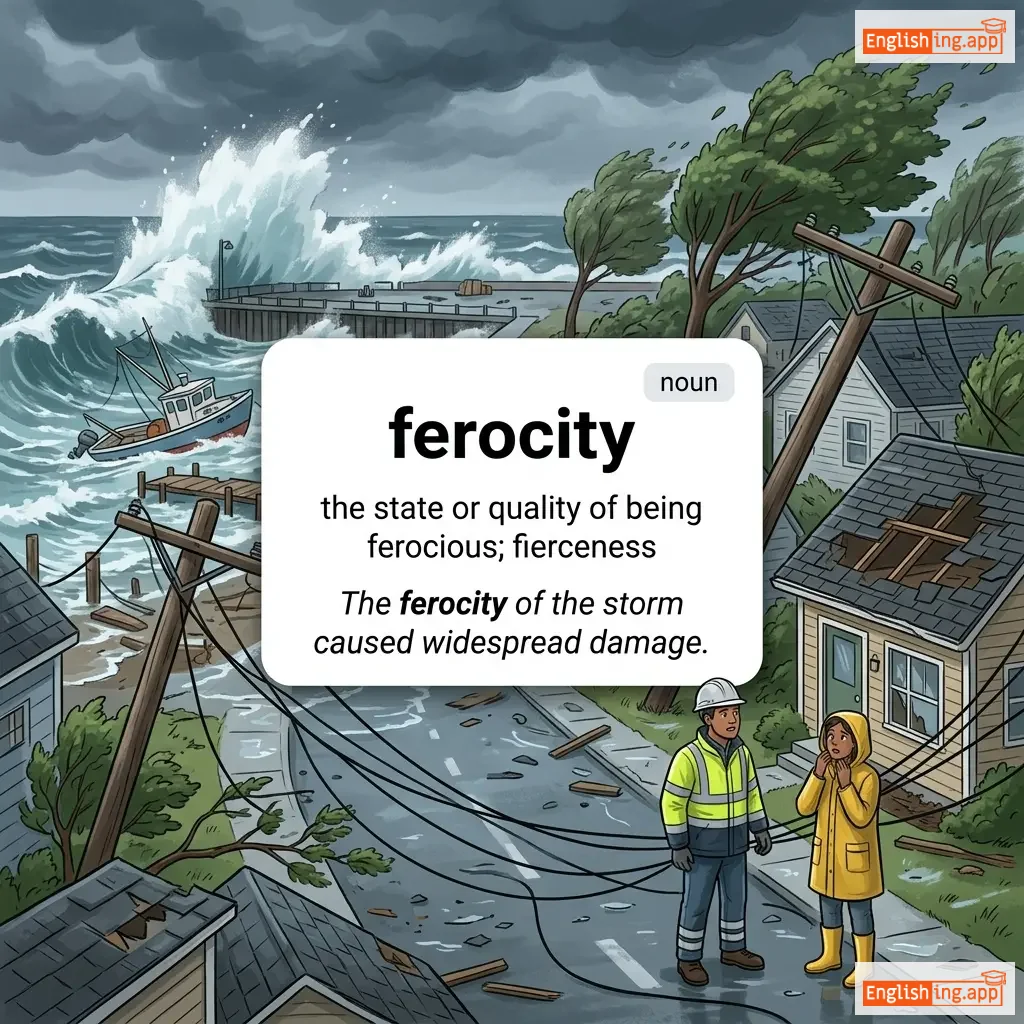
ferocity definition card — visual illustration of the meaning
noun
/fəˈrɒsəti/
ferocidad, brutalidad, fiereza (ferosidad, brutalidad, fierza)

the state or quality of being ferocious; fierceness

"The ferocity of the storm caused widespread damage."

"La ferocidad de la tormenta causó daños generalizados." (La ferocidad de la tormenta causó daños generalizados.)
noun, verb
/ˈfɛrɪt/
hurón, buscar persistentemente o descubrir algo (huron, buscar persistentemente o descubrir algo)

a small domesticated animal used for hunting; to search or uncover something persistently

"He ferreted out the hidden documents."

"Él sacó los documentos ocultos." (El saco los documentos ocultos.)
adjective
/ˈfer.əs/
rico en hierro (rico en hierro)

containing or consisting of iron

"Ferrous metals are commonly used in construction."

"Los metales ferrosos se usan comúnmente en la construcción." (Los metales ferrosos se usan comúnmente en la construcción.)
verb
/ˈfɛri/
transportar en ferry (transportar en ferry)

to transport by boat; to carry back and forth

"The boat ferried passengers across the river."

"El bote transportó a los pasajeros a través del río." (El bote transportó a los pasajeros a través del río.)
noun
/ˈfer.i boʊt/
ferry (ferry)

a boat that carries passengers and vehicles across water

"We took the ferry-boat to cross the river."

"Tomamos el ferry-bot para cruzar el río." (Tomamos el ferry-bot para cruzar el rio.)
adjective
/ˈfɜːr.taɪl/
fértil (fertil)

capable of producing abundant vegetation or offspring

"The fertile soil yielded a bountiful harvest."

"El suelo fértil produjo una cosecha abundante." (El suelo fertil produjo una cosecha abundante.)
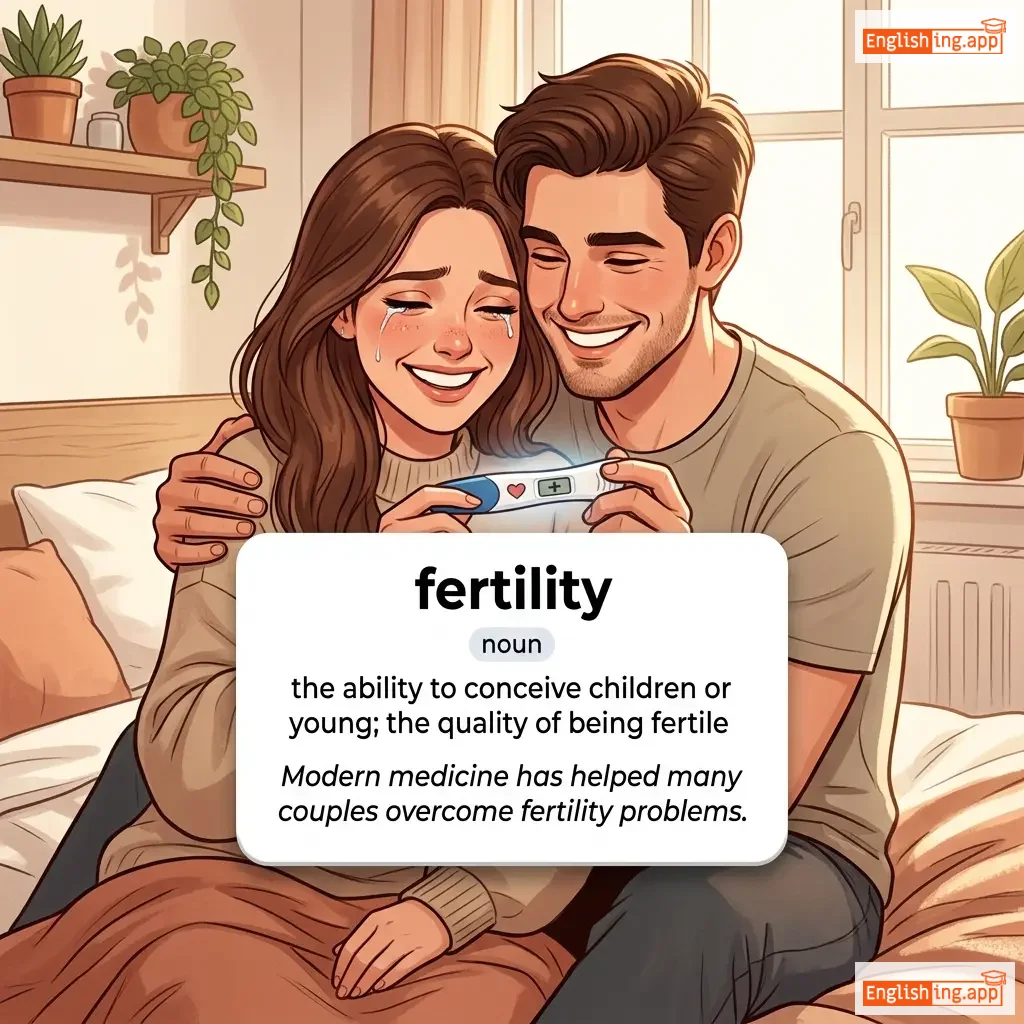
fertility definition card — visual illustration of the meaning
noun
/fərˈtɪl.ə.ti/
fertilidad (fertilidad)

the ability to conceive children or young; the quality of being fertile

"Modern medicine has helped many couples overcome fertility problems."

"La medicina moderna ha ayudado a muchas parejas a superar los problemas de fertilidad." (La medicina moderna ha ayudado a muchas parejas a superar los problemas de fertilidad.)
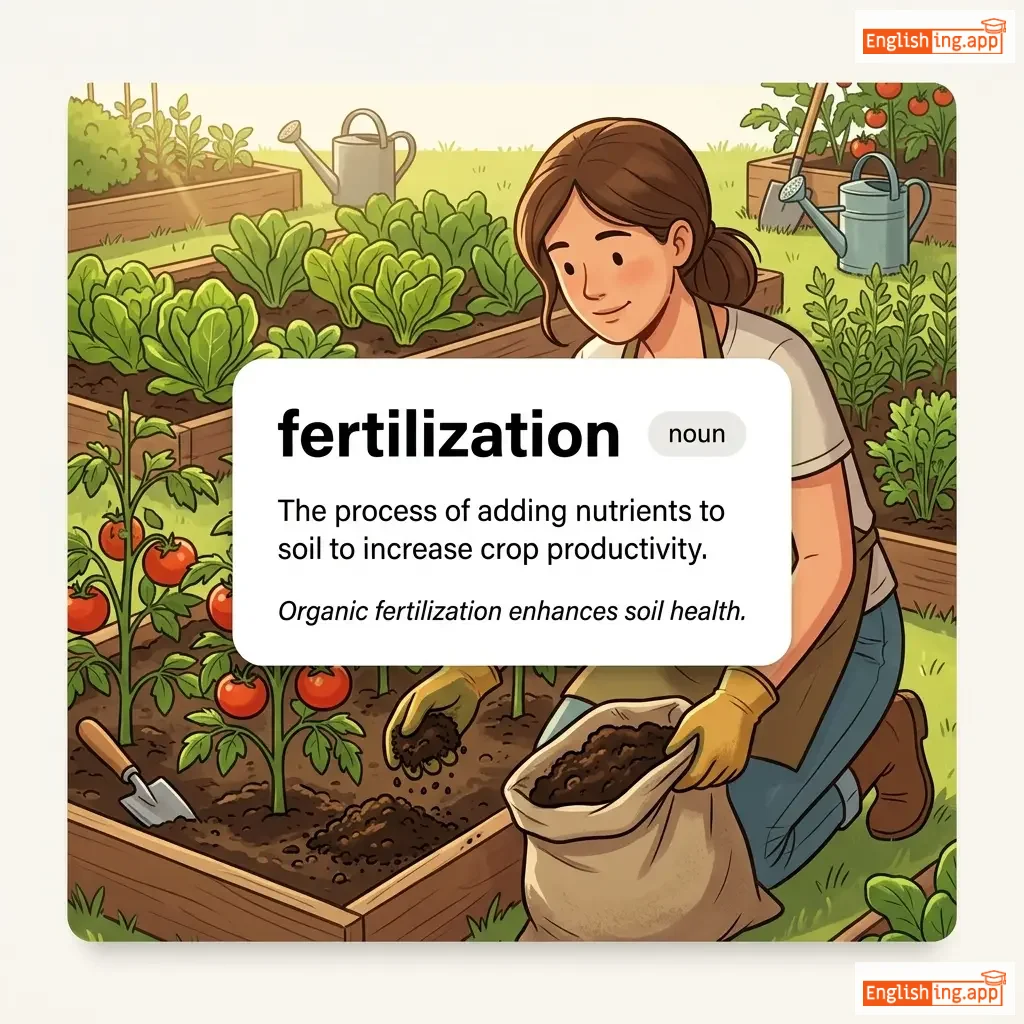
fertilization definition card — visual illustration of the meaning
noun
ˌfɜːr.tɪ.laɪˈzeɪ.ʃən
fertilización (fertilizacion)

The process of adding nutrients to soil to increase crop productivity.

"Organic fertilization enhances soil health."

"La fertilización orgánica mejora la salud del suelo." (La fertilizacion organica mejora la salud del suelo.)
verb
/ˈfɜːr.tɪ.laɪz/
fertilizar (fertilizar)

to make soil or land more fertile by adding substances

"Farmers fertilize the fields to increase crop yield."

"Los agricultores fertilizan los campos para aumentar la cosecha." (Los agricultores fertilizan los campos para aumentar la cosecha.)
noun
/ˈfɜː.tɪ.laɪ.zər/
fertilizante (fertilizante)

a substance added to soil to make plants grow more successfully

"Farmers use fertilizer to increase crop production."

"Los agricultores usan fertilizante para aumentar la producción de cultivos." (Los agricultores usan fertilizante para aumentar la produccion de cultivos.)
adjective
/ˈfɜːr.vənt/
apasionado, entusiasta (apasionado, entusiasta)

having or showing intense passion or enthusiasm

"She gave a fervent speech about climate change."

"Ella dio un discurso apasionado sobre el cambio climático." (Ella dio un discurso apasionado sobre el cambio climático.)
adverb
/ˈfɜː.vənt.li/
con fervor; ardientemente; (con fervor; ardientemente;)

with passionate intensity; ardently; with great emotion or enthusiasm

"She fervently hoped that her dreams would come true."

"Ella esperaba fervientemente que sus sueños se hicieran realidad." (Ella esperaba fervientemente que sus sueños se hicieran realidad.)
adjective
/ˈfɜːr.vɪd/
intenso, apasionado (intenso, apasionado)

intensely passionate or enthusiastic

"He wrote a fervid letter expressing his love."

"Escribió una carta fervida expresando su amor." (Escribió una carta fervida expresando su amor.)
fervor definition card — visual illustration of the meaning
noun
/ˈfɜːrvər/
fervor, pasión (fervor, pasion)

intense and passionate feeling

"She spoke with great fervor about the importance of education."

"Habló con gran fervor sobre la importancia de la educación." (Hablo con gran fervor sobre la importancia de la educacion.)
adjective
/ˈfɛstəl/
relacionado con un festival, festivo (relacionado con un festival, festivo)

relating to a festival or celebration

"The hall was decorated in a festal manner for the wedding."

"El salón estaba decorado de manera festiva para la boda." (El salon estaba decorado de manera festiva para la boda.)
verb
/ˈfɛstər/
empeorar, intensificarse (empeorar, intensificarse)

to become worse or more intense, often through neglect or infection

"If grievances are ignored, they may fester into resentment."

"Si se ignoran las quejas, pueden convertirse en resentimiento." (Si se ignoran las quejas, pueden convertirse en resentimiento.)
noun
/ˈfɛstəvəl/
festival (festival)

a day or period of celebration, often for cultural or religious reasons

"The city was decorated with lights for the annual music festival."

"La ciudad fue decorada con luces para el festival anual de música." (La ciudad fue decorada con luces para el festival anual de música.)
adjective
/ˈfɛstɪv/
festivo, alegre (festivo, alegre)

joyful, celebratory, or suitable for a festival

"The streets were decorated with lights in a festive spirit."

"Las calles estaban decoradas con luces en un espíritu festivo." (Las calles estaban decoradas con luces en un espiritu festivo.)
noun
/feɪt/
fiesta, celebración (fiesta, celebracion)

a celebration or festival, often in honor of someone

"The village held a grand fete to celebrate the harvest."

"El pueblo celebró una gran fiesta para celebrar la cosecha." (El pueblo celebro una gran fiesta para celebrar la cosecha.)
noun
/ˈfetiʃ/
fétich (fetich)

an object believed to have magical powers or to be inhabited by a spirit

"The villagers treated the statue as a powerful fetich."

"Los aldeanos trataban la estatua como un fétich poderoso." (Los aldeanos trataban la estatua como un fétich poderoso.)
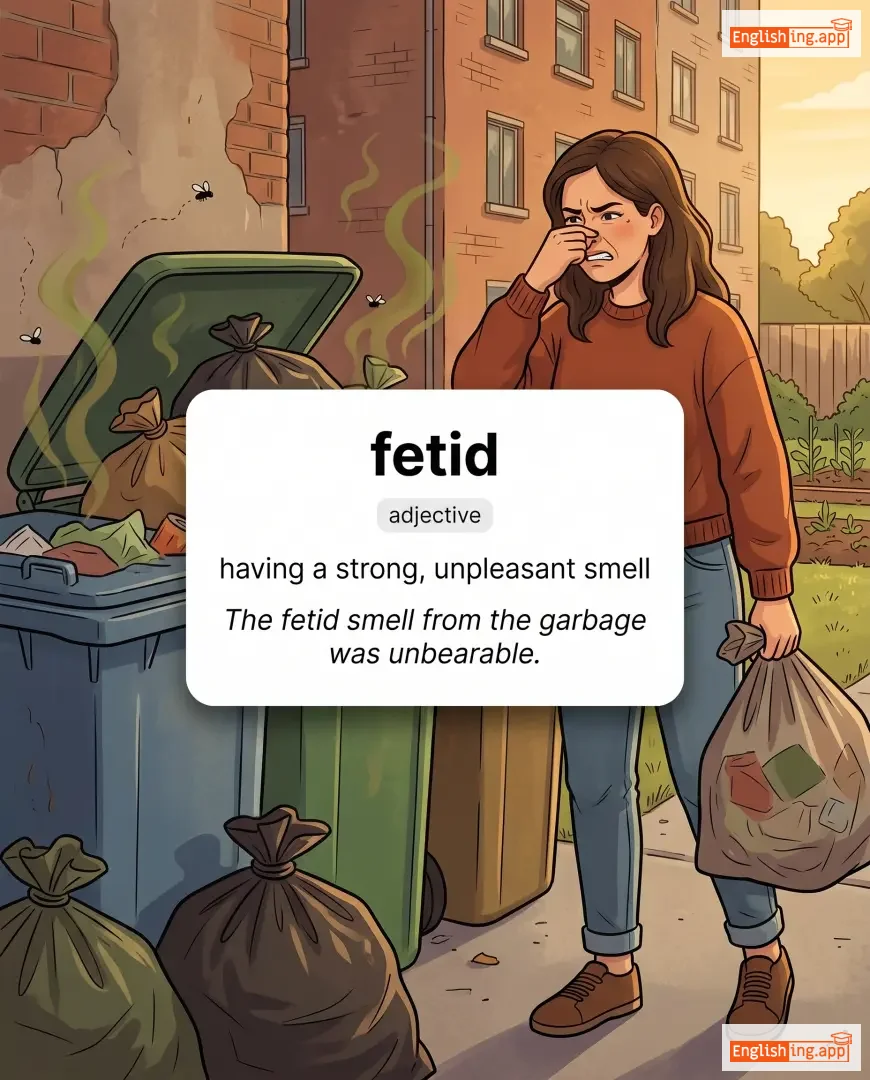
fetid definition card — visual illustration of the meaning
adjective
/ˈfɛtɪd/
fétido, maloliente (fetido, maloliente)

having a strong, unpleasant smell

"The fetid smell from the garbage was unbearable."

"El olor fétido de la basura era insoportable." (El olor fetido de la basura era insoportable.)
noun
/ˈfɛtɪʃ/
devoción excesiva o irracional (devocion excesiva o irracional)

an excessive or irrational devotion to something

"He has a fetish for collecting rare stamps."

"Él tiene una fijación por coleccionar sellos raros." (El tiene una fijacion por coleccionar sellos raros.)
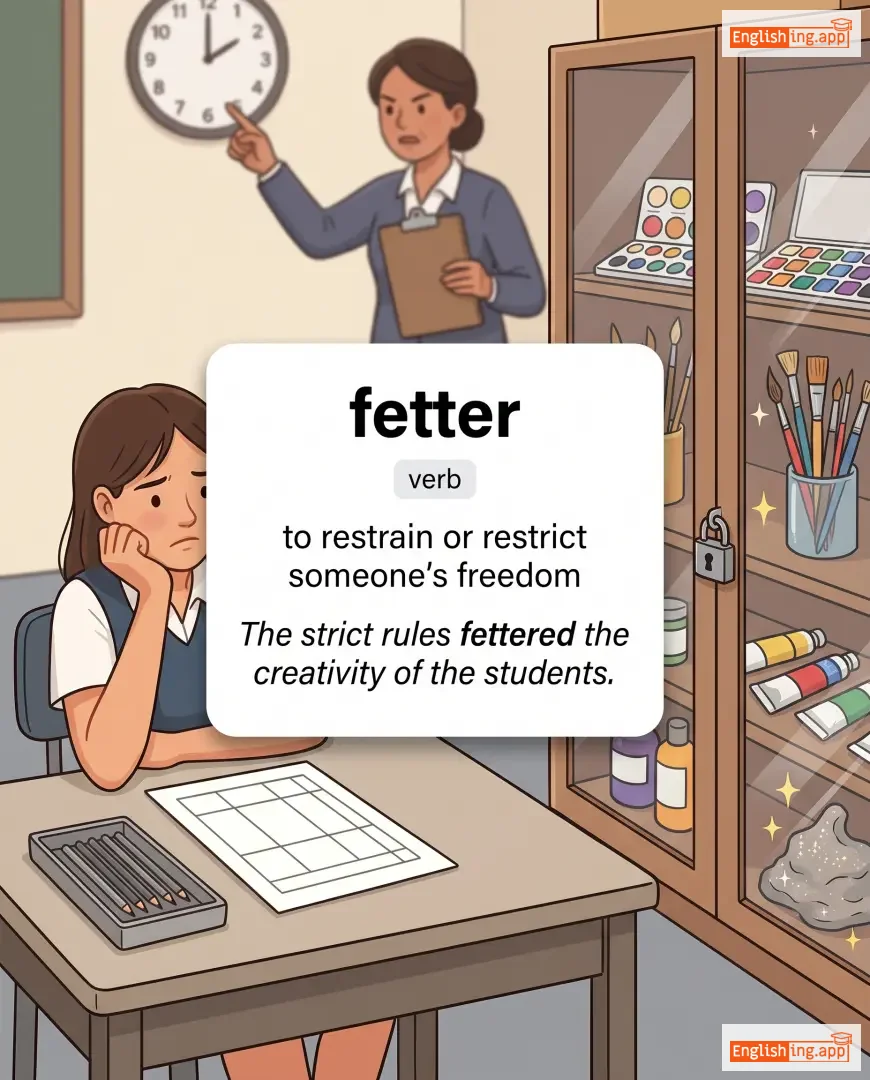
fetter definition card — visual illustration of the meaning
verb
/ˈfɛtər/
atar, restringir (atar, restringir)

to restrain or restrict someone’s freedom

"The strict rules fettered the creativity of the students."

"Las reglas estrictas limitaban la creatividad de los estudiantes." (Las reglas estrictas limitaban la creatividad de los estudiantes.)
noun
/ˈfiːtəs/
feto (feto)

an unborn or unhatched offspring in the womb or egg

"The doctor explained the development of the fetus during pregnancy."

"El doctor explicó el desarrollo del feto durante el embarazo." (El doctor explico el desarrollo del feto durante el embarazo.)
noun
/fjuːd/
disputa, enemistad (disputa, enemistad)

a prolonged and bitter quarrel or conflict, often between families or groups

"The two families have been in a feud for generations."

"Las dos familias han estado en una disputa durante generaciones." (Las dos familias han estado en una disputa durante generaciones.)
adjective
/ˈfjuː.dəl/
feudal (feudal)

relating to the system of feudalism, a medieval social system based on land ownership and obligations

"The castle is a remnant of the feudal era."

"El castillo es un vestigio de la era feudal." (El castillo es un vestigio de la era feudal)
noun
/ˈfjuː.də.lɪ.zəm/
feudalismo (feudalismo)

the social system in medieval Europe in which people worked and fought for nobles who gave them protection and land in return

"Feudalism shaped the political structure of medieval Europe."

"El feudalismo moldeó la estructura política de la Europa medieval." (El feudalismo moldeó la estructura política de la Europa medieval.)
noun
/ˈfiːvər/
fiebre (fiebre)

a medical condition in which the body temperature is higher than normal

"He couldn’t go to work because he had a high fever."

"No pudo ir a trabajar porque tenía fiebre alta." (No pudo ir a trabajar porque tenia fiebre alta.)
adjective
/fjuː/
pocos (pocos)

A small number of; not many.

"Only a few students attended the class."

"Solo unos pocos estudiantes asistieron a la clase." (Solo unos pocos estudiantes asistieron a la clase.)
determiner/adjective
/ˈfjuːər/
menos (menos)

a smaller number of; not as many

"Fewer people attended the meeting than expected."

"Menos personas asistieron a la reunión de lo esperado." (Menos personas asistieron a la reunion de lo esperado.)
noun
/fez/
fez (fez)

a flat-topped conical red hat with a tassel, traditionally worn in some Middle Eastern countries

"He wore a traditional fez during the cultural festival."

"Llevaba un fez tradicional durante el festival cultural." (Llevaba un fez tradicional durante el festival cultural.)