Vocabularios

Descubra, aprenda y domine el vocabulario en inglés

adjective
/fjuːˈɡeɪʃəs/
fugaz (fugaz)

Lasting only a short time; fleeting or ephemeral.

"Youth is beautiful but fugacious."

"La juventud es hermosa pero fugaz." (La juventud es hermosa pero fugaz.)
🏃‍♂️

Fugitive (fugítiv)

noun
/ˈfjuːdʒətɪv/
fugitivo (fugitivo)

A person who has escaped from captivity or is in hiding, usually to avoid arrest.

"The police captured the fugitive after a long chase."

"La policía capturó al fugitivo después de una larga persecución." (La policía capturó al fugitivo después de una larga persecución.)
noun
/ˈfʊl.krəm/
punto de apoyo (punto de apoyo)

The point or support on which a lever pivots; a central or essential point of activity or support.

"The teacher became the fulcrum of change in the school."

"La maestra se convirtió en el fúlcrum del cambio en la escuela." (La maestra se convirtió en el fúlcrum del cambio en la escuela.)
verb
/fʊlˈfɪl/
cumplir (cumplir)

to complete or achieve something that was expected or promised; to satisfy a requirement or desire

"She worked hard to fulfil her dream of becoming a doctor."

"Trabajó duro para cumplir su sueño de convertirse en doctora." (Trabajó duro para cumplir su sueño de convertirse en doctora)
verb
/fʊlˈfɪl/
cumplir (cumplir)

to complete or accomplish something, especially a task or promise

"He worked hard to fulfill his dreams."

"Trabajó duro para cumplir sus sueños." (Trabajo duro para cumplir sus sueños.)
adjective
/ˈfʊl.dʒənt/
brillante (brillante)

Shining brightly; dazzling.

"The fulgent stars lit up the night sky."

"Las estrellas brillantes iluminaron el cielo nocturno." (Las estrellas brillantes iluminaron el cielo nocturno.)
adjective
/fʊl/
lleno (lleno)

Containing as much or as many as possible; complete.

"The glass is full of water."

"El vaso está lleno de agua." (El vaso está lleno de agua.)
adjective
/ˌfʊl ˈbɒd.id/
de sabor intenso (de sabor intenso)

Having a strong, rich, and robust quality, especially of wine, coffee, or voice.

"He prefers a full-bodied red wine with his dinner."

"Él prefiere un vino tinto de sabor intenso con su cena." (Él prefiere un vino tinto de sabor intenso con su cena.)
adjective, adverb
/ˈfʊl taɪm/
a tiempo completo (a tiempo completo)

working or studying for the whole standard period of time

"She works full-time as a teacher."

"Ella trabaja a tiempo completo como profesora." (Ella trabaja a tiempo completo como profesora.)
adverb
/ˈfʊli/
completamente (completamente)

completely or entirely; to the fullest extent

"She is fully aware of the risks."

"Ella está completamente consciente de los riesgos." (Ella esta completamente consciente de los riesgos.)
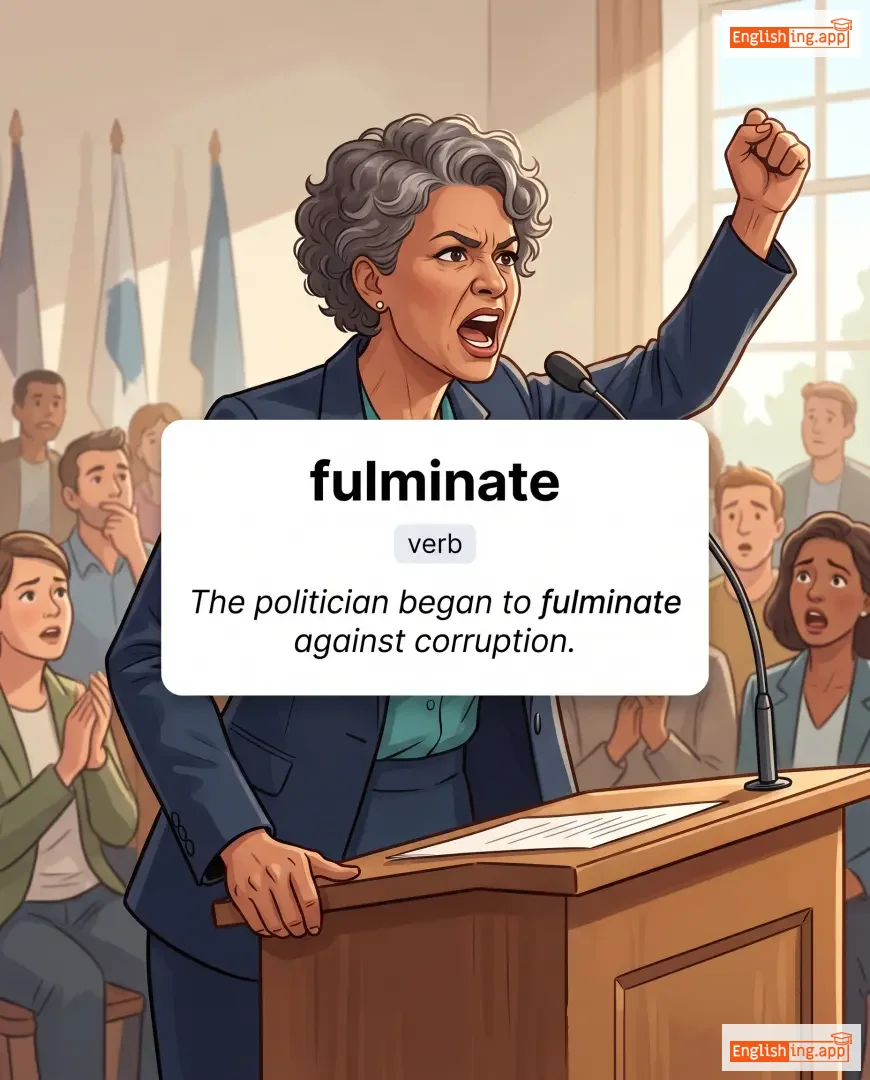
fulminate definition card — visual illustration of the meaning
verb
/ˈfʊl.mɪ.neɪt/
protestar enérgicamente (protestar energicamente)

To express strong protest or criticism loudly and forcefully; to explode violently.

"The politician began to fulminate against corruption."

"El político comenzó a protestar enérgicamente contra la corrupción." (El politico comenzo a protestar energeticament contra la corrupcion.)
fulsome definition card — visual illustration of the meaning
adjective
/ˈfʊl.səm/
elogios excesivos (elogios excesivos)

Excessively flattering or insincere; abundant or generous in amount.

"He offered fulsome praise to his boss."

"Él ofreció elogios excesivos a su jefe." (Él ofreció elogios excesivos a su jefe.)
verb
/ˈfʌmbəl/
torpeza (torpeza)

to handle something clumsily or to make mistakes while doing something

"He fumbled with the keys and dropped them on the floor."

"Él torpedeó con las llaves y las dejó caer al suelo." (El torpeó con las llaves y las dejó caer al suelo.)
verb
/ˈfjuːmɪˌɡeɪt/
fumigar (fumigar)

to disinfect or purify an area by using chemical fumes

"They fumigated the warehouse to kill the insects."

"Ellos fumigaron el almacén para matar los insectos." (Ellos fumigaron el almacén para matar los insectos.)
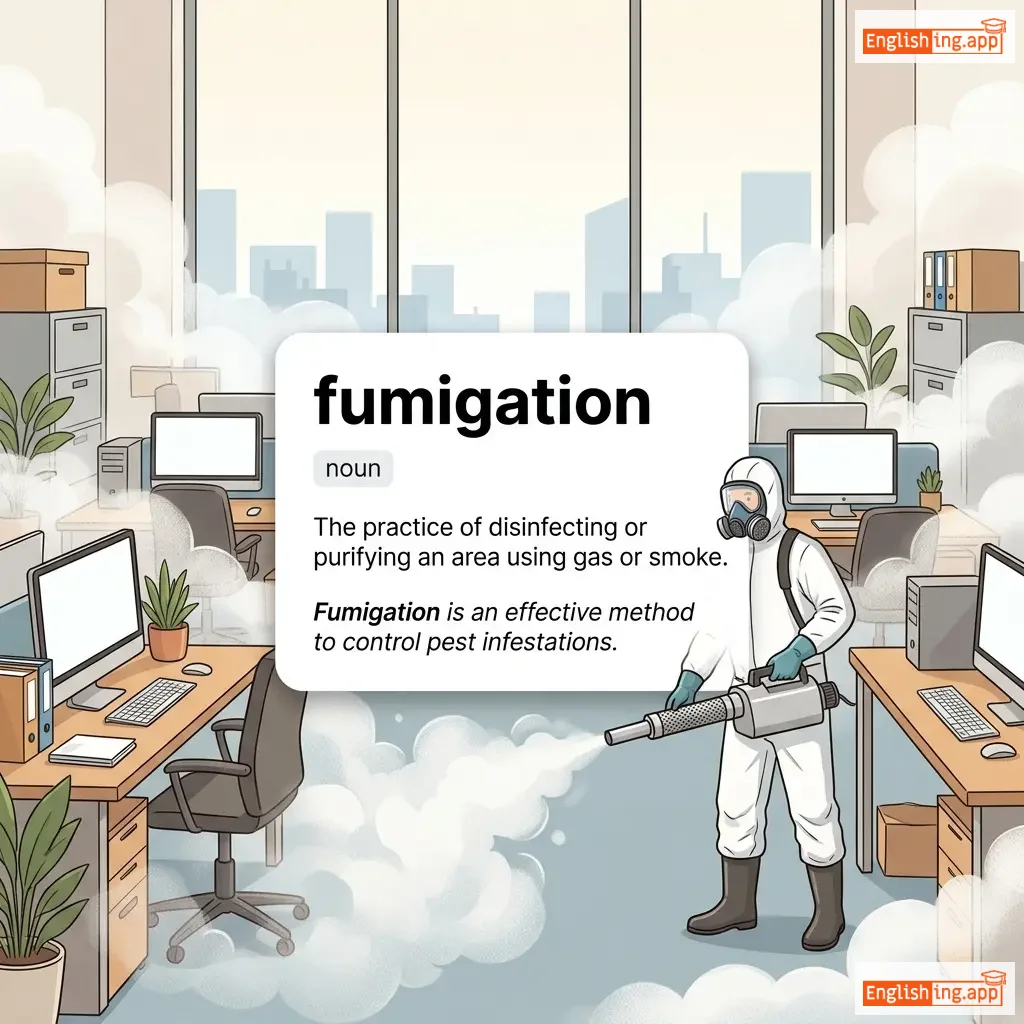
fumigation definition card — visual illustration of the meaning
noun
ˌfjuːmɪˈɡeɪʃən
fumigación (fumigacion)

The practice of disinfecting or purifying an area using gas or smoke.

"Fumigation is an effective method to control pest infestations."

"La fumigación es un método efectivo para controlar las infestaciones de plagas." (La fumigacion es un metodo efectivo para controlar las infestaciones de plagas.)
noun
/fʌn/
diversión (diversion)

enjoyment, amusement, or light-hearted pleasure

"We had a lot of fun at the party."

"Nos divertimos mucho en la fiesta." (Nos divertimos mucho en la fiesta.)
noun
/ˈfʌŋkʃən/
función (funcion)

An activity or purpose natural to or intended for a person or thing.

"The main function of the heart is to pump blood."

"La principal función del corazón es bombear sangre." (La principal funcion del corazon es bombear sangre.)
adjective
/ˈfʌŋkʃənl/
funcional (funcional)

designed to be practical and useful, rather than just decorative

"The design of the chair is simple but highly functional."

"El diseño de la silla es simple pero altamente funcional." (El diseno de la silla es simple pero altamente funcional.)
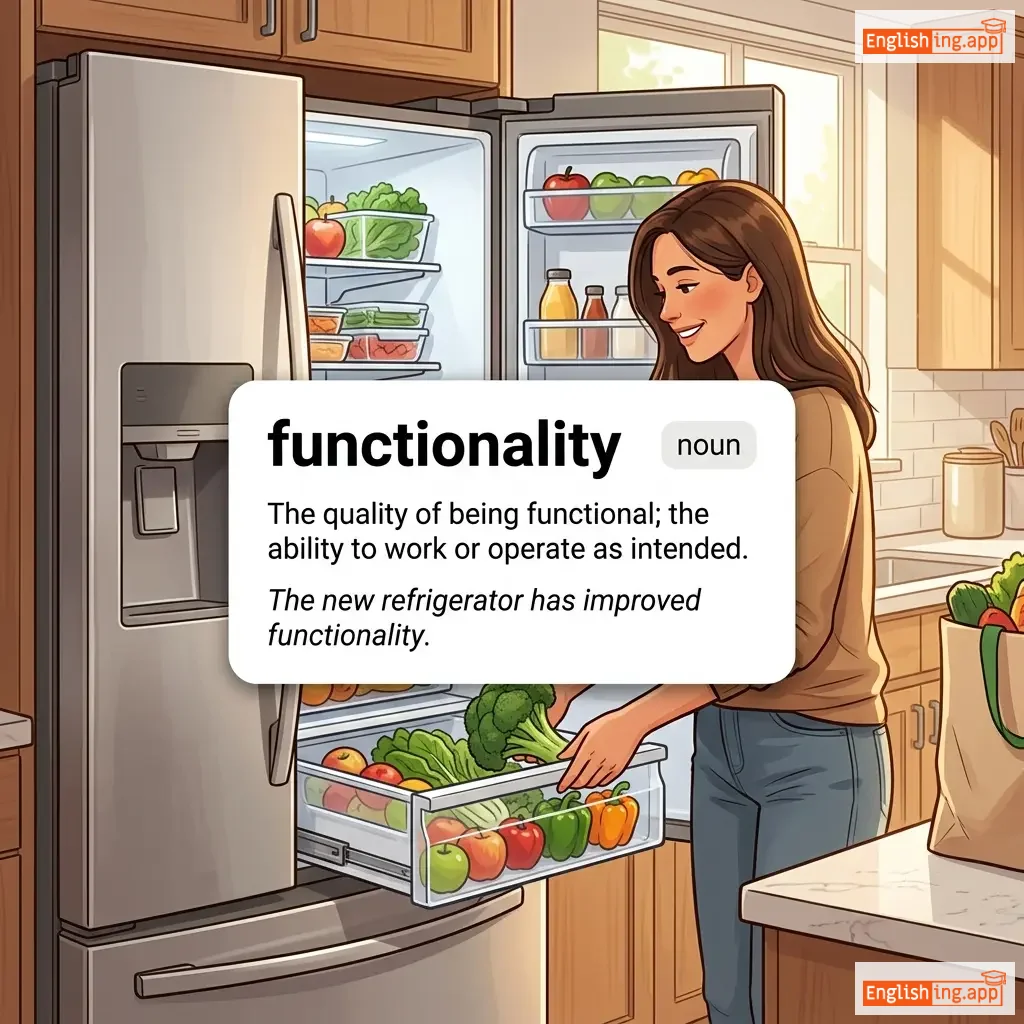
functionality definition card — visual illustration of the meaning
noun
ˌfʌŋk.ʃəˈnæl.ə.ti
funcionalidad (funcionalidad)

The quality of being functional; the ability to work or operate as intended.

"The new refrigerator has improved functionality."

"El nuevo refrigerador ha mejorado la funcionalidad." (El nuevo refrigerador ha mejorado la funcionalidad.)
noun
/ˈfʌŋkʃəˌnɛri/
funcionario (funcionario)

a person who has official duties in an organization, especially one with little authority

"The minor functionary was responsible for filing reports."

"El funcionario menor era responsable de presentar los informes." (El funcionario menor era responsable de presentar los informes.)
fund definition card — visual illustration of the meaning
noun/verb
/fʌnd/
fondo (fondo)

a sum of money saved or made available for a particular purpose; to provide money for

"The government created a fund for education."

"El gobierno creó un fondo para la educación." (El gobierno creo un fondo para la educacion.)
adjective
/ˌfʌndəˈmɛntl/
fundamental (fundamental)

forming a necessary base or core; of central importance

"Honesty is a fundamental principle of good leadership."

"La honestidad es un principio fundamental de buen liderazgo." (La honestidad es un principio fundamental de buen liderazgo.)
adverb
/ˌfʌndəˈmɛntəli/
fundamentalmente (fundamentalmente)

in a basic and important way; at the core

"The two theories are fundamentally different."

"Las dos teorías son fundamentalmente diferentes." (Las dos teorías son fundamentalmente diferentes.)
noun
/ˈfʌndɪŋ/
financiación (financiacion)

financial support for a project or organization

"The startup is seeking funding from investors."

"La startup está buscando financiación de inversores." (La startup esta buscando financiacion de inversores.)
noun
/ˈfʌndˌreɪzɪŋ/
recaudación de fondos (recaudacion de fondos)

the process of collecting money for a cause or project

"The organization is organizing a fundraising event."

"La organización está organizando un evento de recaudación de fondos." (La organizacion esta organizando un evento de recaudacion de fondos.)
noun
/ˈfjuːnərəl/
funeral (funeral)

a ceremony held to honor and bury or cremate someone who has died

"The family attended the funeral of their grandfather."

"La familia asistió al funeral de su abuelo." (La familia asistió al funeral de su abuelo.)
adjective
/fjuːˈnɪəriəl/
funerario (funerario)

having the mournful, somber character of a funeral

"The room was filled with a funereal silence after the announcement."

"La habitación se llenó de un silencio funerario después del anuncio." (La habitacion se llenó de un silencio funerario después del anuncio.)
noun (plural of fungus)
/ˈfʌndʒaɪ/
hongo (hongo)

a group of spore-producing organisms such as mushrooms, molds, and yeasts

"Fungi play an important role in breaking down organic matter in nature."

"Los hongos desempeñan un papel importante en la descomposición de materia orgánica en la naturaleza." (Los hongos desempeñan un papel importante en la descomposición de materia orgánica en la naturaleza.)
adjective
/ˈfʌndʒəbl/
fungible (fungible)

interchangeable; able to replace or be replaced by another identical item

"In finance, money is considered a fungible asset."

"En finanzas, el dinero se considera un activo fungible." (En finanzas, el dinero se considera un activo fungible.)
adjective
/ˈfʌŋɡəs/
relacionado con hongo (relacionado con hongo)

relating to or resembling a fungus

"The damp basement had a fungous smell."

"El sótano húmedo tenía un olor relacionado con hongo." (El sotano humedo tenia un olor relacionado con hongo.)
noun
/ˈfʌŋɡəs/
hongo (hongo)

a spore-producing organism feeding on organic matter, including molds, yeast, and mushrooms

"A strange fungus was growing on the old tree."

"Un extraño hongo estaba creciendo en el viejo árbol." (Un extrano hongo estaba creciendo en el viejo arbol.)
adjective
/ˈfʌni/
gracioso (gracioso)

Causing laughter or amusement; humorous.

"The comedian told a very funny joke."

"El comediante contó un chiste muy gracioso." (El comediante conto un chiste muy gracioso.)
noun
/fɜːr/
pelaje (pelaje)

the thick hair covering the skin of certain animals

"The cat’s fur is soft and shiny."

"El pelaje del gato es suave y brillante." (El pelaje del gato es suave y brillante.)
verb
/ˈfɜːrbɪʃ/
pulir (pulir)

to polish, renovate, or give a fresh look to something

"The workers furbished the old sword until it gleamed like new."

"Los trabajadores pulieron la antigua espada hasta que brilló como nueva." (Los trabajadores pulieron la antigua espada hasta que brilló como nueva.)
adjective
/ˈfjʊəriəs/
furioso (furioso)

Extremely angry.

"She was furious when she heard the bad news."

"Ella estaba furiosa cuando escuchó las malas noticias." (Ella estaba furiosa cuando escuchó las malas noticias.)
noun
/ˈfɜːrlɔːŋ/
unidad de distancia (220 yardas o aproximadamente 201 metros) (unidad de distancia (220 yardas o aproximadamente 201 metros))

a unit of distance equal to 220 yards or about 201 meters

"The horse ran a furlong before slowing down."

"El caballo corrió un furlong antes de desacelerar." (El caballo corrió un furlong antes de desacelerar.)
noun, verb
/ˈfɜːrloʊ/
licencia temporal (licencia temporal)

temporary leave of absence from work, especially that granted to an employee or soldier

"Many workers were placed on furlough during the crisis."

"Muchos trabajadores fueron puestos en furlough durante la crisis." (Muchos trabajadores fueron puestos en furlough durante la crisis.)
noun
/ˈfɜːrneɪs/
horno (horno)

an enclosed structure in which heat is produced for a building or for melting metal

"The factory's furnace melted the metal quickly."

"El horno de la fábrica fundió el metal rápidamente." (El horno de la fábrica fundió el metal rápidamente.)
verb
/ˈfɜːrnɪʃ/
amueblar, proporcionar (amueblar, proporcionar)

to provide or supply with furniture or equipment

"They furnished the new house with modern furniture."

"Ellos amueblaron la nueva casa con muebles modernos." (Ellos amueblaron la nueva casa con muebles modernos.)
noun
/ˈfɜːrnɪtʃər/
muebles (muebles)

Objects such as chairs, tables, beds, or cupboards used to make a room suitable for living or working.

"The living room was filled with beautiful wooden furniture."

"La sala estaba llena de hermosos muebles de madera." (La sala estaba llena de hermosos muebles de madera.)
noun
/ˈfjʊərɔːr/
alboroto (alboroto)

An outbreak of public anger or excitement.

"The politician's remarks created a furor in the media."

"Los comentarios del político crearon un furor en los medios." (Los comentarios del politico crearon un furor en los medios.)
noun
/ˈfʌriər/
peluquero (peluquero)

A person who prepares or deals in furs.

"The furrier displayed fine coats in his shop."

"El peluquero exhibió abrigos finos en su tienda." (El peluquero exhibió abrigos finos en su tienda.)
noun/verb
/ˈfʌrəʊ/
surco (surco)

A long narrow trench made in the ground by a plow; to make wrinkles or grooves.

"The farmer plowed furrows in the field."

"El agricultor hizo surcos en el campo." (El agricultor hizo surcos en el campo.)
adverb/adjective/verb
/ˈfɜːrðər/
avanzar (avanzar)

At a greater distance; to advance or promote something.

"She studied hard to further her career."

"Ella estudió mucho para avanzar en su carrera." (Ella estudió mucho para avanzar en su carrera.)
noun
/ˈfɜːrðərəns/
avance (avance)

The advancement or promotion of something.

"The new policy was introduced in furtherance of social justice."

"La nueva política se introdujo en pro de la justicia social." (La nueva política se introdujo en pro de la justicia social.)
adverb
/ˌfɜːrðərˈmɔːr/
además (ademas)

Used to introduce an additional point or idea; in addition.

"The plan is simple and, furthermore, it is affordable."

"El plan es sencillo y, además, es asequible." (El plan es sencillo y, ademas, es asequible.)
adjective
/ˈfɜːrtɪv/
furtivo (furtivo)

Attempting to avoid notice or attention, typically because of guilt or a belief that discovery would lead to trouble.

"He cast a furtive glance at the door before leaving."

"Él echó una mirada furtiva a la puerta antes de salir." (El echó una mirada furtiva a la puerta antes de salir.)
noun
/ˈfjʊr.ʌŋ.kəl/
forúnculo; bulto; (forunculo, bulto)

a painful pus-filled bump under the skin caused by infected, inflamed hair follicles

"The doctor prescribed antibiotics to treat the painful furuncle on his neck."

"El doctor recetó antibióticos para tratar el doloroso furúnculo en su cuello." (El doktor receto antibioticos para tratar el doloroso furunculo en su cuello.)
noun
/ˈfjʊri/
furia (furia)

Wild or violent anger; extreme rage.

"She was trembling with fury after the insult."

"Ella temblaba de furia después de la insulto." (Ella temblaba de furia después de la insulto.)
verb
/fjuːz/
fusionar (fusionar)

To join or blend two or more things together into one.

"The two metals fused under high heat."

"Los dos metales se fusionaron bajo calor alto." (Los dos metales se fusionaron bajo calor alto.)