Vocabularios

Descubra, aprenda y domine el vocabulario en inglés

verb
/ɪkˈsiːd/
superar (superar)

to go beyond a limit or expectation

"The athlete exceeded everyone's expectations by winning the gold medal."

"El atleta superó las expectativas de todos al ganar la medalla de oro." (El atleta superó las expectativas de todos al ganar la medalla de oro.)
adjective
/ɪkˈsiːdɪŋ/
excesivo; más allá (excesivo; mas alla)

going beyond; surpassing; extremely

"The project was completed with exceeding excellence."

"El proyecto se completó con una excelencia excesiva." (El proyecto se completo con una excelencia excesiva.)
verb
/ɪkˈsɛl/
sobresalir (sobresalir)

to be exceptionally good at or proficient in an activity or subject

"She always tries to excel in her studies."

"Ella siempre trata de sobresalir en sus estudios." (Ella siempre trata de sobresalir en sus estudios.)
noun
/ˈɛksələns/
excelencia (excelencia)

the quality of being outstanding or extremely good

"The school is known for its academic excellence."

"La escuela es conocida por su excelencia académica." (La escuela es conocida por su excelencia académica.)
noun
/ˈɛksələnsɪ/
excelencia (eksellensia)

a title of honor for people of high rank, especially ambassadors or governors

"His Excellency the Ambassador attended the ceremony."

"Su Excelencia el Embajador asistió a la ceremonia." (Su Excellencia el Embajador asistió a la ceremonia.)
adjective
/ˈɛksələnt/
excelente (excelente)

extremely good; outstanding

"The food at this restaurant is excellent."

"La comida en este restaurante es excelente." (La comida en este restaurante es excelente.)
preposition/conjunction
/ɪkˈsɛpt/
excepto (excepto)

not including; other than

"Everyone was invited except John."

"Todos fueron invitados excepto Juan." (Todos fueron invitados excepto Juan.)
noun
/ɪkˈsɛpʃən/
excepción (excepcion)

A case or instance that does not follow a general rule.

"Every rule has an exception."

"Cada regla tiene una excepción." (Cada regla tiene una excepcion.)
adjective
/ɪkˈsɛpʃənəbl/
objecionable (objecionable)

Open to objection; causing disapproval.

"His rude remarks were considered exceptionable by everyone present."

"Sus comentarios groseros fueron considerados objetables por todos los presentes." (Sus comentarios groseros fueron considerados objetables por todos los presentes.)
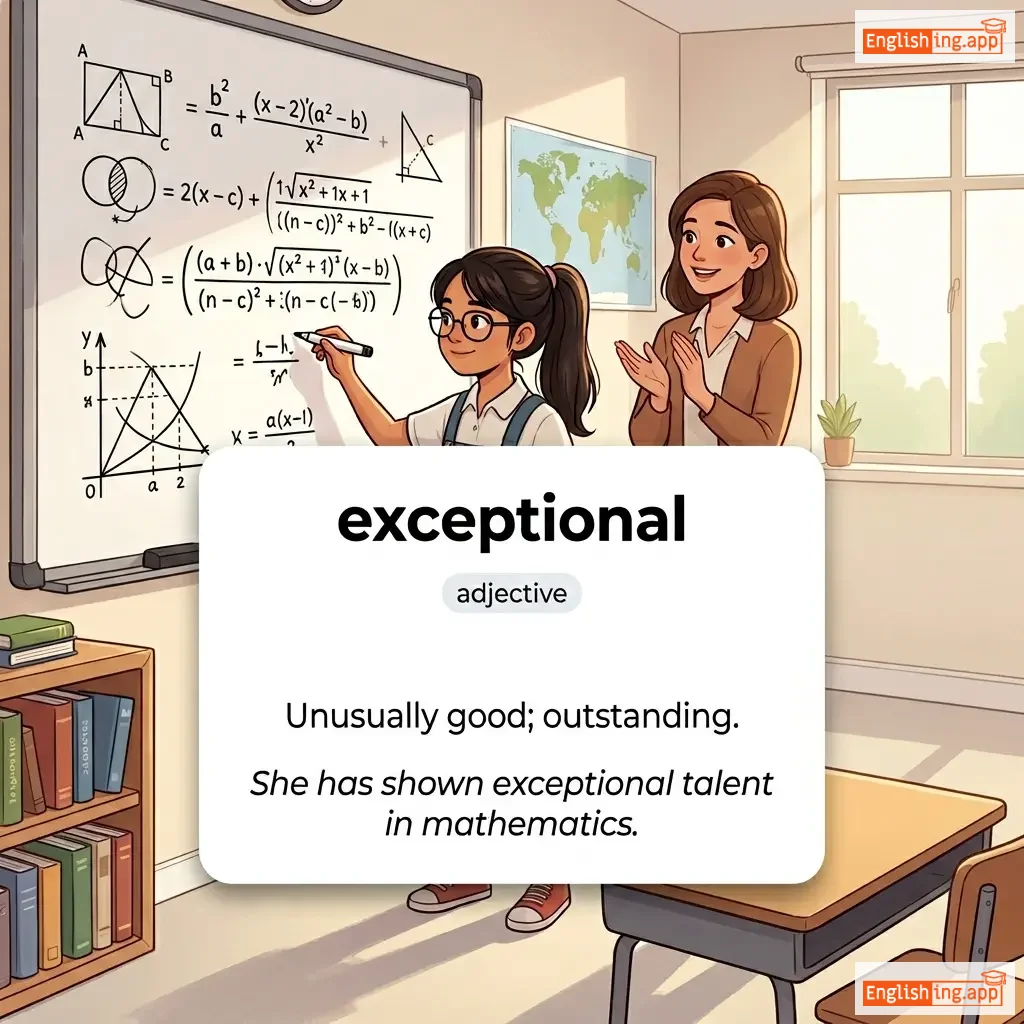
exceptional definition card — visual illustration of the meaning
adjective
/ɪkˈsɛpʃənl/
excepcional (excepcional)

Unusually good; outstanding.

"She has shown exceptional talent in mathematics."

"Ella ha mostrado un talento excepcional en matemáticas." (Ella ha mostrado un talento excepcional en matemáticas.)
noun
/ˈɛksɜːrpt/
extracto (extracto)

A short portion taken from a text, film, or piece of music.

"The teacher read an excerpt from the novel."

"El maestro leyó un extracto de la novela." (El maestro leyó un extracto de la novela.)
noun
/ɪkˈsɛs/
exceso (exceso)

An amount more than necessary, permitted, or desirable.

"Too much sugar can lead to excess weight gain."

"Demasiada azúcar puede llevar a un aumento de peso excesivo." (Demasiada azucar puede llevar a un aumento de peso excesivo.)
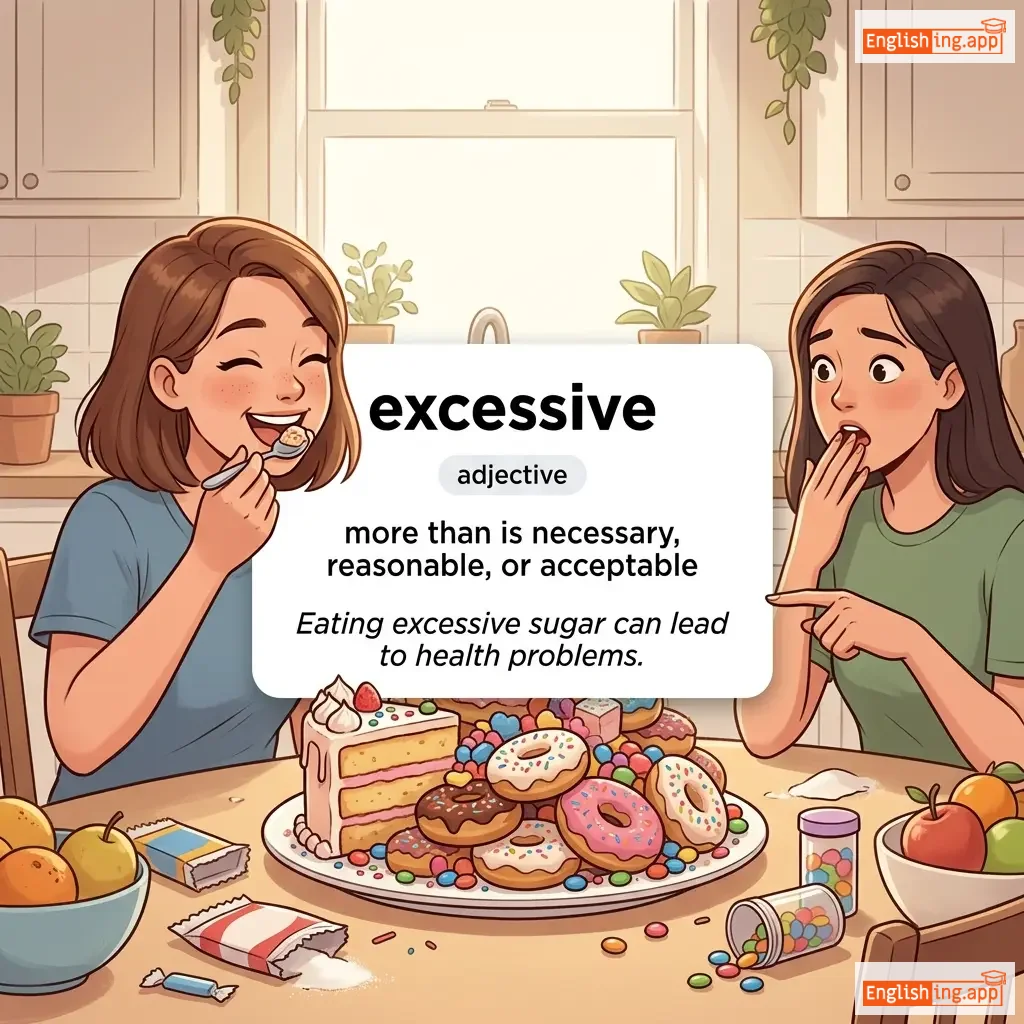
excessive definition card — visual illustration of the meaning
adjective
/ɪkˈsɛsɪv/
excesivo (excesivo)

more than is necessary, reasonable, or acceptable

"Eating excessive sugar can lead to health problems."

"Comer azúcar excesiva puede provocar problemas de salud." (Comer azucar excesiva puede provocar problemas de salud.)
excessive strain definition card — visual illustration of the meaning
adjective + noun
এক্সেসিভ স্ট্রেইন
estrés excesivo (estres excesivo)

An amount of physical pressure or stress that is more than what is normal or acceptable.

"Excessive strain on fingers can cause musculoskeletal issues."

"El estrés excesivo en los dedos puede causar problemas musculoesqueléticos." (El estres excesivo en los dedos puede causar problemas musculoesqueleticos.)
Exchange definition card — visual illustration of the meaning
verb
/ɪksˈtʃeɪndʒ/
intercambio (intercambio)

To give something and receive something in return.

"They exchanged gifts during the festival."

"Ellos intercambiaron regalos durante el festival." (Ellos intercambiaron regalos durante el festival.)
noun
/ɪksˈtʃɛkər/
tesorería (tesoreria)

The treasury of a state or country.

"The government announced new measures to improve the exchequer."

"El gobierno anunció nuevas medidas para mejorar la tesorería." (El gobierno anuncio nuevas medidas para mejorar la tesoreria.)
verb
/ˈɛkˌsaɪz/
extirpar (extirpar)

to cut out or remove completely, often by surgery

"The surgeon excised the tumor successfully."

"El cirujano extirpó el tumor con éxito." (El cirujano extirpo el tumor con exito.)
noun
/ɪkˈsɪʒən/
excisón (excisón)

the act of cutting something out, especially by surgical removal

"The excision of the infected tissue prevented further complications."

"La excisión del tejido infectado previno complicaciones adicionales." (La excision del tejido infectado previno complicaciones adicionales.)
adjective
/ɪkˈsaɪtəbl̩/
excitable (excitable)

easily excited or emotionally aroused

"The child was excitable and laughed at every small thing."

"El niño era excitable y se reía de cada pequeña cosa." (El nino era excitable y se reia de cada pequena cosa.)
noun
/ˌɛksaɪˈteɪʃən/
excitación (excitación)

a state of great excitement or the process of stimulating activity

"The news created great excitation among the fans."

"La noticia creó gran excitación entre los aficionados." (La noticia creó gran excitación entre los aficionados.)
verb
/ɪkˈsaɪt/
emocionar (emocionar)

to cause strong feelings of enthusiasm or eagerness

"The idea of traveling abroad excites her."

"La idea de viajar al extranjero la excita." (La idea de viajar al extranjero la excita.)
adjective
/ɪkˈsaɪtɪd/
emocionado (emocionado)

very enthusiastic and eager about something

"The children were excited to open their presents."

"Los niños estaban emocionados por abrir sus regalos." (Los niños estaban emocionados por abrir sus regalos.)
noun
/ɪkˈsaɪtmənt/
emoción (emocion)

a feeling of great enthusiasm and eagerness

"There was a lot of excitement before the concert began."

"Hubo mucha emoción antes de que comenzara el concierto." (Hubo mucha emocion antes de que comenzara el concierto.)
exciting definition card — visual illustration of the meaning
adjective
/ɪkˈsaɪtɪŋ/
emocionante (emocionante)

Causing great enthusiasm and eagerness.

"The movie was so exciting that I watched it twice."

"La película fue tan emocionante que la vi dos veces." (La pelicula fue tan emocionante que la vi dos veces.)
verb
/ɪkˈskleɪm/
gritar (gritar)

to cry out suddenly in surprise, strong emotion, or excitement

"She exclaimed with joy when she saw the gift."

"Ella exclamó con alegría cuando vio el regalo." (Ella exclamó con alegría cuando vio el regalo.)
noun
/ˌɛkskləˈmeɪʃən/
exclamación (exclamacion)

A sudden cry or remark expressing strong emotion or surprise.

"She let out an exclamation of joy when she heard the news."

"Ella soltó una exclamación de alegría cuando escuchó las noticias." (Ella solto una exclamacion de alegria cuando escucho las noticias.)
verb
/ɪkˈskluːd/
excluir (ekscluir)

To deliberately leave out or prevent someone or something from being included.

"The list excludes temporary workers."

"La lista excluye a los trabajadores temporales." (La lista ekskluye a los trabajadores temporales.)
adjective
/ɪkˈskluːdɪd/
excluido; marginado (excluido; marginado)

not included; left out; barred from participation

"He felt excluded from the group activities and conversations."

"Él se sintió excluido de las actividades del grupo y de las conversaciones." (El se sintio excluido de las actividades del grupo y de las conversaciones.)
noun
/ɪkˈskluːʒən/
exclusión (exclusion)

The process or state of being left out or denied access.

"The policy led to the exclusion of certain groups."

"La política llevó a la exclusión de ciertos grupos." (La política llevó a la exclusión de ciertos grupos.)
adjective
/ɪkˈskluːsɪv/
restringido a una persona, grupo o área particular; no compartido con otros (restringido a una persona, grupo o area particular; no compartido con otros)

restricted to a particular person, group, or area; not shared with others

"The hotel offers exclusive access to a private beach."

"El hotel ofrece acceso exclusivo a una playa privada." (El hotel ofrece acceso exclusivo a una playa privada.)
adverb
/ɪkˈskluːsɪvli/
exclusivamente (eksklusivamente)

only; not shared with others

"This service is available exclusively to premium members."

"Este servicio está disponible exclusivamente para miembros premium." (Este servicio está disponible exclusivamente para miembros premium.)
verb
/ɛkˈskɔːrieɪt/
criticar severamente (kritikar severamente)

To strongly criticize someone; to denounce severely.

"The critic excoriated the film for its poor script."

"El crítico criticó severamente la película por su guion deficiente." (El critico critico severamente la pelicula por su guion deficiente.)
noun
/ɪkˈskrɛsəns/
crecimiento anómalo (crecimiento anomalo)

An abnormal outgrowth or lump, often considered unattractive.

"The building was considered an excrescence on the landscape."

"El edificio fue considerado una excrescencia en el paisaje." (El edificio fue considerado una excrescencia en el paisaje.)
verb
/ɪkˈskriːt/
excretar (excretar)

to eliminate waste matter from the body

"Humans excrete carbon dioxide through breathing."

"Los humanos excretan dióxido de carbono a través de la respiración." (Los humanos excretan dióxido de carbono a través de la respiración.)
noun
/ɪkˈskriːʃən/
excreción (excrecion)

the process of eliminating waste matter from the body

"Excretion is vital for maintaining a healthy body."

"La excreción es vital para mantener un cuerpo saludable." (La excrecion es vital para mantener un cuerpo saludable.)
verb
/ɪkˈskruːʃieɪt/
excruciar (eks-cru-siar)

to cause intense pain or suffering

"The injury excruciated him with unbearable pain."

"La herida lo excruciaba con un dolor insoportable." (La herida lo excruciaba con un dolor insoportable.)
adjective
/ɪkˈskruːʃieɪtɪŋ/
excruciante (excruciante)

causing extreme physical or mental pain

"She was in excruciating pain after the accident."

"Ella estaba en dolor insoportable después del accidente." (Ella estaba en dolor insoportable despues del accidente.)
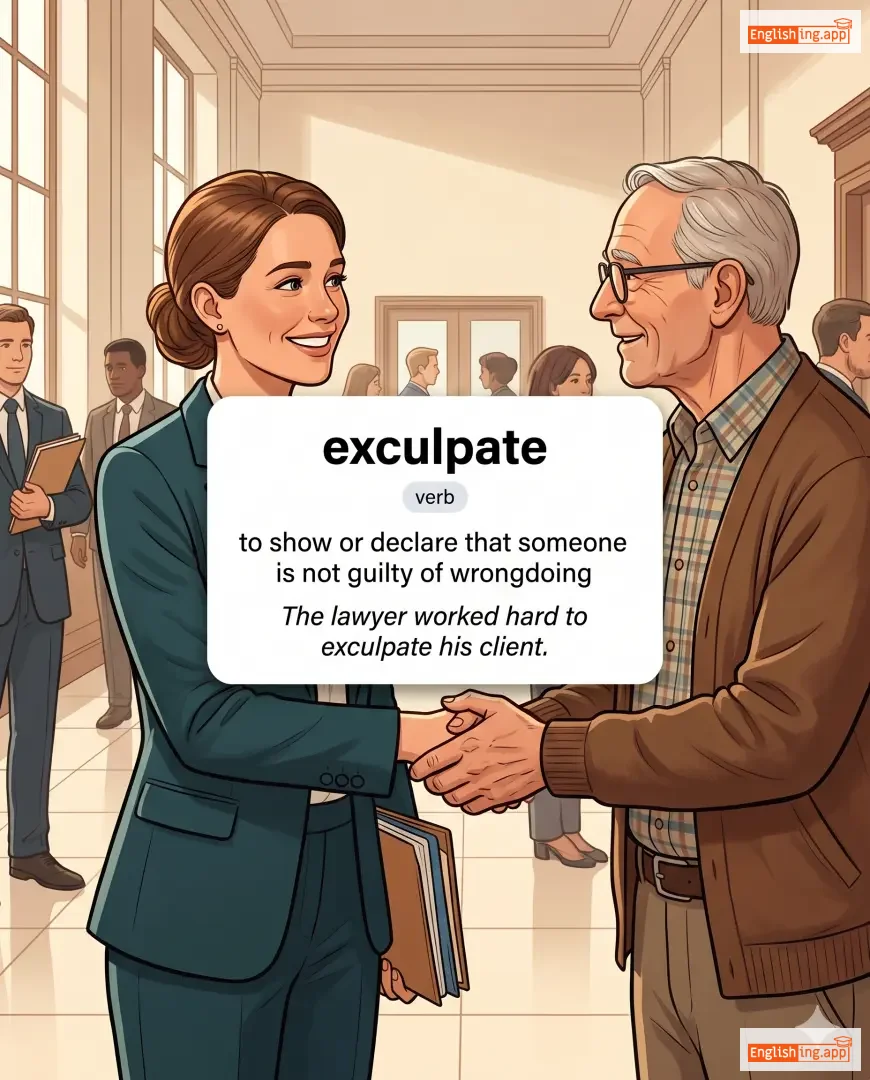
exculpate definition card — visual illustration of the meaning
verb
/ˈɛkskʌlpeɪt/
exculpar (exculpar)

to show or declare that someone is not guilty of wrongdoing

"The lawyer worked hard to exculpate his client."

"El abogado trabajó duro para exculpar a su cliente." (El abogado trabajó duro para exculpar a su cliente.)
noun
/ɪkˈskɜːʒən/
excursión (excursion)

A short journey or trip, especially one taken for leisure or educational purposes.

"The students went on an excursion to the national museum."

"Los estudiantes fueron a una excursión al museo nacional." (Los estudiantes fueron a una excursion al museo nacional.)
adjective
/ɪkˈskɜːsɪv/
excursivo (excursivo)

Tending to digress or wander; moving away from the main subject.

"His excursive lecture left the students confused about the main topic."

"Su conferencia excursive dejó a los estudiantes confundidos sobre el tema principal." (Su conferencia excursive dejó a los estudiantes confundidos sobre el tema principal.)
adjective
/ɪkˈskjuːzəbl/
excusable (eksuzable)

Able to be forgiven or justified.

"Her mistake was excusable given the circumstances."

"Su error era excusable dadas las circunstancias." (Su error era excusable dadas las circunstancias.)
verb
/ɪkˈskjuːz/
perdonar, justificar (perdonar, justificar)

to forgive someone for doing something wrong or to justify an action

"Please excuse my lateness; there was heavy traffic."

"Por favor, excusa mi tardanza; había mucho tráfico." (Por favor, excusa mi tardanza; había mucho tráfico.)
execrable definition card — visual illustration of the meaning
adjective
/ˈeksɪkrəbl/
execrable (execrable)

Extremely bad or unpleasant.

"The movie was so execrable that many people left the theater early."

"La película era tan execrable que muchas personas se fueron temprano del cine." (La película era tan execrable que muchas personas se fueron temprano del cine.)
verb
/ˈeksɪkreɪt/
despreciar (despreciar)

To feel or express great loathing or hatred for something.

"The community execrated the corrupt politician."

"La comunidad despreciaba al político corrupto." (La comunidad despreciaba al político corrupto.)
noun
/ˌɛksɪˈkreɪʃən/
maldición (maldicion)

An act of cursing or denouncing someone or something with hatred.

"The dictator’s name was spoken with execration after his fall."

"El nombre del dictador fue pronunciado con maldición después de su caída." (El nombre del dictador fue pronunciado con maldición después de su caída.)
execute definition card — visual illustration of the meaning
verb
/ˈɛksɪkjuːt/
ejecutar (ejecutar)

To carry out a plan, order, or action; to perform or put into effect.

"The company plans to execute its new strategy next year."

"La empresa planea ejecutar su nueva estrategia el próximo año." (La empresa planea ejecutar su nueva estrategia el próximo año.)
noun
/ˌɛksɪˈkjuːʃən/
ejecución, implementación (ejecucion, implementacion)

the act of carrying out a plan, order, or legal sentence

"The success of a project depends on its proper execution."

"El éxito de un proyecto depende de su correcta ejecución." (El exito de un proyecto depende de su correcta ejecucion.)
noun
/ˌɛksɪˈkjuːʃənər/
verdugo (verdugo)

A person who carries out a death sentence by execution.

"The executioner prepared the gallows for the condemned prisoner."

"El verdugo preparó la horca para el prisionero condenado." (El verdugo preparó la horca para el prisionero condenado.)
executive definition card — visual illustration of the meaning
noun/adjective
/ɪɡˈzɛkjətɪv/
ejecutivo (ejecutivo)

A person with senior managerial responsibility in a business; relating to the execution of plans or laws.

"She works as an executive in a multinational company."

"Ella trabaja como ejecutiva en una empresa multinacional." (Ella trabaja como ejecutiva en una empresa multinacional.)
noun
/ɪɡˈzɛkjətər/
ejecutor de testamento (ejecutor de testamento)

A person appointed to carry out the terms of someone's will after their death.

"The executor managed the estate according to the deceased’s wishes."

"El ejecutor gestionó la propiedad según los deseos del fallecido." (El ejecutor gestiono la propiedad segun los deseos del fallecido.)