Vocabularios

Descubra, aprenda y domine el vocabulario en inglés

noun
/kɔːrs flaʊər/
harina gruesa (harina gruesa)

coarsely ground flour with larger particles, typically used for baking bread

"She used course flour to make homemade bread with a rustic texture."

"Ella usó harina gruesa para hacer pan casero con una textura rústica." (Ella uso harina gruesa para hacer pan casero con una textura rustica.)
noun
/ˈkɔːrsər/
caballo rápido o caballo de caza (caballo rapido o caballo de caza)

a swift horse or a hunting horse

"The knight rode a fast courser into battle."

"El caballero montó un corcel rápido en la batalla." (El caballero monto un corcel rapido en la batalla.)
noun,verb
/kɔːrt/
tribunal o lugar donde se busca atención o favor (tribunal o lugar donde se busca atencion o favor)

a place where legal cases are heard or to seek favor or attention

"He courted the judge with respect."

"Él corteó al juez con respeto." (Él corteó al juez con respeto.)
adjective
/ˈkɜːrtiəs/
cortés (cortes)

polite, respectful, or considerate in manner

"The staff at the hotel were very courteous to all guests."

"El personal del hotel fue muy cortés con todos los huéspedes." (El personal del hotel fue muy cortes con todos los huespedes.)
noun
/ˈkɜːrtəsi/
cortesía, amabilidad o favor (cortesía, amabilidad o favor)

polite behavior or a polite action; a favor or privilege

"He opened the door as a courtesy."

"Él abrió la puerta por cortesía." (Él abrió la puerta por cortesía.)
noun
/ˈkɔːtruːm/
sala de audiencias (sala de audiencias)

a room in which legal cases are heard and decided by a judge

"The witness was called to testify in the courtroom."

"Se llamo al testigo a testificar en la sala de audiencias." (Se llamo al testigo a testificar en la sala de audiencias.)
noun
/ˈkʌzn/
primo/prima (primo/prima)

A child of one's uncle or aunt.

"My cousin is coming to visit us this weekend."

"Mi primo viene a visitarnos este fin de semana." (Mi primo viene a visitarnos este fin de semana.)
🧙‍♀️

coven (cóven)

noun
/ˈkʌvən/
un grupo de brujas (un grupo de brujas)

a group or gathering of witches

"The witches met secretly in a coven in the forest."

"Las brujas se reunieron secretamente en un coven en el bosque." (Las brujas se reunieron secretamente en un coven en el bosque.)
noun
/ˈkʌvənənt/
pacto (pacto)

a formal agreement or promise, often legally binding

"The landlord and tenant signed a covenant to maintain the property."

"El arrendador y el inquilino firmaron un pacto para mantener la propiedad." (El arrendador y el inquilino firmaron un pacto para mantener la propiedad.)
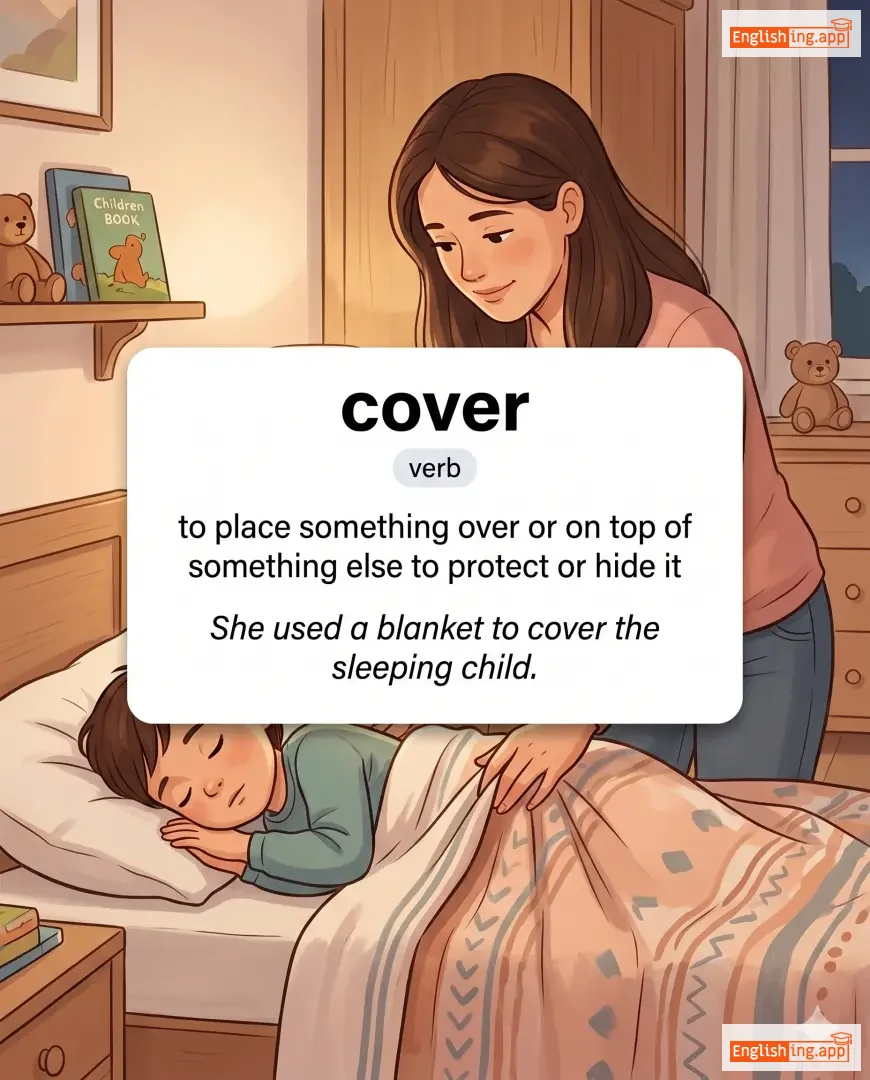
cover definition card — visual illustration of the meaning
verb
/ˈkʌvər/
cubrir (cubrir)

to place something over or on top of something else to protect or hide it

"She used a blanket to cover the sleeping child."

"Ella usó una manta para cubrir al niño que dormía." (Ella usó una manta para cubrir al niño que dormía.)
noun
/ˈkʌvərɪdʒ/
cobertura (cobertura)

The extent or scope of something, such as insurance protection or media reporting.

"The news channel provided extensive coverage of the event."

"El canal de noticias proporcionó una amplia cobertura del evento." (El canal de noticias proporcionó una amplia cobertura del evento.)
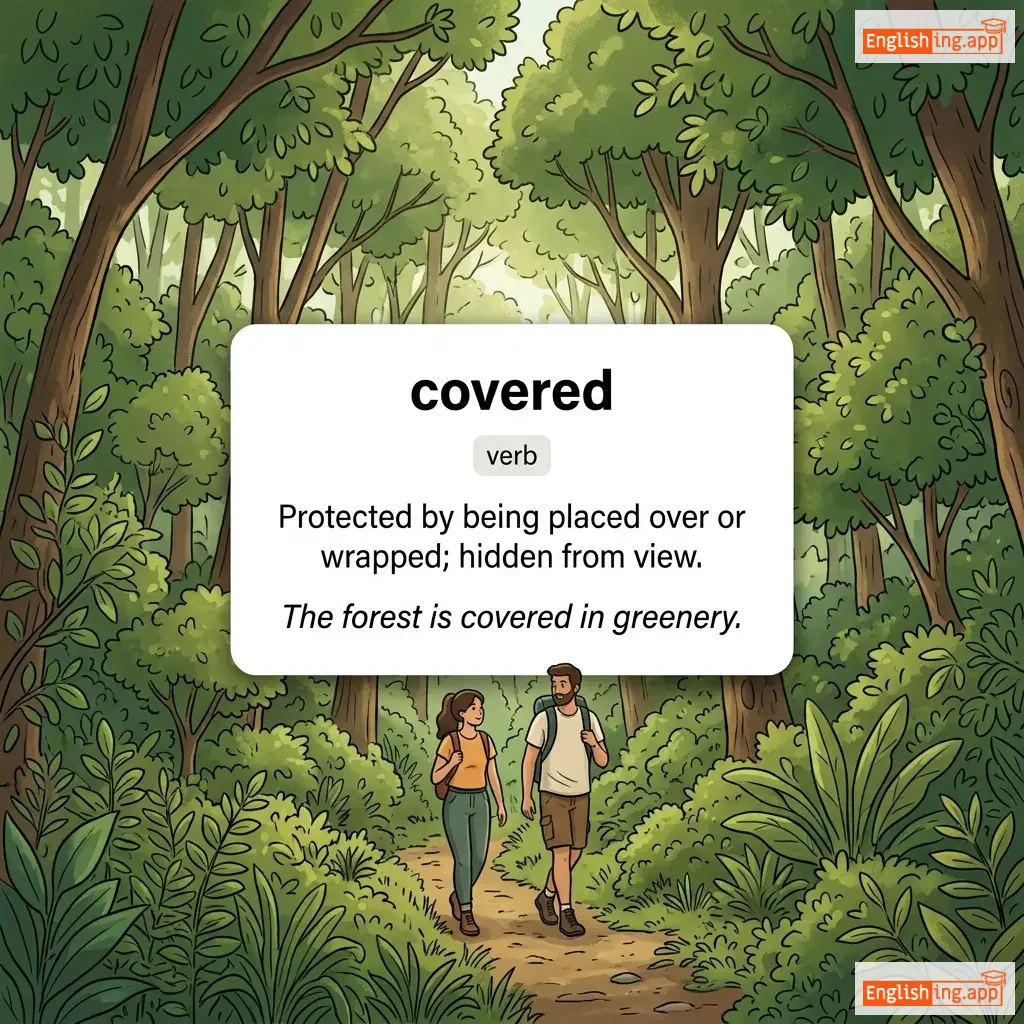
covered definition card — visual illustration of the meaning
verb
/ˈkʌv.ərd/
cubierto (cubierto)

Protected by being placed over or wrapped; hidden from view.

"The forest is covered in greenery."

"El bosque está cubierto de vegetación." (El bosque está cubierto de vegetación.)
covert definition card — visual illustration of the meaning
🕵️‍♂️

covert (cóvert)

adjective
/ˈkoʊvərt/
secreto (secreto)

hidden, secret, or not openly acknowledged

"The spy conducted a covert operation behind enemy lines."

"El espía llevó a cabo una operación encubierta detrás de las líneas enemigas." (El espía llevó a cabo una operación encubierta detrás de las líneas enemigas.)
verb
/ˈkʌvət/
codiciar (codiciar)

to desire something belonging to someone else

"He coveted his neighbor's new car."

"Él codició el coche nuevo de su vecino." (Él codició el coche nuevo de su vecino.)
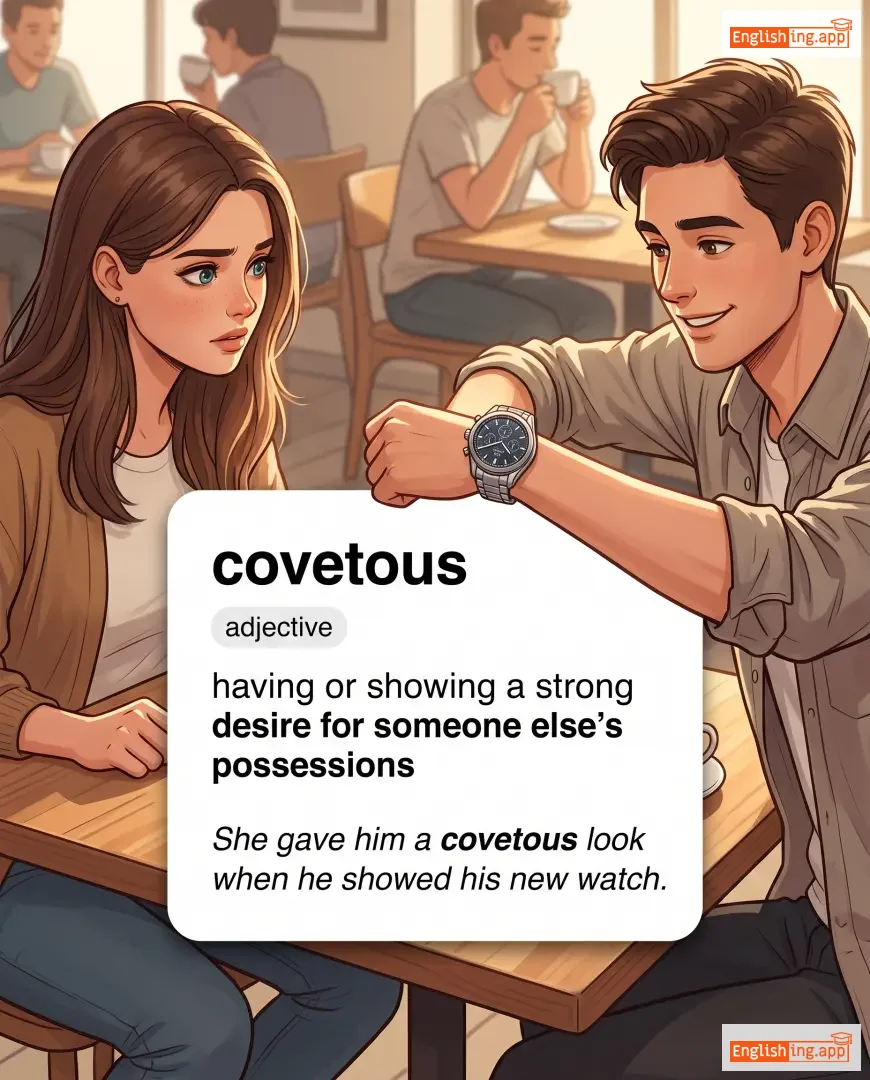
covetous definition card — visual illustration of the meaning
adjective
/ˈkʌvətəs/
codicioso (codicioso)

having or showing a strong desire for someone else's possessions

"She gave him a covetous look when he showed his new watch."

"Le lanzó una mirada codiciosa cuando mostró su nuevo reloj." (Le lanzo una mirada codiciosa cuando mostro su nuevo reloj.)
noun
/ˈkʌvi/
un pequeño grupo de aves (un pequeno grupo de aves)

a small group of birds, especially partridges or quails

"A covey of quails flew across the field."

"Un covey de codornices voló sobre el campo." (Un covey de codornices voló sobre el campo.)
noun
/kaʊ/
vaca (kau)

a large domesticated bovine animal kept for milk or meat

"The farmer milked the cow early in the morning."

"El granjero ordeñó la vaca temprano por la mañana." (El granjero ordeno la vaca temprano por la manana.)
noun
/ˈkaʊ.ərd/
cobarde (cobarde)

a person who lacks the courage to do or endure dangerous or unpleasant things

"He called himself a coward for not standing up to the bully."

"Él se llamó a sí mismo un cobarde por no enfrentarse al matón." (El se llamo a si mismo un cobarde por no enfrentarse al maton.)
noun
/ˈkaʊərdɪs/
cobardía (cobardía)

lack of courage; behavior showing fear

"His cowardice prevented him from speaking up."

"Su cobardía le impidió hablar." (Su cobardía le impidió hablar.)
noun
/ˈkaʊbɔɪ/
vaquero (vaquero)

a man, typically one on horseback, who herds and tends cattle

"The cowboy rode across the plains."

"El vaquero cabalgaba por las llanuras." (El vaquero cabalgaba por las llanuras.)
verb
/ˈkaʊər/
agacharse por miedo (agacharse por miedo)

to crouch down in fear

"The child cowered behind the sofa during the thunderstorm."

"El niño se encogió detrás del sofá durante la tormenta." (El niño se encogió detrás del sofá durante la tormenta.)
noun
/ˈkɒksweɪn/
timón de barco (timón de barco)

the person in charge of navigating and steering a boat, especially a racing or small boat

"The coxswain shouted instructions to the rowing team."

"El coxswain dio instrucciones al equipo de remo." (El coxswain dio instrucciones al equipo de remo.)
adjective
/kɔɪ/
tímido, reservado (timido, reservado)

reluctant to give details or reveal feelings; shy or reserved

"She gave a coy smile when asked about her plans."

"Ella dio una sonrisa tímida cuando le preguntaron sobre sus planes." (Ella dio una sonrisa timida cuando le preguntaron sobre sus planes.)
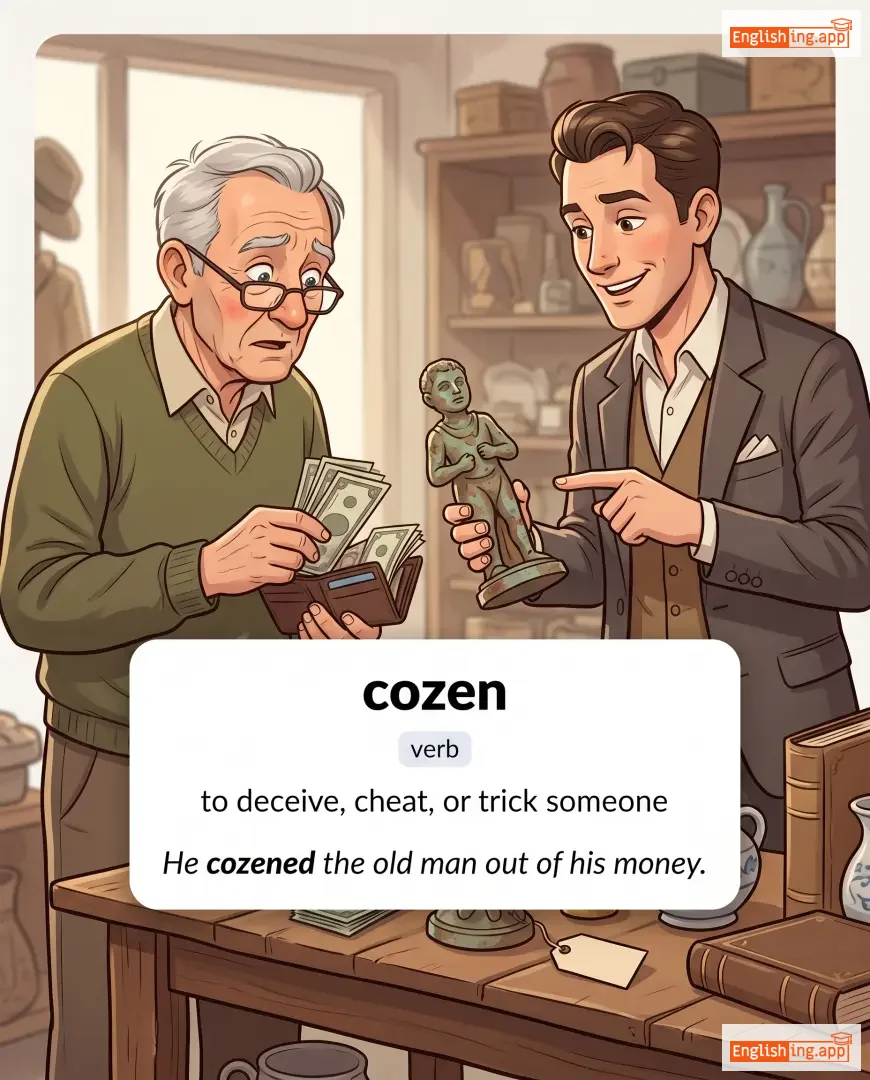
cozen definition card — visual illustration of the meaning
verb
/ˈkʌzən/
engañar, estafar (engañar, estafar)

to deceive, cheat, or trick someone

"He cozened the old man out of his money."

"Él engañó al anciano y le quitó su dinero." (Él engañó al anciano y le quitó su dinero.)
adjective
/ˈkoʊzi/
acogedor (acogedor)

giving a feeling of comfort, warmth, and relaxation

"We sat in a cozy little café on a rainy day."

"Nos sentamos en un acogedor café pequeño en un día lluvioso." (Nos sentamos en un acogedor cafe pequeno en un dia lluvioso.)
noun
/kræb/
cangrejo (cangrejo)

a crustacean with a broad carapace, stalked eyes, and five pairs of legs, the first pair of which are modified as pincers

"The crab scuttled sideways across the sand."

"El cangrejo se arrastró lateralmente por la arena." (El cangrejo se arrastró lateralmente por la arena.)
adjective
/ˈkræbɪd/
difícil de leer, malhumorado (dificil de leer, malhumorado)

difficult to read or understand; ill-tempered

"His handwriting was crabbed and almost illegible."

"Su letra era difícil de leer y casi ilegible." (Su letra era dificil de leer y casi ilegible.)
verb
/kræk/
felicidad (felicidad)

To break or cause to break without complete separation; to make a sharp sound.

"The glass cracked when it was dropped on the floor."

"Ella no pudo ocultar su felicidad cuando recibió el premio." (Ella no pudo ocultar su felicidad cuando recibió el premio.)
noun
/ˈkreɪ.dəl/
cuna (cuna)

a small bed for a baby, especially one that rocks from side to side

"The baby sleeps peacefully in the cradle."

"El bebé duerme tranquilamente en la cuna." (El bebe duerme tranquilamente en la cuna)
noun
/kræft/
habilidad, oficio, artesanía (habilidad, oficio, artesania)

an activity involving skill in making things by hand; a trade or occupation

"She has mastered the craft of pottery."

"Ella ha dominado el oficio de la alfarería." (Ella ha dominado el oficio de la alfareria.)
adjective
/ˈkræfti/
astuto, ingenioso, tramposo (astuto, ingenioso, tramposo)

skilled at achieving goals through cunning or deceit; sly

"The crafty fox evaded the hunters again."

"El astuto zorro evadió a los cazadores nuevamente." (El astuto zorro evadió a los cazadores nuevamente.)
noun
/kræɡ/
un acantilado o roca empinada (un acantilado o roca empinada)

a steep or rugged cliff or rock face

"The hikers climbed the jagged crag to reach the summit."

"Los excursionistas subieron el acantilado escarpado para llegar a la cima." (Los excursionistas subieron el acantilado escarpado para llegar a la cima.)
adjective
/kræmpt/
estrecho, incómodamente pequeño (estrecho, incomodamente pequeño)

uncomfortably small or restricted

"The room was so cramped that we could barely move."

"La habitación estaba tan estrecha que apenas podíamos movernos." (La habitación estaba tan estrecha que apenas podíamos movernos.)
noun
/kreɪn/
grúa (grua)

a large tall bird with long legs and neck; a machine for lifting heavy objects

"The graceful crane stood motionless by the water's edge."

"La grácil grúa permaneció inmóvil al borde del agua." (La gracil grua permaneció inmovil al borde del agua.)
noun
/ˈkreɪniəm/
cráneo (craneo)

the skull, especially the part enclosing the brain

"The archaeologists carefully examined the ancient cranium."

"Los arqueólogos examinaron cuidadosamente el cráneo antiguo." (Los arqueólogos examinaron cuidadosamente el cráneo antiguo.)
adjective
/ˈkræŋki/
malhumorado (malhumorado)

bad-tempered, easily annoyed, or irritable

"The child gets cranky when he is hungry."

"El niño se pone malhumorado cuando tiene hambre." (El niño se pone malhumorado cuando tiene hambre.)
verb
/kræʃ/
felicidad (felicidad)

To collide violently; to suddenly stop working (for machines or computers).

"The car crashed into the wall at high speed."

"Ella no pudo ocultar su felicidad cuando recibió el premio." (Ella no pudo ocultar su felicidad cuando recibió el premio.)
adjective
/kræs/
tosco, sin sensibilidad o refinamiento (tosko, sin sensibilidad o refinamiento)

lacking sensitivity, refinement, or intelligence

"His crass remarks offended everyone at the meeting."

"Sus comentarios groseros ofendieron a todos en la reunión." (Sus comentarios groseros ofendieron a todos en la reunión.)
verb
/kreɪv/
desear intensamente, ansiar (desear intensamente, ansiar)

to have a strong desire for something

"She craves adventure and often travels to remote places."

"Ella anhela aventura y a menudo viaja a lugares remotos." (Ella anhela aventura y a menudo viaja a lugares remotos.)
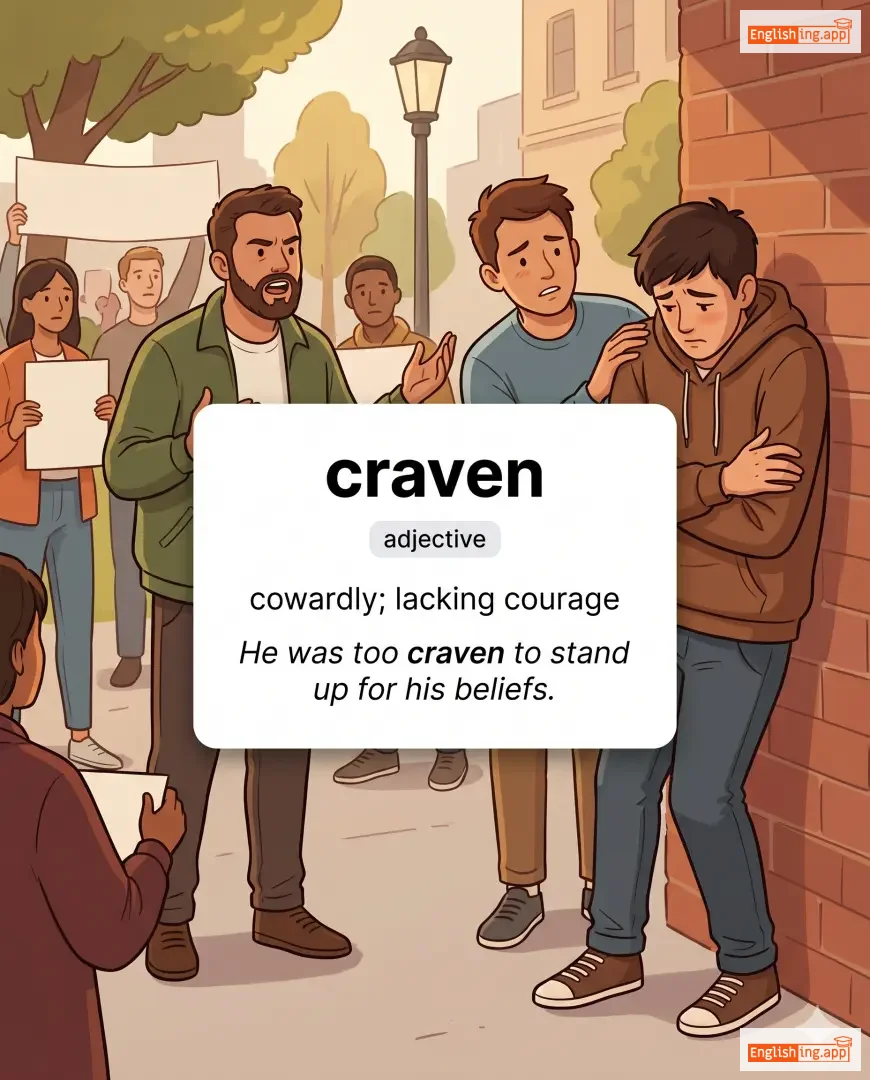
craven definition card — visual illustration of the meaning
adjective
/ˈkreɪvən/
cobarde (cobarde)

cowardly; lacking courage

"He was too craven to stand up for his beliefs."

"Él era demasiado cobarde para defender sus creencias." (El era demasiado cobarde para defender sus creencias.)
noun
/ˈkreɪvɪŋ/
antojo, deseo fuerte (antojo, deseo fuerte)

a strong desire for something

"She has a craving for chocolate every evening."

"Ella tiene un antojo de chocolate todas las noches." (Ella tiene un antojo de chocolate todas las noches.)
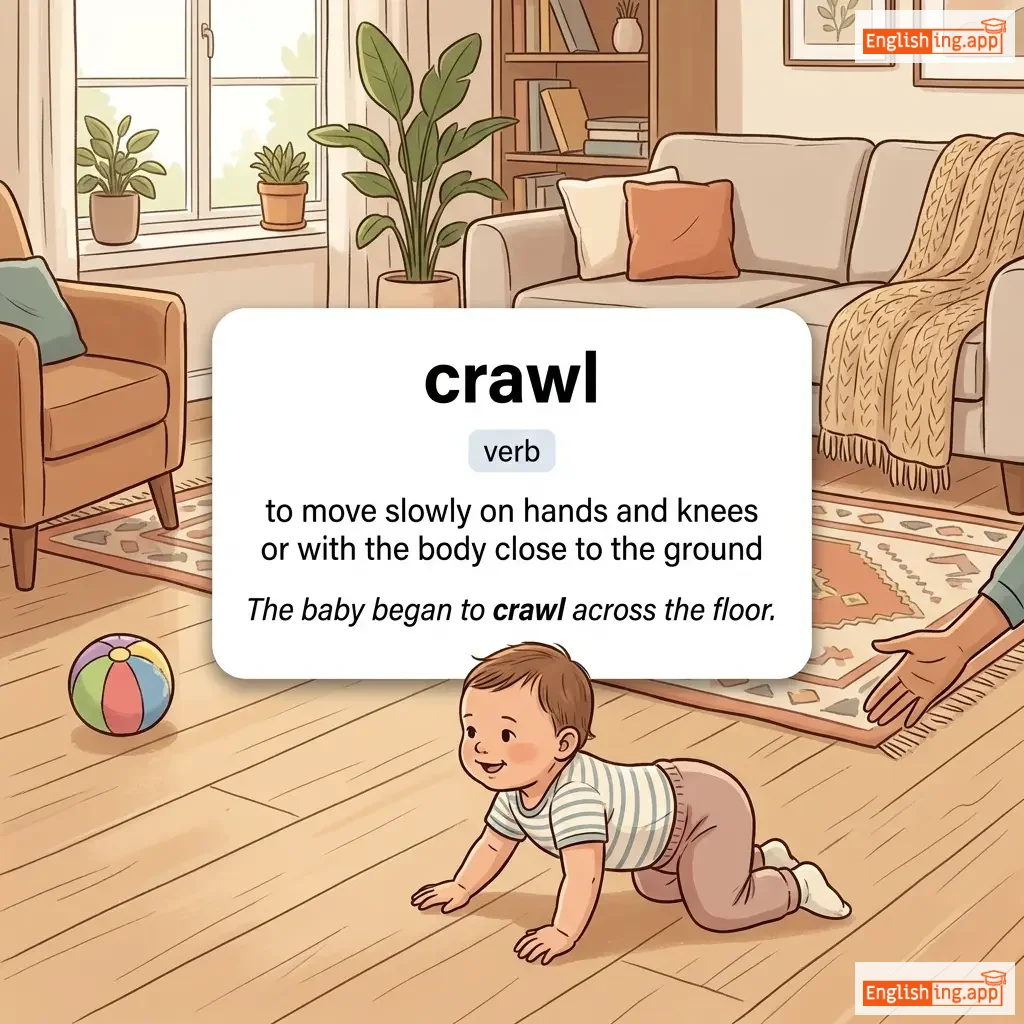
crawl definition card — visual illustration of the meaning
verb
/krɔːl/
arrastrarse (arrastrarse)

to move slowly on hands and knees or with the body close to the ground

"The baby began to crawl across the floor."

"El bebé comenzó a arrastrarse por el suelo." (El bebé comenzó a arrastrarse por el suelo.)
adjective
/ˈkreɪzi/
loco (loco)

mentally unsound; extremely foolish or enthusiastic

"He had a crazy idea that actually worked."

"Él tenía una idea loca que realmente funcionó." (El tenía una idea loca que realmente funcionó.)
verb
/kriːk/
hacer un ruido chirriante o agudo (hacer un ruido chirriante o agudo)

to make a high-pitched, squeaking noise when moved

"The old door creaked as she opened it."

"La puerta vieja crujió cuando la abrió." (La puerta vieja crujió cuando la abrió.)
noun
/kriːm/
crema (krema)

A thick, fatty part of milk that rises to the top; also a soft substance used in cooking or cosmetics.

"She added some cream to her coffee."

"Ella añadió un poco de crema a su café." (Ella añadio un poco de crema a su cafe.)
noun
/ˈkriːməri/
lechería (lechera)

a place where milk and cream are processed and dairy products are made

"The local creamery produces fresh butter and cheese daily."

"La lechería local produce mantequilla y queso fresco diariamente." (La lechería local produce mantequilla y queso fresco diariamente.)
adjective
/ˈkriːmi/
textura suave y rica como la crema (textura suave y rica como la crema)

having a smooth, rich texture like cream

"She poured a creamy sauce over the pasta."

"Ella vertió una salsa cremosa sobre la pasta." (Ella vertió una salsa cremosa sobre la pasta.)
noun, verb
/kriːs/
pliegue, arruga (pliegue, arruga)

a line or fold produced on paper, cloth, or other material; to make a fold or wrinkle

"She ironed the shirt carefully to remove every crease."

"Ella planchó la camisa cuidadosamente para eliminar cada pliegue." (Ella planchó la camisa cuidadosamente para eliminar cada pliegue.)
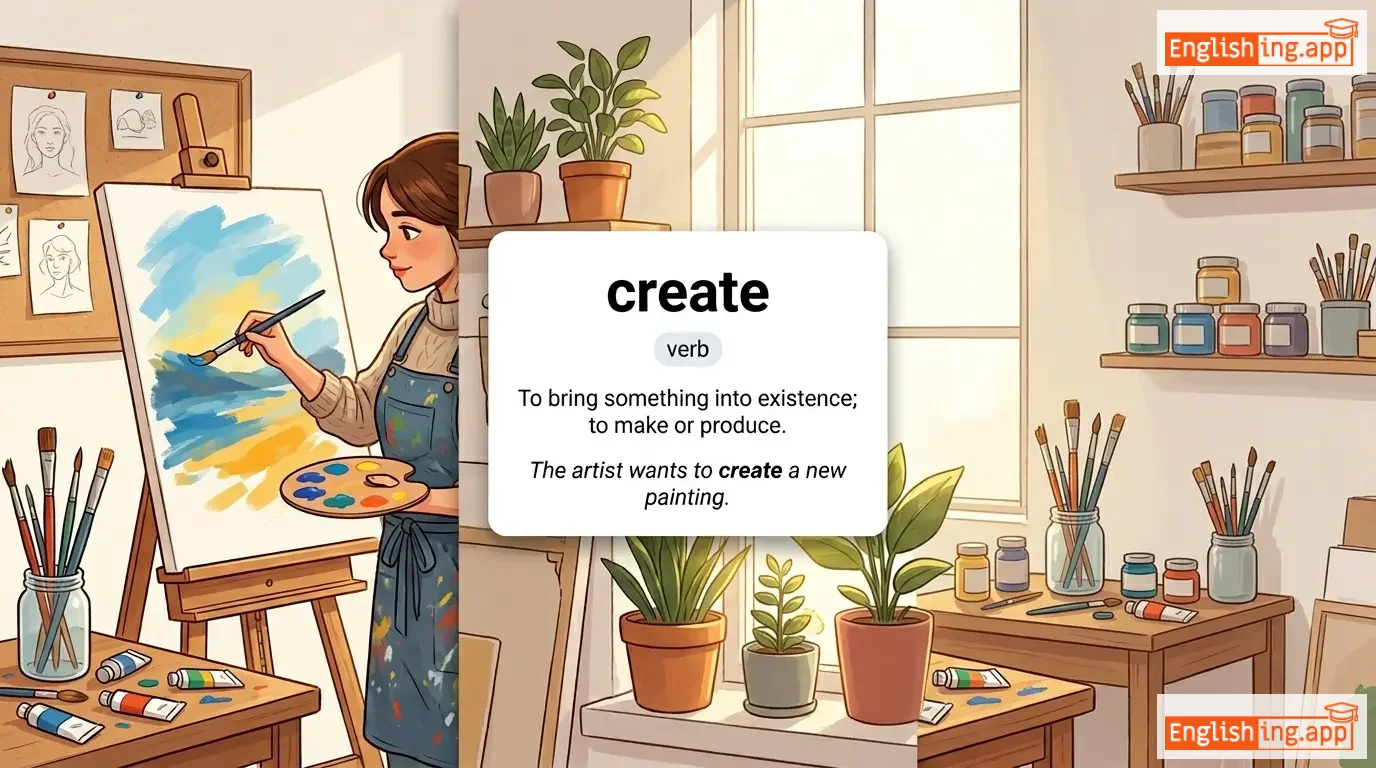
create definition card — visual illustration of the meaning
verb
/kriˈeɪt/
crear (crear)

To bring something into existence; to make or produce.

"The artist wants to create a new painting."

"El artista quiere crear una nueva pintura." (El artista quiere crear una nueva pintura.)
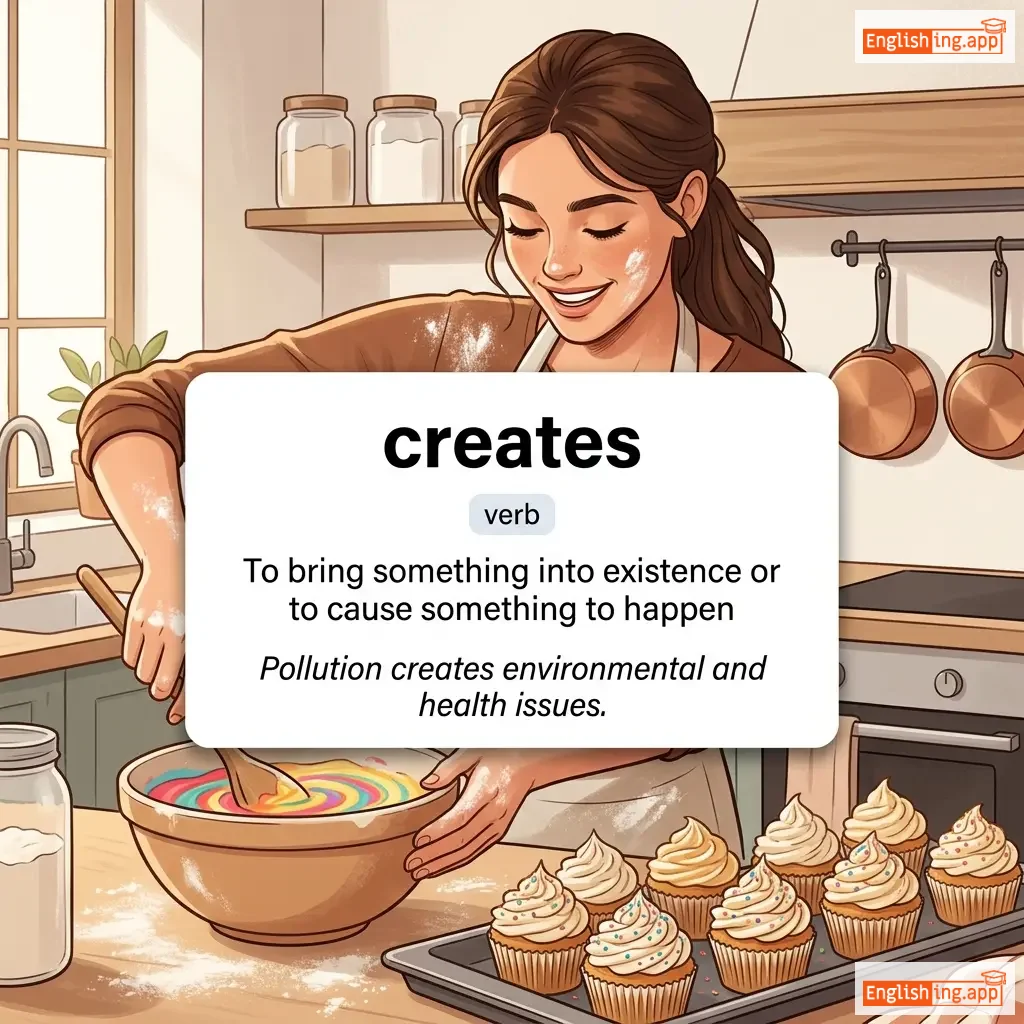
creates definition card — visual illustration of the meaning
verb
kriˈeɪts
crear (crear)

To bring something into existence or to cause something to happen

"Pollution creates environmental and health issues."

"La contaminación crea problemas ambientales y de salud." (La contaminación crea problemas ambientales y de salud.)