Vocabularios

Descubra, aprenda y domine el vocabulario en inglés

noun
/bɪˈliːvər/
creyente (creyente)

a person who believes in something, especially a religious faith, idea, or principle

"She is a strong believer in hard work and honesty."

"Ella es una firme creyente del trabajo duro y la honestidad." (ella es una firme creyente del trabajo duro y la honestidad)
verb
/bɪˈlɪtl/
menospreciar (menospreciar)

To make someone or something seem less important or less valuable.

"He often belittled his coworkers to feel superior."

"Él a menudo menospreciaba a sus compañeros de trabajo para sentirse superior." (Él a menudo menospreciaba a sus compañeros de trabajo para sentirse superior.)
noun
/bɛl/
campana (bell)

a hollow object, usually made of metal, that makes a ringing sound when struck

"The school bell rang loudly at noon."

"La campana de la escuela sonó fuertemente al mediodía." (La campana de la escuela sono fuertemente al mediodia)
noun
/bel ˈæp.əl/
manzana campana (manzana campana)

a tropical fruit with a crisp texture and sweet taste, scientifically known as Syzygium malaccense

"The bell apple tree produces beautiful red fruits that are popular in tropical regions."

"El árbol de manzana campana produce hermosas frutas rojas que son populares en las regiones tropicales" (El arbol de manzana campana produce hermosas frutas rojas que son populares en las regiones tropicales)
noun
/bɛl/
bella mujer (bella mujer)

A beautiful woman, especially the most attractive woman at a gathering.

"She was the belle of the ball that evening."

"Ella era la bella de la fiesta esa noche." (Ella era la bella de la fiesta esa noche.)
adjective
/ˈbɛlɪˌkoʊs/
belicoso (belicoso)

Showing a tendency to argue or fight; aggressive.

"His bellicose attitude often got him into unnecessary conflicts."

"Su actitud belicosa a menudo lo metía en conflictos innecesarios." (Su actitud belicosa a menudo lo metía en conflictos innecesarios.)
belligerent definition card — visual illustration of the meaning
adjective
/bəˈlɪdʒərənt/
beligerante (beligerante)

Hostile and aggressive; eager to fight.

"She became belligerent when the waiter got her order wrong."

"Ella se volvió beligerante cuando el camarero cometió un error con su pedido." (Ella se volvio beligerante cuando el camarero cometio un error con su pedido.)
noun
/ˈbɛlˌwɛðər/
líder de tendencia (lider de tendencia)

A person or thing that leads or indicates a trend.

"The company is seen as a bellwether of the technology industry."

"La compañía se ve como un líder de tendencia de la industria tecnológica." (La compania se ve como un lider de tendencia de la industria tecnologica.)
noun
/ˈbɛli/
vientre (vientre)

The front part of the human body below the chest; stomach or abdomen.

"He rubbed his belly after the big meal."

"Él frotó su vientre después de la gran comida." (Él frotó su vientre después de la gran comida.)
verb
/bɪˈlɒŋ/
pertenecer (pertenecer)

to be in the right place or to be a member of a group

"She felt she truly belonged to the team."

"Ella sintió que realmente pertenecía al equipo." (Ella sintió que realmente pertenecía al equipo.)
adjective
/bɪˈlʌvɪd/
querido (querido)

dearly loved, highly regarded

"She was the beloved queen of the kingdom."

"Ella era la querida reina del reino." (Ella era la querida reina del reino.)
preposition
/bɪˈloʊ/
debajo (debajo)

At a lower level or position than something else.

"The basement is below the ground floor."

"El sótano está debajo del primer piso." (El sótano está debajo del primer piso.)
noun
/bɛlt/
cinturón (sinturon)

a strip of material worn around the waist to support clothes or as decoration

"He tightened his belt before leaving for work."

"Apretó su cinturón antes de irse al trabajo." (Apreto su cinturon antes de irse al trabajo.)
verb
/bɪˈmoʊn/
lamentar (lamentar)

To express discontent or sorrow over something.

"Critics bemoaned the lack of diversity in the film."

"Los críticos lamentaron la falta de diversidad en la película." (Los críticos lamentaron la falta de diversidad en la película.)
verb
/bɪˈmjuːz/
confundir (confundir)

To confuse or puzzle someone.

"The complex instructions bemused the new employees."

"Las instrucciones complejas confundieron a los nuevos empleados." (Las instrucciones complejas confundieron a los nuevos empleados.)
adjective
/bɪˈmjuːzd/
perplejo, confundido (perplejo, confundido)

confused, puzzled, or lost in thought

"She looked bemused when he asked the strange question."

"Ella parecía confundida cuando él hizo la extraña pregunta." (Ella parecia confundida cuando el hizo la extrana pregunta.)
noun
/bɛntʃ/
banco (banco)

a long seat for several people, typically made of wood or stone

"They sat on the park bench watching the sunset."

"Se sentaron en el banco del parque mirando el atardecer." (Se sentaron en el banco del parque mirando el atardecer.)
benchmark definition card — visual illustration of the meaning
noun
/ˈbɛntʃmɑːrk/
punto de referencia (punto de referencia)

a standard or point of reference against which things are compared or assessed

"The company set a new benchmark for customer service."

"La empresa estableció un nuevo punto de referencia para el servicio al cliente." (La empresa estableció un nuevo punto de referencia para el servicio al cliente.)
benchmarking definition card — visual illustration of the meaning
noun
/ˈbɛntʃˌmɑːr.kɪŋ/
evaluación comparativa (evaluacion comparativa)

Comparing with a specific industry or competitor to set standards

"Companies use benchmarking to assess their performance."

"Las empresas utilizan el benchmarking para evaluar su desempeño." (Las empresas utilizan el benchmarking para evaluar su desempeño.)
verb
/bɛnd/
doblar / agacharse (doblar / agacharse)

to curve something or cause it to change shape; to move the body or part of it downward or forward

"She had to bend down to pick up the coin."

"Ella tuvo que agacharse para recoger la moneda." (Ella tuvo que agacharse para recoger la moneda.)
adjective
/ˈbɛndi/
flexible (flexible)

Easily curved or flexible.

"The bendy straw made it easier to drink from the cup."

"La pajita flexible hizo más fácil beber del vaso." (La pajita flexible hizo más fácil beber del vaso.)
preposition
/bɪˈniːθ/
debajo (debajo)

in or to a lower position than something; under

"The cat was hiding beneath the bed."

"El gato estaba escondido debajo de la cama." (El gato estaba escondido debajo de la cama.)
noun
/ˌbɛnɪˈdɪkʃən/
bendición (bendicion)

a blessing or expression of good wishes, often at the end of a religious service

"The priest gave a final benediction before the congregation left."

"El sacerdote dio una bendición final antes de que la congregación se fuera." (El sacerdote dio una bendicion final antes de que la congregacion se fuera.)
noun
/ˈbɛnɪˌfæktər/
benefactor, donante (benefactor, donante)

a person who gives money or help to a cause or individual

"The school received a large donation from an anonymous benefactor."

"La escuela recibió una gran donación de un benefactor anónimo." (La escuela recibió una gran donación de un benefactor anónimo.)
noun
/ˈbɛnɪfɪs/
beneficio eclesiástico (beneficio eclesiastico)

a permanent church appointment for which property and income are provided

"The bishop appointed him to a wealthy benefice."

"El obispo lo nombró para un beneficio eclesiástico rico." (El obispo lo nombro para un beneficio eclesiastico rico.)
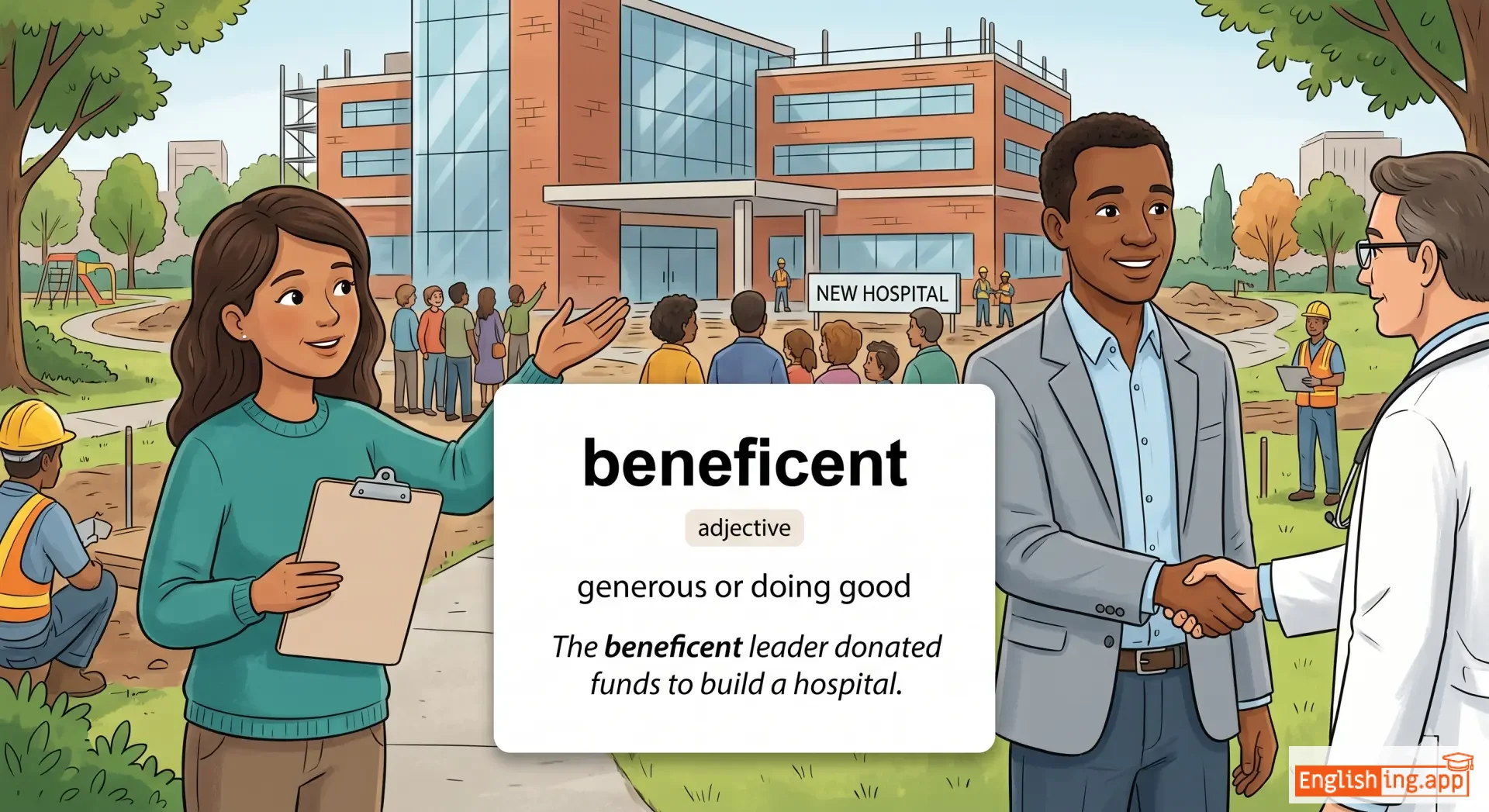
beneficent definition card — visual illustration of the meaning
adjective
/bəˈnɛfɪsənt/
benévolo, generoso (benevolo, generoso)

generous or doing good

"The beneficent leader donated funds to build a hospital."

"El líder benévolo donó fondos para construir un hospital." (El lider benevolo dono fondos para construir un hospital.)
beneficial definition card — visual illustration of the meaning
adjective
/ˌbɛnɪˈfɪʃəl/
beneficioso (beneficioso)

producing good or helpful results; favorable or advantageous

"Regular exercise is beneficial for your health."

"El ejercicio regular es beneficioso para tu salud." (El ejercicio regular es beneficioso para tu salud.)
noun
/ˌbɛnɪˈfɪʃəri/
beneficiario (beneficiario)

a person who receives something, especially money or property, from a will or insurance policy

"She is the sole beneficiary of her father’s estate."

"Ella es la única beneficiaria de la propiedad de su padre." (Ella es la única beneficiaria de la propiedad de su padre.)
noun/verb
/ˈbɛnɪfɪt/
beneficio / ventaja (beneficio / ventaja)

an advantage, profit, or good effect; to receive help or an advantage

"Employees benefit from the company’s health insurance program."

"Los empleados se benefician del programa de seguro de salud de la empresa." (Los empleados se benefician del programa de seguro de salud de la empresa.)
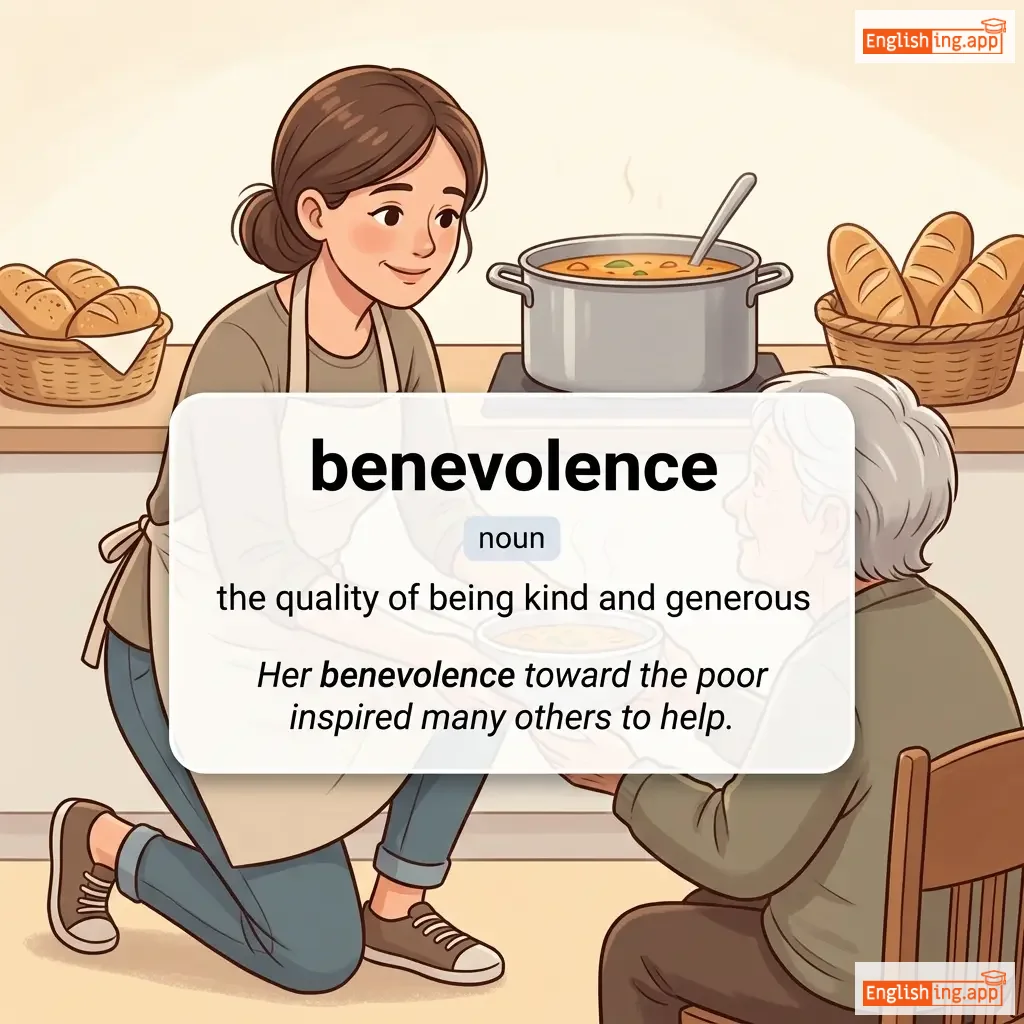
benevolence definition card — visual illustration of the meaning
noun
/bəˈnɛvələns/
benevolencia (benevolencia)

the quality of being kind and generous

"Her benevolence toward the poor inspired many others to help."

"Su benevolencia hacia los pobres inspiró a muchos a ayudar." (Su benevolencia hacia los pobres inspiró a muchos a ayudar.)
benevolent definition card — visual illustration of the meaning
adjective
/bəˈnɛvələnt/
benevolente (benevolente)

well-meaning and kindly; generous

"The benevolent teacher helped students beyond the classroom."

"El maestro benevolente ayudó a los estudiantes más allá del aula." (El maestro benevolente ayudo a los estudiantes mas alla del aula.)
adjective
/bɪˈnaɪtɪd/
oscuro, ignorante (oscuro, ignorante)

In a state of intellectual or moral ignorance; overtaken by darkness.

"The explorers were lost in the benighted forest without any guide."

"Los exploradores se perdieron en el bosque oscuro sin ningún guía." (Los exploradores se perdieron en el bosque oscuro sin ningun guia.)
adjective
/bɪˈnaɪn/
benigno, inofensivo (benigno, inofensivo)

Gentle, kind, or not harmful (especially of a disease or tumor).

"The doctor assured her that the tumor was benign."

"El médico le aseguró que el tumor era inofensivo." (El medico le aseguro que el tumor era inofensivo.)
adjective
/bɪˈnɪɡnənt/
benigno, bondadoso (benigno, bondadoso)

Kindly and benevolent in nature.

"The teacher’s benignant attitude made the students feel comfortable."

"La actitud benigna del maestro hizo que los estudiantes se sintieran cómodos." (La actitud benigna del maestro hizo que los estudiantes se sintieran cómodos.)
noun
/bɪˈnɪɡnəti/
benignidad, amabilidad (benignidad, amabilidad)

The quality of being kind and gentle.

"She treated everyone with benignity and respect."

"Ella trató a todos con benignidad y respeto." (Ella trato a todos con benignidad y respeto.)
noun
/ˈbɛnɪsən/
bendición (bendicion)

A blessing or benefit.

"The rain was a benison for the drought-stricken farmers."

"La lluvia fue una bendición para los agricultores afectados por la sequía." (La lluvia fue una bendicion para los agricultores afectados por la sequía.)
adjective
/bɛnt/
decidido / inclinación (decidido / inclinacion)

strongly determined or having a natural talent or inclination for something

"She is bent on becoming a successful lawyer."

"Ella está decidida a convertirse en una abogada exitosa." (Ella esta decidida a convertirse en una abogada exitosa.)
verb
/bɪˈnʌm/
adormecer (adormecer)

to make physically numb or without sensation; to make mentally dull or insensitive

"The freezing wind seemed to benumb his fingers within minutes."

"El viento helado parecía adormecerle los dedos en minutos." (El viento helado parecia adormecerle los dedos en minutos)
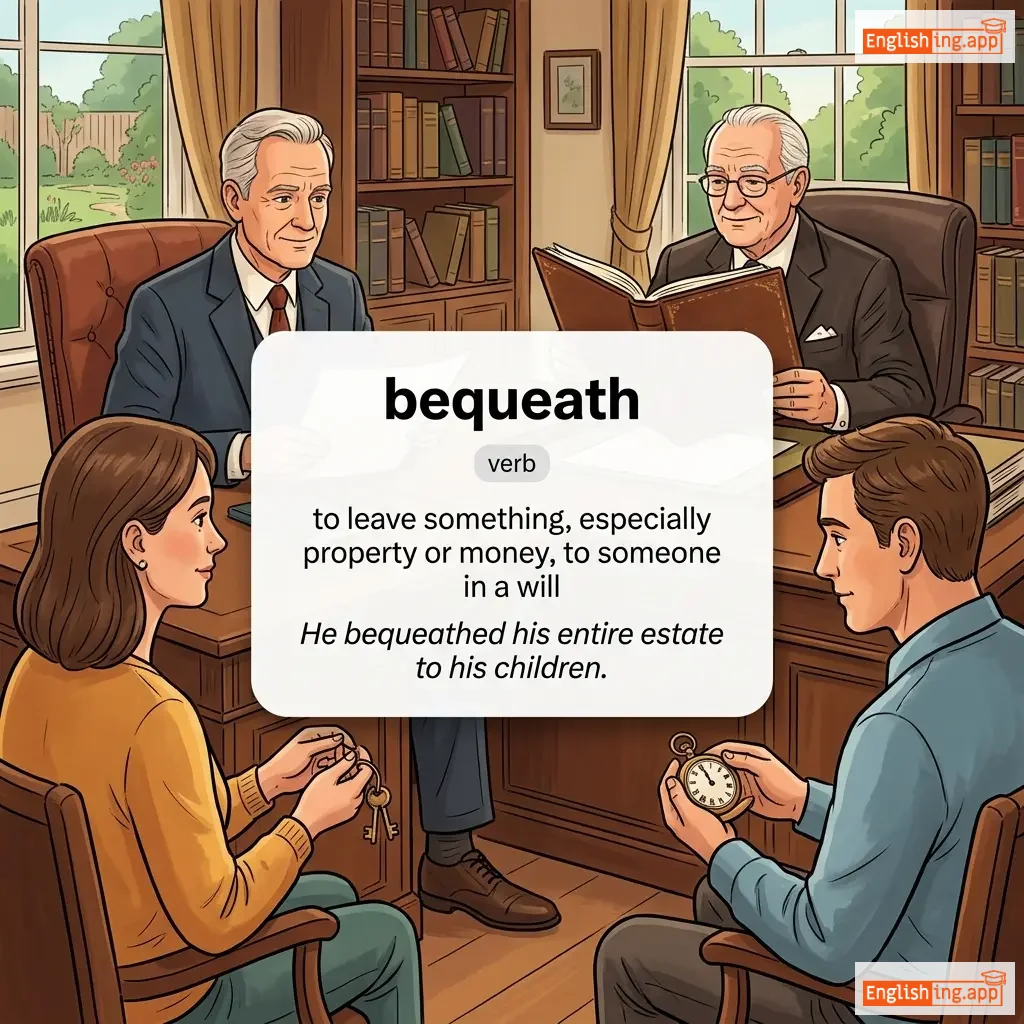
bequeath definition card — visual illustration of the meaning
verb
/bɪˈkwiːð/
legar (legar)

to leave something, especially property or money, to someone in a will

"He bequeathed his entire estate to his children."

"Él legó toda su propiedad a sus hijos." (Él legó toda su propiedad a sus hijos.)
verb
/bɪˈreɪt/
regañar (regañar)

to scold or criticize angrily

"The teacher berated the student for being late."

"El maestro regañó al estudiante por llegar tarde." (El maestro regañó al estudiante por llegar tarde.)
verb
/bɪˈriːv/
perder a un ser querido (perder a un ser querido)

to deprive someone of a loved one through death

"She was bereaved of her husband last year."

"Ella perdió a su esposo el año pasado." (Ella perdió a su esposo el año pasado.)
adjective
/bɪˈriːvd/
afligido por la pérdida (afligido por la perdida)

suffering the loss of a loved one through death

"The bereaved mother wept silently at the funeral."

"La madre afligida lloraba en silencio en el funeral." (La madre afligida lloraba en silencio en el funeral.)
noun
/bɪˈriːvmənt/
duelo (bereavement)

The state of having lost a loved one through death.

"She received many letters of sympathy during her time of bereavement."

"Ella recibió muchas cartas de simpatía durante su periodo de duelo." (Ella recibio muchas cartas de simpatia durante su periodo de duelo.)
adjective
/bɪˈrɛft/
despojado (despojado)

Deprived of or lacking something, especially a nonmaterial asset.

"After the betrayal, he felt bereft of hope and trust."

"Después de la traición, se sintió despojado de esperanza y confianza." (Después de la traición, se sintió despojado de esperanza y confianza.)
adjective
/bəˈzɜːrk/
enloquecido (enloquecido)

Out of control with anger or excitement; wild or frenzied.

"The fans went berserk when their team won the championship."

"Los fanáticos se volvieron enloquecidos cuando su equipo ganó el campeonato." (Los fanaticos se volvieron enloquecidos cuando su equipo ganó el campeonato.)
noun
/bɜːrθ/
litera / lugar de amarre (litera / lugar de amarre)

A place to sleep on a ship or train; a ship's allocated place at a dock.

"They reserved a lower berth on the overnight train."

"Reservaron una litera inferior en el tren nocturno." (Reservaron una litera inferior en el tren nocturno.)
verb
/bɪˈsiːtʃ/
suplicar (suplícar)

To ask someone urgently and fervently to do something; to beg.

"He beseeched the judge for mercy."

"Él suplicó al juez por misericordia." (Él suplicó al juez por misericordia.)
verb
/bɪˈsɛt/
asediar, acosar (asediar, acosar)

to trouble, harass, or attack on all sides

"The village was beset by constant floods."

"La aldea estaba asediada por inundaciones constantes." (La aldea estaba asediada por inundaciones constantes.)
preposition
/bɪˈsaɪd/
al lado de (al lado de)

next to or at the side of someone or something

"She sat beside her best friend during the ceremony."

"Ella se sentó al lado de su mejor amiga durante la ceremonia." (Ella se sentó al lado de su mejor amiga durante la ceremonia.)
adverb, preposition
/bɪˈsaɪdz/
además (ademas)

in addition to; apart from

"Besides English, he also speaks French."

"Además del inglés, también habla francés." (Ademas del ingles, tambien habla frances.)