Vocabularios

Descubra, aprenda y domine el vocabulario en inglés

noun
/biːf/
carne de res (carne de res)

the flesh of a cow, bull, or ox, used as food; also a complaint or dispute

"He ordered a plate of grilled beef for dinner."

"Pidió un plato de carne de res a la parrilla para la cena." (Pidió un plato de carne de res a la parrilla para la cena.)
noun
/ˈbiːlaɪn/
línea recta (linea recta)

a straight, direct route to a destination

"He made a beeline for the food table as soon as he entered the party."

"Hizo una línea recta hacia la mesa de comida tan pronto como entró a la fiesta." (Hizo una linea recta hacia la mesa de comida tan pronto como entro a la fiesta.)
noun
/bɪər/
cerveza (cerveza)

An alcoholic drink made from yeast-fermented malt flavored with hops.

"He ordered a glass of cold beer at the bar."

"Él pidió un vaso de cerveza fría en el bar." (Él pidió un vaso de cerveza fría en el bar.)
noun
/biːt/
remolacha (remolacha)

a plant with a round dark red root that is eaten as a vegetable

"Roasted beet with goat cheese makes a delicious salad."

"La remolacha asada con queso de cabra hace una ensalada deliciosa." (La remolacha asada con queso de cabra hace una ensalada deliciosa.)
noun
/ˈbiː.təl/
escarabajo (escarabajo)

a hard-bodied insect with wing covers

"The black beetle scurried across the garden path."

"El escarabajo negro corrió por el camino del jardín." (El escarabajo negro corrió por el camino del jardín.)
verb
/bɪˈfɪt/
ser apropiado para (ser apropiado para)

to be suitable for; to be appropriate to

"Formal attire befits the seriousness of the occasion."

"La vestimenta formal es apropiada para la seriedad de la ocasión." (La vestimenta formal es apropiada para la seriedad de la ocasion)
adjective
/bɪˈfɪt.ɪŋ/
adecuado; apropiado; adecuado para una situación o persona particular (bifiting)

appropriate; suitable; proper for a particular situation or person

"He wore formal attire befitting the important occasion."

"Llevó ropa formal adecuada para la ocasión importante." (Levo ropa formal adecuada para la ocasion importante.)
verb
/bɪˈfɒɡ/
nebulizar (nebulizar)

to confuse or make unclear; to cover with fog or mist

"His mind was befogged by exhaustion."

"Su mente estaba confundida por el agotamiento." (Su mente estaba confundida por el agotamiento.)
adjective
/bɪˈfɒɡd/
confuso, aturdido (confuso, aturdido)

Confused or clouded in mind; made unclear like being surrounded by fog.

"His mind felt befogged after the long and exhausting meeting."

"Su mente se sentía confusa después de la larga y agotadora reunión." (Su mente se sentía confusa después de la larga y agotadora reunión.)
verb
/bɪˈfuːl/
engañar (engañar)

to deceive or trick someone into believing something false; to make someone appear foolish

"The scammer tried to befool innocent people with fake promises."

"El estafador intentó engañar a personas inocentes con promesas falsas." (El estafador intento enganar a personas inocentes con promesas falsas)
preposition/adverb/conjunction
/bɪˈfɔːr/
antes (antes)

At an earlier time; in front of in order or place.

"She arrived before the meeting started."

"Ella llegó antes de que comenzara la reunión." (Ella llegó antes de que comenzara la reunión.)
adverb
/bɪˈfɔːr.hænd/
de antemano; con anticipación; antes (de antemano; kon anticipasion; antes)

in advance; ahead of time; earlier

"We prepared everything beforehand."

"Preparamos todo de antemano." (preparamos todo de antemano)
verb
/bɪˈfaʊl/
contaminar (contaminar)

to make dirty or polluted; to disgrace or corrupt

"The factory waste befouled the river."

"Los desechos de la fábrica contaminaron el río." (los desechos de la fabrica contaminaron el rio)
verb
/bɪˈfrɛnd/
hacer amistad (hacer amistad)

to act as a friend to someone; to make friends with

"She befriended the new student at school."

"Ella hizo amistad con el nuevo estudiante en la escuela." (Ella hizo amistad con el nuevo estudiante en la escuela.)
verb
/bɪˈfʌdəl/
confundir (confundir)

to confuse someone completely; to make someone unable to think clearly

"The complex instructions befuddled the students."

"Las instrucciones complejas confundieron a los estudiantes." (Las instrucciones complejas confundieron a los estudiantes.)
adjective
/bɪˈfʌdld/
desconcertado (desconcertado)

confused, unable to think clearly

"He looked befuddled after hearing the complex instructions."

"Él se veía desconcertado después de escuchar las instrucciones complejas." (Él se veía desconcertado después de escuchar las instrucciones complejas.)
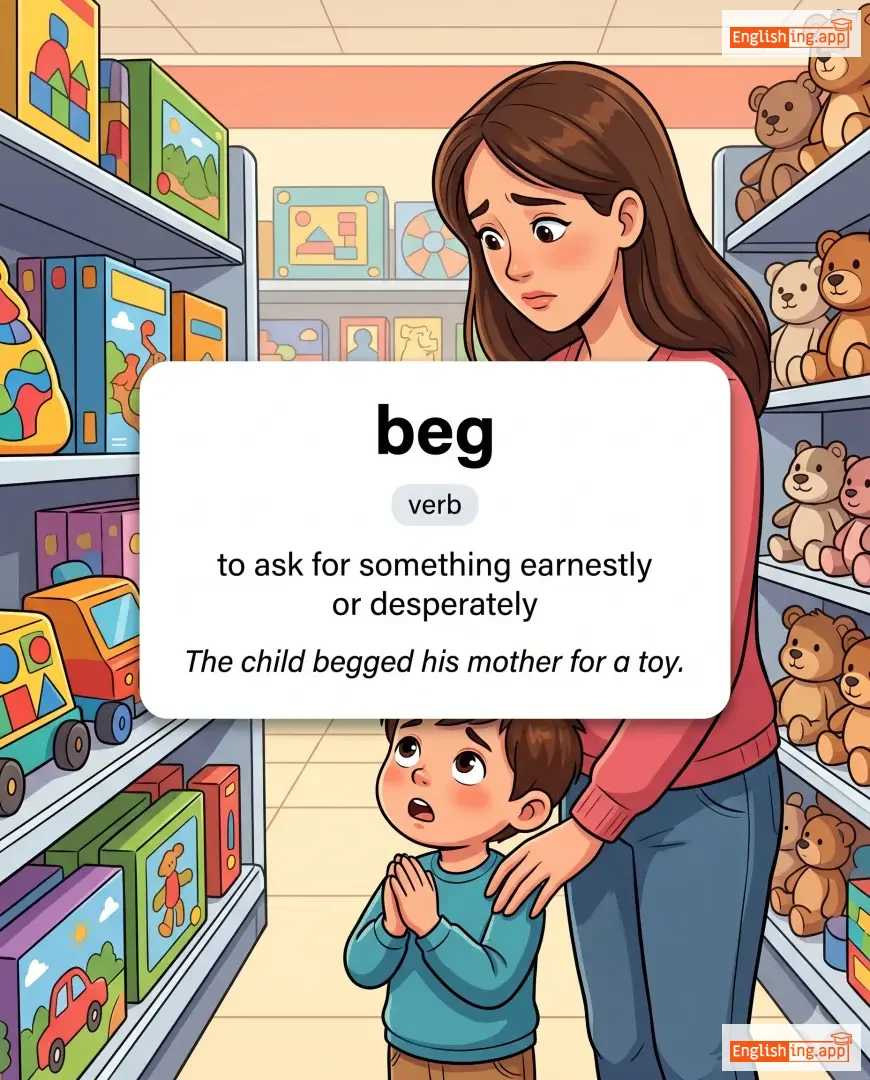
beg definition card — visual illustration of the meaning
verb
/bɛɡ/
rogar / pedir (rogar / pedir)

to ask for something earnestly or desperately

"The child begged his mother for a toy."

"El niño rogó a su madre por un juguete." (El niño rogo a su madre por un juguete.)
verb
/bɪˈɡɛt/
engendrar / procrear (engendrar / procrear)

to bring about or give rise to; to father or produce

"Violence begets more violence."

"La violencia engendra más violencia." (La violencia engendra más violencia.)
noun
/ˈbeɡər/
mendigo (mendigo)

a person who lives by asking for money or food

"The beggar sat by the temple asking for alms."

"El mendigo estaba sentado junto al templo pidiendo limosna." (El mendigo estaba sentado junto al templo pidiendo limosna)
begin definition card — visual illustration of the meaning
verb
/bɪˈɡɪn/
empezar (empezar)

To start something; to perform the first part of an action.

"They will begin the project tomorrow."

"Ellos comenzarán el proyecto mañana." (Ellos comenzarán el proyecto mañana.)
noun
/bɪˈɡɪnɪŋ/
comienzo (comienzo)

The start or first part of something.

"The beginning of the story was very interesting."

"El comienzo de la historia fue muy interesante." (El comienzo de la historia fue muy interesante.)
verb
/bɪˈɡrʌdʒ/
resentir a alguien por tener algo / dar algo de mala gana (resentir a alguien por tener algo / dar algo de mala gana)

to resent someone for having something; to give reluctantly

"She did not begrudge him his success."

"Ella no le guardó rencor por su éxito." (Ella no le guardó rencor por su éxito.)
verb
/bɪˈɡaɪl/
encantar / engañar para atraer (encantar / enganhar para atraer)

to charm or enchant someone, often in a deceptive way

"She beguiled the audience with her storytelling."

"Ella cautivó a la audiencia con su narración." (Ella cautivó a la audiencia con su narración.)
noun
/bɪˈhɑːf/
en nombre de (en nombre de)

as a representative of someone; in the interest of someone

"She accepted the award on behalf of her team."

"Ella aceptó el premio en nombre de su equipo." (Ella aceptó el premio en nombre de su equipo.)
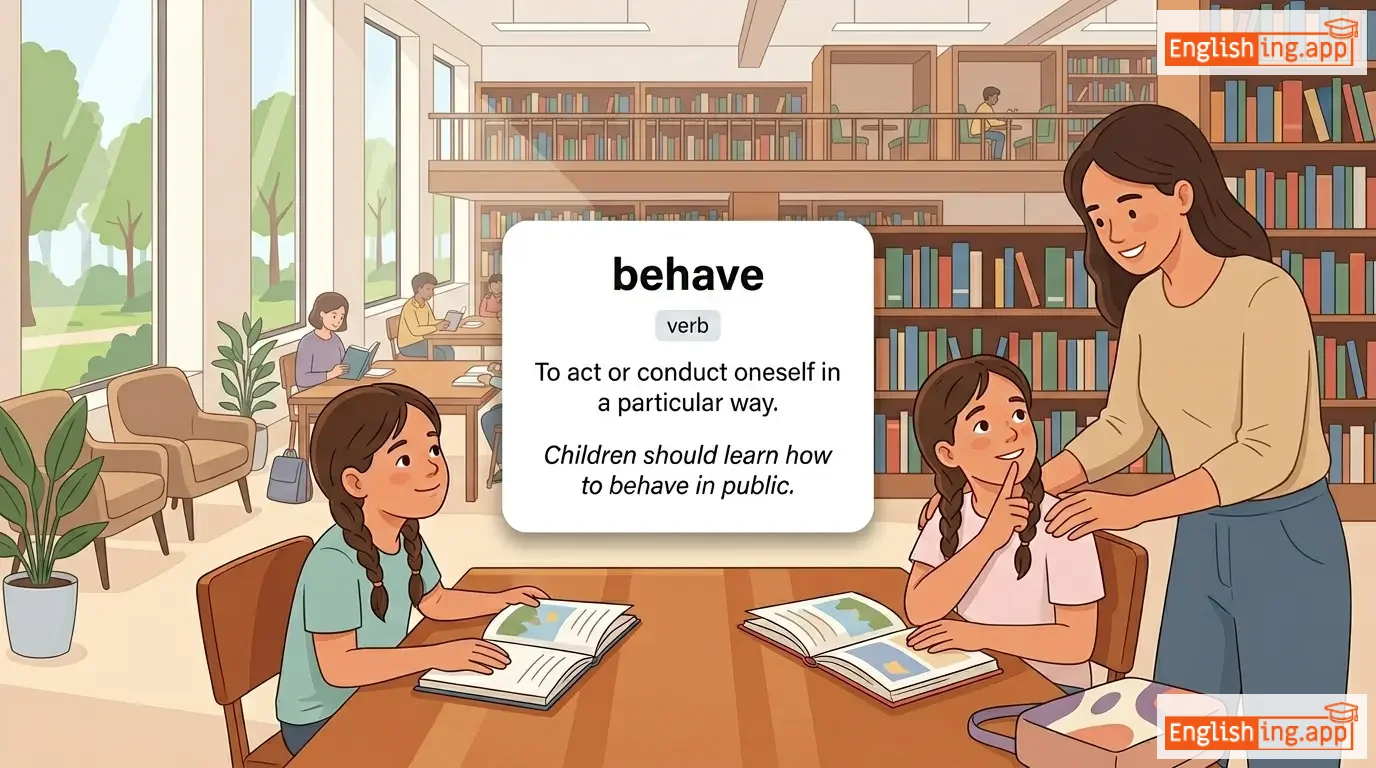
behave definition card — visual illustration of the meaning
verb
/bɪˈheɪv/
comportarse (comportarse)

To act or conduct oneself in a particular way.

"Children should learn how to behave in public."

"Los niños deben aprender cómo comportarse en público." (Los ninos deben aprender como comportarse en publico.)
noun
/bɪˈheɪvjər/
comportamiento (comportamiento)

The way in which one acts or conducts oneself, especially toward others.

"The teacher praised her good behavior in class."

"El maestro elogió su buen comportamiento en clase." (El maestro elogió su buen comportamiento en clase.)
adjective
/bɪˈheɪvjərəl/
comportamental (comportamental)

relating to the way a person or animal acts

"The psychologist studied the child's behavioral patterns."

"El psicólogo estudió los patrones de comportamiento del niño." (El psicólogo estudió los patrones de comportamiento del niño.)
noun
/bɪˈheɪ.vjər/
comportamiento (comportamiento)

the way a person or animal acts or conducts themselves

"His behaviour at the meeting was very professional."

"Su comportamiento en la reunión fue muy profesional." (Su comportamiento en la reunión fue muy profesional.)
verb
/bɪˈhɛd/
decapitar (decapitar)

to cut off a person's or animal's head; to remove the leader or most important part

"The historical account describes how the traitor was beheaded as punishment."

"El relato histórico describe cómo el traidor fue decapitado como castigo." (El relato historico describe como el traidor fue decapitado como castigo)
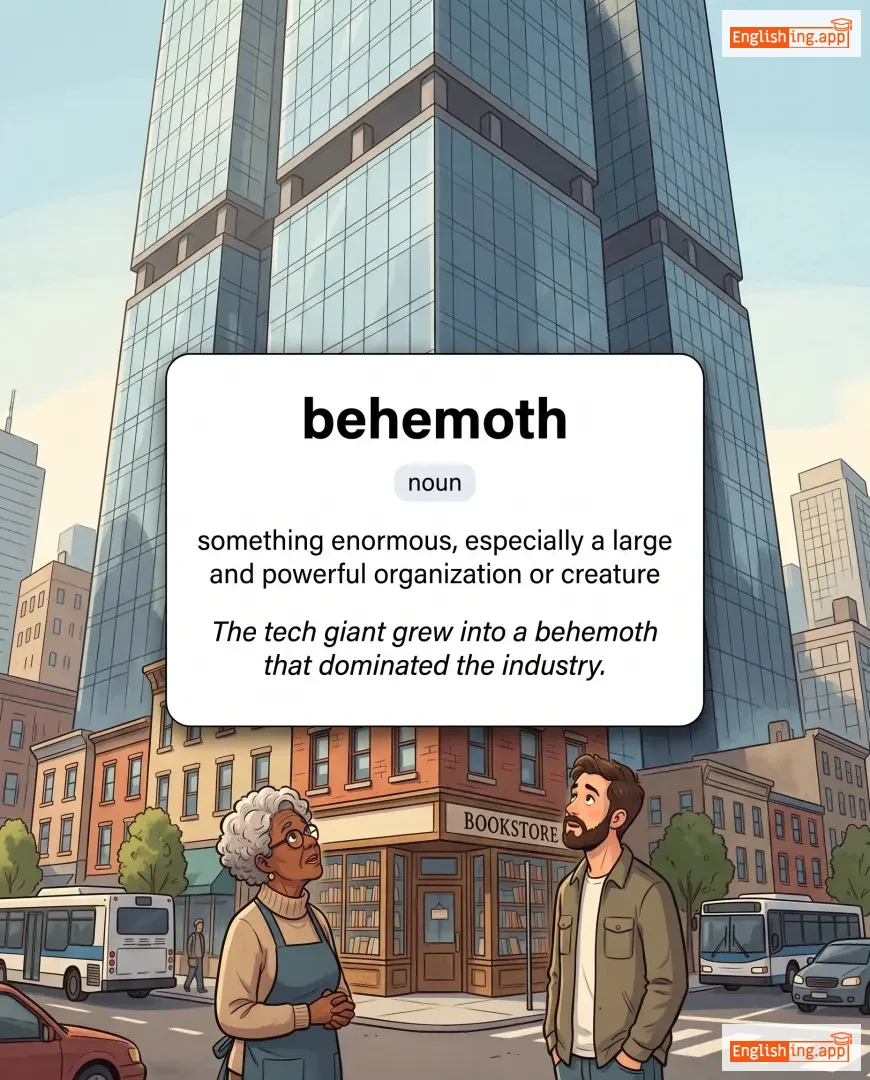
behemoth definition card — visual illustration of the meaning
noun
/bɪˈhiːməθ/
gigante, algo enorme y poderoso (gigante, algo enorme y poderoso)

something enormous, especially a large and powerful organization or creature

"The tech giant grew into a behemoth that dominated the industry."

"El gigante tecnológico creció hasta convertirse en un behemoth que dominaba la industria." (El gigante tecnologico crecio hasta convertirse en un behemoth que dominaba la industria.)
preposition/adverb
/bɪˈhaɪnd/
detrás (detras)

At or to the back of something; in a position further back.

"The cat is hiding behind the curtain."

"El gato se está escondiendo detrás de la cortina." (El gato se está escondiendo detrás de la cortina.)
verb
/bɪˈhoʊld/
contemplar; observar (contemplar; observar)

to see or observe something, especially something remarkable or impressive

"She stood quietly to behold the sunrise over the hills."

"Ella se quedó en silencio para contemplar el amanecer sobre las colinas." (Ella se quedo en silencio para contemplar el amanecer sobre las colinas)
adjective
/bɪˈhoʊldən/
agradecido o en deuda (agradecido o en deuda)

indebted or obliged to someone for a service or help

"He felt beholden to his mentor for all the guidance."

"Se sentía agradecido con su mentor por toda la orientación." (Se sentía agradecido con su mentor por toda la orientación.)
verb
/bɪˈhuːv/
ser necesario o apropiado para alguien hacer algo (ser necesario o apropiado para alguien hacer algo)

to be necessary, proper, or appropriate for someone to do

"It would behoove you to study before the exam."

"Sería conveniente que estudiaras antes del examen." (Sería conveniente que estudiaras antes del examen.)
verb
/bɪˈhuːvz/
es necesario (es necesario)

third person singular form of 'behoove'; means it is proper or necessary

"It behooves every citizen to follow the law."

"Es necesario que cada ciudadano siga la ley." (Es necesario que cada ciudadano siga la ley.)
verb
/bɪˈhəʊv/
ser apropiado (ser apropiado)

British spelling of 'behoove'; to be appropriate or necessary

"It would behove the company to listen to its customers."

"Sería apropiado que la empresa escuchara a sus clientes." (Sería apropiado que la empresa escuchara a sus clientes.)
noun/verb
/ˈbiːɪŋ/
existencia (existencia)

Existence; the state of living; a living creature.

"Kindness is part of being human."

"La amabilidad es parte de ser humano." (La amabilidad es parte de ser humano.)
verb
/bɪˈleɪbər/
exponer en exceso (exponer en exceso)

to argue or elaborate on a subject in excessive detail; to attack verbally or physically

"The professor belabored the point until the students grew restless."

"El profesor expuso tanto el punto hasta que los estudiantes se inquietaron." (El profesor expuso tanto el punto hasta que los estudiantes se inquietaron.)
verb
/bɪˈleɪbə/
recalcar en exceso (recalcar en exceso)

to explain something repeatedly or with excessive detail; to criticize or attack verbally at length

"The teacher did not belabour the point once the students understood it."

"El profesor no recalcó el punto cuando los estudiantes ya lo entendieron." (El profesor no recalco el punto cuando los estudiantes ya lo entendieron)
verb
/bɪˈleɪt/
retrasar (retrasar)

to delay or make late

"Heavy traffic belated our arrival at the party."

"El tráfico pesado retrasó nuestra llegada a la fiesta." (El trafico pesado retraso nuestra llegada a la fiesta.)
adjective
/bɪˈleɪtɪd/
tardío (tardio)

coming or happening later than expected or usual

"She sent me a belated birthday card."

"Me envió una tarjeta de cumpleaños tardía." (Me envio una tarjeta de cumpleaños tardia.)
verb
/bɪˈleɪ/
asegurar una cuerda (asegurar una cuerda)

to secure a rope by winding it around an object; to stop or cancel an order (nautical/military use)

"The climber asked his partner to belay the rope tightly."

"El escalador le pidió a su compañero que asegurara la cuerda fuertemente." (El escalador le pidió a su compañero que asegurara la cuerda fuertemente.)
😮‍💨

belch (belch)

verb; noun
/beltʃ/
eructar (eructar)

to expel air noisily from the stomach through the mouth; to emit or pour out suddenly and forcefully

"After drinking the soda, he belched loudly."

"Después de beber el refresco, eructó fuerte." (despues de beber el refresco eructo fuerte)
noun
/ˈbeɪleɪ/
pez bele (pez bele)

a type of freshwater fish found in South Asian rivers, known for its distinctive appearance

"The bele fish is commonly caught in the rivers of Bangladesh."

"El pez bele se captura comúnmente en los ríos de Bangladés." (el pez bele se kaptura komunmente en los rios de Banglades)
verb
/bɪˈliːɡər/
asediar, hostigar (asediar, hostigar)

to cause difficulties, troubles, or harassment; to surround with military forces

"The company was beleaguered by constant complaints from its customers."

"La empresa estaba siendo asediada por constantes quejas de sus clientes." (La empresa estaba siendo asediada por constantes quejas de sus clientes.)
noun
/ˈbɛlfri/
campanario (campanario)

A bell tower, especially one attached to a church or building.

"The church belfry housed a large bronze bell."

"El campanario de la iglesia albergaba una gran campana de bronce." (El campanario de la iglesia albergaba una gran campana de bronce.)
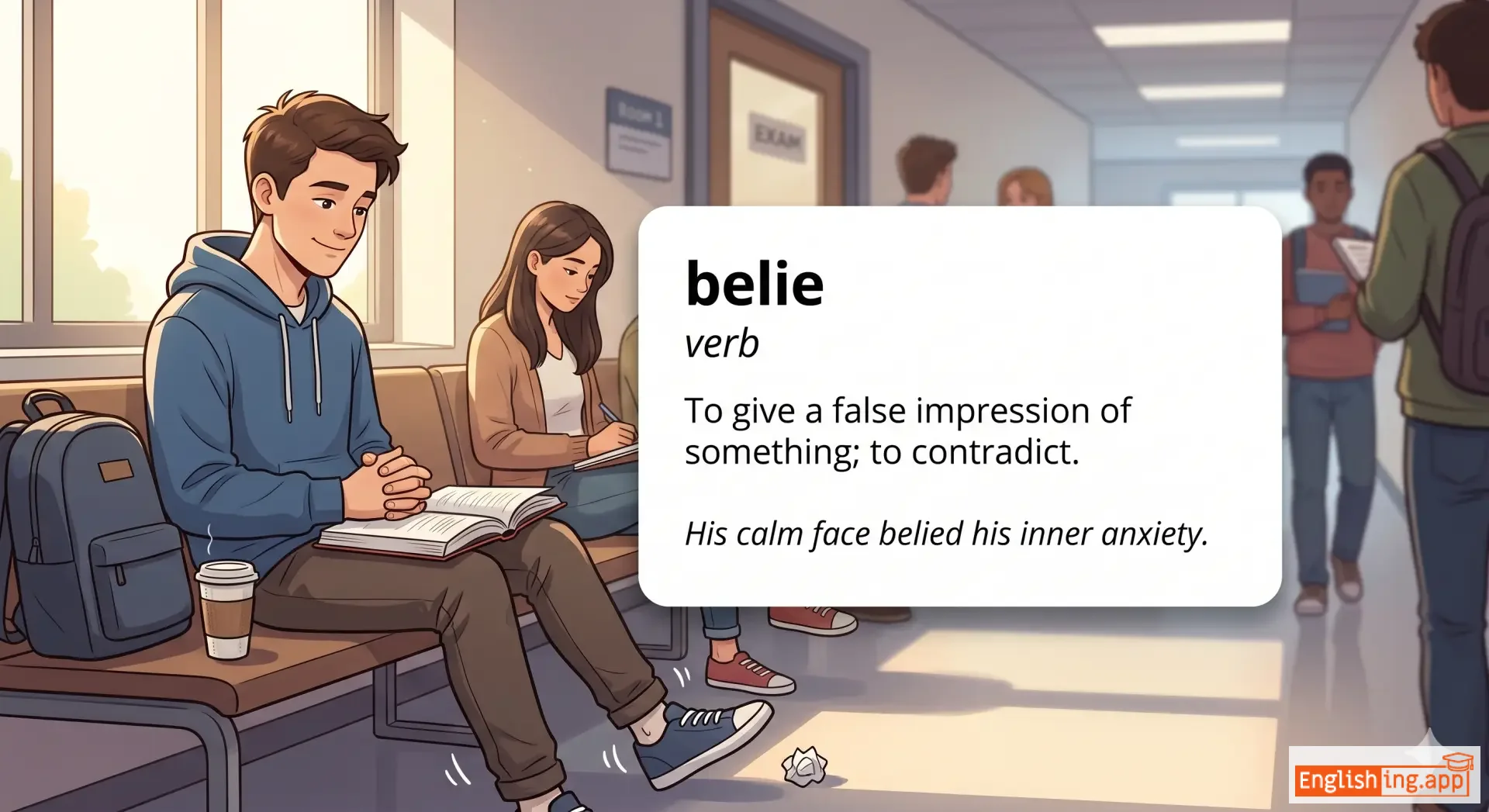
belie definition card — visual illustration of the meaning
verb
/bɪˈlaɪ/
desmentir (desmentir)

To give a false impression of something; to contradict.

"His calm face belied his inner anxiety."

"Su rostro tranquilo desmentía su ansiedad interna." (Su rostro tranquilo desmentía su ansiedad interna.)
noun
/bɪˈliːf/
creencia (creencia)

an acceptance that something exists or is true, especially without proof

"Her belief in kindness inspired many people."

"Su creencia en la bondad inspiró a muchas personas." (Su creencia en la bondad inspiro a muchas personas.)
adjective
/bɪˈliːvəbl̩/
creíble (creible)

Able to be trusted or accepted as true or reasonable.

"Her story was so detailed that it sounded believable."

"Su historia era tan detallada que sonaba creíble." (Su historia era tan detallada que sonaba creíble.)
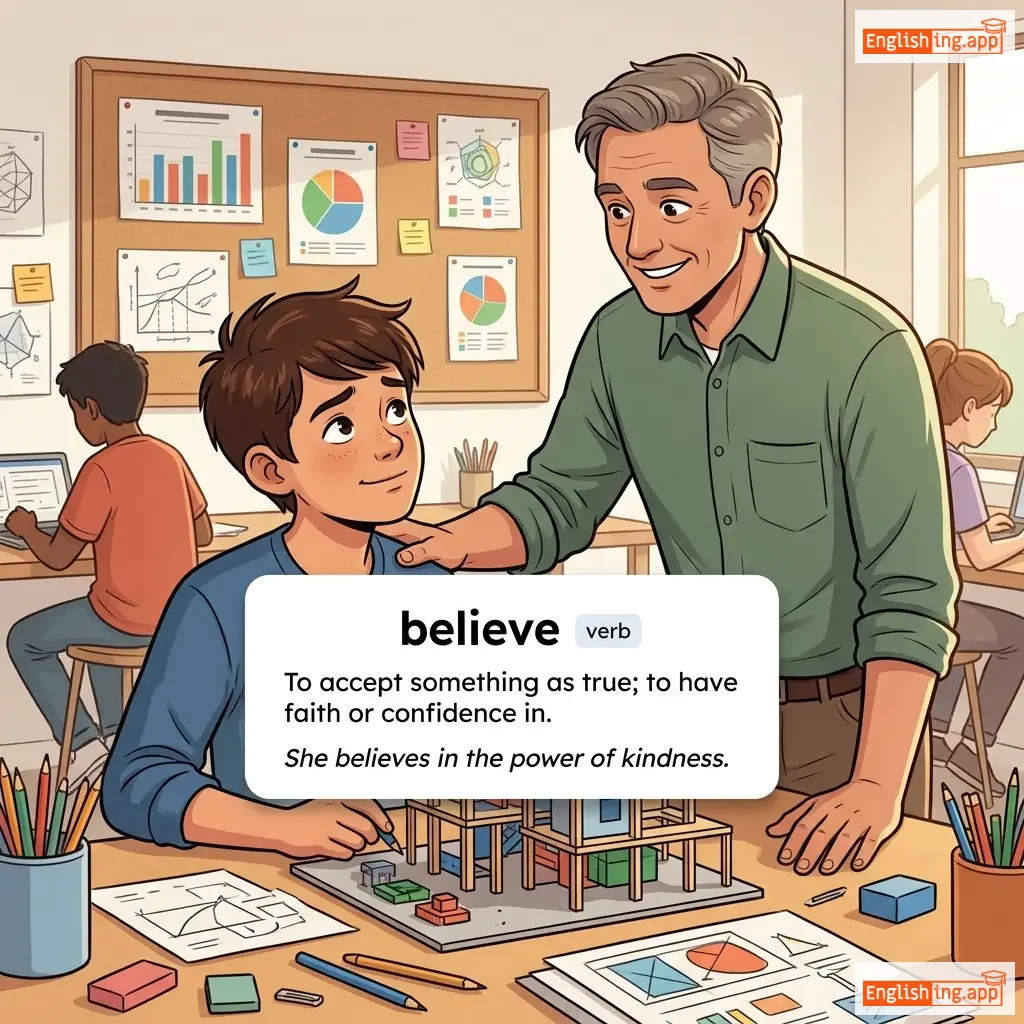
believe definition card — visual illustration of the meaning
verb
/bɪˈliːv/
creer (kreer)

To accept something as true; to have faith or confidence in.

"She believes in the power of kindness."

"Ella cree en el poder de la bondad." (Ella cree en el poder de la bondad.)