Vocabularios

Descubra, aprenda y domine el vocabulario en inglés

noun
/əˈmɛrɪkəˌnɪzəm/
americanismo (americanismo)

A word, phrase, or practice characteristic of American English or culture.

"The term 'sidewalk' is an Americanism, while 'pavement' is used in British English."

"El término 'sidewalk' es un americanismo, mientras que 'pavement' se usa en el inglés británico." (El termino 'sidewalk' es un americanismo, mientras que 'pavement' se usa en el ingles britanico.)
adjective
/ˈeɪmiəbəl/
amable (amable)

Having a friendly and pleasant manner.

"She has an amiable personality that makes her well-liked by everyone."

"Ella tiene una personalidad amable que la hace querida por todos." (Ella tiene una personalidad amable que la hace querida por todos.)
adverb
/ˈeɪ.mi.ə.bli/
amistosamente, de manera amistosa (amistosamente, de manera amistosa)

in a friendly and pleasant manner

"They discussed the issue amiably without any arguments."

"Ellos discutieron el tema amigablemente sin discusiones." (Ellos discutieron el tema amigablemente sin discusiones.)
amicable definition card — visual illustration of the meaning
adjective
/ˈæmɪkəbəl/
amistoso (amistoso)

Friendly and peaceful, especially in resolving conflicts.

"The two companies reached an amicable agreement after months of negotiation."

"Las dos empresas llegaron a un acuerdo amistoso después de meses de negociaciones." (Las dos empresas llegaron a un acuerdo amistoso despues de meses de negociaciones.)
adverb
/ˈæm.ɪ.kə.bli/
amistosamente (amistosamente)

in a friendly way without anger or resentment

"The divorce was settled amicably between both parties."

"El divorcio se resolvió amistosamente entre ambas partes." (El divorcio se resolvió amistosamente entre ambas partes.)
preposition
/əˈmɪd/
en medio de (en medio de)

in the middle of or surrounded by something

"The team stayed calm amid the chaos."

"El equipo permaneció tranquilo en medio del caos." (El equipo permaneció tranquilo en medio del caos.)
adjective/adverb
/əˈmɪs/
equivocado (equivocado)

Not quite right; inappropriate or out of place.

"Something seems amiss with the car's engine."

"Parece haber algo equivocado con el motor del coche." (Parece haber algo equivocado con el motor del coche.)
noun
/ˈæmɪti/
amistad (amistad)

A friendly relationship between people or countries.

"The treaty helped maintain amity between the neighboring nations."

"El tratado ayudó a mantener la amistad entre las naciones vecinas." (El tratado ayudo a mantener la amistad entre las naciones vecinas.)
noun
/æmˈniːʒə/
amnesia (amnesia)

A partial or total loss of memory, usually caused by injury, illness, or psychological trauma.

"After the accident, she suffered from amnesia and could not remember her own name."

"Después del accidente, sufrió de amnesia y no pudo recordar su propio nombre." (Despues del accidente, sufrio de amnesia y no pudo recordar su propio nombre.)
noun
/ˈæmnəsti/
amnistía (amnistia)

An official pardon granted to people who have been convicted of political offenses.

"The government announced an amnesty for all political prisoners."

"El gobierno anunció una amnistía para todos los prisioneros políticos." (El gobierno anuncio una amnistia para todos los prisioneros politicos.)
adverb
/əˈmʌk/
descontroladamente (descontroladamente)

Behaving uncontrollably and disruptively.

"The angry mob ran amok after the verdict was announced."

"La multitud enojada corrió descontroladamente después de que se anunció el veredicto." (La multitud enojada corrió descontroladamente después de que se anunció el veredicto.)
preposition
/əˈmʌŋ/
entre (entre)

surrounded by; in the middle of a group

"He was sitting among his friends."

"Él estaba sentado entre sus amigos." (Él estaba sentado entre sus amigos.)
adjective
/ˌeɪˈmɔːrəl/
amoral (amoral)

Lacking a moral sense; unconcerned with rightness or wrongness of something.

"The character in the novel was portrayed as completely amoral."

"El personaje en la novela fue retratado como completamente amoral." (El personaje en la novela fue retratado como completamente amoral.)
adverb
/ˌeɪˈmɔːrəli/
inmoralmente (inmoralmente)

In a way that shows no concern about whether behavior is morally right or wrong.

"He acted amorally, ignoring the consequences of his actions."

"Actuó inmoralmente, ignorando las consecuencias de sus acciones." (Actuó inmoralmente, ignorando las consecuencias de sus acciones.)
adjective
/ˈæmərəs/
amoroso (amoroso)

Showing, feeling, or relating to romantic love or desire.

"He sent her an amorous letter filled with declarations of love."

"Él le envió una carta amorosa llena de declaraciones de amor." (El le envió una carta amorosa llena de declaraciones de amor.)
adjective
/əˈmɔːrfəs/
amórfico (amorfiko)

Lacking a clear shape or form; without a defined structure.

"The plan remained amorphous and lacked concrete details."

"El plan permaneció amorfo y carecía de detalles concretos." (El plan permaneció amorfo y carecía de detalles concretos.)
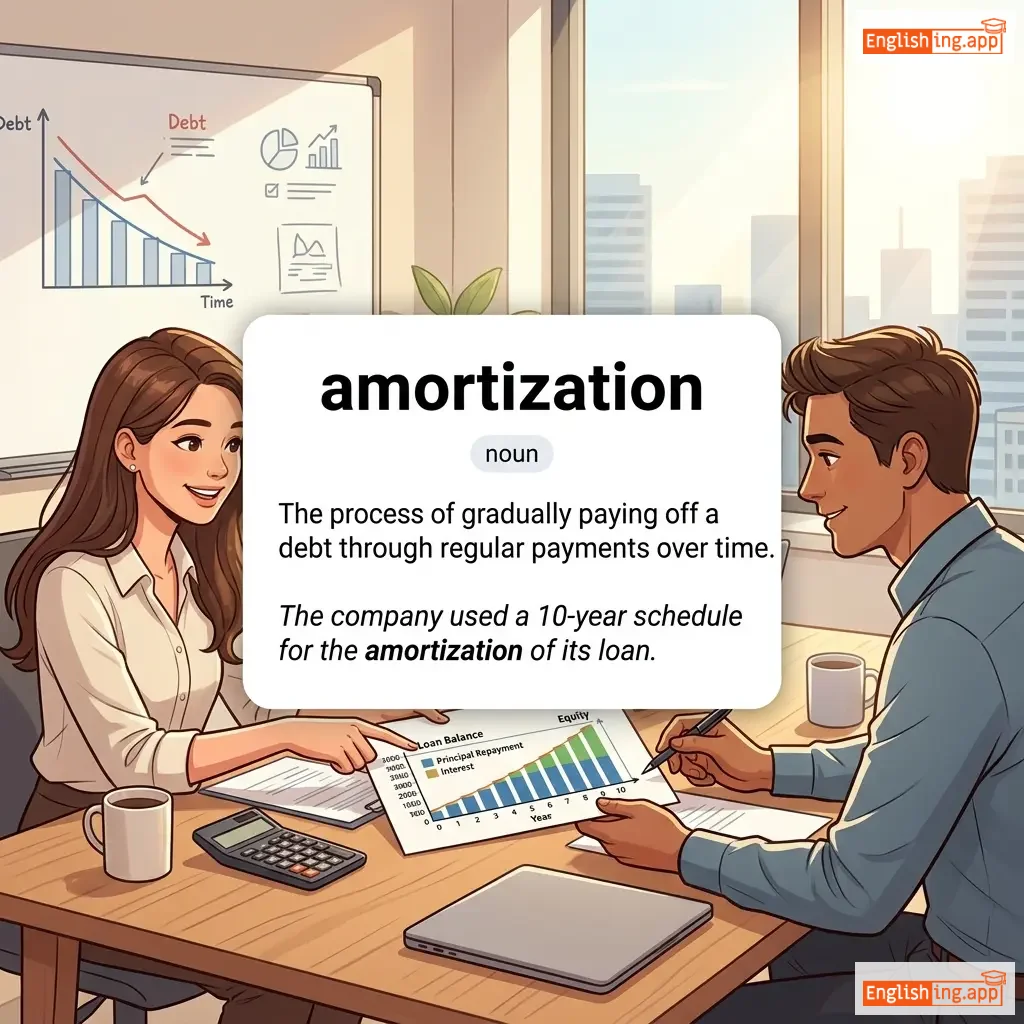
amortization definition card — visual illustration of the meaning
noun
/əˌmɔːrtəˈzeɪʃən/
amortización de la deuda (amortizacion de la deuda)

The process of gradually paying off a debt through regular payments over time.

"The company used a 10-year schedule for the amortization of its loan."

"La empresa utilizó un programa de 10 años para la amortización de su préstamo." (La empresa utilizó un programa de 10 años para la amortización de su préstamo.)
verb
/ˈæmərˌtaɪz/
amortizar (amortizar)

To gradually reduce or pay off a debt with regular payments.

"They plan to amortize the mortgage over 20 years."

"Ellos planean amortizar la hipoteca en 20 años." (Ellos planean amortizar la hipoteca en 20 años.)
noun/verb
/əˈmaʊnt/
cantidad (cantidad)

a quantity of something, typically the total of a thing or things in number, size, value, or extent

"The total amount of money is not enough."

"La cantidad total de dinero no es suficiente." (La cantidad total de dinero no es suficiente.)
noun
/əˈmʊr/
amor secreto (amor secreto)

A secret or illicit love affair.

"The novel tells the story of a forbidden amour between two characters."

"La novela cuenta la historia de un amor prohibido entre dos personajes." (La novela cuenta la historia de un amor prohibido entre dos personajes.)
noun
/ˈæmpɛər/
ámper (amper)

A unit of electric current in the International System of Units (SI), symbolized as A.

"The current flowing through the wire is measured in amperes."

"La corriente que fluye a través del cable se mide en amperios." (La corriente que fluye a través del cable se mide en amperios.)
noun
/ˈæmpərˌsænd/
ampersand (ampersand)

The symbol '&' used to represent the word 'and'.

"Use an ampersand instead of writing the word 'and' in the company name."

"Usa un ampersand en lugar de escribir la palabra 'y' en el nombre de la empresa." (Usa un ampersand en lugar de escribir la palabra 'y' en el nombre de la empresa.)
noun
/æmˈfɪbiən/
anfibio (anfibio)

A cold-blooded vertebrate animal that can live both on land and in water.

"A frog is a common amphibian that lives both in water and on land."

"Una rana es un anfibio común que vive tanto en el agua como en la tierra." (Una rana es un anfibio comun que vive tanto en el agua como en la tierra.)
adjective
/æmˈfɪbiəs/
anfibio (anfibio)

Able to live or operate both on land and in water.

"The army used amphibious vehicles to cross the river."

"El ejército usó vehículos anfibios para cruzar el río." (El ejercito uso vehiculos anfibios para cruzar el rio.)
noun
/ˈæmfɪˌθiətər/
anfiteatro (anfiteatro)

A large open circular or oval building with rising tiers of seats, used for public events.

"The concert was held in an ancient amphitheater."

"El concierto se celebró en un antiguo anfiteatro." (El concierto se celebró en un antiguo anfiteatro.)
adjective
/ˈæmpəl/
abundante (abundante)

more than enough; plentiful; abundant

"There was ample food for everyone at the party."

"Había suficiente comida para todos en la fiesta." (Había suficiente comida para todos en la fiesta.)
noun
/ˌæmplɪfɪˈkeɪʃən/
amplificación (amplificacion)

the act or process of making something stronger, louder, or more intense; an expansion or elaboration of details

"The microphone provides amplification of the speaker’s voice."

"El micrófono proporciona amplificación de la voz del orador." (el microfono proporciona amplificacion de la voz del orador)
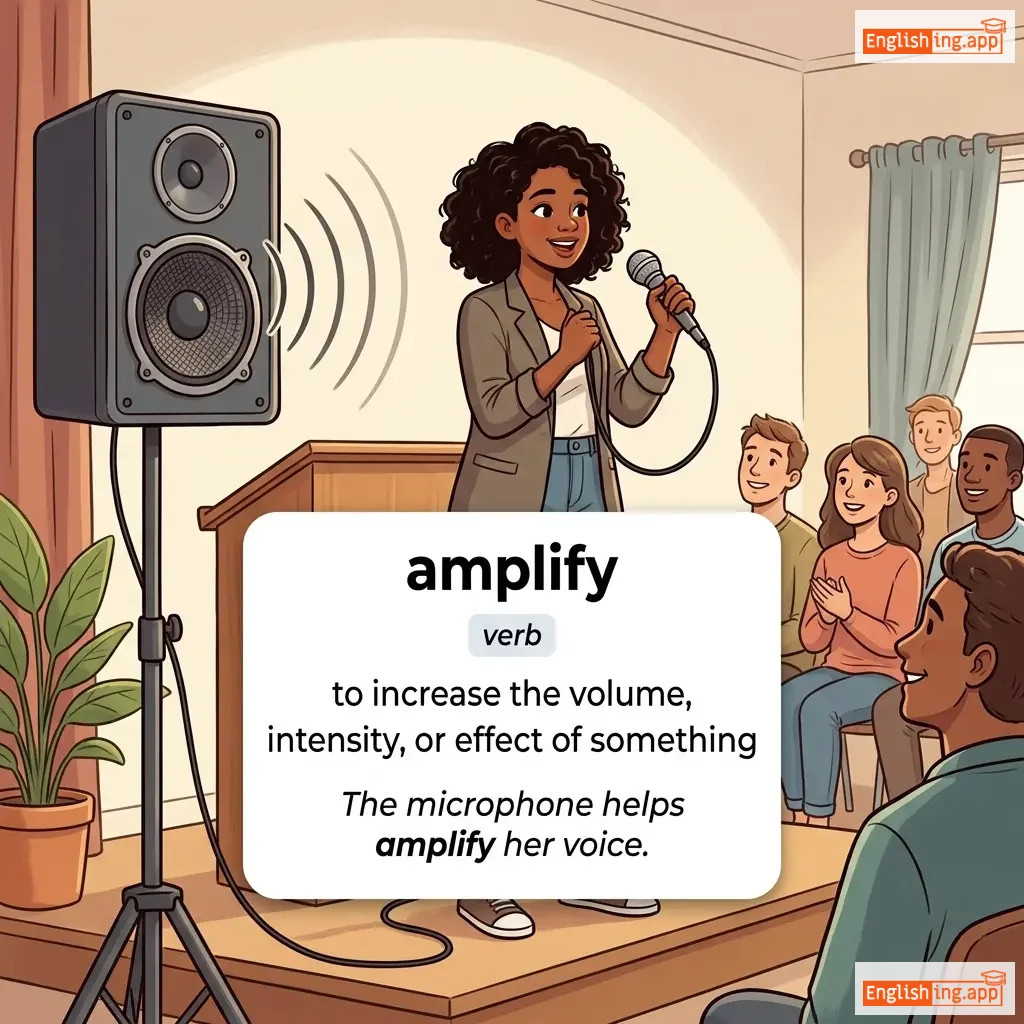
amplify definition card — visual illustration of the meaning
verb
/ˈæmplɪfaɪ/
amplificar (amplificar)

to increase the volume, intensity, or effect of something

"The microphone helps amplify her voice."

"El micrófono ayuda a amplificar su voz." (El microfono ayuda a amplificar su voz.)
noun
/ˈæmplɪtjuːd/
amplitud (amplitud)

the maximum extent of a vibration or oscillation, or the size of something

"The amplitude of the earthquake was measured on the Richter scale."

"La amplitud del terremoto fue medida en la escala de Richter." (La amplitud del terremoto fue medida en la escala de Richter.)
adverb
/ˈæmpli/
ampliamente (ampliamente)

more than sufficiently; generously

"She was amply rewarded for her hard work."

"Ella fue generosamente recompensada por su arduo trabajo." (Ella fue generosamente recompensada por su arduo trabajo.)
verb
/ˈæmpjʊteɪt/
amputar (amputar)

to cut off a limb from the body by surgery

"The doctors had to amputate his leg after the accident."

"Los médicos tuvieron que amputar su pierna después del accidente." (Los médicos tuvieron que amputar su pierna después del accidente.)
adverb
/əˈmʌk/
de manera descontrolada (de manera descontrolada)

in a frenzied, uncontrolled, or chaotic manner

"The bull ran amuck through the village."

"El toro corrió de manera descontrolada por el pueblo." (El toro corrió de manera descontrolada por el pueblo.)
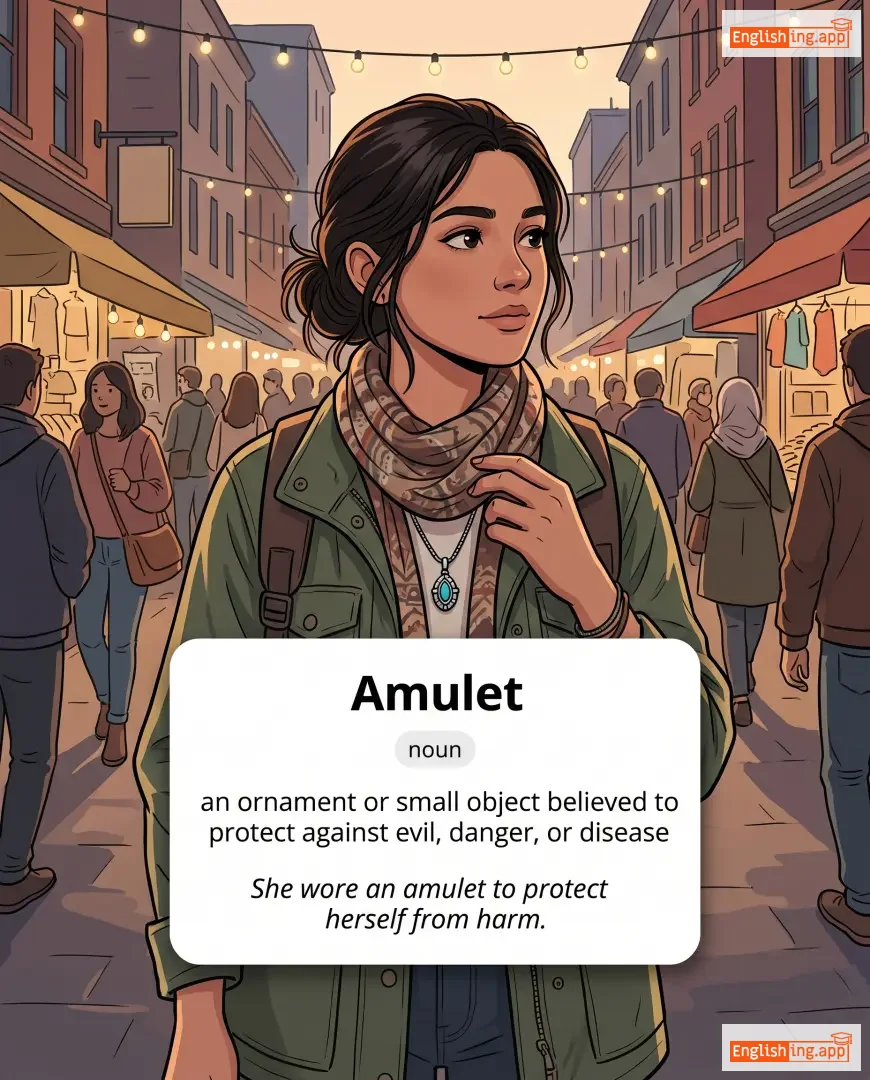
Amulet definition card — visual illustration of the meaning
noun
/ˈæmjʊlət/
amuletos (amuletos)

an ornament or small object believed to protect against evil, danger, or disease

"She wore an amulet to protect herself from harm."

"Ella llevaba un amuleto para protegerse del daño." (Ella llevaba un amuleto para protegerse del daño.)
verb
/əˈmjuːz/
entretener (entretener)

to entertain or make someone laugh or smile; to occupy pleasantly

"The clown amused the children at the party."

"El payaso entretuvo a los niños en la fiesta." (el payaso entretuvo a los ninos en la fiesta)
noun
/əˈmjuːzmənt/

the state of being entertained or finding something funny

"The children watched the clown with great amusement."

adjective
/əˈmjuːzɪŋ/
divertido (divertido)

causing laughter or amusement

"The movie was very amusing, and I laughed a lot."

"La película fue muy divertida, y me reí mucho." (La pelicula fue muy divertida, y me rei mucho.)
🅰️

an (an)

article
/æn/
un/una (un/una)

used before a noun to refer to a non-specific item that begins with a vowel sound

"She ate an apple for breakfast."

"Ella comió una manzana para el desayuno." (ella comio una manzana para el desayuno)
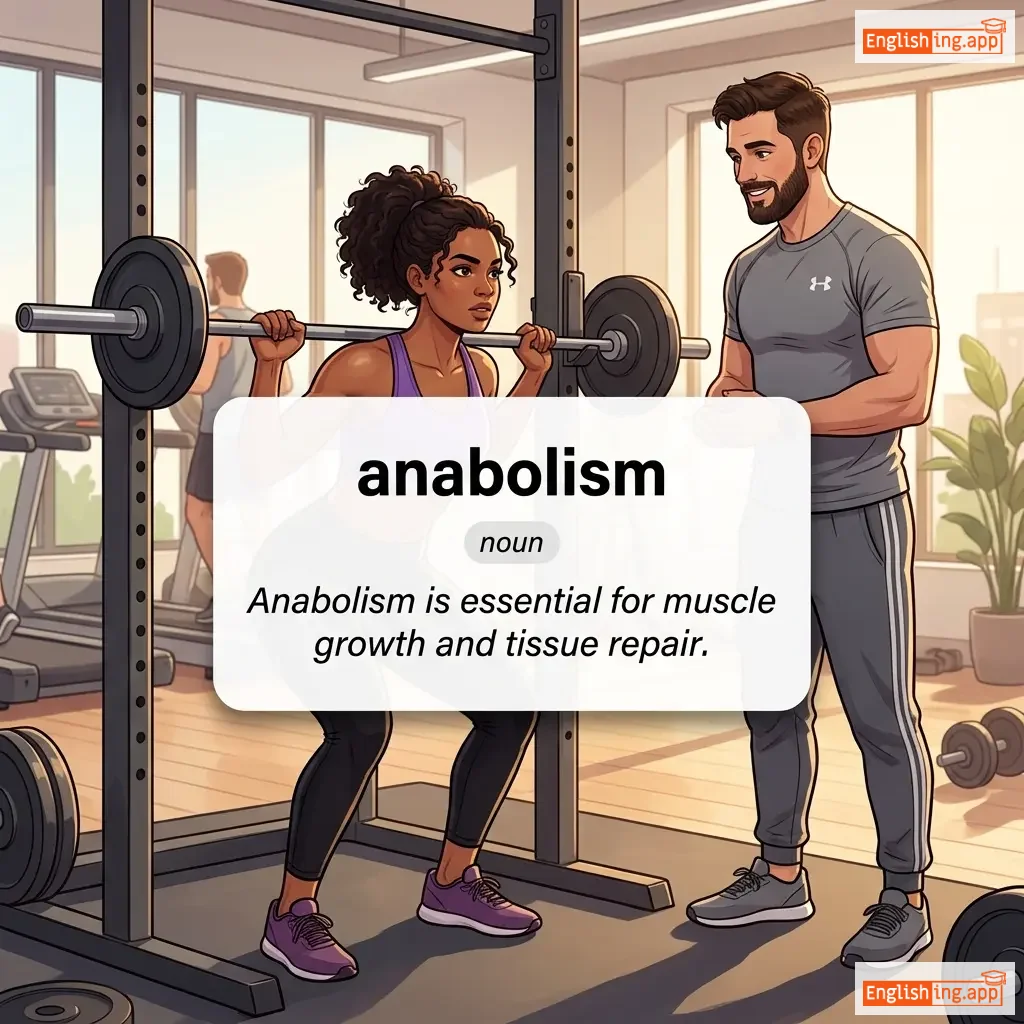
anabolism definition card — visual illustration of the meaning
noun
/əˈnæb.ə.lɪ.zəm/
anabolismo (anabolismo)

The set of metabolic pathways that construct molecules from smaller units, involving tissue repair and growth.

"Anabolism is essential for muscle growth and tissue repair."

"El anabolismo es esencial para el crecimiento muscular y la reparación de tejidos." (El anabolismo es esencial para el crecimiento muscular y la reparacion de tejidos.)
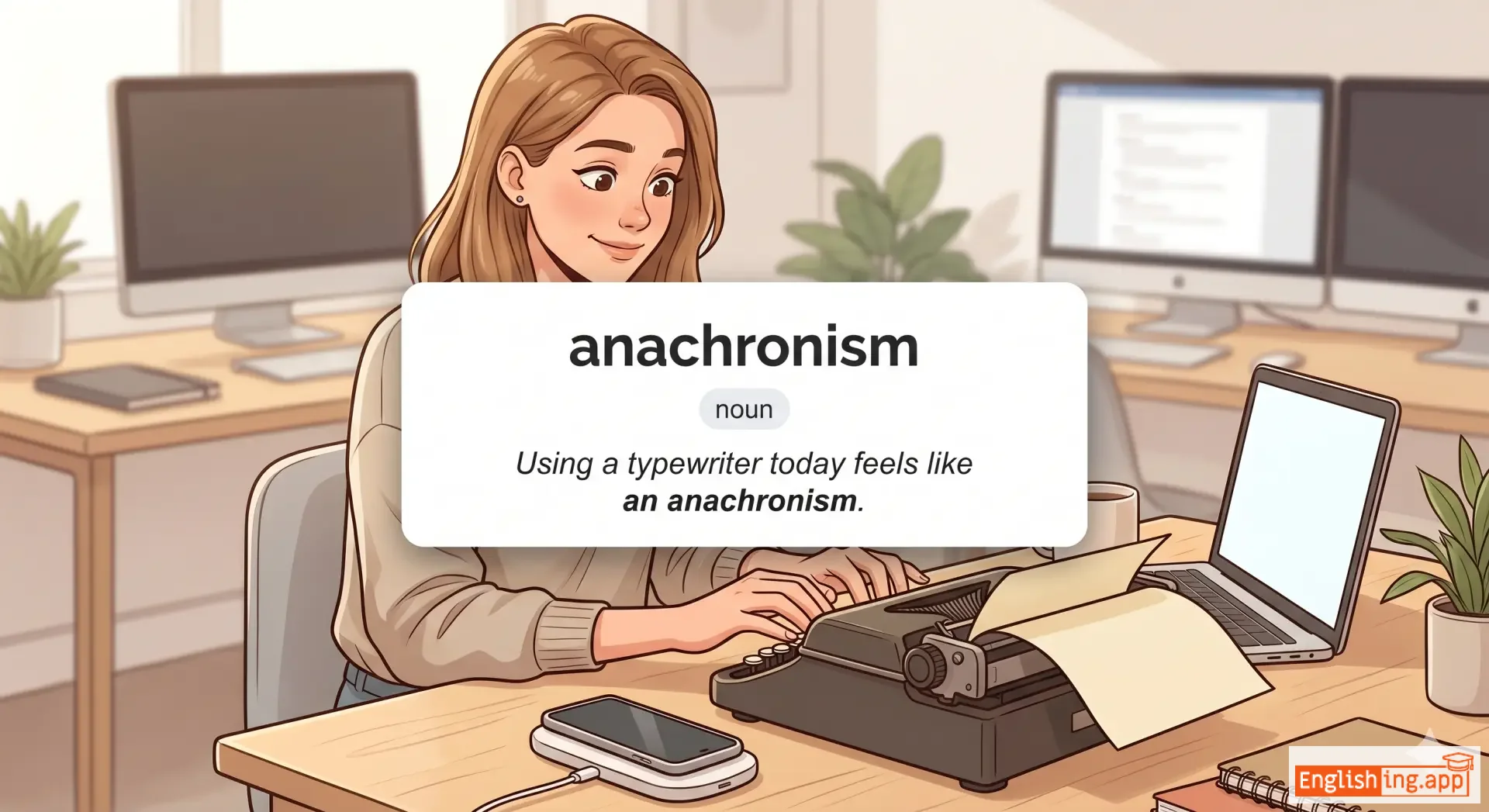
anachronism definition card — visual illustration of the meaning
noun
/əˈnækrəˌnɪzəm/
anacronismo (uhnakrohnizuhm)

something that is out of its proper time period, especially something old-fashioned in a modern context

"Using a typewriter today feels like an anachronism."

"Usar una máquina de escribir hoy se siente como un anacronismo." (Usar una maquina de escribir hoy se siente como un anacronismo)
adjective
/əˌnækrəˈnɪstɪk/
anacrónico (anacronico)

belonging to a period other than that being portrayed; old-fashioned or outdated

"His views on gender roles are considered anachronistic."

"Sus puntos de vista sobre los roles de género se consideran anacrónicos." (Sus puntos de vista sobre los roles de género se consideran anacrónicos.)
noun
/ˈænəɡræm/
una palabra o frase formada reordenando las letras de otra palabra o frase. (una palabra o frase formada reordenando las letras de otra palabra o frase)

A word or phrase formed by rearranging the letters of another word or phrase.

"The word 'listen' is an anagram of 'silent'."

"La palabra 'listen' es un anagrama de 'silent'." (La palabra 'listen' es un anagrama de 'silent'.)
noun
/ˌænəlˈdʒiːziə/
analgesia (analgesia)

The inability to feel pain while still conscious.

"The doctor induced analgesia before performing the procedure."

"El doctor indujo la analgesia antes de realizar el procedimiento." (El doctor indujo la analgesia antes de realizar el procedimiento.)
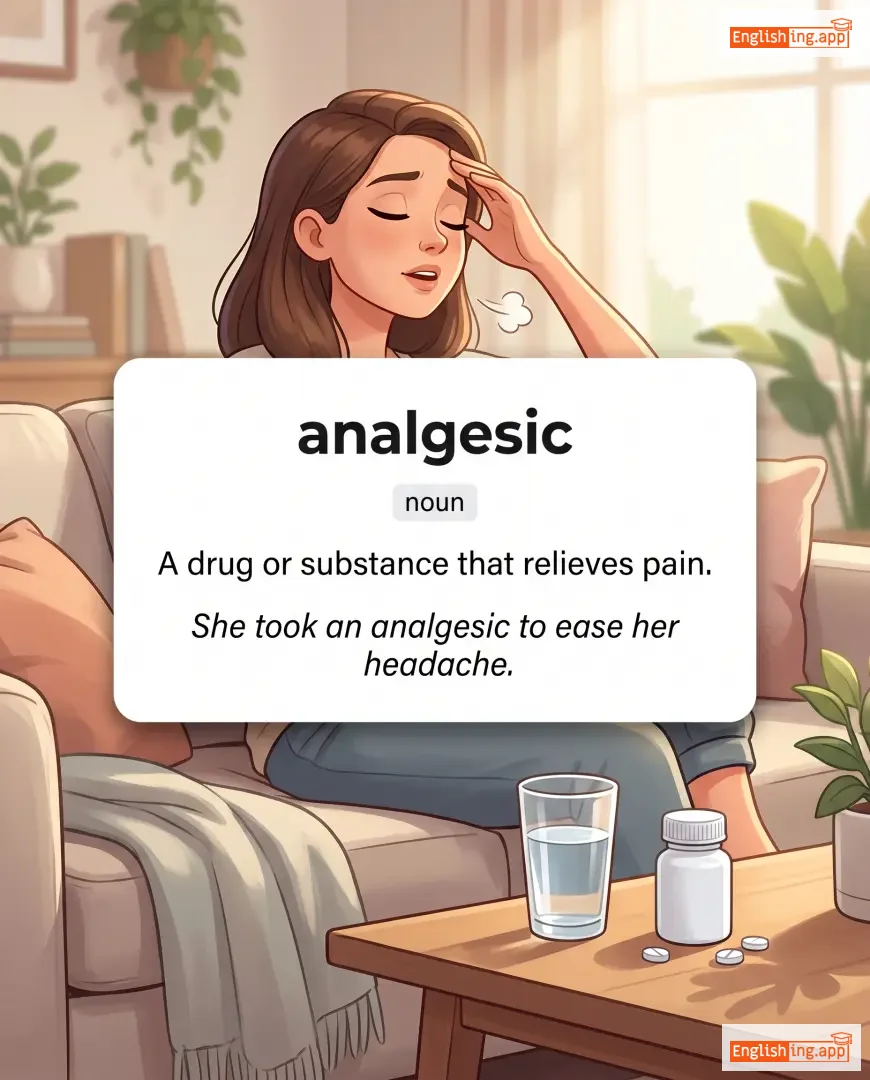
analgesic definition card — visual illustration of the meaning
noun
/ˌænəlˈdʒiːzɪk/
analgésico (analgesico)

A drug or substance that relieves pain.

"She took an analgesic to ease her headache."

"Ella tomó un analgésico para aliviar su dolor de cabeza." (Ella tomo un analgesico para aliviar su dolor de cabeza.)
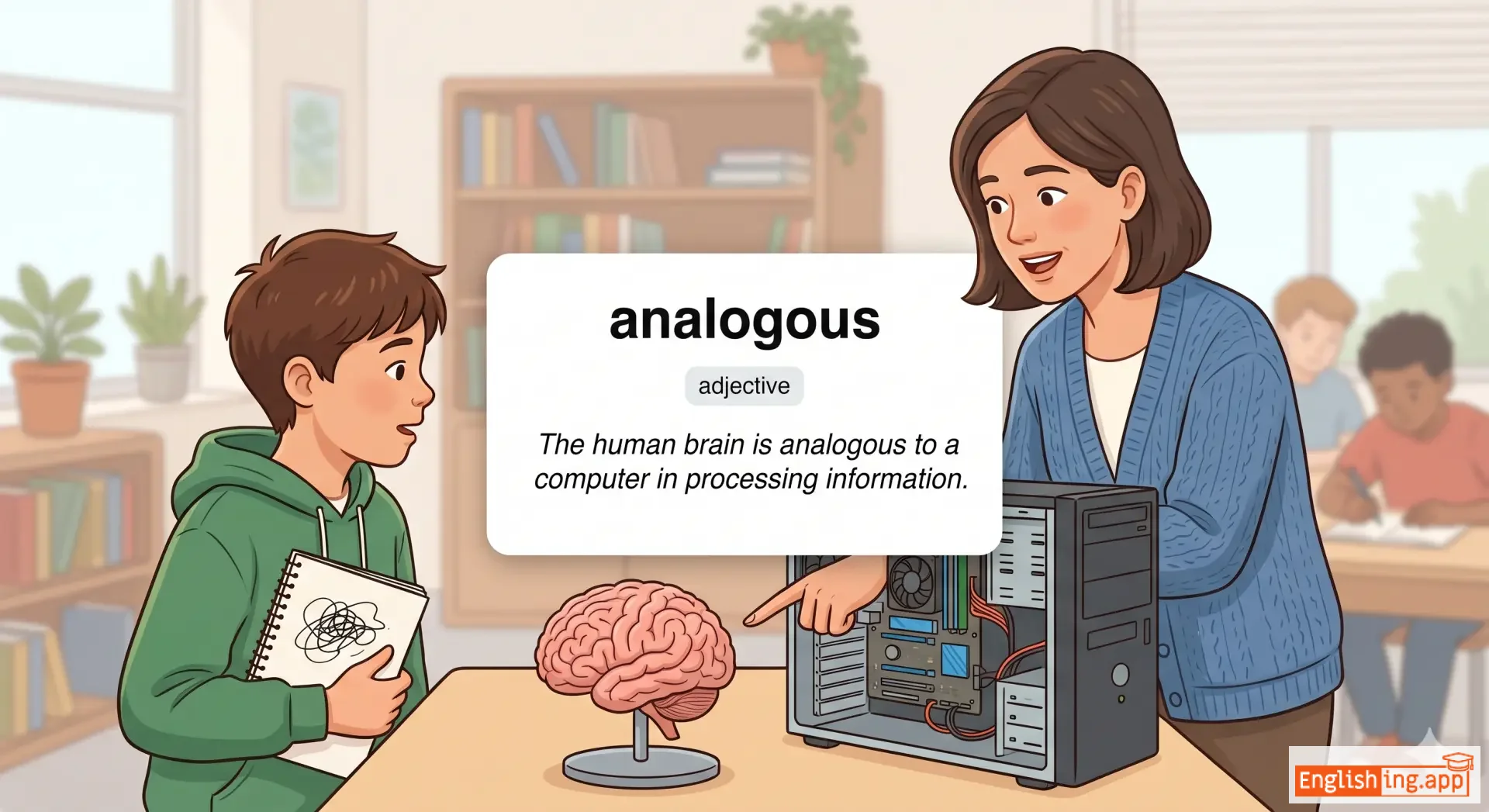
analogous definition card — visual illustration of the meaning
adjective
/əˈnæləɡəs/

Comparable in certain respects, typically in a way that makes clearer the nature of the things compared.

"The human brain is analogous to a computer in processing information."

noun
/əˈnælədʒi/
analogía (analogía)

A comparison between two things for the purpose of explanation or clarification.

"The teacher used the analogy of a tree to explain the structure of an essay."

"El maestro utilizó la analogía de un árbol para explicar la estructura de un ensayo." (El maestro utilizo la analogia de un arbol para explicar la estructura de un ensayo.)
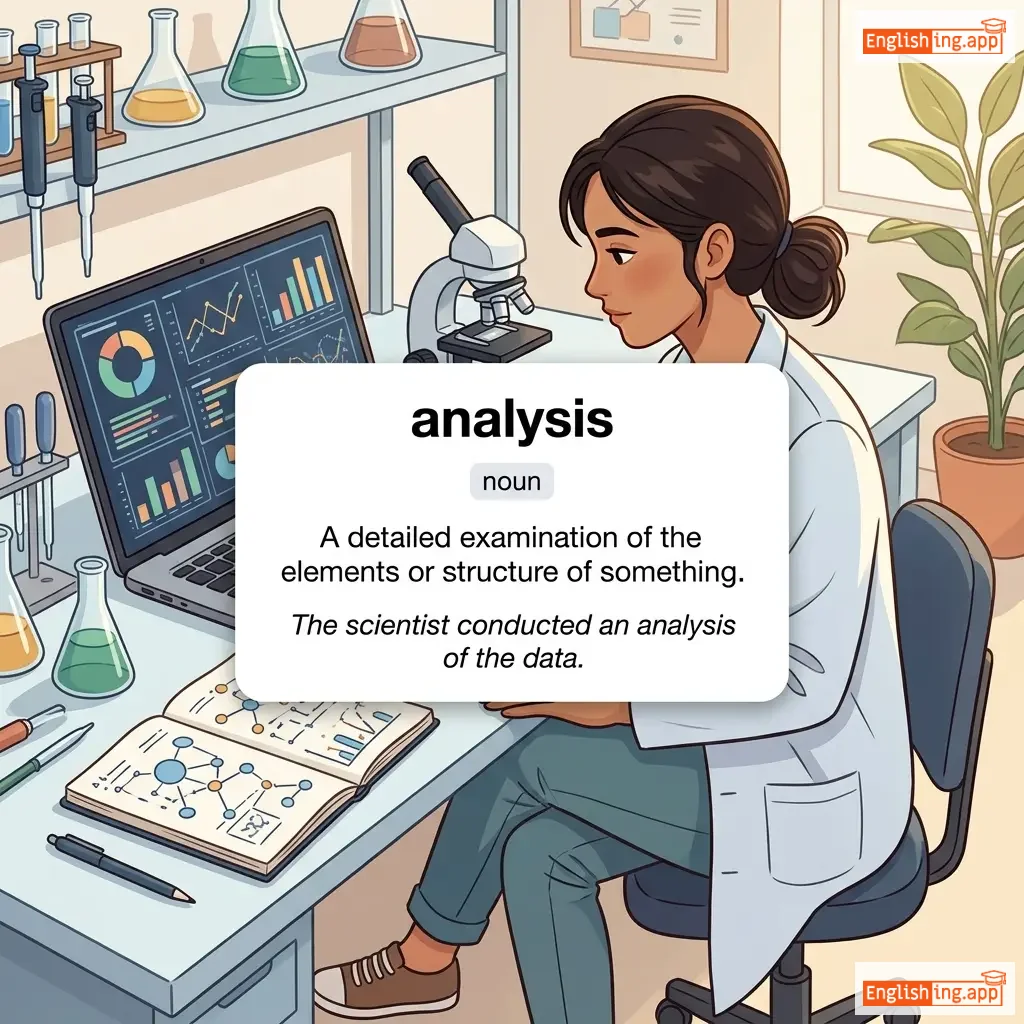
analysis definition card — visual illustration of the meaning
noun
/əˈnæləsɪs/
análisis (analisis)

A detailed examination of the elements or structure of something.

"The scientist conducted an analysis of the data."

"El científico realizó un análisis de los datos." (El científico realizó un análisis de los datos.)
noun
/ˈænəlɪst/
analista (analista)

a person who studies or examines something carefully to understand it or make decisions

"The financial analyst predicted a rise in the stock market."

"El analista financiero predijo un aumento en el mercado de valores." (El analista financiero predijo un aumento en el mercado de valores.)
analytical definition card — visual illustration of the meaning
adjective
ˌæn.əˈlɪt.ɪ.kəl
analítico (analitico)

Using analysis or logical reasoning; characterized by the use of analysis.

"His analytical approach helped solve the problem."

"Su enfoque analítico ayudó a resolver el problema." (Su enfoque analitico ayudo a resolver el problema.)
verb
/ˈænəlaɪz/
analizar (analizar)

to examine something in detail to understand it better or draw conclusions

"Scientists analyze data to discover new patterns."

"Los científicos analizan los datos para descubrir nuevos patrones." (Los cientificos analizan los datos para descubrir nuevos patrones.)
noun
/ˈænərkɪst/
anarquista (anarquista)

a person who believes in or promotes the absence of government or authority

"The anarchist group protested against state control."

"El grupo anarquista protestó contra el control estatal." (El grupo anarquista protestó contra el control estatal.)