Получите неограниченный доступ ко всем словам с подпиской Pro
Обновить до ProПолучите неограниченный доступ ко всем предложениям с подпиской Pro
Обновить до Pro|
Эмодзи
|
Слово | Images | Перевод | Прошедшее | Причастие прошедшего времени | Третье лицо единственного числа | Герундий | Значение | Пример предложения | Перевод примера предложения | Пример выражения | Значение примера выражения | Перевод примера выражения | Синонимы | Антонимы | Коллокации | Мнемоника |
|---|---|---|---|---|---|---|---|---|---|---|---|---|---|---|---|---|---|
|
😒
••••••
|
/əˈnɔɪɪŋ/
adjective
(энойинг)
••••••
|
- •••••• |
раздражающий
razdrazhayushchiy
••••••
|
- •••••• | - •••••• | - •••••• | - •••••• |
causing irritation or mild anger; bothersome or troublesome
••••••
|
The constant noise from the street was extremely annoying.
Зе констант нойз фром зе стрит уоз экстремли энойинг.
••••••
|
Постоянный шум с улицы был очень раздражающим.
postoyannyy shum s ulitsy byl ochen razdrazhayushchim
••••••
|
annoying habit
энойинг хэбит
••••••
|
a behavior that repeatedly irritates others
••••••
|
раздражающая привычка
razdrazhayushchaya privychka
••••••
|
irritating, bothersome, frustrating, vexing, troublesome
••••••
|
pleasant, agreeable, enjoyable
••••••
|
annoying noise, annoying habit, annoying problem, really annoying
••••••
|
Annoying = раздражающий, сразу злит
••••••
|
|
📅
••••••
|
/ˈæn.ju.əl/
adjective
(аннуал)
••••••
|
- •••••• |
ежегодный
ezhegodny
••••••
|
- •••••• | - •••••• | - •••••• | - •••••• |
happening once every year
••••••
|
The company holds an annual meeting for all its shareholders. |
Компания проводит ежегодное собрание для всех своих акционеров.
Kompaniya proyvodit ezhegodnoe sobranie dlya vsekh svoikh aktsionerov.
••••••
|
annual tradition |
a custom or event repeated every year
••••••
|
ежегодная традиция
ezhegodnaya traditsiya
••••••
|
yearly, once-a-year, periodic, regular
••••••
|
monthly, daily
••••••
|
annual meeting, annual report, annual budget, annual celebration
••••••
|
Annual – это ежегодно, как ‘ANNUAl' каждый год’.
••••••
|
|
📅
••••••
|
/ˈænjuəli/
adverb
(аннуали)
••••••
|
- •••••• |
ежегодно
ezhegodno
••••••
|
- •••••• | - •••••• | - •••••• | - •••••• |
once every year; yearly
••••••
|
The company holds a general meeting annually. |
Компания проводит общее собрание ежегодно.
Kompaniya provodit obshchee sobranie ezhegodno.
••••••
|
annual report |
a document that summarizes a company's yearly activities and finances
••••••
|
ежегодный отчет
ezhegodnyy otchet
••••••
|
yearly, per year, every year, once a year
••••••
|
monthly, daily
••••••
|
annually report, meet annually, pay annually, celebrate annually
••••••
|
Annual означает ежегодно, и annually также означает ежегодно. Как ежегодный отчет.
••••••
|
|
❌
••••••
|
/əˈnʌl/
verb
(анул)
••••••
|
- •••••• |
аннулировать
annulirovat
••••••
|
annulled
аннулд
••••••
|
annulled
аннулд
••••••
|
annuls
аннулс
••••••
|
annulling
аннуллинг
••••••
|
to declare something legally invalid or cancel it
••••••
|
The court decided to annul the marriage due to fraud.
Суд решил аннулировать брак из-за мошенничества.
••••••
|
Суд решил аннулировать брак из-за мошенничества.
Sud reshyl annulirovat' brak iz-za moshennichestva.
••••••
|
annul a contract
аннулировать контракт
••••••
|
to cancel or invalidate a legal agreement
••••••
|
аннулировать контракт
annulirovat' kontrakt
••••••
|
cancel, invalidate, repeal, void, abolish
••••••
|
validate, enforce, approve
••••••
|
annul a contract, annul a marriage, annul a law, annul officially
••••••
|
Annul означает аннулировать, то есть отменить что-то юридически.
••••••
|
|
👤
••••••
|
/əˈnɒnɪməs/
adjective
(анонимный)
••••••
|
- •••••• |
анонимный
anonimnyy
••••••
|
- •••••• | - •••••• | - •••••• | - •••••• |
without a name; not identified by name
••••••
|
The donation was made by an anonymous benefactor.
Пожертвование было сделано анонимным благотворителем.
••••••
|
Пожертвование было сделано анонимным благотворителем.
Pozhertvovanie bylo sdelano anonimnym blagotovoritelem.
••••••
|
anonymous tip
анонимный совет
••••••
|
information given without revealing the identity of the informant
••••••
|
анонимный совет
anonimnyy sovet
••••••
|
nameless, unidentified, unknown, incognito
••••••
|
named, identified
••••••
|
anonymous source, anonymous donor, remain anonymous, anonymous letter
••••••
|
Анонимный означает без имени - без имени, без следов!
••••••
|
|
➕
••••••
|
/əˈnʌðər/
determiner/pronoun
(аназер)
••••••
|
- •••••• |
другой
drugoy
••••••
|
- •••••• | - •••••• | - •••••• | - •••••• |
one more person or thing of the same type
••••••
|
Can I have another cup of tea? |
Можно мне еще одну чашку чая?
Mozhno mne eshche odnu chashku chaya?
••••••
|
another day |
a different or additional day
••••••
|
другой день
drugoy den'
••••••
|
one more, additional, extra, different
••••••
|
same, identical
••••••
|
another chance, another reason, another person, another story
••••••
|
Another значит другой—еще одна чашка чая для вас!
••••••
|
|
🗣️
••••••
|
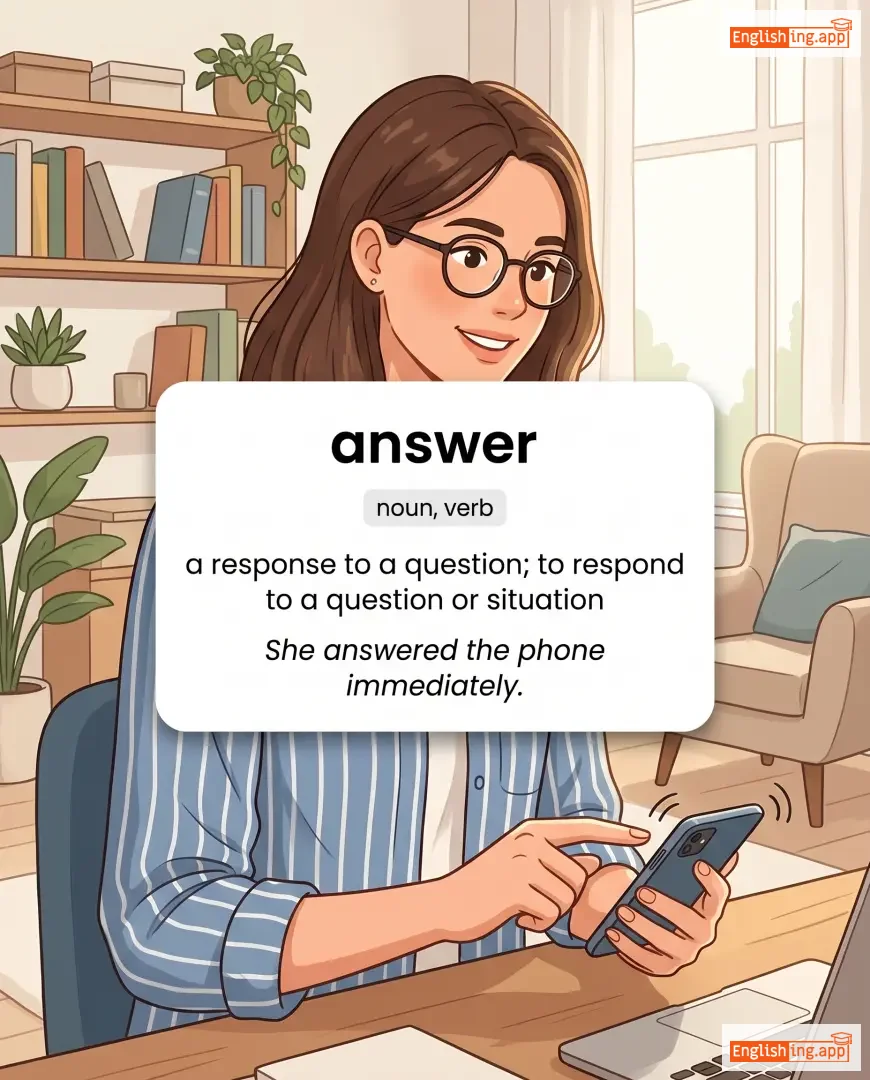
/ˈænsər/
noun, verb
(ænsər)
••••••
|
|
ответ
otvet
••••••
|
answered
ænsərd
••••••
|
answered
ænsərd
••••••
|
answers
ænsərs
••••••
|
answering
ænsəring
••••••
|
a response to a question; to respond to a question or situation
••••••
|
She answered the phone immediately.
Она ответила на телефон немедленно.
••••••
|
Она ответила на телефон немедленно.
Ona otvetila na telefon nemedlenno.
••••••
|
have no answer
не иметь ответа
••••••
|
to not know how to respond to a question or situation
••••••
|
не иметь ответа
ne imet' otveta
••••••
|
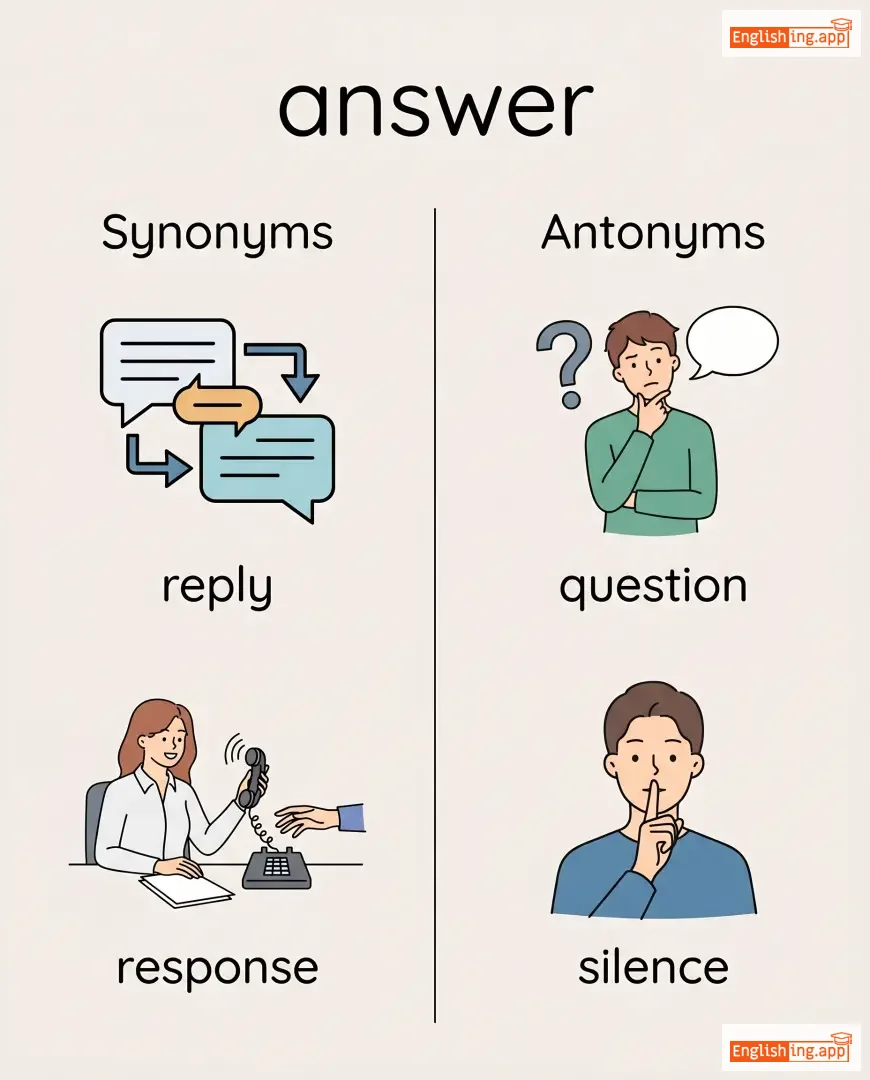
reply, response, solution, explanation, comeback
••••••
|
question, silence, ignorance
••••••
|
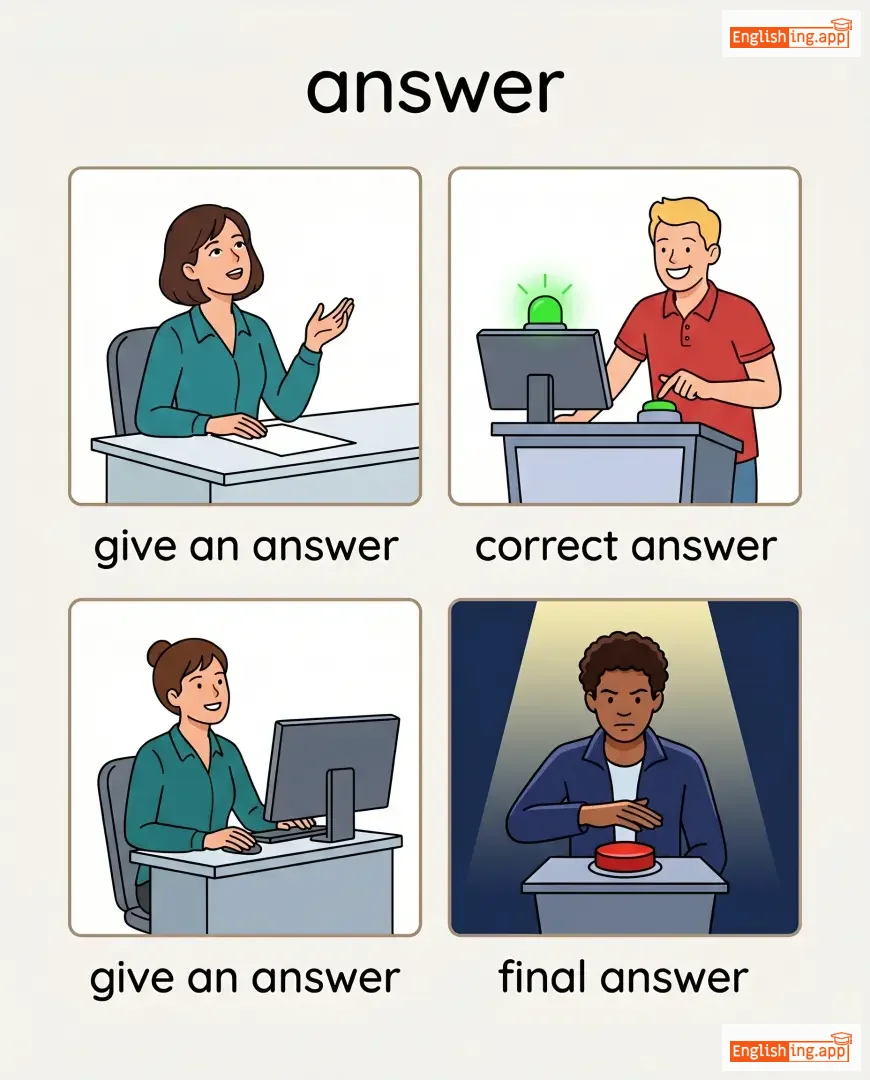
give an answer, correct answer, final answer, answer quickly
••••••
|
Answer в английском это ответ по-русски.
••••••
|
|
🔮
••••••
|
/ænˈtɪsɪˌpeɪt/
verb
(антиципейт)
••••••
|
- •••••• |
ожидать
ozhidat'
••••••
|
anticipated
антиципейтед
••••••
|
anticipated
антиципейтед
••••••
|
anticipates
антиципейтс
••••••
|
anticipating
антиципейтинг
••••••
|
to expect or look forward to something; to realize or foresee in advance
••••••
|
We anticipate a large crowd at the event.
Мы ожидаем большую толпу на мероприятии.
••••••
|
Мы ожидаем большую толпу на мероприятии.
My ozhidayem bol'shuyu tolpu na meropriyatii.
••••••
|
anticipate the worst
ожидать худшее
••••••
|
to expect the most negative or undesirable outcome
••••••
|
ожидать худшее
ozhidat' khudshee
••••••
|
expect, foresee, predict, await, prepare
••••••
|
doubt, ignore, neglect
••••••
|
anticipate problems, anticipate demand, anticipate success, anticipate changes
••••••
|
Антиципировать – это ожидать что-то заранее.
••••••
|
|
😰
••••••
|
/æŋˈzaɪəti/
noun
(æŋˈzaɪəti)
••••••
|
|
тревога
trevoga
••••••
|
- •••••• | - •••••• | - •••••• | - •••••• |
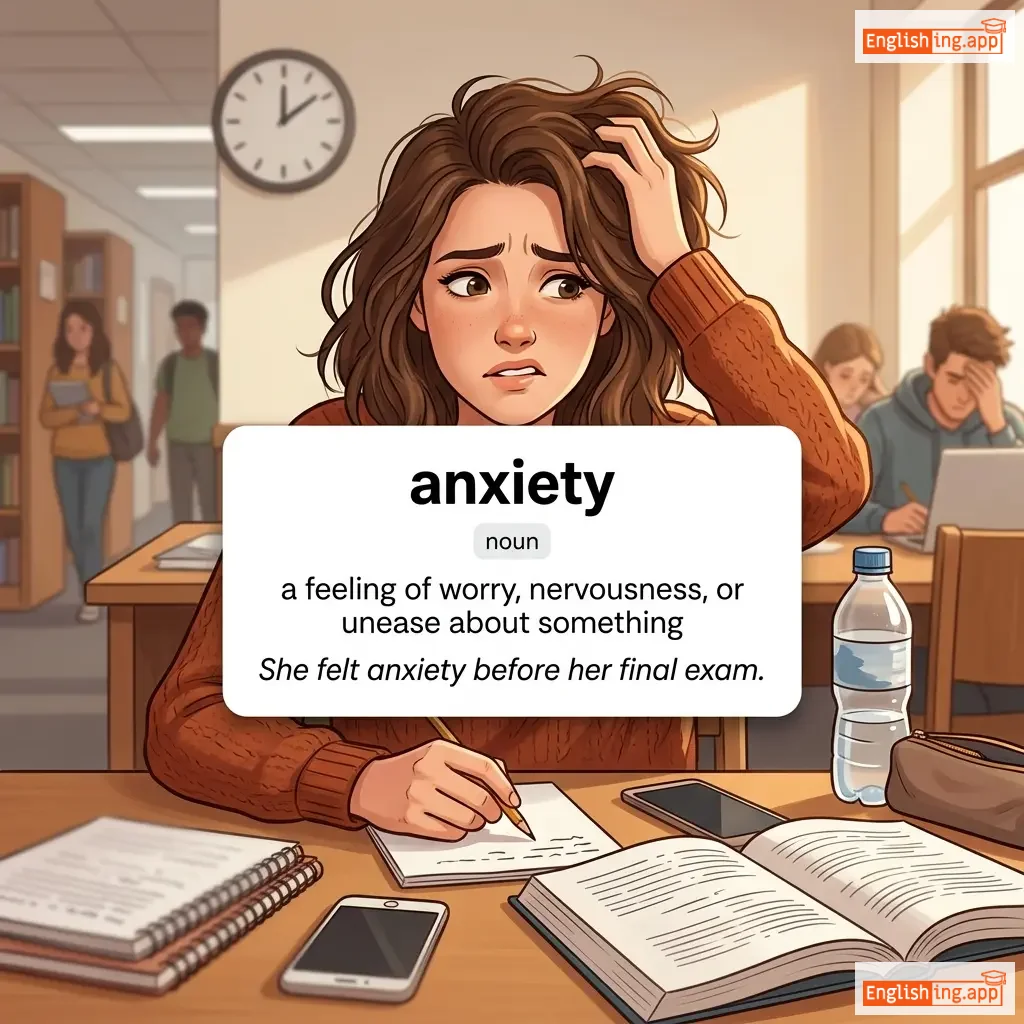
a feeling of worry, nervousness, or unease about something
••••••
|
She felt anxiety before her final exam. |
Она почувствовала тревогу перед финальным экзаменом.
Ona pochuvstvovala trevogu pered final'nym ekzamenom.
••••••
|
separation anxiety |
a feeling of distress when separated from a loved one
••••••
|
тревога при расставании
trevoga pri rasstavanii
••••••
|
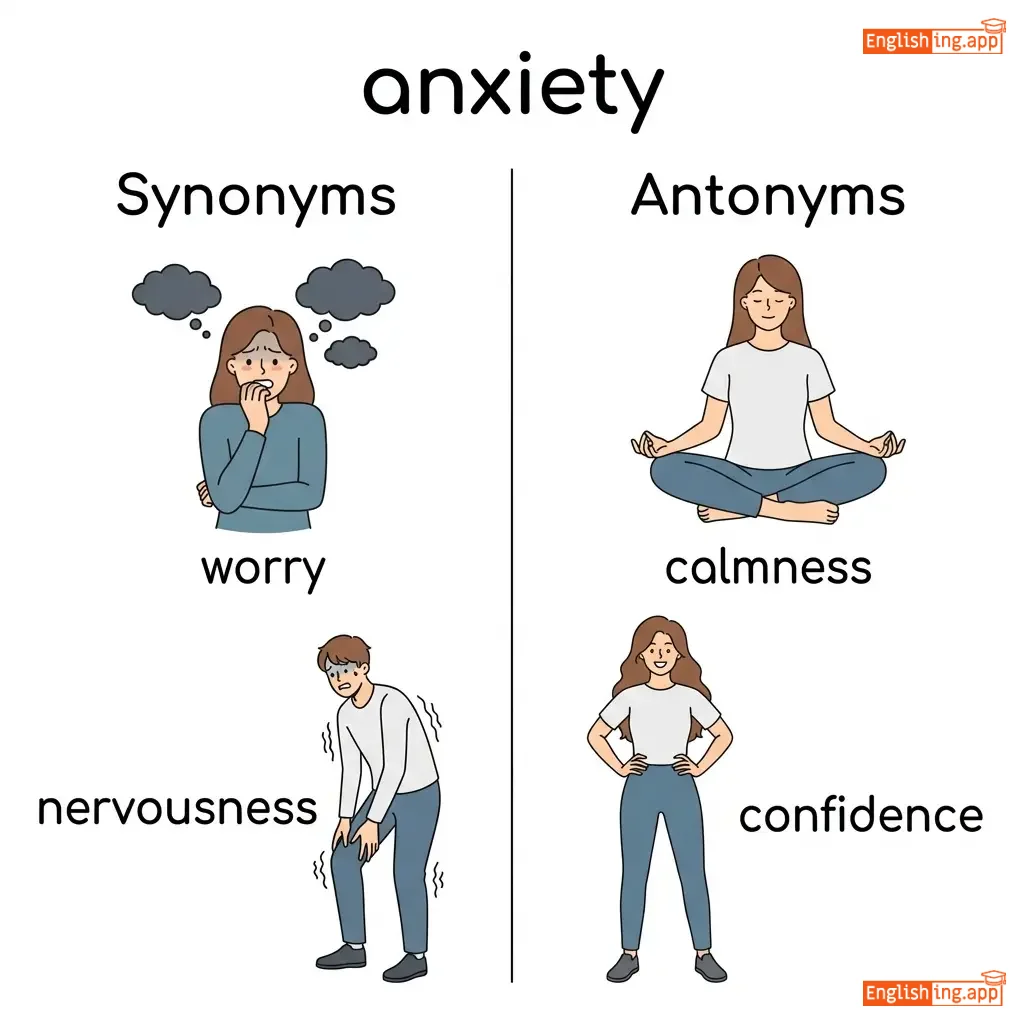
worry, nervousness, unease, tension, apprehension
••••••
|
calmness, confidence, peace
••••••
|
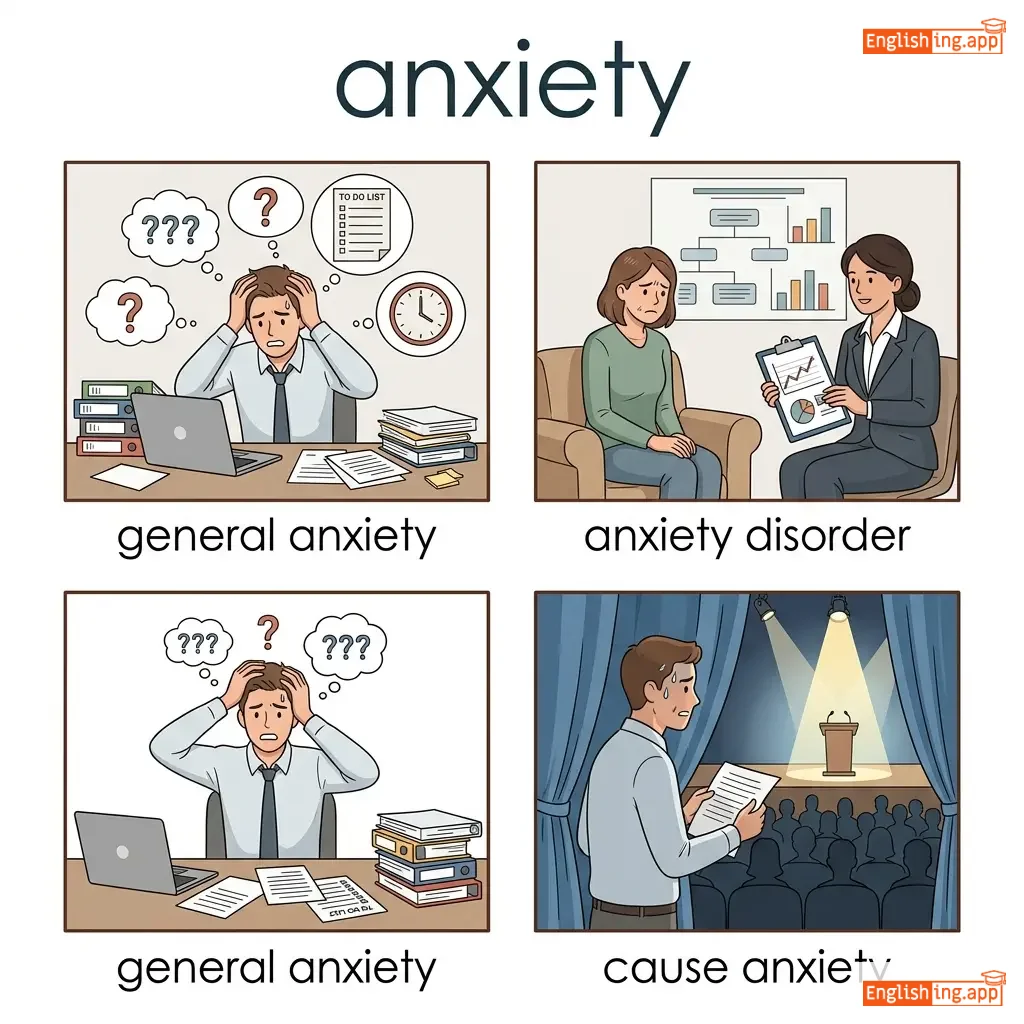
general anxiety, anxiety disorder, cause anxiety, reduce anxiety
••••••
|
Перед экзаменом тревога растет, тревога - это беспокойство.
••••••
|
|
😟
••••••
|
/ˈæŋkʃəs/
adjective
(aŋkʃəs)
••••••
|
- •••••• |
тревожный
trevozhnyy
••••••
|
- •••••• | - •••••• | - •••••• | - •••••• |
feeling worried, nervous, or uneasy about something
••••••
|
She felt anxious before her job interview. |
Она чувствовала тревогу перед своим собеседованием.
Ona chuvstvovala trevogu pered svoim sobesedovaniem.
••••••
|
anxious about |
to feel worried or uneasy regarding something
••••••
|
тревожиться о
trevozhit'sya o
••••••
|
worried, nervous, uneasy, restless, apprehensive
••••••
|
calm, relaxed, confident
••••••
|
feel anxious, anxious about, anxious to, anxious for
••••••
|
Тревожный — когда мы нервничаем, например, перед собеседованием.
••••••
|
|
😰
••••••
|
/ˈæŋkʃəsli/
adverb
(энкшесли)
••••••
|
- •••••• |
тревожно
trevozhno
••••••
|
- •••••• | - •••••• | - •••••• | - •••••• |
in a worried, nervous, or uneasy manner; with anxious anticipation
••••••
|
She waited anxiously for the exam results.
Она тревожно ждала результатов экзамена.
••••••
|
Она тревожно ждала результатов экзамена.
ona trevozhno zhdala rezultatov ekzamena
••••••
|
wait anxiously
тревожно ждать
••••••
|
to wait with worry or nervous expectation
••••••
|
тревожно ждать
trevozhno zhdat
••••••
|
nervously, worriedly, uneasily, apprehensively
••••••
|
calmly, confidently
••••••
|
wait anxiously, watch anxiously, look anxiously, anxiously await
••••••
|
Trevozhno sounds tense, like anxiety
••••••
|
|
🔄
••••••
|
/ˈɛni/
determiner/pronoun
(ɛni)
••••••
|
- •••••• |
любой
lyuboy
••••••
|
- •••••• | - •••••• | - •••••• | - •••••• |
one, some, or all, without specifying which
••••••
|
Do you have any questions? |
У тебя есть вопросы?
U tebya yest' voprosy?
••••••
|
any day now |
something expected to happen very soon
••••••
|
любой день сейчас
lyuboy den' seychas
••••••
|
some, whatever, each, all, every
••••••
|
none, nothing
••••••
|
any chance, any time, any questions, any problem
••••••
|
ANY значит любой, как в 'любой день теперь'.
••••••
|
|
👤
••••••
|
/ˈɛniˌbɒdi/
pronoun
(энибоди)
••••••
|
- •••••• |
любой
lyuboy
••••••
|
- •••••• | - •••••• | - •••••• | - •••••• |
any person; anyone
••••••
|
Anybody can join the club. |
Любой может присоединиться к клубу.
Lyuboy mozhet prisoyedinit'sya k klubu.
••••••
|
- •••••• | - •••••• | - •••••• |
anyone, somebody, whoever, everyone
••••••
|
nobody, no one
••••••
|
ask anybody, tell anybody, anybody else, anybody interested
••••••
|
ANYBODY означает любой, как в Anybody can run in the park.
••••••
|
|
⏳
••••••
|
/ˌɛniˈmɔr/
adverb
(enimor)
••••••
|
- •••••• |
больше не
bol'she ne
••••••
|
- •••••• | - •••••• | - •••••• | - •••••• |
used to refer to the present time, typically to mean no longer
••••••
|
He doesn’t live here anymore. |
Он больше не живет здесь.
On bol'she ne zhivet zdes'.
••••••
|
- •••••• | - •••••• | - •••••• |
no longer, not now, no more
••••••
|
still, yet
••••••
|
not anymore, hardly anymore, anymore questions
••••••
|
больше не значит ANYMORE, как я больше не живу здесь.
••••••
|
|
👤
••••••
|
/ˈɛniwʌn/
pronoun
(энивэн)
••••••
|
- •••••• |
кто-то
kto-to
••••••
|
- •••••• | - •••••• | - •••••• | - •••••• |
any person at all; used to refer to an unspecified person
••••••
|
Does anyone know the answer to this question? |
Кто-то знает ответ на этот вопрос?
Kto-to znayet otvet na etot vopros?
••••••
|
anyone's guess |
something that is very difficult to predict or know
••••••
|
предсказание любого
predskazaniye lyubogo
••••••
|
somebody, anybody, person, individual, someone
••••••
|
nobody, no one
••••••
|
anyone else, if anyone, hardly anyone, ask anyone
••••••
|
ANYONE означает 'кто-то', как мы говорим в русском 'кто-то'.
••••••
|
|
🔑
••••••
|
/ˈɛnɪθɪŋ/
pronoun
(энитинг)
••••••
|
- •••••• |
что угодно
chto ugodno
••••••
|
- •••••• | - •••••• | - •••••• | - •••••• |
any object, event, or matter; whatever thing
••••••
|
You can ask me anything about the project. |
Ты можешь спросить меня о чем угодно касаемо проекта.
Ty mozhesh' sprosit' menya o chem ugodno kasaemo proyektu.
••••••
|
anything but |
definitely not something
••••••
|
что угодно, кроме
chto ugodno, krome
••••••
|
whatever, everything, object, matter, item
••••••
|
nothing, none
••••••
|
do anything, say anything, anything else, almost anything
••••••
|
ANYTHING означает 'что угодно'—как мы говорим по-русски 'что угодно'.
••••••
|
|
➡️
••••••
|
/ˈɛniweɪ/
adverb
(эниуэй)
••••••
|
- •••••• |
в любом случае
v lyubom sluchaye
••••••
|
- •••••• | - •••••• | - •••••• | - •••••• |
used to emphasize a statement or to return to a previous subject; regardless of what happened
••••••
|
I was tired, but I went to the meeting anyway. |
Я был уставшим, но я все равно пошел на встречу.
Ya byl ustavshim, no ya vse ravno poshel na vstrechu.
••••••
|
anyway you slice it |
no matter how you look at it
••••••
|
как бы то ни было
kak by to ni bylo
••••••
|
regardless, nevertheless, still, anyhow, though
••••••
|
because, therefore
••••••
|
but anyway, anyway you, anyway possible
••••••
|
В любом случае он пойдет – как бы то ни было.
••••••
|
|
🌍
••••••
|
/ˈɛnɪwɛər/
adverb
(энивэр)
••••••
|
- •••••• |
в любом месте
anywhere
••••••
|
- •••••• | - •••••• | - •••••• | - •••••• |
in, at, or to any place
••••••
|
You can find good food anywhere in this city.
В этом городе можно найти хорошую еду в любом месте.
••••••
|
В этом городе можно найти хорошую еду в любом месте.
V etom gorode mozhno nayti khoroshuyu yedu v lyubom meste.
••••••
|
go anywhere
го эниуэр
••••••
|
to have freedom to travel or move to any place
••••••
|
ехать куда угодно
go anywhere
••••••
|
everywhere, someplace, anyplace, location, place
••••••
|
nowhere, somewhere specific
••••••
|
anywhere else, almost anywhere, find anywhere, go anywhere
••••••
|
Anywhere = Аня где? Imagine Anya asking 'where?' and pointing to 'в любом месте'.
••••••
|
|
↔️
••••••
|
/əˈpɑːrt/
adverb
(апарт)
••••••
|
- •••••• |
на расстоянии
apart
••••••
|
- •••••• | - •••••• | - •••••• | - •••••• |
separated by distance or time; into pieces
••••••
|
They live miles apart from each other.
Они живут на расстоянии многих миль друг от друга.
••••••
|
Они живут на расстоянии многих миль друг от друга.
Oni zhivut na rasstoyanii mnogikh mil drug ot druga
••••••
|
fall apart
фолл апарт
••••••
|
to break into pieces or fail completely
••••••
|
развалиться на куски
fall apart
••••••
|
separately, away, aside, alone, divided
••••••
|
together, close
••••••
|
miles apart, set apart, apart from, fall apart
••••••
|
Апарт = A PART, две части на расстоянии друг от друга; представь две половинки карты, разделенные милями.
••••••
|
|
🏢
••••••
|
/əˈpɑːrtmənt/
noun
(апартмент)
••••••
|
- •••••• |
квартира
kvartira
••••••
|
- •••••• | - •••••• | - •••••• | - •••••• |
a set of rooms forming a residence within a building
••••••
|
She rented an apartment in the city center.
Она арендовала квартиру в центре города.
••••••
|
Она арендовала квартиру в центре города.
Ona arendovala kvartiru v tsentre goroda.
••••••
|
apartment complex
жилой комплекс
••••••
|
a group of apartment buildings in one area
••••••
|
жилой комплекс
zhiloy kompleks
••••••
|
flat, unit, residence, condo, lodging
••••••
|
house, bungalow
••••••
|
rent an apartment, small apartment, apartment building, apartment complex
••••••
|
APARTMENT означает квартиру, как мы говорим по-английски.
••••••
|
|
🙏
••••••
|
/əˈpɒlədʒaɪz/
verb
(аполоджайз)
••••••
|
- •••••• |
извиняться
izvinyatsya
••••••
|
apologized
аполоджайзд
••••••
|
apologized
аполоджайзд
••••••
|
apologizes
аполоджает
••••••
|
apologizing
аполоджаинг
••••••
|
to say sorry for something wrong you have done
••••••
|
He apologized for being late to the meeting.
Он извинился за опоздание на встречу.
••••••
|
Он извинился за опоздание на встречу.
On izvinilsya za opazdanie na vstrechu.
••••••
|
apologize sincerely
извиняться искренне
••••••
|
to express genuine regret for a mistake or wrongdoing
••••••
|
извиняться искренне
izvinyatsya iskrenne
••••••
|
regret, repent, ask forgiveness, express remorse
••••••
|
accuse, blame, deny
••••••
|
apologize for mistake, apologize sincerely, apologize publicly
••••••
|
Извиниться - это сказать 'извините', значит извинимся, когда ошибаемся.
••••••
|
|
🙏
••••••
|
/əˈpɒlədʒi/
noun
••••••
|
- •••••• | - •••••• | - •••••• | - •••••• | - •••••• | - •••••• |
a statement expressing regret for something wrong or hurtful
••••••
|
He offered an apology for being late to the meeting. |
- •••••• |
make an apology |
to formally express regret for a mistake or offense
••••••
|
- •••••• |
regret, excuse, admission, acknowledgment
••••••
|
defiance, denial, justification
••••••
|
offer an apology, sincere apology, formal apology, public apology
••••••
|
No •••••• |
|
😱
••••••
|
/əˈpɔːl/
verb
(apol)
••••••
|
- •••••• |
ошеломить
oshelomit
••••••
|
appalled
apold
••••••
|
appalled
apold
••••••
|
appalls
apols
••••••
|
appalling
apoling
••••••
|
To shock or horrify someone with something unpleasant or bad.
••••••
|
The cruelty of the crime appalled the entire community.
Жестокость преступления потрясла все сообщество.
••••••
|
Жестокость преступления ошеломила все сообщество.
Zhestokost' prestupleniya oshelomila vse soobshchestvo.
••••••
|
- •••••• | - •••••• | - •••••• |
shock, horrify, disgust, outrage, distress
••••••
|
please, delight, satisfy
••••••
|
appall the public, appalling crime, appalling behavior, deeply appalled
••••••
|
Appall похоже на 'all are shocked'—все потрясены.
••••••
|
|
🛠️
••••••
|
/ˌæpəˈreɪtəs/
noun
(aparatəs)
••••••
|
|
аппарат
apparat
••••••
|
- •••••• | - •••••• | - •••••• | - •••••• |
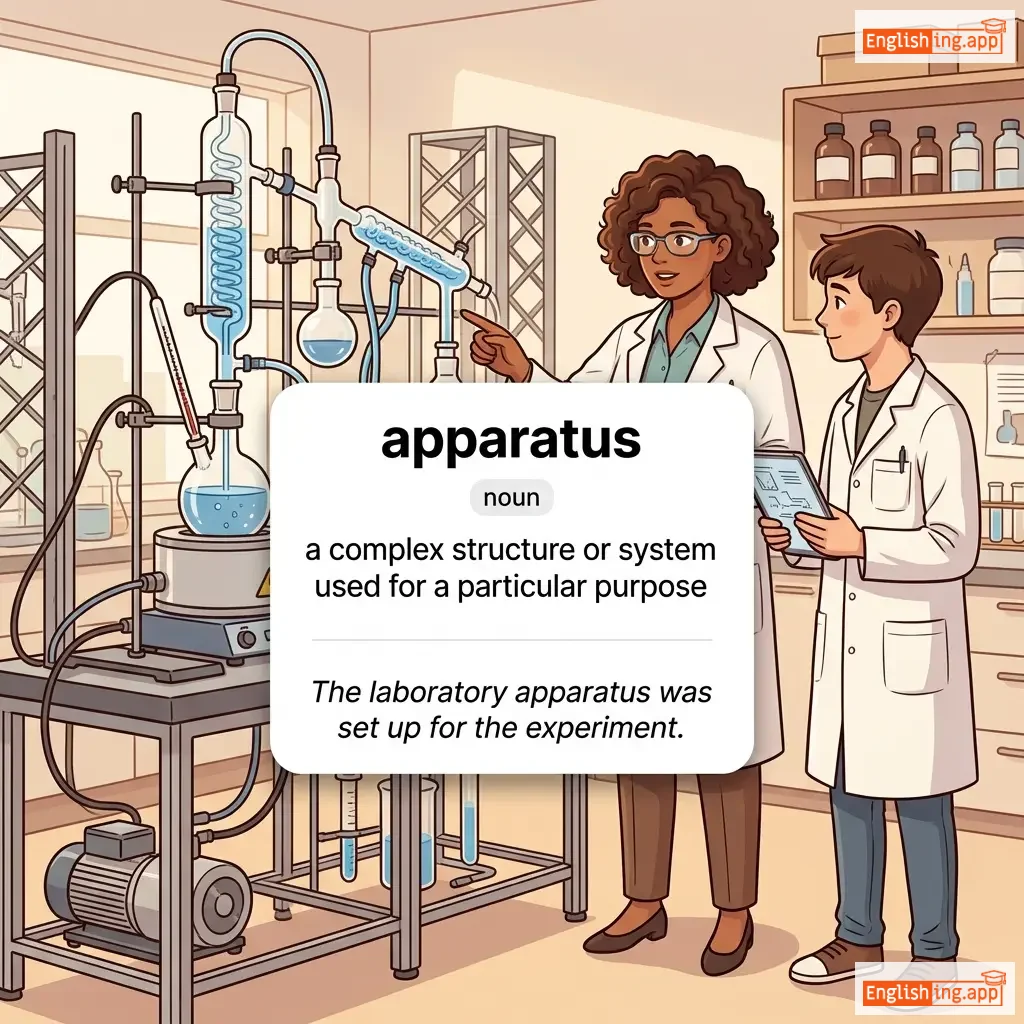
a complex structure or system used for a particular purpose
••••••
|
The laboratory apparatus was set up for the experiment.
Лабораторный аппарат был настроен для эксперимента.
••••••
|
Лабораторный аппарат был настроен для эксперимента.
Laboratornyi apparat byl nastroen dlya eksperimenta.
••••••
|
- •••••• | - •••••• | - •••••• |
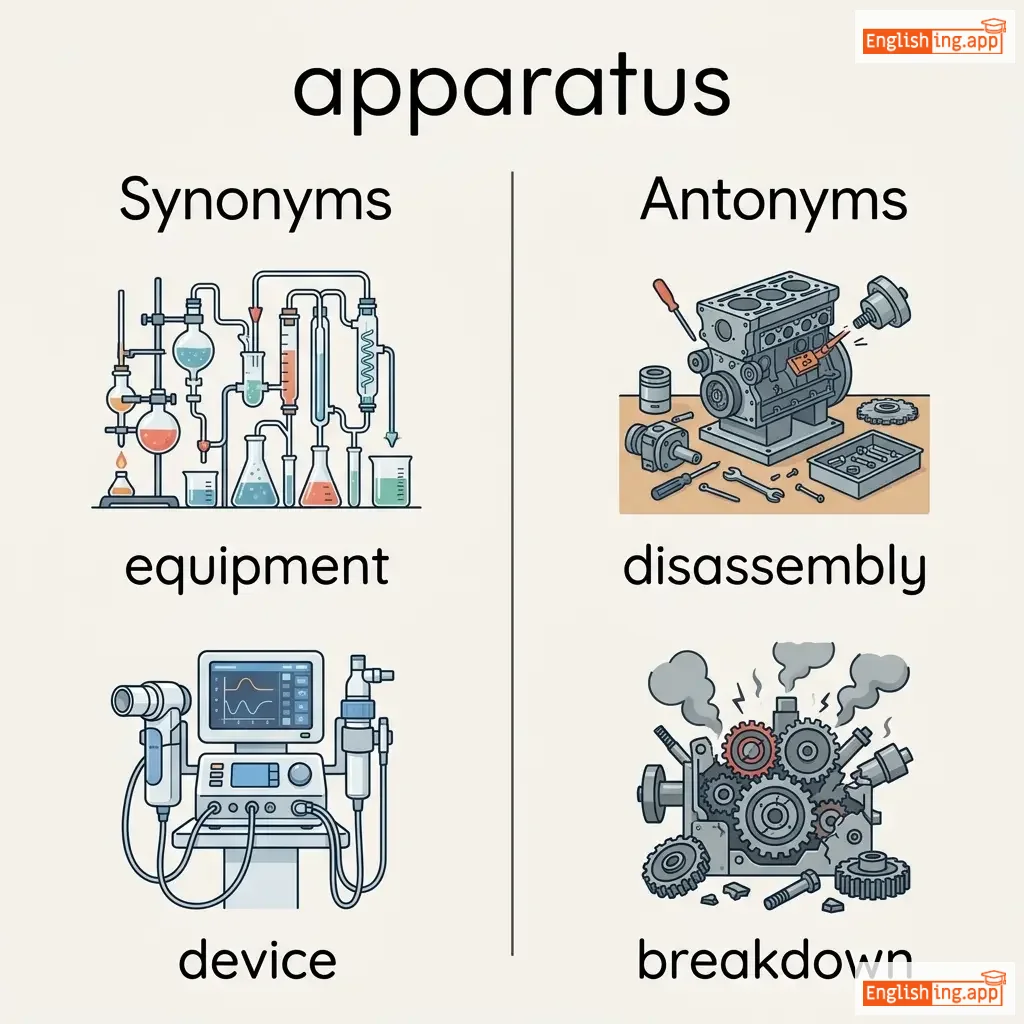
equipment, device, machinery, instrument
••••••
|
disassembly, breakdown
••••••
|
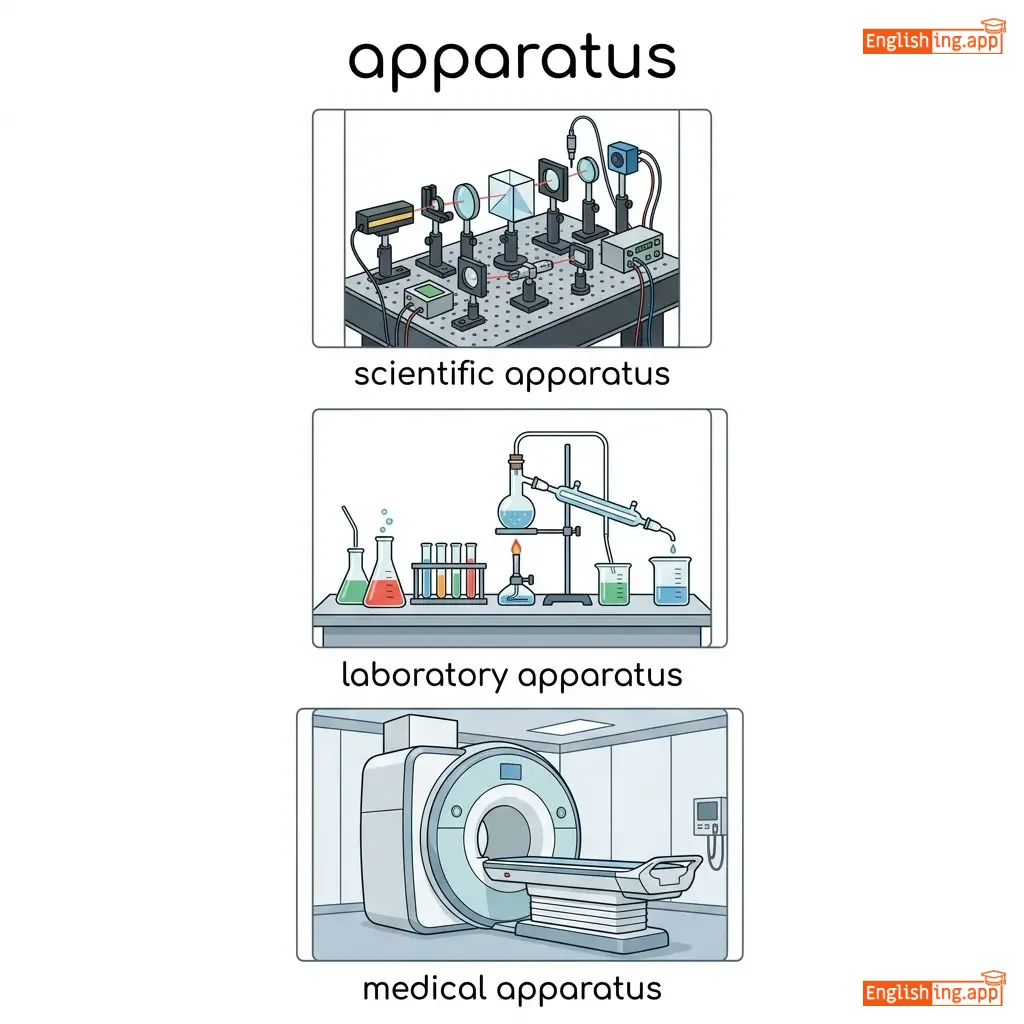
scientific apparatus, laboratory apparatus, medical apparatus
••••••
|
Запомни аппарат, как лабораторное оборудование (Zapomni apparat, kak laboratornoe oborudovanie)
••••••
|
|
👀
••••••
|
/əˈpærənt/
adjective
(апарэнт)
••••••
|
- •••••• |
очевидный
ochevidnyy
••••••
|
- •••••• | - •••••• | - •••••• | - •••••• |
Clearly visible or understood; obvious.
••••••
|
It soon became apparent that he was not telling the truth.
Скоро стало очевидно, что он не говорил правду.
••••••
|
Скоро стало очевидно, что он не говорил правду.
Skoro stalo ochevidno, chto on ne govoril pravdu.
••••••
|
apparent reason
очевидная причина
••••••
|
an obvious or clear reason
••••••
|
очевидная причина
ochevidnaya prichina
••••••
|
obvious, evident, clear, plain, visible
••••••
|
hidden, obscure, unclear
••••••
|
apparent reason, apparent mistake, became apparent, quite apparent
••••••
|
Apparent - это то, что очевидно, то есть очевидное.
••••••
|
|
👀
••••••
|
/əˈperəntli/
adverb
(apyerentli)
••••••
|
- •••••• |
очевидно;
ochevidno
••••••
|
- •••••• | - •••••• | - •••••• | - •••••• |
seemingly; as far as one knows or can see; clearly; evidently
••••••
|
Apparently, the meeting has been postponed to next week.
Очевидно, встреча была перенесена на следующую неделю.
••••••
|
Очевидно, встреча была перенесена на следующую неделю.
ochevidno, vstrecha byla perenesena na sleduyushchuyu nedelyu.
••••••
|
- •••••• | - •••••• | - •••••• |
seemingly, evidently, clearly, obviously
••••••
|
actually, really, truly, certainly
••••••
|
apparently not, apparently so, quite apparently
••••••
|
Когда кажется, что это очевидно — это именно так.
••••••
|
|
📢
••••••
|
/əˈpiːl/
verb, noun
(apíl)
••••••
|
- •••••• |
обращение / привлечение
obrashchenie / privlechenie
••••••
|
appealed
apíld
••••••
|
appealed
apíld
••••••
|
appeals
apíls
••••••
|
appealing
apíling
••••••
|
to make a serious request; to be attractive or interesting; a formal request to a higher authority for a decision to be changed
••••••
|
The charity appealed to the public for donations.
благотворительная организация обратилась к публике за пожертвованиями.
••••••
|
благотворительная организация обратилась к публике за пожертвованиями.
blagotvoritel'naya organizatsiya obratilas' k publike za pozhertvovaniyami.
••••••
|
make an appeal
сделать обращение
••••••
|
to formally ask for something, often publicly
••••••
|
сделать обращение
sdelat' obraschenie
••••••
|
request, petition, attraction, plea, entreaty
••••••
|
demand, order, repulsion
••••••
|
appeal to, appeal against, strong appeal, emotional appeal
••••••
|
Appeal = обращение, представьте, что кто-то использует 📢 для обращения — Appeal = обращение
••••••
|
|
😍
••••••
|
/əˈpiː.lɪŋ/
adjective
(æpílɪŋ)
••••••
|
- •••••• |
привлекательный; интересный; приятный
prityvkatel'nyy; interesnyy; priyatnyy
••••••
|
- •••••• | - •••••• | - •••••• | - •••••• |
attractive; interesting; pleasing
••••••
|
The colorful garden looks very appealing to visitors.
Цветной сад выглядит очень привлекательным для посетителей.
••••••
|
Цветной сад выглядит очень привлекательным для посетителей.
Tsvetnoy sad viglyadit ochen' privlekatel'nym dlya posetiteley.
••••••
|
- •••••• | - •••••• | - •••••• |
attractive, charming, alluring, enticing
••••••
|
repulsive, unattractive, disgusting
••••••
|
appealing idea, appealing offer, visually appealing
••••••
|
Appealing sounds like 'privlekatel'nyy' – this colorful garden looks very privlekatel'nyy (appealing).
••••••
|
|
👀
••••••
|
/əˈpɪə/
verb
(апир)
••••••
|
- •••••• |
появиться
poyavitsya
••••••
|
appeared
апирд
••••••
|
appeared
апирд
••••••
|
appears
апиерс
••••••
|
appearing
апиринг
••••••
|
to become visible or come into sight; to seem
••••••
|
She appeared suddenly at the door.
Она апирд внезапно у двери.
••••••
|
Она появилась внезапно у двери.
Ona poyavilas' vnezapno u dveri.
••••••
|
appear out of thin air
апир из тонкого воздуха
••••••
|
to emerge suddenly and unexpectedly
••••••
|
появиться из воздуха
poyavitsya iz vozdukha
••••••
|
emerge, show, arise, surface, seem
••••••
|
disappear, vanish, hide
••••••
|
appear suddenly, appear in court, appear likely
••••••
|
Poyavitsya: когда кто-то появляется из ниоткуда.
••••••
|
|
👀
••••••
|
/əˈpɪərəns/
noun
(apirens)
••••••
|
- •••••• |
внешность
vneshnost
••••••
|
- •••••• | - •••••• | - •••••• | - •••••• |
the way that someone or something looks
••••••
|
His sudden appearance surprised everyone. |
Его внезапное появление удивило всех.
Ego vnezapnoe poyavlenie udivilo vsekh.
••••••
|
keep up appearances |
to maintain an outward show of good behavior or success
••••••
|
поддерживать видимость
poddierzhivat' vidimost'
••••••
|
look, aspect, presence, form, figure
••••••
|
disappearance, absence
••••••
|
physical appearance, public appearance, sudden appearance, outward appearance
••••••
|
Appearance означает внешность — внешность раскрывает внутренность.
••••••
|
|
🤲
••••••
|
/əˈpiːz/
verb
(apiz)
••••••
|
|
успокаивать / удовлетворять
uspokaivat' / udovletvorjat'
••••••
|
appeased
apizd
••••••
|
appeased
apizd
••••••
|
appeases
apizes
••••••
|
appeasing
apizing
••••••
|
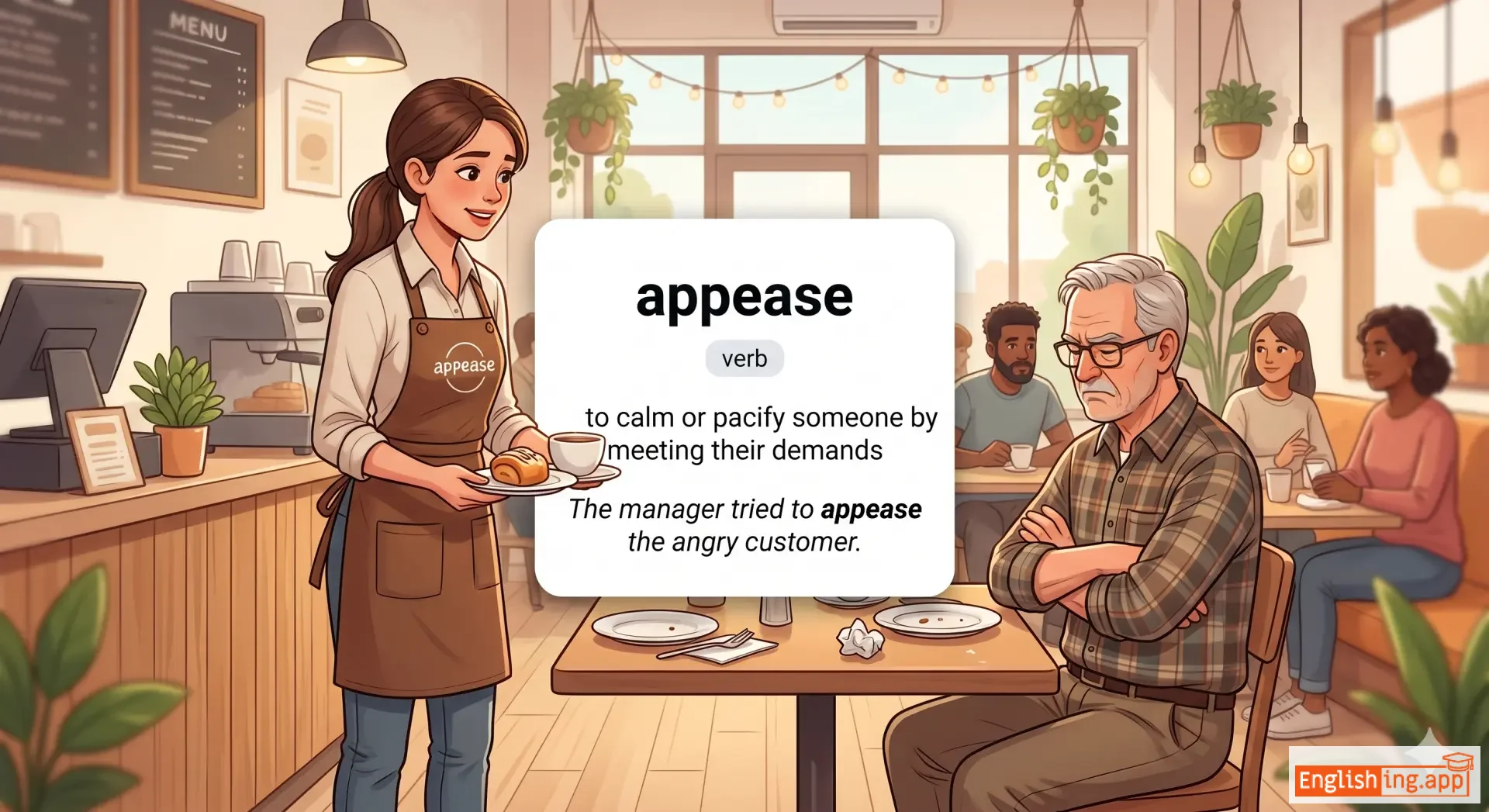
to calm or pacify someone by meeting their demands
••••••
|
The manager tried to appease the angry customer.
Менеджер пытался успокоить сердитого клиента.
••••••
|
Менеджер пытался успокоить сердитого клиента.
Menedzher pytalsya uspokoit' serditogo klienta.
••••••
|
appease someone's anger
успокоить чью-то злость
••••••
|
to reduce someone's anger by satisfying them
••••••
|
успокоить чью-то злость
uspokoit' ch'yu-to zlost'
••••••
|
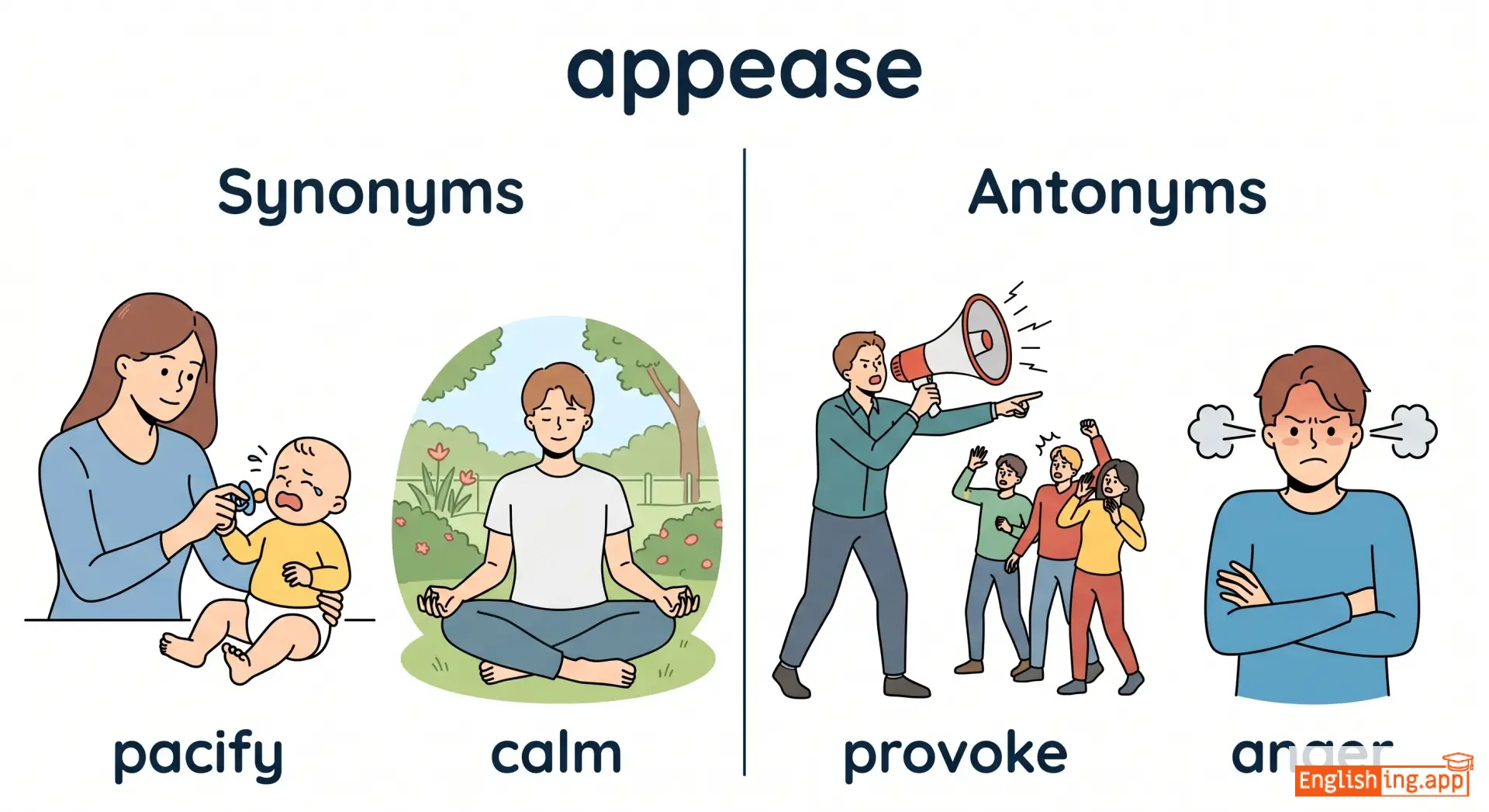
pacify, calm, satisfy, placate, soothe
••••••
|
provoke, anger, agitate
••••••
|
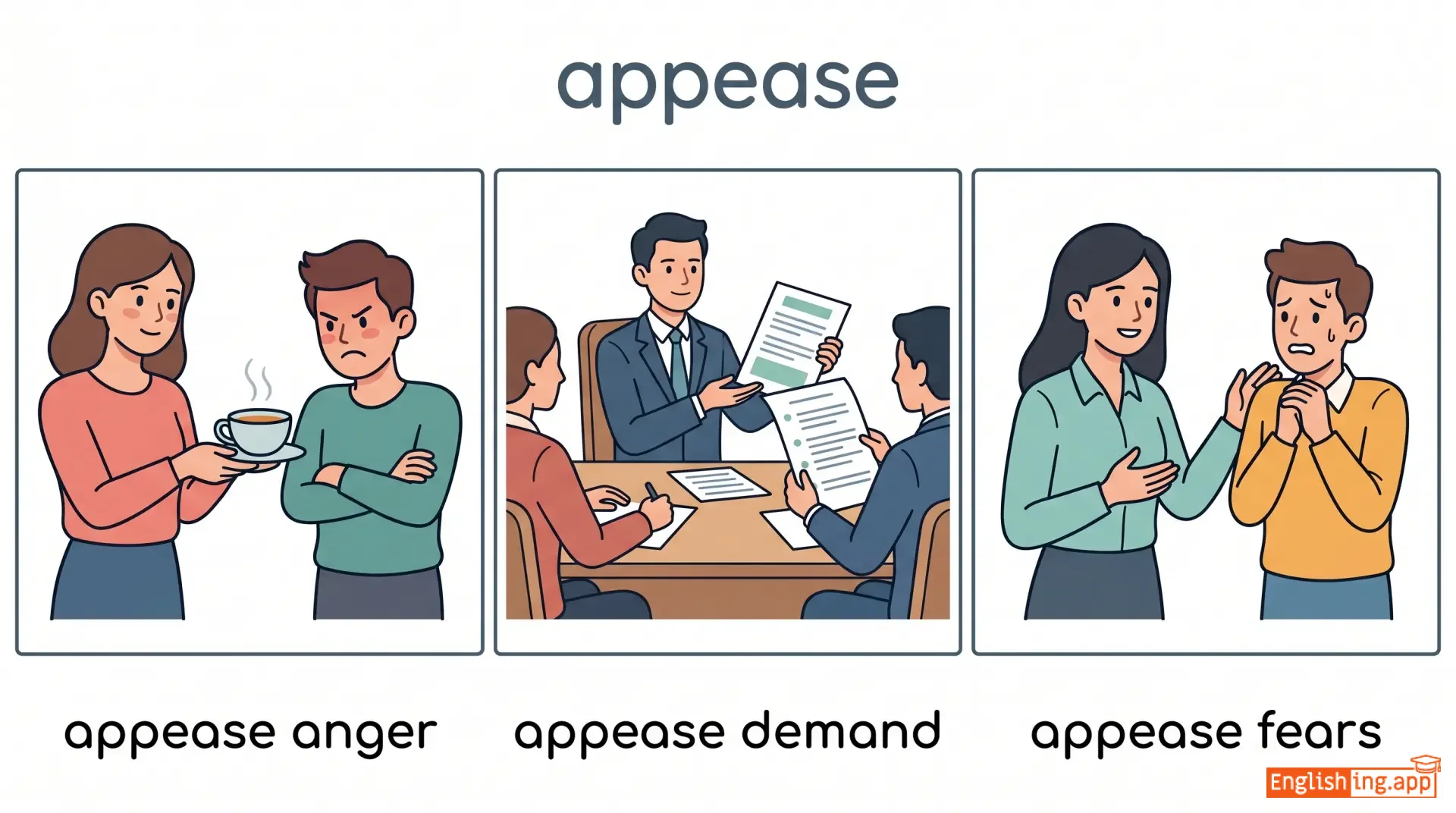
appease anger, appease demand, appease fears
••••••
|
Appease означает успокоить, представьте, что вам нужно успокоить, чтобы принести ‘Peace’.
••••••
|
|
🍽️
••••••
|
/ˈæpɪtaɪt/
noun
(аппетит)
••••••
|

|
аппетит
appetit
••••••
|
- •••••• | - •••••• | - •••••• | - •••••• |
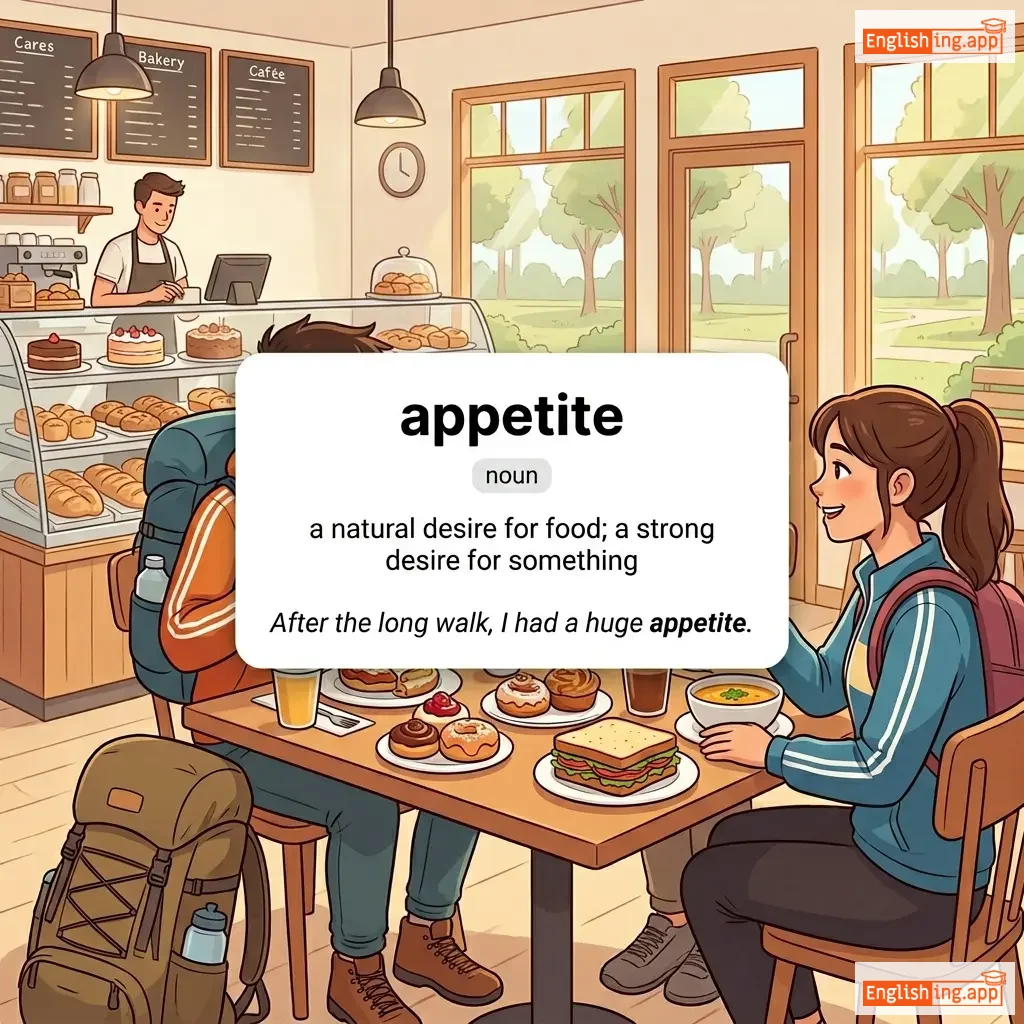
a natural desire for food; a strong desire for something
••••••
|
After the long walk, I had a huge appetite. |
После долгой прогулки у меня был огромный аппетит.
Posle dolgoy progulki u menya byl ogromnyy appetit.
••••••
|
whet the appetite |
to stimulate interest or desire
••••••
|
разжигать аппетит
razzhigat' appetit
••••••
|
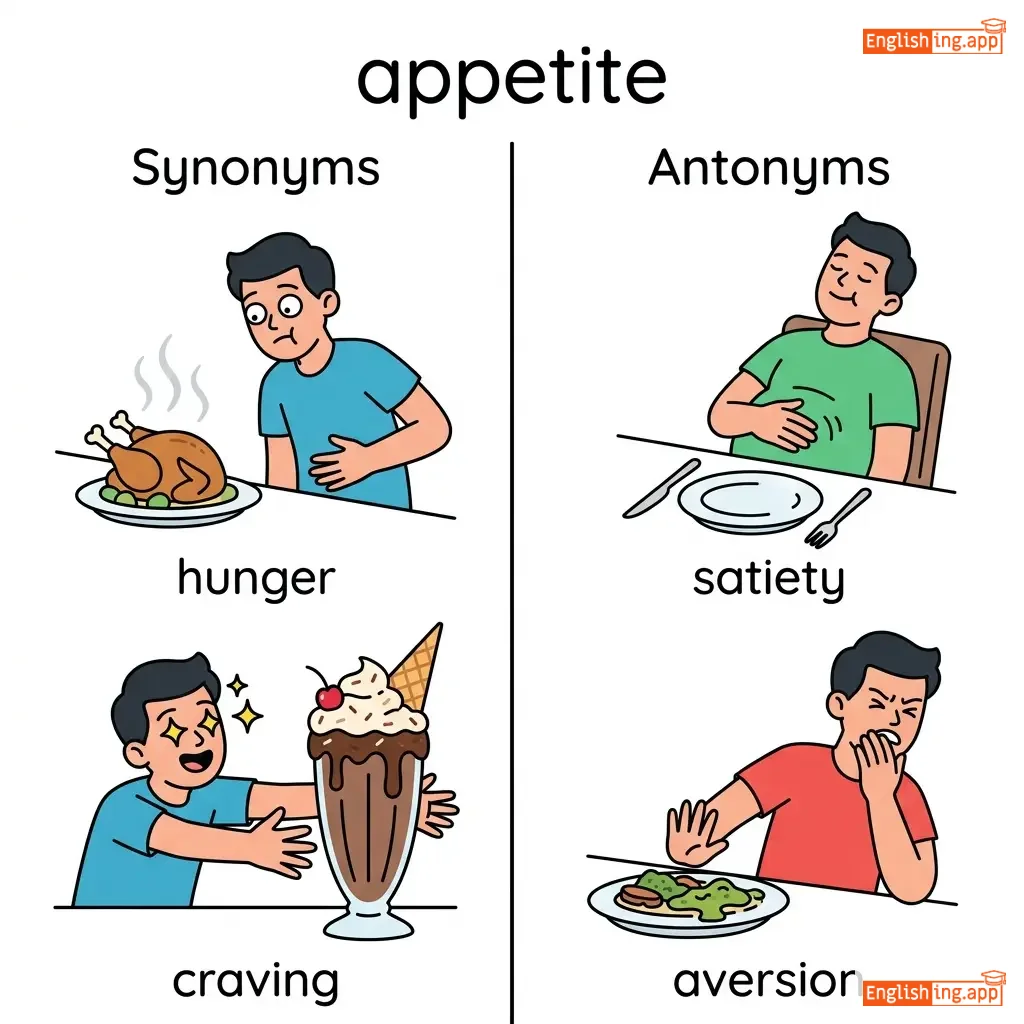
hunger, craving, desire, urge, longing
••••••
|
satiety, aversion
••••••
|
big appetite, healthy appetite, appetite for success
••••••
|
Appetite означает аппетит – аппетит означает желание к еде.
••••••
|
|
🍽️
••••••
|
/ˈæpɪtaɪz/
verb
(эпетайз)
••••••
|
- •••••• |
вызывать аппетит
vyzyvat appetit
••••••
|
appetized
эпетайзд
••••••
|
appetized
эпетайзд
••••••
|
appetizes
эпетайзис
••••••
|
appetizing
эпетайзинг
••••••
|
to stimulate the appetite; to make someone eager or interested
••••••
|
The aroma of fresh bread will appetize the guests before dinner.
Аромат свежего хлеба будет эпетайзить гостей.
••••••
|
Аромат свежего хлеба вызовет аппетит у гостей.
Aromat svezhego khleba vyzovet appetit u gostei
••••••
|
- •••••• | - •••••• | - •••••• |
stimulate, whet, entice, tempt, arouse
••••••
|
repel, discourage, suppress
••••••
|
appetize the guests, appetize the senses, appetize appetite, appetize interest
••••••
|
Appetize похоже на аппетит — значит вызывать аппетит.
••••••
|
|
👏
••••••
|
/əˈplɔːd/
verb
(apl-ood)
••••••
|
- •••••• |
аплодировать
aplodirovat
••••••
|
applauded
apl-ood-ed
••••••
|
applauded
apl-ood-ed
••••••
|
applauds
apl-oods
••••••
|
applauding
apl-ood-ing
••••••
|
to show approval by clapping or expressing admiration
••••••
|
The audience applauded the performance.
Зрители аплодировали выступлению.
••••••
|
Зрители аплодировали выступлению.
Zriteli aplodirovali vystupleniyu.
••••••
|
- •••••• | - •••••• | - •••••• |
cheer, praise, commend, hail
••••••
|
criticize, condemn
••••••
|
applaud enthusiastically, applaud someone for something
••••••
|
Applaud sounds like 'Appl' – так что вы аплодируете, когда вам что-то нравится!
••••••
|
|
🍎
••••••
|
/ˈæpəl/
noun
(æpl)
••••••
|
- •••••• |
яблоко
yabloko
••••••
|
- •••••• | - •••••• | - •••••• | - •••••• |
a round fruit with red, green, or yellow skin
••••••
|
She ate a red apple for breakfast. |
Она съела красное яблоко на завтрак.
Ona syela krasnoye yabloko na zavtrak.
••••••
|
the apple of one's eye |
a person or thing that is greatly loved or treasured
••••••
|
яблоко из ока
yabloko iz oka
••••••
|
fruit, pome, produce
••••••
|
null
••••••
|
apple pie, apple tree, apple juice, eat an apple
••••••
|
Яблоко - 'Яблоко в день, и доктор будет далеко!'
••••••
|
|
📌
••••••
|
/ˈæplɪkəbl/
adjective
(aplikabl)
••••••
|
|
применимый
primenimy
••••••
|
- •••••• | - •••••• | - •••••• | - •••••• |
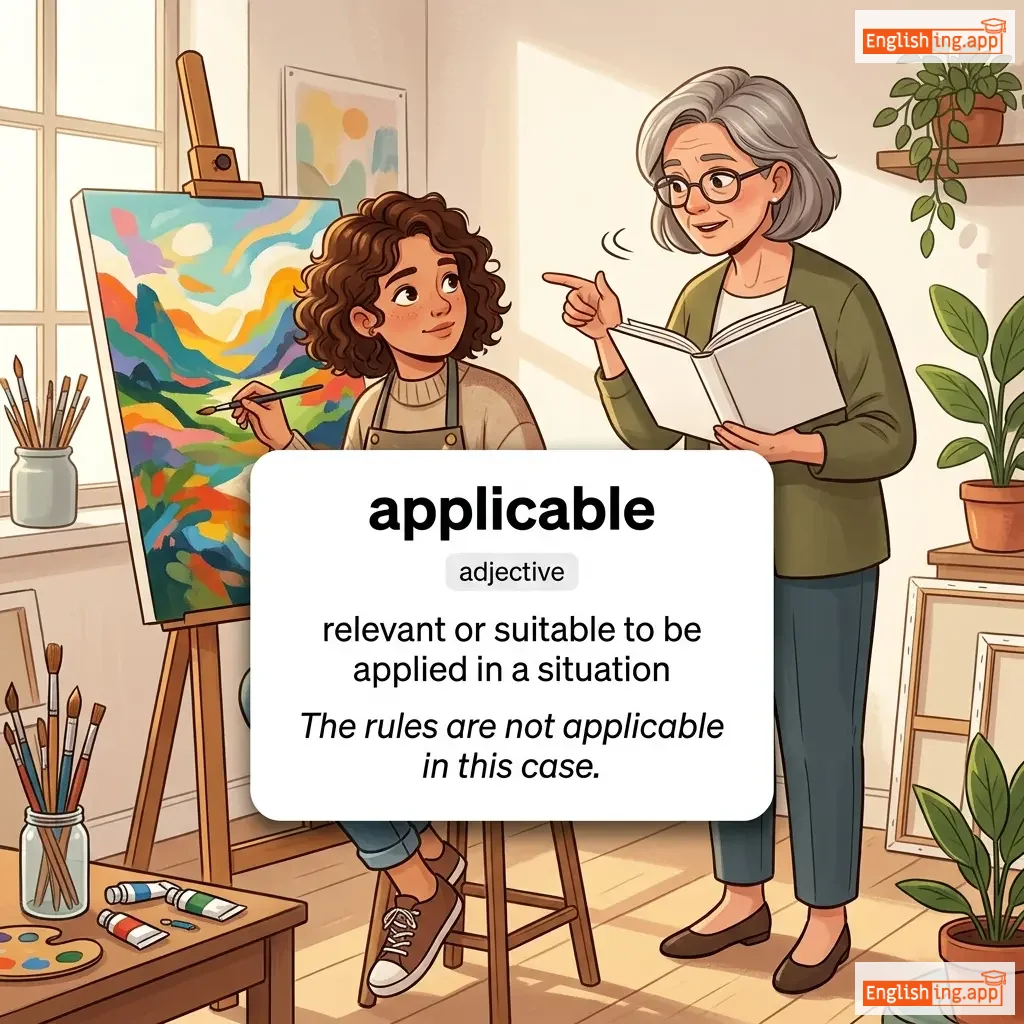
relevant or suitable to be applied in a situation
••••••
|
The rules are not applicable in this case. |
Правила не применимы в этом случае.
Pravila ne primenimy v etom sluchaye.
••••••
|
- •••••• | - •••••• | - •••••• |
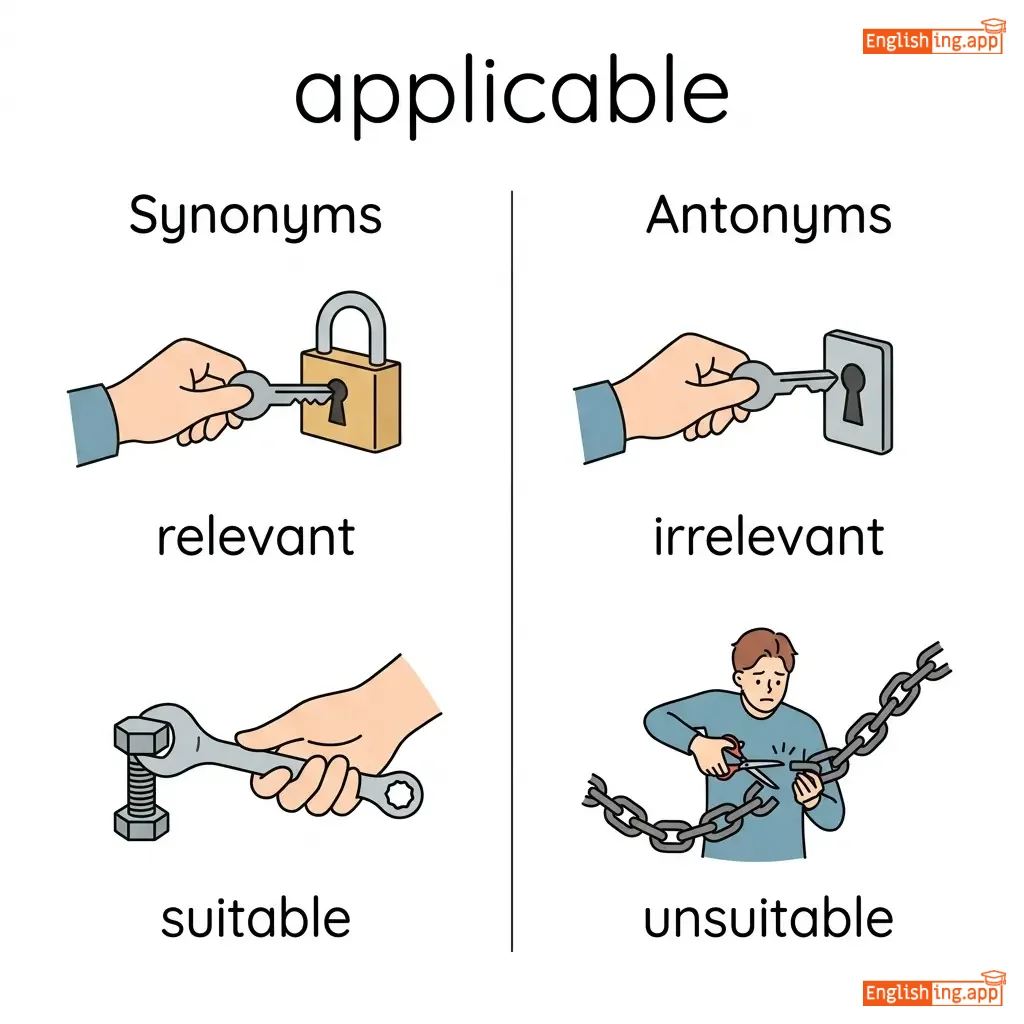
relevant, suitable, appropriate, pertinent, fitting
••••••
|
irrelevant, unsuitable, inappropriate
••••••
|
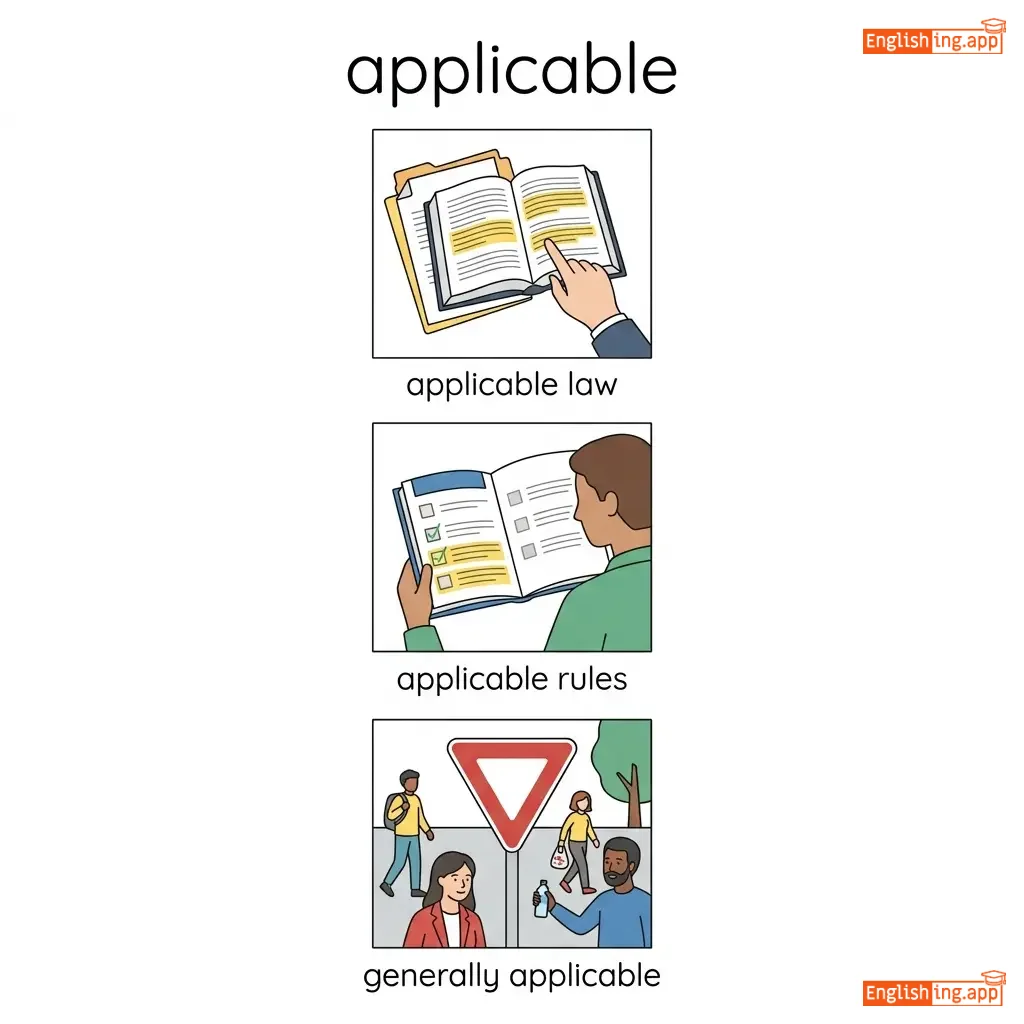
applicable law, applicable rules, generally applicable
••••••
|
Applicable означает, что что-то можно применить, то есть применимо.
••••••
|
|
📝
••••••
|
/ˈæplɪkənt/
noun
(æplɪkænt)
••••••
|
- •••••• |
кандидат
kandidat
••••••
|
- •••••• | - •••••• | - •••••• | - •••••• |
a person who applies for something, such as a job or a position
••••••
|
The applicant was interviewed for the position. |
Кандидат был интервьюирован для этой позиции.
Kandidat byl intervyuirovan dlya etoj pozitsii.
••••••
|
- •••••• | - •••••• | - •••••• |
candidate, contender, petitioner, seeker
••••••
|
employer, recruiter
••••••
|
job applicant, applicant form, qualified applicant
••••••
|
An applicant is someone who is a candidate (kandidat) for a position.
••••••
|
|
📝
••••••
|
/ˌæplɪˈkeɪʃən/
noun
(аппликация)
••••••
|
- •••••• |
заявка / приложение / программное обеспечение
zayavka / prilozhenie / programmnoe obespeshenie
••••••
|
- •••••• | - •••••• | - •••••• | - •••••• |
a formal request for something; the act of putting something into operation; or a software program
••••••
|
She submitted her application for the scholarship. |
Она подала заявку на стипендию.
Ona podala zayavku na stipendiyu.
••••••
|
put into application |
to use something practically
••••••
|
ввести в действие
vvesti v deystvie
••••••
|
request, use, implementation, petition, software
••••••
|
withdrawal, neglect
••••••
|
job application, application form, software application, practical application
••••••
|
Application означает заявку или приложение, используется в обоих значениях.
••••••
|
|
📄
••••••
|
/əˈplaɪ/
verb
(applai)
••••••
|
- •••••• |
подать заявление / применять
podat zayavlenie / primenyat
••••••
|
applied
aplaid
••••••
|
applied
aplaid
••••••
|
applies
applaiyz
••••••
|
applying
applaiyng
••••••
|
to make a formal request for something; to put into practice
••••••
|
He decided to apply for the scholarship.
Он решил подать заявку на стипендию.
••••••
|
Он решил подать заявку на стипендию.
On reshil podat zayavlenie na stipendiyu.
••••••
|
apply oneself
прилагать усилия
••••••
|
to make a serious effort to do something
••••••
|
серьезно стараться
ser'yezno starat'sya
••••••
|
request, use, implement, employ, submit
••••••
|
ignore, neglect
••••••
|
apply for a job, apply pressure, apply rules, apply cream
••••••
|
Apply означает подать заявку - Подавая заявку, ты повышаешь шансы.
••••••
|
|
📌
••••••
|
/əˈpɔɪnt/
verb
(əˈpɔɪnt)
••••••
|


|
назначить
naznachit
••••••
|
appointed
əˈpɔɪntəd
••••••
|
appointed
əˈpɔɪntəd
••••••
|
appoints
əˈpɔɪnts
••••••
|
appointing
əˈpɔɪntɪŋ
••••••
|
to officially assign a job or role to someone
••••••
|
The board decided to appoint her as the new manager.
Правление решило назначить её новым менеджером.
••••••
|
Правление решило назначить её новым менеджером.
Pravlenie reshilo naznachit yeye novym menedzherom.
••••••
|
appoint someone to a post
назначить кого-то на должность
••••••
|
to officially give someone a position or job
••••••
|
назначить кого-то на должность
naznachit kogo-to na dolzhnost'
••••••
|
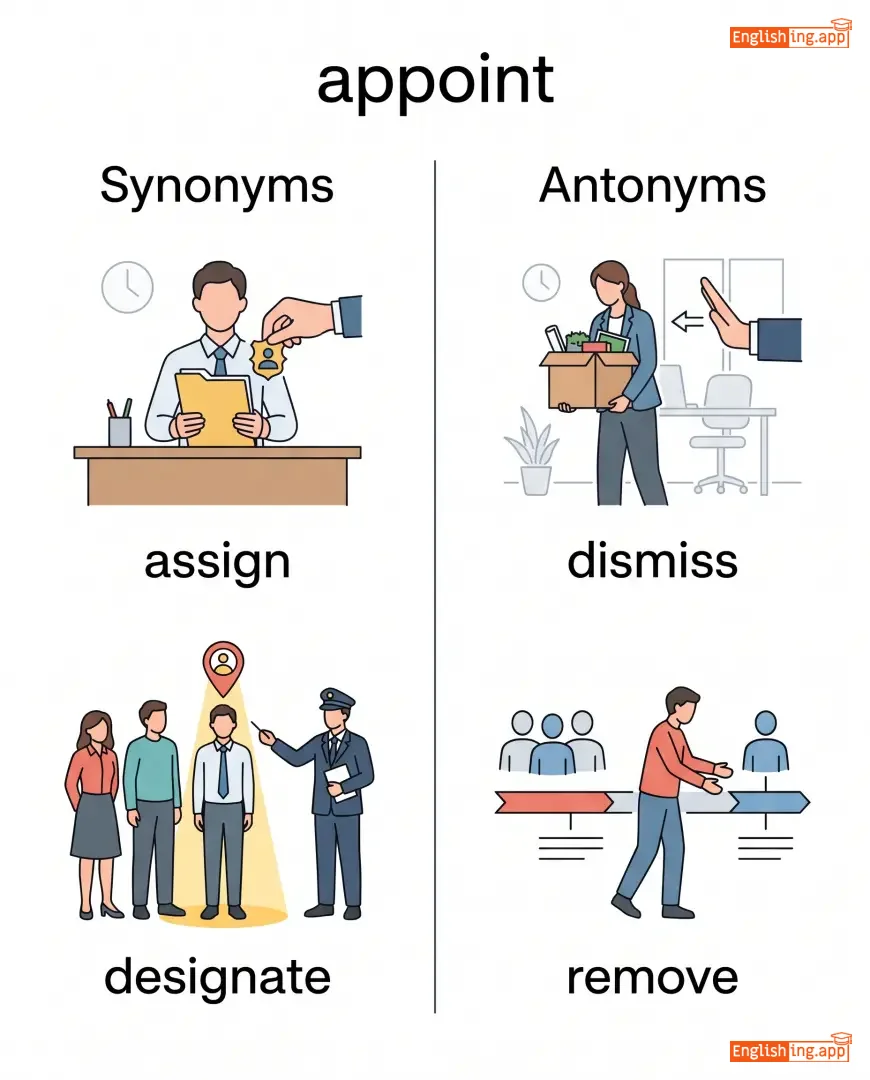
assign, designate, nominate, delegate, commission
••••••
|
dismiss, remove, reject
••••••
|
appoint a manager, appoint a committee, appoint a date, appoint someone
••••••
|
Appoint значит назначить—'App находит точку для назначения'.
••••••
|
|
📅
••••••
|
/əˈpɔɪntmənt/
noun
(эпойнтмент)
••••••
|
- •••••• |
встреча
vstrecha
••••••
|
- •••••• | - •••••• | - •••••• | - •••••• |
an arrangement to meet someone at a particular time
••••••
|
I have a doctor's appointment tomorrow. |
У меня завтра прием у врача.
U menya zavtra priem u vracha.
••••••
|
keep an appointment |
to attend an arranged meeting
••••••
|
соблюдать встречу
soblyudat' vstrechu
••••••
|
meeting, arrangement, date, schedule, reservation
••••••
|
cancellation, absence
••••••
|
make an appointment, cancel an appointment, keep an appointment, appointment time
••••••
|
Appointment — это встреча, не забудь!
••••••
|
|
🙏
••••••
|
/əˈpriːʃieɪt/
verb
(ap-ree-shee-eyt)
••••••
|

|
ценить
tsen-it
••••••
|
appreciated
ap-ree-shee-ey-ted
••••••
|
appreciated
ap-ree-shee-ey-ted
••••••
|
appreciates
ap-ree-shee-eyts
••••••
|
appreciating
ap-ree-shee-ey-ting
••••••
|
to recognize the value of something or to be thankful for it
••••••
|
I really appreciate your help with this project.
Я действительно ценю вашу помощь в этом проекте.
••••••
|
Я действительно ценю вашу помощь в этом проекте.
Ya deystvitel'no tsenyu vashu pomoshch' v etom pro-yekte.
••••••
|
appreciate the gesture
ценить жест
••••••
|
to value someone's action or kindness
••••••
|
ценить жест
tsen-it' zhest
••••••
|
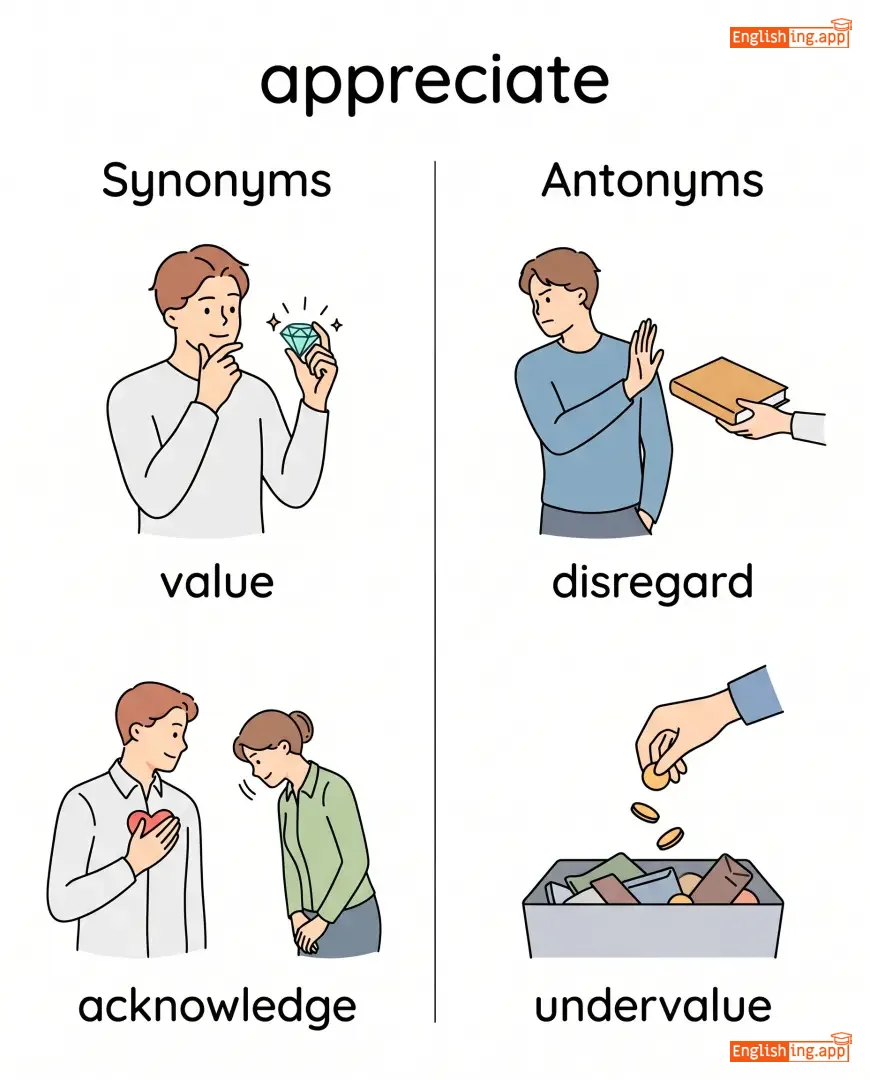
value, acknowledge, recognize, respect, admire
••••••
|
disregard, undervalue, ignore
••••••
|
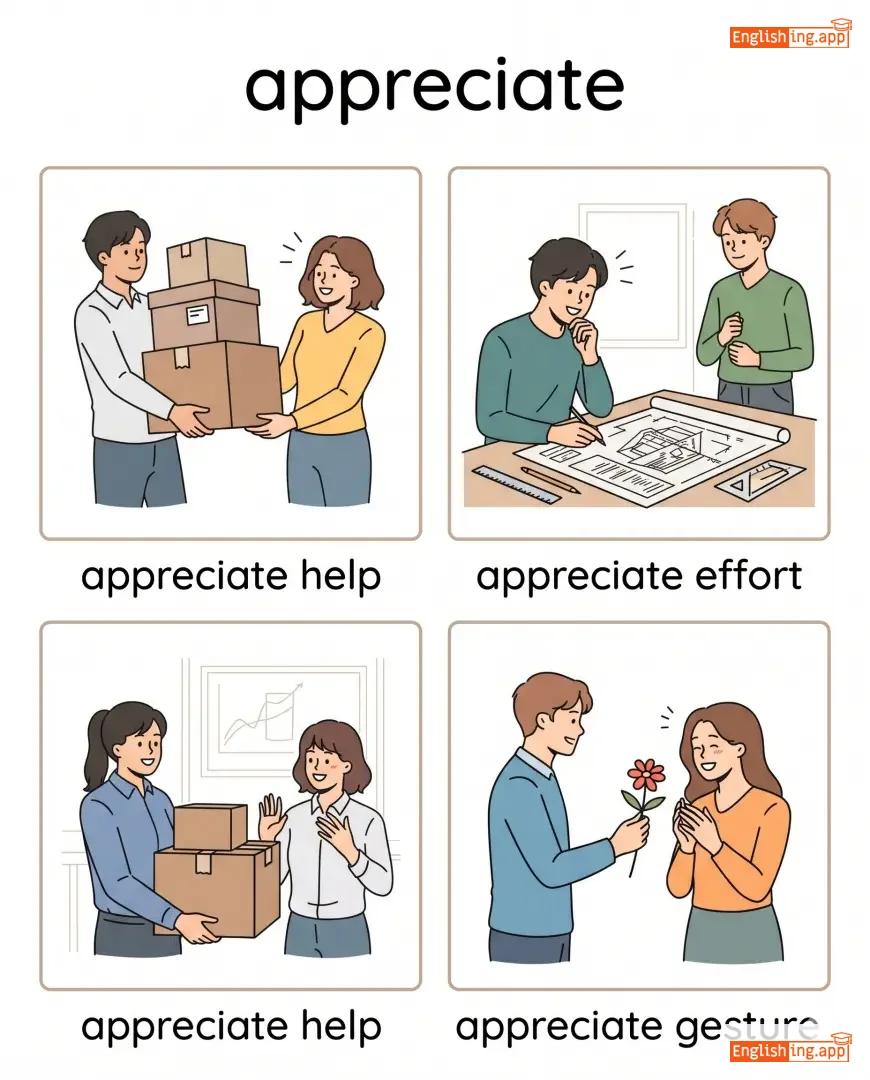
appreciate help, appreciate effort, appreciate gesture, appreciate support
••••••
|
Appreciate - это как сказать 'спасибо' 🙏
••••••
|
|
💐
••••••
|
/əˌpriːʃiˈeɪʃən/
noun
(apreʃijɪˈeɪʃən)
••••••
|


|
признательность, благодарность
priznatelnosť, blagodarnost'
••••••
|
- •••••• | - •••••• | - •••••• | - •••••• |
recognition and enjoyment of the good qualities of someone or something
••••••
|
She showed great appreciation for his hard work. |
Она выразила глубокую признательность за его тяжелую работу.
Ona vyrazila glubokuyu priznatelnosť za ego tyazheluyu rabotu.
••••••
|
token of appreciation |
a small gift or gesture to show gratitude
••••••
|
жест признательности
zhest priznatelnosti
••••••
|
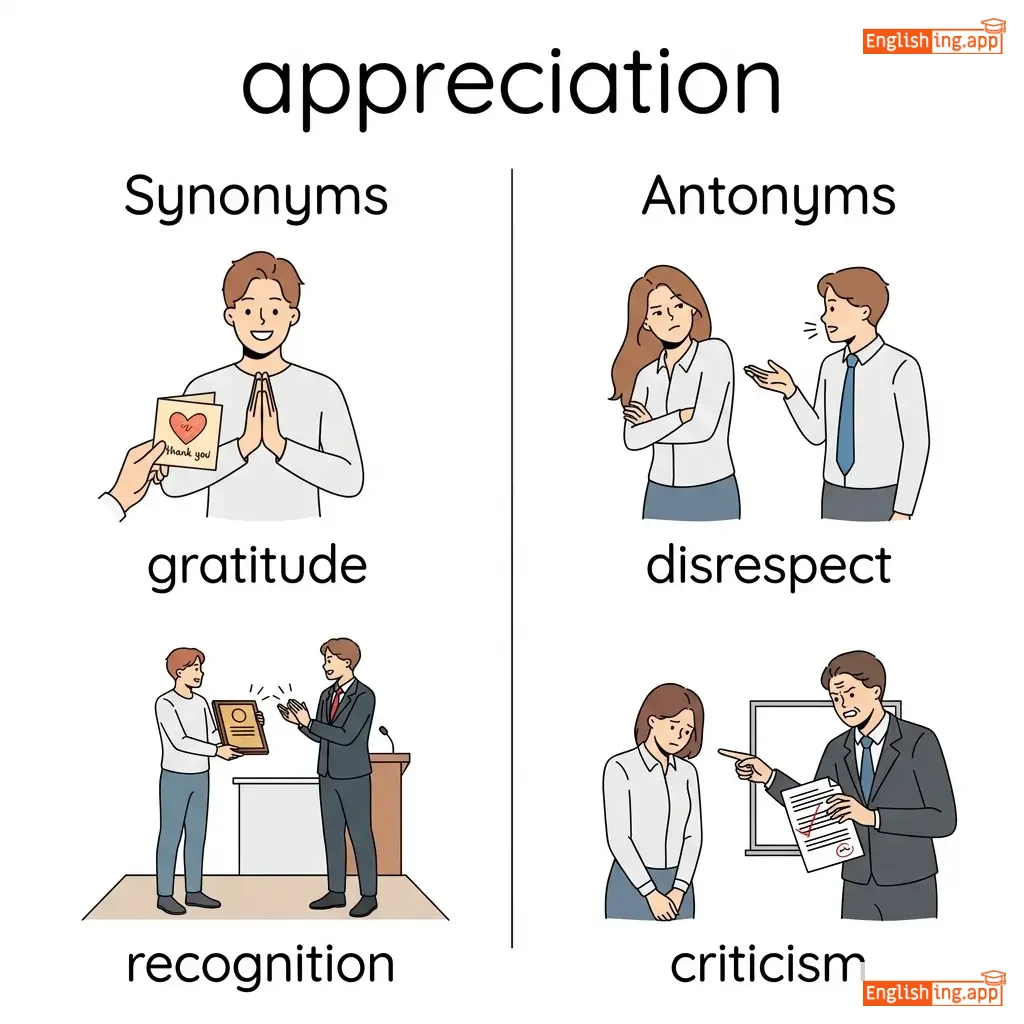
gratitude, recognition, admiration, thankfulness, respect
••••••
|
disrespect, criticism, ungratefulness
••••••
|
show appreciation, express appreciation, in appreciation of
••••••
|
Appreciation значит ценить, так что appreciation означает ценить — помни, все хотят appreciation 🎁
••••••
|
|
🚓
••••••
|
/ˌæprɪˈhɛnd/
verb
(aprihend)
••••••
|
- •••••• |
задержать
zaderzhat
••••••
|
apprehended
aprihended
••••••
|
apprehended
aprihended
••••••
|
apprehends
aprihends
••••••
|
apprehending
aprihending
••••••
|
to arrest or seize someone; to understand or perceive something
••••••
|
The police managed to apprehend the thief after a long chase.
Полиция сумела арестовать вора после долгой погони.
••••••
|
Полиция сумела арестовать вора после долгой погони.
Politsiya sumela arestovat vori posle dolgoy pogoni.
••••••
|
apprehend the meaning
понять смысл
••••••
|
to understand or grasp the meaning
••••••
|
понять смысл
ponyat smysl
••••••
|
arrest, capture, seize, detain, grasp
••••••
|
release, free, liberate
••••••
|
apprehend a suspect, apprehend quickly, apprehend the meaning
••••••
|
Задержание (арест) помогает осознать важность понимания.
••••••
|
|
📢
••••••
|
/əˈpraɪz/
verb
(apraiz)
••••••
|
|
проинформировать
proinformirovat'
••••••
|
apprised
apraizd
••••••
|
apprised
apraizd
••••••
|
apprises
apraizes
••••••
|
apprising
apraizing
••••••
|
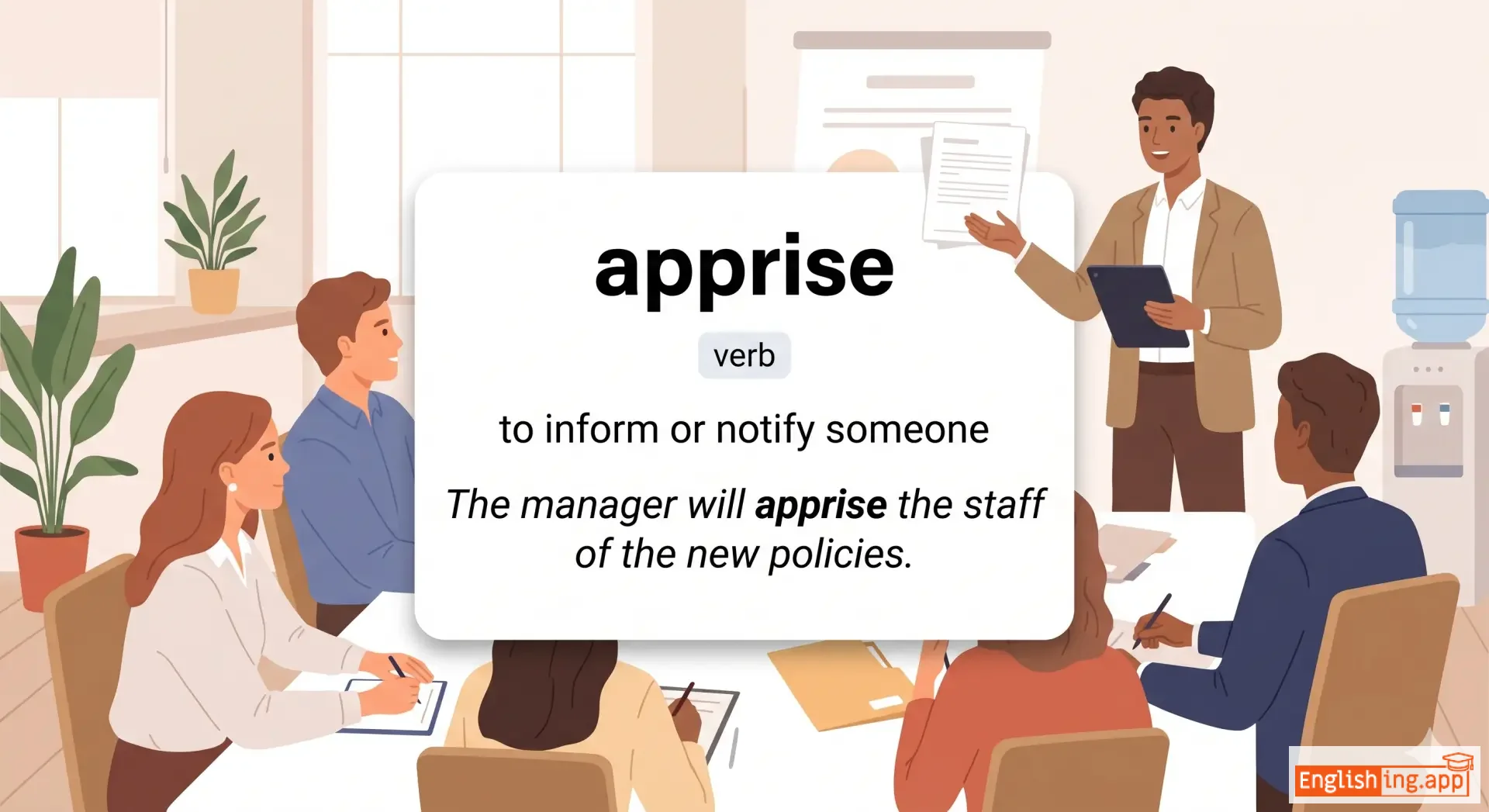
to inform or notify someone
••••••
|
The manager will apprise the staff of the new policies.
Менеджер проинформирует персонал о новых политиках.
••••••
|
Менеджер проинформирует персонал о новых политиках.
Menedzher proinformiruet personal o novykh politikakh.
••••••
|
keep apprised
быть в курсе
••••••
|
to keep informed about something
••••••
|
быть в курсе
byt' v kursye
••••••
|
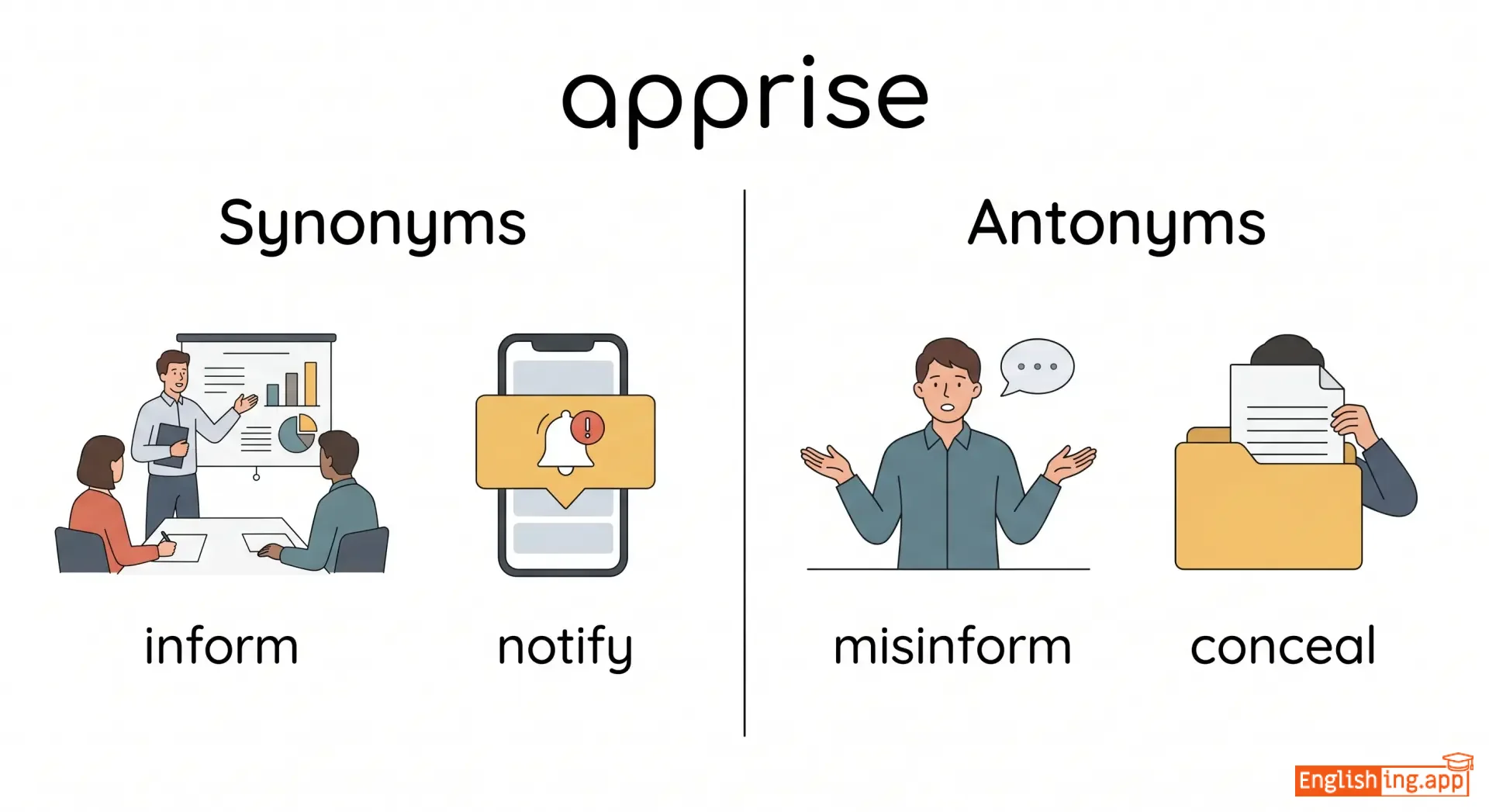
inform, notify, brief, update, advise
••••••
|
misinform, conceal
••••••
|
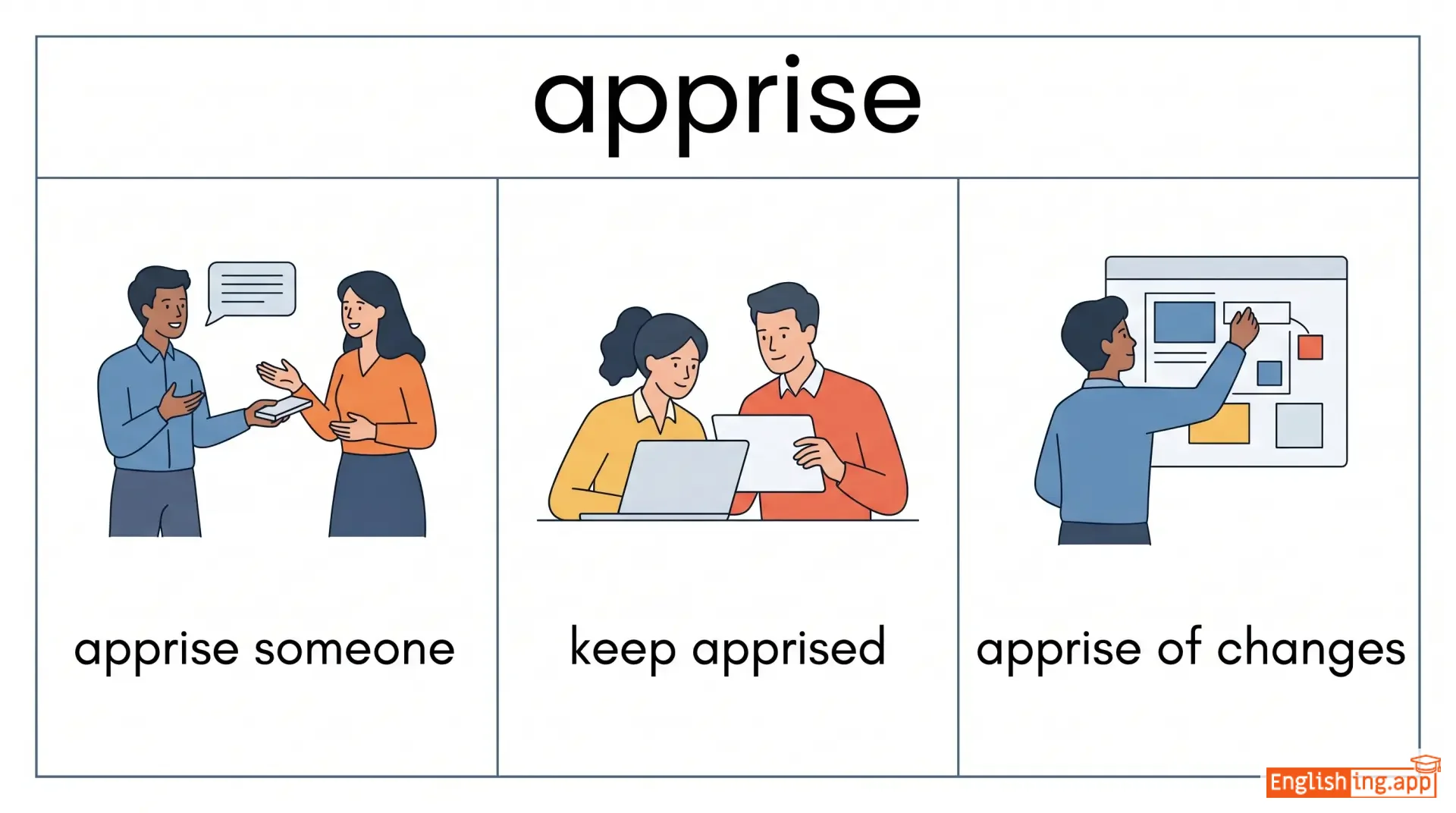
apprise someone, keep apprised, apprise of changes
••••••
|
Apprise — похоже на 'информировать', когда новости важны.
••••••
|
|
➡️
••••••
|
/əˈproʊtʃ/
verb
(aproach)
••••••
|
- •••••• |
подходить / решать проблему
podkhodit / reshat problemu
••••••
|
approached
aproshd
••••••
|
approached
aproshd
••••••
|
approaches
aproches
••••••
|
approaching
aproching
••••••
|
to move closer to someone or something; to deal with a situation or problem
••••••
|
The teacher approached the student to offer help.
Учитель подошел к ученику, чтобы предложить помощь.
••••••
|
Учитель подошел к ученику, чтобы предложить помощь.
Uchitel' podoshel k ucheniku, chtoby predlozhit' pomoshch'.
••••••
|
approach with caution
подходить с осторожностью
••••••
|
to be careful when dealing with something or someone
••••••
|
подходить с осторожностью
podkhodit' s ostorozhnost'yu
••••••
|
come near, advance, move toward, reach, tackle
••••••
|
retreat, withdraw, avoid
••••••
|
new approach, practical approach, approach a problem, approach someone
••••••
|
Подходить — значит идти к проблеме: сначала подходишь, потом решаешь.
••••••
|
|
✔️
••••••
|
/əˈproʊpriət/ (adj), /əˈproʊprieɪt/ (verb)
adjective, verb
(apropriéit)
••••••
|
|
уместный / присваивать
umestny / prisvaivat
••••••
|
appropriated
apropiéit
••••••
|
appropriated
apropiéit
••••••
|
appropriates
apropieits
••••••
|
appropriating
apropiáting
••••••
|
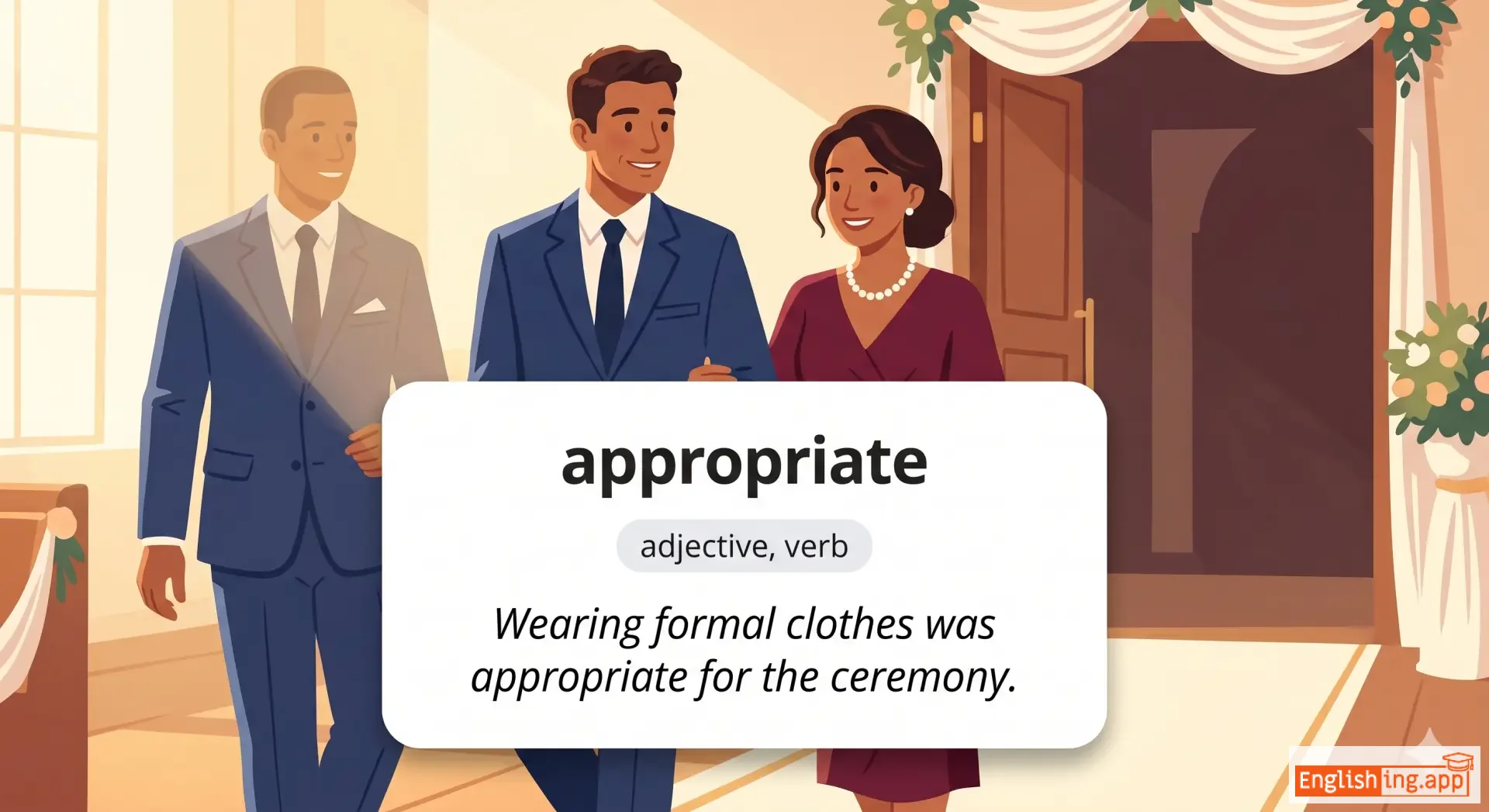
suitable or proper in the circumstances (adj); to take something for one’s own use, often without permission (verb)
••••••
|
Wearing formal clothes was appropriate for the ceremony.
Ношение формальной одежды было уместным для церемонии.
••••••
|
Носить формальную одежду было уместно для церемонии.
Nosit' formal'nuyu odezhdu bylo umestno dlya tseremonii.
••••••
|
- •••••• | - •••••• | - •••••• |
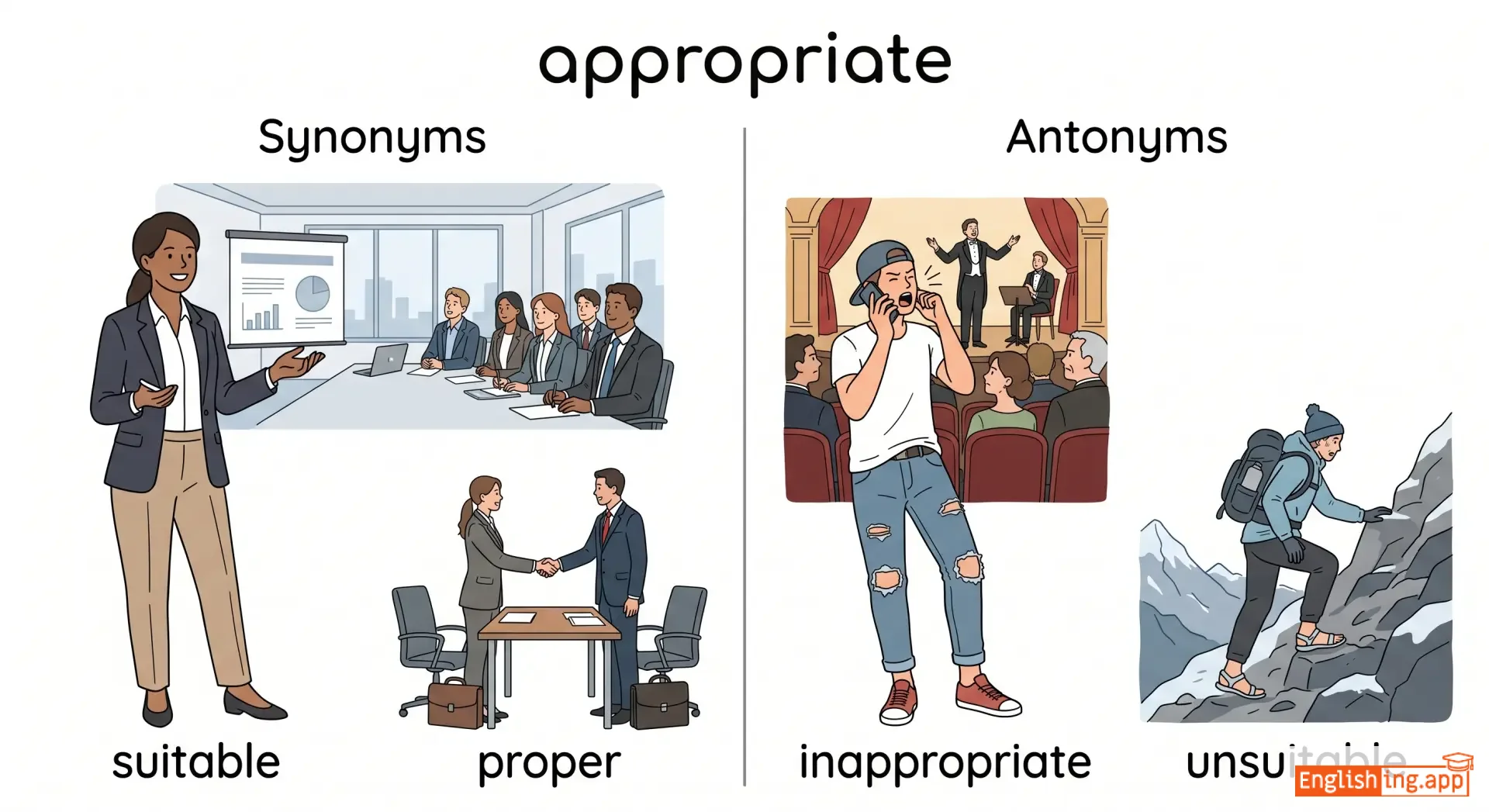
suitable, proper, fitting, apt, seize
••••••
|
inappropriate, unsuitable
••••••
|
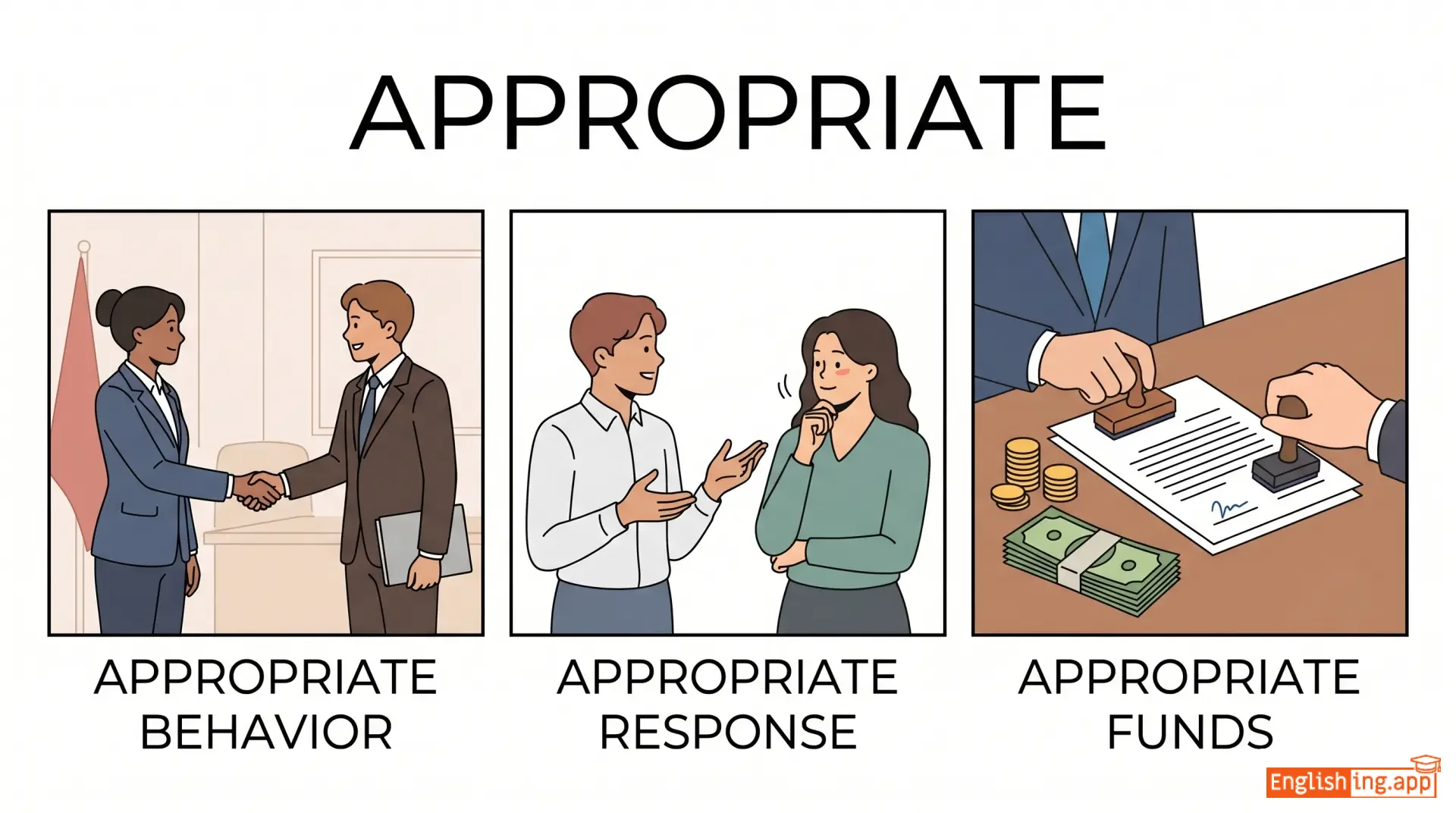
appropriate behavior, appropriate response, appropriate funds, culturally appropriate
••••••
|
Appropriate означает правильный—что подходит для ситуации, а иногда и взять что-то без разрешения.
••••••
|
|
👌
••••••
|
/əˈproʊpriətli/
adverb
(апроприэтли)
••••••
|
- •••••• |
соответственно
sotvetstvenno
••••••
|
- •••••• | - •••••• | - •••••• | - •••••• |
in a way that is suitable or proper for a particular situation
••••••
|
She was dressed appropriately for the event.
Она была одета соответственно мероприятию.
••••••
|
Она была одета соответственно мероприятию.
Ona byla odita sotvetstvenno meropriyatiyu.
••••••
|
- •••••• | - •••••• | - •••••• |
suitably, properly, fittingly, correctly
••••••
|
inappropriately, wrongly
••••••
|
act appropriately, dress appropriately, respond appropriately
••••••
|
Когда вы действуете соответственно, вы 'соответствуете' ситуации.
••••••
|
|
✔️
••••••
|
/əˈpruː.vəl/
noun
(apruval)
••••••
|
- •••••• |
одобрение
odobrenie
••••••
|
- •••••• | - •••••• | - •••••• | - •••••• |
official permission or agreement for something
••••••
|
The project received government approval. |
Проект получил одобрение правительства.
Proyekt poluchil odobrenie pravitel'stva.
••••••
|
seal of approval |
official acceptance or endorsement
••••••
|
пломба одобрения
plomba odobreniya
••••••
|
acceptance, consent, permission, endorsement, authorization
••••••
|
disapproval, rejection, denial
••••••
|
gain approval, seek approval, official approval, parental approval
••••••
|
Approval означает одобрение ✔️ — всё подтверждается, когда получаешь одобрение.
••••••
|
|
✅
••••••
|
/əˈpruːv/
verb
(apruv)
••••••
|
- •••••• |
одобрить
odobrit
••••••
|
approved
apruvdt
••••••
|
approved
apruvdt
••••••
|
approves
apruvs
••••••
|
approving
apruving
••••••
|
to officially accept, agree to, or allow something
••••••
|
The manager approved the budget for next year.
Менеджер утвердил бюджет на следующий год.
••••••
|
Менеджер утвердил бюджет на следующий год.
Menedzher utverdil byudzhet na sleduyushchiy god.
••••••
|
approve of
одобрить
••••••
|
to think well of something or someone
••••••
|
одобрить
odobrit
••••••
|
authorize, endorse, accept, permit, sanction
••••••
|
reject, deny, disapprove
••••••
|
approve plan, approve application, approve budget
••••••
|
Одобрить = ✅ одобрение – менеджер утвердил бюджет
••••••
|

