ভোকাবুলারিসমূহ

ইংরেজি শব্দের বাংলা অর্থ | English to Bangla Word Meaning Dictionary

adverb
/ˈɡrædʒuəli/
ধীরে ধীরে (dhire dhire)

Slowly and steadily, taking place step by step.

"She gradually improved her English over the year."

"সে ধীরে ধীরে বছরের মধ্যে তার ইংরেজি উন্নত করেছিল।" (Se dhire dhire bochorer moddhe tar ingreji unnotto korechhilo.)
noun, verb
/ˈɡrædʒuət/ (noun), /ˈɡrædʒueɪt/ (verb)
স্নাতক (snatak)

As a noun: a person who has completed a course of study; As a verb: to complete a course of study successfully.

"She will graduate from university next year."

"সে আগামী বছর বিশ্ববিদ্যালয় থেকে স্নাতক হবে।" (se agami bochhor bishwobidyaloy theke snatak hobe.)
adjective
/ˈɡrædʒuˌeɪtɪd/
স্নাতক / ধাপভিত্তিক (snatok / dhapbhittik)

Arranged in steps, levels, or stages; having completed a course of study and received a degree

"The scientist used a graduated cylinder to measure the liquid precisely."

"বিজ্ঞানী তরলটি সঠিকভাবে মাপতে একটি গ্র্যাজুয়েটেড সিলিন্ডার ব্যবহার করেছিলেন।" (Bigyani torolti sothikvabe mapte ekti graduated cylinder byabohar korechilen.)
noun
/ˌɡrædʒ.uˈeɪ.ʃən/
স্নাতক সমাপনী অনুষ্ঠান (snatok somaponi onushthan)

the act of receiving a degree or diploma after completing a course of study

"Her parents attended her graduation ceremony with pride."

"তার বাবা-মা গর্বের সাথে তার স্নাতক সমাপনী অনুষ্ঠানে উপস্থিত ছিলেন।" (Tar baba-ma gorber sathe tar snatok somaponi onushthane uposthit chilen.)
noun
/ɡrəˈfiː.ti/
দেয়ালে লিখিত লেখা; দেয়ালচিত্র; (deyale likhito lekha, deyalchitro)

writing or drawings scribbled, scratched, or sprayed illicitly on a wall or other surface in a public place

"The subway walls were covered with colorful graffiti created by local street artists."

"সাবওয়ের দেয়ালগুলো স্থানীয় রাস্তার শিল্পীদের তৈরি রঙিন গ্রাফিতি দিয়ে ঢাকা ছিল।" (subwayer deyalgulo sthaniy rastar shilpider toiri rongin graffiti diye dhaka chhilo.)
noun/verb
/ɡræft/
কলম / ঘুষ (kolom / ghush)

To join or insert a part of one plant or tissue into another; also refers to corruption or bribery

"The surgeon performed a skin graft to treat the burn victim."

"সার্জন পোড়া রোগীকে চিকিৎসা করতে একটি চামড়া প্রতিস্থাপন করেছিলেন।" (Sarjan pora rogike chikitsa korte ekti chamra protisthapon korechilen.)
noun
/ɡreɪn/
শস্যদানা / দানা (shosso dana / dana)

a small hard seed of a cereal plant such as wheat or rice; a tiny particle of a substance

"A grain of rice fell off the plate."

"একটি চালের দানা প্লেট থেকে পড়ে গেল।" (Ekti chaler dana plet theke pore gela.)
noun
/ɡræm/
ছোলা (chhola)

chickpea; a leguminous plant and its edible seed

"She cooked gram curry for lunch today."

"তিনি আজ দুপুরের খাবারের জন্য ছোলার তরকারি রান্না করলেন।" (tini aj dupurer khabarar jonno chholar torkari ranna korlen.)
noun
/ˈɡræmər/
ব্যাকরণ (byakoron)

the system and structure of a language, including rules for syntax, morphology, and usage

"She studied grammar to improve her writing skills."

"সে তার লেখার দক্ষতা উন্নত করতে ব্যাকরণ পড়েছিল।" (se tar lekhar dokkhota unnoti korte byakoron porechhilo)
noun
/ˈɡrænəri/
ধানের গোলা (dhaner gola)

A storehouse for grain; a region that produces a large amount of grain

"The farmers stored their harvest in the village granary."

"কৃষকরা তাদের ফসল গ্রামের ধানের গোলায় সংরক্ষণ করেছিলেন।" (Krishokra tader foshol gramer dhaner golay songrokkhon korechilen.)
adjective
/ɡrænd/
জাঁকজমকপূর্ণ (jankjomokpurno)

magnificent and impressive in appearance, size, or style

"They stayed at a grand hotel in Paris."

"তারা প্যারিসে একটি জাঁকজমকপূর্ণ হোটেলে থাকেছিল।" (Tara Paris e ekti jankjomokpurno hotel e thakchilo.)
noun
/ˈɡrænd.tʃaɪld/
নাতি বা নাতনি (nati ba natni)

the child of one's son or daughter

"They love spending time with their grandchild on weekends."

"তারা সপ্তাহান্তে তাদের নাতি বা নাতনির সঙ্গে সময় কাটাতে ভালোবাসে।" (Tara soptahante tader nati ba natnir songe somoy katate bhalobashe.)
noun
/ˈɡræn(d)ˌdɔːtər/
নাতনি (natni)

the daughter of one’s son or daughter

"Her granddaughter visits her every weekend."

"তার নাতনি প্রতি সপ্তাহান্তে তাকে দেখতে আসে।" (tar natni proti shoptahante take dekhte ashe)
Grandeur definition card — visual illustration of the meaning
noun
/ˈɡrændʒər/
জাঁকজমক (jankajmok)

Impressive beauty, scale, or magnificence

"The grandeur of the palace left the visitors speechless."

"প্রাসাদের জাঁকজমক দর্শকদের নির্বাক করে দিয়েছিল।" (Prasader jankajmok dorshokder nirbak kore diyechilo.)
noun
/ˈɡrændˌfɑːðər/
দাদা / নানা (dada / nana)

the father of one's father or mother

"My grandfather tells us stories every evening."

"আমার দাদা প্রতিদিন সন্ধ্যায় আমাদের গল্প বলেন।" (Amar dada protidin sondhyay amader golpo bolen.)
noun
/ˈɡrændɪləkwəns/
আড়ম্বরপূর্ণ ভাষা (aromborpurno bhasha)

Pompous or extravagant language, style, or manner, often intended to impress

"The politician’s speech was full of empty grandiloquence."

"রাজনীতিবিদের বক্তৃতা ছিল ফাঁপা আড়ম্বরপূর্ণ কথায় ভরা।" (Rajniti bider boktrita chilo fapa aromborpurno kathay vora.)
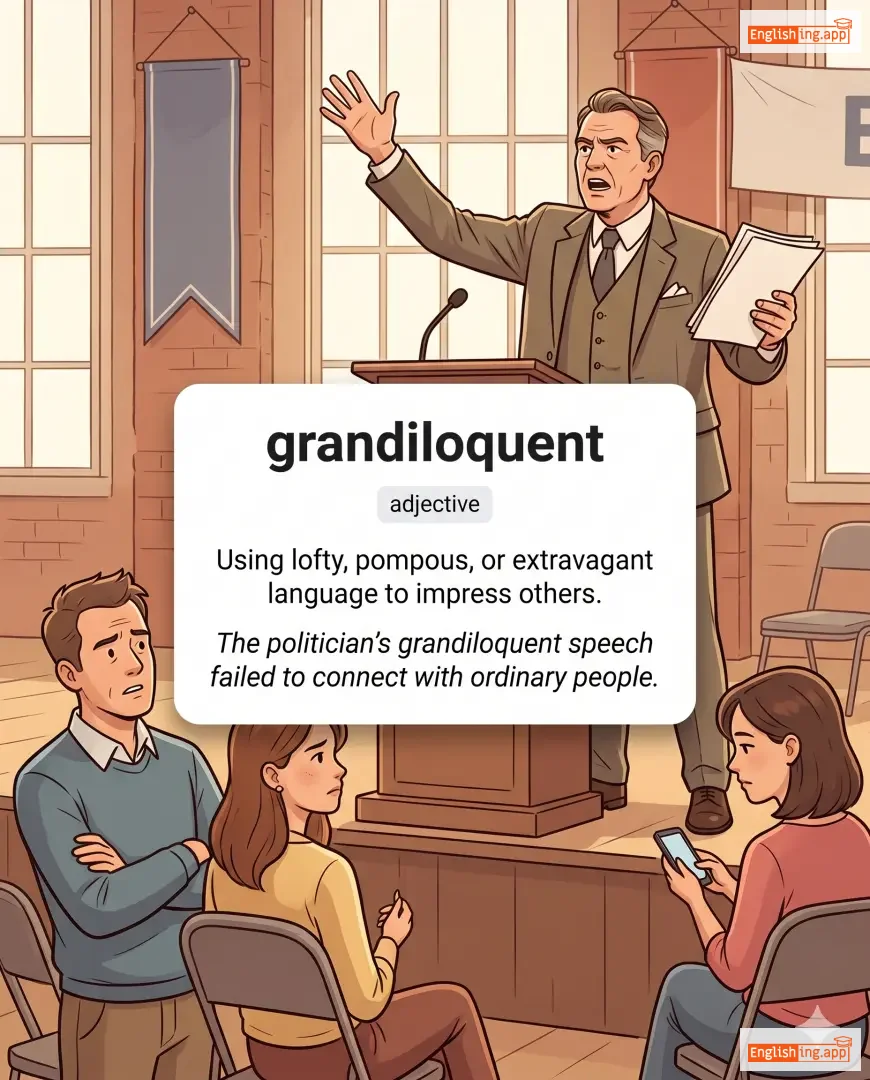
grandiloquent definition card — visual illustration of the meaning
adjective
/ɡrænˈdɪləkwənt/
আড়ম্বরপূর্ণ ভাষণ (aromborpurno bhashon)

Using lofty, pompous, or extravagant language to impress others.

"The politician’s grandiloquent speech failed to connect with ordinary people."

"রাজনীতিবিদের আড়ম্বরপূর্ণ বক্তৃতা সাধারণ মানুষের সাথে সংযোগ করতে ব্যর্থ হয়েছিল।" (Rajniti bider aromborpurno boktrita shadharon manusher sathe songjog korte byartho hoyechhilo.)
adjective
/ˈɡrændioʊs/
অতিআড়ম্বরপূর্ণ (otiaromborpurno)

Impressive or magnificent in appearance or style, often pretentiously so.

"He had grandiose plans of building a futuristic city in the desert."

"তার মরুভূমিতে একটি ভবিষ্যত নগর গড়ার অতিআড়ম্বরপূর্ণ পরিকল্পনা ছিল।" (Tar morubhumi te ekti vobishyot nogor gora oti aromborpurno porikolpona chilo.)
noun
/ˈɡrændˌmʌðər/
দাদি / নানি (dadi / nani)

the mother of one's father or mother

"My grandmother makes delicious cakes."

"আমার দাদি সুস্বাদু কেক বানান।" (Amar dadi shuswadu kek banan.)
noun
/ˈɡrændˌpeə.rənt/
দাদা-দাদি বা নানা-নানি (dada-dadi ba nana-nani)

the parent of one's father or mother

"My grandparents live in a small village near the hills."

"আমার দাদা-দাদি পাহাড়ের কাছে একটি ছোট গ্রামে থাকেন।" (Amar dada-dadi paharer kache ekti chhoto grame thaken.)
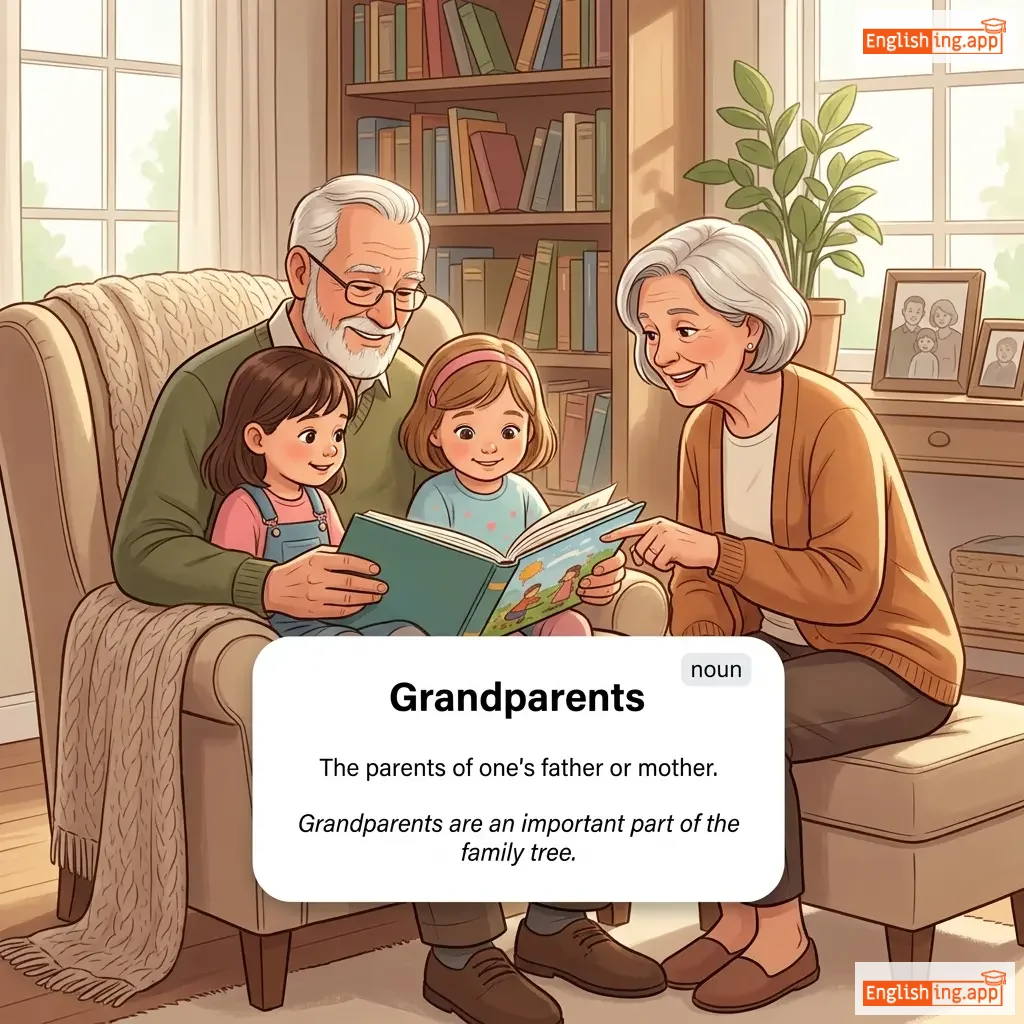
Grandparents definition card — visual illustration of the meaning
noun
ˈɡrænˌpɛrənts
দাদা-দাদী বা নানা-নানী (daadaa-daadee baa naanaa-naanee)

The parents of one's father or mother.

"Grandparents are an important part of the family tree."

"দাদা-দাদী বা নানা-নানী পারিবারিক গাছের একটি গুরুত্বপূর্ণ অংশ।" (Daadaa-daadee baa naanaa-naanee paribaarik gaachher ekti guruttopurno ongsho.)
noun
/ˈɡrændsʌn/
নাতি (nati)

the son of one's son or daughter

"His grandson visits him every weekend."

"তার নাতি প্রতি সপ্তাহান্তে তাকে দেখতে আসে।" (tar nati proti soptahante take dekhte ase)
verb
/ˈɡrændstænd/
আড়ম্বর করে প্রদর্শন করা (arombor kore prodorshon kora)

To seek attention or applause by behaving or speaking in a showy way.

"The actor was accused of grandstanding during the charity event."

"চ্যারিটি ইভেন্টে আড়ম্বরপূর্ণভাবে আচরণ করার অভিযোগ উঠেছিল অভিনেতার বিরুদ্ধে।" (Charity event e aromborpurnovabe acharon korar obhijog uthchhilo abhinetar biruddhe.)
grant definition card — visual illustration of the meaning
verb
/ɡrænt/
প্রদান করা (prodan kora)

To give or allow something, usually in an official or formal way.

"The university granted him a scholarship for his excellent results."

"বিশ্ববিদ্যালয় তার চমৎকার ফলাফলের জন্য তাকে একটি বৃত্তি প্রদান করেছিল।" (Bishwabidyaloy tar chomotkar folafoler jonno take ekti britti prodan korechhilo.)
noun
/ɡrænˈtiː/
বৃত্তিপ্রাপক (brittiprapok)

A person or organization that receives a grant or benefit.

"The grantee must submit a progress report every six months."

"গ্রান্টি প্রতি ছয় মাসে একটি অগ্রগতি প্রতিবেদন জমা দিতে হবে।" (Grantee proti chhoy mase ekti ogragoti protibedon joma dite hobe.)
noun
/ˈɡræn.tɔːr/
দানকারী (danokari)

A person or entity that makes a grant or transfers property or rights to another.

"The grantor transferred the property rights to the nonprofit organization."

"গ্রান্টর সম্পত্তির অধিকারটি অলাভজনক সংস্থাকে হস্তান্তর করেছেন।" (Grantor sompottir odhikaroti olavjonok songstake hostanto korechen.)
adjective
/ˈɡræn.jʊ.lər/
দানাদার (danadar)

Consisting of small grains or particles; detailed and specific.

"The report provided a granular analysis of the market data."

"রিপোর্টটি বাজারের তথ্যের একটি বিশদ বিশ্লেষণ প্রদান করেছে।" (Reportti bajarer tothyer ekti bishod bishleshon prodan koreche.)
verb
/ˈɡræn.jʊ.leɪt/
দানাদার করা (danadar kora)

To form or cause to form into grains or small particles.

"The sugar began to granulate as it cooled."

"চিনি ঠান্ডা হলে এটি দানাদার হতে শুরু করে।" (Chini thanda hole eti danadar hote suru kore.)
noun
/ˈɡræn.juːl/
দানাদার কণা (danadar kona)

A small compact particle of a substance.

"Each granule of salt sparkled under the sunlight."

"প্রতিটি লবণের দানা সূর্যের আলোতে ঝলমল করছিল।" (Pratiti loboner dana surjer alote jholmol korchhilo.)
noun
/ɡreɪp/
আঙুর (angur)

a small, round fruit that grows in clusters on vines and is used to make wine or eaten as food

"She picked a bunch of grapes from the vine."

"সে লতা থেকে একগুচ্ছ আঙুর তুলল।" (Se lata theke ekguchchho angur tull.)
noun
/ɡreɪps/
আঙ্গুর (angur)

small round fruits that grow in clusters on vines; used to make wine

"She bought a bunch of grapes from the market."

"সে বাজার থেকে এক গুচ্ছ আঙ্গুর কিনেছে।" (she bajar theke ek guchho angur kinechhe.)
adjective
/ˈɡræf.ɪk/
চিত্রশিল্পসংক্রান্ত (chitroshilposongkranto)

Relating to visual art, especially involving drawing, design, or vivid description.

"The movie contained graphic scenes of violence."

"সিনেমাটিতে সহিংসতার গ্রাফিক দৃশ্য ছিল।" (Cinemate shohingsotar graphic drishsho chhilo.)
noun
/ˈɡræfɪks/
চিত্রকলা (chitrokola)

visual images, designs, or drawings used to convey information or artistic expression

"The website uses stunning graphics to attract visitors."

"ওয়েবসাইটটি দর্শকদের আকর্ষণ করতে চমৎকার গ্রাফিক্স ব্যবহার করে।" (Websaitti dorshokder akorshon korte chamatkar graphics bebohrito kore.)
noun
/ˈɡræfaɪt/
গ্রাফাইট (graphite)

a soft, black form of carbon used in pencils and as a lubricant

"The artist sketched the portrait using a graphite pencil."

"শিল্পী একটি গ্রাফাইট পেন্সিল ব্যবহার করে প্রতিকৃতি এঁকেছিলেন।" (Shilpi ekti graphite pencil byabohar kore protikriti enkhechilen.)
verb
/ˈɡræpəl/
লড়াই করা, মোকাবিলা করা (lorae kora, mokabila kora)

to struggle or wrestle with something, often a problem or opponent

"The company is grappling with financial difficulties."

"কোম্পানিটি আর্থিক সমস্যার সাথে লড়াই করছে।" (Companyti arthik shomosshar sathe lorai korche.)
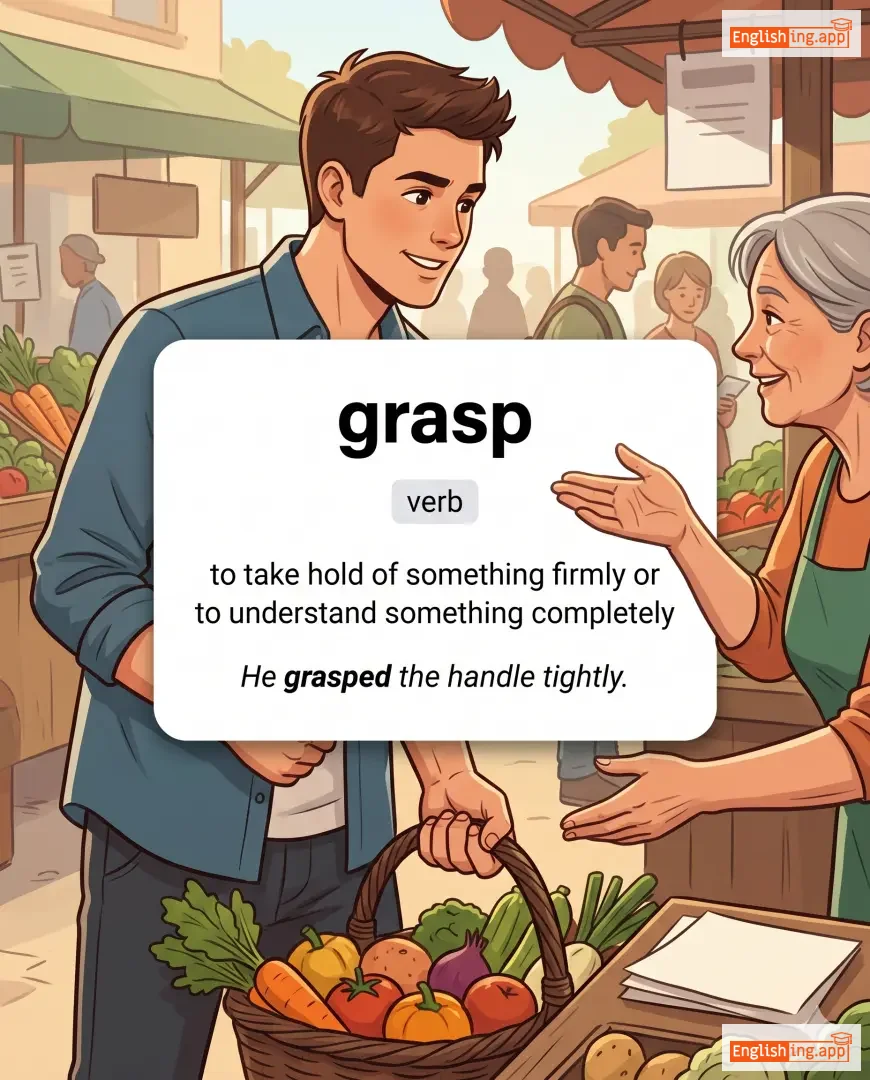
grasp definition card — visual illustration of the meaning
verb
/ɡrɑːsp/
আকঁড়ে ধরা বা বোঝা (akre dhora ba bojha)

to take hold of something firmly or to understand something completely

"He grasped the handle tightly."

"সে হ্যান্ডেলটি শক্ত করে ধরল।" (Se handleti shokt kore dhorlo.)
verb/adjective
/ˈɡræspɪŋ/
দৃঢ়ভাবে ধরা / লোভী (drirobhabe dhora / lobhi)

Holding firmly; or (as an adjective) excessively greedy.

"The child was grasping her mother’s hand tightly."

"শিশুটি তার মায়ের হাত শক্ত করে ধরে ছিল।" (Shishuti tar mayer hat shokto kore dhore chhilo.)
noun
/ɡræs/
ঘাস (ghas)

plants with narrow green leaves, often covering the ground in fields or gardens

"Children are playing on the grass."

"শিশুরা ঘাসের উপর খেলছে।" (Shishura ghaser upor khelche.)
noun
/ˈɡræs.hɒp.ər/
ফড়িং (foring)

a jumping insect with long hind legs that feeds on grass and plants

"The grasshopper jumped from one leaf to another."

"ফড়িংটি একটি পাতা থেকে অন্য পাতায় লাফিয়ে গেল।" (foringti ekti pata theke onno patay lafiye gelo.)
adjective
/ˈɡræs.i/
সবুজ বর্ণ (shobuj borno)

covered with grass; resembling grass in color; green like grass

"The grassy field stretched as far as the eye could see."

"ঘাসে ভরা মাঠটি যতদূর চোখ যায় বিস্তৃত ছিল।" (ghashe bhora mathti jotodur chokh jay bistrito chilo)
verb
/ɡreɪt/
কুঁচানো, বিরক্ত করা (kuchano, biroktokora)

to shred food into small pieces using a grater; to irritate or annoy

"She grated the cheese for the pasta dish."

"সে পাস্তার জন্য চিজ কুঁচিয়ে নিল।" (Se pasta r jonno cheese kuchie nilo.)
adjective
/ˈɡreɪtfəl/
কৃতজ্ঞ (kritoggo)

feeling or showing thanks for something or someone

"I am grateful for your help."

"আমি তোমার সাহায্যের জন্য কৃতজ্ঞ।" (Ami tomar sahajjer jonno kritoggo.)
noun
/ˈɡreɪt.fəl.nəs/
কৃতজ্ঞতা; (kritogota)

the quality of being thankful; readiness to show appreciation for kindness

"She expressed her gratefulness to the doctors who saved her life."

"তিনি তার জীবন রক্ষাকারী ডাক্তারদের প্রতি কৃতজ্ঞতা প্রকাশ করেছিলেন।" (tini tar jibon rokkhakaari daktarder proti kritogota prokash korechhilen.)
noun
/ˈɡreɪ.tər/
আঁচড়ানি (anchrani)

a kitchen utensil with a rough surface for grating food into small pieces

"Use the grater to grate cheese for the pizza."

"পিজার জন্য পনির কুচি করতে আঁচড়ানি ব্যবহার করো।" (pizar jonno ponir kuchi korte anchrani bebhar koro.)
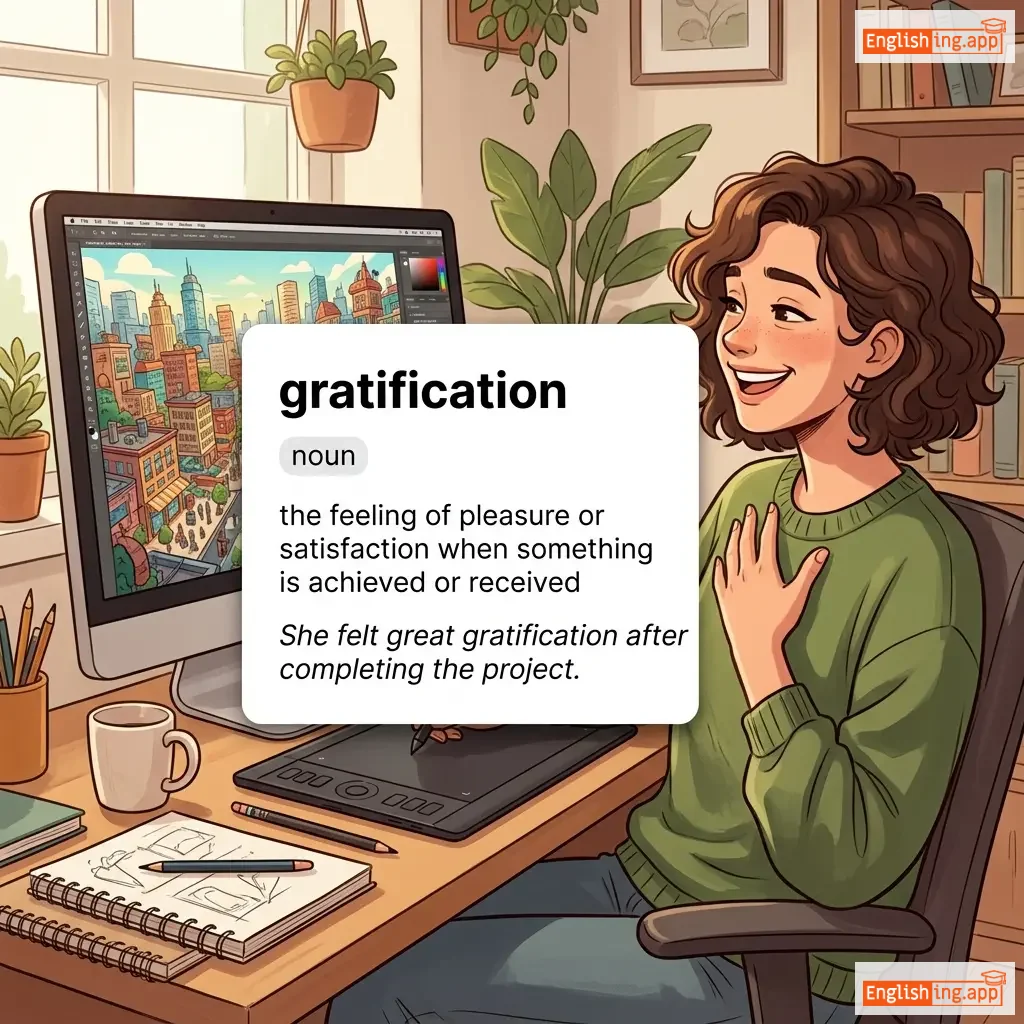
gratification definition card — visual illustration of the meaning
noun
/ˌɡrætɪfɪˈkeɪʃən/
সন্তুষ্টি, তৃপ্তি (shontushti, tripti)

the feeling of pleasure or satisfaction when something is achieved or received

"She felt great gratification after completing the project."

"প্রকল্প শেষ করার পর সে গভীর তৃপ্তি অনুভব করেছিল।" (Prokolpo shesh korar por se gobhir tripti onubhob korechilo.)
verb
/ˈɡrætɪfaɪ/
সন্তুষ্ট করা, খুশি করা (shontushto kora, khushi kora)

to give pleasure or satisfaction to someone

"It gratified him to know his work was appreciated."

"তার কাজের প্রশংসা পাওয়া তাকে সন্তুষ্ট করেছিল।" (Tar kajer proshongsha pawa take shontushto korechilo.)
adjective, noun
/ˈɡreɪtɪŋ/
কর্কশ শব্দ / লোহার জালি (korkosh shobdo / lohar jali)

Harsh and unpleasant to the senses, especially sound; a framework of bars covering an opening.

"The teacher's grating voice made it hard to concentrate."

"শিক্ষকের কর্কশ কণ্ঠস্বর মনোযোগ দেওয়া কঠিন করে তুলেছিল।" (Shikkhoker korkosh kontoshor monojog deowa kothin kore tulchhilo.)
adverb, adjective
/ˈɡrætɪs/ or /ˈɡreɪtɪs/
বিনা মূল্যে (bina mulye)

Without charge; free of cost.

"The drinks at the event were provided gratis."

"অনুষ্ঠানে পানীয় বিনা মূল্যে দেওয়া হয়েছিল।" (Onusthane paniyo bina mulye deowa hoyechhilo.)
gratitude definition card — visual illustration of the meaning
noun
/ˈɡrætɪˌtjuːd/
কৃতজ্ঞতা (kritoggo)

The quality of being thankful; readiness to show appreciation for and return kindness.

"She expressed her gratitude to the team for their support."

"সে দলের প্রতি তাদের সমর্থনের জন্য কৃতজ্ঞতা প্রকাশ করেছিল।" (Se daler proti tader somorthoner jonno kritoggo prokash korechhilo.)
adjective
/ɡrəˈtjuːɪtəs/
অপ্রয়োজনীয় (oprojonyo)

Unnecessary, unwarranted, or given freely without reason or cause.

"The movie was criticized for its gratuitous violence."

"সিনেমাটি এর অপ্রয়োজনীয় সহিংসতার জন্য সমালোচিত হয়েছিল।" (Cinemati er oprojoniyo sohingshotar jonno somalochito hoyechhilo.)