ভোকাবুলারিসমূহ

ইংরেজি শব্দের বাংলা অর্থ | English to Bangla Word Meaning Dictionary

noun
/skɑːrf/
ওড়না (orhona)

a length of fabric worn around the neck or head for warmth, protection, or fashion

"She wrapped a warm scarf around her neck in the cold weather."

"ঠান্ডা আবহাওয়ায় তিনি গলায় একটি উষ্ণ ওড়না জড়িয়েছিলেন।" (thanda abahaoyay tini golay ekti ushno orhona joriyechilen)
verb
/ˈskærɪfaɪ/
মাটি আলগা করা (mati alga kora)

to make shallow cuts or scratches; to loosen the surface of soil

"The farmer scarified the soil before planting seeds."

"চাষী বীজ রোপণের আগে মাটি আলগা করেছিল।" (Chashi bij roponer age mati alga korechhilo.)
adjective
/ˈskɑː.lət/
চকচকে লাল (skarlet)

a bright red color with a slightly orange tinge

"The scarlet roses in the garden looked magnificent in the morning light."

"বাগানের চকচকে লাল গোলাপগুলো সকালের আলোতে দুর্দান্ত লাগছিল।" (baganer chokchokey lal golapgulo shokaler alote durdanto lagchilo.)
adjective
/ˈskeəri/
ভয়ঙ্কর (bhoyonkor)

causing fear or making you feel frightened

"That horror movie was really scary."

"ওই ভৌতিক সিনেমাটি সত্যিই ভয়ঙ্কর ছিল।" (oi bhoutik sinemati shotyi bhoyonkor chhilo.)
adjective
/ˈskeɪðɪŋ/
তীব্র সমালোচনামূলক (tibro somalochinamulok)

severely critical; harshly scornful

"The critic wrote a scathing review of the movie."

"সমালোচক ছবিটির তীব্র সমালোচনা লিখেছিল।" (Somalochok chhobitir tibro somalochona likhechhilo.)
verb
/ˈskætər/
ছড়িয়ে দেওয়া (chhorie deowa)

to throw or spread things over a wide area in different directions

"The farmer scattered seeds across the field."

"চাষী মাঠজুড়ে বীজ ছড়িয়ে দিয়েছিল।" (chashi mathjure bij chhorie diyechhilo.)
adjective
/ˈskætərd/
ছড়ানো (chorano)

Spread irregularly or widely in different directions.

"The toys were scattered all over the floor."

"খেলনাগুলো মেঝেতে ছড়িয়ে ছিল।" (Khelonagulo mejhete choriye chhilo.)
verb
/ˈskævɪndʒ/
আবর্জনা থেকে খোঁজা (aborjona theke khoja)

to search through waste or discarded material to find useful items

"The children scavenged for food in the garbage dump."

"শিশুরা আবর্জনার স্তুপে খাবার খুঁজে বেড়াচ্ছিল।" (Shishura aborjonar stupe khabar khuje berachhilo.)
noun
/ˈskævɪndʒər/
মরা প্রাণীভোজী / আবর্জনা সংগ্রহকারী (mora pranibhogi / aborjana songrohokari)

an animal or person that feeds on dead or discarded material

"Vultures are natural scavengers that clean up the environment."

"শকুন প্রাকৃতিক স্ক্যাভেঞ্জার যা পরিবেশ পরিষ্কার করে।" (Shokun prakritik scavenger ja poribesh porishkar kore.)
noun
/səˈnɛərioʊ/
সম্ভাব্য পরিস্থিতি (sombhabyo poristhiti)

a possible situation or sequence of events

"The company prepared for the worst-case scenario."

"কোম্পানি সবচেয়ে খারাপ পরিস্থিতির জন্য প্রস্তুতি নিয়েছিল।" (Company sobcheye kharap poristhitir jonno prostuti niechilo.)
noun
/siːn/
দৃশ্য (drishyo)

a place or setting of an event or activity, or the part of a play or film

"The final scene of the movie was very emotional."

"চলচ্চিত্রের চূড়ান্ত সিনটি খুবই আবেগময় ছিল।" (Cholocchitro er churanto sin ti khub emotional chilo.)
noun
/ˈsiː.nər.i/
দৃশ্য; দৃশ্যপট; প্রাকৃতিক সৌন্দর্য; (shinari)

the natural features of a landscape; the painted background used on a theater stage

"The mountain scenery was breathtakingly beautiful."

"পাহাড়ের দৃশ্য শ্বাসরুদ্ধকর সুন্দর ছিল।" (pahaṛer drishyo shbashuruddhkar shundor chilo.)
noun
/sɛnt/
সুগন্ধ (sugondho)

a distinctive smell, especially a pleasant one

"The scent of roses filled the garden."

"গোলাপের সুবাসে বাগান ভরে গিয়েছিল।" (Golaper subase bagan bhore giyechhilo.)
adjective
/ˈskeptɪkəl/
অবিশ্বাসী; সংশয়বাদী; সন্দেহপ্রবণ; (obishshbashi)

having doubts; not easily convinced; questioning the truth of something

"Many scientists remain sceptical about the new theory."

"অনেক বিজ্ঞানী নতুন তত্ত্ব সম্পর্কে সন্দেহ পোষণ করে থাকেন।" (onek biggani notun totto somporkhe sondho poshon kore thaken)
noun
/ˈʃɑːdənfrɔɪdə/
অন্যের দুর্দশায় আনন্দ (onnor durdoshay anondo)

pleasure derived from another person's misfortune

"He felt a sense of schadenfreude when his rival failed."

"তার প্রতিদ্বন্দ্বী ব্যর্থ হলে সে শাডেনফ্রয়েড অনুভব করেছিল।" (Tar protidwondi byartho hole se schadenfreude onuvhob korechilo.)
noun
/ˈskɛdʒʊl/
সময়সূচী (somoysuchi)

a plan for carrying out a process or task, showing the time and sequence of actions

"I have a busy schedule for today."

"আজকের জন্য আমার একটি ব্যস্ত সময়সূচী আছে।" (Aajker jonno amar ekti byasto somoysuchi achhe.)
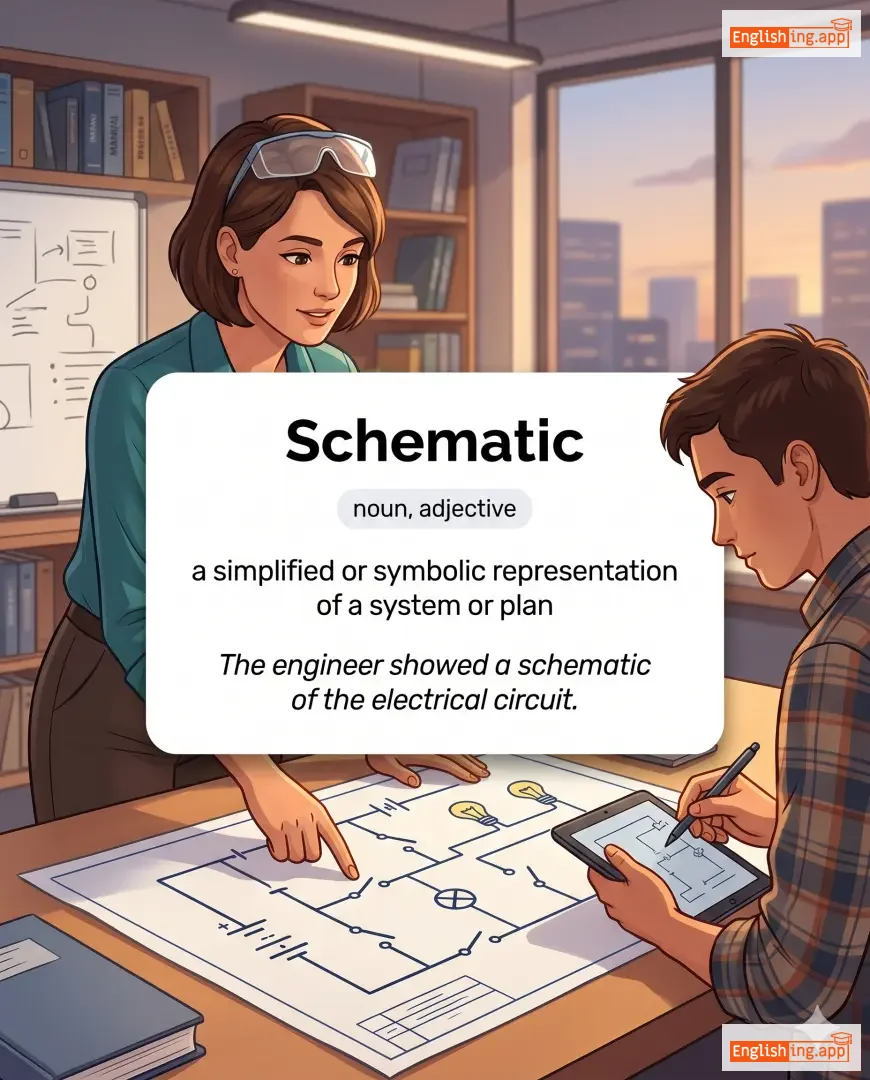
Schematic definition card — visual illustration of the meaning
noun, adjective
/skiːˈmætɪk/
চিত্র পরিকল্পনা (chitro porikolpona)

a simplified or symbolic representation of a system or plan

"The engineer showed a schematic of the electrical circuit."

"প্রকৌশলী বৈদ্যুতিক সার্কিটের একটি স্কিম্যাটিক দেখিয়েছিলেন।" (Prokousholi boidyutik circuit er ekti schematic dekhiechilen.)
noun, verb
/skiːm/
চক্রীয় পরিকল্পনা / ষড়যন্ত্র (chokriyo porikolpona / shorojontro)

a plan or arrangement, especially one that is secret or dishonest

"They devised a scheme to cheat investors."

"তারা বিনিয়োগকারীদের ঠকানোর জন্য একটি স্কিম তৈরি করেছিল।" (Tara binijogkarider thokanor jonno ekti scheme toiri korechilo.)
noun
/ˈskɪz.əm/ or /ˈsɪz.əm/
বিভাজন (bibajon)

A division or split between strongly opposed parties, often in religion or organizations.

"The schism in the church led to the formation of two separate groups."

"গির্জার বিভাজন দুটি আলাদা গোষ্ঠীর সৃষ্টি করেছিল।" (Girjar bibajon duti alada goshtir sristi korechilo.)
noun
/ˈskɒlər/
পণ্ডিত (pondit)

a person who studies a particular subject or academic field

"The scholar presented a research paper on ancient civilizations."

"পণ্ডিত প্রাচীন সভ্যতাগুলির উপর একটি গবেষণাপত্র উপস্থাপন করেছিলেন।" (Pondit prachin sabhyatagulir upor ekti gobeshonapatro uposthapon korechhilo.)
scholarly definition card — visual illustration of the meaning
adjective
/ˈskɒl.ə.li/
পণ্ডিতসুলভ (ponditshulobh)

Having or showing knowledge, learning, or devotion to academic study.

"She wrote a scholarly article on medieval literature."

"সে মধ্যযুগীয় সাহিত্য নিয়ে একটি পণ্ডিতসুলভ প্রবন্ধ লিখেছিল।" (Se moddhoyugio sahitto niye ekti ponditshulobh probondho likhechilo.)
noun
/ˈskɒlərʃɪp/
বৃত্তি (brittī)

an award or grant to support a student's education

"She received a scholarship to study abroad."

"সে বিদেশে পড়াশোনা করার জন্য একটি বৃত্তি পেয়েছে।" (Se bideshe porashona korar jonyo ekti brittī peyechhe.)
adjective
/skəˈlæstɪk/
বিদ্যালয়সংক্রান্ত (bidyaloy songkranto)

Relating to schools, education, or academic learning.

"The school organizes scholastic competitions every year."

"বিদ্যালয় প্রতি বছর বিদ্যালয়সংক্রান্ত প্রতিযোগিতা আয়োজন করে।" (Bidyaloy proti bochor bidyaloy songkranto protijogita aayojon kore.)
noun
/skuːl/
বিদ্যালয় (bidyaloy)

An institution for educating children; also a group of people sharing the same ideas or discipline.

"The children walked to school together."

"শিশুরা একসাথে বিদ্যালয়ে হেঁটে গেল।" (Shishura eksathe bidyaloye hente gelo.)
science definition card — visual illustration of the meaning
noun
/ˈsaɪəns/
বিজ্ঞান (biggan)

the systematic study of the structure and behavior of the physical and natural world

"Science has made incredible advancements in medicine."

"বিজ্ঞান চিকিৎসায় অবিশ্বাস্য অগ্রগতি করেছে।" (Biggan chikitsay obishwasha agrogoti korechhe.)
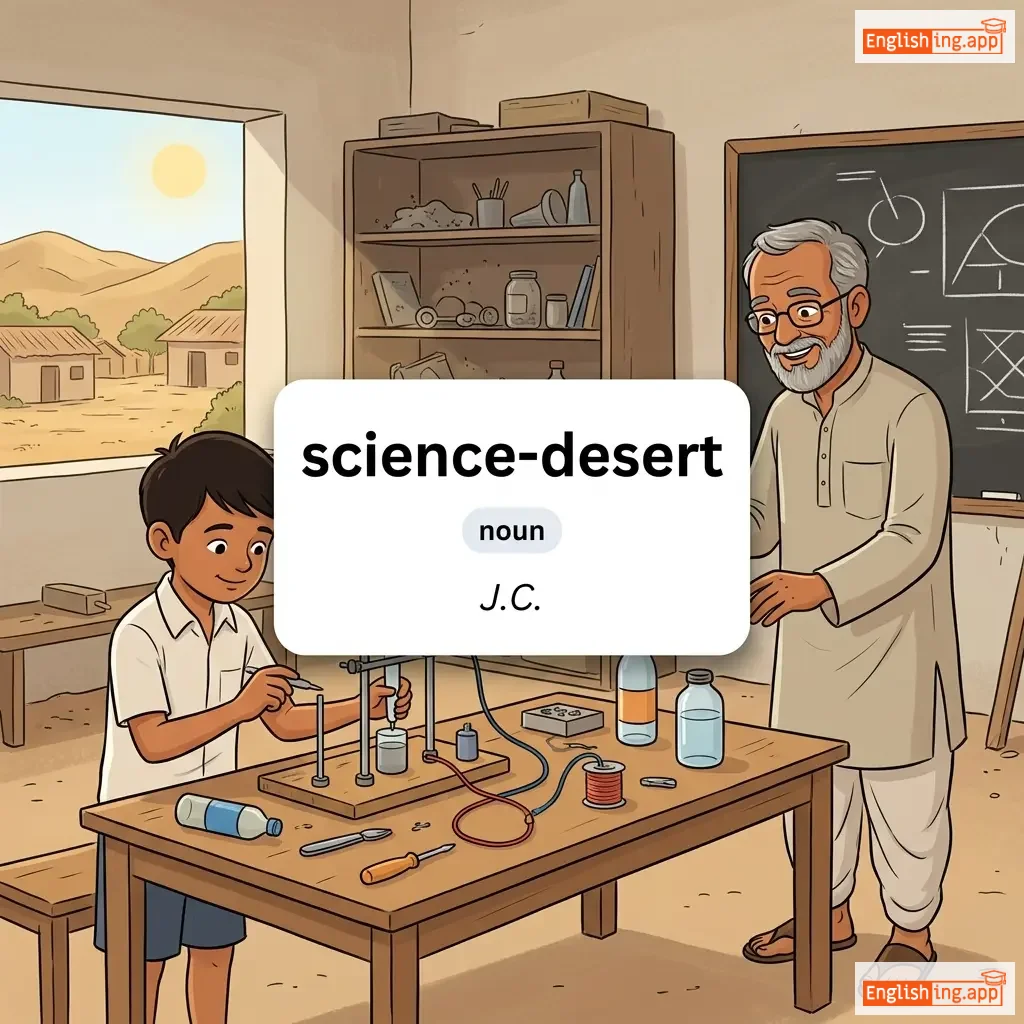
science-desert definition card — visual illustration of the meaning
noun
ˈsaɪəns ˈdezət
বিজ্ঞান-মরু (bigyan-moru)

A region or area lacking in scientific development, research facilities, or educational institutions.

"J.C. Bose thrived in a science-desert."

"বিজ্ঞান-মরুতে জগদীশচন্দ্র বসু লড়াই করেছিলেন।" (Bigyan-morute Jagadishchondro Boshu lorai korechilon.)
scientific definition card — visual illustration of the meaning
adjective
/ˌsaɪənˈtɪfɪk/
বৈজ্ঞানিক (boigganik)

relating to or based on science

"The scientific community is working to find a cure for cancer."

"বৈজ্ঞানিক সম্প্রদায় ক্যান্সারের চিকিৎসার জন্য কাজ করছে।" (Boigganik somproday kyanserer chikitsar jonyo kaj korchhe.)
scientist definition card — visual illustration of the meaning
noun
/ˈsaɪəntɪst/
বিজ্ঞানী (bigyani)

a person who conducts scientific research or experiments

"The scientist made a groundbreaking discovery in physics."

"বিজ্ঞানী পদার্থবিজ্ঞানে একটি যুগান্তকারী আবিষ্কার করেছিলেন।" (Bigyani podarthobigganay ekti jugantokari abishkar korechhilo.)
noun
/sɪnˈtɪl.ə/
সামান্য অংশ (samanjo angsho)

A tiny trace or spark of a specified quality or feeling.

"There wasn’t a scintilla of doubt in her mind."

"তার মনে এক বিন্দু সন্দেহও ছিল না।" (Tar mone ek bindu shondheho chilo na.)
verb
/ˈsɪn.tɪ.leɪt/
ঝলমল করা (jholmol kora)

to sparkle or shine brightly; to emit flashes of light

"The diamond ring scintillated under the bright lights."

"উজ্জ্বল আলোতে হীরার আংটিটি ঝলমল করছিল।" (Ujjol alote hirar angtiti jholmol korchhilo.)
adjective
/ˈsɪn.tɪ.leɪ.tɪŋ/
দীপ্তিময় (diptimoy)

brilliantly clever, exciting, or sparkling

"Her scintillating conversation kept everyone entertained."

"তার দীপ্তিময় আলাপচারিতা সবাইকে আনন্দিত রেখেছিল।" (Tar diptimoy alapcharita sobaike anondito rekhechhilo.)
noun
/ˈsaɪ.ə.lɪz.əm/
অগভীর জ্ঞান প্রদর্শন (ogobhir gyan prodorshon)

pretentious show of superficial knowledge

"His speech was full of sciolism, impressing no one."

"তার বক্তৃতা ছিল অগভীর জ্ঞানের ভান পূর্ণ, যা কাউকে প্রভাবিত করতে পারেনি।" (Tar boktrita chhilo ogobhir gyaner vhan purno, ja kauke probhabit korte pareni.)
noun
/ˈsaɪ.ən/
উত্তরাধিকারী (uttoradhikari)

a descendant of a wealthy, aristocratic, or influential family

"He is the scion of a wealthy industrialist family."

"সে এক ধনী শিল্পপতির পরিবারের উত্তরাধিকারী।" (Se ek dhoni shilpopotir paribarer uttaradhikari.)
noun
/ˈsɪʒ.ən/
বিভাজন (bibhajon)

the act of cutting or dividing something

"The political party suffered a scission over ideological disputes."

"রাজনৈতিক দলটি আদর্শগত বিরোধের কারণে বিভাজনের শিকার হয়েছিল।" (Rajnaitik dolti adorshogoto birodher karone bibhajoner shikar hoyechhilo.)
verb
/ˈsɪzər/
কাঁচি দিয়ে কাটা (kanchi diye kata)

to cut with or as if with scissors

"The tailor scissored the fabric neatly."

"দর্জি কাপড়টি সুন্দরভাবে কেটে ফেলল।" (Dorji kaporti sundorbhabe kete felllo.)
noun
/ˈsɪz.ərz/
কাঁচি (kanchi)

a cutting instrument with two blades that can be closed together

"I need scissors to cut this paper."

"এই কাগজ কাটার জন্য আমার কাঁচি দরকার।" (ei kagoj katar jonno amar kanchi dorkar.)
verb
/skɒf/
বিদ্রূপ করা (bidrup kora)

to speak about something in a mocking or dismissive way

"He scoffed at the idea of moving abroad."

"সে বিদেশে যাওয়ার ধারণাটিকে বিদ্রূপ করেছিল।" (Se bideshe jawar dharanatike bidrup korechilo.)
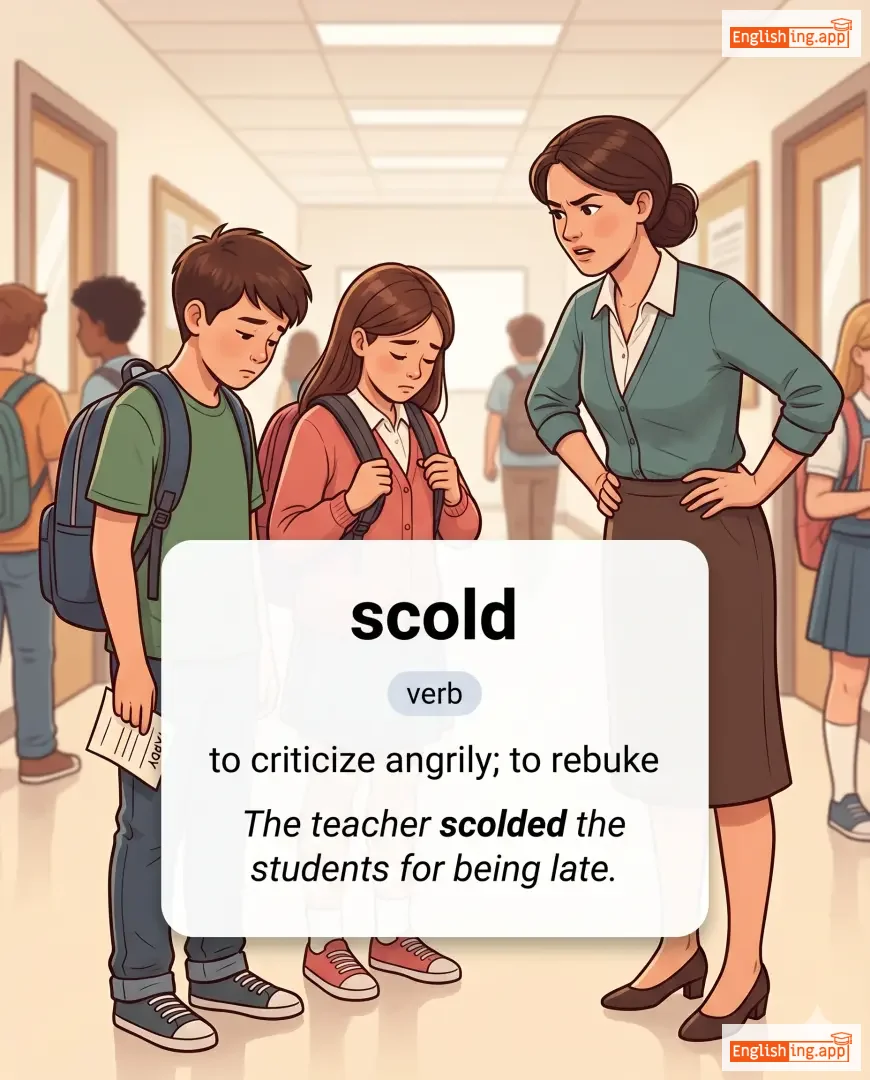
scold definition card — visual illustration of the meaning
verb
/skoʊld/
বকাঝকা করা (bokajhoka kora)

to criticize angrily; to rebuke

"The teacher scolded the students for being late."

"শিক্ষক ছাত্রদের দেরি করার জন্য বকাঝকা করেছিলেন।" (Shikkhok chatroder deri korar jonno bokajhoka korechilen.)
noun
/ˈskuːtər/
স্কুটার (scooter)

a small two-wheeled vehicle powered by an engine or electricity

"She rides a scooter to work every day."

"সে প্রতিদিন কাজের জন্য স্কুটারে চড়ে।" (Se protidin kajer jonno scooter e chode.)
noun
/skoʊp/
সীমা (sima)

the range of one's perception, understanding, or activity

"The project is beyond the scope of our resources."

"প্রকল্পটি আমাদের সম্পদের সীমার বাইরে।" (Prokolpoti amader sompoder simar baire.)
verb
/skɔːrtʃ/
দগ্ধ করা (dogdho kora)

to burn the surface of something slightly

"The fire scorched the walls of the building."

"আগুন ভবনের দেয়ালগুলো দগ্ধ করেছিল।" (Agun bhoboner deyalgulo dogdho korechilo.)
noun/verb
/skɔːr/
স্কোর / নম্বর (skor / nombor)

a number of points achieved in a game or test; to gain points or achieve a goal

"He scored the winning goal in the final match."

"সে ফাইনাল ম্যাচে বিজয়ী গোল করেছিল।" (Se final matche bijoyi gol korechilo.)
noun/verb
/skɔːrn/
অবজ্ঞা (obogga)

the feeling or expression of contempt or disdain; to treat with contempt

"She looked at him with open scorn."

"সে তাকে প্রকাশ্যে অবজ্ঞার চোখে দেখল।" (Se take prokashye oboggar chokhe dekhlo.)
adjective
/ˈskɔːrnfəl/
অবজ্ঞাপূর্ণ; তাচ্ছল্যপূর্ণ; (abojnnapurno)

showing contempt or disdain; expressing scorn

"She gave him a scornful look when he made the rude comment."

"সে তার দিকে একটি অবজ্ঞাপূর্ণ দৃষ্টি নিক্ষেপ করল যখন সে অভদ্র মন্তব্য করল।" (she tar dike ekti abojnnapurno drishthi nikkhep korol jkhon she abhodro montobbo korol)
noun
/ˈskɔːr.pi.ən/
বিছা/বৃশ্চিক (bicha/brishchik)

a small creature with eight legs, two claws, and a curved tail with a poisonous sting

"The scorpion hid under the rock during the day."

"বিছাটি দিনের বেলা পাথরের নিচে লুকিয়ে ছিল।" (bichati diner bela pathorer niche lukiye chilo.)
noun
/ˈskɔːrpiən fɪʃ/
সিং মাছ (shing mach)

a type of fish with venomous spines that belongs to the family Scorpaenidae

"The scorpion fish has dangerous spines that can inject venom."

"সিং মাছের বিপজ্জনক কাঁটা রয়েছে যা বিষ ঢুকাতে পারে।" (shing macher bipojonok kata royeche ja bish dhukaite pare)
verb/noun
/skɒtʃ/
বন্ধ করা / স্কচ হুইস্কি (bondho kora / skoch whisky)

to put an end to something; also a type of whisky

"The report scotched the rumors of a merger."

"প্রতিবেদনটি একীভূত হওয়ার গুজব বন্ধ করে দিল।" (Protibedonti ekibhuto howar gujob bondho kore dilo.)
noun
/ˈskaʊndrəl/
দুর্বৃত্ত (durbrityo)

a dishonest or unscrupulous person; a villain

"That scoundrel cheated the old man out of his savings."

"ওই দুর্বৃত্ত বুড়ো মানুষটিকে প্রতারণা করে তার সঞ্চয় ছিনিয়ে নিল।" (Oi durbritto buro manushke protarona kore tar sonchoy chiniye nilo.)
verb
/ˈskaʊər/
ঘষে পরিষ্কার করা / খুঁজে দেখা (ghoshe porishkar kora / khuje dekhha)

to clean or brighten the surface of something by scrubbing; to search thoroughly

"She scoured the kitchen until it shone."

"সে রান্নাঘরটা এত ঘষে পরিষ্কার করল যে সেটি ঝকঝক করছিল।" (Se rannaghor ta eto ghoshe porishkar korlo je seti jhokjhok korchhilo.)
noun/verb
/skɜːrdʒ/
অভিশাপ / যন্ত্রণা (abhishap / jontrona)

A source of great pain or punishment; to whip or inflict suffering on someone.

"Disease and poverty remain a scourge in many regions."

"রোগ ও দারিদ্র্য অনেক অঞ্চলে এখনও অভিশাপ রয়ে গেছে।" (Rog o daridro onek onchole ekhono abhishap roye geche.)