ভোকাবুলারিসমূহ

ইংরেজি শব্দের বাংলা অর্থ | English to Bangla Word Meaning Dictionary

noun, verb
/mɪnt/
পুদিনা / টাকাশালা (pudina / takashala)

a place where coins are made; to produce or invent something new

"The government decided to mint new coins to commemorate the anniversary."

"সরকার বার্ষিকী স্মরণে নতুন মুদ্রা তৈরি করার সিদ্ধান্ত নিয়েছিল।" (Sorkar barshiki smorone notun mudra toiri korar siddhanto niechilo.)
adjective
/ˈmɪnəskjuːl/
অতিক্ষুদ্র (otikshudro)

extremely small in size or importance

"She made only a minuscule contribution to the project."

"সে প্রকল্পে শুধুমাত্র একটি অতিক্ষুদ্র অবদান রেখেছিল।" (Se proklope shudhumatro ekti otikshudro obodan rekhechilo.)
noun, adjective
/maɪˈnjuːt/ (adj), /ˈmɪnɪt/ (noun)
মিনিট / ক্ষুদ্র (minit / khudro)

a period of sixty seconds; extremely small or detailed

"He examined the painting with minute attention to detail."

"সে ছবিটি ক্ষুদ্রতম বিস্তারিত সহ পরীক্ষা করল।" (Se chobiti khudrotomo bistariyo sho porikkha korlo.)
adverb
/maɪˈnjuːtli/
সূক্ষ্মভাবে; (shukkhobhabe)

in very small detail; extremely carefully

"The detective examined the evidence minutely."

"গোয়েন্দা প্রমাণগুলি সূক্ষ্মভাবে পরীক্ষা করলেন।" (goyenda promanguli shukkhobhabe porikha korlen)
noun
/maɪˈnjuːʃə/
ক্ষুদ্র বিবরণ (khudro biboron)

a small or trivial detail of something

"He was bored by the minutia of office paperwork."

"সে অফিসের কাগজপত্রের ক্ষুদ্র বিবরণে বিরক্ত ছিল।" (Se officer kagojpotrer khudro biborone birokt chilo.)
noun (plural)
/maɪˈnjuːʃiiː/
ক্ষুদ্র বিবরণসমূহ (khudro biboronsomuho)

the small, precise, or trivial details of something

"The lawyer focused on the minutiae of the contract."

"আইনজীবী চুক্তির ক্ষুদ্র বিবরণগুলোর উপর মনোযোগ দিলেন।" (Ainjibi chuktir khudro biborongulor upor monojog dilen.)
noun
/ˈmɪrəkəl/
অলৌকিক ঘটনা (oloukik ghotona)

an extraordinary event that cannot be explained by natural laws

"Surviving the accident was nothing short of a miracle."

"দুর্ঘটনা থেকে বেঁচে যাওয়া এক অলৌকিক ঘটনার চেয়ে কম কিছু ছিল না।" (durghotona theke benche jaoa ek oloukik ghotonar cheye kom kichu chilo na.)
adjective
/mɪˈrækjələs/
অলৌকিক (oloukik)

Extraordinarily wonderful or unusual, as if by a miracle.

"Her recovery after the accident was truly miraculous."

"দুর্ঘটনার পর তার সুস্থতা সত্যিই অলৌকিক ছিল।" (Durghotonar por tar susthota sottyi oloukik chilo.)
noun
/məˈrɑːʒ/
মরীচিকা (morichika)

An optical illusion caused by atmospheric conditions, often seen in deserts or hot roads, where water or objects appear to exist but do not.

"The weary travelers saw a mirage of water in the desert."

"ক্লান্ত ভ্রমণকারীরা মরুভূমিতে পানির মরীচিকা দেখেছিল।" (klanto vromonkarira morubhumite panir morichika dekhchilo.)
noun, verb
/ˈmaɪər/
কাদা / জটিলতা (kada / jatikota)

A stretch of swampy or boggy ground; as a verb, to entangle or involve someone in a difficult situation.

"The car was stuck in the mire after the heavy rain."

"ভারি বৃষ্টির পর গাড়িটি কাদায় আটকে গিয়েছিল।" (bari brishtir por gaditi kaday atke giyechilo.)
adjective, verb (past tense/participle of mire)
/ˈmaɪərd/
জড়িয়ে পড়া (jorie pora)

Trapped or entangled in something, typically a difficult situation.

"The politician was mired in scandal."

"রাজনীতিবিদ কেলেঙ্কারিতে জড়িয়ে পড়েছিলেন।" (rajnitibid kelenkarite jorie porechilen.)
noun
/ˈmɪrər/
আয়না (ayna)

A reflective surface, typically made of glass, that shows an image.

"She looked at herself in the mirror before leaving."

"বের হওয়ার আগে সে আয়নায় নিজেকে দেখল।" (Ber howar age se aynay nijeke dekhlo.)
noun
/mɜːrθ/
আনন্দ (anondo)

Great joy, amusement, or laughter.

"The festival was full of mirth and laughter."

"উৎসব আনন্দ ও হাসি-খুশিতে ভরপুর ছিল।" (utsob anondo o hasi khushite vorpur chilo.)
noun
/ˌmɪsədˈvɛntʃər/
অভাগ্যজনক ঘটনা (obhaggojonok ghona)

An unlucky accident, mishap, or unfortunate event.

"He broke his leg during a skiing misadventure."

"সে স্কিইং-এর সময় একটি অভাগ্যজনক দুর্ঘটনায় তার পা ভেঙেছিল।" (se skiing er somoy ekti obhaggojonok durghotonay tar pa bhengechilo.)
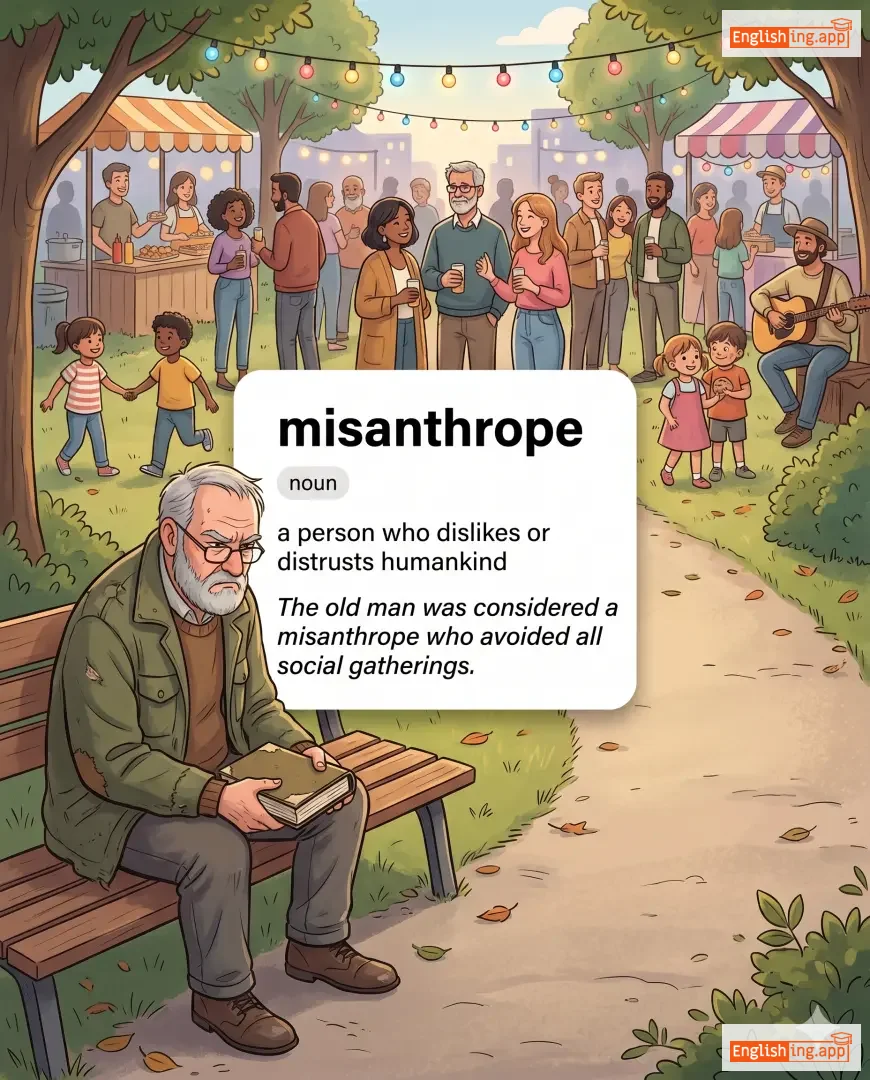
misanthrope definition card — visual illustration of the meaning
noun
/ˈmɪsənˌθroʊp/
মানুষবিদ্বেষী (manush bidbeshi)

a person who dislikes or distrusts humankind

"The old man was considered a misanthrope who avoided all social gatherings."

"বৃদ্ধ মানুষটিকে একজন মানুষবিদ্বেষী মনে করা হতো, যিনি সব সামাজিক সমাবেশ এড়িয়ে চলতেন।" (Briddho manush tike ekjon manush bidbeshi mone kora hoto, jini sob samajik somabesh eriye cholten.)
adjective
/ˌmɪsənˈθrɑːpɪk/
মানুষবিদ্বেষী স্বভাবের (manush bidbeshi shvaber)

having or showing a dislike of humankind

"His misanthropic attitude made it difficult for him to make friends."

"তার মানুষবিদ্বেষী মনোভাবের কারণে তার পক্ষে বন্ধু তৈরি করা কঠিন ছিল।" (Tar manush bidbeshi monobhober karone tar pokkhe bondhu toiri kora kothin chilo.)
noun
/mɪˈsænθrəpi/
মানুষবিদ্বেষ (manush bidbesh)

a general dislike, distrust, or hatred of humankind

"His misanthropy was evident in the way he avoided people."

"তার মানুষবিদ্বেষ স্পষ্ট ছিল যেভাবে তিনি মানুষকে এড়িয়ে চলতেন।" (Tar manush bidbesh sposto chilo jevabe tini manushke eriye cholten.)
verb
/ˌmɪsæprɪˈhɛnd/
ভুল বোঝা (bhul boja)

to misunderstand or misinterpret something

"He misapprehended the teacher’s instructions and did the task incorrectly."

"সে শিক্ষকের নির্দেশ ভুল বুঝেছিল এবং কাজটি ভুলভাবে করেছিল।" (Se shikkhoker nirdesh bhul bujhechhilo ebong kajti bhulvabe korechhilo.)
noun
/ˌmɪsæprɪˈhɛnʃən/
ভুল ধারণা (bhul dharana)

a mistaken belief or misunderstanding

"There is a common misapprehension about the causes of the disease."

"রোগের কারণ নিয়ে একটি সাধারণ ভুল ধারণা রয়েছে।" (Rog er karon niye ekti shadharon bhul dharana royeche.)
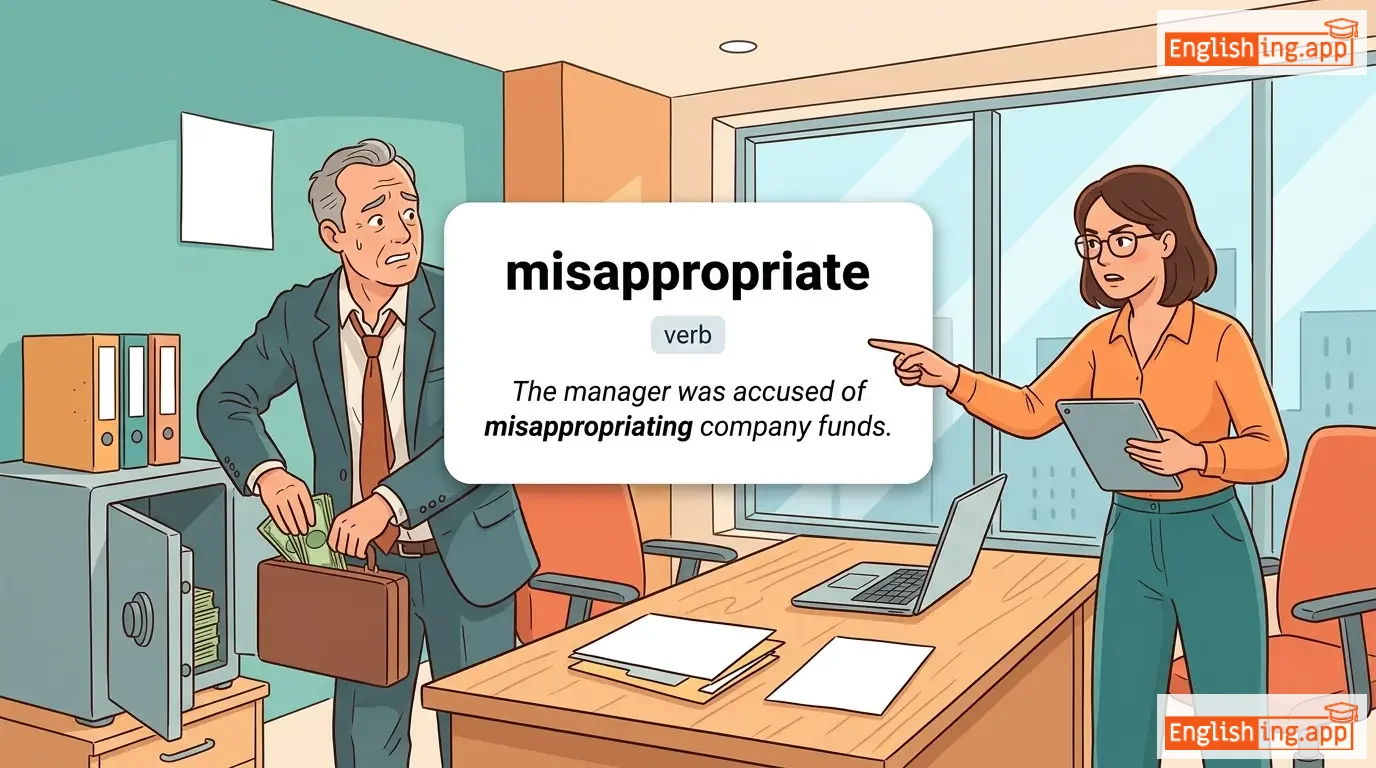
misappropriate definition card — visual illustration of the meaning
verb
/ˌmɪsəˈproʊprieɪt/
অবৈধভাবে ব্যবহার করা (obaidhobhabe byabohar kora)

to take or use something dishonestly, especially money or property, for one's own use

"The manager was accused of misappropriating company funds."

"ম্যানেজারকে কোম্পানির তহবিল অবৈধভাবে ব্যবহারের অভিযোগ আনা হয়েছিল।" (Manejerke kompanir tohbilo obaidhobhabe byaboharer abhijog ana hoyechilo.)
verb
/ˌmɪs.əˈtrɪb.juːt/
ভুলভাবে আরোপ করা (vulbhabe arop kora)

to incorrectly credit something, such as a work or remark, to the wrong person or source

"The quote was misattributed to Shakespeare."

"উক্তিটি ভুলভাবে শেক্সপিয়ারের নামে আরোপ করা হয়েছিল।" (Uktiti vulbhabe Shekspiarer name arop kora hoyechilo.)
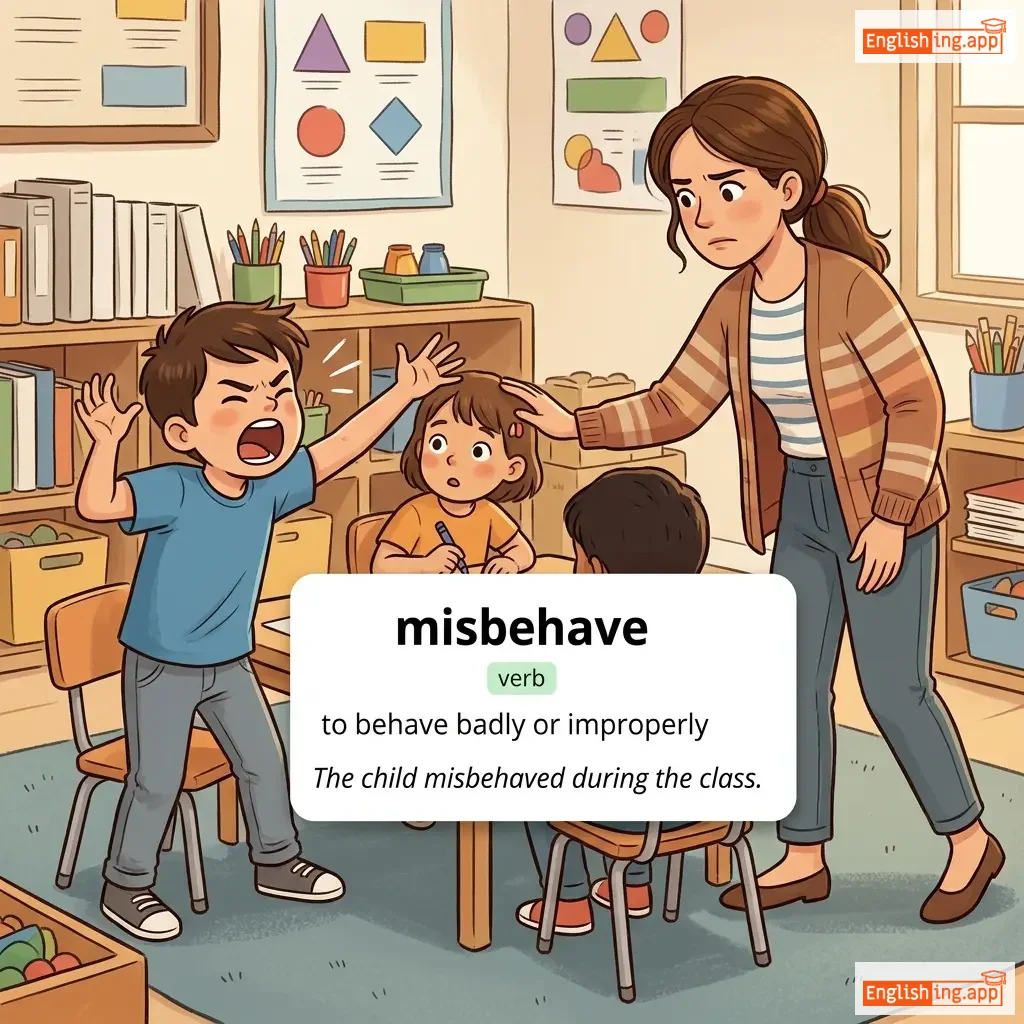
misbehave definition card — visual illustration of the meaning
verb
/ˌmɪsbɪˈheɪv/
অসদাচরণ করা (osodachoron kora)

to behave badly or improperly

"The child misbehaved during the class."

"শিশুটি ক্লাস চলাকালীন অসদাচরণ করেছিল।" (Shishuti klas cholakaline osodachoron korechilo.)
noun
/ˌmɪsbɪˈheɪvjər/
অসদাচরণ (osodachoron)

bad or improper behavior

"The teacher punished the student for his misbehavior."

"শিক্ষক ছাত্রকে তার অসদাচরণের জন্য শাস্তি দিয়েছিলেন।" (Shikkhok chatroke tar osodachoroner jonno shasti diyechilen.)
noun
/ˌmɪs.bɪˈheɪ.vjər/
অশোভন বা অশালীন আচরণ; (misbehaviour)

Bad or unacceptable behavior, especially by children or in formal situations

"The student was punished for his misbehaviour in class."

"ছাত্রটি ক্লাসে তার খারাপ আচরণের জন্য শাস্তি পেয়েছিল।" (chatrati klase tar kharap achoroner jonno shasti peyechilo.)
noun
/mɪˌsɛdʒəˈneɪʃən/
জাতিগত মিশ্র বিবাহ (jatigoto mishro bibaho)

the interbreeding of people considered to be of different racial types

"The law once prohibited miscegenation in many countries."

"একসময় অনেক দেশে মিসসেজেনেশন আইন দ্বারা নিষিদ্ধ ছিল।" (Eksomoy onek deshe miscegenation ain dara nishiddho chilo.)
adjective
/ˌmɪsəˈleɪniəs/
বিবিধ (bibidho)

Consisting of a variety of different items or types.

"The drawer was filled with miscellaneous objects."

"ড্রয়ারটি বিবিধ জিনিসে পূর্ণ ছিল।" (Drawarti bibidho jinise purno chhilo.)
noun
/ˈmɪsəleɪni/
সংকলন (songkolon)

A collection or mixture of various things.

"The book is a miscellany of essays and poems."

"বইটি প্রবন্ধ ও কবিতার একটি সংকলন।" (Boiti probondho o kobitar ekti songkolon.)
noun
/ˌmɪsˈtʃæns/
অভাগ্য (obhaggo)

An unfortunate accident or event; bad luck.

"By mischance, he missed the last train home."

"অভাগ্যের কারণে সে শেষ ট্রেনটি মিস করল।" (Obhagger karone se shesh trenti mis korlo.)
noun
/ˈmɪstʃɪf/
দুষ্টুমি (dustoomee)

Playful misbehavior or troublemaking.

"The children were full of mischief during the party."

"পার্টির সময় বাচ্চারা দুষ্টুমিতে ভরপুর ছিল।" (Partir somoy bachchara dustoomite vorpur chhilo.)
adjective
/ˈmɪstʃɪvəs/
দুষ্টুমি পূর্ণ (dustoomi purno)

Causing or showing a fondness for causing trouble in a playful way.

"She gave him a mischievous smile."

"সে তাকে দুষ্টুমি ভরা হাসি দিল।" (Se take dustoomi vora hasi dilo.)
verb
/ˌmɪskənˈsiːv/
ভুলভাবে ধারণা করা (vulbhabe dharona kora)

To misunderstand or form an incorrect idea about something.

"He misconceived the purpose of the project."

"সে প্রকল্পের উদ্দেশ্য ভুলভাবে বুঝেছিল।" (Se prokolper uddeshyo vulbhabe bujhechilo.)
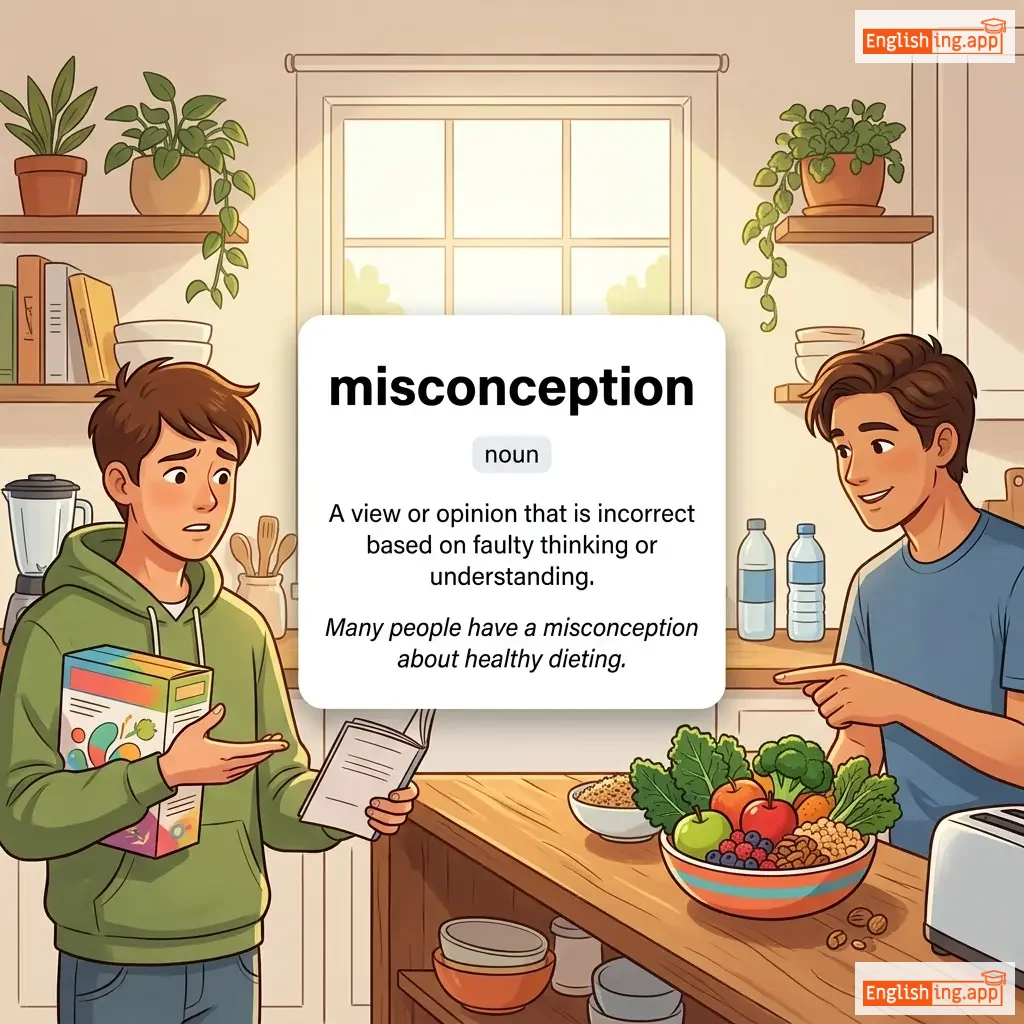
misconception definition card — visual illustration of the meaning
noun
/ˌmɪs.kənˈsep.ʃən/
ভুল ধারণা, বিভ্রান্তি, অপধারণা (bhul dharona, bibhranti, opadharana)

A view or opinion that is incorrect based on faulty thinking or understanding.

"Many people have a misconception about healthy dieting."

"অনেকের স্বাস্থ্যকর খাদ্যাভ্যাস সম্পর্কে ভুল ধারণা রয়েছে।" (Oneker shashthokor khadyabhyas somporke bhul dharona royeche.)
noun
/ˌmɪsˈkɒndʌkt/
অসদাচরণ (osodocharon)

Improper or unacceptable behavior, especially by a professional or authority figure.

"The teacher was dismissed for serious misconduct."

"শিক্ষককে গুরুতর অসদাচরণের জন্য বরখাস্ত করা হয়েছিল।" (Shikkhokke gurutor osodocharoner jonno borkhasto kora hoyechilo.)
verb
/ˌmɪskənˈstruː/
ভুলভাবে ব্যাখ্যা করা (vulbhabe byakkha kora)

To interpret something wrongly or misunderstand the meaning.

"She misconstrued his silence as anger."

"সে তার নীরবতাকে রাগ হিসেবে ভুলভাবে ব্যাখ্যা করেছিল।" (Se tar nirbotake rag hisebe vulbhabe byakkha korechilo.)
verb
/ˌmɪsˈkaʊnt/
ভুল গণনা করা (vul gonona kora)

To count wrongly or inaccurately.

"He miscounted the number of chairs in the hall."

"সে হলে চেয়ারের সংখ্যা ভুল গুনেছিল।" (Se hole cheyarer shonkha vul gunecchilo.)
noun
/ˈmɪskriənt/
দুর্বৃত্ত (durbrityo)

A person who behaves badly or criminally.

"The police arrested the miscreant responsible for the theft."

"পুলিশ চুরির জন্য দায়ী দুর্বৃত্তকে গ্রেফতার করেছিল।" (Polish churir jonno dayi durbrityoke greftar korechilo.)
noun
/ˌmɪsˈdiːd/
অপকর্ম (opokormo)

A wrong or illegal act.

"He regretted his past misdeeds and apologized."

"সে তার অতীতের অপকর্ম নিয়ে অনুতপ্ত হয়েছিল এবং ক্ষমা চেয়েছিল।" (Se tar otiter opokormo niye onutopto hoyechilo ebong khoma cheyechilo.)
noun
/ˌmɪsdɪˈmiːnər/
সামান্য অপরাধ (samanno aparadh)

A minor wrongdoing or criminal offense that is less serious than a felony.

"He was fined for a misdemeanor involving public disturbance."

"সে জনসমক্ষে গোলযোগ করার জন্য একটি সামান্য অপরাধে জরিমানা হয়েছিল।" (Se jonsomokhe golojog korar jonno ekti samanno aparadhe jorimana hoyechhilo.)
noun
/ˈmaɪzər/
কৃপণ (kripon)

A person who hoards wealth and spends as little money as possible.

"The old miser refused to donate even a penny to charity."

"বৃদ্ধ কৃপণ দানশীলতায় এক পয়সাও দান করতে অস্বীকার করেছিল।" (Briddho kripon danshilotay ek poisao dan korte aswikar korechhilo.)
adjective
/ˈmɪzərəbəl/
দু:খী (dukkhi)

Extremely unhappy or uncomfortable.

"He felt miserable after losing his job."

"চাকরি হারানোর পর সে খুব দুঃখী অনুভব করল।" (Chakri haranor por se khub dukkhi onuvob korlo.)
adverb
/ˈmɪzərəbli/
দুর্ভাগ্যজনকভাবে; দুঃখজনকভাবে; (durvaggojnokvabe)

in a wretched or unhappy manner; extremely badly

"The team performed miserably in the championship."

"দলটি চ্যাম্পিয়নশিপে দুর্ভাগ্যজনকভাবে খেলেছে।" (dolti championshipe durvaggojnokvabe khelechhe)
adjective
/ˈmaɪzərli/
কৃপণতাপূর্ণ (kriponatapurno)

Unwilling to spend money; stingy.

"She lived a miserly life, refusing to buy anything new."

"সে কৃপণতাপূর্ণ জীবনযাপন করত, নতুন কিছু কিনতে অস্বীকার করত।" (Se kriponatapurno jibonjapon korto, notun kichu kinTe aswikar korto.)
noun
/ˈmɪzəri/
কষ্ট (kosto)

A state of great suffering, unhappiness, or discomfort.

"The refugees lived in constant misery."

"শরণার্থীরা সবসময় কষ্টে বাস করত।" (Shoronarthira sobsomoy koste bash korto.)
noun
/ˌmɪsˈfɔːrtʃən/
দুর্ভাগ্য (durvaggo)

Bad luck or an unfortunate event.

"He suffered the misfortune of losing his job during the recession."

"সে মন্দার সময় চাকরি হারানোর দুর্ভাগ্যের শিকার হয়েছিল।" (Se mondar somoy chakri haranor durvaggyer shikar hoyechhilo.)
noun
/ˌmɪsˈɡɪvɪŋ/
সন্দেহ (sondeho)

A feeling of doubt, worry, or suspicion.

"She had serious misgivings about signing the contract."

"সে চুক্তিতে স্বাক্ষর করা নিয়ে গুরুতর সন্দেহ করেছিল।" (Se chuktite sakhkhor kora niye guruTor sondeho korechhilo.)
noun
/mɪsˈɡɪvɪŋz/
সন্দেহ, আশঙ্কা (sondeho, ashanka)

feelings of doubt or concern about the outcome or propriety of something

"She had serious misgivings about signing the contract."

"চুক্তিতে সই করার বিষয়ে তার গুরুতর সন্দেহ ছিল।" (Chuktite soi korar bishoye tar gurutor sondeho chilo.)
noun
/ˈmɪshæp/
দুর্ঘটনা, বিপত্তি (durghotona, bipotti)

an unlucky accident or minor misfortune

"A minor mishap delayed the train for half an hour."

"একটি ছোট দুর্ঘটনার কারণে ট্রেনটি আধা ঘণ্টা দেরি হয়েছিল।" (Ekti choto durghotonar karone trenti adha ghonta deri hoyechilo.)
verb
/ˌmɪsɪnˈtɜːrprɪt/
ভুলভাবে ব্যাখ্যা করা (bhulbhabe byakkha kora)

to understand or explain something wrongly

"He misinterpreted her silence as agreement."

"সে তার নীরবতাকে সম্মতি হিসেবে ভুলভাবে ব্যাখ্যা করেছিল।" (Se tar nirabotake sommotir hishebe bhulbhabe byakkha korechilo.)
verb
/ˌmɪsˈleɪ/
অস্থায়ীভাবে হারানো (osthaeibhabe harano)

to lose something temporarily by putting it in the wrong place

"I must have mislaid my keys somewhere in the house."

"আমি নিশ্চয়ই আমার চাবিগুলো বাড়ির কোথাও ভুলে রেখেছি।" (Ami nishchoyi amar chabigulo barir kothao bhule rekhechi.)
adjective
/mɪsˈliːdɪŋ/
ভ্রান্তি (bhranti)

giving the wrong idea or impression

"The advertisement was misleading and gave false information."

"বিজ্ঞাপনটি মিথ্যা তথ্য দিয়েছিল।" (Biggapon ti mithya totho diyechhilo.)