ভোকাবুলারিসমূহ

ইংরেজি শব্দের বাংলা অর্থ | English to Bangla Word Meaning Dictionary

verb
/ˈɪmprəvaɪz/
তাৎক্ষণিক সৃষ্টি করা (tatkhanik sristi kora)

To create or perform something spontaneously without preparation.

"The actor had to improvise his lines when he forgot the script."

"অভিনেতাকে স্ক্রিপ্ট ভুলে যাওয়ায় তার সংলাপ তাৎক্ষণিকভাবে তৈরি করতে হয়েছিল।" (abhinetake script vule jaoyay tar songlap tatkhanikvabe toiri korte hoyechhilo.)
noun
/ɪmˈpruːdəns/
অবিবেচনা (obibechona)

Lack of caution or good judgment.

"His imprudence in investing all his money in one stock was disastrous."

"তার সমস্ত টাকা এক স্টকে বিনিয়োগ করার অবিবেচনা ছিল বিপর্যয়কর।" (tar somosto taka ek stocke binoyog korar obibechona chhilo biporjoykor.)
adjective
/ɪmˈpruːdənt/
অবিবেচক (obibechok)

Not showing care for the consequences of an action.

"It was imprudent to drive in such stormy weather."

"এমন ঝড়ো আবহাওয়ায় গাড়ি চালানো অবিবেচক কাজ ছিল।" (emon jhoro abohaway gari chalano obibechok kaj chhilo.)
noun
/ˈɪmpjʊdəns/
উদ্ধত আচরণ (uddhoto acharon)

Rude and disrespectful behavior.

"The student's impudence shocked the entire class."

"ছাত্রের উদ্ধত আচরণ পুরো ক্লাসকে হতবাক করেছিল।" (chatrer uddhoto acharon puro classke hotbak korechhilo.)
adjective
/ˈɪmpjəd(ə)nt/
ধৃষ্ট, উদ্ধত (dhrishta, uddhoto)

not showing due respect for another person; rude

"The impudent child talked back to the teacher."

"অভদ্র শিশুটি শিক্ষকের সাথে তর্ক করল।" (Obhodro shishuti shikkhoker sathe torko korlo.)
verb
/ɪmˈpjuːn/
অসত্য বা সঠিকতা নিয়ে প্রশ্ন তোলা (osotto ba sothikota nie prosno tola)

to dispute the truth, validity, or honesty of a statement or motive

"The lawyer tried to impugn the credibility of the witness."

"আইনজীবী সাক্ষীর বিশ্বাসযোগ্যতা নিয়ে প্রশ্ন তুলেছিলেন।" (Ainjibi sakkhir bishwasoniyo ta nie prosno tulechilen.)
noun
/ɪmˈpjuːɪsəns/
অক্ষমতা, অসহায়ত্ব (okhomota, oshohayotto)

inability to take effective action; helplessness

"The government’s impuissance in the face of crisis frustrated the people."

"সংকটের মুখে সরকারের অসহায়ত্বে মানুষ হতাশ হয়েছিল।" (Songkoter mukhe sorkarer oshohayotoye manush hotash hoyechilo.)
noun
/ˈɪmpʌls/
হঠাৎ প্রেরণা (hotat prerona)

a sudden strong desire or urge to act without thinking

"He bought the watch on impulse without planning to."

"সে কোনো পরিকল্পনা ছাড়াই হঠাৎ ঘড়িটি কিনে ফেলেছিল।" (Se kono porikolpona charai hotat ghoriti kine felchhilo.)
noun
/ɪmˈpʌlʃən/
প্রেরণা, তাড়না (prerona, tadorona)

a strong urge or drive to act; the act of impelling

"His impulsion to travel made him leave his job suddenly."

"ভ্রমণের তাড়নায় সে হঠাৎ চাকরি ছেড়ে দিল।" (Bhramoner tadoronay se hotat chakri chhere dilo.)
adjective
/ɪmˈpʌlsɪv/
হঠকারী, আবেগপ্রবণ (hotkari, abegprobon)

acting suddenly without careful thought

"She made an impulsive decision to buy the car."

"সে হঠাৎ করেই গাড়ি কেনার সিদ্ধান্ত নিল।" (Se hotat korei gari kenar siddhanto nilo.)
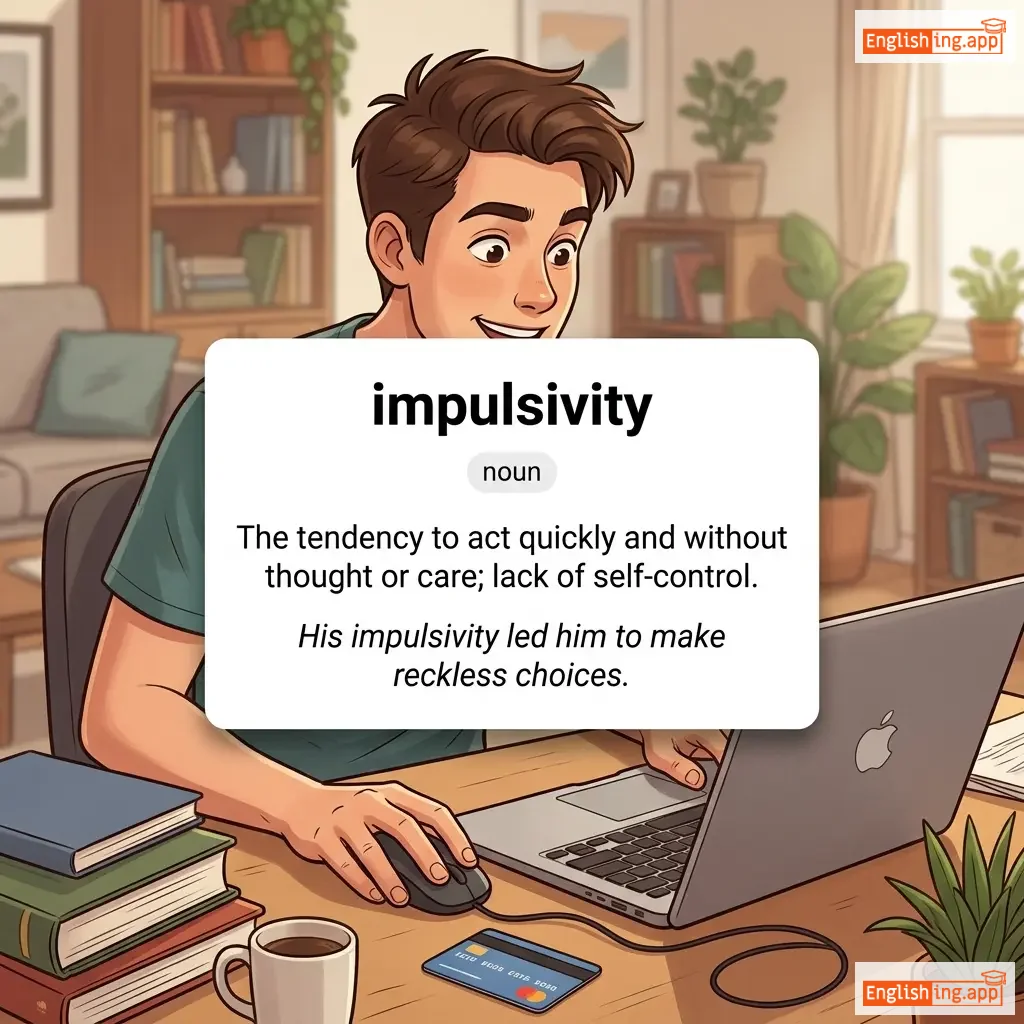
impulsivity definition card — visual illustration of the meaning
noun
ˌɪm.pʌlˈsɪv.ɪ.ti
আবেগপ্রবণ আচরণ, হঠাৎ সিদ্ধান্ত গ্রহণের প্রবণতা (abegprobon achron, hothat siddhanto gohoner probonota)

The tendency to act quickly and without thought or care; lack of self-control.

"His impulsivity led him to make reckless choices."

"তার আবেগপ্রবণতা তাকে অবিবেচক সিদ্ধান্ত নিতে বাধ্য করেছিল।" (Tar abegprobonota take obibechok siddhanto nite badhyo korechhilo.)
noun
/ɪmˈpjuːnɪti/
শাস্তিমুক্তি (shastimukti)

freedom from punishment or harmful consequences for an action

"The dictator ruled with impunity, ignoring international laws."

"একনায়ক আন্তর্জাতিক আইন অগ্রাহ্য করে শাস্তিমুক্তভাবে শাসন করেছিলেন।" (Eknayok antorjatik ain ogroho kore shastimuktovabe shason korechilen.)
adjective
/ɪmˈpjʊər/
অশুদ্ধ (ashuddho)

not clean or free from contamination; morally corrupt

"The water was impure and unsafe to drink."

"পানির অশুদ্ধতা এটিকে পান করার জন্য অনিরাপদ করেছিল।" (Panir ashuddhota etike pan korar jonne onirapod korechhilo.)
noun
/ɪmˈpjʊərəti/
অশুদ্ধতা (oshuddhota)

the state of being unclean or contaminated; a substance that makes something impure

"The scientist removed every impurity from the water sample."

"বিজ্ঞানী পানির নমুনা থেকে সব অশুদ্ধতা দূর করেছেন।" (biggyani panir nomuna theke shob oshuddhota dur korechen)
noun
/ˌɪmpjuˈteɪʃən/
অভিযোগ (obhijog)

an accusation or attribution of blame

"The politician denied the imputation of corruption."

"রাজনীতিবিদ দুর্নীতির অভিযোগ অস্বীকার করেছিলেন।" (Rajnaitibid durnitir obhijog oshikar korechhilen.)
verb
/ɪmˈpjuːt/
আরোপ করা (arop kora)

to attribute a fault or responsibility to someone

"They imputed the company's success to good leadership."

"তারা কোম্পানির সাফল্যকে ভালো নেতৃত্বের ওপর আরোপ করেছিল।" (Tara kompanir safollo ke bhalo netrittwer upor arop korechhilo.)
preposition
/ɪn/
ভিতরে (bhitore)

expressing the situation of being enclosed or surrounded by something

"She is in the kitchen preparing dinner."

"সে রান্নাঘরে রাতের খাবার প্রস্তুত করছে।" (Se rannaghore rater khabar prostut korche.)
preposition
/ɪn ˈfrʌnt əv/
সামনে (samne)

positioned before or ahead of something; facing or located at the forward side of a person or object

"She stood in front of the building."

"সে ভবনের সামনে দাঁড়িয়েছিল।" (se bhoboner samne dariyechilo)
noun
/ˌɪnəˈbɪləti/
অক্ষমতা (okhommota)

the state of being unable to do something

"His inability to make decisions affected his career."

"তার সিদ্ধান্ত নিতে অক্ষমতা তার কর্মজীবনকে প্রভাবিত করেছিল।" (Tar siddhanto nite okhomota tar karmojibone probhavit korechhilo.)
adjective
/ˌɪnækˈsɛsəbl/
অগম্য (ogommo)

unable to be reached, entered, or understood

"The remote village is almost inaccessible during the rainy season."

"বর্ষাকালে দূরবর্তী গ্রামটি প্রায় অগম্য হয়ে যায়।" (Borshakale durborti gramti pray ogommo hoye jay.)
noun
/ɪnˈækjʊrəsi/
অসঠিকতা (oshothikota)

lack of accuracy or precision; an incorrect or wrong detail

"The report contained several factual inaccuracies."

"রিপোর্টটিতে বেশ কয়েকটি তথ্যগত অসঠিকতা ছিল।" (reporttite besh koekti toththogoto oshothikota chilo)
adjective
/ɪnˈækjʊrət/
অসঠিক (oshothik)

Not correct, precise, or exact; containing errors.

"The report was full of inaccurate data."

"রিপোর্টটি অসঠিক তথ্য দিয়ে পূর্ণ ছিল।" (Reportti oshothik totho diye purno chhilo.)
adjective
/ɪnˈæktɪv/
নিষ্ক্রিয় (niskrio)

Not engaging in activity; not active.

"The account has been inactive for six months."

"অ্যাকাউন্টটি ছয় মাস ধরে নিষ্ক্রিয় রয়েছে।" (Accountti chhoy mash dhore niskrio royeche.)
noun
/ˌɪnækˈtɪvɪti/
নিষ্ক্রিয়তা (nishkriyota)

the state of not being active physically or mentally; lack of action

"Prolonged inactivity can negatively affect both physical and mental health."

"দীর্ঘ সময়ের নিষ্ক্রিয়তা শারীরিক ও মানসিক স্বাস্থ্যের উপর নেতিবাচক প্রভাব ফেলতে পারে।" (dirgho shomoyer nishkriyota sharirik o manoshik shasther upor netibachok probhab felte pare)
noun
/ɪnˈædɪkwəsi/
অপর্যাপ্ততা (oporyaptoata)

lack of sufficient ability, quality, or strength; a feeling of not being good enough

"She struggled with feelings of inadequacy at work despite her strong qualifications."

"তার শক্ত যোগ্যতা থাকা সত্ত্বেও কর্মস্থলে সে অপর্যাপ্ততার অনুভূতিতে ভুগছিল।" (tar shokto joggota thaka shotteo karmosthole se oporyaptotar onubhutitay bhugchhilo)
adjective
/ɪnˈædɪkwət/
অপর্যাপ্ত (oporjapto)

Not sufficient or good enough.

"The funding was inadequate to complete the project."

"প্রকল্প শেষ করতে অর্থায়ন অপর্যাপ্ত ছিল।" (Prokolpo shesh korte orthayan oporjapto chhilo.)
adjective
/ˌɪnədˈmɪsəbl̩/
অগ্রহণযোগ্য (ogrohonjoggo)

Not allowed, especially as evidence in a court of law.

"The judge ruled the evidence inadmissible."

"বিচারক প্রমাণটিকে অগ্রহণযোগ্য ঘোষণা করেছেন।" (Bicharok promontike ogrohonjoggo ghoshona korechen.)
noun
/ˌɪnədˈvɜːrtəns/
অসতর্কতা (osotorkota)

Failure to pay attention; carelessness.

"The error happened through sheer inadvertence."

"শুধুমাত্র অসতর্কতার কারণে ভুলটি ঘটেছিল।" (Shudhumatro osotorkotar karone bhulti ghotechhilo.)
adjective
/ˌɪnədˈvɜːrtənt/
অবচেতন, অনিচ্ছাকৃত (obocheton, onichchhakrito)

Not resulting from or achieved through deliberate planning; unintentional.

"Her inadvertent mistake caused a delay in the project."

"তার অনিচ্ছাকৃত ভুল প্রকল্পে বিলম্ব ঘটিয়েছিল।" (tar onichchhakrito bhul projekte bilomb ghatiyechhilo.)
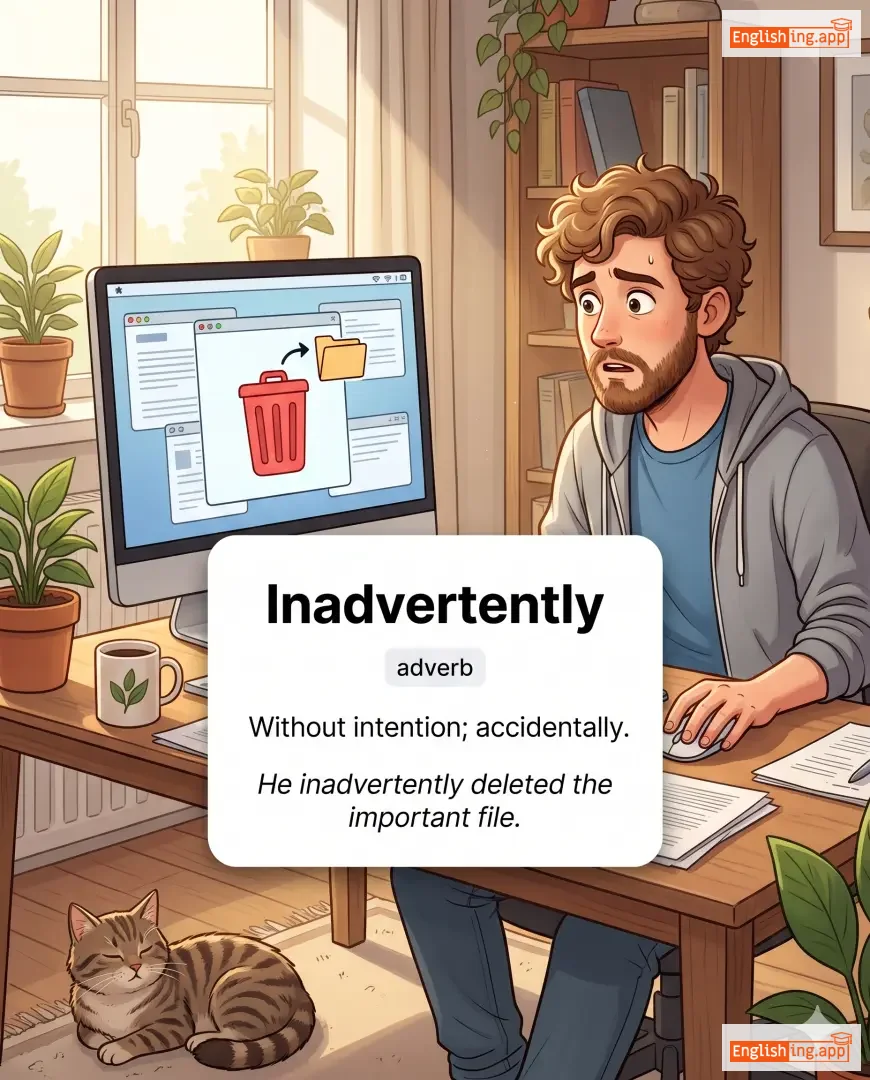
Inadvertently definition card — visual illustration of the meaning
adverb
/ˌɪnədˈvɜːrtəntli/
অনিচ্ছাকৃতভাবে (onichchhakritovabe)

Without intention; accidentally.

"He inadvertently deleted the important file."

"সে অনিচ্ছাকৃতভাবে গুরুত্বপূর্ণ ফাইলটি মুছে ফেলেছিল।" (se onichchhakritovabe guruttopurno fileti muche fellchhilo.)
adjective
/ˌɪnədˈvaɪzəbl/
অনুপযুক্ত, বুদ্ধিহীন (onupojukto, buddhihin)

Not recommended; likely to have undesirable consequences.

"It is inadvisable to drive in such heavy rain."

"এত ভারী বৃষ্টিতে গাড়ি চালানো অনুপযুক্ত।" (eto bhari bristite gari chalano onupojukto.)
adjective
/ɪnˈeɪliənəbl/
অপরিবর্তনীয়, অস্বত্বান্তরযোগ্য (oporibortoniyo, oshottontorjoggo)

Unable to be taken away or transferred; absolute and permanent.

"Freedom of speech is an inalienable right."

"মতপ্রকাশের স্বাধীনতা একটি অপরিবর্তনীয় অধিকার।" (motprokash er shadhinota ekti oporibortoniyo odhikar.)
noun
/ˌɪnəməˈrɑːtə/
প্রেমিকা (premika)

A woman with whom someone is in love; a female lover.

"He wrote a poem dedicated to his inamorata."

"সে তার প্রেমিকার উদ্দেশ্যে একটি কবিতা লিখেছিল।" (se tar premikar uddeshye ekti kobita likhechhilo.)
adjective
/ɪˈneɪn/
অর্থহীন, বোকামি (orthihin, bokami)

lacking sense, meaning, or significance; silly or pointless

"The movie was criticized for its inane dialogue."

"ছবিটি তার অর্থহীন সংলাপের জন্য সমালোচিত হয়েছিল।" (Chobiti tar orthihin songlaper jonno somalochito hoyechhilo.)
adjective
/ɪˈnænɪmət/
জড় বস্তু (jor bostu)

not alive, especially not in the manner of animals and humans; lifeless

"The museum was full of inanimate objects from ancient times."

"জাদুঘর প্রাচীন যুগের জড় বস্তুরে পূর্ণ ছিল।" (Jadughor prachin juger jor bosture purno chhilo.)
noun
/ɪˈnænɪti/
অর্থহীনতা, বোকামি (orthihinota, bokami)

a nonsensical remark or action; silliness; emptiness

"The speech was full of inanities that bored the audience."

"ভাষণটি এমন বোকামিতে ভরা ছিল যা শ্রোতাদের বিরক্ত করেছিল।" (Bhashonti emon bokamite bhora chhilo ja srotader birokt korechhilo.)
adjective
/ˌɪnæprɪˈhɛnsəbl/
অবোধ্য (obodho)

not understandable; incomprehensible

"The concept was so abstract that it seemed inapprehensible to most students."

"ধারণাটি এত বিমূর্ত ছিল যে এটি অধিকাংশ ছাত্রের কাছে অবোধ্য মনে হয়েছিল।" (Dharnati eto bimoortho chhilo je eti odhikongso chatrer kache obodho mone hoyechhilo.)
adjective
/ˌɪnəˈproʊpriət/
অপ্রাসঙ্গিক (apropriyo)

not suitable or proper in the circumstances

"It was inappropriate to talk loudly in the library."

"লাইব্রেরিতে জোরে কথা বলা অপ্রাসঙ্গিক ছিল।" (Laibrerite jore kotha bola apropriyo chhilo.)
adjective
/ɪnˈæpt/
অনুপযুক্ত (onupojukto)

not suitable or appropriate in the circumstances

"His inapt choice of words offended many people."

"তার অনুপযুক্ত শব্দচয়ন অনেককে আঘাত করেছিল।" (Tar onupojukto shobdochonon onekke aghat korechhilo.)
adjective
/ˌɪnɑːrˈtɪkjʊlət/
অস্পষ্টভাষী (osposthobhashi)

Unable to express oneself clearly or effectively in speech or writing.

"She became inarticulate with emotion during the speech."

"ভাষণের সময় সে আবেগে অস্পষ্টভাষী হয়ে পড়েছিল।" (Bhashoner somoy se abege osposthobhashi hoye porechhilo.)
adverb
/ˌɪnəzˈmʌtʃ/
যেহেতু (jehetu)

To the extent that; considering that.

"Inasmuch as you are their teacher, you should guide them carefully."

"যেহেতু তুমি তাদের শিক্ষক, তোমার উচিত তাদের সাবধানে পথপ্রদর্শন করা।" (Jehetu tumi tader shikkhok, tomar uchit tader sabdhane pothprodorshon kora.)
conjunction
/ˌɪnəzˈmʌtʃ æz/
যেহেতু (jehetu)

Because; since.

"He cannot attend, inasmuch as he is unwell."

"সে উপস্থিত হতে পারবে না, যেহেতু সে অসুস্থ।" (Se uposthit hote parbe na, jehetu se osustho.)
adjective
/ˌɪnəˈtɛntɪv/
অমনোযোগী (omonojogi)

not paying attention; lacking focus or concentration

"The inattentive student missed several important instructions."

"অমনোযোগী ছাত্রটি কয়েকটি গুরুত্বপূর্ণ নির্দেশনা মিস করেছে।" (omonojogi chhatroti koyekti guruttopurno nirdeshona mis koreche)
adjective
/ɪnˈɔːdəbl/
অশ্রাব্য (oshrabbya)

Unable to be heard.

"Her voice was almost inaudible over the noise."

"শব্দের মধ্যে তার কণ্ঠস্বর প্রায় অশ্রাব্য ছিল।" (Shobder moddhe tar kontoshor pray oshrabbya chhilo.)
adjective
/ɪˈnɔːɡjərəl/
উদ্বোধনী; প্রারম্ভিক; (udbodhoni)

marking the beginning of something; first; opening

"The president delivered his inaugural speech."

"রাষ্ট্রপতি তার উদ্বোধনী ভাষণ দিয়েছিলেন।" (Rashtropoti tar udbodhoni bhashan diyechhilen.)
verb
/ɪˈnɔːɡjʊreɪt/
উদ্বোধন করা (udbodhon kora)

To formally begin or introduce something, especially with a ceremony.

"The mayor will inaugurate the new bridge tomorrow."

"মেয়র আগামীকাল নতুন সেতুর উদ্বোধন করবেন।" (Meyor agamikal notun setur udbodhon korben.)
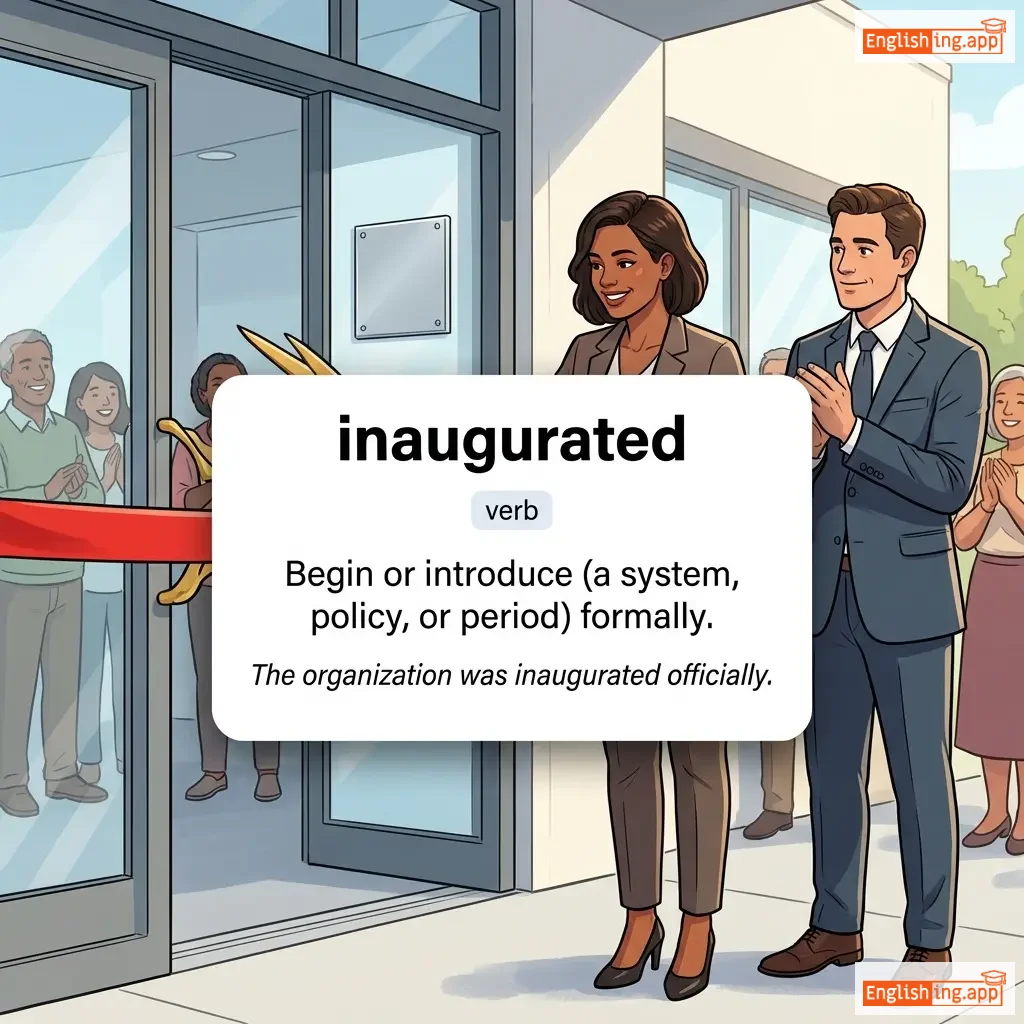
inaugurated definition card — visual illustration of the meaning
verb
ɪˈnɔː.ɡjə.reɪ.tɪd
উদ্বোধন করা (udvodhon kora)

Begin or introduce (a system, policy, or period) formally.

"The organization was inaugurated officially."

"সংগঠনটি আনুষ্ঠানিকভাবে উদ্বোধন করা হয়।" (Shonggothonti anushthanikvabe udvodhon kora hoy.)
adjective
/ˌɪnɔːˈspɪʃəs/
অশুভ (ashuvo)

Not conducive to success; unpromising or unlucky.

"The event began under inauspicious circumstances."

"অনুষ্ঠানটি অশুভ পরিস্থিতিতে শুরু হয়েছিল।" (Onusthanti ashuvo poristhitite shuru hoyechilo.)
adjective
/ˈɪnˌbɔːrn/
সহজাত (sohojat)

existing from birth; innate

"She has an inborn talent for music."

"তার সহজাত সঙ্গীত প্রতিভা রয়েছে।" (Tar sohojat songit protibha royechhe.)
adjective
/ˈɪnˌbrɛd/
সহজাত, স্বজাতজাত (sohojat, sojatojat)

existing naturally in a person or animal; also related to reproduction within a limited community

"He has an inbred sense of loyalty."

"তার সহজাত আনুগত্যের অনুভূতি রয়েছে।" (Tar sohojat anugotyer onubhuti royechhe.)