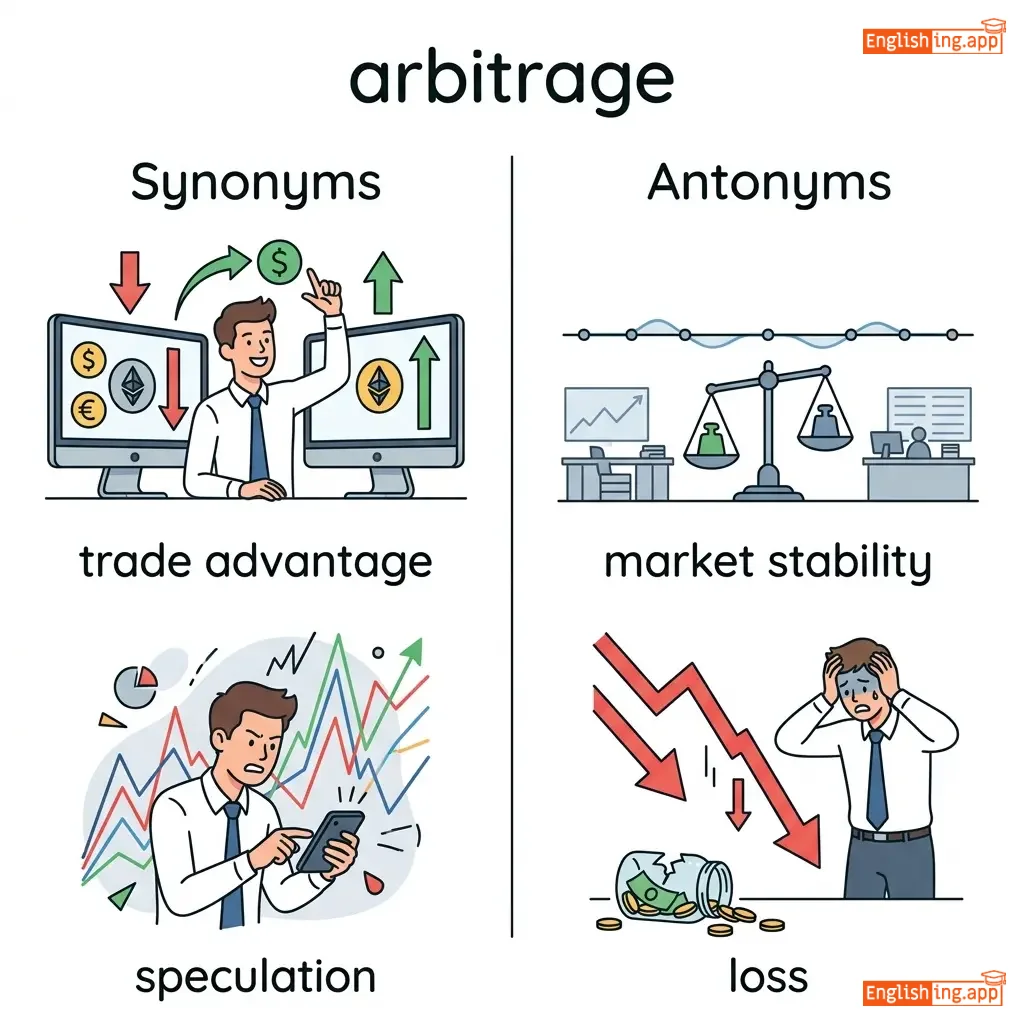
💹arbitrage (ā-bǐ-tuó-luó)

noun
/ˈɑːr.bɪ.trɑːʒ/
套利 (taolì)

含义

The simultaneous buying and selling of securities in different markets to take advantage of differing prices.
The practice of taking advantage of a price difference between two or more markets.
含义翻译
在不同市场上同时买卖证券,利用价格差异获利。
Zài bùtóng shìchǎng shàng tóngshí mǎimài zhèngquàn, lìyòng jiàgé chāyì huòlì.

例句

Investors use arbitrage to make profits in global markets.

投资者利用套利在全球市场中获取利润。
Tóuzī zhě lìyòng tàolì zài quánqiú shìchǎng zhōng huòqǔ lìrùn.

He used arbitrage to profit from currency exchange differences.

他利用货币兑换差价进行了套利。
Tā lìyòng huòbì duìhuàn chājià jìnxíngle tàolì.

Arbitrage opportunities exist in volatile markets.

在波动的市场中存在套利机会。
Zài bōdòng de shìchǎng zhōng cúnzài tàolì jīhuì.

同义词

trading, exploiting price differences, speculation, market exploitation, trading profit, price advantage
条目 1
trading, exploiting price differences, speculation
条目 2
market exploitation, trading profit, speculation
条目 3
market exploitation, price advantage, trading profit

反义词

fixed pricing, loss-making trade, unprofitability, loss-making, price stagnation, non-trade, loss, speculation failure, risky investment
条目 1
fixed pricing, loss-making trade, unprofitability
条目 2
loss-making, price stagnation, non-trade
条目 3
loss, speculation failure, risky investment

相关词汇

the act of taking something or someone away or out of a place
a person who has specialized knowledge or training in a particular area; an expert
Strengthening or encouraging behavior through positive motivation or repetition.
a quantity of precious metals, gems, or other valuable objects; something of great worth or value
A problem that has no easy solution
a sum of money paid regularly to a person; permission to do something

探索更多