Получите неограниченный доступ ко всем словам с подпиской Pro
Обновить до ProПолучите неограниченный доступ ко всем предложениям с подпиской Pro
Обновить до Pro|
Эмодзи
|
Слово | Images | Перевод | Прошедшее | Причастие прошедшего времени | Третье лицо единственного числа | Герундий | Значение | Пример предложения | Перевод примера предложения | Пример выражения | Значение примера выражения | Перевод примера выражения | Синонимы | Антонимы | Коллокации | Мнемоника |
|---|---|---|---|---|---|---|---|---|---|---|---|---|---|---|---|---|---|
|
⚖️
••••••
|
/dɪˈskrɛʃən/
noun
(дискреций)
••••••
|

|
дискретность
diskretnost
••••••
|
- •••••• | - •••••• | - •••••• | - •••••• |
the quality of behaving or speaking in a way to avoid causing offense or revealing private information; the freedom to decide what should be done in a particular situation
••••••
|
The manager acted with discretion in handling the sensitive matter. |
Менеджер действовал с дискретностью при решении чувствительного вопроса.
Menedzher deystvoval s diskretnost'yu pri reshenii chuvstvitel'nogo voprosa.
••••••
|
at one's discretion |
according to one's own judgment or decision
••••••
|
по своему усмотрению
po svoemu usmotreniyu
••••••
|
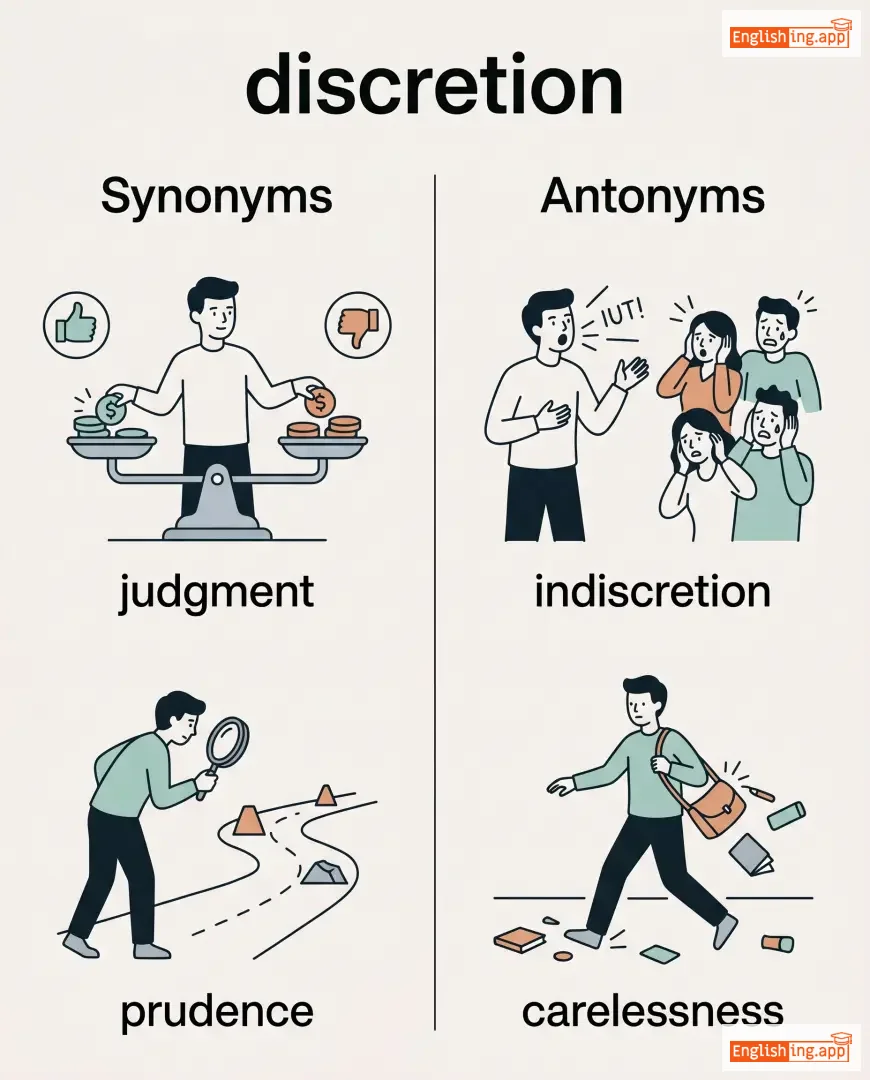
judgment, prudence, caution, choice, option
••••••
|
indiscretion, carelessness, compulsion
••••••
|
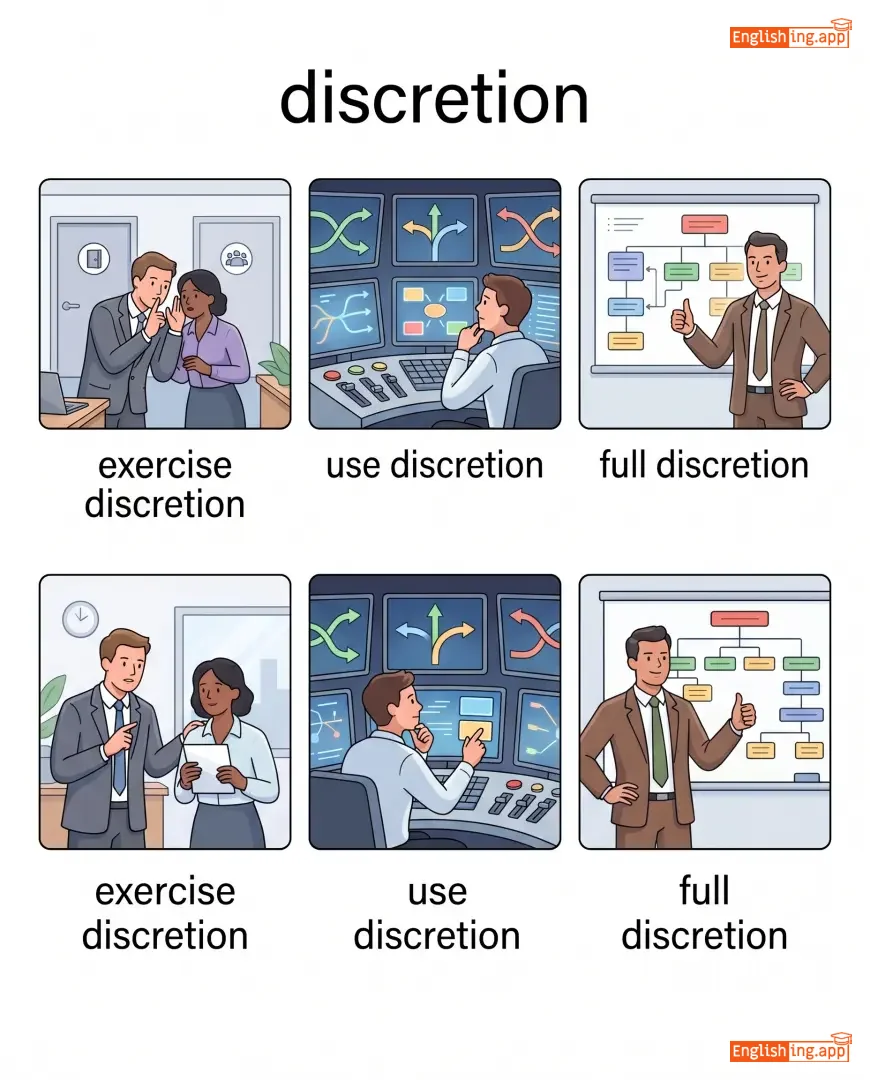
exercise discretion, use discretion, full discretion, sole discretion
••••••
|
Discretion = Decision с дискретностью.
••••••
|
|
💬
••••••
|
/dɪˈskʌs/
verb
(diskus)
••••••
|
- •••••• |
обсуждать
obshchushdat
••••••
|
discussed
diskust
••••••
|
discussed
diskust
••••••
|
discusses
diskuses
••••••
|
discussing
diskusing
••••••
|
To talk about something with another person or group in detail.
••••••
|
We need to discuss the project before finalizing it.
Нам нужно обсудить проект перед его завершением.
••••••
|
Нам нужно обсудить проект перед его завершением.
Nam nuzhno obshchusdat proyekt pered yego zaversheniem.
••••••
|
discuss matters
обсуждать дела
••••••
|
to talk about issues or problems
••••••
|
обсуждать вопросы
obshchushdat voprosy
••••••
|
talk, debate, confer, deliberate, examine
••••••
|
ignore, avoid
••••••
|
discuss a plan, discuss issues, discuss openly, discuss further
••••••
|
Обсуждать означает говорить о чём-то с другими.
••••••
|
|
💬
••••••
|
/dɪˈskʌʃən/
noun
(diskʌʃən)
••••••
|
- •••••• |
обсуждение
obsuzhdenie
••••••
|
- •••••• | - •••••• | - •••••• | - •••••• |
The action or process of talking about something in order to reach a decision or share ideas.
••••••
|
The project needs more discussion before moving forward. |
Проект требует больше обсуждения перед продолжением.
Proyekt trebuyet bol'she obsuzhdeniya pered prodolzheniem.
••••••
|
open for discussion |
Available to be debated or considered
••••••
|
открыт для обсуждения
otkryt dlya obsuzhdeniya
••••••
|
conversation, dialogue, debate, talk, consultation
••••••
|
silence, monologue
••••••
|
group discussion, open discussion, detailed discussion, lively discussion
••••••
|
Обсуждение — обсуждай и слушай, чтобы понять!
••••••
|
|
🦠
••••••
|
/dɪˈziːz/
noun
(dɪˈziːz)
••••••
|
- •••••• |
болезнь
bolezn
••••••
|
- •••••• | - •••••• | - •••••• | - •••••• |
An illness or medical condition that affects the body or mind.
••••••
|
The doctor is researching a cure for the disease. |
Доктор исследует лечение для болезни.
Doktor issleduyet lecheniye dlya bolezni.
••••••
|
heart disease |
A general term for conditions affecting the heart.
••••••
|
сердечная болезнь
serdyechnaya bolezn'
••••••
|
illness, sickness, ailment, disorder, infection
••••••
|
health, wellness
••••••
|
infectious disease, chronic disease, disease prevention, disease outbreak
••••••
|
Disease - это болезнь, представьте, что если ваше тело не отдыхает, это болезнь.
••••••
|
|
🤢
••••••
|
/dɪsˈɡʌst/
noun
(дисгаст)
••••••
|
- •••••• |
отвращение
otvrashchenie
••••••
|
- •••••• | - •••••• | - •••••• | - •••••• |
a feeling of revulsion or strong disapproval aroused by something unpleasant
••••••
|
She expressed her disgust at the politician's corrupt behavior openly. |
Она открыто выразила свое отвращение к коррумпированному поведению политика.
Ona otkryto vyrazila swoe otvrashchenie k korrupirovannomu povedeniyu politika.
••••••
|
- •••••• | - •••••• | - •••••• |
revulsion, repugnance, distaste, loathing
••••••
|
delight, pleasure, admiration, approval
••••••
|
utter disgust, express disgust, fill with disgust
••••••
|
Отвращение может возникать, когда видим что-то отвратительное, как коррупция.
••••••
|
|
🤢
••••••
|
/dɪsˈɡʌstɪd/
adjective
(дисгастед)
••••••
|
- •••••• |
возмущенный
vozmushchennyy
••••••
|
- •••••• | - •••••• | - •••••• | - •••••• |
feeling a strong sense of dislike or revulsion
••••••
|
She was disgusted by the way he treated the animals.
Она была возмущена тем, как он обращался с животными.
••••••
|
Она была возмущена тем, как он обращался с животными.
Ona byla vozmushchena tem, kak on obrashchalsya s zhivotnymi.
••••••
|
turn your stomach
вызывать отвращение
••••••
|
to cause extreme disgust or nausea
••••••
|
вызывать отвращение
vyzyvat otvrashchenie
••••••
|
repulsed, revolted, horrified, nauseated
••••••
|
pleased, delighted, satisfied
••••••
|
disgusted look, utterly disgusted, feel disgusted, visibly disgusted
••••••
|
Возмущенный = disgusted, представьте сильное отвращение.
••••••
|
|
🤢
••••••
|
/dɪsˈɡʌstɪŋ/
adjective
(дисгастинг)
••••••
|
- •••••• |
отвратительный
otvratitelnij
••••••
|
- •••••• | - •••••• | - •••••• | - •••••• |
extremely unpleasant or offensive; causing strong dislike or revulsion
••••••
|
The smell coming from the trash can was absolutely disgusting.
Запах из мусорного ведра был абсолютно дисгастинг.
••••••
|
Запах из мусорного ведра был абсолютно отвратительный.
Zapakh iz musornogo vedra byl absolyutno otvratitelnij
••••••
|
- •••••• | - •••••• | - •••••• |
repulsive, revolting, nauseating, offensive, foul
••••••
|
pleasant, appealing, attractive
••••••
|
disgusting behavior, disgusting smell, absolutely disgusting, find disgusting
••••••
|
Think 'otvratitelnij' as 'utter trash in nose'—very disgusting
••••••
|
|
🍽️
••••••
|
/dɪʃ/
noun
(дɪʃ)
••••••
|
- •••••• |
тарелка / блюдо
tarelka / blyudo
••••••
|
- •••••• | - •••••• | - •••••• | - •••••• |
A shallow container for serving or preparing food; also a particular kind of food prepared.
••••••
|
She prepared a delicious pasta dish for dinner. |
Она приготовила вкусное паста-блюдо на ужин.
Ona prigotovila vkusnoe pasta-blyudo na uzhin.
••••••
|
dish out |
To distribute or serve something, often food or criticism.
••••••
|
подавать еду
podavat' edu
••••••
|
plate, bowl, meal, course, recipe
••••••
|
drink, beverage
••••••
|
main dish, side dish, traditional dish, favorite dish
••••••
|
Тарелка означает посуду или блюдо, помни - еда мамы всегда лучшая.
••••••
|
|
🤥
••••••
|
/dɪsˈɑːnɪst/
adjective
(dishonest)
••••••
|
- •••••• |
нечестный
nechestny
••••••
|
- •••••• | - •••••• | - •••••• | - •••••• |
Behaving in an untruthful or deceitful way; not honest.
••••••
|
It is dishonest to cheat in exams. |
Нечестно обманывать на экзаменах.
Nechestno obmanyvat' na ekzamenakh.
••••••
|
dishonest gain |
Wealth or advantage obtained through unfair or illegal means
••••••
|
нечестная выгода
nechestnaya vygoda
••••••
|
deceitful, fraudulent, untruthful, corrupt
••••••
|
honest, truthful, sincere
••••••
|
dishonest act, dishonest behavior, dishonest person
••••••
|
Нечестный — это тот, кто не честен, это нечестно!
••••••
|
|
👎
••••••
|
/dɪsˈlaɪk/
verb, noun
(дислайк)
••••••
|
- •••••• |
не любить
ne lyubit
••••••
|
disliked
дислайкд
••••••
|
disliked
дислайкд
••••••
|
dislikes
дислайкс
••••••
|
disliking
дислайкинг
••••••
|
to feel distaste or aversion for someone or something; a feeling of aversion
••••••
|
I really dislike eating spicy food.
Мне действительно не нравится есть острую еду.
••••••
|
Мне действительно не нравится есть острую еду.
Mne deystvitelno ne nravitsya yest ostruyu edu
••••••
|
nothing to dislike
нечего не не любить
••••••
|
used to say something is completely acceptable or agreeable
••••••
|
нечего не не любить
nechego ne ne lyubit
••••••
|
detest, loathe, abhor, hate
••••••
|
like, enjoy, love
••••••
|
dislike intensely, dislike strongly, express dislike, personal dislike, mutual dislike
••••••
|
Dislike = 'не любить', легко запомнить как антоним любви.
••••••
|
|
🚪
••••••
|
/dɪsˈmɪs/
verb
(дисмис)
••••••
|
|
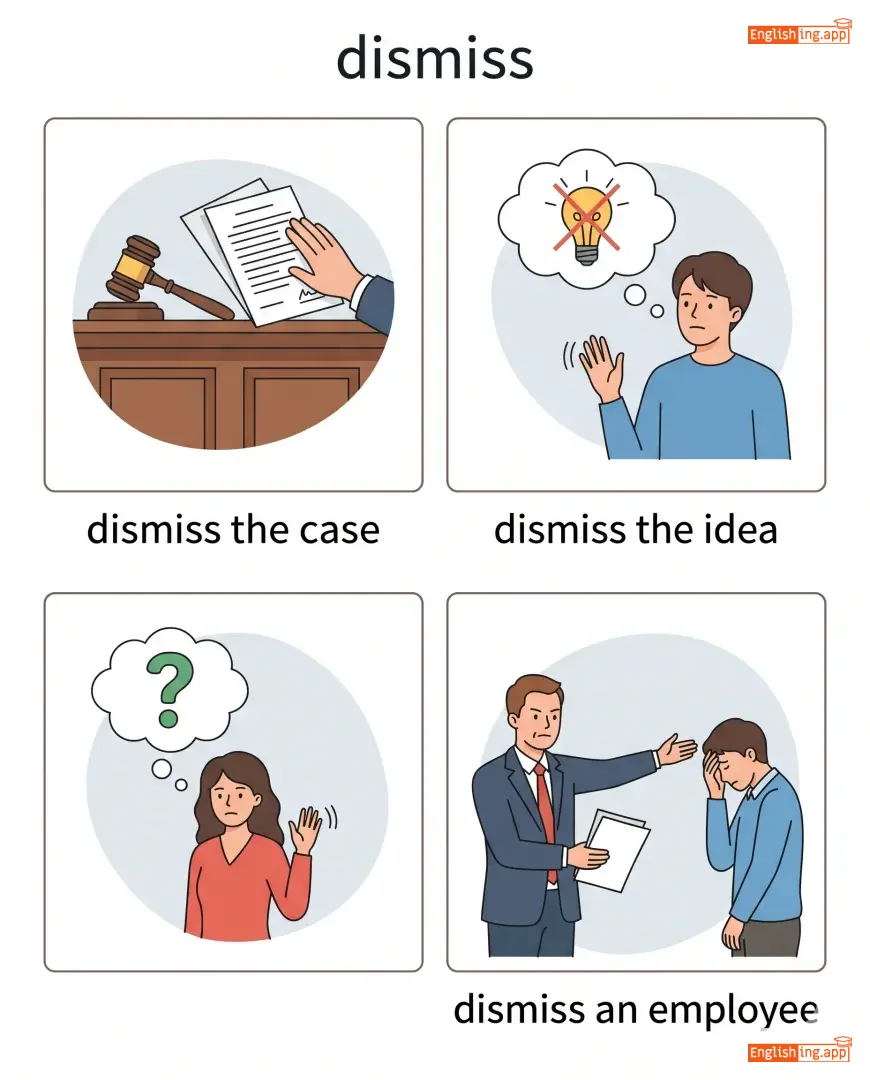
уволить, отклонить
uvolit', otklonit'
••••••
|
dismissed
дисмисед
••••••
|
dismissed
дисмисед
••••••
|
dismisses
дисмисез
••••••
|
dismissing
дисмисинг
••••••
|
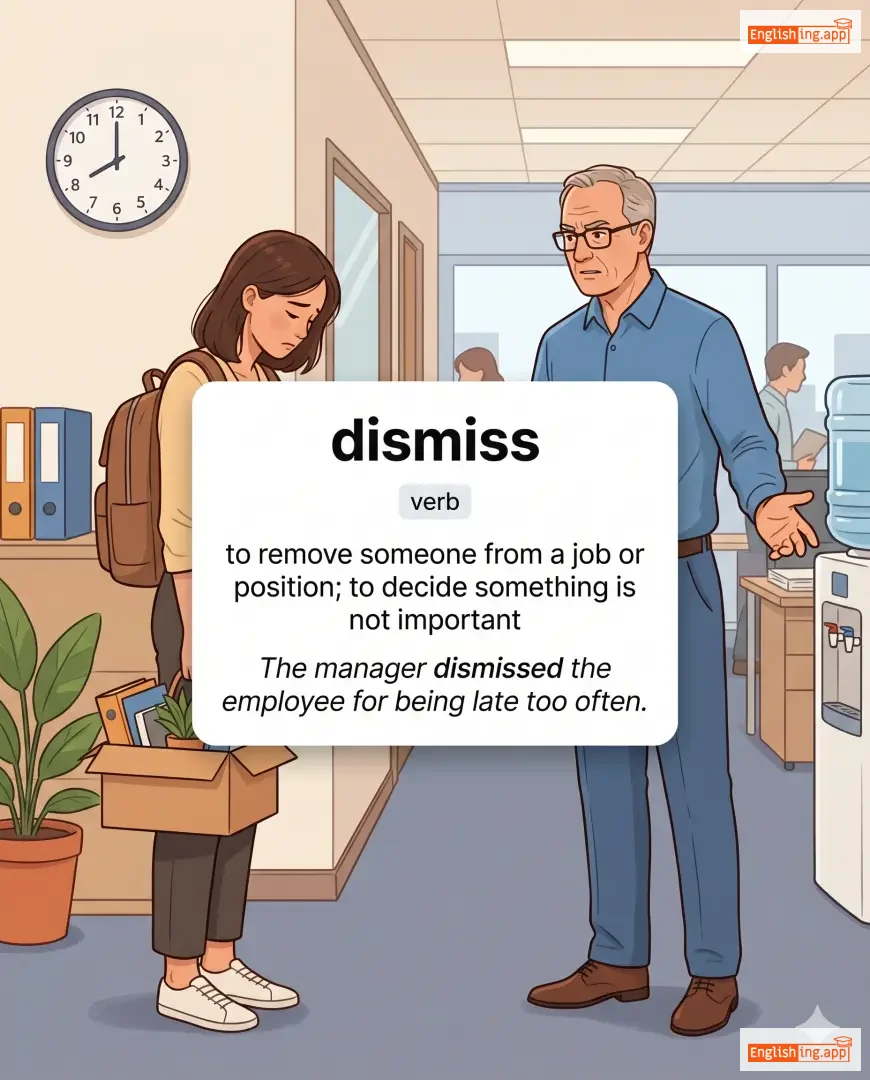
to remove someone from a job or position; to decide something is not important
••••••
|
The manager dismissed the employee for being late too often.
Менеджер уволил сотрудника за то, что тот слишком часто опаздывал.
••••••
|
Менеджер уволил сотрудника за то, что тот слишком часто опаздывал.
Menedzher uvolil sotrudnika za to, chto tot slishkom chasto opazdyval.
••••••
|
dismiss out of hand
отклонить без рассмотрения
••••••
|
to reject something immediately without considering it
••••••
|
отклонить без рассмотрения
otklonit' bez rassmotreniya
••••••
|
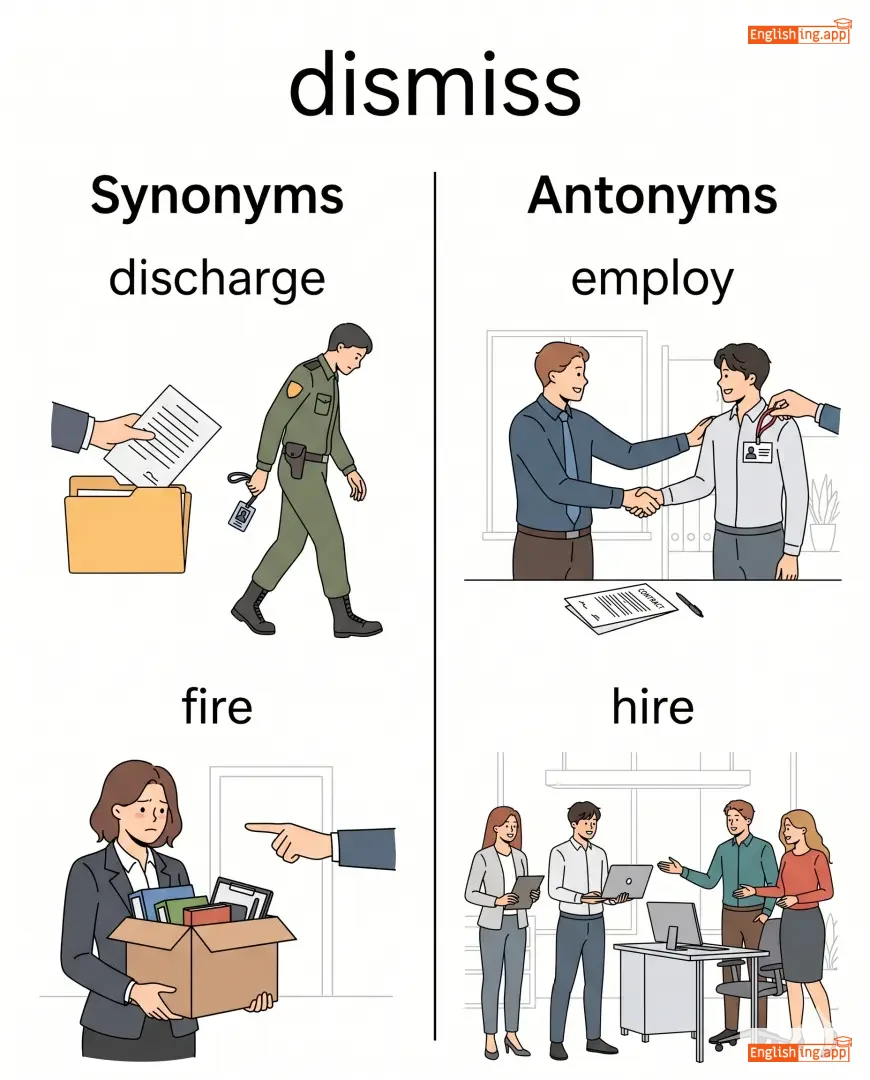
discharge, fire, release, reject, expel
••••••
|
employ, hire, accept
••••••
|
dismiss the case, dismiss the idea, dismiss an employee, dismiss charges
••••••
|
Dis + Miss = уволить человека
••••••
|
|
📄
••••••
|
/dɪsˈmɪsl̩/
noun
(дисмисал)
••••••
|
- •••••• |
увольнение, отклонение
uvolnenie, otklonenie
••••••
|
- •••••• | - •••••• | - •••••• | - •••••• |
the act of removing someone from their job; the act of treating something as unimportant
••••••
|
His unfair dismissal led to a lawsuit against the company. |
Его несправедливое увольнение привело к иску против компании.
Ego nespravedlivoe uvolnenie privedlo k isku protiv kompanii.
••••••
|
- •••••• | - •••••• | - •••••• |
termination, firing, discharge, expulsion, rejection
••••••
|
employment, acceptance, retention
••••••
|
wrongful dismissal, unfair dismissal, dismissal from work, dismissal of charges
••••••
|
Dismiss + AL = результат увольнения с работы (увольнение)
••••••
|
|
⚠️
••••••
|
/dɪsˈɔːrdər/
noun
(дисордер)
••••••
|
- •••••• |
расстройство
rasstroystvo
••••••
|
- •••••• | - •••••• | - •••••• | - •••••• |
A state of confusion or lack of order; also a medical or mental condition.
••••••
|
The protest ended in disorder when the crowd became violent. |
Протест закончился расстройством, когда толпа стала агрессивной.
Protest zakonchilsya rasstroystvom, kogda tolpa stala agressivnoy.
••••••
|
eating disorder |
A medical condition involving abnormal eating habits.
••••••
|
расстройство пищевого поведения
rasstroystvo pishchevogo povedeniya
••••••
|
confusion, chaos, disturbance, illness, ailment
••••••
|
order, organization, harmony
••••••
|
mental disorder, physical disorder, cause disorder, public disorder
••••••
|
Disorder значит расстройство, помните — если нет порядка, будет расстройство.
••••••
|
|
🏚️
••••••
|
/dɪsˈpleɪs/
verb
(дɪсˈплэйс)
••••••
|
- •••••• |
перемещать
peremeshchat
••••••
|
displaced
дɪсˈплэйст
••••••
|
displaced
дɪсˈплэйст
••••••
|
displaces
дɪсˈплэйсез
••••••
|
displacing
дɪсˈплэйсɪнɡ
••••••
|
To force someone or something out of its usual place or position.
••••••
|
The flood displaced hundreds of families from their homes.
наводнение переместило сотни семей из их домов.
••••••
|
Наводнение переместило сотни семей из их домов.
Navodnenie peremestilo sotni semej iz ikh domov.
••••••
|
displaced person
перемещённый человек
••••••
|
someone forced to leave their home, especially because of war or disaster
••••••
|
перемещённый человек
peremeshchyonnyy chelovek
••••••
|
remove, replace, shift, expel, oust
••••••
|
retain, keep, maintain
••••••
|
displace workers, displace people, displace water, displace families
••••••
|
Displace означает перемещать, как переместить кого-то или что-то из привычного места.
••••••
|
|
🖥️
••••••
|
/dɪˈspleɪ/
verb
(displéy)
••••••
|
- •••••• |
показывать
pokazyvat
••••••
|
displayed
displeid
••••••
|
displayed
displeid
••••••
|
displays
displéys
••••••
|
displaying
displèing
••••••
|
To show or exhibit something to be seen.
••••••
|
The shop displayed its new products in the window.
Магазин показал свои новые продукты на витрине.
••••••
|
Магазин показал свои новые продукты на витрине.
Magazin pokazal svoi novye produkty na vitriny.
••••••
|
on display
на выставке
••••••
|
Visible for people to see, usually in a public place.
••••••
|
на выставке
na vystavke
••••••
|
show, exhibit, present, demonstrate, reveal
••••••
|
hide, conceal, cover
••••••
|
display information, display screen, proudly display, digital display
••••••
|
Display значит показывать, как продукты на выставке.
••••••
|
|
🗑️
••••••
|
/dɪsˈpoʊzl/
noun
(dispozal)
••••••
|
- •••••• |
удаление
udalenie
••••••
|
- •••••• | - •••••• | - •••••• | - •••••• |
the action or process of getting rid of something
••••••
|
The disposal of waste is crucial for maintaining a clean environment.
Утилизация отходов имеет решающее значение для поддержания чистоты окружающей среды.
••••••
|
Утилизация отходов имеет решающее значение для поддержания чистоты окружающей среды.
Utilizatsiya otkhodov imeyet reshayushcheye znacheniye dlya podderzhaniya chistoty okruzhayushchey sredy.
••••••
|
- •••••• | - •••••• | - •••••• |
removal, elimination, clearance, junking
••••••
|
retention, preservation
••••••
|
waste disposal, disposal process, proper disposal, disposal site
••••••
|
When you DISPOSE (утилизировать) of waste, you 'dispose' of it in a trash container (мусорный контейнер).
••••••
|
|
🗑️
••••••
|
/dɪˈspoʊz/
verb
(диспоз)
••••••
|
- •••••• |
избавляться
izbavlyatsya
••••••
|
disposed
диспозед
••••••
|
disposed
диспозед
••••••
|
disposes
диспозес
••••••
|
disposing
диспозинг
••••••
|
To get rid of something, or to arrange or incline towards something.
••••••
|
He disposed of the old furniture responsibly.
Он ответственно избавился от старой мебели.
••••••
|
Он ответственно избавился от старой мебели.
On otvetstvenno izbavilsya ot staroy mebeli.
••••••
|
dispose of
избавляться от
••••••
|
to throw away or get rid of something
••••••
|
избавляться от
izbavlyatsya ot
••••••
|
discard, throw away, eliminate, arrange, incline
••••••
|
keep, retain, preserve
••••••
|
dispose of waste, properly dispose, dispose quickly, dispose carefully
••••••
|
Dispose = избавиться, как избавиться от ненужного.
••••••
|
|
⚔️
••••••
|
/dɪˈspjuːt/
noun/verb
(диспют)
••••••
|
- •••••• |
спор, разногласие
spor, raznoglasiye
••••••
|
disputed
диспутированный
••••••
|
disputed
диспутированный
••••••
|
disputes
диспутирует
••••••
|
disputing
диспутируя
••••••
|
a disagreement or argument about something important
••••••
|
The two countries are in dispute over the border issue.
Две страны находятся в споре по поводу вопроса границы.
••••••
|
Две страны находятся в споре по поводу вопроса границы.
Dve strany nakhodyatsya v spore po povodu voprosa granitsy.
••••••
|
settle a dispute
урегулировать спор
••••••
|
to resolve a disagreement
••••••
|
урегулировать спор
uregulirovat' spor
••••••
|
conflict, quarrel, argument, debate, disagreement
••••••
|
agreement, harmony, peace
••••••
|
trade dispute, legal dispute, border dispute, dispute resolution
••••••
|
Dispute звучит как 'dis' + 'put' → не быть вместе → означает спор или разногласие
••••••
|
|
💥
••••••
|
/dɪsˈrʌpt/
verb
(дисрупт)
••••••
|

|
нарушать
narushat
••••••
|
disrupted
дисруптед
••••••
|
disrupted
дисруптед
••••••
|
disrupts
дисруптс
••••••
|
disrupting
дисруптинг
••••••
|
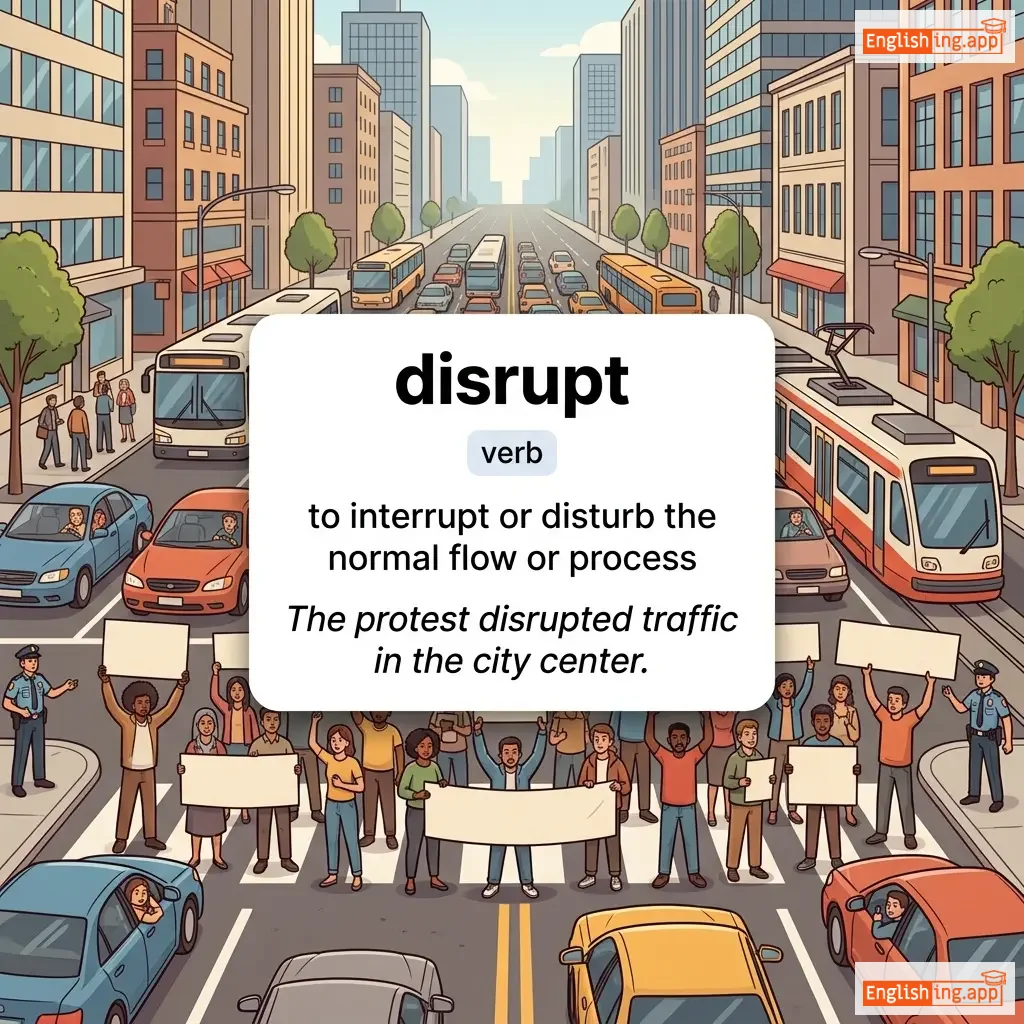
to interrupt or disturb the normal flow or process
••••••
|
The protest disrupted traffic in the city center.
Протест нарушил движение на центральной улице города.
••••••
|
Протест нарушил движение на центральной улице города.
Protest narushil dvizhienie na tsentral'noy ulitse goroda.
••••••
|
disrupt the status quo
нарушить статус-кво
••••••
|
to change the established way of doing things
••••••
|
нарушить статус-кво
narushit' status-kvo
••••••
|
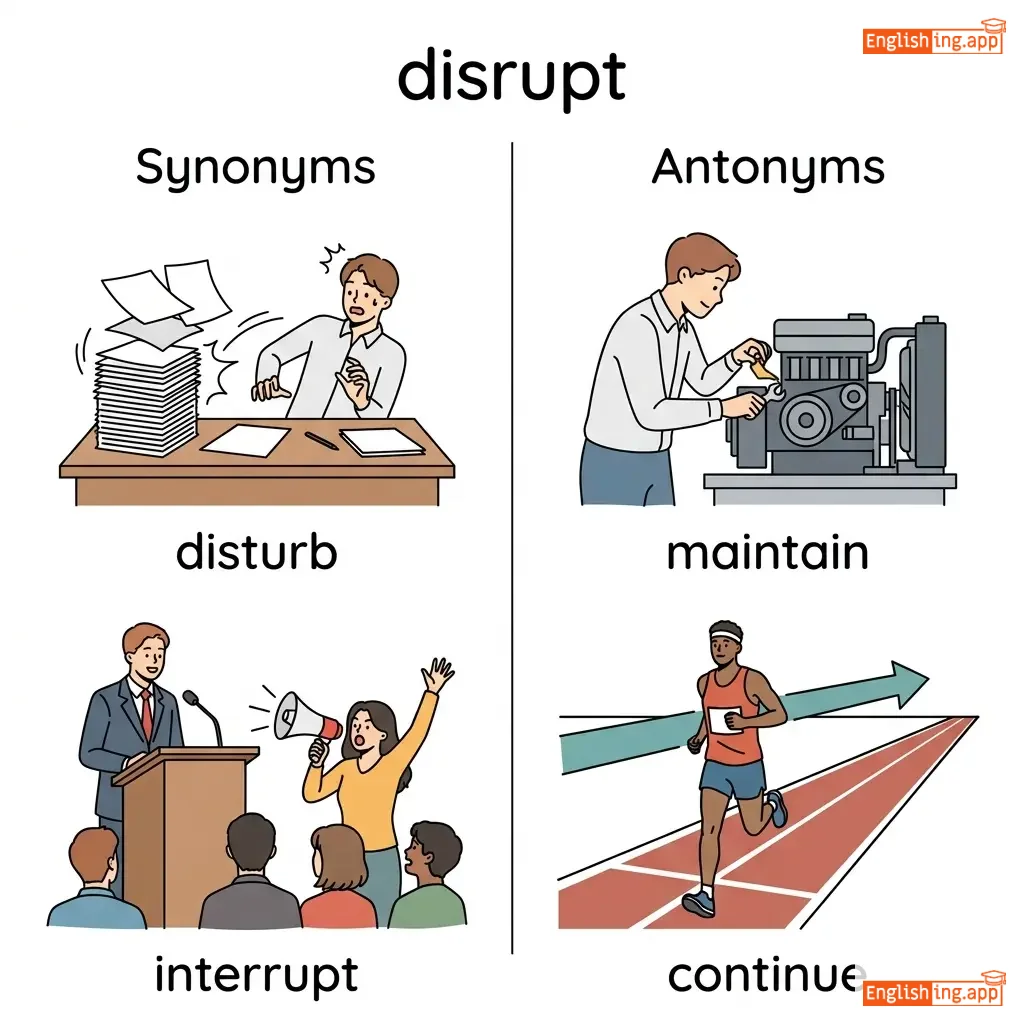
disturb, interrupt, interfere, derail, unsettle
••••••
|
maintain, continue, sustain
••••••
|
disrupt services, disrupt business, disrupt meeting
••••••
|
Disrupt = нарушать, как протест, нарушающий движение.
••••••
|
|
⚠️
••••••
|
/dɪsˈrʌpʃən/
noun
(disrʌpʃən)
••••••
|
|
нарушение
narushenie
••••••
|
- •••••• | - •••••• | - •••••• | - •••••• |
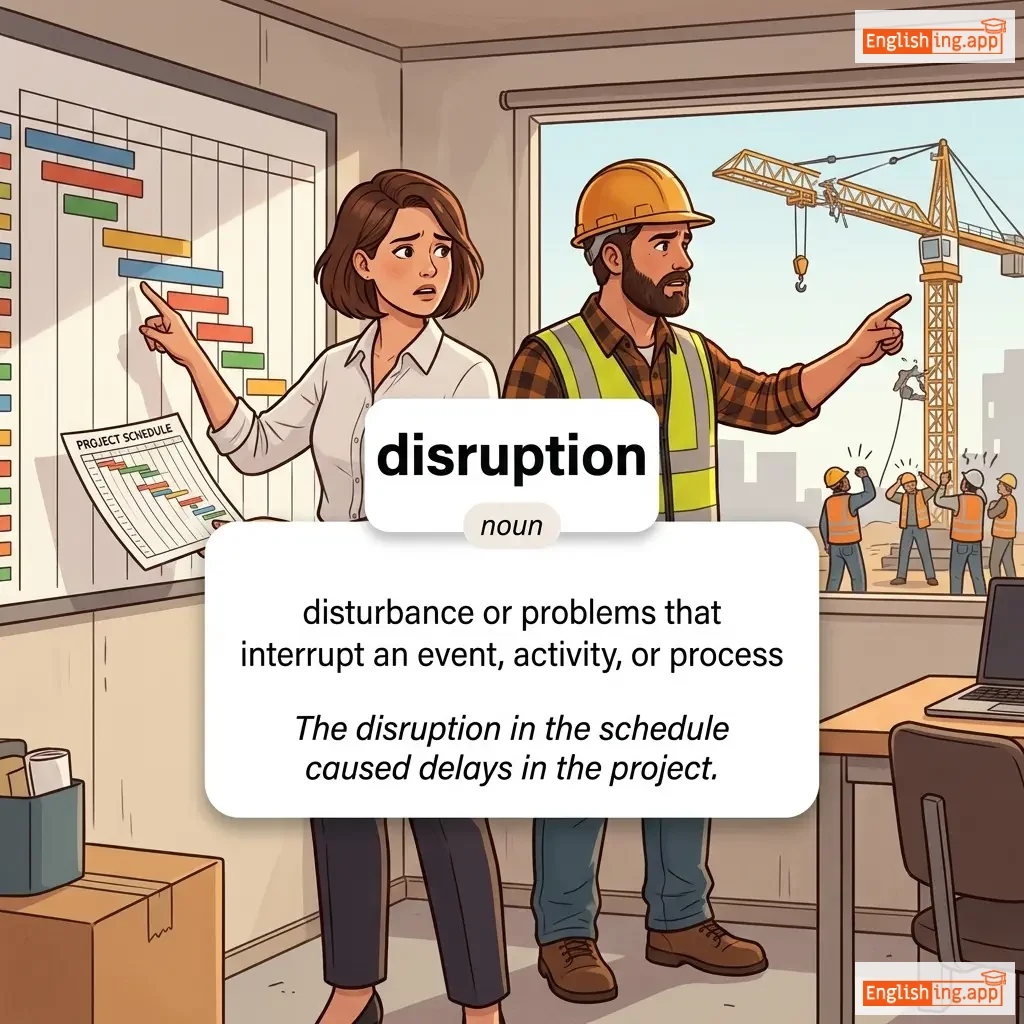
disturbance or problems that interrupt an event, activity, or process
••••••
|
The disruption in the schedule caused delays in the project. |
Нарушение расписания вызвало задержки в проекте.
Narusheniye raspisaniya vyzvalo zaderzhki v proyekte.
••••••
|
- •••••• | - •••••• | - •••••• |
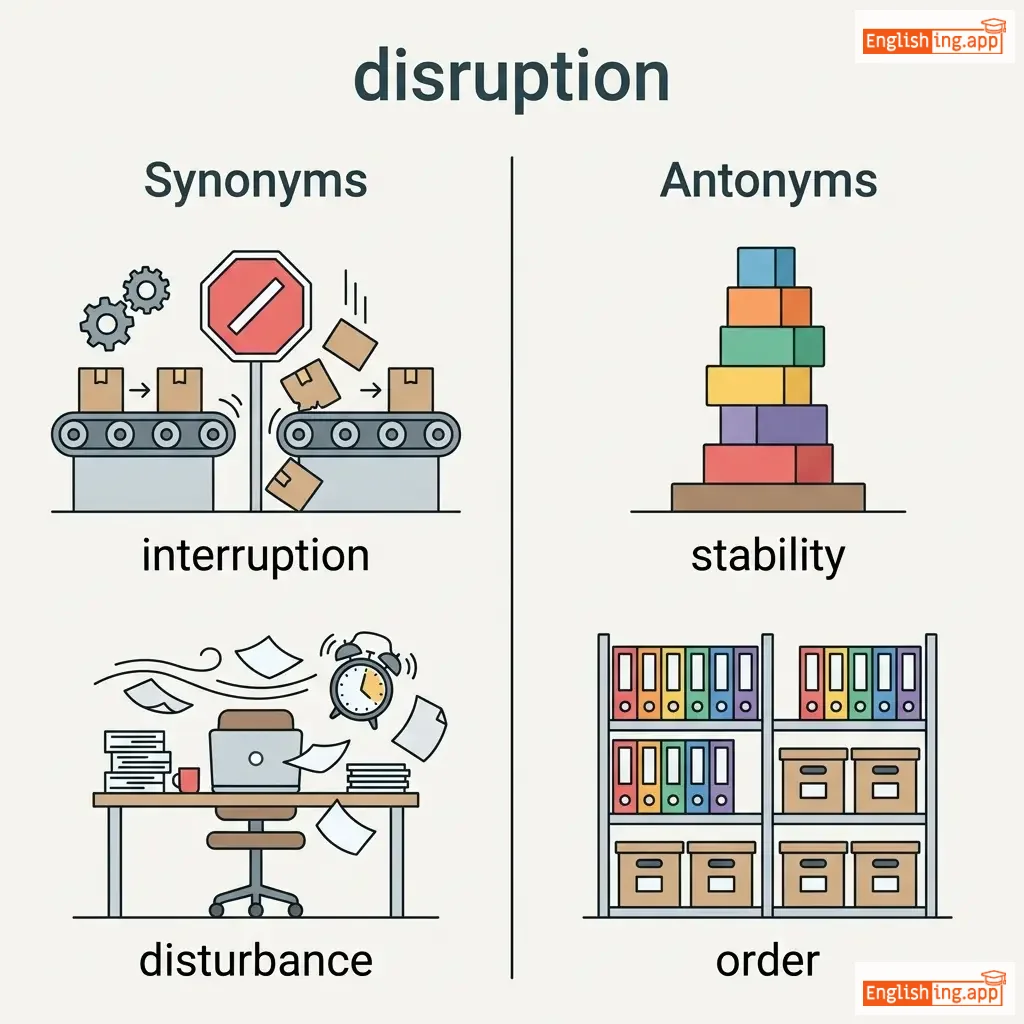
interruption, disturbance, interruption, chaos
••••••
|
stability, order, continuity
••••••
|
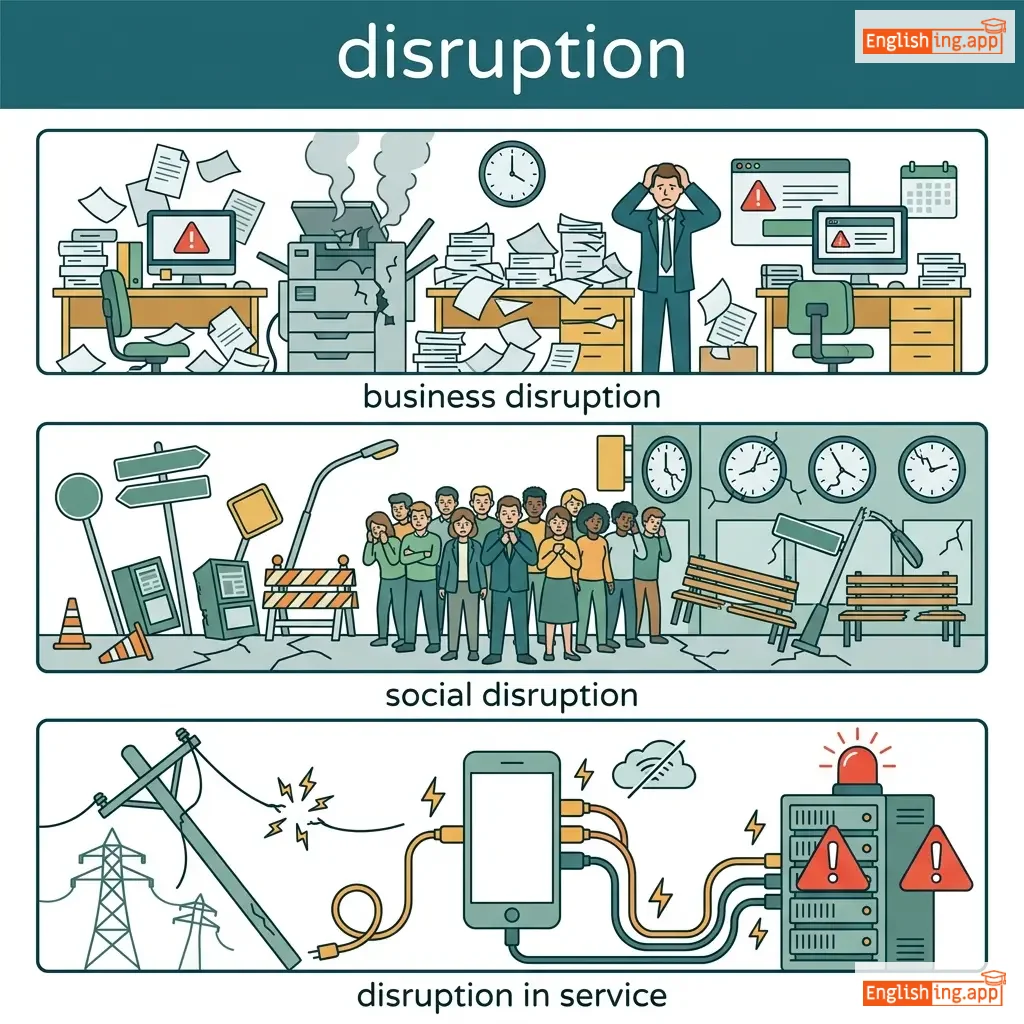
business disruption, social disruption, disruption in service, major disruption
••••••
|
Нарушение (нарушение) в планах похоже на непредсказуемый дождь, который разрушает спокойствие.
••••••
|
|
🫗
••••••
|
/dɪˈzɒlv/
verb
••••••
|
- •••••• | - •••••• |
dissolved
••••••
|
dissolved
••••••
|
dissolves
••••••
|
dissolving
••••••
|
to melt or become liquid; to officially end or break up an agreement or organization
••••••
|
The sugar will dissolve quickly in hot tea. |
- •••••• |
dissolve into tears |
to suddenly start crying uncontrollably
••••••
|
- •••••• |
melt, liquefy, disband, terminate, vanish
••••••
|
solidify, unite, establish
••••••
|
dissolve sugar, dissolve parliament, dissolve the marriage
••••••
|
No •••••• |
|
📏
••••••
|
/ˈdɪstəns/
noun
(ДИСТАНС)
••••••
|
- •••••• |
расстояние
rasstoyanie
••••••
|
- •••••• | - •••••• | - •••••• | - •••••• |
The amount of space between two points or places.
••••••
|
The distance between Dhaka and Chittagong is about 250 kilometers. |
Расстояние между Дакой и Читтагонгом составляет около 250 километров.
Rasstoyanie mezhdu Dakoj i Chittagongom sostavlyaet okolo 250 kilometrov.
••••••
|
keep your distance |
To stay away or avoid close contact.
••••••
|
соблюдайте дистанцию
soblyudayte distantsiyu
••••••
|
gap, space, length, interval, remoteness
••••••
|
closeness, nearness
••••••
|
long distance, travel distance, distance learning, safe distance
••••••
|
Distance это расстояние, когда держишь дистанцию — все будет безопасно!
••••••
|
|
🌄
••••••
|
/ˈdɪstənt/
adjective
(дистант)
••••••
|
- •••••• |
дальний
dalniy
••••••
|
- •••••• | - •••••• | - •••••• | - •••••• |
far away in space or time
••••••
|
They could see the distant mountains from their home. |
Они могли видеть дальние горы из своего дома.
Oni mogli videt dalnie gory iz svoego doma.
••••••
|
distant relative |
a relative who is not closely related
••••••
|
далёкий родственник
dalekiy rodstvennik
••••••
|
far, remote, faraway, detached, aloof
••••••
|
near, close, friendly
••••••
|
distant land, distant memory, distant future, distant relative
••••••
|
Distant звучит как distance—где есть расстояние, там и distant.
••••••
|
|
✨
••••••
|
/dɪˈstɪŋkt/
adjective
(дɪсˈтɪнкт)
••••••
|
- •••••• |
отличительный
otlichitelny
••••••
|
- •••••• | - •••••• | - •••••• | - •••••• |
clearly different or separate from others of its kind
••••••
|
The twins have distinct personalities. |
У близнецов разные, отличительные личности.
U bliznetsov raznye, otlichitel'nye lichnosti.
••••••
|
distinct possibility |
something that is clearly a real chance of happening
••••••
|
очевидная возможность
ochevidnaya vozmozhnost'
••••••
|
clear, separate, definite, unique, noticeable
••••••
|
indistinct, vague, unclear
••••••
|
distinct possibility, distinct feature, distinct voice, distinct style
••••••
|
Distinct — это отличительный, как отличительный признак, ясно разделенный.
••••••
|
|
🏅
••••••
|
/dɪˈstɪŋkʃən/
noun
••••••
|
- •••••• | - •••••• | - •••••• | - •••••• | - •••••• | - •••••• |
a difference or contrast between similar things or people; excellence that sets someone apart
••••••
|
She graduated with distinction from the university. |
- •••••• |
make a distinction |
to draw a clear difference between things
••••••
|
- •••••• |
difference, contrast, excellence, honor, separation
••••••
|
similarity, sameness, mediocrity
••••••
|
with distinction, fine distinction, make a distinction, subtle distinction
••••••
|
No •••••• |
|
🎨
••••••
|
/dɪˈstɪŋktɪv/
adjective
(дɪˈстɪŋктɪв)
••••••
|
- •••••• |
характерный
kharakternyy
••••••
|
- •••••• | - •••••• | - •••••• | - •••••• |
having a quality or characteristic that makes something different and easily noticed
••••••
|
The restaurant is known for its distinctive flavors.
ресторан известен своими характерными вкусами.
••••••
|
Ресторан известен своими характерными вкусами.
Restoran izvesten svoimi kharakternymi vkusami.
••••••
|
- •••••• | - •••••• | - •••••• |
unique, characteristic, special, individual, memorable
••••••
|
common, ordinary, typical
••••••
|
distinctive feature, distinctive style, distinctive look, distinctive character
••••••
|
Характерный означает уникальный, как вкус, который запоминается.
••••••
|
|
🔍
••••••
|
/dɪˈstɪŋɡwɪʃ/
verb
(дистингуиш)
••••••
|
- •••••• |
различать
razlichat'
••••••
|
distinguished
дистингвишд
••••••
|
distinguished
дистингвишд
••••••
|
distinguishes
дистингвишез
••••••
|
distinguishing
дистингвишинг
••••••
|
to recognize or show the differences between two or more things; to set apart as different
••••••
|
It can be difficult to distinguish between truth and rumor.
Бывает сложно различить правду и слухи.
••••••
|
Бывает сложно различить правду и слухи.
Byvayet slozhno razlichit' pravdu i slukhi.
••••••
|
distinguish oneself
выделиться
••••••
|
to do something that makes one notable or worthy of recognition
••••••
|
выделиться
vydelit'sya
••••••
|
differentiate, discern, identify, separate, recognize
••••••
|
confuse, mix, combine
••••••
|
distinguish between, distinguish clearly, distinguish features, distinguish easily
••••••
|
Distinguish = различать, отделять отличное
••••••
|
|
🔄
••••••
|
/dɪˈstɔːrt/
verb
(дисторт)
••••••
|
- •••••• |
искажать
distort
••••••
|
distorted
дистортед
••••••
|
distorted
дистортед
••••••
|
distorts
дистортс
••••••
|
distorting
дистортинг
••••••
|
to twist or change the shape, appearance, or meaning of something so it is not true or accurate
••••••
|
The mirror distorted her reflection.
Зеркало исказило её отражение.
••••••
|
Зеркало исказило её отражение.
Zerkalo iskazilo eyo otrazhenie.
••••••
|
distort the truth
дисторт зе трут
••••••
|
to misrepresent or alter facts dishonestly
••••••
|
искажать правду
iskazhat pravdu
••••••
|
twist, deform, misrepresent, warp, bend
••••••
|
straighten, clarify, preserve
••••••
|
distort reality, distort facts, distort image, distort sound
••••••
|
Dисторт the Truth: держи Правду, не исказай Факты
••••••
|
|
🙃
••••••
|
/dɪˈstrækt/
verb
(дистракт)
••••••
|
- •••••• |
отвлекать
otvlekat
••••••
|
distracted
дистракционирован
••••••
|
distracted
отвлечен
••••••
|
distracts
отвлекает
••••••
|
distracting
отвлекающий
••••••
|
to take someone's attention away from what they are doing or focusing on
••••••
|
The loud noise distracted her during the exam.
Громкий шум отвлек ее во время экзамена.
••••••
|
Громкий шум отвлек ее во время экзамена.
Gromkiy shum otvlek yevo vo vremya eksamen
••••••
|
easily distracted
легко отвлекается
••••••
|
to lose focus quickly due to small interruptions
••••••
|
легко отвлекается
legko otvlekaetsya
••••••
|
divert, sidetrack, disturb, interrupt, absorb
••••••
|
focus, concentrate, attend
••••••
|
distract attention, distract someone, distract from, distract easily
••••••
|
Отвлечь - это как увести внимание с одного направления.
••••••
|
|
😞
••••••
|
/dɪsˈtrɛs/
noun
(дистресс)
••••••
|
- •••••• |
стресс
stress
••••••
|
- •••••• | - •••••• | - •••••• | - •••••• |
extreme anxiety, sorrow, or pain
••••••
|
He felt a deep sense of distress when he heard the bad news. |
Он почувствовал глубокий стресс, когда услышал плохие новости.
On pochuvstvoval glubokiy stress, kogda uslyshal plokhiye novosti.
••••••
|
- •••••• | - •••••• | - •••••• |
misery, anguish, pain, sorrow
••••••
|
comfort, ease, happiness
••••••
|
emotional distress, financial distress, physical distress, mental distress
••••••
|
In distress (стресс), you feel overwhelmed with anxiety and sorrow.
••••••
|
|
📦
••••••
|
/dɪˈstrɪbjuːt/
verb
(дистрибуировать)
••••••
|
|
распределять
raspredelyat'
••••••
|
distributed
распределённый
••••••
|
distributed
распределённый
••••••
|
distributes
распределяет
••••••
|
distributing
распределяя
••••••
|
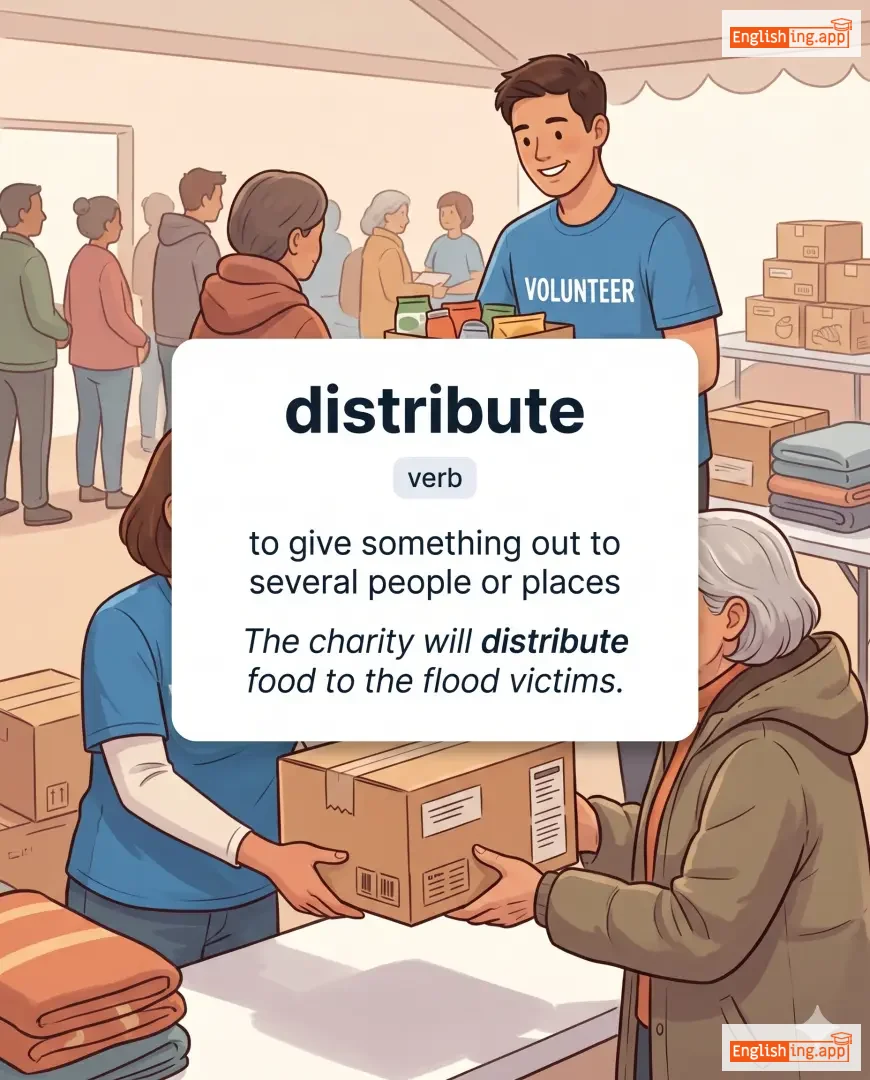
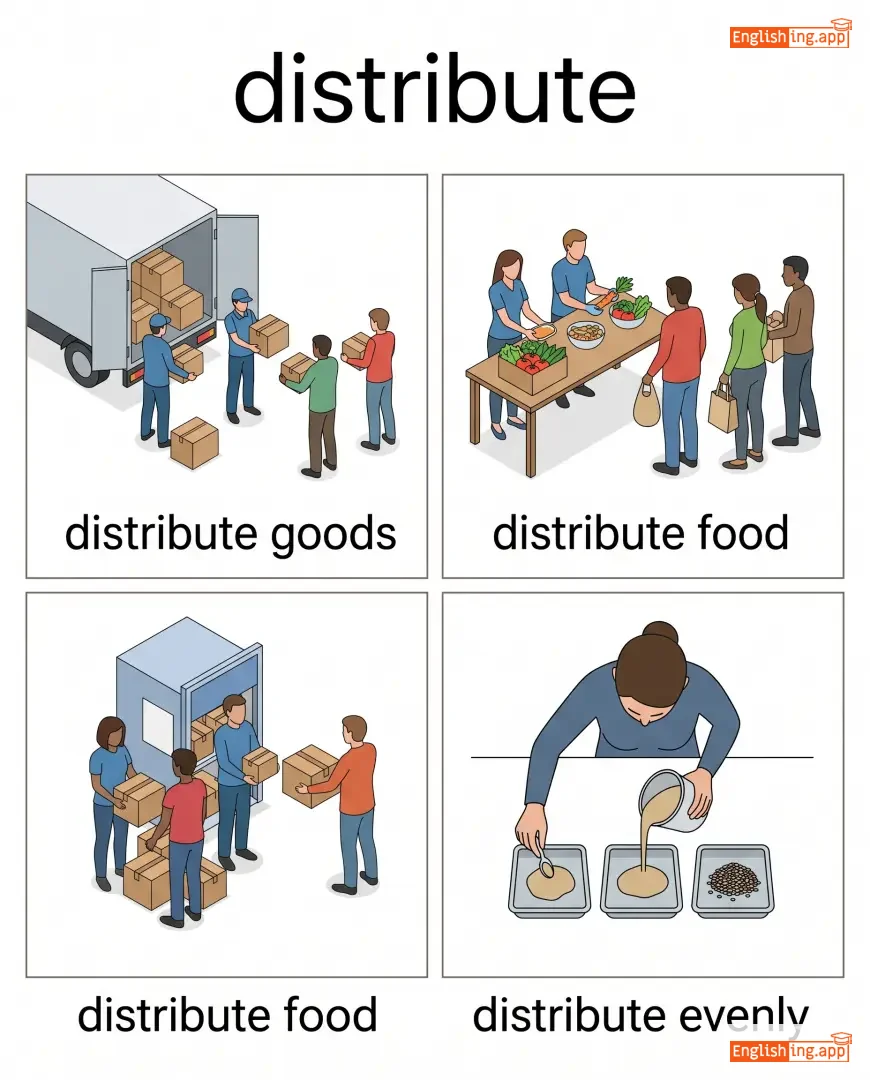
to give something out to several people or places
••••••
|
The charity will distribute food to the flood victims.
Благотворительная организация распределит продукты среди пострадавших от наводнения.
••••••
|
Благотворительная организация распределит продукты среди пострадавших от наводнения.
Blagotvoritelnaya organizatsiya raspredelit produkty sredi postradavshikh ot navodneniya.
••••••
|
fairly distribute
справедливо распределять
••••••
|
to share something equally
••••••
|
справедливо распределять
spravedlivo raspredelyat'
••••••
|
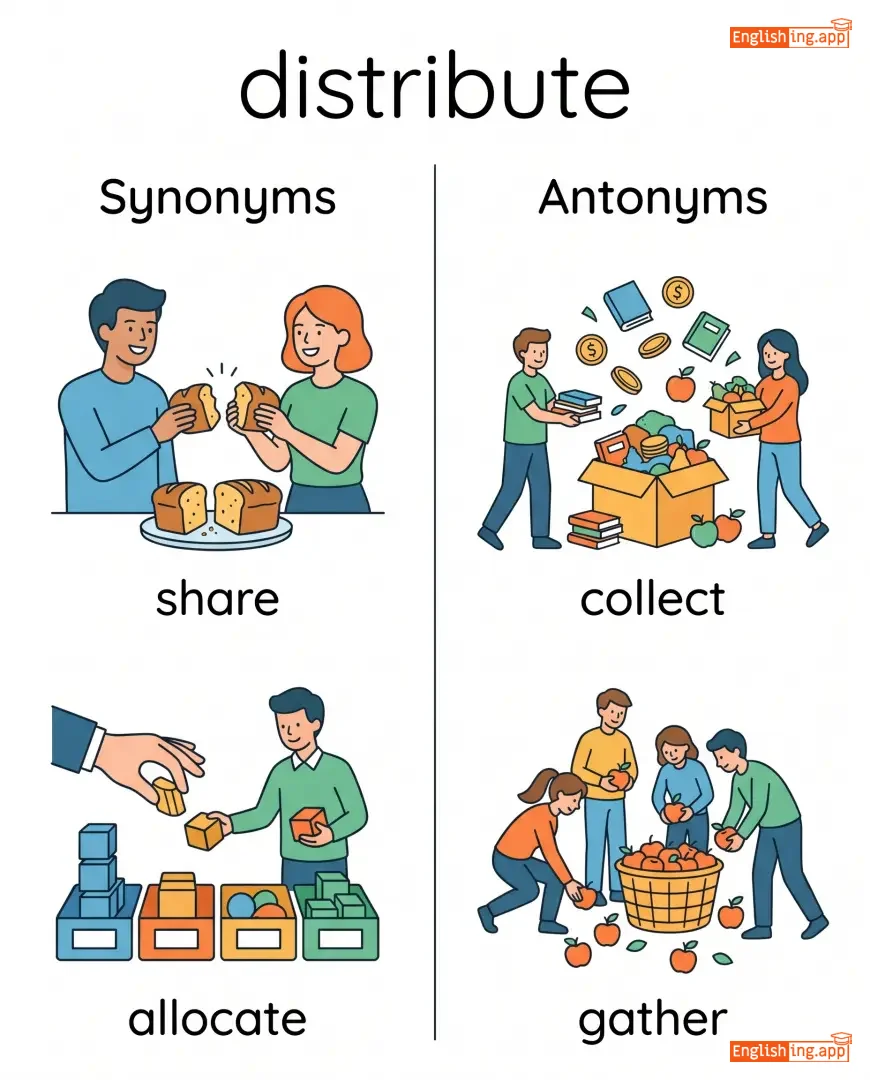
share, allocate, deliver, spread, hand out
••••••
|
collect, gather, withhold
••••••
|
distribute goods, distribute food, distribute evenly, distribute wealth
••••••
|
Distribute означает распределение в округах
••••••
|
|
📦
••••••
|
/ˌdɪstrɪˈbjuːʃən/
noun
(дɪстрɪˈбʲʊшн)
••••••
|
- •••••• |
распределение
raspredelenie
••••••
|
- •••••• | - •••••• | - •••••• | - •••••• |
the act of sharing or delivering something to multiple people or places
••••••
|
The company manages the distribution of food supplies to rural areas. |
Компания управляет распределением продуктов питания в сельские районы.
Kompaniya upravlyaet raspredeleniem produktov pitaniya v selskiye rayony.
••••••
|
- •••••• | - •••••• | - •••••• |
delivery, allocation, supply, circulation
••••••
|
collection, concentration
••••••
|
distribution system, distribution network, distribution channel, fair distribution
••••••
|
Distribution означает распределение, по-русски ‘распределение’.
••••••
|
|
🗺️
••••••
|
/ˈdɪstrɪkt/
noun
(ˈdɪstrɪkt)
••••••
|
- •••••• |
район
rayon
••••••
|
- •••••• | - •••••• | - •••••• | - •••••• |
a specific area of a country, city, or town, often with official boundaries
••••••
|
She lives in the northern district of the city. |
Она живет в северном районе города.
Ona zhivyot v severnom rayone goroda.
••••••
|
- •••••• | - •••••• | - •••••• |
region, area, zone, territory
••••••
|
whole, entirety
••••••
|
school district, business district, residential district, rural district
••••••
|
‘Район’ — это территория, ограниченная официальными границами.
••••••
|
|
🚫
••••••
|
/dɪsˈtɜːb/
verb
(disturb)
••••••
|
- •••••• |
мешать
meshchat
••••••
|
disturbed
disturbd
••••••
|
disturbed
disturbd
••••••
|
disturbs
disturbs
••••••
|
disturbing
disturbing
••••••
|
to interrupt or cause someone to stop what they are doing
••••••
|
Please don’t disturb me while I’m studying.
Пожалуйста, не мешайте мне, пока я учусь.
••••••
|
Пожалуйста, не мешайте мне, пока я учусь.
Pozhaluysta, ne meshayte mne, poka ya uchus'.
••••••
|
do not disturb
не беспокоить
••••••
|
used to tell people not to interrupt or bother someone
••••••
|
не беспокоить
ne bespokoit'
••••••
|
interrupt, bother, annoy, upset, distract
••••••
|
calm, soothe, comfort
••••••
|
disturb peace, disturb sleep, disturb someone, disturb balance
••••••
|
'Do Not Disturb' на русском означает 'не беспокоить' — не мешайте! 🚫
••••••
|
|
😨
••••••
|
/dɪˈstɜː.bɪŋ/
adjective
(дɪˈстɜːрбɪнɡ)
••••••
|
- •••••• |
тревожный
trevozhny
••••••
|
- •••••• | - •••••• | - •••••• | - •••••• |
causing anxiety, worry, or emotional distress
••••••
|
The news about the accident was deeply disturbing.
Новости о происшествии были глубоко тревожными.
••••••
|
Новости о происшествии были глубоко тревожными.
Novosti o proisshestvii byli gluboko trevozhnymi.
••••••
|
disturbing the peace
нарушение мира
••••••
|
to make noise or cause trouble in a quiet public place
••••••
|
нарушение мира
narushenie mira
••••••
|
upsetting, alarming, distressing, troubling, shocking
••••••
|
comforting, calming, soothing
••••••
|
deeply disturbing, disturbing image, disturbing trend, disturbing news
••••••
|
Disturbing — это то, что вызывает тревогу — тревожный вызывает беспокойство!
••••••
|
|
🤿
••••••
|
/daɪv/
verb
(daiv)
••••••
|
- •••••• |
нырять
nyryat
••••••
|
dove
dov
••••••
|
dived
daivd
••••••
|
dives
daivs
••••••
|
diving
daiving
••••••
|
to plunge headfirst into water or another substance
••••••
|
He decided to dive into the pool on a hot day.
Он решил нырнуть в бассейн в жаркий день.
••••••
|
Он решил нырнуть в бассейн в жаркий день.
On reshil nyrnut' v basseyn v zharkiy den'.
••••••
|
- •••••• | - •••••• | - •••••• |
plunge, jump, leap, submerge
••••••
|
float, rise
••••••
|
dive into, dive down, deep dive, dive off
••••••
|
Нырять (нырять) в новые возможности, как рыба в воду.
••••••
|
|
🦆
••••••
|
/ˈdaɪ.vər/
noun
(дайвэр)
••••••
|
- •••••• |
нырок
nyrok
••••••
|
- •••••• | - •••••• | - •••••• | - •••••• |
a type of water bird that dives underwater to catch fish
••••••
|
The diver disappeared beneath the surface to catch a fish. |
Нырок исчез под поверхностью, чтобы поймать рыбу.
Nyrok ischez pod poverkhnost'yu, chtoby poymat' rybu.
••••••
|
- •••••• | - •••••• | - •••••• |
loon, grebe, diving duck
••••••
|
- •••••• |
great northern diver, red-throated diver, diving bird, water diver
••••••
|
Нырок (nyrok) ныряет под воду, чтобы поймать рыбу.
••••••
|
|
🌎
••••••
|
/daɪˈvɜːrs/
adjective
(дайвёрс)
••••••
|
|
разнообразный
raznoobraznyj
••••••
|
- •••••• | - •••••• | - •••••• | - •••••• |
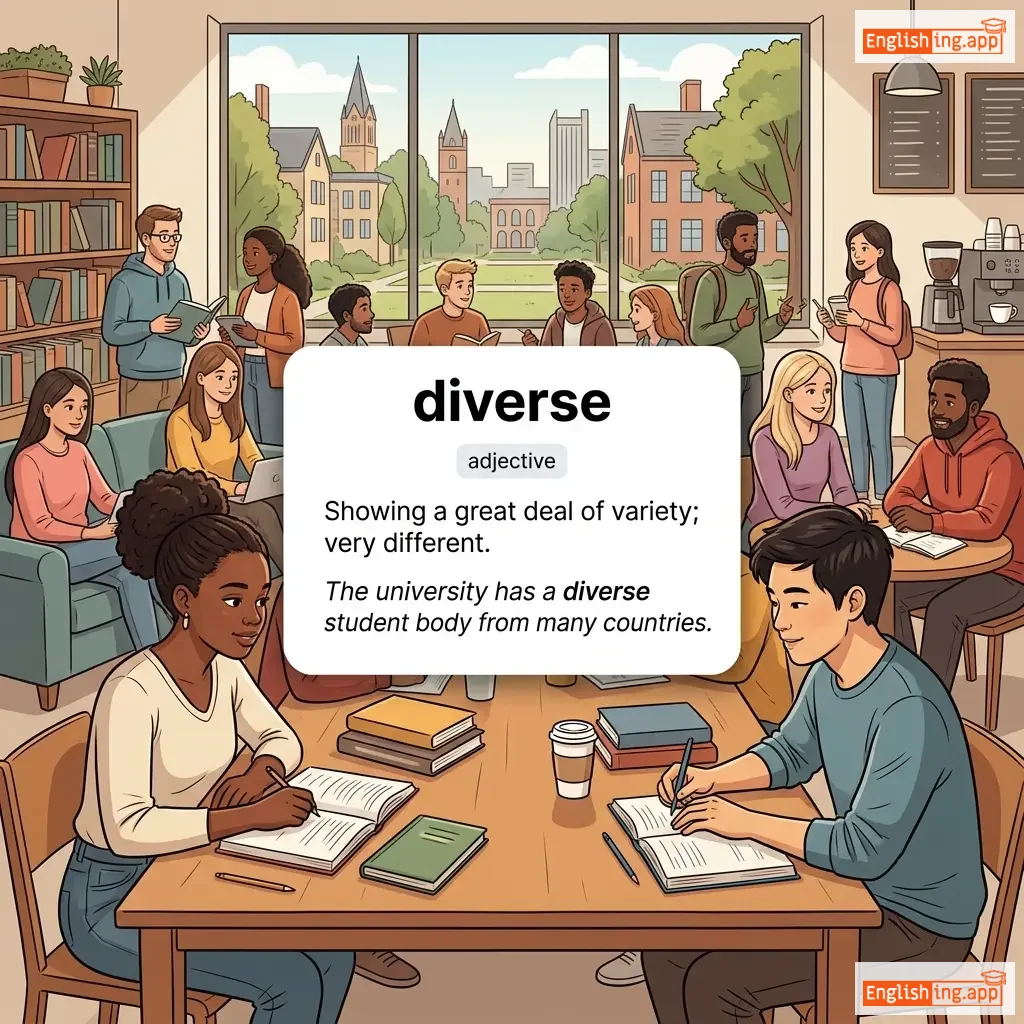
Showing a great deal of variety; very different.
••••••
|
The university has a diverse student body from many countries.
университет имеет разнообразный студенческий корпус из многих стран.
••••••
|
Университет имеет разнообразный студенческий корпус из многих стран.
Universitet imeyet raznoobraznyj studencheskij korpus iz mnogikh stran.
••••••
|
diverse backgrounds
разнообразные фоны
••••••
|
Different cultural, social, or personal experiences.
••••••
|
разнообразные фоны
raznoobraznye fony
••••••
|
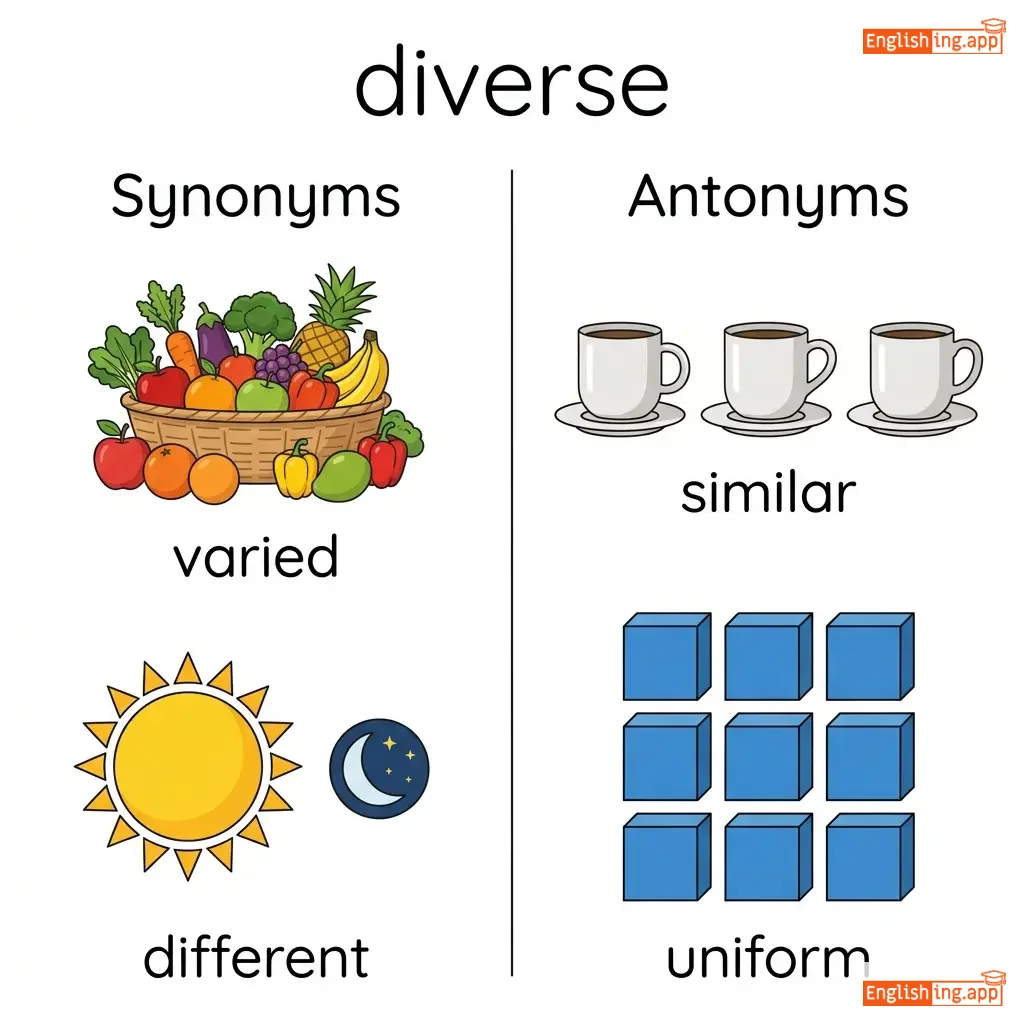
varied, different, assorted, mixed, heterogeneous
••••••
|
similar, uniform, identical
••••••
|
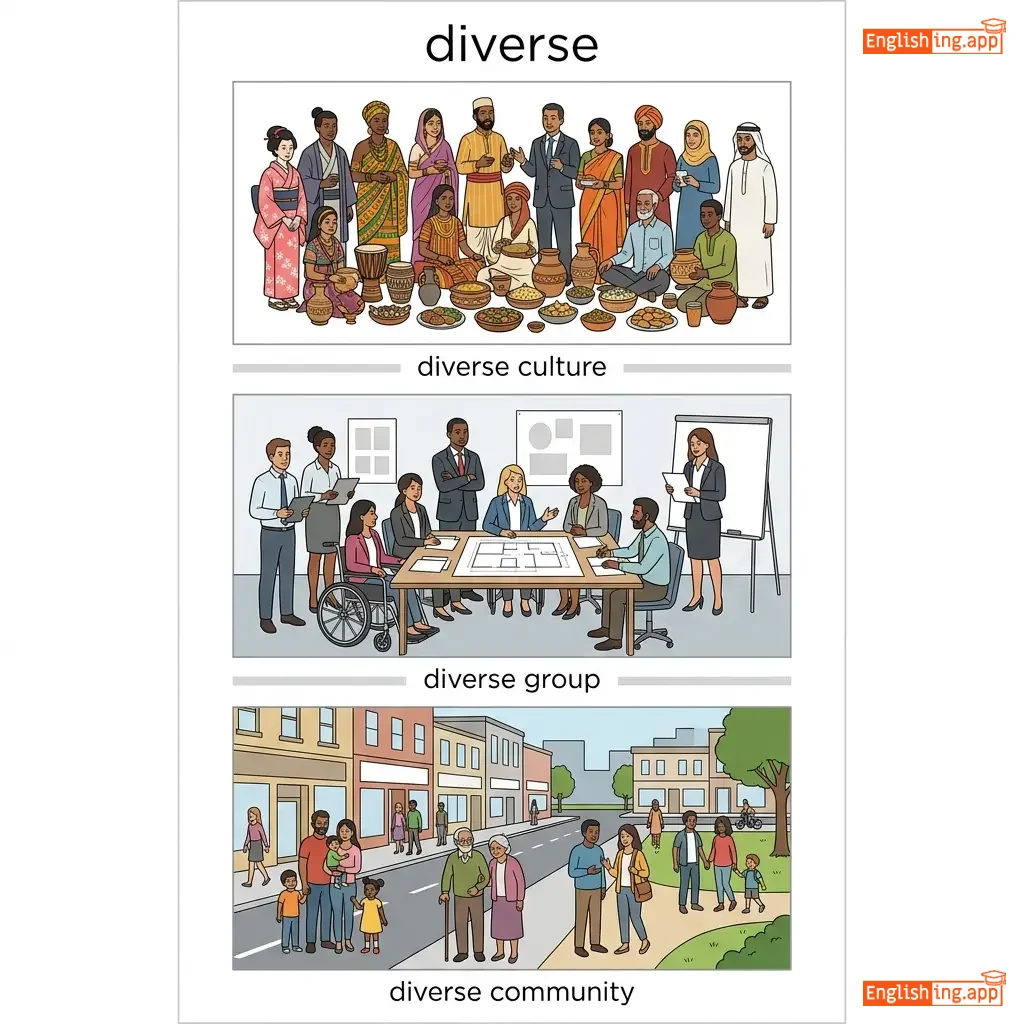
diverse culture, diverse group, diverse community, diverse interests
••••••
|
Разнообразный означает что-то, включающее разные части.
••••••
|
|
🌈
••••••
|
/daɪˈvɜːrsəti/
noun
(дайˈвёрсити)
••••••
|

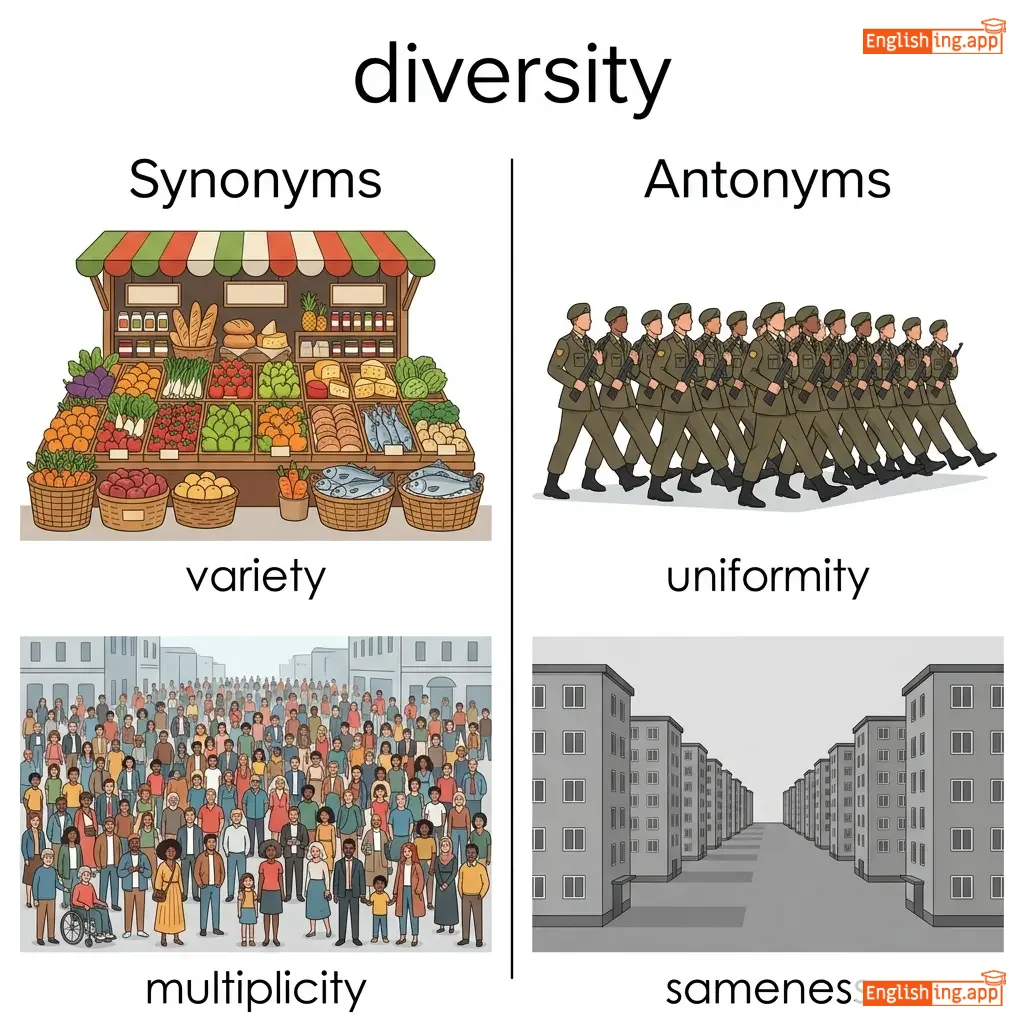
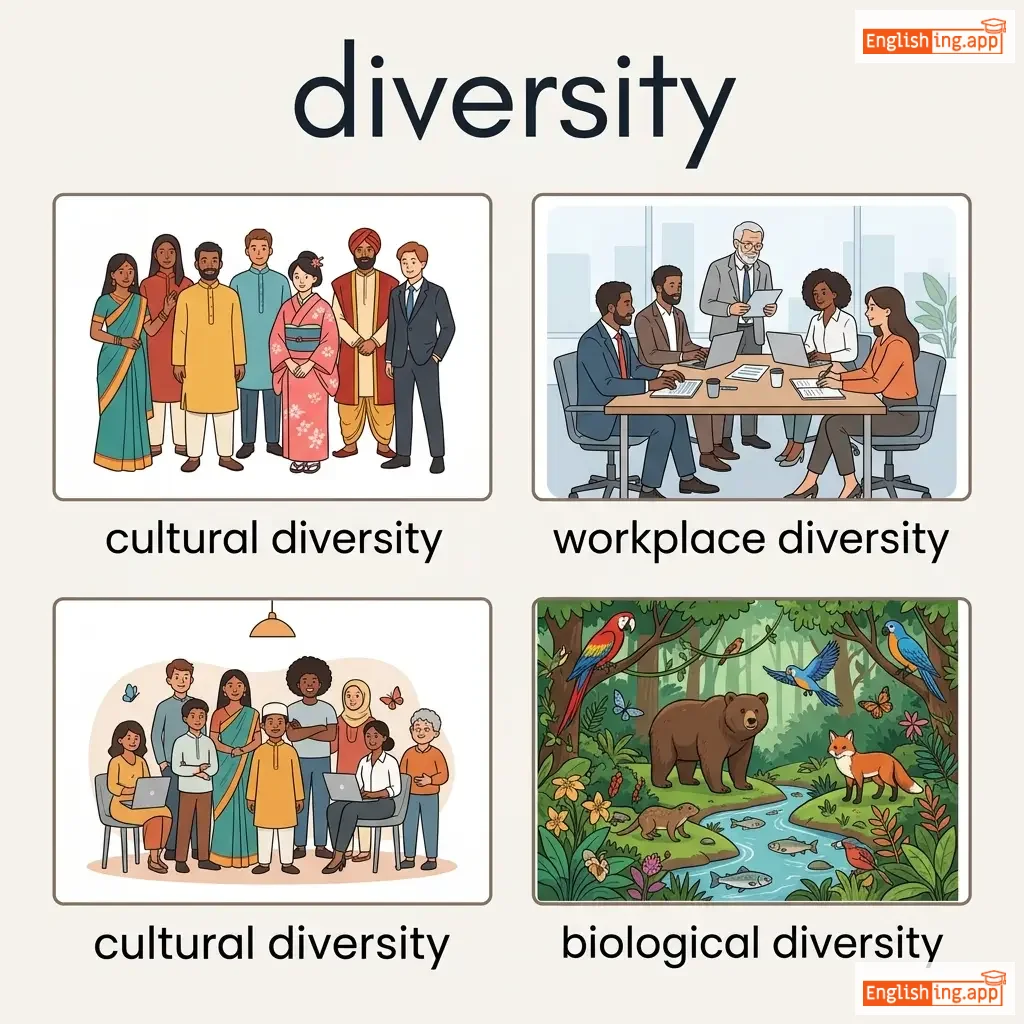
|
разнообразие
raznoobrazie
••••••
|
- •••••• | - •••••• | - •••••• | - •••••• |
A range of different things or people; variety.
••••••
|
Workplace diversity helps foster innovation and creativity. |
Разнообразие на рабочем месте способствует инновациям и креативности.
Raznoobrazie na rabochem meste sposobstvuet innovatsiyam i kreativity.
••••••
|
cultural diversity |
The existence of different cultural groups within a society.
••••••
|
культурное разнообразие
kul'turnoe raznoobrazie
••••••
|
variety, multiplicity, heterogeneity, assortment, difference
••••••
|
uniformity, sameness, similarity
••••••
|
cultural diversity, workplace diversity, biological diversity, embrace diversity
••••••
|
Diversity означает 'Different Variety City' – город с разнообразием.
••••••
|
|
↪️
••••••
|
/daɪˈvɜːrt/
verb
••••••
|
- •••••• | - •••••• |
diverted
••••••
|
diverted
••••••
|
diverts
••••••
|
diverting
••••••
|
to turn aside from a course; to redirect or entertain
••••••
|
The police diverted traffic to a side road. |
- •••••• |
divert one's attention |
to shift focus away from something
••••••
|
- •••••• |
redirect, reroute, deflect, distract, amuse
••••••
|
focus, concentrate, direct
••••••
|
divert traffic, divert funds, divert attention, divert resources
••••••
|
No •••••• |
|
➗
••••••
|
/dɪˈvaɪd/
verb
(дивайд)
••••••
|
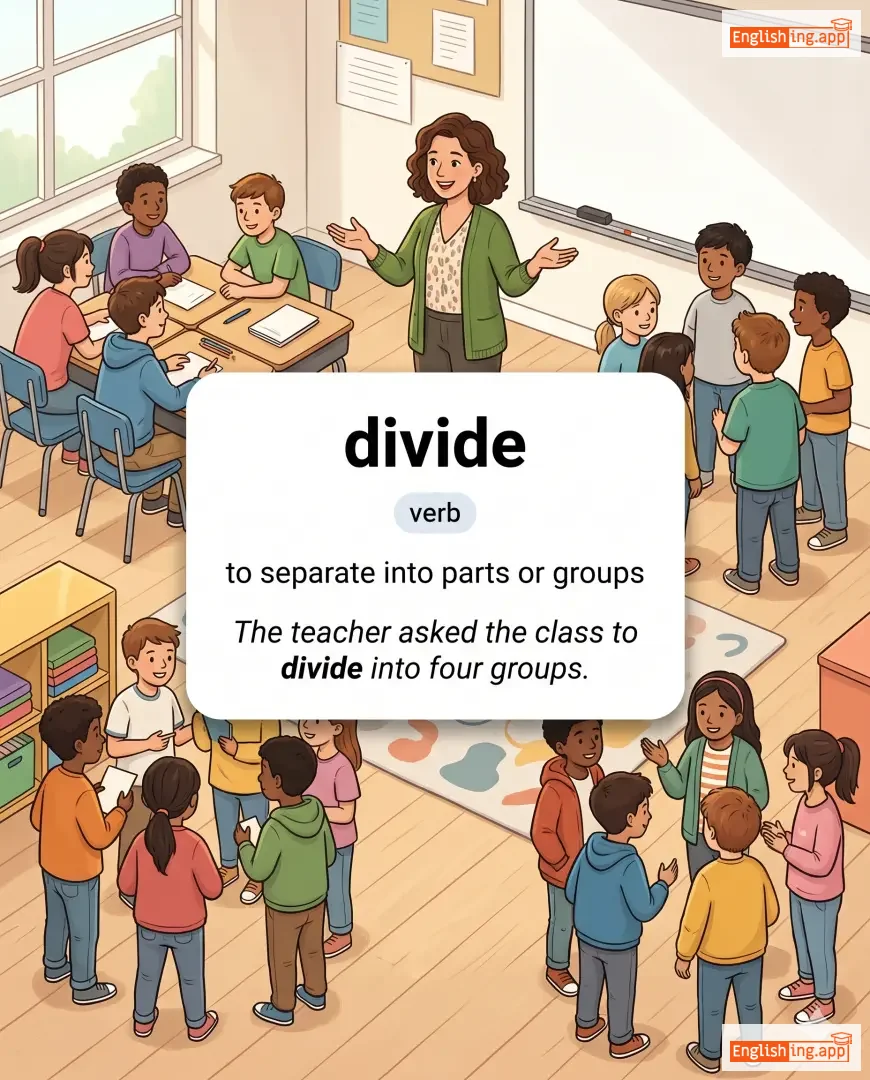
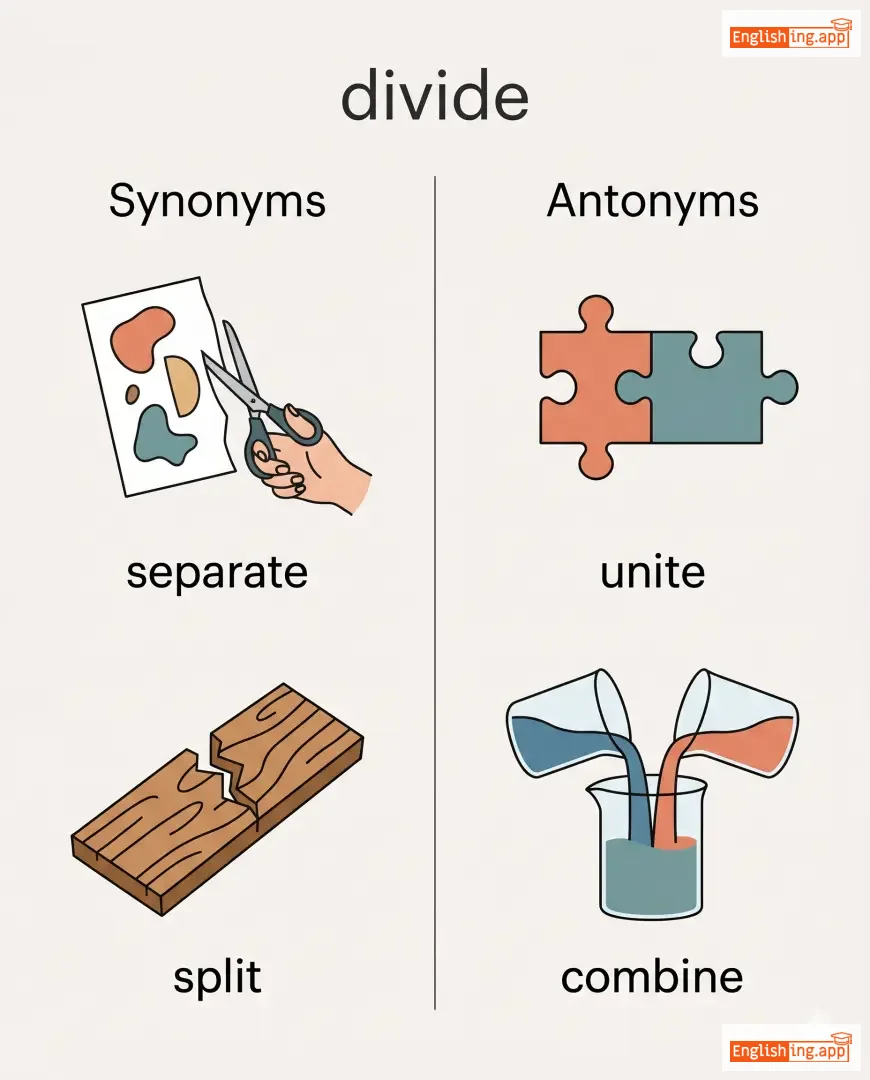
|
делить
delit
••••••
|
divided
дивайдед
••••••
|
divided
дивайдед
••••••
|
divides
дивайдс
••••••
|
dividing
дивайдиднг
••••••
|
to separate into parts or groups
••••••
|
The teacher asked the class to divide into four groups.
Учитель попросил класс разделиться на четыре группы.
••••••
|
Учитель попросил класс разделиться на четыре группы.
Uchitel' poprosil klass razdelit'sya na chetyre gruppy.
••••••
|
divide and rule
разделяй и властвуй
••••••
|
a strategy to gain power by causing divisions among people
••••••
|
разделяй и властвуй
razdelyay i vlastvuy
••••••
|
separate, split, partition, allocate, distribute
••••••
|
unite, combine, merge
••••••
|
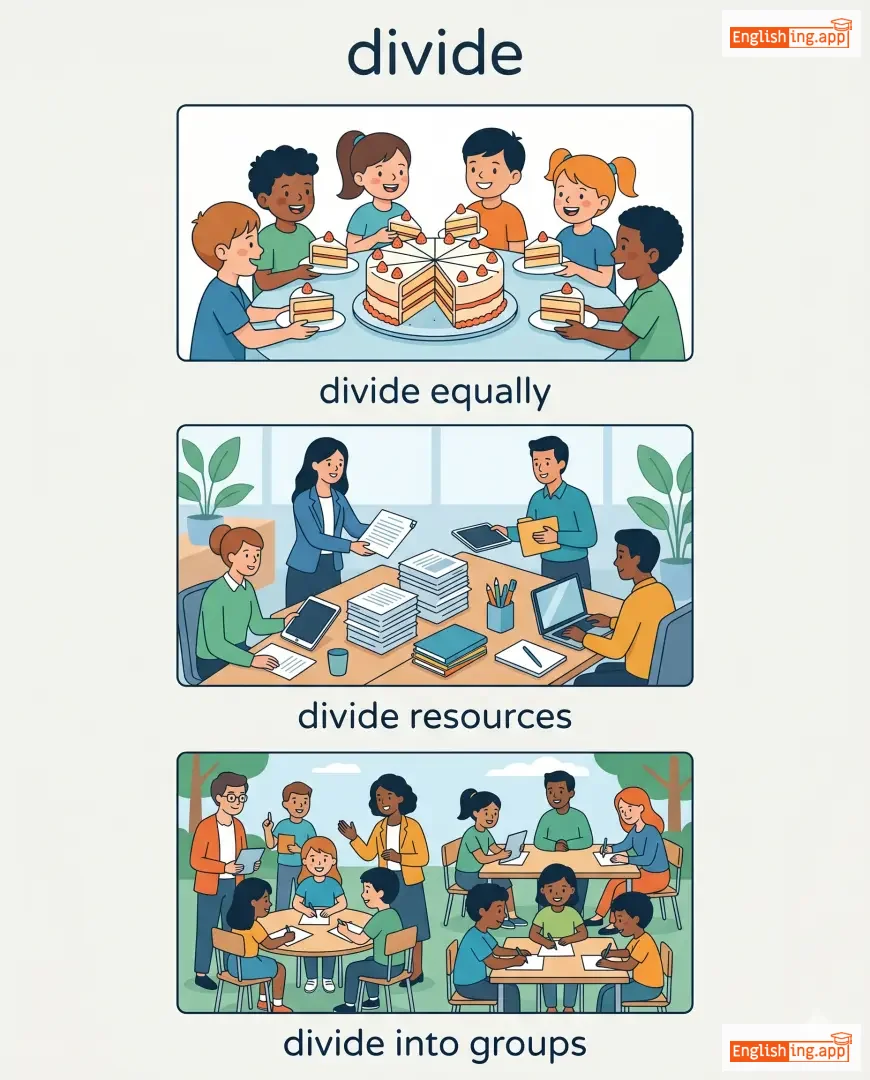
divide equally, divide resources, divide into groups, divide land
••••••
|
Делить – значит разделить, но также и управлять
••••••
|
|
✨
••••••
|
/dɪˈvaɪn/
adjective, verb
(дивайн)
••••••
|
- •••••• |
божественный
bozhestvennyy
••••••
|
divined
дивайнд
••••••
|
divined
дивайнд
••••••
|
divines
дивайнс
••••••
|
divining
дивайнинг
••••••
|
Relating to God or a deity; exceptionally wonderful or pleasing; to discover or foresee by intuition or supernatural means.
••••••
|
She believed the divine power guided her actions.
Она верила, что божественная сила направляла её действия.
••••••
|
Она верила, что божественная сила направляла её действия.
Ona verila, chto bozhesvtennaya sila napravyala yeye deystviya.
••••••
|
divine intervention
божественное вмешательство
••••••
|
A miraculous occurrence believed to be caused by God.
••••••
|
божественное вмешательство
bozhestvennoe vmeshatel'stvo
••••••
|
godly, heavenly, sacred, holy, spiritual
••••••
|
earthly, mortal, profane
••••••
|
divine power, divine will, divine intervention, divine love
••••••
|
Божественный - как божественная сила, которая ведет к успеху.
••••••
|
|
➗
••••••
|
/dɪˈvɪʒən/
noun
(diviziyon)
••••••
|
- •••••• |
подразделение
podrazdelenie
••••••
|
- •••••• | - •••••• | - •••••• | - •••••• |
the action of separating something into parts; or a large administrative unit
••••••
|
The company has a separate division for research and development. |
У компании есть отдельное подразделение для исследований и разработок.
U kompanii yest' otdel'noe podrazdelenie dlya issledovaniy i razrabotok.
••••••
|
cause division |
to create disagreement or separation among people
••••••
|
создавать разделение
sozdavat' razdeleniye
••••••
|
separation, partition, department, section
••••••
|
unity, whole, agreement
••••••
|
division of labor, administrative division, mathematical division, division between
••••••
|
Division ➗ означает разделение, по-русски подразделение.
••••••
|
|
💔
••••••
|
/dɪˈvɔːrs/
noun/verb
(divors)
••••••
|
- •••••• |
развод
razvod
••••••
|
divorced
••••••
|
divorced
••••••
|
divorces
••••••
|
divorcing
••••••
|
the legal ending of a marriage; to officially end a marriage
••••••
|
After years of conflict, they decided to get a divorce. |
После лет конфликтов они решили развестись.
Posle let konfliktov oni reshilì razvéstis'.
••••••
|
divorce oneself from |
to separate or distance oneself from something
••••••
|
развестись с чем-то
razvestis' s chem-to
••••••
|
separation, annulment, breakup, dissolution
••••••
|
marriage, union
••••••
|
get a divorce, file for divorce, divorce settlement, divorce lawyer
••••••
|
Развод - это разделение, как развести что-то.
••••••
|
|
✅
••••••
|
/duː/
verb
(ду)
••••••
|
|
делать
delat'
••••••
|
did
дид
••••••
|
done
дан
••••••
|
does
дас
••••••
|
doing
дуинг
••••••
|
To perform an action, task, or activity.
••••••
|
I need to do my homework before dinner.
Мне нужно сделать домашку до ужина.
••••••
|
Мне нужно сделать домашку до ужина.
Mne nuzhno sdelat' domashku do uzhina.
••••••
|
do one's best
делать все возможное
••••••
|
To make the greatest possible effort
••••••
|
делать все возможное
delat' vse vozmozhnoe
••••••
|
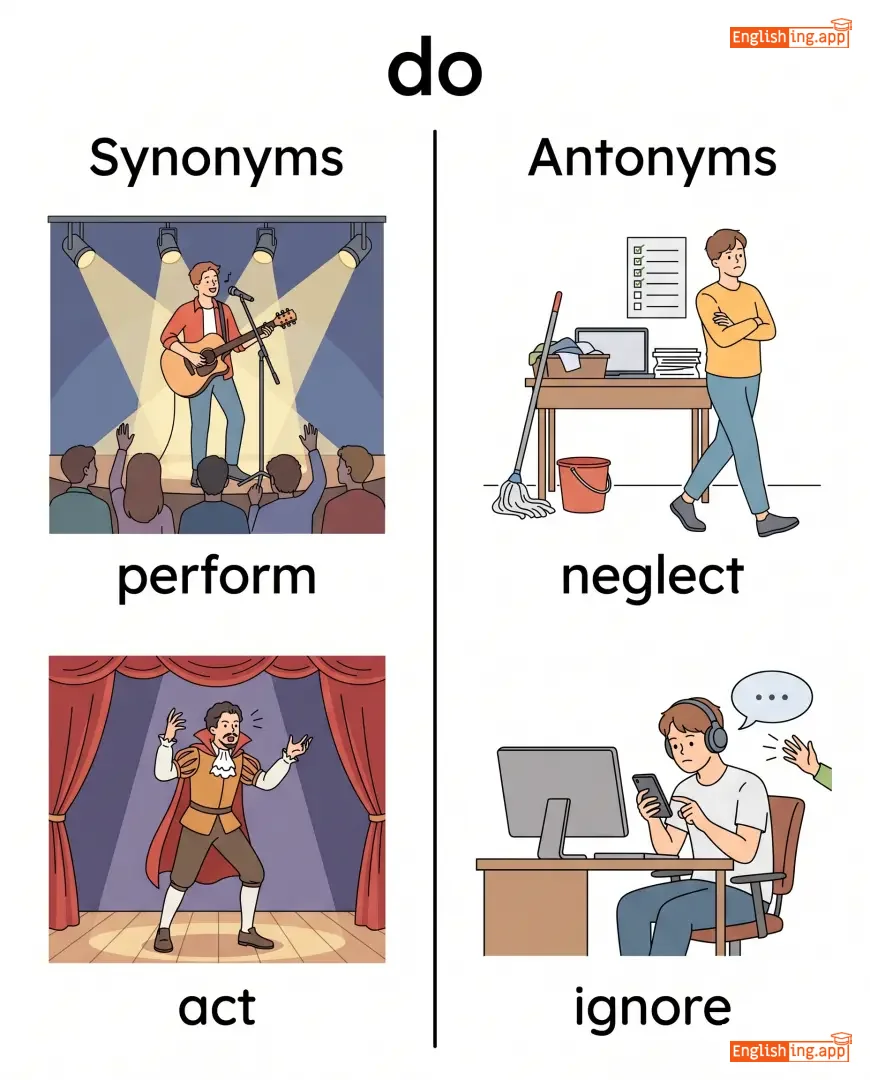
perform, act, execute, carry out, accomplish
••••••
|
neglect, ignore, stop
••••••
|
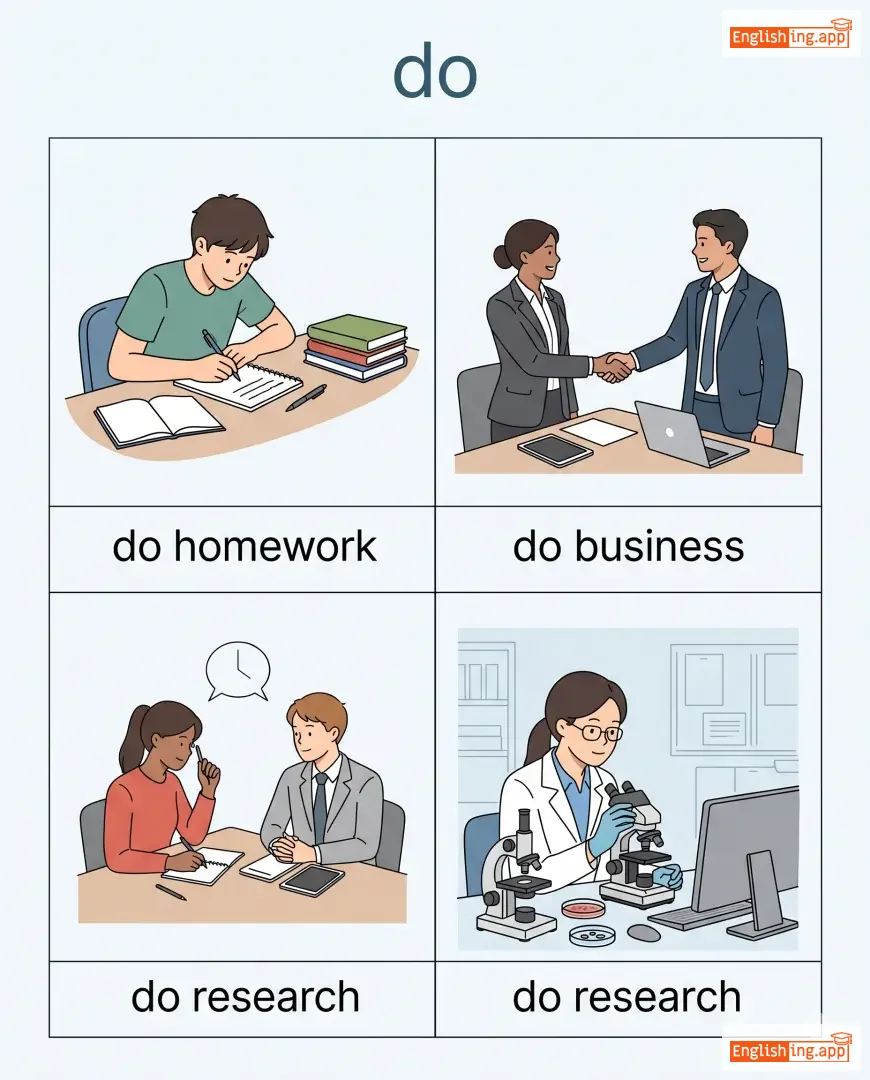
do homework, do business, do research, do a favor
••••••
|
Do означает делать — Делай, не утопай!
••••••
|
|
🩺
••••••
|
/ˈdɒktər/
noun
(доктор)
••••••
|
- •••••• |
врач
vrach
••••••
|
- •••••• | - •••••• | - •••••• | - •••••• |
A qualified medical professional who treats illnesses and injuries.
••••••
|
The doctor prescribed medicine for the patient. |
Доктор прописал лекарства для пациента.
Doktor propisal lekarstva dlya patsiyenta.
••••••
|
the doctor is in |
The doctor is available to see patients
••••••
|
Доктор на месте
Doktor na meste
••••••
|
physician, medic, surgeon, healer
••••••
|
patient, layman
••••••
|
doctor appointment, family doctor, consulting doctor, doctor visit
••••••
|
Врач = всегда помогает вылечиться.
••••••
|
|
📜
••••••
|
/ˈdɒktrɪn/
noun
(doktrin)
••••••
|
- •••••• |
доктрина
doktrina
••••••
|
- •••••• | - •••••• | - •••••• | - •••••• |
A set of beliefs or principles held and taught by a religious, political, or other group.
••••••
|
The church follows a strict doctrine on moral values. |
Церковь придерживается строгой доктрины в отношении моральных ценностей.
Tserkov' pridержivayetsya strogoi doktriny v otnoshenii moral'nykh tsennostei.
••••••
|
official doctrine |
The established principles or policies endorsed by an authority.
••••••
|
официальная доктрина
ofitsial'naya doktrina
••••••
|
belief, principle, teaching, tenet, ideology
••••••
|
heresy, disbelief, doubt
••••••
|
religious doctrine, political doctrine, military doctrine, core doctrine
••••••
|
Доктрина - это как строгий кодекс, которому нужно следовать.
••••••
|
|
📄
••••••
|
/ˈdɒkjʊmənt/
noun/verb
(документ)
••••••
|


|
документ
dokument
••••••
|
documented
документирован
••••••
|
documented
документирован
••••••
|
documents
документы
••••••
|
documenting
документируя
••••••
|
Noun: A written, printed, or electronic record that provides information or evidence. Verb: To record information in written or electronic form.
••••••
|
She carefully documented all the expenses of the trip.
Она тщательно задокументировала все расходы поездки.
••••••
|
- •••••• |
official document
официальный документ
••••••
|
An authoritative or legal record recognized by an institution.
••••••
|
- •••••• |
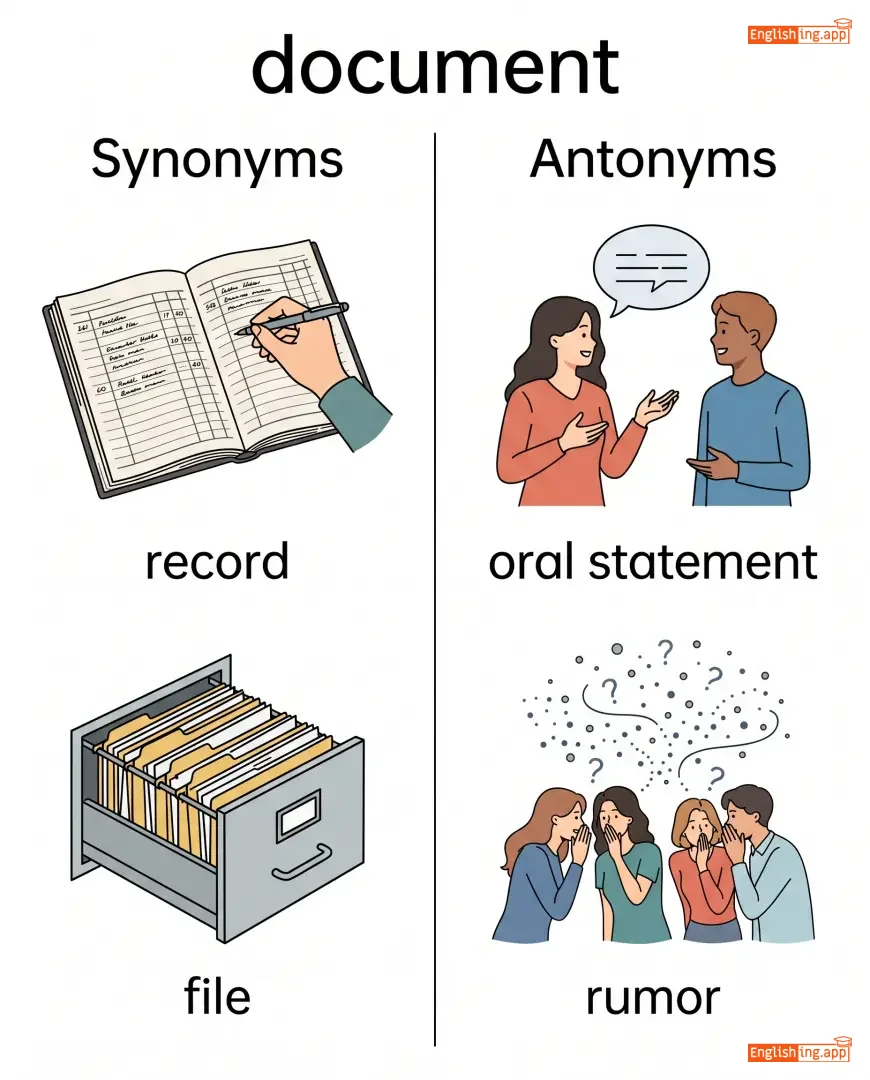
record, file, paper, certificate, report
••••••
|
oral statement, rumor
••••••
|
legal document, official document, document file, document evidence
••••••
|
No •••••• |
|
📄
••••••
|
/ˌdɒkjʊmɛnˈteɪʃən/
noun
(докьюментейшн)
••••••
|
- •••••• |
документация
dokumentatsiya
••••••
|
- •••••• | - •••••• | - •••••• | - •••••• |
material that provides official information or evidence
••••••
|
The documentation for the project is available for review. |
Документация для проекта доступна для проверки.
Dokumentatsiya dlya proyektu dostupna dlya proverki.
••••••
|
- •••••• | - •••••• | - •••••• |
records, paperwork, files, archives
••••••
|
neglect, disregard
••••••
|
project documentation, legal documentation, technical documentation, documentation review
••••••
|
Documentation (документация) is your guide to the information, like a map to navigate the project!
••••••
|
|
🐶
••••••
|
/dɔːɡ/
noun
(дɔɡ)
••••••
|
- •••••• |
собака
sobaka
••••••
|
- •••••• | - •••••• | - •••••• | - •••••• |
a domesticated carnivorous mammal kept as a pet or for work
••••••
|
The dog barked loudly at the stranger. |
Собака громко залаяла на незнакомца.
Sobaka gromko zalayala na neznakomtsa.
••••••
|
every dog has its day |
everyone will have a chance to succeed or be lucky at some point
••••••
|
каждая собака имеет свой день
kazhdaya sobaka imeet svoy den
••••••
|
canine, hound, pooch, pup, mongrel
••••••
|
cat, feline
••••••
|
pet dog, stray dog, guard dog, dog bark
••••••
|
Dog = собака 🐕 - Вспомни собаку, каждый день будет твоим.
••••••
|

